5Y Capital Day 1: The You Others Thought Was Crazy, Starting to Be Believed

Setting out anew — the same team, the same founding vision.
Twelve years ago, 5Y Capital — then known as MorningSide Capital — set sail on Wuyuan Road in Shanghai, carrying the dreams of its two founding partners, Qin Liu and Jianming Shi. After a dozen years of growth, our five partners, driven by a bolder vision, completed a transformation from the inside out. We are now officially rebranded as "5Y Capital."
"5Y" is derived from the one-way street where our Shanghai office has stood since day one — Wuyuan Road. Same team, same original aspiration. "Y" stands for yuan — source, origin — as in a river that flows far and long. We hope to build ultra-long-term partnerships with entrepreneurs, peers, and friends. Wuyuan Road is a beautiful one-way street. Like entrepreneurship, you must push forward without looking back to appreciate the scenery along the way.
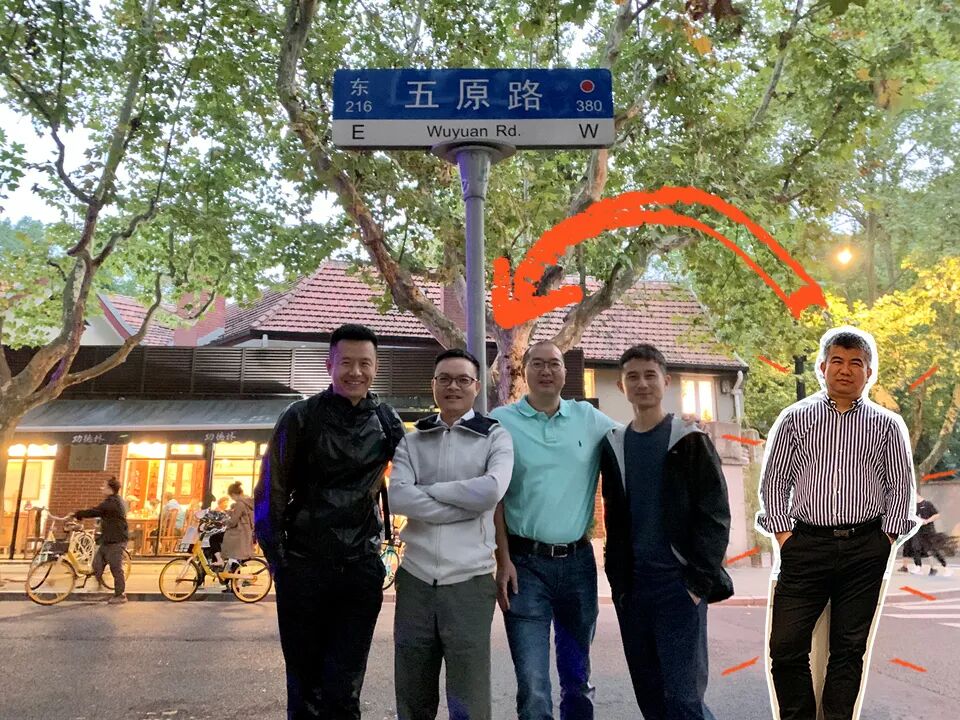
5Y Capital partners group photo
(Far right: Founding partner Jianming Shi, who couldn't attend in person due to COVID-19 restrictions)
Below is a transcript of the keynote speech delivered by Qin Liu, founding partner of 5Y Capital, on this rebranding. We've edited it for readability and hope you enjoy it :)
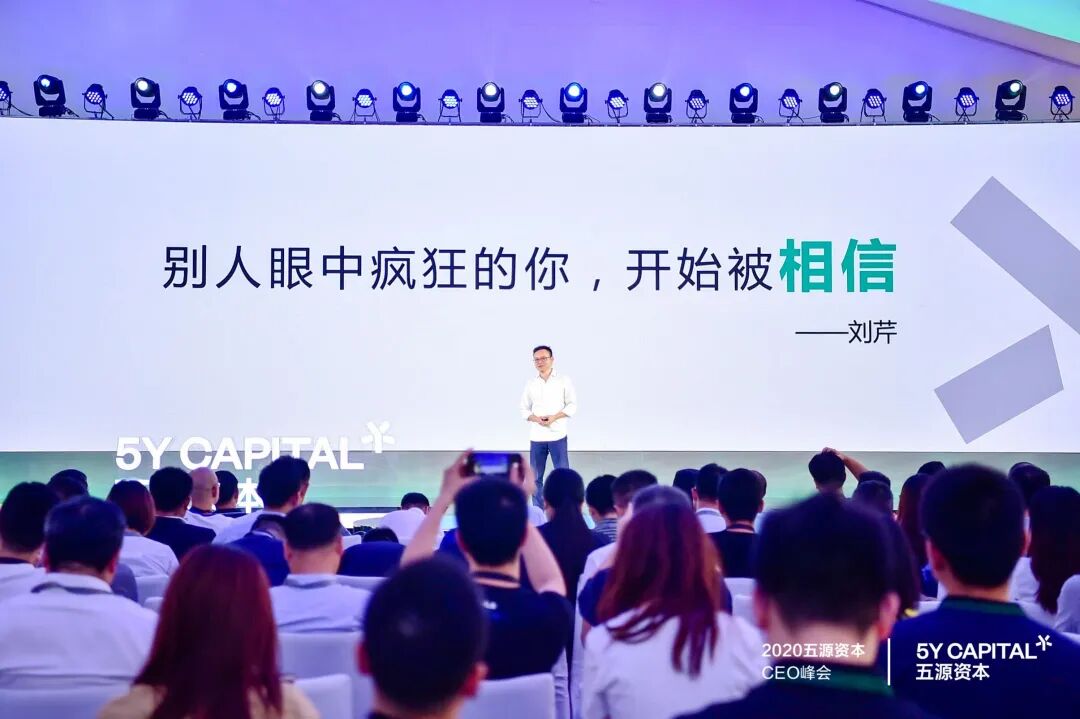
Hello everyone. This is my first speech as a founding partner of 5Y Capital.
Today I want to share some stories about "madness" — stories about you, and stories about me.
01
Awaken Yourself. Stay Untamed.
I graduated from university in 1993. My first job was at a state-owned enterprise in my hometown of Wuhan. I saw the red-hot rolling mill of Wuhan Iron and Steel. If you've ever been there, you've seen steel billets heated to 1,200 degrees being pressed into strips one or two kilometers long in a matter of minutes under massive machinery. It was spectacular. My job was to build and maintain the automated production systems. That gleaming, high-tech server room you see in the photo below? That was my workplace.

Working at Wuhan Iron and Steel in 1993 was actually an enviable job. The pay was decent, and my superiors thought well of me. But I felt a quiet unease. It seemed too stable. I could see my future laid out before me.
That tension was shattered by a sudden fire. Remember that bright, clean server room? Beneath those raised floors ran dense tangles of power cables and signal cables. One day a fire burned them all out. I joined the emergency response, dragging out the charred cables and laying new ones. It was a lightless cable trench. I basically worked like a rat for a month, breathing toxic, acrid fumes.
In that moment I asked myself: Is this really where I want to spend my future? Or should I break out of this comfortable life? I decided to awaken myself. I wanted to go out and see a different world.
Only later did I learn that someone else was in Wuhan at the same time — Lei Jun. Lei Jun enrolled at Wuhan University in 1987. By chance, he borrowed a book from the library: The Silicon Valley Way. It seems unremarkable today, but I believe it shook something in that young student at Wuhan University. It told the stories of so many Silicon Valley heroes and their early entrepreneurial journeys.

Lei Jun later said that after reading that book, a fire lit up inside him. He was restless for several nights, walking lap after lap around the campus track. He silently resolved that one day, he would become a great person.
More recently, another story has become familiar — that of He Xiaopeng, my longtime friend.
He was awakened by the birth of his son. You see, He Xiaopeng was already financially secure, with more than enough to live comfortably. Few people start another company after already succeeding and achieving financial freedom. But He Xiaopeng said he held his newborn son and asked himself: When my son grows up and asks what his father does, what will I say? He decided to do something his son could be proud of. He decided to start over. And now he's taken another company public.
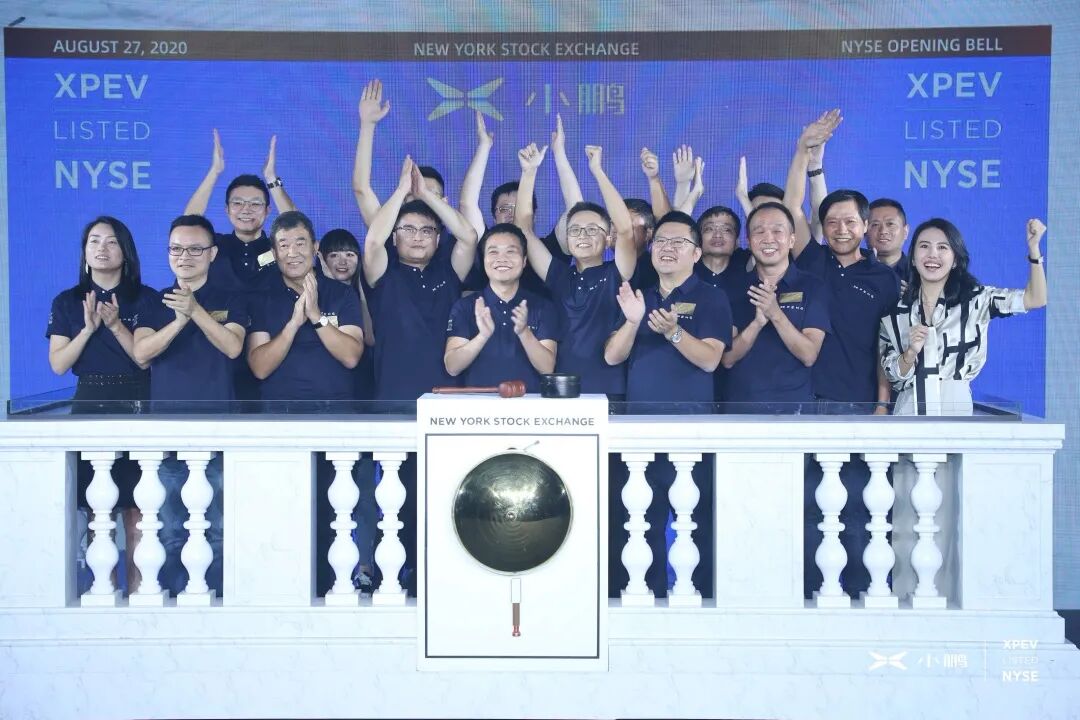
These are our three stories of "moments of awakening" — as students, as young professionals, and after achieving major success. At every stage, you need to awaken yourself and resist being tamed by the life you currently lead.
I've said before that entrepreneurship is an opportunity deliberately left to the few by the vast majority who choose not to take it. That's because only a rare few can awaken themselves and resist being tamed by their present circumstances. I believe every one of you here today is our fellow traveler.
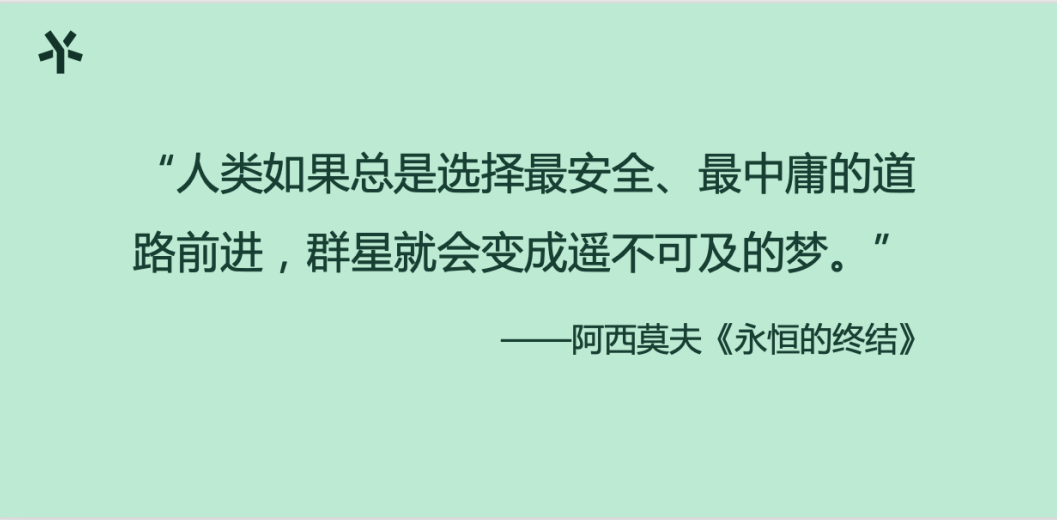
I love this quote from the science fiction novel The End of Eternity: "If humanity always chooses the safest, most moderate path forward, the stars will become an unreachable dream." I offer it to all of you.
02
Staying Untamed Is Hard.
Staying Untamed by Past Success, and Continuously Embracing Massive Change, Is Harder.
Awakening yourself is only the first step in a grueling journey. Now let's go back more than 200 years, to when China was in the Qianlong golden age. The Qing Dynasty's GDP accounted for 30% of global GDP. To put that in perspective: even today's most powerful nation, the United States, represents only about 24% of global GDP.
In 1792, the 58th year of Qianlong's reign, the emperor was in the twilight of his life when he received a British delegation. Qianlong styled himself the "Perfectly Accomplished Elder." He arrogantly dismissed the British representatives. They showed him numerous achievements of the Industrial Revolution — firearms, precision machinery — but Qianlong kept only the clocks. He sealed himself off. He looked away from the Industrial Revolution already transforming the world.
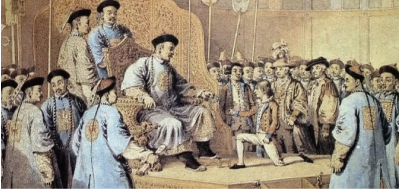
Success is the enemy most likely to tame you. When you're unknown, you possess tremendous determination to change yourself. But after you achieve success, you become weighed down by your own accomplishments. Staying untamed is hard. Staying untamed by past success, and continuing to embrace ever-greater transformation, is even harder.
03
Pursuing Massive Change
Is Itself a Massive Gamble
The rise and fall of nations follows this pattern, and so do business empires. From 1980 to 2020, if you look at the list of most valuable companies by decade, each ten-year cycle had its own trend. And each major trend produced that era's greatest business champions.
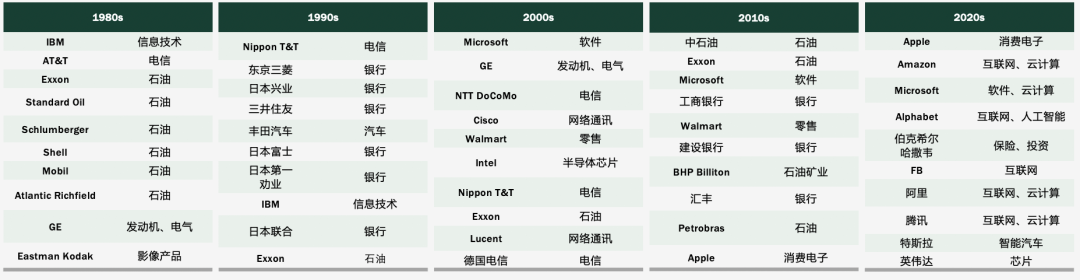
By 2020, the most powerful company was Apple. We all know Apple conquered the internet through the iPhone and became the mightiest company of them all. But you may not know that back in 1990, there was another company in Silicon Valley called General Magic. This small company had just spun out of Apple. Steve Jobs was then running Apple and invested $10 million in it.
Why did such a small company attract so much attention? Because its vision was to take the PC's powerful computing capability and put it into a handheld, mobile personal terminal that you could carry everywhere.
In 1990, does that vision sound familiar? It was the earliest conception of what is now in everyone's hand: the smartphone. What happened to General Magic? It failed. Born 1990, died 2002.
The video is short, but every time I watch it, I'm deeply moved. Many people remember the halo around Jobs. Apple today is a trillion-dollar empire. But many have forgotten General Magic. Just as that founder spoke with such emotion about having this grand concept — that moving moment — he failed, but in my mind he is a hero.
Pursuing massive change is itself a massive gamble. If you identify, embrace, and bet on a future of massive transformation, then even as an unknown nobody, you might create miracles.
In 2011 we held extensive strategic discussions internally. We believed that from the camera's perspective, the smartphone was most likely to give rise to social media with rich media characteristics. At that time, a young newcomer in our firm — his name was Yuan Ye — found a GIF Kuaishou creator on Weibo named Cheng Yixiao and sent him an email. Yixiao wrote back: "Hello Yuan Ye, I'm Cheng Yixiao, author of GIF Kuaishou. Any opportunities to collaborate?"
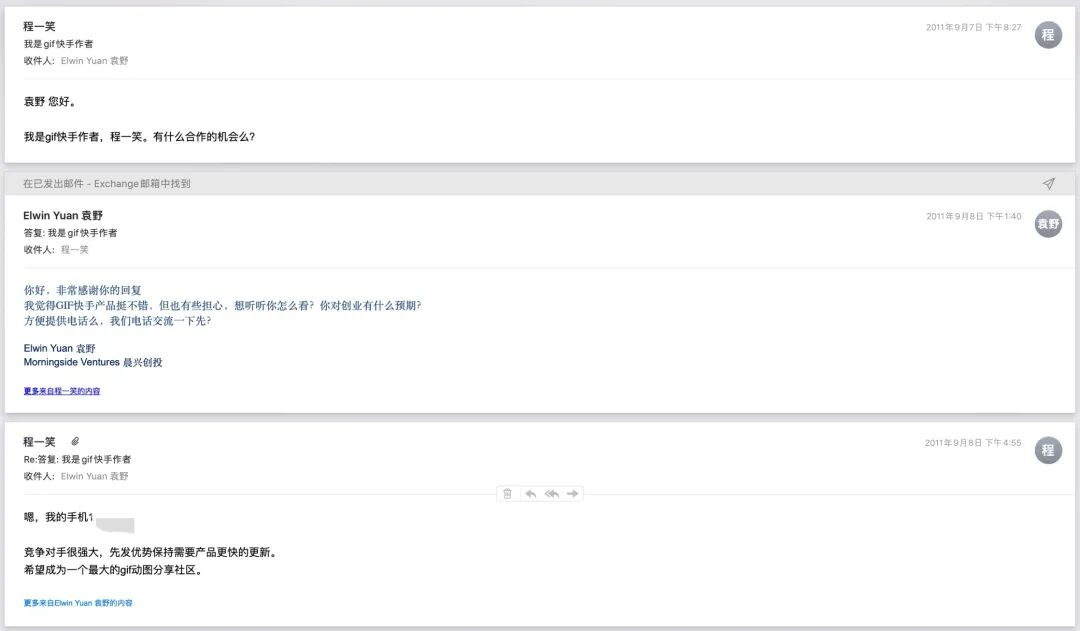
I still get excited when I see this email today. This great experiment in innovation, this early connection we made — it was ignited by this single email.
In 2012, Hua Su joined the company and brought machine-learning recommendation algorithms to Kuaishou. An extreme product manager and an extreme technology geek — a match made in heaven. They transformed Kuaishou into the social platform it is today.
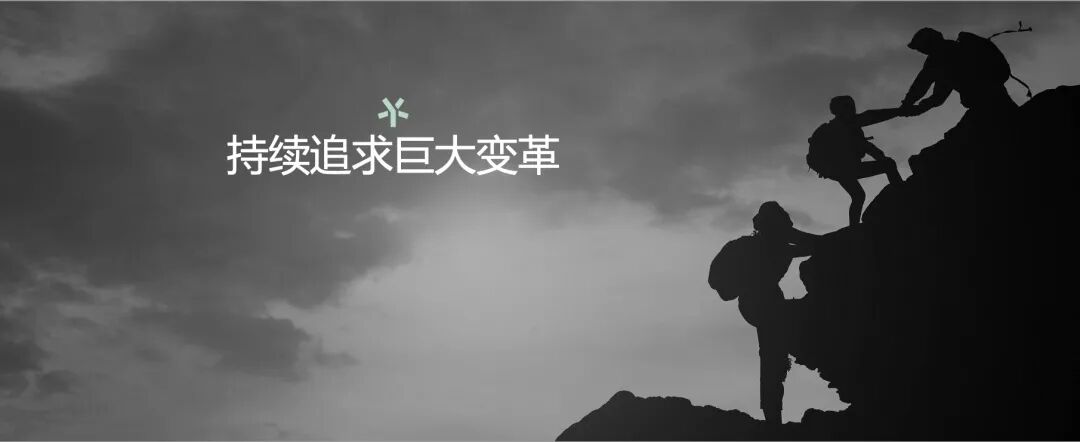
We keep pursuing massive change because change's defining characteristic is that it never stops. It cycles, again and again.
The opportunity to embrace massive change isn't reserved for emperors or giant corporations. Even ordinary people — if you're willing, if you see earlier than others, if you're more willing to take risks, if you're bolder in embracing that risk — you can create astonishing change and impact.
Speaking of unknown nobodies creating miracles, let's look at another fascinating video.
Ants, with such tiny bodies, gain the power to survive on this planet through collective collaboration. That video showed how small ants in the rainforest rely on group strength to survive.
Humans share one thing with ants: the power of collaboration. But human collaboration is a more advanced, more intelligent form of what ants do.
Unlike many other species on Earth, humans have imagination. We use imagination to construct the ideas and systems that enable our collaboration.
Therefore, individual strength alone isn't enough to make humans the planet's dominant species. Through a more advanced form of social collaboration, we've built the most intricate, complex society on Earth — our vast global village. From nations and societies down to individual companies, all face the challenge of how to realize grand visions and dreams. Commercial success requires leveraging all forms of collaboration. But the path is never smooth.
04
Our Ten-Billion-Dollar Lesson
Seven or eight years ago, model innovation became the new hot spot in venture capital. The sharing economy was declared a core focus by many funds. In fact, as early as 2011, there was a company called Yongche. We were the first fund in the industry to make a major bet on the sharing economy — $10 million in the Series A. Although we made that heavy bet back then, two years later DiDi and Kuaidi's fundraising far exceeded anything we imagined, overturning all our assumptions. We were ahead of the market in our thinking, but we didn't win the biggest returns from this race.
05
Evolution
But I've been asking myself: What is the deeper issue here? The deeper issue is that the environment changed dramatically. The barriers to model innovation were so low that they attracted massive imitators. And enormous amounts of capital began chasing these low-barrier model innovations, creating bloody red-ocean competition. The entire external environment shifted — from an era where a company might raise tens of millions or a few hundred million dollars at most, to one where a single company could raise ten or even twenty billion dollars historically. It overturned the entire industry.
But as a believer in technology, when the external world changes dramatically, you can't complain about the environment. You have to change yourself. We can only survive crises through evolution.
Returning to the essence of venture capital — innovation — our answer to this challenge was that we couldn't simply raise more money like everyone else to chase the same low-barrier, low-innovation models. We had to step outside our comfort zone, find bigger blue oceans, and identify the next innovation hotspots.
Driven by this vision, over the past five or six years we resolutely expanded into new blue oceans and new domains. We marched decisively into cloud computing, artificial intelligence, next-generation biomedicine, and semiconductors.
06
Collaborative Evolution
But I still felt uneasy. I asked myself: We've survived this crisis, but what about the future? We will certainly face the next crisis, the next challenge. What got us through this time, and what can help us survive future crises?
My answer: Evolution isn't enough. Like ants, we must achieve collaborative evolution. Evolution represents individual evolution. Collaborative evolution represents organizational evolution.
If you ask me today what kind of institution 5Y Capital is, I'd tell you: Rather than an investment firm, we are a knowledge-management organization built on mutual collaboration, collective sense-making, shared understanding, and mutual empowerment. When facing entirely new domains, anyone can propose an idea that seems crazy and implausible. We don't want to easily dismiss ideas that seem incomprehensible or mad today. We need to find a working method, a workflow, that allows colleagues to organize open debate internally. Through orderly division of labor and collaboration, we achieve not the elevation of any individual's understanding, but the elevation of 5Y Capital as an entire organization.
When we first tried this approach, it was far harder than when we invested as lone wolves. Our efficiency dropped. We had to put in more grueling work. But combining individual strengths with the collaborative capabilities of the whole team, sharing all bold and insightful ideas internally at the earliest moment, exploring together — this is how we ensure that when we face the next massive challenge, we can overcome it.
We say every company has its life cycle. They grow from obscurity to dominance. But every company will eventually decline. Every company will face massive crises. When crisis comes, I hope everyone here maintains courage, dares to be reborn, and always remains an awakener, an untamed person.
Innovation is cyclical. Those new revolutions belong to the courageous, the untamed — who, through collaboration again and again, discard the old and bring forth the new, creating new history.
07
When Others Saw You as Crazy, They Begin to Believe
Today we've decided to complete this evolution from the inside out. Our entire team discussed, co-created, and launched our new brand: 5Y Capital.
We've also adopted a new slogan: "When others saw you as crazy, they begin to believe."
We believe that no matter how crazy a person may seem, they deserve to be seen. No matter how crazy an idea may seem, it deserves to be tried.

5Y Capital (formerly MorningSide Capital) currently manages approximately $3 billion across USD and RMB dual-currency funds. We believe that if those others saw as crazy begin to be believed, the world becomes a better place.