5Y Capital's Xutian Jing: ITBT Sector Has a Promising Future, Poised to Produce a New Breed of Pharma Companies with Strong Cash-Generation Capabilities | Light View

ITBT is a long game, but when it succeeds, its contribution to human society is immense.


The rapid development of big data, artificial intelligence, and other computing technologies has driven a new wave of innovation in healthcare. More and more medical institutions and pharmaceutical companies are beginning to experiment with AI for disease diagnosis and even drug discovery, and medical AI companies are springing up like mushrooms after rain.
AI-powered healthcare can quickly stimulate the industry's growth, breaking through many limitations that were previously beyond human capability in clinical medicine or laboratories. The convergence of these two sectors has inevitably attracted strong interest from capital, with a growing number of investment firms starting to invest in the medical AI space.
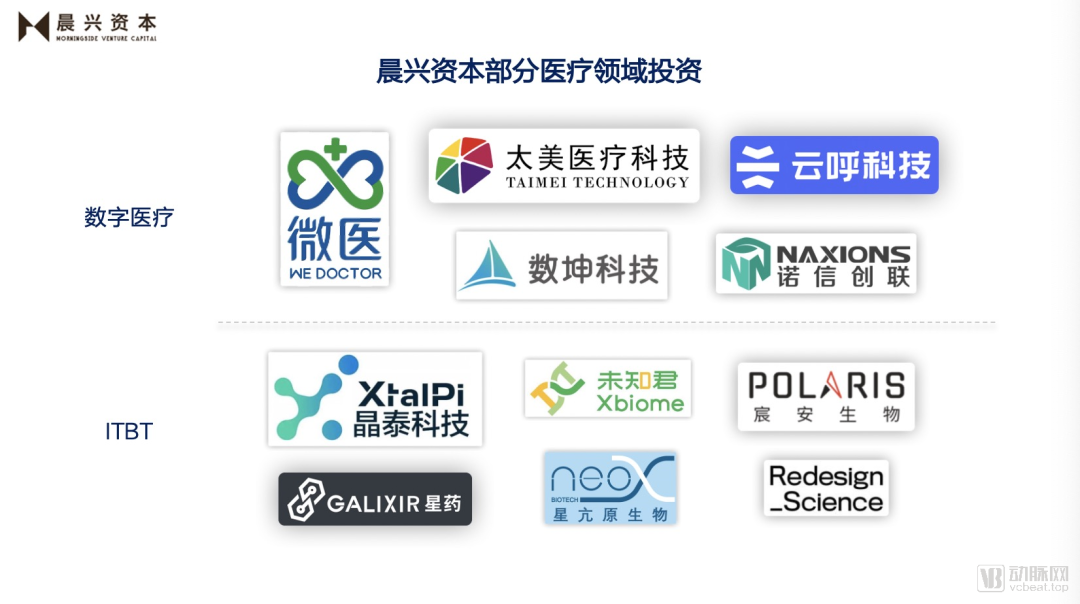
As a top-tier institution in the TMT sector, 5Y Capital has invested in super-unicorns like Xiaomi, Kuaishou, Kingsoft Office, Xpeng Motors, and SenseTime. In healthcare, 5Y has also begun making strategic bets. Approaching from a TMT perspective, 5Y invested in WeDoctor Group at an early stage, and in recent years has successively deployed in leading digital healthcare companies such as Taimei Medical Technology, Shukun Technology, Yunhu Technology, Nuoxin Chuanglian, and CyanBio. 5Y is also one of the earliest domestic investors to bet on "AI drug discovery" companies, with investments in XtalPi, Unknown (xbiome), Neox Biotech, Galixir, and Redesign Science. Internally at 5Y, this sector is referred to as "ITBT."
As the first domestic investment institution to propose the "ITBT" concept, how does 5Y Capital view the development of this track? How does it achieve precise positioning in the ITBT industry? With these questions, VB Data (WeChat ID: vcbeat) interviewed Xu Tian Jing, Vice President at 5Y Capital.
1
ITBT: The Organic Integration of Information Technology and Biotechnology
Jing graduated from the University of Pennsylvania and previously worked as a management consultant at IMS Health, serving global top-tier pharmaceutical companies and leading PE firms. Through his healthcare consulting work, he identified numerous pain points in Chinese healthcare companies that urgently needed addressing, and saw that the combination of information technology with biotechnology and medical technology could lay the groundwork for solving these problems. In 2016, Jing joined 5Y Capital, hoping to leverage the power of information technology to help the healthcare industry discover better and newer treatments more quickly, and to deliver medical services in an orderly and efficient manner.
As a VC firm focused on TMT, 5Y Capital approaches the biopharmaceutical industry from a different angle than specialized biotech funds. TMT funds pay closer attention to developments in IT and information technology, and place particular emphasis on opportunities where IT can reshape industry value chains.
Jing combined his professional background in biotechnology and healthcare consulting experience with 5Y Capital's IT investment expertise to propose the "ITBT" concept. In "ITBT," "IT" refers to information technology, while "BT" refers to biotechnology, particularly biotech related to new drug discovery.
As early as 2017, 5Y Capital recognized the development potential of the ITBT track. In 2018, it established a dedicated investment vertical, ready to provide capital support to capable companies in this space. In subsequent deployments, 5Y Capital successively invested in ITBT companies including XtalPi, Unknown, CyanBio, Neox Biotech, Galixir, and Redesign Science.
2
The Value of IT-BT Collision: Accelerating Drug Discovery and Continuous Iteration
In 2017, AI medical imaging was at its peak hype, while the ITBT track remained in its early stages with virtually no investor consensus. Drawing on his understanding of the pharmaceutical industry and combining it with the AI and computing principles he encountered at 5Y Capital, Jing sensed from an IT technology development perspective that this track held enormous transformative potential for the future.
The pharmaceutical industry is a $1.2 trillion market. Every new drug follows a certain cycle from R&D and launch to sales peak, then patent expiration and potential replacement by newer products. Traditional new drug investment opportunities exist within this cycle.
In 2010, bringing a new drug to market cost an average of $1 billion; by 2020, that figure had risen to $2 billion. Meanwhile, the average peak sales of newly launched drugs have been declining year over year. R&D costs keep climbing while returns shrink. If we analogize new drug R&D investment to financial investment, the average IRR has been decreasing annually.
At the same time, biology-related data has exploded. Gene sequencing costs have dropped exponentially, the throughput of various biological screening assays has grown massively, and increasingly sophisticated observation methods — next-generation mass spectrometry, cryo-electron microscopy, and more — have continuously emerged, creating new data dimensions and driving explosive data volume growth.
On the other hand, computing costs have steadily declined, deep learning algorithms have achieved breakthrough after breakthrough, and IT-related bioinformatics talent has grown increasingly abundant. "On one side, you have rapidly proliferating new-dimensional information; on the other, increasingly powerful and faster data analysis capabilities. The collision of these two will definitely produce something new," Jing asserted.
The ITBT track was born against this backdrop. ITBT's core impact on the pharmaceutical industry currently falls into two main categories. First, it dramatically improves the efficiency of small-molecule new drug discovery. Through multidisciplinary technical approaches, it enables rapid identification of optimally matched small-molecule compounds for promising target candidates sitting in university research institutions — even protein targets whose structures scientists haven't yet determined — accelerating the commercial translation of human scientific achievements. Second, in many entirely new therapeutic areas, it enables de novo drug discovery through data-native approaches to find completely novel treatment solutions. Companies in this category are characterized by their ability to build analytical and interpretive capabilities for new-dimensional data and translate these into experimental validation.
Additionally, Jing noted that in the current drug industry, synergies between multiple drug products during R&D within pharmaceutical companies remain relatively limited, and the traditional new drug discovery process iterates rather slowly on its own. That's why many large pharma companies expand primarily through acquiring innovative drug projects. For big pharma, true economies of scale manifest in clinical research, regulatory approval, and market access — not notably in R&D. Head effects at the discovery stage are not particularly pronounced.
But ITBT companies enter with new drug discovery engines. "IT" can support "BT" in iteratively producing better drugs. Through continuous molecular prediction and activity validation, they can self-iterate their algorithmic engines, outputting candidate drugs faster and more accurately. Therefore, from a longer time horizon — perhaps 10 to 20 years — a new generation of pharmaceutical companies may develop more pronounced head effects and economies of scale at the drug discovery stage.
3
5Y Capital's ITBT Logic: From Team Sourcing to Precise Project Positioning
"A thorough understanding of technical principles is primary and essential for companies. Second, they must have the ability to deconstruct problems — knowing what problems they're trying to solve, what methods can be used, and what their strongest path is." When asked how 5Y Capital identifies promising ITBT projects, Jing responded thus.
"The founding teams of ITBT companies we invest in must be top-tier talent in their fields. Beyond high technical requirements for the team, 5Y also demands sufficient understanding of the industry — knowing how to take the 'hammer (IT/AI)' and find the right 'nail.' ITBT is a cross-disciplinary endeavor. Founding teams need strong learning abilities and sufficient patience and humility to accumulate knowledge and compound it over time," Jing added.
For outstanding entrepreneurs in this space, once 5Y Capital is convinced, it doesn't hesitate to bet big. 5Y Capital's first contact with NeoX Biotech founder Hang Chen came when Jing was heading to the airport after a business trip. "Dr. Chen shared with me their vision of using computational chemistry and AI methods for immuno-oncology drug development. This was 2018, and applying IT/AI methods to new drug discovery wasn't yet market consensus — but it was precisely what I'd been thinking about. So we hit it off immediately, and I started preparing investment committee materials in the airport lounge right after our meeting," Jing recalled. When investing in XtalPi, it was right before the Spring Festival holiday. Due to their strong conviction, the 5Y team flew back from a Boston business trip and immediately went to Shenzhen to meet the XtalPi team, quickly completing a follow-on investment after the holiday — outside the company's normal fundraising window.
5Y Capital also has long-term patience for ITBT portfolio companies it believes in, and is willing to continue doubling down. In subsequent funding rounds for multiple 5Y-backed ITBT companies (such as Neox Biotech and Unknown), 5Y has made above-pro-rata commitments. Jing stated: "In areas where we have firm conviction, even before the market reaches consensus, as companies validate their milestones, we're willing to double down to help them reach a clearer tomorrow."
5Y Capital believes the ITBT industry is a marathon, but once successful, its value contribution to human society will be enormous. The road is long and difficult. Through this arduous process, investors need sufficient patience and faith, and entrepreneurs need long-term vision and delayed gratification. We believe that in 10 to 20 years, humanity will discover the optimal path for systematic new drug discovery, greatly invigorating the pharmaceutical industry and providing the most solid support for human disease recovery and lifespan extension.
Recommended Reading

5Y Capital is one of China's earliest venture capital institutions focused on early-stage investing, currently managing both USD and RMB funds with assets under management totaling several billion dollars. Its limited partners include internationally renowned sovereign wealth funds, family offices, fund-of-funds, and university endowments.
Over nearly two decades of working together, 5Y Capital seeks out, supports, and inspires entrepreneurs who dare to go it alone, sharing their exceptional vision and providing our insights, industry experience, and support across all operational aspects of entrepreneurship — from the spiritual to the practical.
5Y Capital's successful investments include Sohu (NASDAQ: SOHU), Trip.com Group (NASDAQ: CTRP), The9 (NASDAQ: NCTY), China Distance Education (NYSE: DL), Focus Media (SZ: 002027), Xunlei (NASDAQ: XNET), Phoenix New Media (NYSE: FENG), UCWeb (Alibaba (NYSE: BABA)), JOYY (NASDAQ: YY), Didi Dache (DiDi), Musical.ly (ByteDance), NYSE: ZEPP, TAL Education (NYSE: ONE), Huya (NYSE: HUYA), Xiaomi (HK: 0181), Viomi (NASDAQ: VIOT), Kingsoft Office (688111.SH), Lizhi (NASDAQ: LIZI.US), and Agora (NASDAQ: API). The portfolio also includes rapidly growing companies such as Kuaishou, WeDoctor Group, SenseTime, Xpeng Motors, Souche, Horizon Robotics, Bigo, Aihuishou, Xiaozhu, Maimai, Smartmi, Pony.AI, and Keep.