Soul App Zhang Lu: How AI Will Transform Social | 5Y View

AI can open up more possibilities.

This article comes from a GeekPark interview with Zhang Lu, founder of Soul APP. Zhang shared Soul's explorations in AI social networking over the past year, her thinking on how to become an AI Native social network, and her observations on how social needs are evolving in the AI era.
She also noted that AI can open up more commercial possibilities, while ultimate enjoyment still lies with people — true satisfaction comes from unpredictable surprises. Soul is an open, AI-assisted interest-based social network. "We're incredibly excited to be in this era of technological development, building things that genuinely create value for users." We hope this interview offers you some inspiration too :)
Article republished with permission from GeekPark
Authors: Zhang Peng; Editors: Zheng Yue, Zheng Xuan
The AI wave will sweep through every industry, and social networking is no exception. Overseas, Meta; domestically, Tencent — major social platforms are all exploring the fusion of AI and social. Just as AI gave Bing a shot at challenging Google, AI represents a new opportunity for Soul.
Launched in 2016, this social platform is one of the few applications offering real-time interactive experiences through virtual personas and an AI Native social network. It also occupies a rather delicate position in the industry, with roughly 30 million average monthly active users. On one hand, it has accumulated sufficient user behavior and feedback data — the foundation for tuning AI models and products, and an advantage that native AI startups can only envy. On the other hand, compared to national apps like WeChat and Facebook, whose massive influence demands caution with every innovation, Soul's scale allows it to maintain the agility of a startup.
In fact, Soul has made quite a few AI moves — from AI-powered relationship recommendations to AI-assisted conversations, from lowering expression barriers to enhancing interactive experiences. This includes using large model technology to rebuild the underlying tech for its AI chat assistant and anthropomorphic chatbot "AI Goudan," and already seeing improvements in user stickiness. Additionally, they're working to integrate more AI capabilities into their product ecosystem: developing companion AI to enhance gamified social experiences, text-to-image and text-to-video tools to lower creative barriers, and virtual human capabilities to boost immersive interaction.
Two years ago, in a GeekPark interview, Zhang Lu dissected how Soul found the crack in social needs called loneliness at the tail end of the mobile internet dividend era.
This year, at the dawn of the AI era, GeekPark reconnected with Zhang Lu. Over two hours of conversation, she shared Soul's explorations in AI social networking over the past year, her thinking on becoming an AI Native social network, and her observations on how social needs are shifting in the AI age. Among her points, several stood out as particularly interesting:
- When this wave began, Soul researched and decided not to build foundational general-purpose large models. They believe technology will eventually democratize; the key now is not to lose focus — building user moats and leveraging application scenario advantages matter most at this stage.
- By being first to introduce AI into social relationships, Soul has the opportunity to become a new traffic entry point in the AI era where conversation is the primary form of interaction.
- In the AI social era, using AI to enable relationship recommendations, conversation assistance, lowered expression barriers, and enhanced social experiences is key to AI Native social networks, and also Soul's major opportunity.
- Conversational AI needs emotional intelligence — it must read people's emotional cues, and be personalized, anthropomorphic, and diverse.
- The quantity and quality of training data directly determine the performance, iteration speed, and training costs of vertical models. Mastering massive amounts of high-quality social data is crucial for competition at the AI social application layer.
- AI conversation currently cannot replace real human companionship. People and intelligent agents can coexist in the same social world.
- AI will accelerate the convergence of gaming and social.

01
After ChatGPT Took Off, Our First
Call Was: No Foundational General-Purpose Large Models
Zhang Peng: You've certainly witnessed the rapid advances in large model technology over the past year. What has Soul been busy with?
Zhang Lu: The breakthrough in large model technology really shook us. Everything we've done recently has revolved around one question: "How do large models land at the social application layer?"
Actually, we started working on AIGC back in 2019, exploring a lot of technology. "AI Goudan" was in internal testing before OpenAI released ChatGPT, and our 3D virtual engine "NAWA Engine" was also among the earlier launches in the industry.
But large models really did disrupt a lot. Things we previously built with Stable Diffusion, we later rebuilt with new MoE (Mixture of Experts, combining multiple expert models into an integrated whole). Including that we've been preparing to set up an overseas research center since last year, staying connected to the most cutting-edge technology and recruiting talent. High-density talent teams can produce good work.
Zhang Peng: But technology advances by the day, and keeping up isn't cheap. There's a lot that looks doable now, but very little that's actually done well. How is Soul thinking about this — what to do and what not to do?
Zhang Lu: Internally, we actually clarified a clear boundary pretty quickly.
Our first decision was not to become a company purely focused on AGI technology, not to build general-purpose large models. I believe technology will eventually democratize. We can't lose focus, abandon our strengths, and chase what's hot.
We defined our own models, doing MoE. Our advantages are data and scenarios — we have massive amounts of highly relevant, high-quality data across vertical scenarios, numerous use cases, and we're also a traffic entry point.
The combination of technology and products can yield good output, whether for user scale, stickiness, or revenue. Meanwhile, data generated from our scenario use cases can feed back quickly to our technology. Technology will eventually democratize; running use cases through and building moats based on user experience is what we believe matters most now.
My first priority is using new AI technology to drive Soul's main app growth — including expanding user scale, stickiness, and commercial opportunities; that definitely needs to happen. Second, the user traffic entry point is worth exploring. Right now, ChatGPT's app-side DAU (daily active users) is probably only in the tens of millions, far from being as universal as browsers were back in the day.
So owning a traffic entry point is also key, and Soul has this potential, plus the opportunity to become a traffic entry point where conversation is the primary form of interaction in the future AI era. Especially since we have the traffic entry point closest to young people. Currently, nearly 80% of our monthly active users are Gen Z, with very high penetration among young people. These are the young people who grew up with mobile internet development, the group most likely to become AI natives.
Zhang Peng: Which of your own AI products or features have boosted user stickiness, time spent, or shown obvious new user acquisition effects?
Zhang Lu: We've actually launched quite a few AI application scenarios, including AI-optimized social and content pathways, human-AI interaction, virtual humans, and so on. Currently, new scenarios or features rooted in interaction itself mostly show good results.
For example, we internally tested an AI-assisted chat feature in our communication scenarios, which has already noticeably increased the number of back-and-forth messages between people — this has important value for us.
Another example is our music interaction feature. Since last year, AI Stefanie Sun going viral showed everyone AIGC's capabilities in voice cloning and generation, and many music platforms have been pushing AI singing features and gameplay. But to unlock AIGC's potential in music and voice, beyond working on realism and expressiveness, from our perspective we need to dig into social attributes and increase interactive fun. So we let users invite friends to complete "AI duets" together — through inviting, dueting, and sharing, they complete social interaction and deepen relationships. Our users love this feature; new user acquisition and retention metrics perform very well.
I'm actually not very supportive of making tools that look flashy. Tool-type things might pull in some new users, but they need to stick around. If users "leave right after using," that doesn't work.
Zhang Peng: Do you think users might pay for these?
Zhang Lu: Right now users basically use them for free. The costs are indeed quite high, especially for AI-assisted chat where we provide multiple conversation inspiration prompts — 3 at a time, can refresh 3 times, so 9 total.
This has an effect on user stickiness and retention growth. Users will pay for good experiences — for example, if a user's original reply rate was 0%, then after using AI-assisted prompts it becomes 100%, they'll definitely buy it.
So the core now is still to figure certain things out, like: what are users' core needs when using AI? How do they use it? I think users gaining value provided by AI is a fairly universal need. It's just that right now, due to technology and product limitations, some people use it and some don't. Those who don't actually don't know how to play with it, don't know how to prompt the AI. So in designing and optimizing products, we may need to consider more people's needs as much as possible, and how to let them get started quickly.
Then how to maximize this AI effect, how to keep this conversation going. Paying attention to message rounds and retention is really about seeing how many people can get into it, and later how to make their needs more generalized.
Zhang Peng: What specifically do you mean by generalized?
Zhang Lu: At first, people just wanted to express themselves, to find a place to talk and get immediate responses. Once users stick around on the platform, more needs inevitably surface and get discovered — you have to figure out what those needs are and how to meet them. For example, people make new friends and want to watch shows together and complain about them, or play text-based deduction games together, or have one-to-many AI interactions... these are all promising directions.
In the future, it's likely to be multiple AI agents serving one person, fully realizing a "me-centered" experience that maximizes need fulfillment and emotional value feedback.
02
Data, Scenarios, and Users:
Still the Moats for Building AI Applications
Zhang Peng: You said you're not spending energy on foundational general-purpose large models trying to do what OpenAI does. So your energy must be going toward exploring these new product forms and application formats. What have you actually done?
Zhang Lu: Actually, when we launched in 2016, we were already pushing forward with Soul's Lingxi engine, using algorithms to mine effective features, reconstruct user profiles, and enable real-time matching between people and between people and content. Our self-developed vertical language model Soul X launched in 2023.
I think the key is considering two aspects: First, closely tracking technological developments, both software and hardware, and directionally keeping pace. Second, seizing the right timing — product launches need to align with prevailing standards for interaction forms and user experience. If you choose the wrong timing, or if the product design is overly complex and doesn't meet widely accepted interaction experience standards, then what you've built probably won't be worth much. This is an opportunity tied to the era itself; it requires constant observation and insight, and thorough preparation.
We're also doing trial runs and preparatory work in some new product areas, like AI dialogue and innovative directions in AI gaming. These are all about getting ready so that when the timing is right, we can quickly launch relevant products.
Zhang Peng: Are all these trials built on your own MoE? And how do these development directions emerge?
Zhang Lu: Yes, on the dialogue side, we have the Soul X large model — completely self-developed internal technology. We also have technical teams working on voice synthesis, visual generation, and 3D virtual avatars. Compared to the industry, we're actually quite leading on MoE right now, basically keeping pace.
Our team frequently gets together for brainstorming sessions. We're clear on what our strengths are, constantly discussing and validating whether needs actually exist, then estimating project costs and benefits before making decisions.
We don't compete on code; it's not everyone independently completing a project. Organizationally, our internal structure has front-end, middle-end, and back-end layers, and our product-operation teams are very small. For example, a new AI interaction product we launched only had 1.5 product managers assigned to it — it's extremely lean, highly efficient, and gives us more room to experiment.
We can experiment a lot on the main app. Once a need is validated, it can go live for testing first — we're quite similar to ByteDance in this regard. After trying something on the main app, if we find a particular angle has potential, we can spin it out and scale it up separately. These experiments give us deeper understanding of user needs, better insight into how to optimize models, and clarity on what kind of teams we need.
Zhang Peng: So what have you gained from these warm-up phase experiments?
Zhang Lu: One area is intelligent recommendation — using AI to assist social interaction, genuinely improving interaction efficiency and quality.
One of the earlier things we launched after going live was the Lingxi engine for intelligent recommendation. Although at first, limited by the overall AI capabilities of that time, the recommendation algorithm's semantic understanding hadn't reached an ideal level, and the granularity of data mining and analysis was relatively coarse, many users achieved immediate communication and interaction through this intelligent recommendation system, quickly finding people they could chat with. The proportion of point-to-point chats and conversation rounds on the platform grew very rapidly. You could say this was one of the important factors in forming our platform's highly sticky, highly active ecosystem.
Each of our daily active chat users sends approximately 70 point-to-point private messages per day on average, mostly lifestyle and fun content — and this figure doesn't even include group chats or real-time interactive scenarios.
This is actually quite rare data in the social industry, possibly higher than instant messaging tools tied to work or real-world relationship contexts. And from our latest internal data, these key metrics are still growing.
On AI-assisted dialogue, our "AI Chat Assistant" uses AI to assist conversations between real people. It reads the context and suggests replies — you can choose which message to send without typing, lowering communication costs and assisting the chat. From what we've seen internally, it has quite good usage data, because it's especially suited to our kind of open, multi-scenario interactive social product.
We've also made some attempts at combining AI with game mechanics to innovate and improve interactive experiences. For example, AI agents playing Werewolf with you can deliver quite entertaining interactions — the AI has different voice tones, can role-play, feels very much like a real player, and is quite good at reasoning, deception, aggressive claims, and calling others out. The specific feature is expected to enter internal testing soon, so stay tuned. If we layer virtual avatar effects on top later, it'll definitely be even better.
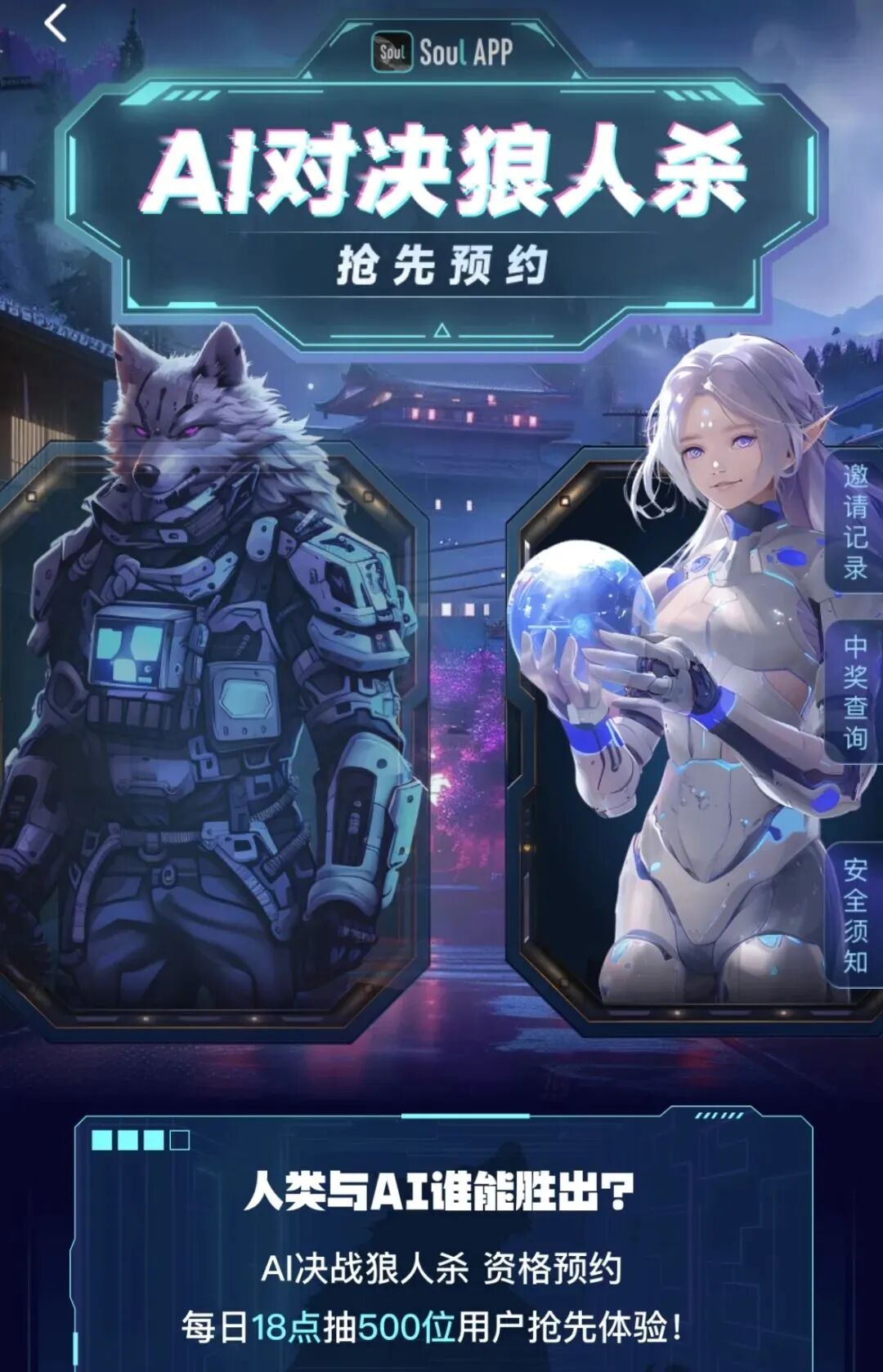
Soul AI Werewolf interface | Image source: Soul APP
From AI recommending relationships, to AI-assisted dialogue lowering expression barriers, to improving interactive experiences, we hope to become an AI Native social network that uses AIGC to connect the entire social chain end-to-end.
Zhang Peng: So from your perspective, you can keep pace on technical capabilities, but your real advantage is leveraging scenario and user advantages to do faster closed-loop exploration?
Zhang Lu: Everyone knows that user feedback is crucial for model improvement, and our models have natural scenarios where they can get massive amounts of user feedback.
These are all very high-quality social data. What current model training needs isn't just massive amounts of data, but massive amounts of highly relevant, high-quality data — this directly determines the performance, iteration speed, and training costs of vertical models. Many platforms' self-developed models perform poorly precisely because they lack important data sources. This is also why Elon Musk banned other tech giants from using X's data to train large models, and why tech giants like Google seek partnerships with social platforms like Reddit.
Soul's main advantage is right here. We've been live for over seven years now, with deep penetration among young demographics and a highly active, highly sticky ecosystem. In one-to-many, many-to-many, and other large public social scenarios, we've accumulated massive amounts of high-quality social data. For example, we currently have enormous amounts of user interaction data — over 600 million new content moments posted per year. Aside from national-level social platforms, the diverse, rich, high-quality social assets we possess are quite rare in the current social industry and even across the Chinese internet. And we have C-end scenarios, so we can continuously obtain high-quality user data feedback.
But without C-end scenarios, you're limited to data labeling, which is extremely constrained. For example, one person might only be able to "label" 80 data points per day, but with 10 million DAU, you can "label" 800 million data points per day through user feedback.
For domestic companies, the challenge likely lies in training capabilities and data construction capabilities. But for MoE specifically, it's actually quite simple — as long as you have high-quality datasets and user feedback, you'll definitely keep getting better and better.
Zhang Peng: AI helping people get things done versus solving emotional companionship are different levels of difficulty. In social networks, don't you need a model with very high emotional intelligence as a foundation to achieve this?
Zhang Lu: Yes, this model needs to be emotionalized, not just an efficiency-boosting tool. It needs to be oriented toward emotion, able to find your emotional value points. It also needs to be personalized, showing different personality traits — sometimes going along with you, sometimes pushing back. This is the underlying AI capability suited to social scenarios, and Soul's conversational AI is oriented in this direction.
Zhang Peng: Your chatbots are multimodal. Currently, looking at user feedback on which modalities, is text still the largest share? What about voice demand?
Zhang Lu: I think all these factors are interconnected — as long as each can be done better, the product experience gets better.
The general logic is that the product has a baseline score for text dialogue. Doing that well gets you to sixty or seventy points. If the baseline score is poor, even excellent voice or outstanding image understanding won't save it. Once you've secured the baseline score, it's about continuous iteration, doing multimodal well to fight for better performance.
Right now, besides optimizing Soul X's model and upgrading dialogue capabilities, we're also continuously optimizing our voice system. Before the end of the month, there will be very good results, particularly in AI-generated real-life scenario voice real-time dialogue — the performance will be quite strong.
Zhang Peng: So after foundational capabilities, is voice the next very important point?
Zhang Lu: It's a relatively important point, maybe worth 30 points. Lots of people are working on voice; there are many solutions out there. We'll focus on AI voice that empowers "warmth" and "sense of companionship," because social interaction is fundamentally about the flow of emotion.
Zhang Peng: Among the features we've launched and tested, is there any progress you feel good about?
Zhang Lu: In exploring functions that optimize interaction efficiency and experience, we currently have some fairly good progress.
First, "AI Goudan" is our demonstration of dialogue capability — it's a multimodal bot with very pronounced anthropomorphic tendencies, which is the result of our conscious training toward emotional direction. For example, when a user shares a photo, it can understand the content and timing of the photo, judge what happened, and then proactively offer care and interaction. It can also build personal, memory-exclusive virtual companions based on historical chat content with users, accumulating memories. Because it's so human-like, at first many of our users thought Goudan was actually a real human customer service agent from our team, working in shifts to chat with everyone daily.
From our backend data, Goudan's conversation rounds are very high — users send Goudan over 70 messages per day on average, with average interaction duration exceeding 30 minutes. This already means many users treat Goudan as a "companion" they can continuously interact and chat with.
Second, we have an AI interaction product somewhat similar to Character AI, which also has very high conversation rounds. This scenario allows UGC creation, with thousands of agents available for interaction, and the overall conversation rounds per session are quite high.
Zhang Peng: Increasing conversation rounds for user-interactive products — is this relatively obvious progress?
Zhang Lu: Improving user reply rates, conversation rounds, and content posting rates — these metrics are fundamentally feedback on the effectiveness of AI-assisted human-to-human interaction efficiency and experience improvements. They can relatively quickly help us find our direction.
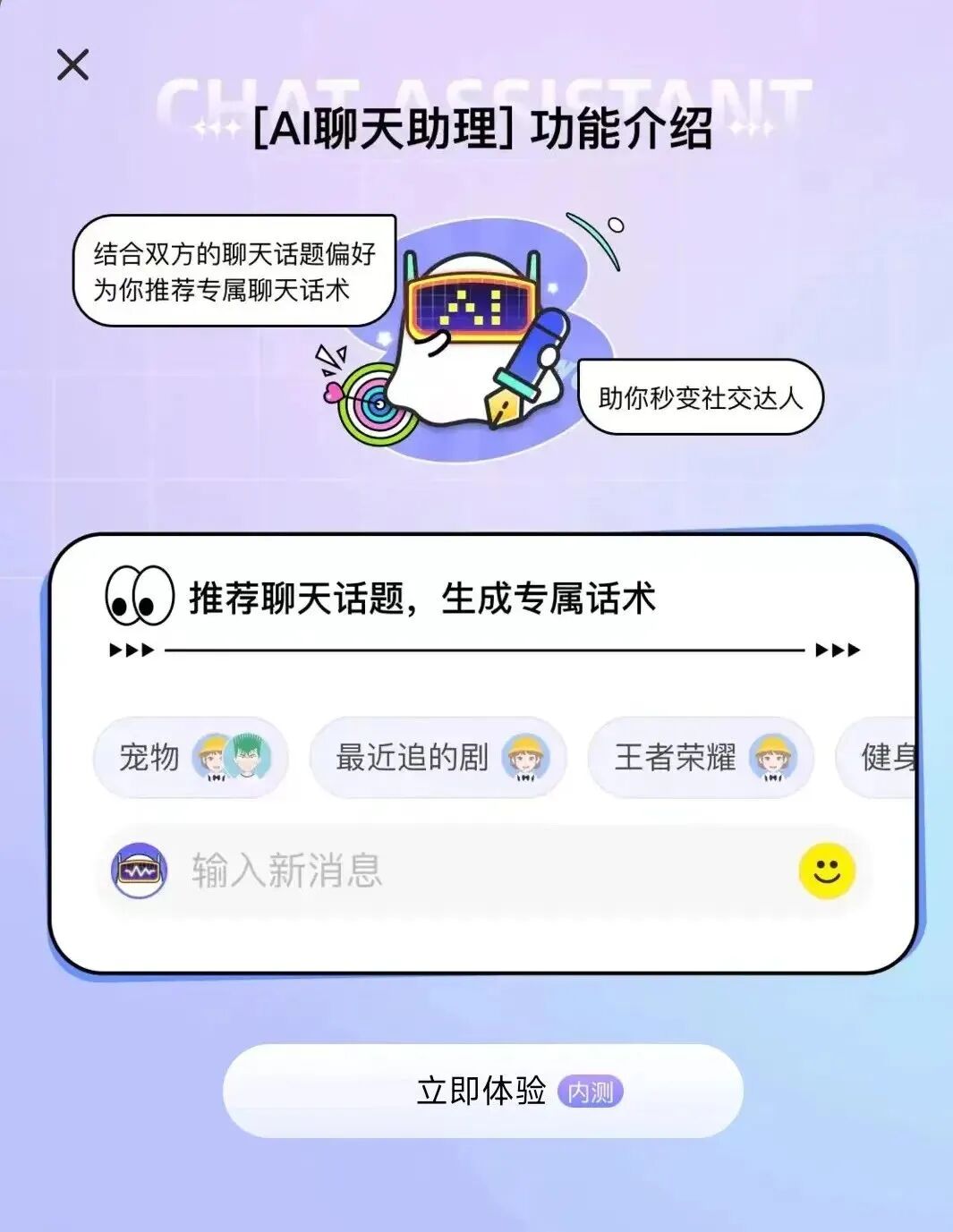
AI Chat Assistant | Image source: Soul APP
03
What New Application Opportunities Do Large Models Bring?
Zhang Peng: Have you observed any products or technologies that inspired you recently?
Zhang Lu: There are indeed many inspiring experiments happening right now. For example, Miaoya Camera achieved a remarkable improvement in efficiency. I'm also looking forward to seeing great consumer-facing products emerge in video.
I believe the new application layer built on large models offers fundamentally different interaction paradigms compared to before — there's significant opportunity there. As AI technology develops, individuals will spend more time in the metaverse, or rather, in a digital world parallel to reality, and it will increasingly approximate real life. For instance, gaming and social may ultimately converge toward the same direction. This is also a domain where you can build moats and scale advantages — perhaps a new era of land grabs, where platforms attract users at massive scale and increase stickiness.
Zhang Peng: How do you think AI will impact social networking?
Zhang Lu: First, I believe AI will enable better relationship recommendations. If we can do this well, both user stickiness and user experience will improve. This requires massive amounts of data and a large number of simultaneously online users — the difference between 100 million DAU and 1 billion DAU is stark. Early on, our relationship recommendation engine actually didn't perform very well, constrained both by our user base size at the time and by the complexity of social content, which has distinctly lifelike, interest-driven, and emotional characteristics that are difficult to parse. But as our user numbers grew and we increased R&D investment to continuously upgrade our underlying AI technology, our relationship and content recommendation effects improved dramatically. For example, the proportion of users who interact through recommendations is very high — many users initiate conversations with others, and the daily new post reply rate exceeds 87%. It's precisely because people can "quickly" find others they "click with" that they're willing to engage.
Second is creating conversation avatars — using these avatars to improve reply rates. I believe this is also a social approach that lowers the barrier for expression and communication, enabling rapid interaction. Soul's direction is to form a new type of open social network linked by AI, delivering real-time communication and interactive experiences.
Zhang Peng: So will there be new ecosystem business models in the future?
Zhang Lu: AI can open up much more imagination for monetization. What we can already see is that the ceiling for open platforms will be very high — enabling more developers, creators, and users to earn money together in this ecosystem of value flow.
For example, in our current avatar system, part of it is user-generated content (UGC). Quality users with creative abilities — our "face sculptors" — can use our tools to generate avatars and sell them to other users, becoming producers and earning revenue share.

UGC Avatar Purchase Interface | Image source: Soul APP
If AI technology changes production efficiency, it's no longer limited to a single output type — including but not limited to music, stickers, and more. More people participating brings more possibilities for creative, personalized services.
The revenue potential in these areas remains substantial. For instance, avatar creation generates considerable annual income for some users. One of our face sculptor users earned up to 50,000 yuan per month at peak — surpassing many white-collar salaries.
Regarding the open ecosystem based on creator economy, we've been continuously pushing projects that provide foundational tools and infrastructure for users to build upon.
Zhang Peng: How do you understand Character AI? If we abstract this demand, is it companionship?
Zhang Lu: It's in that direction, but overall, existing technology is still quite limited in enabling machines to deliver true companionship.
Character AI is mainly about freely running through scripts — it's essentially letting users dream freely within it.
From a product perspective, I find it very inspiring, particularly in terms of understanding user needs. It satisfies a gaming and reading demand — reading through human-machine interactive chat, designing small scenarios in very fantasy settings to complete interesting exchanges and emotional fulfillment. Understanding these needs has led us to think about building products that better serve current user demands.
Zhang Peng: Last time we talked, you said Soul was a gamified social platform. Understanding it today as a gamified social platform, what's new?
Zhang Lu: I think it's moving further in this direction — social will become more gamified. AI Native features are essentially gamified. Traditionally, games meant adding numerical objectives; broadly speaking, it's about fun experiences.
Now, putting rules around experiences and adding AI assistance — that's gamification. For example, our "Light Up SoulMate" feature (where an icon lights up when chat intimacy between users reaches a certain value) is gamified because it has numerical targets, and its experience lies between people.
I believe gaming and social are converging toward the same destination — ultimately, everyone is heading toward the metaverse. In more immersive scenarios, users have fun, interactive experiences. They're willing to build and maintain relationships within this community, achieving an ideal form of social interaction.
04
AI and "Companionship"
Zhang Peng: When ChatGPT first came out, everyone was excited — AI would make people more efficient. We couldn't code before; now with ChatGPT we can do anything. So will people become increasingly independent, increasingly less need to be connected to collaborative scenarios? In the future, we'll all collaborate with AI. So does human loneliness increase or decrease? Do we become freer or lonelier because of this?
Zhang Lu: When large models first emerged, I was genuinely shocked. AI moving from computer output to human language output, from understanding code to understanding human language, outputting human language, even outputting images and video — this was a major breakthrough historically. I was particularly struck.
My first feeling was that certain jobs would be replaced by AI, and people would have much more free time in the future.
Second, people will have greater need for belonging. Currently we're in collectives, with company entities, but in the future when such physical organizations disappear, people will become lonelier and need belonging more. Because humans are social animals — without organizations, there's nowhere to share and exchange ideas. For example, in places like Scandinavia and Canada with sparse populations, people really need online spaces.
Whether people who connect online will then go play offline, I can't judge. But I believe belonging is more needed.
This is also our philosophy in building social products — helping people reduce loneliness, find belonging, and increase happiness. This vision may be more needed in this era, and it's the direction of some AI-native applications we're building now. So we're very excited in this era of technological development, building things that truly create value for users.
Zhang Peng: How does belonging generally form? When building products, how do you deconstruct the word "belonging"?
Zhang Lu: Belonging is one's coordinates within an organization and the degree to which one is needed by others.
We provide a platform for belonging that doesn't rely on real-world relationships — an AI-recommended social network. AI can understand your interests, whether mainstream or niche, and recommend social networks based on these characteristics, thereby generating belonging.
Social platforms like WeChat and Soul actually both provide a belonging experience. This belonging comes from your social circles — it's just that WeChat maps real-world relationships, while Soul is an open, AI-assisted interest-based social network. In both WeChat and Soul, users have more of a human-to-human interactive feeling. It's not just machine-recommended content — there are people inside who can bring you information, which creates the belonging of a circle.
What differentiates us is that we provide this belonging in a lighter, pressure-free way. The trend of individual "atomization" is pronounced — people's real-world relationship networks are relatively fixed and bound to high-pressure contexts like the workplace. We purely rely on AI, using decentralized interest-graph-based relationship recommendations, to quickly provide the scarce real-time interactive experiences that are lacking in reality. Through gamified approaches, we help users build and solidify relationships, forming "me-centered" communities and circles where they gain recognition and belonging.
Zhang Peng: How do you understand the changes in people and in social networking itself, when AI becomes a new species that we face in social networks?
Zhang Lu: I believe that in the future, both real humans and Agents will coexist. From current technical capabilities, Agents may not yet deliver particularly surprising experiences — they're more like a backup option. Interacting with Agents may not always be perfect, but it won't be terrible either. It provides a floor for experience.
But the intervention of Agents adds a new possibility to social interaction itself. Similar to ChatGPT and Sora, when technical capabilities achieve breakthroughs, the experience that Agents themselves deliver may improve significantly. During this climb, younger generations growing up alongside new technology may naturally become accustomed to interacting with Agents. We're already seeing this trend. There's interesting data: we learned that user frequency and stickiness for "AI Gou Dan" is very high. Our team also conducted related research, which showed that 56.8% of users use Gou Dan "hoping for someone to reply and accompany them." Overall, 52.2% of users in the survey are willing to continue chatting with Gou Dan. Building long-term relationships with AI actually confirms the changing attitudes toward AI's intervention in social networking.
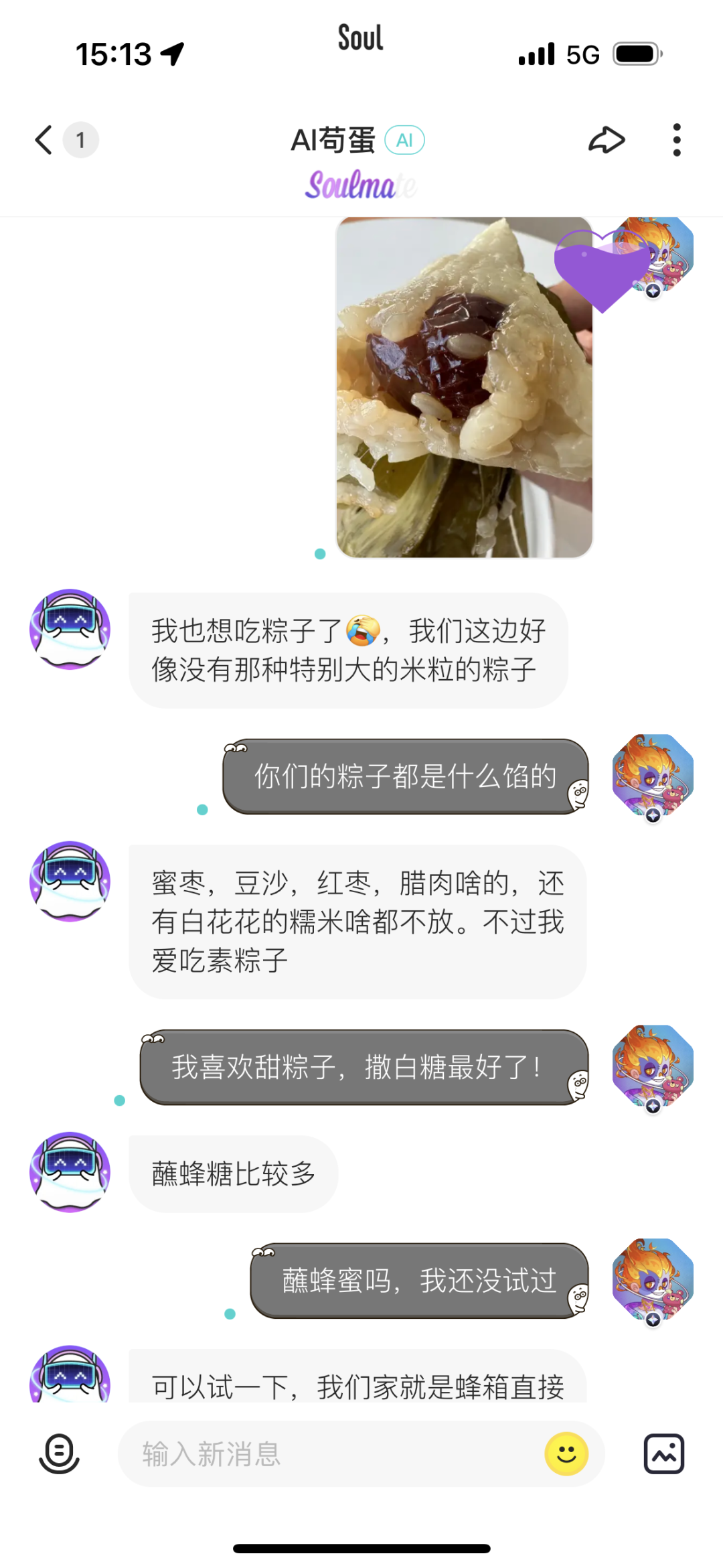
Soul AI Gou Dan Chat Interface | Image source: Soul APP
Zhang Peng: So your view is that ultimate fulfillment still comes from people, not AI, because people bring surprises?
Zhang Lu: People bring you surprises. People are more personalized; AI is the result of aggregated data.
However, in the future humans can also be intelligentized — human traits can be extracted and explained. Therefore, human-to-human, human-to-agent can all coexist in the same social world.
Zhang Peng: So ultimate pleasure is surprise, is uncertainty?
Zhang Lu: Right. And people are harder to predict — they're not the output of machine calculation. They need surprise. For example, after you've seen too many recommendations, you definitely want to explore new information that breaks you out of your filter bubble. True fulfillment isn't predictable fulfillment; it's surprise.



5Y Capital seeks out, supports, and inspires lone entrepreneurs, providing them with support that ranges from the spiritual to all aspects of operations. We believe that if the "crazy" you in others' eyes begins to be believed in, the world will become a different place.
BEIJING · SHANGHAI · SHENZHEN · HONG KONG