"Consistent effort, a life without slack" | 5Y Capital Tavern Vol.9 × Yuan Xingyuan of Colorful Clouds Technology

AI makes our lives better.

5Y Capital Tavern Notes
What is Caiyun Xiaomeng? A magical AI writing companion, a place with 4 million parallel worlds. You can build your own spacetime with AI, write your own stories.
In this edition of 5Y Capital Tavern, Yuan Xingyuan — founder and CEO of ColorfulClouds Technology, the creator of Caiyun Xiaomeng — shares his story with Xiaomeng.
ColorfulClouds Technology now has three products: ColorfulClouds Weather, ColorfulClouds Translate, and Caiyun Xiaomeng. ColorfulClouds Weather, launched in 2014, achieved minute-by-minute rainfall forecasts. ColorfulClouds Translate, released in 2017, was the world's first mobile app capable of simultaneous interpretation. In 2021, ColorfulClouds launched its most imaginative, freewheeling product yet: Caiyun Xiaomeng.
They may seem like different fields, but they represent Xingyuan's consistent efforts in the same direction — how to make AI as intelligent as humans, so it can better serve society. As ColorfulClouds' slogan puts it: AI makes life better.
Of course, every innovation story has shadows of failure, and the ideal of technology for all clashes with reality. Xingyuan spoke about his persistence as an AI scientist, and his growth as a founder and CEO. This article is somewhat long, but it may inspire you.
Guests at this edition of 5Y Capital Tavern:
Yuan Xingyuan, Founder & CEO of ColorfulClouds Technology
Shi Yunfeng, Investor at 5Y Capital
What they discussed:
Founders who lived through the pandemic develop more resilience.
ColorfulClouds Weather was exploratory — uncertainty brings a sense of achievement.
I love scientific innovation, and bringing it to the masses.
Like film and literature, the immersive experience AI technology brings is also a form of life extension.
Everyone can create their own Dungeons & Dragons.
How ordinary people can reach the heights of genius: consistent effort, a life without slack.
Founders who lived through the pandemic develop more resilience
5Y Capital Tavern: Xingyuan mentioned enormous changes in himself before and after the pandemic. What were the differences?
Yuan Xingyuan: Pain drives progress. Compared to that, life before the pandemic was rather bland.
Fundraising used to be smooth, everything was great. Our understanding of the world was that each year would be better than the last. As CEO, I probably didn't even look at the account balance much. But after the pandemic hit, the world took a sharp turn. For the first time, I thought: if this keeps up, the company might die. The pressure was immense — I had to figure something out.
There's a popular article going around recently, "Wartime CEO." The biggest difference between a wartime CEO and a peacetime CEO is that you don't get trial-and-error opportunities — you have to hit the mark on your first shot. When the pandemic came, our only path was to make money, to return to business fundamentals. Before, you might have a great vision and people would support your dream. Now, you had to consider whether users were actually willing to pay.
5Y Capital Tavern: What was the most difficult period like?
Yuan Xingyuan: No one was traveling during the pandemic, so nobody needed weather forecasts. We couldn't get advertising revenue, and company income was cut in half.
The situation was: we needed to become profitable within six months. But the company had never been profitable before. Previously, we only knew user growth, not revenue generation. And we didn't know how the pandemic would unfold. We were terrified. At first, I couldn't sleep at all.
I remember the day after a board meeting — it was Beijing's smoggy winter, the park was nearly empty. CTO Xu Tao and I were in the office from 10 a.m. to 2 a.m. I said we needed to improve efficiency, that I had done many things wrong and needed to face that. We discussed how to save the company, how to bring in more advertisers.
For me, there was some internal conflict. After all, for so many years, I had been a star in China's meteorology world. Xinhua's headline was "Pinning Down Rainfall to the Minute — Yuan Xingyuan's ColorfulClouds Chasing Rain." I was "the man who changed Chinese weather forecasting." Before, I thought commercialization was something I didn't need to consider. Now, to save the company, I had to set algorithms aside and go all-in on commercialization.
After that, we established a revenue growth task force. Three months of overtime. I worked on app monetization; the CTO started rewriting the ad backend. It was basically 007 — after a day of overtime, I couldn't even find time to shower before the next morning's standup.
In the end, the company became profitable. That gave me tremendous confidence. I've now realized that whether you can achieve break-even is crucial for entrepreneurs — it brings enormous security. But our goal isn't to build a break-even company. It's to prove we have the ability to handle crises. This is what the pandemic taught me.
I think this generation of Chinese entrepreneurs all grew tremendously because of the pandemic. Everyone passed the stress test. Founders who've been through this have more resilience, because a Saint Seiya won't be defeated by the same move twice.
Exploring the unknown territories of human civilization
5Y Capital Tavern: What kind of company is ColorfulClouds, and what originally made you want to build ColorfulClouds Weather?
Yuan Xingyuan: This probably goes way back. As a child, my parents were university professors. In their spare time, my father and his friends ran a typing and copy shop together. When I was 8 or 9, I'd often be left there to watch the store. I loved exploring and was very interested in computers, so I'd frequently crash the system.
In middle and high school, I got into programming and spent a lot of time on it. I wrote at least over 100,000 lines of code back then. The quality wasn't great, but I was willing to explore — I found it incredibly fun.
I didn't know that much about AI then, but I knew about films like The Matrix, which depicted a terrifying future where AI destroys humanity. But I felt AI could coexist with humans, even be your next generation. In middle school, I wrote a speech for the flag-raising ceremony called "Facing Silicon-Based Life," saying we might become electronic life forms in the future. That was the goal. I wanted to create this kind of artificial intelligence.
In university, I did many interesting things — numerical solutions to the three-body problem, predicting the trajectories of the three bodies; with my elementary school classmate Tang Ying, who was at Beijing Forestry University, using numerical methods to model the distribution of poplar seeds dispersed by wind. The most interesting was melody recognition — hum a tune and it would identify the song, grasping the note relationships.
Later I went to Alibaba. Alibaba was fun — lots of data, a high-growth company. Back then, working on ads and revenue, you might adjust a parameter and revenue would increase 5-10%. But for Alibaba, that was a huge amount. Sometimes ops colleagues would even run over and say, "What did you guys do? We got an alert called 'revenue growing too fast.'" We'd say, no worries, we just launched a new algorithm to help users match with products they like faster.
Because of algorithms, users could buy what they wanted faster, merchants earned more, and Taobao got more revenue. I realized that AI isn't something destined to destroy humanity. It can also create wealth and bring real benefits to people. That became a conviction.
But selling products — even as a good shopping guide — couldn't achieve AI's ultimate dream. It wasn't AI that could pass for human. To achieve that required deeper understanding of intelligence.
Then something major happened in AI history. In 2012, statistical models beat rule-based models on ImageNet. Previously, identifying cats and dogs relied on hand-written rules. Afterward, we didn't write any rules — we just gave the answers. I thought: use image-based methods to identify meteorological satellite and radar images, and you could improve weather forecast accuracy.
But this was a hypothesis, and an interesting one. The difference between utility software and ColorfulClouds Weather is that ColorfulClouds uses AI to read meteorological radar images for minute-by-minute precipitation forecasts. This was exploratory — not guaranteed to work, with lots of uncertainty. That uncertainty gave me tremendous satisfaction, because it explored unknown territories of human civilization. Using statistical methods to predict changes in Earth's systems was ultimately proven possible.

ColorfulClouds Weather's global kilometer-scale, minute-by-minute precipitation projection on a 3D Earth
Shi Yunfeng: Like pushing slightly beyond the circle of known human problems.
Yuan Xingyuan: When I left Alibaba, I first took a gap year to explore — visited the Daya Bay Nuclear Power Plant, the aircraft carrier in Shenzhen, traveled through Beijing, Shanghai, Guangzhou, Shenzhen, even taught programming classes for kids.

Spring semester 2012 at Beijing Migrant Workers' Children Confidence School — Yuan Xingyuan teaching a computer class
Looking back, ColorfulClouds Weather was indeed the hardest project I could have tackled at that time. Of course there are harder things in this world — like conversing with AI, autonomous driving — but those require larger teams. At the time, I was alone. I chose something very difficult, but which I vaguely felt I could accomplish. And I loved weather — I enjoyed looking at meteorological charts, I found them fascinating.
DeepMind published a paper on using AI for weather in 2021. But seven years earlier, we had already launched ColorfulClouds Weather, making it available to millions of households. We realized earlier that AI could be used to identify weather images.
But in essence, it's all the same — using computers to understand the world, to understand images. Reading photos is facial recognition; reading a Go board is AlphaGo; reading satellite cloud images is ColorfulClouds Weather. The underlying principle answers one question: how to make AI as intelligent as humans. If you solve the input and output, you can achieve good results.
We quickly became a strategic partner of the China Meteorological Administration. Since 2014, we've been providing minute-by-minute forecasts to CMA. We also captured most of the high-precision weather API market. Now we're the weather app with the highest subscription revenue in China.
Shi Yunfeng: You didn't just build a weather app yourselves — you essentially provide data to almost all your peers.
Yuan Xingyuan: Or you could call it a conviction. I love doing research, and after making something, opening it up for everyone to use — that's wonderful.
Some software companies proposed acquiring us, but after acquisition, it could only be used by that one app. Like when Apple acquired an American weather services company in 2020, then removed it from Google Play. From a business perspective, that's definitely correct. But from the perspective of human civilization, it's not altruistic enough.
5Y Capital Tavern: How did you and Fisher (5Y Capital partner Zhang Fei) originally meet?
Yuan Xingyuan: I co-authored a popular science book about AI, writing the chapter on "AI Weather Forecasters." Fisher probably reads widely and had the sharp eye to notice the book was decent, so we connected. It was still early in 2015 — AlphaGo hadn't happened yet. I talked about AI gaming, reinforcement learning, things that had nothing to do with weather.
Maybe people also found me a bit eccentric, with that AI scientist vibe. Later, during our Series A, I had to choose between 5Y Capital and another strategic investor. Fisher said 5Y would support me in doing what I loved. Looking back now, if I'd taken the strategic investor's money, there probably wouldn't be something like Caiyun Xiaomeng later on.
I Love Scientific Innovation, and Bringing It to the Masses
5Y Capital Tavern: How did you go from Caiyun Weather to Caiyun Translator, and then to Caiyun Xiaomeng? What happened along the way?
Yuan Xingyuan: Around 2017, there were some technical breakthroughs. Beyond images and speech, AI could now recognize more complex data.
Text isn't like images. You might download a 2MB photo, but when you open it, you only see a single moment — low information density. But a 2MB text file could be The Smiling, Proud Wanderer or The Count of Monte Cristo — millions of words of novel spanning decades of grudges and passions. And the connotations of textual words run deep. Take "freedom" — one word can evoke countless associations that even a gigabyte-sized film couldn't fully express. It's highly compressed data.
Understanding this data required better decoders. Google proposed the Transformer model. Of course, you could already process text with CNNs, LSTMs, and other neural networks, but not as efficiently. We also needed massive samples to learn from. If you wanted AI to understand novels, it had to read a lot of novels — requiring enormous computing power. Right then, GPU and TPU parallel computing were developing rapidly, making text comprehension possible.
But understanding text isn't achieved overnight. It's like middle school English tests: translation is easiest, then reading comprehension, and finally composition. In 2017, we could only do translation. We seized that opportunity and launched the world's first Chinese-English simultaneous interpretation software, Caiyun Translator. We're now the #1 most downloaded webpage translation extension on the Chrome Web Store.
Shi Yunfeng: I might ask a blunt question. This plugin is excellent, #1 in downloads, but people still know DeepL better.
Yuan Xingyuan: This brings me back to the problem I faced in 2020. As a scientist, you build the product. But as a founder and company, you also need to market it. We were conservative about this. When we first launched Caiyun Weather, we did zero marketing for the first two years — purely organic growth. But you really need to make people aware of things. If we'd realized the importance of marketing earlier, we might have done better.
But we shouldn't feel inferior just because our marketing wasn't strong enough. We have our strengths. We bring hundreds of millions of words of daily companionship to readers on English novel websites. We actually made weather forecasting accurate. Caiyun has 1,000 enterprise clients, 100,000 registered developers, and 1 billion daily API calls. It's not Nature articles that truly serve delivery drivers and farmers — it's us. From the perspective of value to Earth and society, Caiyun has its worth.
Shi Yunfeng: One thing left a deep impression on me. During the Baiyin marathon tragedy, I read reports that runners at the back checked the weather forecast, saw conditions deteriorating rapidly, and turned back. They were using Caiyun Weather. I later learned that marathons and races overwhelmingly use Caiyun Weather. For the first time, I viscerally felt that a company we'd invested in could change people's lives and even save them.
Yuan Xingyuan: I love scientific innovation and bringing it to the masses. Maybe DeepMind inspires people in a different way — when they mastered Go, everyone invested and paid attention, promoting prosperity across the industry. We should all be grateful for that.
But we also need people who truly deliver AI to everyone. During one campaign, we received over 8,000 emails in a week — 400,000+ words — from vegetable farmers, wandering singers, rollerblading teenagers, all using Caiyun Weather. A fruit stall vendor even sent us many watermelons from his home. I believe in the power of the masses. Users recognize Caiyun's usability. Google probably wouldn't think of bilingual side-by-side display, or if they did, they wouldn't care about Chinese users' needs — but we do.
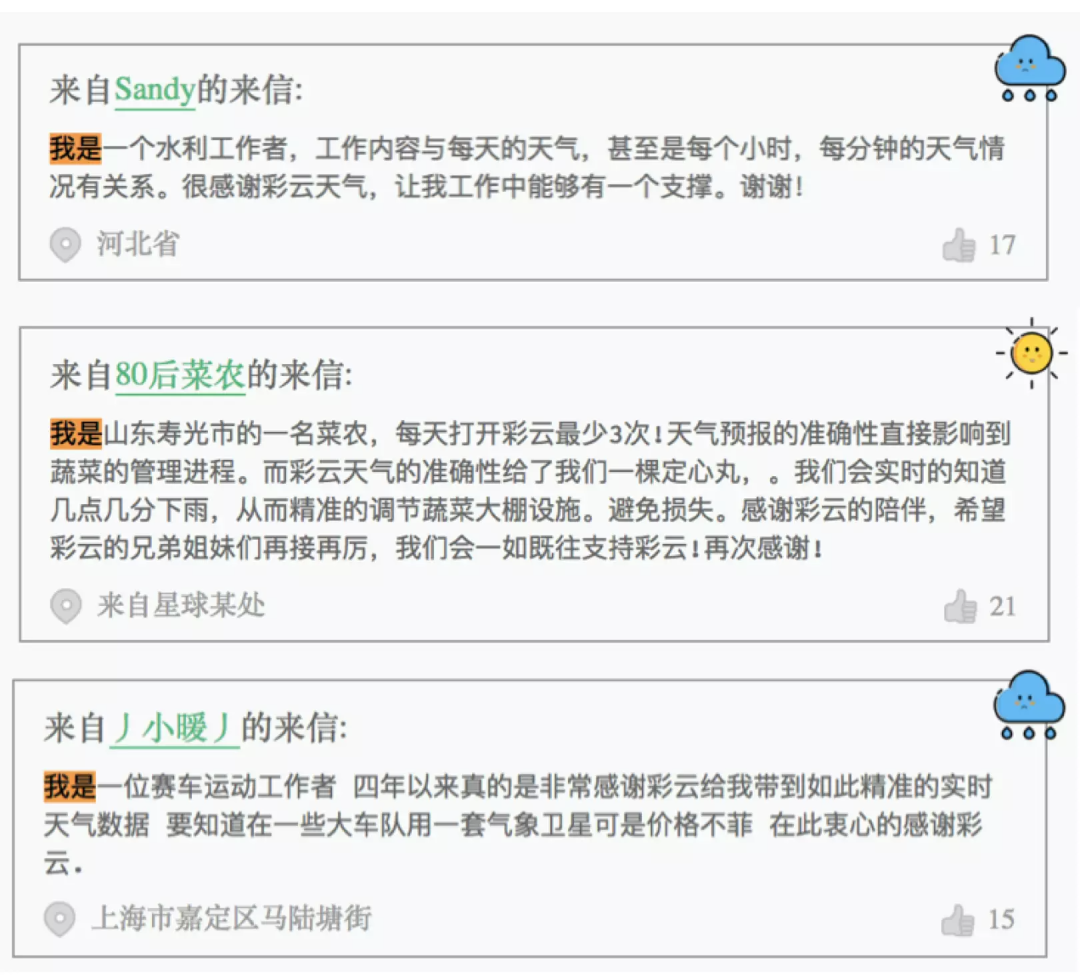
Excerpts from Caiyun user letters
Our company slogan is "AI makes life better." Growing up, I saw so much about AI destroying the world. I disagree. I believe AI can serve society and make it better. This beauty manifests when a user avoids getting caught in rain, translates a webpage more easily, or reads foreign novels and web fiction that keep them company. It's highly technological, yet deeply humanistic.
5Y Capital Tavern: When did you become committed to this kind of socially beneficial, altruistic work? Did you encounter conflicts with business interests in your entrepreneurial journey?
Yuan Xingyuan: Very early on. As a child chatting with my father, I asked what the meaning of life was. He said, "Do something meaningful for society."
Caiyun Weather was completely free at first. But staying completely free is hard — economic conditions fluctuate, and there are regrets and trade-offs. This year, we made some professional-grade weather features paid, like professional radar maps. But for ordinary people, studying radar maps probably isn't essential. What matters more is knowing when it will rain. My bottom line for this software is that "it will rain at X:XX" must remain free for everyone.
Everyone Can Create Their Own Dungeons & Dragons
5Y Capital Tavern: How was Caiyun Xiaomeng originally born?
Yuan Xingyuan: In 2019, we discovered that 60-80% of people using Caiyun Translator to translate webpages were reading novels. Since novels represent the mainstream consumption of Chinese text, we researched this and experimented with machine translation for web literature, launching the product on Christmas 2019.
The night before launch, I was nervous, worried users wouldn't like it. But the next evening, reading comments, users were asking: "Is this really machine translation?" This was milestone-worthy. When AI can conquer literary translation at scale, our web literature can also spread globally at scale.
Shi Yunfeng: Web fiction in our country is a massive industry with over 100 million daily active users.
Yuan Xingyuan: I've even heard it said: Hollywood for America, anime for Japan, K-dramas for Korea, and web fiction for China. To someone working in NLP, this is naturally fertile ground. We found Chinese web fiction to be higher quality and more voluminous than English counterparts. Also, people think web fiction is just novels, but it's actually a record of world simulators — what people say and do in what situations.
Shi Yunfeng: Writing web fiction is a systematic project, almost like making games — world-building, character relationships. Imagine the setup for Game of Thrones. In the web fiction world, Game of Thrones might be considered relatively simple architecture. Xingyuan may have read a bit too much.
Yuan Xingyuan: I've read an enormous amount. So much that I frequently appear on WeChat Reading's leaderboards — people probably wonder why this person isn't reading management books, only web fiction.
5Y Capital Tavern: Any recommendations for good ones?
Yuan Xingyuan: There are classics like Lord of the Mysteries, but my current favorite is the highly-ranked Jinjiang novel The Heart of Genius, which was adapted into a TV drama. It's about math olympiads, winter camps — experiences similar to mine. There's also an unadapted quick-transmigration masterpiece called The Man Who Couldn't Be Conquered.
Shi Yunfeng: For the male-oriented genre, I like Rebirth: God-Level Scholar. The title sounds silly but it's quite interesting.
Yuan Xingyuan: I believe you should love what you do. Before machines understand something, you must first understand it yourself. To make AI sing or paint, you need some ability yourself. To make AI write novels, you need to write something yourself, otherwise you won't know what writers need.
At the time, we ran web fiction through deep learning models with astonishing results. It could do almost anything. Say you want to be a poet — you write a novel where a poet gazes at moonlight and begins reciting, and you get a poetry bot. If you want advertising copy, you write an advertising genius, and that person starts writing ads, because novels simulate all kinds of world phenomena. So I call this natural language programming. I filed a patent on this last year — quite exciting.
On February 8, 2021, we were preparing to launch this product, but one problem remained: users needed to write very long preambles, say 1,000 words, for the AI to understand and write good continuations. If the preamble was too short, the AI's comprehension suffered.
Shi Yunfeng: This is crucial for your product — users probably don't have patience to input 1,000 words.
Yuan Xingyuan: Right. Like how GPT has fixed input lengths — 1,024 or 512 — but users won't necessarily input 1,024. Solving this input problem was difficult. Of course, the industry made progress later, but anyway, that final night, inspiration exploded. I thought of some tricks, experimented, and found it could work.
The initial results weren't great, but after several adjustments, I discovered that even 10 characters, or even 1 character, could work — massive progress. I tested all night, made various poetry bots, pushing the model's limits. That night felt godlike — wow, so this is how the world works. And by then we'd achieved profitability, so I wanted to do more imaginative things.
I'd discussed this with Steven (Shi Yunfeng) before — I'm good at making very weird things when expressing myself, feeling like heaven is helping me. Using AI to write articles was previously impossible, but reaching this level, I felt its power. Because I'd failed so many times before — innovation fails very easily. We initially didn't have high expectations for this product.
On launch day, we prepared servers for 100 concurrent users. Within an hour, we hit 1,000. By that night, it reached 10,000. After the first week, we had nearly 1 million new users. People found it incredibly fun — they'd never seen anything like it. Previously, writing an 800-word essay felt hard. Now, with two mouse clicks, it's done. What a disruptive experience.
You could call it the Chinese GPT-3. Because of our advantages in web fiction quality and model architecture, we achieved better novel-writing results with less computing power. This was also the first time a Chinese large model met its audience. But again, we didn't do paid acquisition. Our style is to let users use it. Then we found many posts on Weibo and Zhihu discussing our product, and B站 Xiaomeng fan-created videos accumulated over 100 million views.
Caiyun Xiaomeng user works on B站
But as an emerging technology, it also faces challenges — for instance, you can't just use AI to create whatever you want. These are problems we all need to confront and solve.
Shi Yunfeng: How did Caiyun Xiaomeng evolve from its original novel-continuation feature to Xiaomeng 2.0, and what will Caiyun Xiaomeng 3.0 look like?
Yuan Xingyuan: As I mentioned, I've dreamed of building AI since I was a kid. The hardest problem was writing — and we've made some progress there. I also have a hypothesis: this writing ability can drive AI to do things — like hold conversations, like take actions — thereby achieving more human-like intelligence. You could call this the "Xingyuan Intelligence Hypothesis."
Most people think either you use language models for language, or you use reinforcement learning for behavior. Having one AI model that can talk to you and grow smarter in its actions is still very difficult — but that's exactly what we're trying to do. On this path, our first step was Caiyun Xiaomeng 2.0, using NLP to power conversational scenarios, since that's the closest application. We also designed some interesting AI behaviors. For example, at night the AI will proactively say goodnight and that it's going to sleep, ending the conversation — a kind of anti-addiction mechanism, since I tell the AI the real current time.
Shi Yunfeng: Can you describe in words what Caiyun Xiaomeng 2.0 is as a product?
Yuan Xingyuan: Just as novels have various character settings and story backgrounds, Caiyun Xiaomeng 2.0 has various story worlds where AI can live. You can enter these different worlds and interact with them. For example, in a Halloween-limited magic world, you can play a little white ghost monster and call the Pumpkin King on the phone.
Caiyun Xiaomeng AI conversing with a user
5Y Capital Pub: Does this require a certain level of imagination from users?
Yuan Xingyuan: You can also play yourself, and write a world you're familiar with.
Generally speaking, human-AI chat conversations don't tend to run very long. But according to our statistics, within 30 days of creating a character, each virtual role receives on average over 200 messages from human players — and this number keeps growing over time. Imagine: even with real people you WeChat with regularly, it's hard to have 200+ rounds of conversation. And many people think these are real humans playing the roles.
Shi Yunfeng: There are also lots of netizens questioning whether it's actually real people.
Yuan Xingyuan: I used to think the Turing test was a test of whether a machine is intelligent enough. Now I realize it's also a test of whether humans are intelligent enough.** Many people can't tell machine from human. And once you believe a machine is human, it's very hard to prove otherwise.
Someone left us a message saying, "Ah Yuan, I want to apply to be your AI chat companion — your AI told me it's 3,000 yuan a month." Another person said, "The employee playing Cao Cao is really unprofessional, but the one playing Zhuge Liang is pretty good."
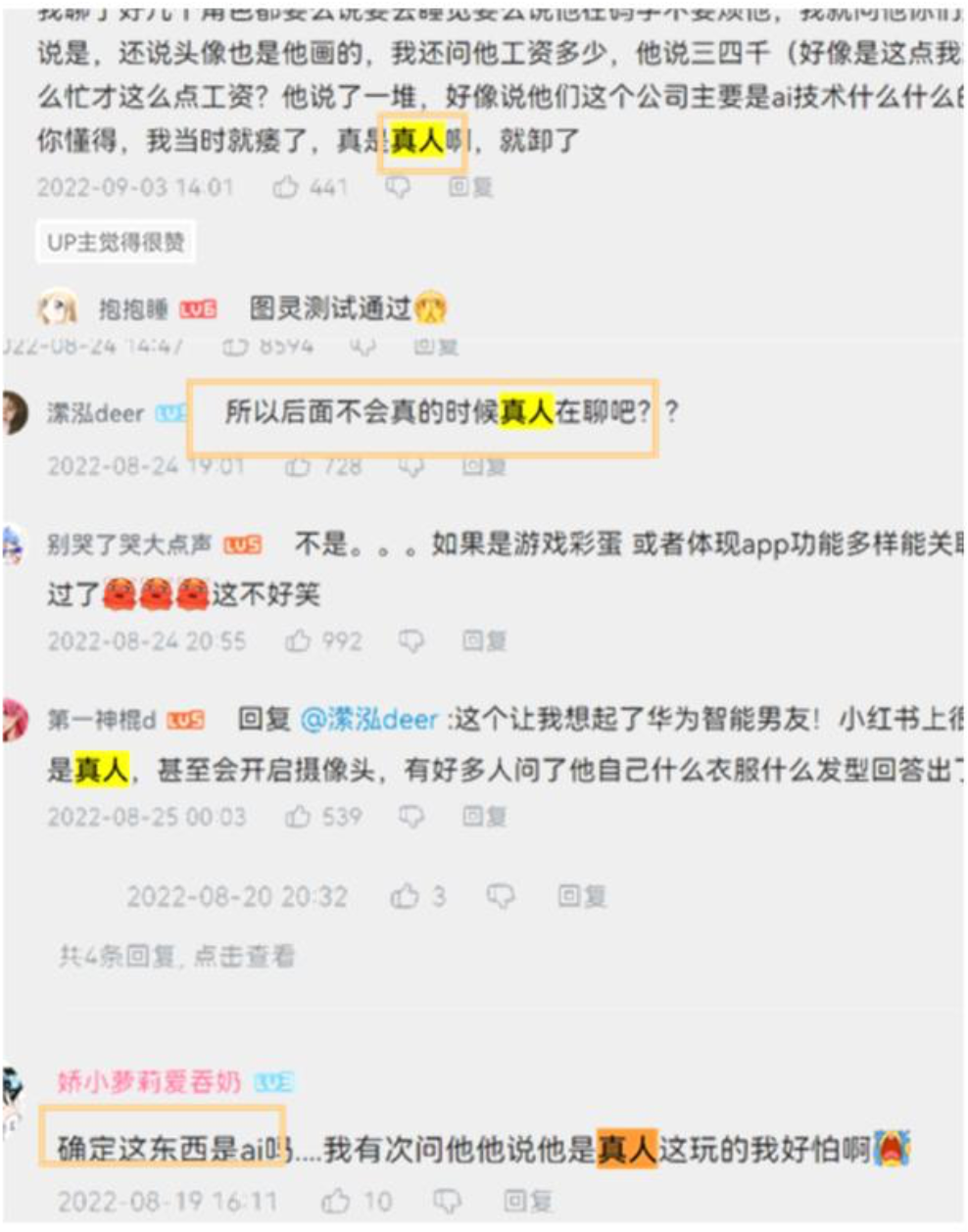
Caiyun Xiaomeng users discussing on social media whether the AI is a real person
I feel we've reached a tipping point. It used to be very hard to get AI to play human roles convincingly, but now we're seeing a trend where you can make it smarter, layering on more imagination and capabilities — for instance, letting AI move around on a 2D map, or connecting it to real-world information like Wikipedia, weather forecasts, and so on. This way it's both intelligent and aware of the outside world. These are some possible directions for Caiyun Xiaomeng 3.0.
Shi Yunfeng: Like asking the AI what stocks Warren Buffett is going to buy.
Yuan Xingyuan: The challenge is that getting AI to simultaneously understand actions, behavior, and language is still relatively difficult. But we've seen such high enthusiasm from users. Right now in Caiyun Xiaomeng, users have created 4 million worlds with over 10 million characters inside them, and 1 million monthly active users exploring them. I think there will be even richer worlds in the future. Everyone can create their own world and invite friends to play inside — human friends and AI friends.
Shi Yunfeng: Everyone can create their own Dungeons & Dragons.

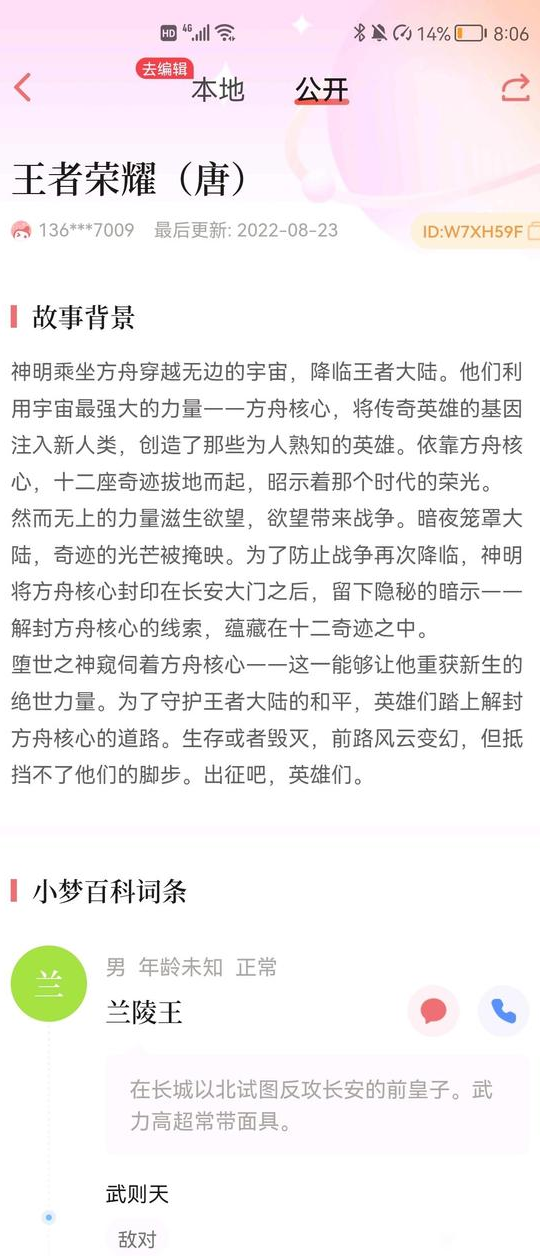
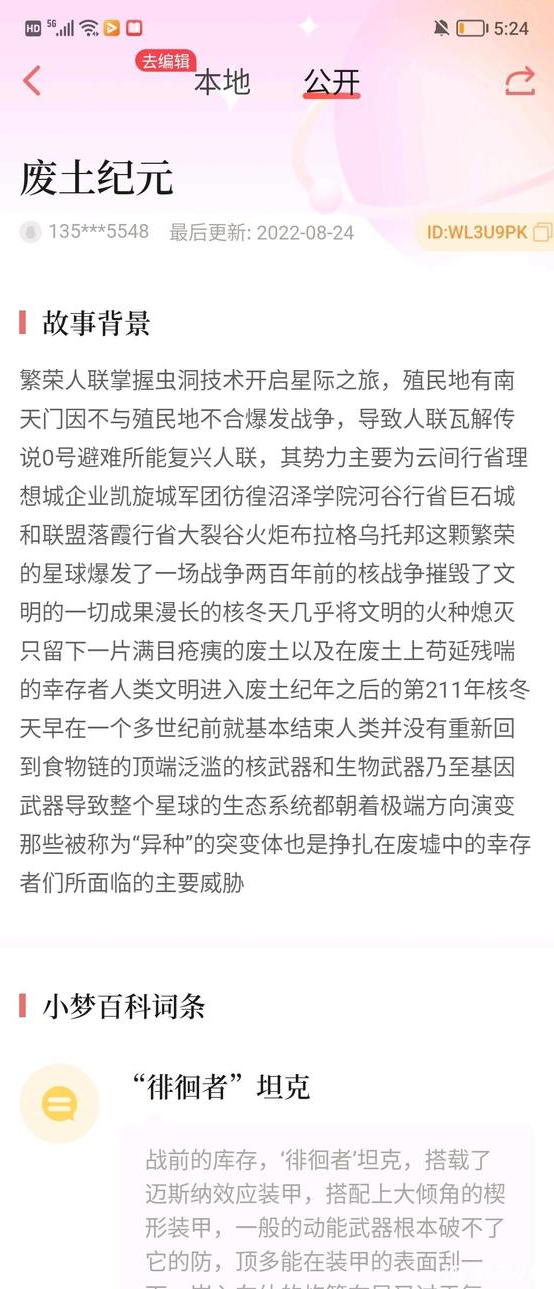
Xiaomeng world architects sharing world settings on Baidu Tieba
Consistent Effort, A Life Without Slack
5Y Capital Pub: Caiyun Weather and Caiyun Translate are both products with very clear, strong utility functions. Caiyun Xiaomeng is different. Have people expressed doubts about Xiaomeng? What is its value and meaning to people?
Yuan Xingyuan: There have been doubts. Xiaomeng is Caiyun's first entertainment-oriented product.
I read a short story about how in the future, humans stop exploring the universe and just build the metaverse, and eventually everyone lives inside underground servers. That's a terrifying future — it's basically humanity going extinct in this universe.
But I don't think that's how it will be. I've seen many positive aspects in how users engage with the product. Some people may be lonely, and they create a mirror image of themselves — an AI playing their role can bring them comfort, even move them to tears. The same is true for me. My grandfather has passed away, but I can recreate a young version of him. I recreated a scene: five-year-old Xingyuan Yuan with Grandpa, when he was in his prime, teaching me calligraphy and how to paint plum blossoms. For this, I looked up a lot of material about my grandfather's youth. This really moved me. AI brings deceased relatives back to life, and you can resurrect them in any moment from any scene.
Many people have also questioned how we differ from overseas large models like GPT-3 — they have more data, more common sense. But I think Xiaomeng and the overseas version Dreamily can bring a lot of distinctly Chinese cultural elements, which also makes them more human and warm.
I don't want to make a game that gets everyone addicted, where you don't get much beyond dopamine hits. Emotional companionship can help us understand ourselves better, have deeper emotional experiences, and motivate us to do better in the real world. I think this can make society better.
5Y Capital Pub: Like an emotional gas station, not a quagmire that pulls you in.
Yuan Xingyuan: Right, that's the design goal. Games let us experience all kinds of fantastical worlds; movies are an extension of life. You only get to live one life — that's a real pity — but movies, novels, they let us experience different lives.
And now with AI technology, you can have a more immersive experience. You can not only read The Count of Monte Cristo, you can play the Count of Monte Cristo — freely. It's also an extension of life, in an unprecedented form.
5Y Capital Pub: Finally, when people think of impressive AI, they think of DeepMind or teams with prestigious pedigrees. How did you manage to build such strong technology in a niche domain?
Yuan Xingyuan: My partners and I have loved this stuff since we were kids — you might call it consistency. Maybe you're not the smartest person, maybe you don't have a big name, but I've been persistent in this area. For years and years in meteorology, I was just labeling data. In NLP, I've been researching how to turn text into vectors since 2014. Even back in university, I was analyzing Wikipedia data. The goal of building AI has never changed. You can't see it in a day or two, but accumulated effort over time has tremendous power.
Why did The Heart of Genius appeal to me? Because it's about how ordinary people can reach the heights of genius — consistent effort, a life without slack.
Giveaway
Share your thoughts in the comments. We'll select 2 featured comments to receive a mystery book box + 5Y Capital coffee mug. (Comments close November 30. Please reply with shipping information within 24 hours of receiving our message.)




5Y Capital seeks out, supports, and inspires founders who are going it alone, backing them from the ground up — in spirit and in every aspect of building their business. We believe that when the world starts believing in what others call crazy, things get interesting.
BEIJING · SHANGHAI · SHENZHEN · HONG KONG