FreeS Fund's Li Feng: Consumer Brands Go From 0 to 1 Easily, But 1 to 10 Is Hard | 10/31 Closed-Door Session Registration

When everyone's doing Douyin, Bilibili, livestreaming... what are the truly sustainable dividends?
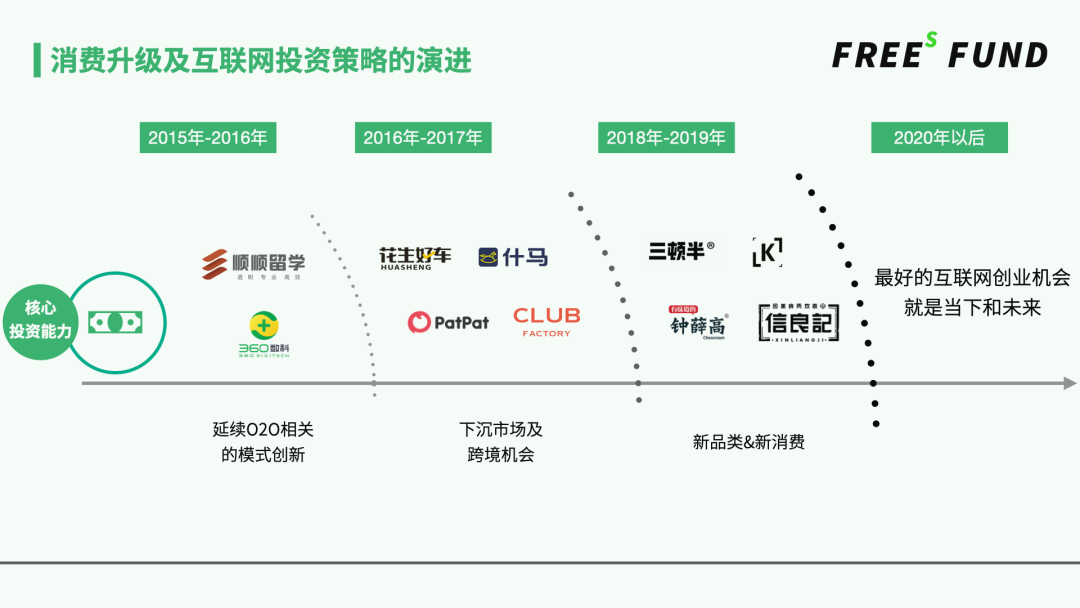
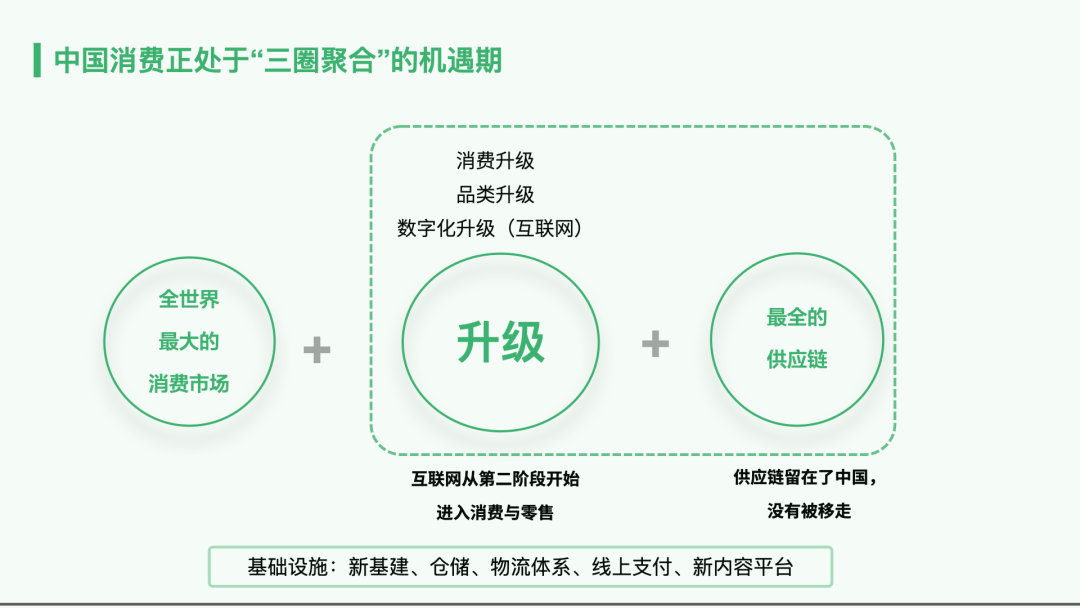

Today is the era of "species explosion" for new brands.
The maturation of back-end supply chains, combined with the rise of highly efficient front-end traffic platforms, has dramatically compressed the growth cycle for new brands. Whether it's Perfect Diary, Zhong Xue Gao, or Saturnbird, all achieved in two to three years what used to take brands decades.
In our view, changes in traffic structure, the evolution of platform logic, and the endless emergence of new sales methods make this an exceptionally favorable time for new brands to go from zero to one. The new challenge becomes: how to break out of your niche, how to scale from one to ten, and how to become profitable. The upside is that whoever makes it through will end up bigger, better, and more international than anyone can imagine today.
On October 31 (Saturday), from 2pm to 6pm, FreeS Fund will partner with Langchao New Consumption to host a closed-door session on new consumption and new brands in Shanghai. We'll do a deep retrospective and discussion on the evolution of traffic/media platforms and the construction of core content capabilities for brands, together with entrepreneurs and industry experts in the consumer sector. We welcome founders and experts in consumer to apply:
Scan the QR code to apply for the closed-door session and explore new trends in consumer
Here, we'd also like to share our latest thinking on consumer entrepreneurship with you. This content comes from a recent presentation by Feng Li, founding partner of FreeS Fund, at the "2020 Yibang Future Retail Conference." We hope it offers fresh perspectives.

FreeS Fund's Feng Li: Is Now the Best Time for Consumer Entrepreneurship?
Source: Yibang Power (WeChat ID: iebrun)
2020 has been a year of great uncertainty for us. Consumer entrepreneurship has become hot this year — perhaps because people feel that major platform opportunities on the internet have been mostly tapped out, and they're turning to consumer; or because the entertainment/content industry has been affected by various factors, prompting a shift to consumer; or perhaps because the sudden pandemic in 2020 dealt a blow to offline business, heating up investment in online consumption.
But the consumer entrepreneurship boom of 2020 has its particularities.
Looking at the statistics, China's total consumption in the first eight months of 2020 (excluding real estate) actually declined year-over-year. Only in August did total retail sales of consumer goods grow 0.5% year-over-year, marking the first positive growth this year.
So why is consumer entrepreneurship/investment hot? And how long will this heat last?
Instant noodles and quick meals are hot right now, but it's important to note that there are many special factors at play. The instant food boom isn't entirely because consumers have upgraded, nor entirely because the pandemic kept everyone cooking at home. It may be because after roughly 2017, food delivery platforms reduced subsidies for users — now ordering a meal costs over 25 yuan, making it acceptable for instant food to rise from 3-5 yuan per package to around 10 yuan. It may also be because of the widespread application of freeze-drying technology, which gives instant food better flavor fidelity at somewhat higher cost.
China is probably the only country in the world with all industrial product categories, a supply chain that has developed over more than 40 years to reach its present form. (Click the link to revisit "A Chart to Understand Changes and Opportunities in China's Industrial Chain | Feng Li Column")
China's total retail sales of consumer goods first exceeded 40 trillion yuan in 2019, just 4% less than the top-ranked country. Where was the gap? It came from currency depreciation in 2018 and 2019. So we might have become the world's largest single consumer market in 2019, but currency effects prevented that.
2019 was also the year with the lowest year-over-year growth in total retail sales of consumer goods in the past 15 years of Chinese history, at 8%. In 2020, China's currency appreciated, so China will very likely soon become the world's largest single market.
The advantage of the Chinese market lies in its extremely high degree of digitization. Reflected in the connection between supply and demand, this means that all the infrastructure you can think of — whether demand digitization, supply digitization, logistics systems, or production process digitization — China leads everywhere else in the world.
In the past, when evaluating logistics system costs globally, people would calculate how much it cost to move one ton of goods one kilometer. The US was considered efficient logistics at 21 cents. Starting from 2009, after a decade of infrastructure investment, China brought this figure down from higher than the US to less than 9 cents per ton-kilometer, across sea, land, and air. So today, China's logistics network, logistics costs, and logistics efficiency lead globally.
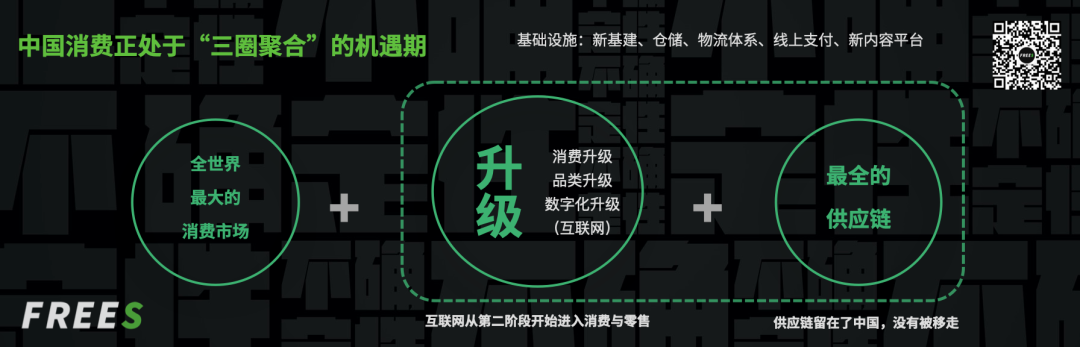
As shown in the chart, the logic of [world's largest consumer market + upgrades (consumption upgrade, category upgrade, digital upgrade) + most complete supply chain] applies to all industries.
Take smartphones as an example. What evolution did Chinese smartphones undergo? Before 2000, to transfer communications technology, foreign telecom companies and major Chinese firms established joint ventures, but they didn't effectively transfer core mobile communications technology to China. So starting in 1999, the state relaxed one license requirement — phone manufacturers could produce phones and even access the network — which drove the first wave of Chinese brands, the "fighter jets" of mobile phones. (Click the link to revisit "Feng Li's New Year Outlook | A Chart to See 2020 China Opportunities")
But those fighter jets didn't soar for too long before China's phone assembly capacity quickly became number one in the world. China exported assembly capacity globally, and from 2005 to 2008, shanzhai phones became active in the market.
Starting in 2018, Chinese production supply chains appeared in new types of assembly enterprises — for example, today the capital markets know well names like Sunny Optical, Goertek, AAC Technologies, and Lens Technology. This shift from simple manufacturing to precision manufacturing was an important change on the supply chain side.
Because of these changes, even during the poor US-China relations of 2018-2020, Apple's supplier weight in China still increased by nearly 20% for its most supply-chain-demanding, hardest-to-produce products. This came down to that upgrade in manufacturing.
Returning to demand: starting in 2012, China became the world's largest single market for smartphones because we had money and many upgrade demands, able to catch up with supply. And because of supply-side upgrades, in 2011 internet phones appeared — Xiaomi — followed by Huawei, VIVO, OPPO, and others.
As China is about to become the world's largest market and also has the most complete industrial chain, because both the industrial chain and the supply-demand market have become too large and too good, it has also become the world's most competitive market. From the competition between Xiaomi and Huawei, we can see what it means for the largest market to create the largest opportunity, and for the largest opportunity to produce the fiercest competition and the challenge of how to gain long-term competitiveness.
Additionally, we've done some traffic research. Although China has some super apps or platforms that are very powerful, the internet has proven in different directions that platforms ultimately cannot monopolize — or if they do monopolize, the result is that they start forcing platform innovation.
Today, another important change is happening on the internet: the traffic medium has changed. As people's time allocation shifts from text-and-image internet to video, we have irreversibly entered the video era. Data shows that time users spend on video has already surpassed IM.
Recently, the biggest change at e-commerce platform Taobao is that in the past two weeks, it restructured its homepage, moving "Guess You Like" to the top of the front page. This is a typical off-site traffic operation method, using very precise recommendation mechanisms.
In fact, all recommendation platforms are like this now. Douyin, Xiaohongshu, WeChat, live e-commerce — all of them. (Click the link to view FreeS Fund's e-commerce livestreaming album)
Looking at traffic structure and platform structure, the narrower your positioning, the more certain your product, and the fewer your categories, the better your launch factors from traffic may be. The reason is that what's being recommended is no longer store brands, but the relationship between products and products, so it skips the store brand layer and does recommendation directly. This is the biggest significance of Taobao's redesign — the more tags in its traffic structure, the more precise the positioning.
Similarly, if you look at information in your Moments feed now, you can hardly see what people with different lifestyles from yours are doing. In earlier internet media, whether forums or portals, you roughly knew what was happening in the world. Weibo may still serve this function to some degree. But as far as your Moments feed is concerned, you can hardly see what's happening in the world anymore — you can almost only see what people related to you are doing.
Current traffic and platform logic have become more product-oriented, especially for precise, niche, highly certain products, making it very difficult to break out of your circle. From platform logic to traffic structure to new sales methods, everything is very suitable for going from zero to one, but the bigger challenge is that breaking out is extremely difficult, because traffic structure, platform logic, and sales methods have all become unfavorable to breaking out of circles or demographics.
How to grow, how many of these zero-to-one companies can make money, and how many can make money from one to ten — these are all very challenging questions.
But the future is always bright. China will inevitably give birth to the world's largest international brands. We just used phones as one example; the new energy vehicle policy and boom happening these past few days — the future development path of new energy vehicles is actually similar to the mobile phone industry.
It looks beautiful now, but the process will be much more painful than before. The good news is that if someone makes it through, the result will be better, bigger, and more international than what you can imagine today.
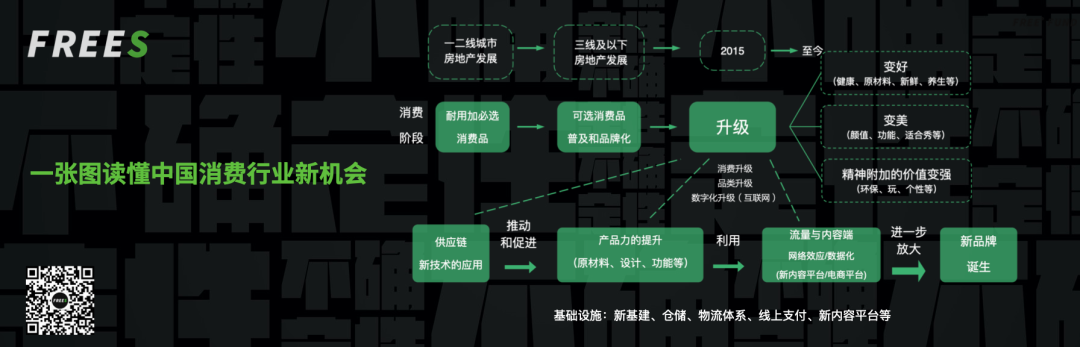
Finally, to summarize in one chart: recent consumer entrepreneurship all fits on this chart ("Surpassing Nestlé and Starbucks on 618, Rising to #1 in Instant Beverages: What Did Saturnbird Do Right? | FreeS Research Institute — Learning from Investment"). Consumer entrepreneurship more or less starts with innovation on the supply chain side, then product strength improvements get amplified, then further amplified through new media forms, and finally become brands with some moat.
October 31
Langchao New Consumption x FreeS Fund Consumer Closed-Door Session
On October 31 (Saturday), from 2pm to 6pm, Langchao New Consumption will partner with FreeS Fund to host a closed-door session on new consumption and new brands in Shanghai. We'll do a deep retrospective and discussion on the evolution of traffic/media platforms and the construction of core content capabilities for brands. We welcome founders and industry experts in the consumer sector to apply.
Questions we'll explore:
- As new media platforms continue to evolve, how should we think about these platforms' new value propositions and new opportunities for brand growth? How can brands replicate the growth engines of content platforms?
- How does content influence consumption decisions? Based on this, how should brands think about core capabilities they need to develop from product, operations, and user perspectives? Can the growth logic of new platforms like Douyin itself be applied to brands?
- When everyone is doing Douyin, Bilibili, and livestreaming, what are the truly sustainable dividends? How will the product and service forms of future new brands be built?
...
Details and agenda:
- Time: October 31 (Saturday), 2:00pm to 6:00pm
- Location: Shanghai (specific location to be notified separately)
- Size: Under 20 people
- Requirements: Consumer company founders and executives; applications subject to review
- Agenda:
- Self-introductions, one minute per person (20 min)
- Themed presentations + deep interaction with 2-3 outstanding founders and investors (1-1.5 hours)
- Topical breakout discussions + Q&A interaction (1.5-2 hours)
Scan the QR code or click "Read More" to apply

FreeS Report 17: What New Opportunities Will Emerge in the Ancient Jewelry and Accessories Industry? | FreeS Research Institute Surpassing Nestlé and Starbucks on 618, Rising to #1 in Instant Beverages: What Did Saturnbird Do Right? | FreeS Research Institute — Learning from Investment 2020: Consumer Entrepreneurship Enters an Era of Multiple Driving Forces | FreeS Research Institute Double 11 Mid-Game: What Did Zhong Xue Gao, Saturnbird, Zhi Guan, and Huasheng Haoche Do Right? The Category Logic Behind the Buzz — Taking Coffee Industry Investment as an Example Breaking Through for Startup Brands: From Traffic Thinking to Content Thinking | FreeS Research Institute From When the Wind Rises to When It Calms: Is E-Commerce Livestreaming a Feature or a Business Model? (Part 1) | FreeS Research Institute Where Is the Endgame of E-Commerce Livestreaming? | FreeS Research Institute