Going live tonight at 8:30 PM | A conversation on opportunities and trends in the brain science industry

See you at 8:30 tonight.
"FreeS Fund Dialogues" Biomedical Livestream Series, Episode 1: Embracing the "Smartest" Trend: Opportunities and Trajectories in Brain Science goes live tonight at 8:30 PM. Robert Wei, co-founder and CEO of NeuCyber Brainnetome, will join Rui Ma, partner at FreeS Fund, for an in-depth conversation.
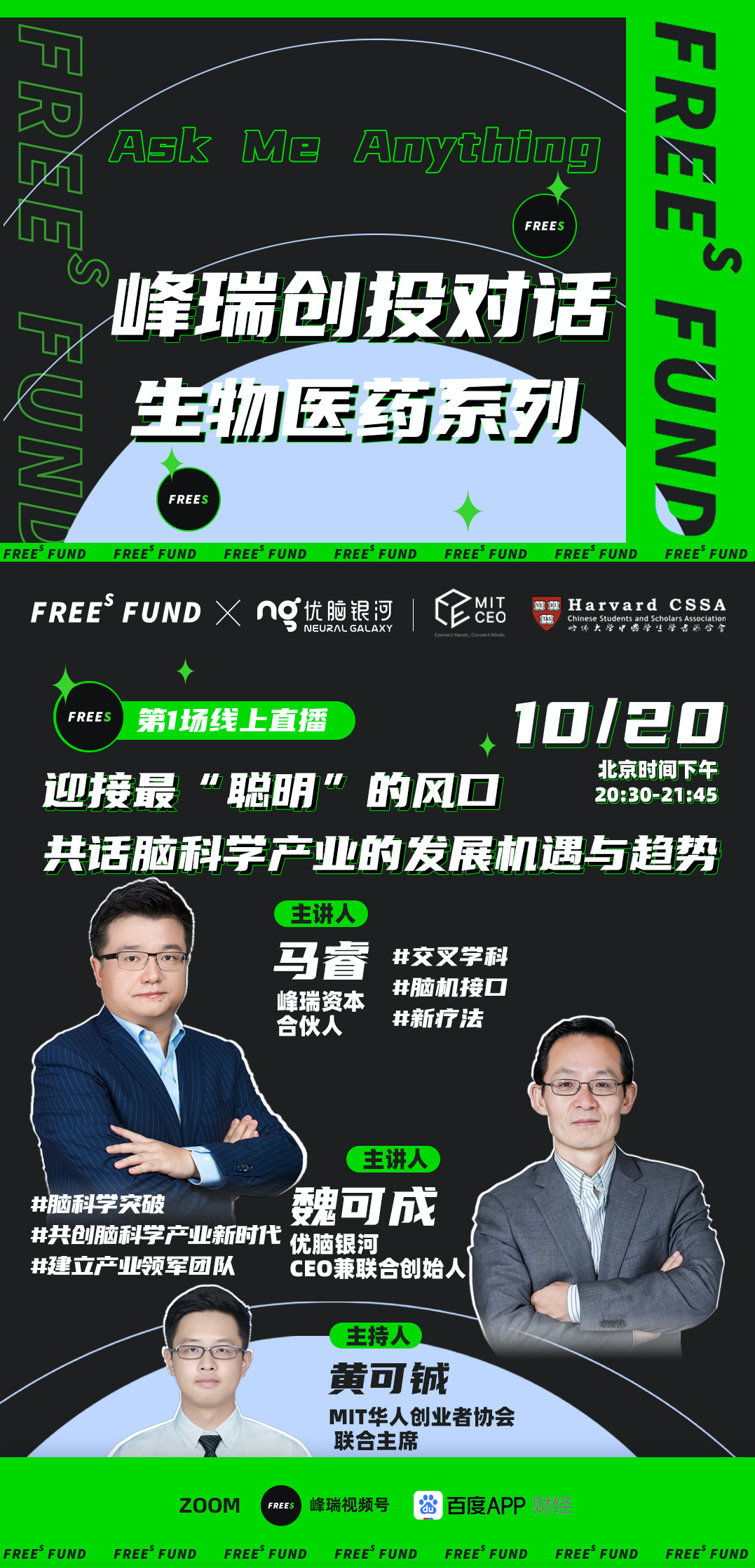
▍Topics they'll cover include:
- How to assess the development prospects of the brain science industry, and what are the similarities and differences between China and the US?
- What distinguishes Elon Musk's brain-computer interface work from what NeuCyber Brainnetome is doing?
- How does FreeS Fund position itself in the brain and neuroscience space, and what investment logic does it follow?
- How did NeuCyber Brainnetome evolve from a platform technology to clinical applications, and potentially to self-operated rehabilitation services in the future?
- Why has NeuCyber Brainnetome's technology been able to advance to clinical stages so quickly, even showing preliminary clinical results for some major diseases with no existing treatments? Can moving away from a molecular biology focus truly solve brain disorders?
▍How to Watch
Tune in via Zoom, Baidu Finance, or FreeS Fund's WeChat Channels. Details for each platform below:
01 Zoom
We've sent out the first wave of Zoom webinar invitations by email. A limited number of spots remain — scan the QR code to register and join the Zoom room for live interaction with our guests. Please also check your inbox for the participation link.
Scan to register 👆
02 Baidu Finance Livestream
Tonight at 8:30 PM, scan the QR code in the image below to watch the livestream in the Baidu app.

Scan to reserve your spot on Baidu 👆
If the link doesn't open after scanning, press your phone's back button to access the livestream page.
03 WeChat Channels Livestream
Click the reservation button above to book your spot now — Channels will send you a reminder when we go live. Return to Channels at 8:30 PM tonight to watch.

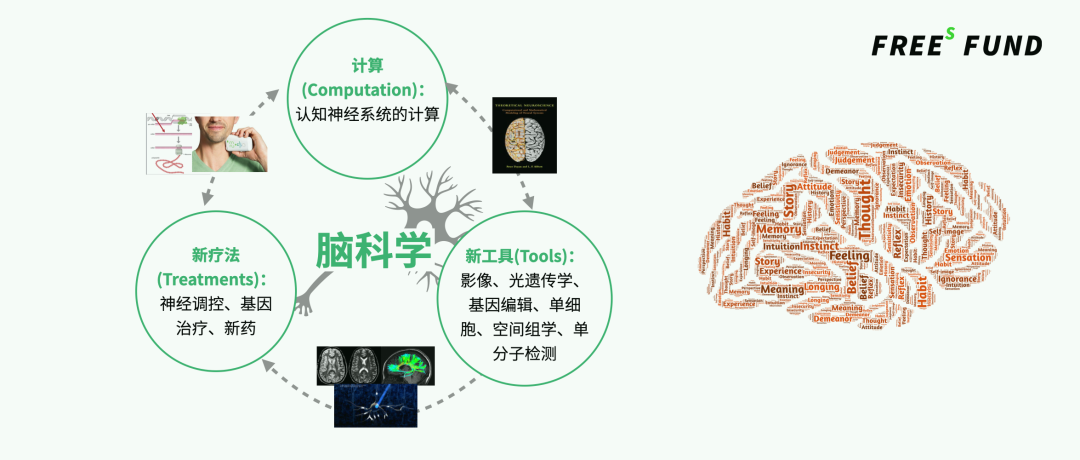
Key points from FreeS Report 24 | Embracing the "Smartest" Trend: Investing Boldly in Brain and Neuroscience, a report on brain science by FreeS Fund partner Rui Ma:
- The brain is humanity's most important organ, yet our understanding of it remains remarkably limited. As global aging accelerates, the unmet clinical demand for CNS (central nervous system) diseases is enormous, generating excess healthcare burdens and rising social costs — while targeted drugs and therapies have seen little progress for years. The root cause lies in our limited knowledge of the brain itself. Thus the central mission of brain science is to understand the brain's fundamental mechanisms; key directions include brain cognition, brain disorders, and brain intelligence. Brain science is becoming the next frontier in advanced technology, and the longest, widest "snow slope" for investment.
- Over the past decade, new tools and interdisciplinary technologies have significantly advanced brain science research. These include imaging technologies, gene sequencing, proteomics, single-cell sequencing, single-molecule detection, optogenetics, gene editing, gene therapy, nucleic acid drugs, brain-computer interfaces, neuromodulation, nanomaterials, and neural electrodes. Breakthroughs in these technologies will bring paradigm shifts to the field. R&D and measurement tools enable faster, better datafication of the CNS and neurobiological processes. Neural cell modulation technologies (such as optogenetics, synthetic biology, and stem cells) allow the study of relationships and functions between different brain regions to move from correlation to causation. As datafication gradually deepens, computational cognitive neuroscience will become essential infrastructure for clarifying questions of consciousness and mind.
- The next decade will be a golden period for developing innovative drugs and therapies for CNS diseases. Risk genes for most CNS diseases will likely be discovered; using gene editing and non-human primate models, human understanding of disease mechanisms will continue to deepen. More brain networks and neural circuits related to brain disorders will be identified, along with new targets for circuit modulation. New neural biomarkers will also help subtype patients with the same disease but different heterogeneity. Moreover, new treatment modalities represented by gene therapy, stem cells, digital therapeutics, and neuromodulation will be introduced to the brain disease field. New targets, more precise patient stratification, plus novel treatment methods will bring new incremental value to CNS disease diagnosis and treatment.
- In the short to medium term, brain-computer interfaces face difficulties for true clinical medical applications due to the technical complexity of invasive implantation, risks of scar tissue formation and immune response, and unknown long-term safety of electrodes implanted in gray matter. But in the long term, brain-computer interfaces represent one of the most important directions and a platform technology in brain science, providing a critical engineering interface for accessing the brain that can integrate future modulation tools, measurement technologies, computational decoding methods, and the latest electrode materials and chips. Once deployed at scale, the data provided by brain-computer interfaces will undoubtedly enhance our understanding of the brain, ultimately achieving seamless human-machine connection.
- Although investing in CNS disease drugs carries very high failure rates and risks, brain and neuroscience has quietly become a hot area for entrepreneurship. In the US, VCs are making bold moves in brain science; in China's primary market, investment interest in brain science is also growing. FreeS Fund persists with early-stage investment in brain science, focusing on new tools, new therapies, and new computation around brain cognition, brain disorders, and brain intelligence, seeking non-consensus opportunities.
Star-follow FreeS Fund's WeChat official account for first-hand industry research.
