Our Past 100 Days: Sailing Against the Wind, Growing Toward the Sun

Venture Capital's Pandemic Fight: A Chronicle
The start of 2020 was brutal. The fallout from COVID-19's global spread exceeded almost everyone's expectations. Economies worldwide took a hit, startups faced challenges that could only be described as "unprecedented."
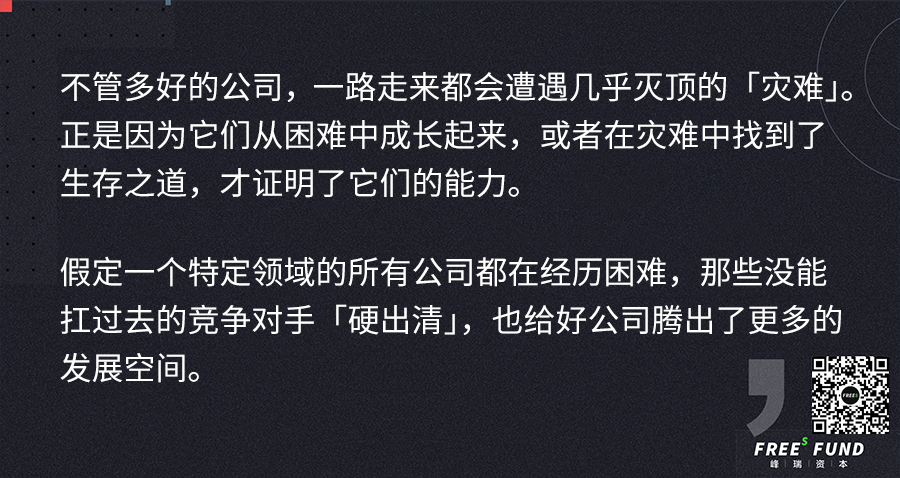
But zoom out on the timeline, and it wasn't that bad. We may be biased, but we believe great companies are born in bad times. And no matter how good a company is, it will face near-existential disasters along the way.
It's precisely because they grow through hardship, or find ways to survive catastrophe, that they prove their mettle. And if every company in a given sector is struggling, the competitors that don't make it — the "hard clearing" — create more room for the survivors to grow.
During this pandemic, we've watched many FreeS Fund portfolio companies turn crisis into opportunity. Here's what they've experienced over the past 100 days, and our story too. It's a microcosm of how Chinese startups and early-stage investors have responded to the crisis.
The past 100 days, us and our portfolio:
- Portfolio companies: 25 completed new funding rounds, raising RMB 1.68 billion in total
- Fundraising: FreeS Fund's RMB Fund II closed with oversubscriptions
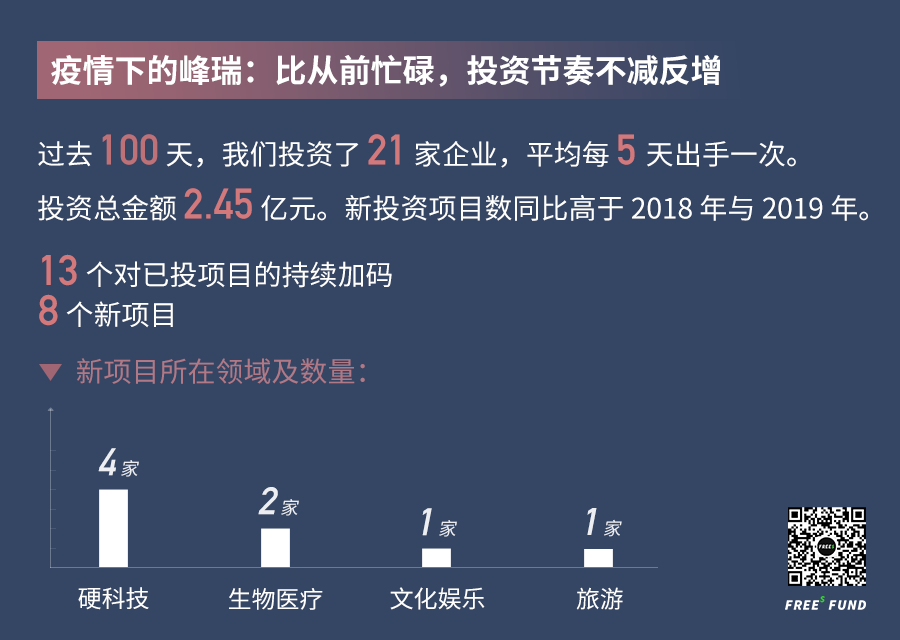
- Investing: 21 deals, including 13 follow-on investments in existing portfolio companies and 8 new investments, deploying RMB 245 million
- Exits: Two exits realized

/ 01 / How Did FreeS Portfolio Companies Fare in COVID-19's "Stress Test"?
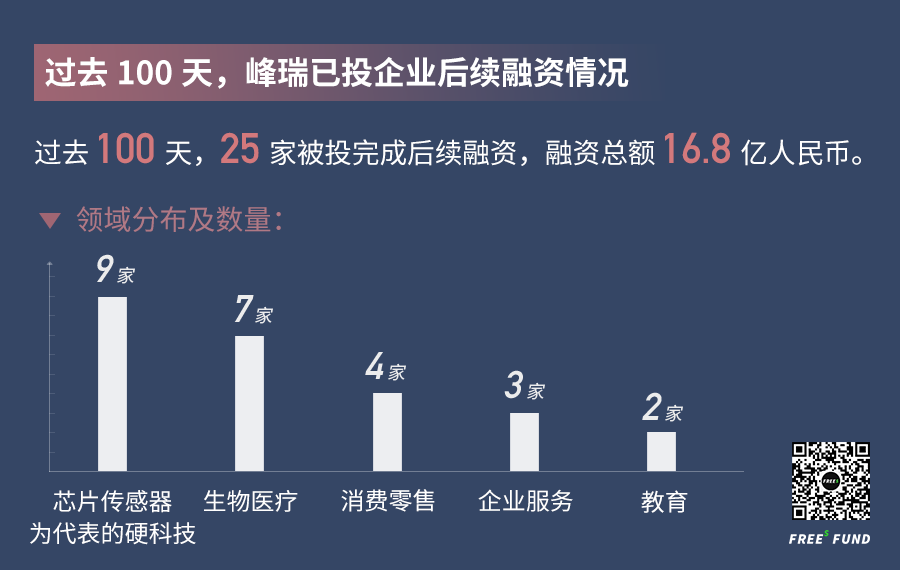
▍Follow-on Funding: 100 Days, 25 Companies, RMB 1.68 Billion Raised
Over the past 100 days, nine chip and smart manufacturing-related hard tech projects — including Qingtao Development, Shenzhen Hande, Lightelligence, Yifei Automation, and XinYi Information Technology — completed follow-on rounds. Seven biotech and healthcare companies, including Nuoxin Chuanglian, METiS Pharmaceuticals, Bluepha, and Changmugu Medical, also secured new funding. Additionally, four consumer retail companies, three enterprise service firms, and two education companies closed new rounds.
These 25 projects raised RMB 1.68 billion combined. Beyond the funding numbers, let's start with the sector hit hardest by the pandemic — consumer retail.
▍Consumer: Counter-Trend Growth and Stubborn Resilience
The pandemic disrupted offline operations for consumer businesses and shifted consumer psychology. FreeS's key internet consumer investments all had online operations, so they weren't devastated, but smooth online execution still depended on offline production and logistics. Consumer companies felt the impact broadly.
Still, we saw some companies grow against the headwinds.
WonderLab, a meal replacement shake brand, was a standout. Setting aside the rising health food trend, the founding team made one crucial move — they stockpiled heavily before Chinese New Year. There was no pandemic yet; they simply anticipated post-holiday fitness and weight loss demand. When COVID hit and people stayed home with little exercise, demand for meal replacements surged. When that demand ignited, WonderLab was one of the few companies with inventory to ship. And the team hustled. In mid-April, founder Xiaoguoxiao Xiao posted on WeChat Moments: "Nine weeks since official work resumption, and we've been on business trips for eight of them."
Winter and early spring are traditionally terrifying seasons for ice cream founders — the acknowledged off-season. In Q1 2020, Chicecream (Zhong Xue Gao) grew sales 1,000%, beating the market and competitors. Partly, "pandemic宅" drove ice cream consumption as users migrated online. But founder Sheng Lin noticed that online traffic growth wasn't "sunshine for all" — it flowed to category leaders. His takeaway: build your brand properly, so when external conditions shift, your brand can catch the wave.
Xinliangji, a foodservice company previously focused on B2B, supplying pre-made aquatic products like crayfish to restaurants, was collateral damage when dining took a hit. Fortunately, its B2C business exploded — 100% growth versus pre-Chinese New Year, with April B2C revenue exceeding RMB 30 million. It also caught Yonghao Luo's e-commerce livestream debut, winning that day's sales championship with nearly RMB 20 million in sales.
Three Squirrels' offline business couldn't escape COVID's impact, but multiple measures stabilized operations and delivered year-on-year revenue growth. Per its Q1 report, revenue reached RMB 3.412 billion, up 19%. The company also launched internal "second startups" during the pandemic, creating four sub-brands covering instant food, baby food, pet food, and wedding supplies.
Ordinary Power: Three Squirrels' entrepreneurship documentary
More founders simply persisted and pushed forward through adversity.
Wedding service platform Vivan's 2020 had started promisingly — orders were double the previous year's. Then the pandemic arrived, mass wedding postponements followed, and cash flow came under severe pressure. Yet Vivan didn't cut jobs or salaries. Instead, it raised pay, hired more people, and accelerated internal training optimization and customer acquisition improvements.
In auto new retail, the pattern was suppression first, recovery after.
Take two FreeS investments — Huasheng Haoche and Shima Chuxing. The auto industry had already been in a downturn for over a year; COVID then hammered their offline operations in the short term. But both actively explored new channels and models, finding new opportunities within them.
During the pandemic, Shima Chuxing formed a joint venture with a Fortune 500 central SOE and closed new funding. Huasheng Haoche saw short-term order impacts at some offline stores, but quickly adjusted strategy, significantly improving sales management efficiency and online traffic acquisition. By mid-March, 92% of Huasheng's national directly-operated stores were open. Transaction volume has now nearly returned to pre-pandemic levels.
▍Cross-Border Commerce: Temporarily Besieged, But Medium-to-Long-Term Opportunities Ahead
When China was first hit, export e-commerce companies suffered production and domestic logistics disruptions, desperate for supply. When the pandemic spread abroad, they faced demand collapse and fulfillment fears — international logistics was a brutal bottleneck. Besieged from within and without: that was the short-term reality.
But longer-term, cross-border e-commerce platforms would actually gain.
First, every manufacturing enterprise that survived this year, big or small, desperately needed export orders. This was the moment for cross-border platforms to court major factories, using it to upgrade supplier quality.
Second, with international travel now difficult, traditional foreign trade relying on face-to-face dealmaking would suffer more. E-commerce platforms became critical alternatives — an advantage for new online platforms.
Take Club Factory. When China's outbreak peaked in February, it could barely export to India, selling mostly from local Indian merchants. By March, Chinese supply recovered and factories were desperate to export; meanwhile India became a new epicenter, locked down, offline shuttered, with online operations permitted. Even with imperfect logistics, users were "driven" online faster — a tailwind for platforms like Club Factory. The company also began experimenting with B2B e-commerce during the pandemic.
PatPat, a vertical母婴 cross-border mobile e-commerce exporter focused on the US and Europe, saw customs restrictions at US ports and supply chain disruptions. March sales plunged; by early April, they hit record highs, with children's clothing a high share. One factor: as Europe and America implemented isolation policies, consumers stuck at home spent more attention on their children. And with most offline malls closed, even with delayed e-commerce logistics, users proved more patient than before.
Cross-border complexity also affected DTC beauty brand JUNO & Co. After going viral in America, it entered China in 2019. The founder candidly admitted new product development fell one month behind schedule. But remarkably, because JUNO & Co.'s production and website operations are in China, they're among the few American-market companies still shipping normally. Website sales doubled expectations, and Target store orders surged.
▍Hard Tech: Hardcore Enough to Be Pandemic-Proof
Looking at hard tech companies — comprising one-third of FreeS's portfolio — most proved pandemic-immune and achieved growth. We noted earlier that nine hard tech companies closed new funding rounds during this period.
We witnessed technology's universality and startups' adaptability.
As we previously covered, industrial robot maker Yifei Automation rapidly developed an automated intelligent mask production line, achieving fully automated processing of disposable medical and surgical masks. Yifei recently completed new funding.
"Machine Phoenix Nirvana": Shandong TV's special interview with Yifei Automation founder Sai Zhang
Beyond Yifei, more companies incorporated pandemic response into their business scope. Their disinfection robot chips, quarantine monitoring terminals, and other products were effectively deployed for outbreak control.
In 2020, Zhaoguan Electronics formally launched its N-series AI vision chips for security, access control, home cameras, and other applications. During the pandemic, it received orders for nearly 10,000 disinfection robot core components, with triple-digit sales growth.

Zhaoguan Electronics founder Xinpeng Feng interviewed by Dragon TV
On April 9, XinYi Information Technology won China Telecom Group's 2020 NB-IoT module bidding. NB-IoT chip-based quarantine monitoring terminals developed with XinYi's technology were widely deployed by the three major telecom operators across Zhejiang, Shaanxi, Shanghai, Jiangsu, Hebei, and other provinces for outbreak control — addressing the limitations of traditional quarantine methods dependent on manual patrols and monitoring, which were costly and difficult to scale rapidly.
SoundAI's visual AI voice elevator solution was selected by the Ministry of Industry and Information Technology for its "AI-Powered Epidemic Prevention and Control Key Materials List." By end-March, the solution had deployed across 18 provinces and municipalities. In March, SoundAI also became one of China's first acoustic front-end software suppliers to pass Amazon Alexa Qualification certification.
On March 6,加特兰微电子 received ISO 26262 functional safety management certification from TÜV Rheinland, making it one of only two Chinese semiconductor chip design companies with this certification.
During the pandemic, Hande Technology hit record highs for installations and revenue. Founder Shaoguang Miao reported that March and April vehicle activations on the Hande platform were triple year-ago levels; April was their highest installation month since founding.
We believe post-pandemic, digitalization across industries will accelerate significantly; automation will increase, and AI deployment will speed up. In this process, low-value-add enterprises with poor cash flow, weak pricing power, and bad inventory control will be eliminated. Additionally, pandemic-stimulated "new infrastructure" industrial policy, combined with China's established industrial chains and circulation efficiency, will jointly improve supply-demand matching.
Holiday Recommendation
On the new infrastructure topic, we'd like to recommend Feng Shu's free course on Dedao: China's Industrial Landscape: Li Feng's Hypothesis. This course is based on Feng Shu's April 28 livestream. Please hit "Like" at the end of this article, and reply with keyword "新基建" in our WeChat official account backend for one-click access to video, full transcript, and PPT.
▍Healthcare: Broadly Positive, Long-Term Bullish
In global public health crises like this pandemic, healthcare is on the front lines. Predictably, technology innovation projects related to epidemic detection and medical diagnosis generally improved during this period.
Kayoudi developed a rapid on-site COVID-19 nucleic acid testing platform on January 20, 2020. After aiding Hubei's outbreak response, its self-developed COVID-19 test kit has recently been exported to multiple overseas countries.
Singleron's single-cell sequencing technology and database were repeatedly applied to research on COVID-19's potential pathogenic mechanisms, antibody screening, and highly sensitive virus detection, in collaboration with Fudan University-affiliated Huashan Hospital, Xiangya Hospital, and Wuhan Huoshenshan Hospital.
Lukon Medical partnered with US industrial purchaser MSC to procure masks and other medical protective materials, with March-April revenue exceeding RMB 100 million.
Second, with people avoiding hospitals during the pandemic, online transformation of medical services and pharmaceutical distribution found its moment. Take Nuoxin Chuanglian, China's leading pharmaceutical data service provider — through one online event, it gathered over 1,000 pharmaceutical industry professionals and converted tens of millions in sales leads.
Additionally, highly internet-enabled healthcare enterprises not dependent on offline operations were less affected.
Wuhan-based Chemintelligence, at the pandemic's epicenter, minimized impact. Since its work is data-oriented, the company transitioned to remote work without project delays. Client communications naturally moved online, and it locked in two major clients during the pandemic.
Cross-border companies faced relatively tougher circumstances.
Affected by the pandemic and China-US flight suspensions, NeuBays (Younao Yinhe)'s core team was stranded in the US. But the team worked to expand American cornerstone clients, launching collaborations with multiple hospitals and research institutions in March-April to provide brain detection and individual brain mapping SaaS services — offering new pathways for neural circuit mechanism explanation and treatment guidance for projects targeting psychosis, OCD (obsessive-compulsive disorder), and drug addiction.
Biotech and healthcare now comprise one-third of FreeS's portfolio. We're long-term bullish on the sector and believe the pandemic will accelerate its development. Post-pandemic, public attention to life and health will increase, and national healthcare systems will strengthen protective infrastructure.
Enterprise Services: Cost-Saving, Efficiency-Improving Services and Applications Stand Out
Post-pandemic, remote work and online collaboration are no longer foreign concepts. Through user experience, exploration, and inevitable comparison, services and applications that both cut costs and boost efficiency are standing out, driving changes from technology to application layers in this space.
Lightspeed (Guangsu Yilai) launched real-time bidirectional data transmission acceleration services, applicable to audio-video transmission solutions, video conferencing performance enhancement, and remote collaboration system optimization — targeting the familiar pain points of unstable video calls and network lag.
Modao, a remote collaboration tool for product managers, was already profitable with substantial user base, and climbed another level during the pandemic. Intelligent background check service iBeidiao achieved 200% paid client growth in Q1 2020.
Shangyue, an intelligent company providing digital procurement solutions for enterprises, moved fast these three months — announcing its Series A, launching new product "Juxiange" open platform, and signing major clients.
Education: Pure Online Education Companies Actually Improved Under COVID-19
As we previously noted, the pandemic "forced conversion" of some highly professional, high-barrier, low-frequency, high-value applications — including online education.
Our online education investments all climbed to new heights during the pandemic.
By early April, Onion Academy had served over 10 million middle and elementary school students and 500,000+ public school teachers in roughly two months — DAU increased 10x versus the same period's peak, with monthly active users reaching 7.9 million.
Over the past three months, Deer Music achieved double-digit compound monthly growth rates, with revenue up 10x. Founder Yipei Xiang attributed growth partly to the pandemic beyond winter vacation's natural peak season. With offline music training temporarily suspended, users migrated online. Once they tried the product, discovered value, and liked it, they stayed.
Shanbay grew overall too. Despite delayed registration for various English exams due to COVID-19 hurting its exam prep business, its quality English and coding businesses saw substantial growth.
Shaonian Dedao (Juvenile Dedao) also achieved leapfrog growth. Chairwoman Quanling Zhang described the company rapidly adjusting to deliver education services: "Every day was like battle." Starting Chinese New Year's fourth day, they began information flow ad placements; day five, their first conversion class. They polished technical systems for online course characteristics, processes, and services, bringing the entire service flow online to ensure smooth online teaching completion.
What demands reflection and discrimination: all online education companies grew during the pandemic, but which will gain long-term user favor and retention post-pandemic, and why? And which were merely阶段性 educational solutions for the pandemic period?
Entertainment: Significant Growth, Stay-at-Home Economy a Long-Term Positive for Online Entertainment
During the pandemic, entertainment saw a new mini-peak, mainly because users spent more time on cultural entertainment.
Wuhan-based animation studio 2:10 Animation released productions and took new orders during the outbreak — including ad animation shorts for gaming companies, meaning it also benefited from gaming's pandemic boom. These achievements came from organizational adjustments ensuring remote work implementation and constant efficiency pursuit.
Trapped City: 2:10 Animation and Buyao Music's pandemic collaboration
Medium-to-long term, we believe the stay-at-home economy will gain new life. You may find that unable to go out, many people discovered home entertainment methods — non-gamers started gaming, non-reality-show watchers started watching, gym-goers followed livestream workouts at home... Hard to quantify, but we believe the stay-at-home economy benefits online entertainment, as both user base and time spent are increasing.
FreeS Under COVID-19: Busier Than Ever, Investment Pace Accelerated Rather Than Slowed
Friends from various industries periodically ask: how much has the pandemic affected your investing? Has the primary market ground to a halt? Our answer has consistently been: not at all.
Here's FreeS over the past 100 days.
Fundraising: Oversubscribed, Sustained Support
Since early February, nearly 10 institutions conducted due diligence and advanced investments. Beyond coordinating LP remote communications and DD, our fundraising team overcame difficulties and pressure to travel and meet in person. During the pandemic, FreeS completed oversubscribed fundraising for RMB Fund II. Our LPs include well-known professional institutions that have long trusted and supported us.
This year, FreeS will also launch fundraising for RMB Growth Fund II and USD Early-Stage Fund II.
Investing: 100 Days, 21 Deals, Identifying "Good Companies" Emerging Across Industries Under COVID-19
February 5, Beijing's first snow melted to sunshine; we were still remote. Four colleagues visited the first post-holiday project — masked, socially distanced pitch meetings were a first for us too. February 10, we returned to the office.
Despite the difficulties, to better understand and judge projects and complete due diligence, investment team colleagues nearly all traveled.
Founders also worked to overcome pandemic impacts. One newly-invested startup CEO drove nine hours from out of town to meet us in Beijing for two-plus hours in mid-February. We confirmed investment intent on the spot; he drove nine hours back home.
As a result, FreeS's investment pace actually accelerated. Over 100 days, we completed 21 investments, including 13 follow-on investments in existing portfolio companies — meaning we deployed roughly every five days. Per Qimingpian's latest Q1 2020 most active institutions ranking, FreeS Fund ranked in the top 15 early-stage investors.
New investment count over the past three months was slightly above 2018 and 2019 comparable periods. New project distribution: hard tech (4), biotech/healthcare (2), cultural entertainment (1), travel (1).
Yes — we made a counter-cyclical investment in a travel internet project during the pandemic. Even with travel devastated overall, we believe post-pandemic competitive dynamics and user behavior will shift and change — an industry inflection point. In February, the investment team re-discussed and researched this direction and project, ultimately deciding to invest with March closing.
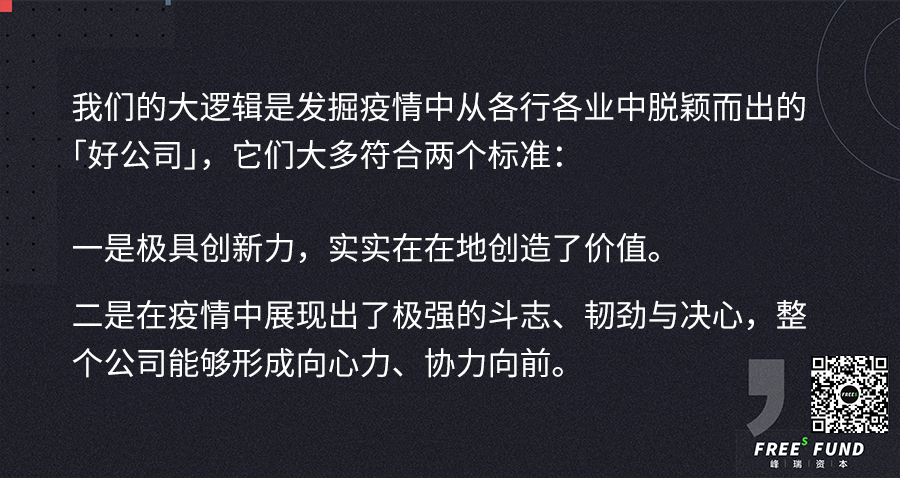
Our broad logic: identify "good companies" emerging across industries under COVID-19. They mostly meet two criteria: first, genuinely innovative, creating real value that we believe is long-term; second, demonstrating exceptional fighting spirit, resilience, and determination during the pandemic, with the entire company unified and pushing forward together.
Exits: One Full Exit, One Partial Exit
During the pandemic, we also completed two exits. One partial exit returned 15.69x; the full exit returned 4.47x.
Portfolio Support: Mutual Watchkeeping
FreeS's active portfolio CEO group became even more active during the pandemic. Founders needed this organization for mutual support more than ever. In the CEO group, founders shared anxieties and challenges, debated opportunities and inflection points. Our interactions with founders grew more frequent than before, and we helped portfolio companies from strategy, funding, and resource connection perspectives.
Founder anxieties also drove us to deeply consider: what impacts has the pandemic had on China and the world, and what long-term changes for the venture capital industry? Based on this, we shared multiple in-depth articles externally, analyzing our thinking on current macro environment and meso-level industries, hoping to help clarify new opportunities post-pandemic. Entrepreneurship is hard; we're in this together.

So you see — the venture market hasn't stopped, despite real difficulties. And we always believe the best gift for the future is to seize the present.
Holiday Recommendation
On April 28, FreeS Fund founding partner Li Feng's livestream on Dedao is now available as seven free mini-courses. Search "Li Feng" on the Dedao app for the course titled China's Industrial Landscape · Li Feng's Hypothesis.
You can also hit "Like" at the end of this article and reply with "新基建" in the FreeS official account backend for one-click course access: video, full transcript, and PPT. Happy holidays!

Where Does E-Commerce Livestreaming End? | Frees Fund
What Did Minister Miao Wei Actually Say About Chinese Manufacturing? | Frees Fund
One Chart to Understand Globalization or Deglobalization | Li Feng Column
After the Pandemic, the New Era of "Good Companies" | Frees Fund