The AI Hardware Opportunity, Seen Through Four Decades of Silicon Valley PC Innovation

Born in hardware, thriving in applications, and maturing into an ecosystem.
November 5 saw a significant personnel shift in consumer hardware: Caitlin Kalinowski, head of Meta's AR glasses division, officially joined OpenAI as head of robotics and consumer hardware. Media commentary noted that "this signals OpenAI's ambition not merely to dominate software, but to redefine the future of human-computer interaction through hardware products."
AI-powered hardware products have already begun appearing in the market. With tech giants entering the fray, what changes might this bring? What factors truly shape the trajectory of consumer hardware development? What advantages would allow a piece of hardware to stand apart and avoid direct competition with dominant general-purpose devices like computers and smartphones?
To borrow a phrase from Bridgewater founder Ray Dalio: "History doesn't repeat, but it often rhymes." Perhaps we can find some guidance for today's AI hardware innovation in the entrepreneurship and innovation of early Silicon Valley hardware and software companies.
Pan Xinlei, founder of Ice Whale Technology, has studied the history of the hardware industry in depth. After examining 1980s chip innovation, the birth and penetration of PCs, and the evolution from DOS to Windows 1.0 between 1980 and 1990, he identified four critical factors—chips, operating systems, applications, and human-computer interaction methods—that iteratively advanced and reinforced one another, profoundly shaping the ecosystem evolution of the PC industry.
Returning to the present, the emergence of large AI models has transformed these four elements. At the chip level, GPUs and TPUs have continuously expanded computing power. At the system level, large models may gradually merge with operating systems themselves. At the terminal level, proprietary data generated through user-device interaction becomes more valuable. Changes in the first three elements will also catalyze new applications. We may witness the birth of an entirely new class of memory-compute integrated devices—ones whose future standing may differ from that of phones, laptops, or even public clouds.
We've edited Pan Xinlei's internal sharing session at FreeS Fund into this article, with investment reflections on the AI hardware sector from FreeS Fund investor Meng Changjie appended at the end, hoping to offer fresh perspectives.
Reader Giveaway In the consumer hardware space, what interesting innovations have you seen or are you hoping to see? Share with us in the comments. We'll randomly select 5 readers to each receive a FreeS Fund research handbook.
/ 01 / The Rise of PCs, the Information Revolution, and the Four Elements of Hardware Development
The 1980s and 1990s marked the first decade of PC ascendancy. The industry's development can be simply summarized as: born in hardware, flourishing in applications, maturing in ecosystem. In the first half of this period, breakthroughs in chip technology, the launch of the IBM PC, and the proliferation of productivity applications like WordPerfect drove vigorous growth. In the second half, GUI (graphical user interface) and graphics applications rose to prominence. Through intense competition, Microsoft gradually became an "ecosystem-level player," with Office eventually absorbing products from the application layer and laying a solid foundation for the second growth curve of 1990–2000. In examining PC hardware development, I identified four critical factors: chips, operating systems, applications, and human-computer interaction methods. These factors continuously evolved and reinforced one another, profoundly shaping the ecosystem evolution of the PC industry.
Silicon Valley in the 1980s: A Constellation of Stars
Today OpenAI, Google, and Microsoft are defining the "Intelligence Era" built on large models. If we return to the early days of the "Information Era" established by the birth of the PC in 1976, we arrive at the moment of the Apple I's creation. This computer was released by Steve Jobs and Steve Wozniak in a geek community called the Homebrew Computer Club, priced at $666. The Apple I's launch in that community was comparable to a new product crowdfunding campaign on Kickstarter today. The computer targeted only geek users, required manual assembly of parts, and sold barely 200 units in its early days. Yet this product laid Apple's foundation, helping Jobs and his team accumulate their first seed users.
Apple followed in 1977 with the Apple II. This generation featured a more refined exterior, added color display, expansion slots, and an integrated chassis that made it easier for geeks to extend and DIY—though other core specifications didn't change much. The Apple II's release was a milestone, priced at $1,250, far below the expensive commercial computers of the time. Four years later, IBM's move proved somewhat intriguing. Reportedly pressured by market competition, IBM dispatched a lean 12-person team to launch a project codenamed "Project Chess" with the posture of an industry leader. As the leading enterprise of the era, they naturally needed to make a resounding statement. They introduced the IBM PC. Based on Intel processors and adopting an open hardware architecture, IBM's move was undeniably epoch-making, defining the open standard for the entire PC industry and opening the door for all other manufacturers to produce compatible equipment. From this perspective, Facebook's later decision to open Oculus designs to third-party manufacturers seems to follow similar logic.
The other side of the story: IBM's system partnership with Microsoft also planted seeds for later developments. One of the internet's most important ecosystems today—the Wintel ecosystem (built on Intel chips and Windows systems)—originated here, though IBM gradually "faded from the narrative," which I'll expand on below.
Returning to 1980s Silicon Valley, Commodore International is also a company worth noting, even if it didn't go the distance. In its early days, it employed several key strategies. In 1982, it launched the Commodore 64 at $595, positioned as high-value. This product featured leading graphics and audio processing capabilities for its time and was well-received by users. Meanwhile, Commodore looked beyond America, prioritizing expansion into European markets. Leveraging local distribution networks and advertising in Europe, the company at one point derived over half its revenue from the continent, laying solid groundwork for capturing the global home computer market.
How did Apple, IBM, and Commodore International manage to drive personal computer prices down? The key was chips. Undeniably, chips are the foundation of PC products, just as NVIDIA and cloud platforms today have propelled OpenAI. PC development depended on continuously declining chip costs and "just right" computing power. Only when computers became suitable for users and appropriately priced could they reach the mass market.
The Intel 8088 chip used in the earliest IBM PC exemplifies this. The 8088 adjusted bus width compared to its predecessor, the 8086, enabling cost reduction that made it the core chip for the IBM PC.
An interesting detail: early 8-bit PC processors were completely outmatched by today's ARM processors, roughly equivalent to the displays on your refrigerator or microwave. In other words, 1980s computers actually operated at the computational level of your home appliances. Looking back, early computers weren't as powerful as people imagine, yet they laid the groundwork for the entire PC industry and internet development.
At the time, IBM's flagship commercial and military computing equipment was massive and relatively powerful, but facing the personal PC market, perhaps such "hardcore" specs weren't necessary—IBM chose a "dimensionality reduction" approach. The 8088 lowered specifications by just the right degree, delivering balanced computing power at lower cost. The 8088 chip resembles today's NAS in some ways, simplifying commercial servers into computing power and form factors more suitable for home use, giving individuals access to small-scale computing solutions.
If NVIDIA's H200 is today's commercial leader, then who is developing the ASIC chips that will bring AI PCs or AI NAS with models into various computing terminals? I've observed that in the AI chip space, FreeS Fund has invested in several companies dedicated to developing next-generation computing chips for large model scenarios.
Regarding user community building, just as today Reddit hosts numerous subreddits around large models—ChatGPT, LocalLLM, Stable Diffusion—every era's early days see remarkable talent and ideas emerging from online and offline communities. This isn't unfamiliar in China either: when the early internet arrived, many future leaders went to Shenzhen and immersed themselves in BBS forums before dispersing into various industries. Today, Tsinghua-affiliated entrepreneurs have created similar online and offline spaces around large models.
However, something important and interesting is that these communities tend to gradually disappear over a decade-long development process. Their "destiny" is to flourish intensely when innovation is active, then fade as the industry matures and giants emerge. The Homebrew Club, as well as today's model industry, 3D printing, and quadcopters, all follow this "rise then retreat" pattern.
The Evolution of Systems: Every Generation Claimed a "Friendly User Interface"
While chips elevated PCs at the hardware level, operating systems reshaped them at the software level.
Just as today essentially only algorithm engineers can "fine-tune" models, around 1979 only some ten thousand Silicon Valley engineers were tinkering with DOS (Disk Operating System, a class of operating systems for personal computers). At that time DOS was entirely command-line based, with no graphical interface. Operating systems were far from penetrating enterprise and mass user daily workflows.
It wasn't until 1981, with IBM's first-generation PC launch, that DOS gradually gained more attention—though it remained a command-line version without GUI. So the computing landscape then resembled AI today: requiring numerous technical geeks and engineers to repeatedly adjust and integrate before concrete applications could emerge.
What truly brought PCs and operating systems to enterprises was Xerox's release of the "Xerox Star"—the world's first commercially viable GUI computer. It featured bitmapped screens, graphical interfaces, a mouse, and email access. GUI brought PCs their first wave of mass user growth.
In 1984, Apple's GUI further extended usage scenarios into creative and education segments, pushing operating system adoption further toward the masses.
Notably, during PCs' first decade, DOS and GUI systems coexisted for a long period. Many PC companies had to maintain both systems simultaneously to serve different scenarios. DOS and GUI shared the same purpose—device operation—but targeted different audiences. The former used commands, was more lightweight, and targeted professional users; the latter used graphical interfaces and was more mass-market oriented.
Early Application Ecosystems of 1980: What We Now Call "Killer Apps"
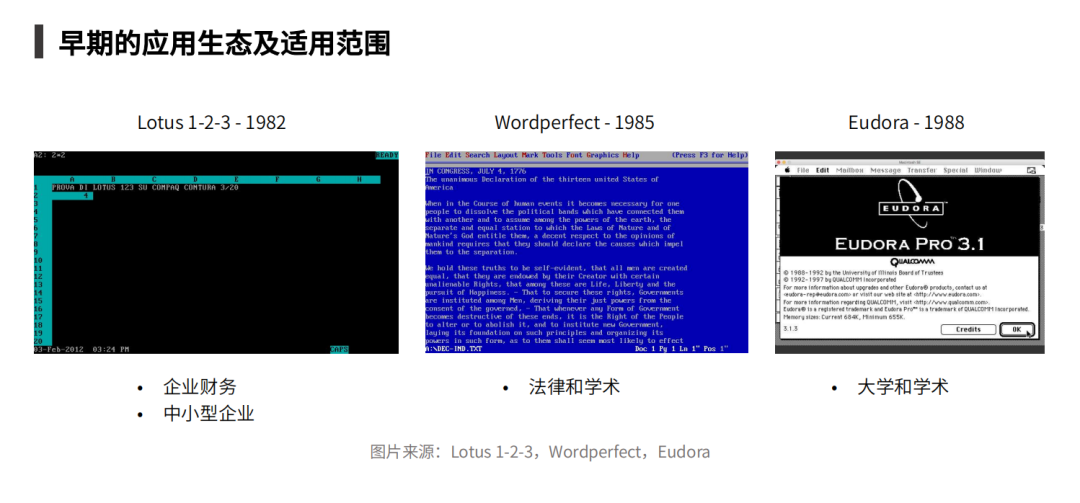
As systems and hardware capabilities improved, early applications gradually took shape. A growing array of software drove more businesses and individual users to engage with and purchase computers. Let's revisit some representative applications to glimpse how software penetrated the market during the PC productivity revolution.
These early applications emerged before the market reached consumer scale, built primarily around productivity scenarios.
In the office domain, for instance, WordPerfect debuted in 1980. Similar to Microsoft Word, it found early adoption in legal and academic fields. Then in 1982, Lotus launched Lotus 1-2-3, bundled with IBM PCs. This was a pioneering spreadsheet program, comparable to today's Excel. Two years after Lotus 1-2-3's release, Intuit's Quicken refined the user experience and expanded into additional scenarios. It improved upon DOS interfaces and configurability, drilling deep into small-business financial management. By targeting a niche market and extending vertically into specific use cases, it avoided direct competition with Excel, which arrived later.
In academic research, collaborative editing and document storage on PCs dramatically boosted efficiency compared to traditional paper manuscripts. PCs achieved remarkably high penetration in file transfer, email communication, and text editing scenarios within academia.
By the late 1980s, as CPU processing power and GUI capabilities advanced, software began transforming the printing and advertising design industries. Traditional workflows — hand-drawing and manual typesetting — started digitizing. In 1989, Corel released CorelDRAW, the first program combining vector graphics design with desktop publishing. Similar to what Photoshop would later become, it offered professional image processing for editorial publishing and marketing materials.
These early applications carried steep price tags. Lotus 1-2-3, for example, cost $495. According to World Bank data, U.S. GNI per capita in 1982 was $14,200 — roughly $1,183 monthly. A single software purchase consumed half a month's income. Early software, in other words, targeted users with substantial purchasing power.
Beyond productivity, entertainment-oriented games gradually developed. In 1995, Microsoft Flight Simulator let people fulfill piloting dreams from home, attracting users drawn to exploration and experimentation.
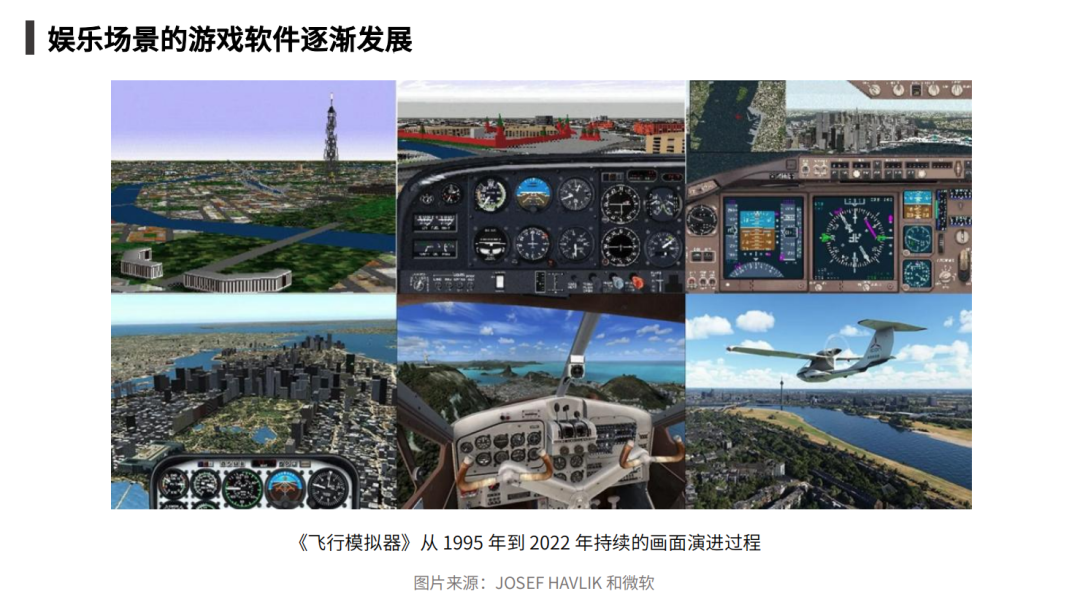
The early PC ecosystem, as we can see, was built by heavy productivity tools alongside intriguing games — starting from industrial and academic research scenarios before gradually breaking into broader markets. Yet this process was exceedingly slow, constrained by the gradual evolution of underlying DOS and GUI technologies.
The commercial scenarios these early applications penetrated resonate with today's technological pulse. Or rather, current AI application directions mirror the early software industry's trajectory. Google's NotebookLM impressed as an AI-powered note management tool. We're also seeing startups build B2B AI applications for legal and financial knowledge bases. Meanwhile, AI games have proliferated rapidly in recent years — spanning chatbots, open worlds, game agents, AI NPCs, and more.
Similarly, just as early application explosions were constrained by DOS and GUI development timelines, today's video generation models from OpenAI haven't rapidly penetrated practical scenarios. One reason: computing resources and GUI technologies still need time to mature. Carefully considering when different technological elements might converge is therefore critical.
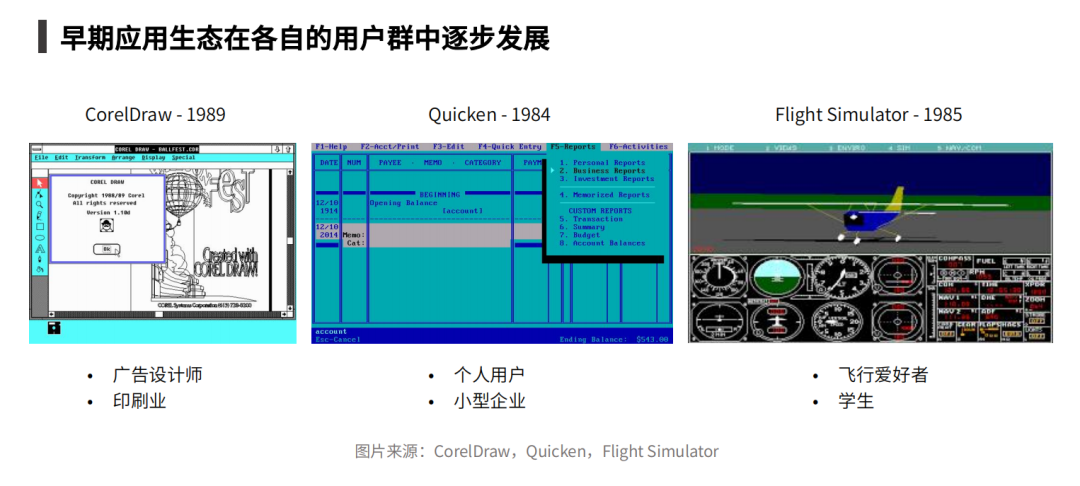
Summarizing the 1980s application ecosystem: WordPerfect and Lotus delivered noteworthy performances. Lotus seized its window and grew rapidly. WordPerfect posted an impressive record of 8 million users in five years. However, Microsoft and Apple spent nearly eight years refining their operating systems. The arrival of Windows Office transformed competitive dynamics entirely. Meanwhile, Quicken, CorelDRAW, and gaming applications each developed gradually within their user bases at a slower pace.
"Killer App" Case Study: Microsoft's "Ecosystem-Scale" Dominance in PCs
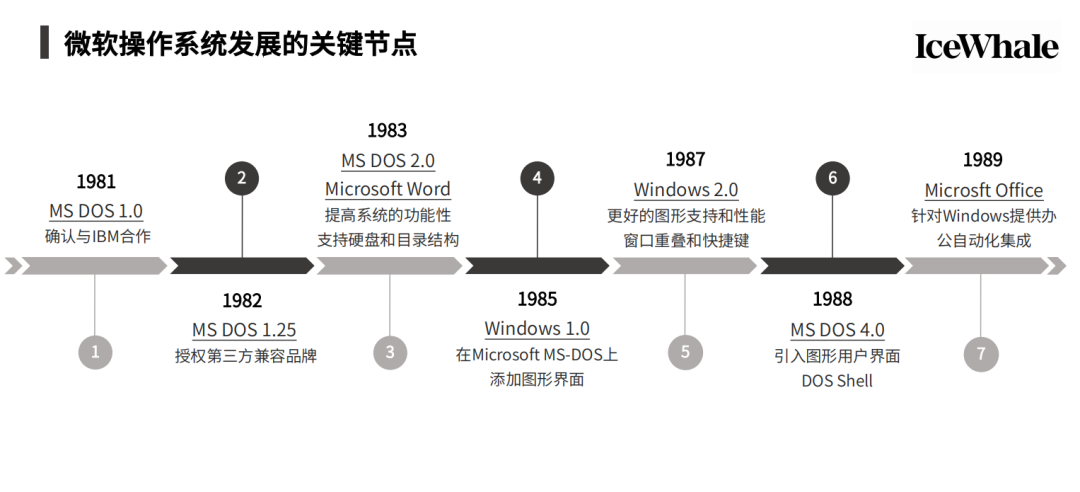
Microsoft was an ecosystem-scale player in PCs. Tracing its development reveals that its rise stemmed less from product superiority than from exceptional business strategy.
From its earliest days, Microsoft demonstrated keen commercial instincts. In 1980, it purchased a third-party operating system called 86-DOS (yes, bought it). This move made Microsoft a key IBM partner — though Microsoft quickly collaborated with other hardware vendors, breaking its exclusive IBM relationship.
From the 1980s through the 1990s, Microsoft hit several critical milestones. In 1981, it released MS-DOS 1.0. In 1983, it began launching text editing software functionally similar to then-dominant WordPerfect. This strategy of "using key applications to drive system sales" persisted throughout Microsoft's evolution.
In 1985, Microsoft released Windows 1.0, capitalizing on GUI growth. It expanded Windows 1.0's market through third-party licensing while simultaneously selling directly to users. At the time, Lotus's spreadsheet software — priced at $495 — commanded over half the market. So it's no surprise that former Microsoft CEO Steve Ballmer, promoting Windows 1.0 on a televised shopping program, repeatedly emphasized: "Our system offers chess, spreadsheets, and image processing — for just $99, not $500 or $600."
Microsoft had to maintain both DOS and Windows 1.0 simultaneously, leaving it virtually no bandwidth for application-layer development for a considerable period. Nevertheless, growth continued. In 1989, Microsoft Office launched, capturing massive application-layer market share and laying a solid foundation for subsequent development.
Notably, Windows 1.0 arrived a full four years after Xerox's GUI system, reflecting to some degree the lengthy R&D process operating systems require. Early Windows sold only tens of thousands of units in its first two to three years, yet cumulative shipments reached five to six million within eight years of its birth — an extraordinarily steep growth curve.
Drawing parallels to today: which AI applications might become new ecosystem-scale players? What roles will Microsoft Azure, OpenAI, and iOS play as AI-era operating systems? Which AI applications can seize development windows? How will large model companies influence innovation opportunities at the application layer? History offers illuminating perspectives on these questions.
New Interaction Methods Gradually Bring Computers to Mass Consumer Markets
Though computer technology originated in North America, some developed European countries imported PC equipment early via maritime trade.
As noted, early PCs focused primarily on productivity scenarios. Not until 1989, when image processing applications emerged, did PCs expand into gaming and other new use cases. Even with more user-friendly GUI systems, PCs failed to penetrate mass consumer markets broadly. PCs truly entered ordinary households around 1994. With the rise of the internet and Netscape's browser, increasing numbers of people who used computers at work began purchasing devices for home use.
One notable variable in PCs' mass-market penetration was the evolution of human-computer interaction. New technologies typically require new front-end interaction methods or devices to win consumer markets and achieve widespread adoption. The mouse, for instance, established entirely new interaction paradigms, dramatically accelerating PC penetration and internet technology adoption. Touchscreens played a similarly crucial role in mobile phones and mobile internet's proliferation.
Today, LLMs, agents, and multimodal technologies may likewise need new interaction entry points to reach mass markets. With advancing chip computing power, back-end processing capabilities have grown more powerful, while front-ends trend toward lighter, more convenient forms. Future hardware may further reduce front-end dependence — users issuing a single back-end command for devices to autonomously complete tasks. I've noted that FreeS Fund is also tracking various AI wearables such as AI/XR glasses and AI headphones.
In the PC era, technology products evolved from productivity-enhancing tools to explosive growth in consumer markets. Today, with information spreading at unprecedented speed, whether AI can empower more consumer scenarios remains to be seen. In early stages, productivity-enhancing applications likely still warrant attention. Beyond large enterprise demand, the globally growing freelance workforce represents a core demographic for new hardware and software services.
Summary: "Four Elements" Shaping the Early Hardware Industry
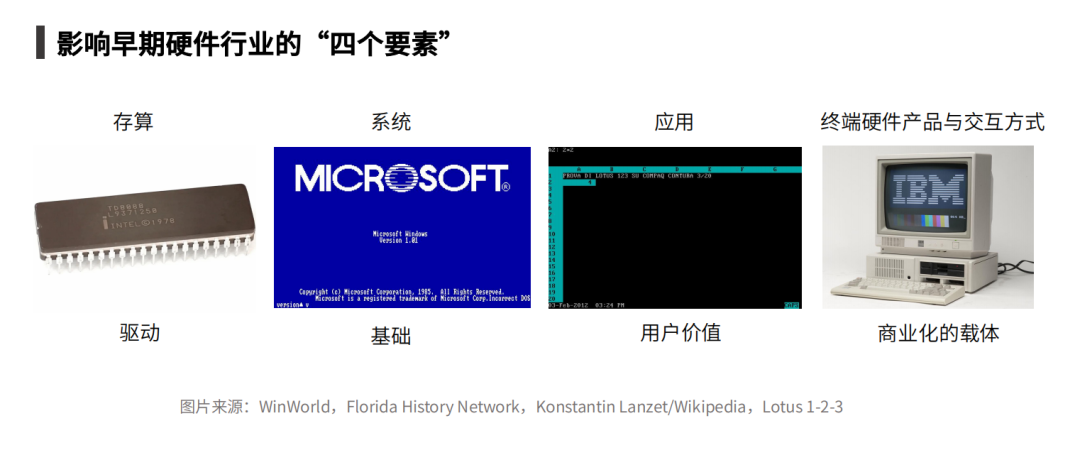
Looking back at the PC industry's first decade of explosive growth, we can identify four core elements that shaped its trajectory: chips, operating systems, applications, and end-user devices.
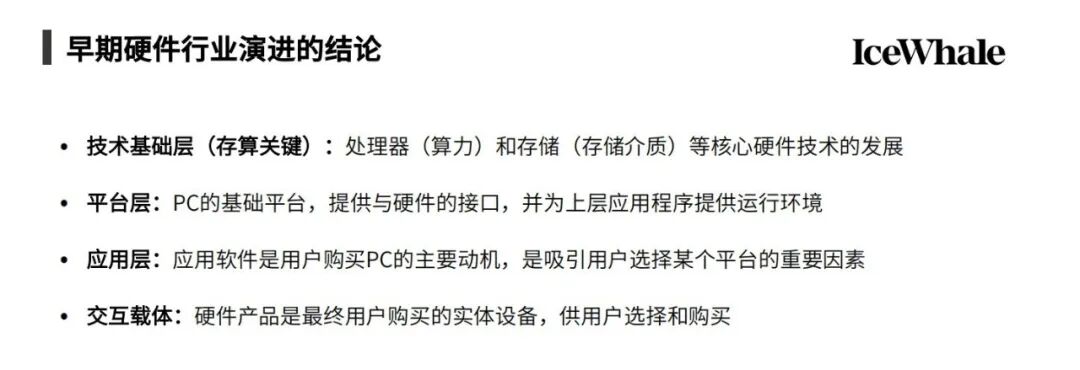
First, chips — or more precisely, the evolution of storage and compute units. Since the 1980s, chip and storage costs have declined, but not dramatically. This relates to Moore's Law: by the time costs drop on an older process node, the industry is already pouring investment into newer, more expensive advanced nodes. Today, to address the challenge of massive data storage beyond cloud computing alone, edge computing has emerged, pushing some data analytics functions to the device level. Thus, reducing AI inference chip costs while simultaneously advancing AI-centric IDC infrastructure has become a top priority.
Second, operating systems. This seemingly minor middleware layer actually handles critical tasks like resource management and device compatibility. Over the long arc of technological development, we've seen the enduring explosive power of operating systems — Windows and iOS being cases in point.
Third, applications. Early killer apps could generate real revenue, but if they failed to penetrate deeper, more vertical scenarios, they were ultimately displaced. Applications traditionally sit above the OS layer — so can app vendors actually sink down to the operating system level? Historically, only Google achieved even "half a step" in this direction, bundling its applications within the OS itself. Today, which AI applications will get absorbed by model companies is a question every AI application founder and investor needs to think hard about.
Finally, end-user hardware products as interaction vehicles that capture commercial value. In the PC's early days, people bought the hardware itself as their gateway to computing. But once the OS platform was established, the hardware itself became relatively less important. In the era of platform dominance, the operating system created user value while nurturing a rich application ecosystem. This same pattern played out in the mobile internet era.
Stories We Know Better: After 1990
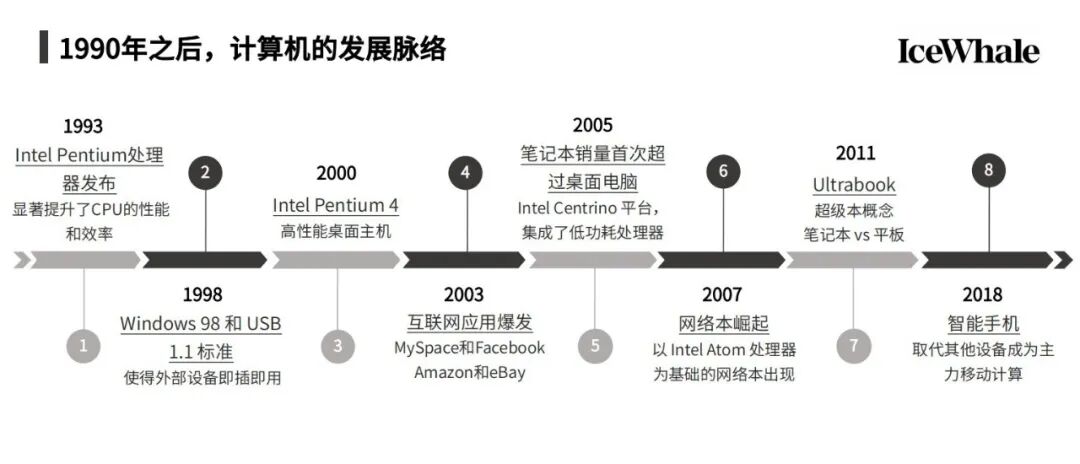
We'll move quickly through the post-1990 story. The 1990s brought us Intel's Pentium processor, the explosion of internet applications, the birth of Windows 98, the USB 1.1 standard for peripheral connectivity, and the miniaturization and slimming-down of laptops — what we came to know as netbooks and ultrabooks. This wave of technical innovation pointed toward a constant trend in computing's evolution: the internet truly entered ordinary households. During this period, CPUs grew lighter, USB 1.1 made peripheral expansion effortless, and connecting devices like mice became trivial. The rise of the internet brought mass consumers into personal computing.
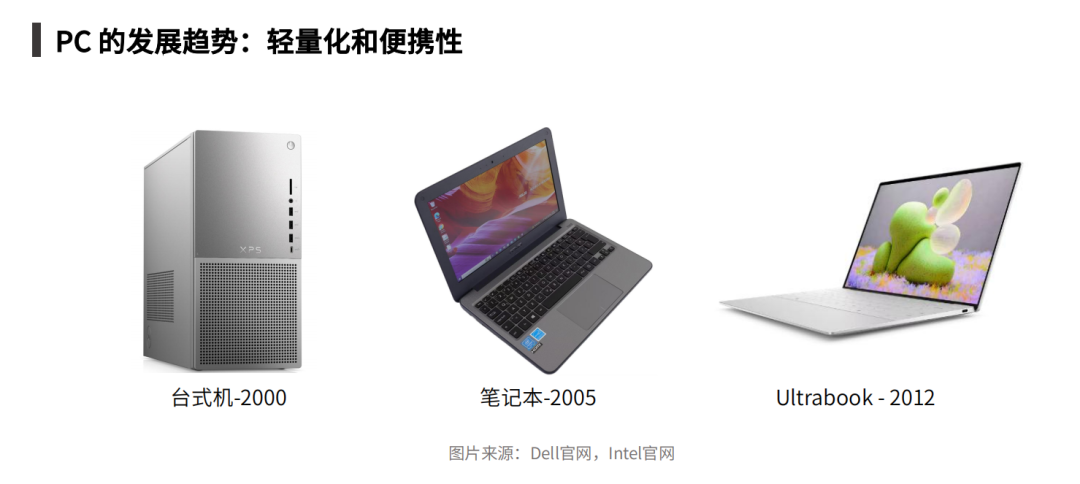
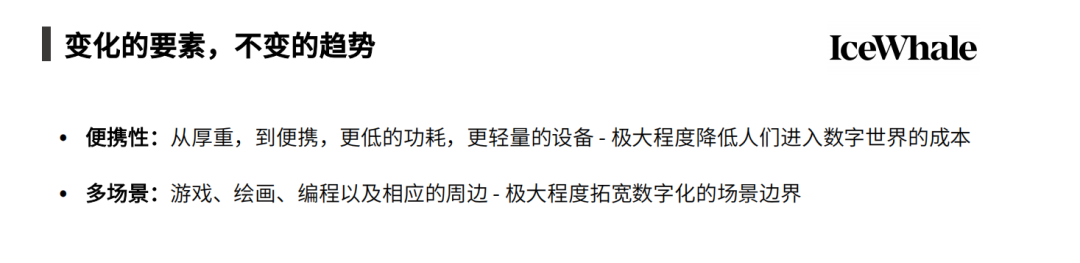
Notably, PC development revealed a clear trend toward lightweight portability.
This brings us to Shenzhen's hardware industry. In the early 2000s, two groups were active: one consisted of Taiwanese assembly plants, initially concentrated in Ningbo and Shenzhen; the other was local Shenzhen entrepreneurs assembling PCs, laying the groundwork for the city to become a consumer hardware manufacturing cluster. Meanwhile, much like the geeks of 1980s Silicon Valley, a cohort of Chinese enthusiasts began building and assembling their own computers — they became the seed users of the PC era.
I've spoken with friends at Lenovo. In their early market penetration phase, browsers already existed, leaving Chinese manufacturers with limited room for innovation. The major players could only make small user-experience-layer tweaks. But these proved remarkably effective. Lenovo developed a simple dial-up internet application that dramatically lowered the learning curve for consumers getting online, helping them capture market share rapidly. Subsequently, the DIY assembly market gradually faded, and the era of branded machines — led by Lenovo — arrived. Familiar names included Founder, Tsinghua Tongfang, and Hasee.
Looking back at the PC's evolution, what remained constant: devices became portable, thinner and lighter, letting people enter the digital world anytime, anywhere; device functionality expanded from early productivity tools into countless scenarios. So which vertical industries will AI, or large models, penetrate first? When will AI capabilities achieve generalization? This is tightly coupled with underlying compute power, device form factors, and OS maturity — these factors are interdependent.
Today, new variables like AI chips — GPUs, TPUs, and RISC-V — are driving system evolution, and system changes will permeate through to the application layer. When the timing is right, we'll see an explosion of interesting AI-native applications on the edge, making local Copilots far more powerful. Yet the industry chain elements here are numerous, requiring deep thought and close observation of key players' moves.
What Makes New Hardware Viable? Specialized Devices vs. General-Purpose Computing
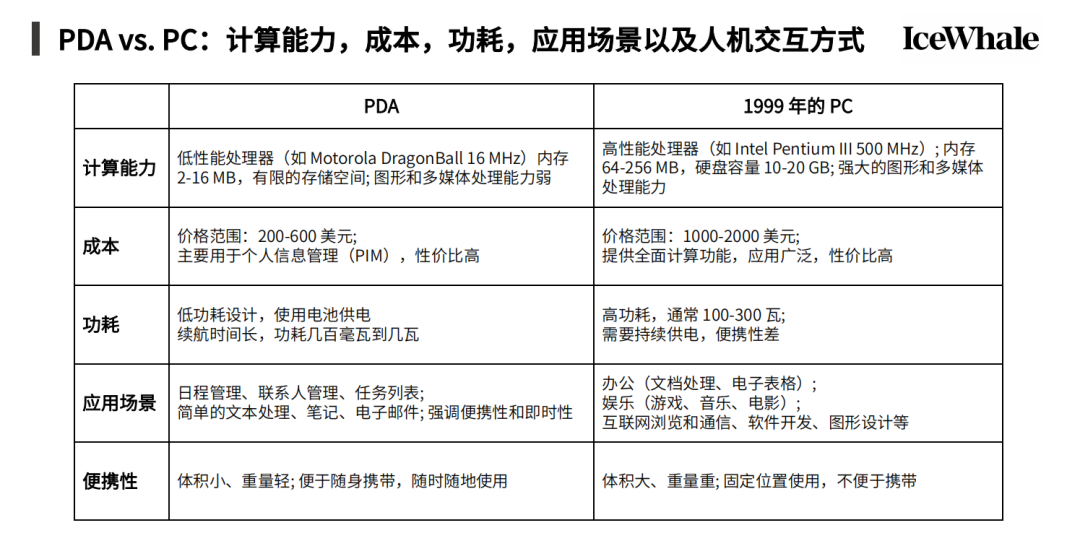
In mapping out the PC industry's development, I noticed a fascinating question: Can today's diverse AI hardware forms be analogized to the PC's evolution? Which device innovations got swallowed by the PC, and which didn't? The PC was so dominant then, just as smartphones, laptops, and cloud computing are today. So in which scenarios did specialized devices split off from general-purpose devices rather than being consumed by a single unified platform?
One resounding name comes to mind: Nintendo. In 1983, Nintendo launched its third-generation game console. It used the exact same chips as Apple's first and second generation computers, yet became a dedicated device. To this day, Sony's PS5 and Microsoft's Xbox maintain their positions in hardware for the same reason. When vertical scenarios have sufficient depth in compute requirements, system needs, user demands, and interaction methods, there's opportunity for an independent specialized device category to emerge.
Motorola's 1999 PDA release followed the same logic. Though it used relatively underpowered hardware, it satisfied personal digital assistant needs. The PDA was simply a low-cost information management tool for scheduling and contacts, priced far below a PC. It occupied a unique niche in portable device history, never absorbed by PCs, and can be seen as a precursor to the smartphone.
Today's AI Hardware, Applications, and New Opportunities
Returning to the present: though industry chain elements have shifted, the fundamental human needs for data acquisition, production, and distribution remain unchanged. At an abstract level, demand is shifting from GUI-based operations toward intelligent agents that complete tasks directly.
With Copilot, creators can input context and have machines help generate creative scripts or research competitor products. Enterprises can deploy an agent to track all industry-relevant innovation in real time, automatically generating weekly reports.
These methods of acquiring and producing data will grow smarter. And the vehicle for this will necessarily differ from traditional PCs — it may be an always-on, real-time computing device. In the past, people relied on mice and GUIs to boost productivity; when AI is embedded directly into computing devices, it can take independent action. This means human-computer interaction need not depend on mice and displays. You send a task, and AI executes it directly. These shifts will catalyze new hardware interaction forms.
How all this unfolds — we can trace some answers through forty years of PC history. Because the underlying scenario demands are consistent. GPT-driven productivity transformation will likely focus early on productivity-enhancing scenarios, much like Lotus 1-2-3 in the DOS era. If we combine this with the gaming industry, image processing industry, and methods of producing, acquiring, and distributing data mentioned earlier, we can theoretically identify many new application scenarios.

How Do New Production Factors Affect Hardware Entrepreneurship?
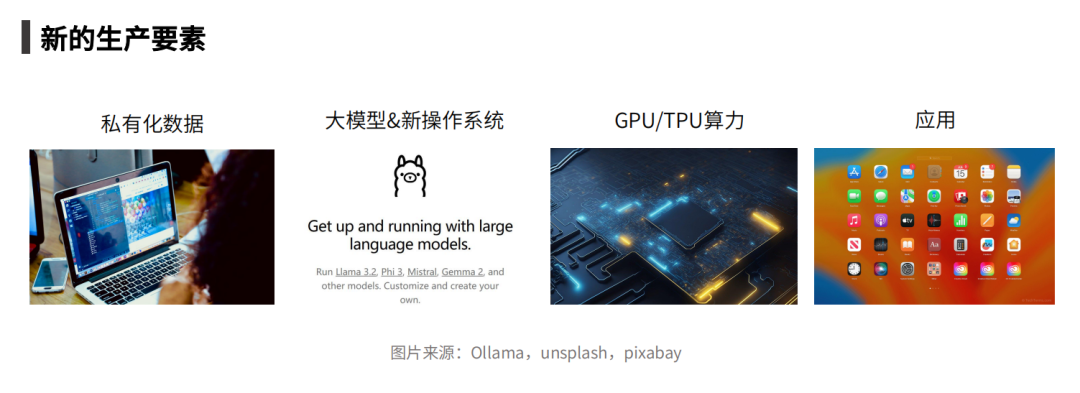
The emergence of AI large models has transformed the four elements. At the chip level, GPUs and TPUs continuously advance compute power. At the system level, large models may gradually merge with the OS itself. At the terminal level, private data generated through user-device interaction becomes more valuable. Changes in these first three elements will catalyze new applications. We may witness the birth of an entirely new compute-storage-integrated device. In the future, its standing may differ from that of phones, laptops, even public cloud. I've tried to map out its characteristics in a table.
Starting from productivity scenarios, penetrating various domains at different speeds.
-
Large models and the new OS: Large models are the engine of intelligence, and they will likely merge with the operating system itself. Today, the growth of Microsoft's cloud computing platform Azure, Windows' moves, and OpenAI's exploration of an App Store model all represent early jockeying among different players to claim position as the new system.
-
GPU or ASIC compute: In the 1980s, Intel dominated hardware. Today, NVIDIA is in the spotlight. GPUs and specialized computing devices for large models are becoming intelligent. I'm very bullish on ASIC chips (Application Specific Integrated Circuits, designed for dedicated purposes rather than general-purpose chips) and NPUs. If these devices iterate rapidly, they could catalyze new applications before 2030.
-
Private data: Data remains the new oil. For AI, unique organizational or proprietary high-quality data resources, or privately acquired machine data, are critical assets for training and generation.
-
AI applications: Looking back at industry development, we can see that applications don't exist independently of systems and hardware. Rather, they emerge from developers' mining and exploration of scenario value based on the current state of systems and hardware. Success hinges on understanding the capabilities of the system and hardware platform, understanding users, and timing.
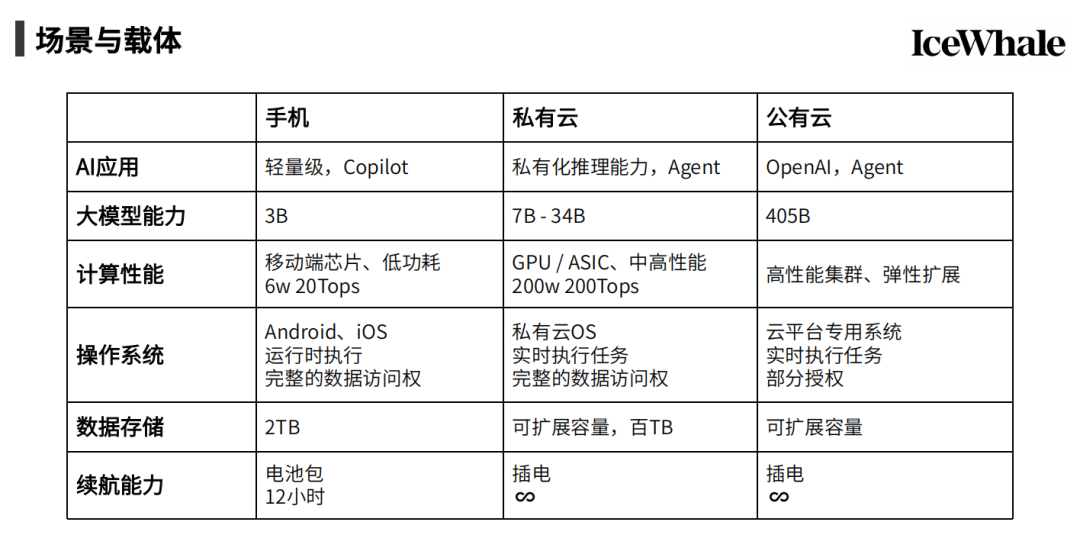
Information technology has always moved toward portability — a persistent human demand. Our computers evolved from immovable PCs to portable electronic notebooks. Yet portability constrains compute power and battery life, which in turn limits the intelligence level of models a device can run. Current smartphones typically handle models around 3B parameters. By contrast, private clouds can run models in the tens of billions of parameters, and public clouds in the hundreds of billions. This means that when Windows or the next-generation Android system is ready, they may use 3B-parameter models and Copilot as a foundation to inspire a new generation of AI applications — AI-powered browsers, email reply agents, AI office software, AI favorites, document retrieval and summarization agents, and so on. This is an inevitable stage for phones and laptops, because from a silicon process perspective, AI compute per watt won't change dramatically in short order. On the other hand, there's superintelligence based on public cloud. Over the past decade of rapid cloud computing growth, the cloud has become widely recognized as the most valuable core AI infrastructure. But the cloud has exposed its own problems: in the AI era, is every individual and organization willing to hand all their data to a single AI company? Or would you grant one vendor full access to your Taobao, WeChat, and financial accounts? This is clearly a massive psychological cost. One possible direction is that the cloud begins to function at the topmost layer, with vendors sending tasks via API calls. In this process, AI leverages powerful model capabilities to provide corresponding data to vendors. Between AI applications and public cloud, an opportunity has emerged to build entirely new systems and hardware. This operating system might function like an intelligent agent, running on a device that's powered 24/7. You could send it tasks from your phone or laptop, and it would execute them automatically in the background. It would have massive data storage capacity, and with no compute constraints, could be equipped with hundred-watt-class GPUs delivering roughly 200 TOPS of AI compute — enough to be genuinely smart. Specifically, it might be a private cloud device with all data kept locally, serving the storage and compute needs of families and small organizations.
The Users This New Device Will Likely Reach First: Creators, Engineers, and Knowledge Workers
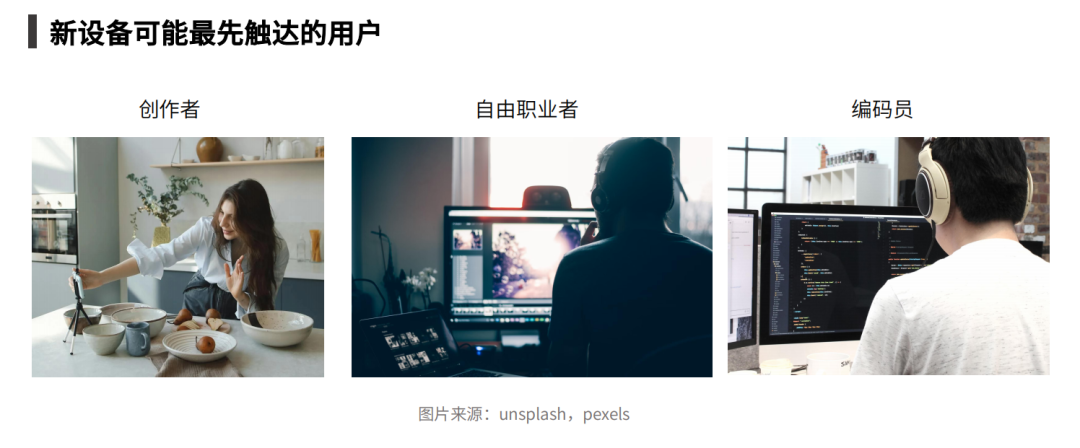
What form might this new device take? AI glasses and AI headphones are discussed frequently. I believe there's a strong likelihood of a personal computing device that starts with productivity, scales up, and then expands to the consumer level — possibly even with integrated compute and storage. Based on these judgments, I founded Ice Whale Technology. In 2021, our first private cloud product launched on overseas crowdfunding platforms, attracting attention from the geek community. Through interviews and research, I discovered that it's not just geek engineers — creators and knowledge workers also have substantial needs for managing data assets, requiring productivity tools to solve their pain points around storage and collaboration. This mirrors the early penetration path of PCs: target users willing to pay who have strong productivity needs, and enter an entirely new battlefield. Through product iteration, we hope to achieve commercial monetization by providing private cloud solutions for creators in vertical scenarios.
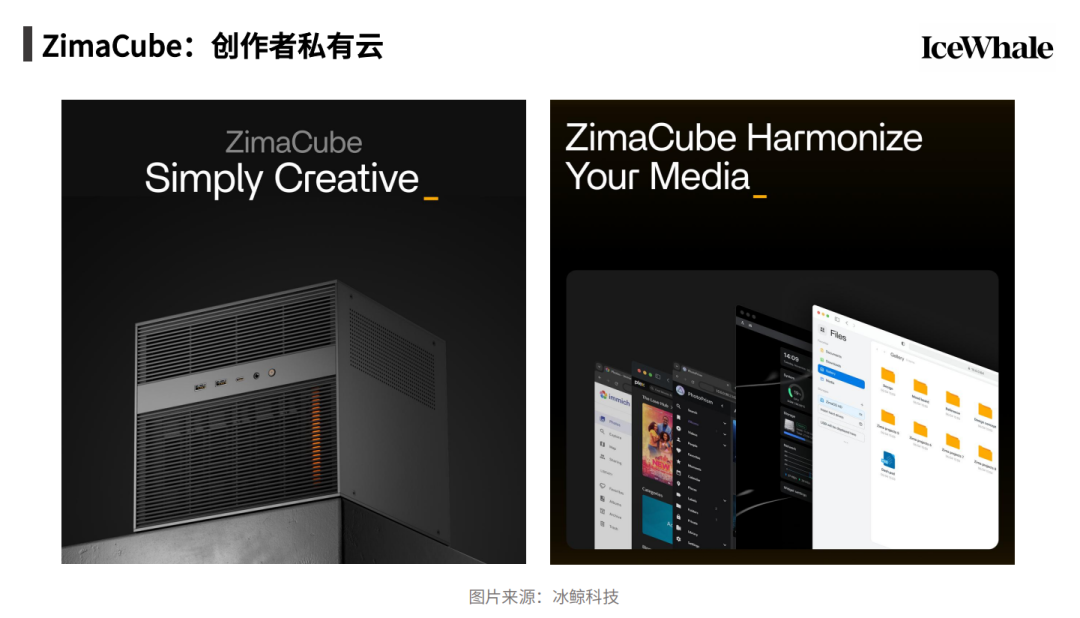
Returning once more to what we discussed earlier: starting with hardware, rising through applications, and culminating in ecosystem. The same holds true for us. Hardware is the starting point, but applications deliver greater value. I believe an open ecosystem and community-driven operations can help us absorb emerging applications earlier — much like the early geek communities of Silicon Valley.
Silicon Valley in 1980 vs. China Today: Structural Opportunities for China in the AI Compute Era
It's foreseeable that over the next decade, the information device sector will likely see structural innovation blending hardware and software. This sets a high bar for startup entry. I believe this direction holds opportunity for very unique, interesting innovation led by Chinese companies. Whether AI NAS or AI PC (Artificial Intelligence Personal Computer), I don't believe Silicon Valley will continue to dominate this round of innovation. Due to weakened industrial chain capabilities, hardware iteration speed in the U.S. has declined exponentially. As Peter Thiel, the well-known Silicon Valley investor, put it: "We haven't known how to invest in hardware for a long time." This is indeed America's current reality, and China's window of opportunity. It would be no exaggeration to say that there's nowhere in the world more suitable for incubating hardware products than China's Pearl River Delta. Without question, the innovation effects enabled by China's long industrial chain will continue. Beyond the industrial chain foundation, in the realm of hardware-software integration, China also has excellent engineer supply. Consensus is forming around China's innovation potential in AI hardware and AI edge devices. As a practitioner in this direction, I hope to embark on this star-reaching journey with more people. I also hope the innovative elements mentioned earlier — operating systems, applications, compute, and models — can offer some inspiration for your investment decisions and entrepreneurial practice.
Investor's Note

Thank you very much, Pan, for your deep insights and reflections. FreeS Fund is also actively positioning in the AI hardware-software integration direction. We warmly welcome entrepreneurs and investors in related fields to engage in deep exchange with us and our portfolio companies. Please contact mengchangjie@freesvc.com. Turning to AI hardware, I currently see four main categories in the market:
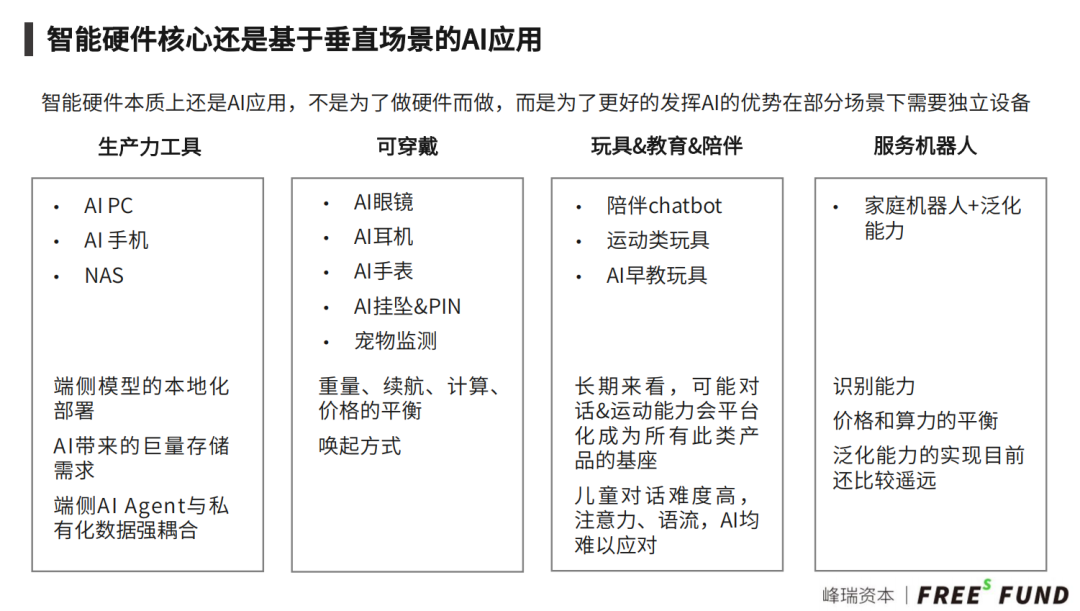
As Pan discussed earlier, vertical-domain AI hardware innovation generally needs to find the right scenario and go deep to avoid being swallowed by phones, PCs, and other existing form factors. In the near term, the ecosystem positions of phones and PCs are difficult to shake, and large model usage is becoming an open playbook. So the key to AI hardware innovation is finding the right scenario, deeply understanding user needs, building a sufficiently thick middleware layer, designing good products, and delivering extreme experiences. From this perspective, AI + hardware is largely AI applications in essence; the hardware itself is closer to a container / vehicle. I won't elaborate further on opportunities in the AI productivity tools赛道 here. Interested friends are welcome to read "The Private Cloud Era Arrives: How AI NAS Reshapes Your Digital Life | FreeS Research". In the AI wearable devices direction, AI PIN was briefly hot in North America this year. The product offered calling, web search, intelligent voice assistant, and other functions. But as deliveries began, problems gradually emerged. In fact, this product form faces major challenges because most consumers struggle to understand a completely new product without an "anchor point." An anchor point is something consumers already have in their mental model. With an AI headphone or AI bicycle, consumers will compare the new product against the average metrics of their anchor point product in mind.
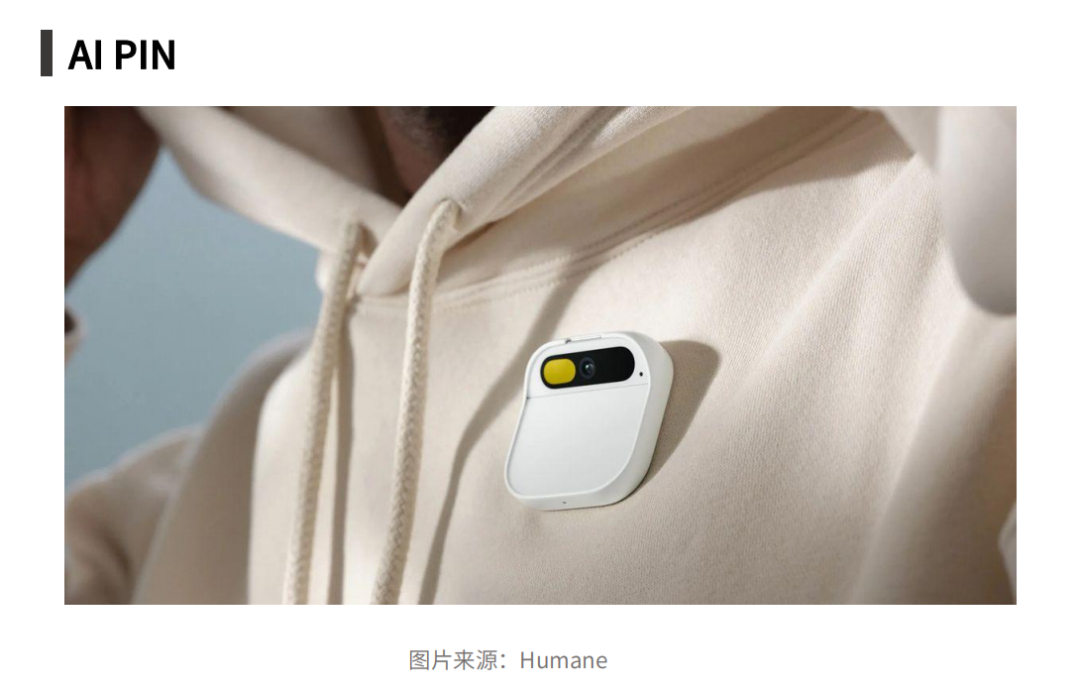
First, this new product can't fall below 90% of industry-standard benchmarks — only then will consumers pay attention to the added innovative features. The AI Pin, by contrast, is a form factor without any anchor point, making it harder for consumers to embrace.
This year we've looked at a massive number of AI wearable products, mainly AI glasses and AI headphones. I've noticed some founders pack glasses with features yet overlook that comfort and style are among the core metrics of eyewear itself. Generally, rimless or thin-frame regular optical glasses weigh roughly 15 to 30 grams, yet current AI glasses tend to be much heavier. Imagine wearing something over 60 grams on your face all day — that would be genuinely miserable.
Making AI glasses light enough while still carrying new functions imposes extremely demanding requirements on overall product architecture, and forces trade-offs among battery life, camera, and display. Of course, this depends on what kind of multimodal interaction you want, which in turn requires balancing weight, materials (comfort), style (swappable modular designs), prescription compatibility, battery life, smartphone connectivity, and more.
At the AI functionality level specifically, "wake-up" is a point that's critically important to user experience yet extremely difficult to solve. Given current hardware and software constraints, achieving frictionless wake-up on a consumer product — no wake word, no physical button press — with automatic operation is extraordinarily hard. This means your agent must continuously recognize environmental cues, effectively understand your intent, and in real time judge what task-processing functions it needs to invoke.
Beneath wake-up lies the specific AI task layer. Simply adding a large-model portal and dumping every task straight to the LLM doesn't effectively solve problems. The key likely lies in identifying the right scenario, going deep on the AI capabilities that scenario demands, and then building a great product. If you choose the office scenario, you probably need to nail basics like translation and transcription first. If you're targeting outdoor sports, then workout metrics analysis, smart navigation, and recording functions may matter more. Moreover, an AI product for travel bloggers and one for people with visual or hearing impairments will differ enormously in content output format. Of course, all these functions ultimately converge on cost.
Beyond AI wearables, I've spent considerable time this year on AI companionship products, which can be further divided into adult emotional companionship and children's learning-and-play companions. For adult emotional companionship AI hardware, the biggest challenge is finding the rationale and necessity for standalone hardware to exist when software-based companionship products like Character.ai are already gaining market traction. You need to answer: in what specific scenario can hardware deliver a materially upgraded sensory experience?
Children's AI learning-and-play companionship is a highly promising yet extremely difficult market. First, because some parents limit children's screen time, this naturally creates an opening for standalone hardware. Second, dual-income families make up a very high share of Chinese households, and parents' time with their children is limited — high-quality companionship for children, plus educational support that entertains while teaching, represents a definite刚需 [rigid demand].
Yet the challenges are equally clear. For instance, children's attention is relatively scattered; even with the most engaging content, most kids struggle to focus beyond half an hour. Additionally, children's language organization and expression differ from adults' — once a large model fails to fully grasp what a child means and starts "talking past" them, the child quickly loses patience. Moreover, the learning-companion function sounds fancy, but once children realize this isn't a toy, it's for studying, they may develop some resistance. In short, a single hardware product is hard-pressed to satisfy children's needs over the long term.
Under these circumstances, delivering high-quality content matters enormously, including bringing in IPs and storylines children love, and effectively combining stories, games, and other elements — that may be one viable approach. Additionally, model training is critical: the model needs to understand children's meaning more effectively before meaningful interaction can happen. Of course, safety factors also require heavy emphasis for children's products.
From a longer-term perspective, if someday all children's toys have conversational and movement capabilities, what becomes the next battleground? The well-known AI plushie LOVOT offers one possible answer. Initially its core differentiator was motion and expression interaction; as technology advanced and other products could do the same, LOVOT shifted from selling functionality to selling IP.
Additionally, the fourth category of AI hardware products is home robots with some generalized capabilities. Breakthroughs in this direction have been limited so far, mostly concentrated on recognition capabilities and handling corner cases. In the near term, these products are constrained by cost and can't use higher-compute chips; over the longer term, the realization of embodied intelligence still has a long road ahead. Friends interested in this topic are welcome to read Embodied Intelligence vs. Sports Tech: One Makes Machines Like Humans, the Other Turns Humans Into Machines? | FreeS Fund Report.
These are some of my thoughts on AI hardware. I very much look forward to active exchanges with AI hardware practitioners and investors.
Reader Giveaway In the consumer hardware space, what interesting innovations have you seen or are you hoping to see? Share with us in the comments. We'll randomly select 5 readers to each receive a FreeS Fund industry research handbook.

▲How Can Tech Consumer Products Go Global?
▲Li Feng in Conversation with Ji Yu: Understanding NVIDIA, Deconstructing NVIDIA, Challenging NVIDIA
▲Even Siri Took 14 Years: What's Hard About Voice Intelligence, and Why Is AI Hardware Suddenly Hot? | In Conversation with Chen Xiaoliang of SoundAI
▲The Private Cloud Era Arrives: How Will AI NAS Reshape Your Digital Life? | FreeS Fund Research
▲Embodied Intelligence vs. Sports Tech: One Makes Machines More Human, the Other Turns Humans Into Machines? | FreeS Fund Research
▲China's Healthcare System Over Four Decades: A Journey From Past to Future | FreeS Fund Research
Star the FreeS Fund WeChat official account for timely business insights.