200,000 Users Love Watching People Jump on Fridges Late at Night — Who's Paying Attention to Short Video? | FreeS Fund Business School

Who's watching short videos?


Who's Watching Short Videos?
Miaopai has 267 million monthly active users; Kuaishou has 400 million registered users; ByteDance's video content racks up over 1.6 billion daily views... Fueled by rising bandwidth, a content creation boom, and the ever-growing influencer economy, short video became a breakout trend over the past year, spawning 18,000 startup teams.
The "second half of the internet" means the demographic dividend is fading — user growth must come from going deeper, not wider. Who are the users? Where do they come from? Where are they going? Entrepreneurs face these three ultimate questions constantly, and short video is no exception.
Building user personas is an indispensable step toward answering them. This article draws on Guangjian Lab's methodology pieces Building User Personas — The First Step Toward Getting Featured on the App Store and 22 User Stories About Video. The former shares Guangjian Lab's methodology and practice for constructing personas; the latter excerpts stories about short video users shared by Wandoujia, Guangjian, and Qingmang co-founder Junyu Wang, "Kaiyan" product manager Xinyang Li, and Kuaishou product manager Huaizhou Cui at a Guangjian Lab offline Design Workshop.
User personas generally fall into two categories: Personas for innovative design, and Profiles based on big data quantitative analysis for refined operations. Competition in short video startups is already fierce, but there's still room for breakthrough innovation. The Persona method introduced here should help. And from these richly detailed user stories, we can ponder some interesting questions:
- Why do users watch short videos? "Audio-visual pleasure," "killing boredom," "looking really cool," "seeking resonance" — what are you after?
- What other needs do users have while watching? Are bullet comments and social features necessary?
- 200,000 people staying up late to watch a man jump onto a refrigerator. Who likes watching people act cute, crack jokes, flaunt wealth, or show off skills? What user psychology lies behind it?
We hope these stories spark some insights. But if you want to rigorously produce Personas tailored to your company or project, be sure to go back to the very beginning and start from Step 1.

Building User Personas
1-on-1 In-Depth Interviews and Analysis

▍Step 1: Define Interview Content
Interview content depends on what kind of Persona you're building. Personas may serve product design or marketing; the former focuses on user behavior, the latter on user perception.
Taking product design Personas as an example — to help us more accurately judge user needs and pain points, the following attributes are practically essential:
- Goal: The user's core need. For example, for a music trendsetter persona, their key concern is "I'm always listening to music, but it's hard to find stunning new songs."
- Use Case: Key behaviors (the parts of user behavior most closely tied to your business) x important scenarios. For example, User A listens to music on their phone while riding the bus.
- Skill: Devices, experience, and other indicators of the user's skill level in the target domain. For example, an iPhone user who has favorited 2,000 songs on Douban FM.
- Story: The user's life state, especially parts related to key behaviors. For example, User C spends weekends reading at cafés, enjoying leisurely time, and sometimes discovering great music there. For User C, a song identification feature would create magic moments that make them fall in love with your music FM app.
- Relationship: Relationships between personas. For example, A spreads fresh info to B, C grows into A after accumulating experience, A > B > C on efficiency, etc.
▍Step 2: Conduct Interviews
First, interview as many target users as possible. For experienced user researchers, each Persona requires interviews with at least 5 target users.
Second, choose the right interview subjects.
- Interview subjects must actually exhibit the key behaviors you care about. Start with heavy users — their rich experience yields many insights. Try asking people you know to recommend their friends, i.e. "friends of friends." On one hand, you're not close, so you can approach them as strangers and avoid prejudging; on the other hand, the mutual friend builds trust, so conversations are more relaxed.
- Remember to "listen to both sides." According to the different scenarios where key behaviors occur, select users with different life states and skill levels to hear from.
- Be careful not to lead users into giving "pleasing" fake answers. Keeping some psychological distance from business goals is important here. Questions should be open-ended — ask more "how" questions, fewer "whether" questions.
▍Step 3: Build Persona Models Using "Behavior Axes"
We create behavior axes for each key behavior, then place users on these axes based on interview data. The diagram below illustrates the concept. Each behavior axis shows how users differ in degree on a particular behavior.
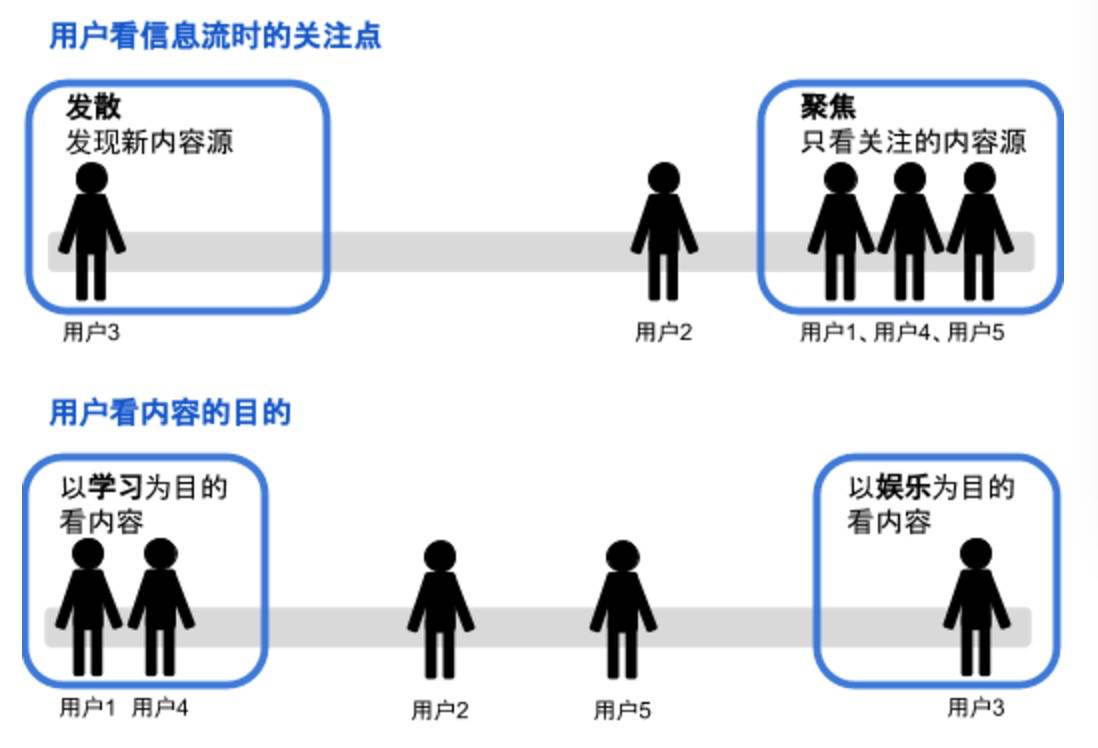
▲ Behavior axis example
Each respondent's precise position on the axis doesn't matter; their relative positions matter more. Clusters of respondents on different axes show clearly distinct behavioral patterns.
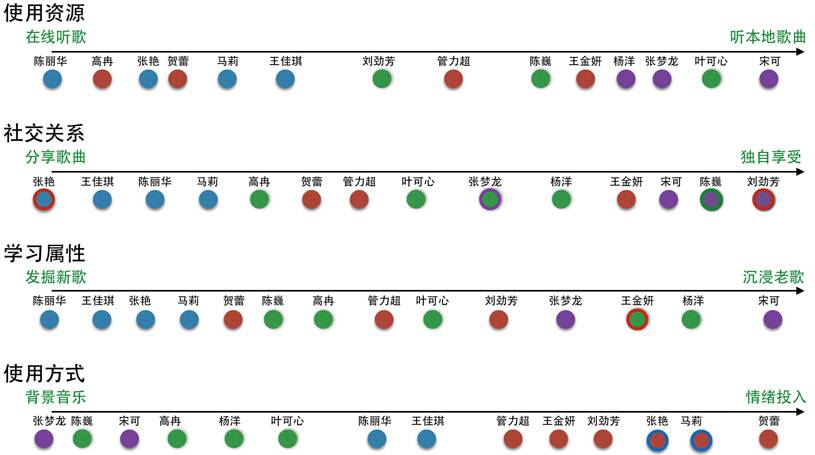
▲ User sample clustering example
Here's a fictional persona of 15 user samples, roughly clustering into 4 groups, distinguished by color after clustering. We observe how users cluster on behavior axes. Users who are close to each other across multiple behavior axes likely represent a typical user archetype; the behavioral patterns they exhibit will form the basis of a Persona.
▍Step 4: Refine Personas as a Team
No Persona should be designed by one person alone. The Qingmang team collectively hones and revises Personas through Design Workshop methods. (See Guangjian Lab's article Design Workshop: How a Product Is Born, Absolutely Fun Edition.)
▍Step 5: Finalize and Display Personas
User researchers and product decision-makers review whether the Persona's dimensions and characteristic attributes are complete, then finalize the description. We made Persona posters and put them on the workspace walls, so the team could "live with" our users daily and discuss around target user needs at any time.
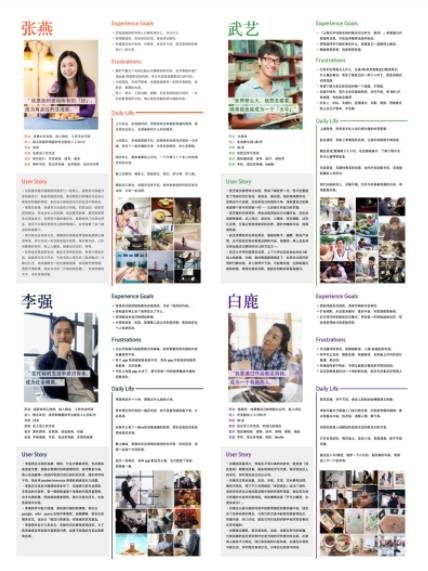
These are abstracted, fictional Qingmang Magazine Personas — the 4 names are not real users:
▲ Yan Zhang: A life aesthete who loves "beauty," shops faster than she can be influenced, emotional, a devotee of quality living
▲ Yi Wu: A naive aspiring youth, endlessly curious, a newbie dreaming of becoming a master
▲ Sam Li: An efficiency-obsessed elite, rational and pragmatic, a logic powerhouse
▲ Lu Bai: An arty creator, a broadly interested naturalist, an influencer passionate about self-expression
▍Step 6: Put Personas to Work
-
Make product priority decisions. The above process typically yields 3-6 Personas; decision-makers must then determine each Persona's priority based on external trends and internal resources, distinguishing primary users, secondary users, and negative users (those you won't focus on for now). Throughout iteration, always consider primary users' needs as higher priority than others.
-
Guide product design. Personas should be established at the start of product design, enabling better design coherence and giving primary users a better experience that keeps them in the product.
-
Improve communication accuracy. When PMs discuss requirements, using Personas and their characteristics in sentences helps everyone understand requirements more accurately and improves communication efficiency. For example, when designing a note feature for "Yan Zhang," we'd discuss: "Yan Zhang needs beautiful notes like a scrapbook."
19 User Stories About Video
This section is excerpted from shares at Guangjian Lab's offline Design Workshop

Why Do Users Watch Video? — 6 User Stories from Wandoujia's Video Search Work
Shared by: Junyu Wang, co-founder of Wandoujia, Qingmang, and Guangjian Lab
▍Story 1 An architect who loves film always carves out large blocks of uninterrupted time for watching movies at home, with his own viewing ritual — pulling down special blackout curtains, brewing tea, only then beginning. He only watches Blu-ray sources; a two-hour film is at least 10 GB, so he's bought several large NAS units. He savors being immersed in film, feeling that the audio-visual pleasure transports him to another world.
▍Story 2 A journalist at Caijing Weekly who loves American TV dramas and obscure books. He described video as something very intuitive: "Reading requires literacy, but video you get without thinking — even mind-bending shows, you immediately understand what's happening, you just might need to think about cause and effect. My English isn't great, but sometimes I'm impatient and watch raw footage; I can mostly understand." His work hours are flexible, he spends lots of time at cafés, and carries a Nexus 7 for video, a Kindle for reading, and a Mac for writing.
▍Story 3 A senior at University of Science and Technology Beijing who commutes by subway with classmates for part-time work. They download bilibili anime videos to their phones the night before to watch on the way. He said: "Two hours on the subway feels boring, but plug in headphones and watch anime, and it passes quickly."
▍Story 4 An 18-year-old working at a Dongguan electronics factory who loves short videos, finding the street dance in them especially cool. He said: "In a few seconds you see amazing street dance, or some village oddball swallowing a lightbulb — super interesting!" He's a second-generation migrant worker, following his parents to work in Dongguan, with little financial pressure, likes riding his motorcycle around picking up girls and seeking thrills.
▍Story 5 An employee at a subway operations center with very regular work, not too busy, who likes watching shows in her free time. She said: "I don't watch for the plot; I pay more attention to certain elements in the show. Watching Korean dramas, I focus on the leads' outfits and makeup; watching Nirvana in Fire, I loved the big fur-collared coats; watching Sherlock, I loved the soundtrack."
▍Story 6 A physics graduate student at a Beijing university — the first time we'd heard someone say "2333" in real life. Her video habit is watching the main episode elsewhere, then coming to Bilibili for the bullet comment roasts. She said: "Everyone sending bullet comments together is like being in a movie theater, watching together — not lonely."

What Else Do Users Want While Watching? — User Feedback Collected Two Months After Kaiyan's Launch
Shared by: Xinyang Li, Kaiyan product manager
▍Story 7 A 24-year-old independent director-cinematographer who doesn't see watching Kaiyan videos as mere entertainment — he treats the product as something to learn from. Because Kaiyan's curated videos at the time generally had strong visual appreciation value and creative standards, professional creators are particularly sensitive to this content and have hard needs for it. He said: "The foreign video we can access in China is still relatively limited, and creativity isn't as abundant as abroad, so I watch videos to learn and try to make them my own."
We asked, besides Kaiyan, how do you find inspiration and learn? We got this answer: "Whenever friends go abroad, I have them download a hard drive full of overseas video work samples from YouTube and bring it back for me." This was in 2015; we were surprised at the time, realizing that accessing overseas websites is genuinely difficult for many people, which also means excellent overseas video content is a scarce resource for both creators and consumers.
▍Story 8 A 28-year-old public institution employee who said: "My work isn't very busy, so I just want to flip through it when I'm free." Interestingly, even someone who seems this unbusy still has delayed sleep phase syndrome, watching videos nonstop at night. Similar bedtime scenarios — Kaiyan collected quite specific descriptions through surveys, such as: "relaxed time that's fully my own, where I can cast aside worries and fatigue," "used as a midnight snack every night," "watching all today's latest short videos before bed makes the sleepiness disappear, heart full of pleasure."
▍Story 9 Mr. Luo, an internet company employee, who always wants to find like-minded people to comment with while watching video. He said: "If I see someone comment with the same thought as me, I feel this strong sense of resonance."
▍Story 10 After Kaiyan opened its comment function, many users' non-video needs were resolved through exchanges between users in comments. One user said: "I saw a really cool video and asked in comments how it was shot; a friend who knew filming explained the techniques used. Sometimes I think the background music sounds good and ask in comments; users who know music tell everyone what music was used."
▍Story 11 Not all users approve of comments and social features. Ms. Liu, a private sector employee in a traditional industry, felt the opposite: "After adding comments, it feels like this became a chat app. I came here to enjoy pure, high-quality content, but then I see comments with trolls and my good mood is instantly ruined."

The Online Society Built by Video — 8 Streamer Stories
Shared by: Huaizhou Cui, Kuaishou product manager
Conventionally, we assume male users in live-streaming and short video products focus on attractive women, but Kuaishou isn't like this. Kuaishou's male users are the majority, and male users are also the majority of top creators — meaning Kuaishou overall is male users providing content for male users to watch. In this community, it's not necessarily about looks. Kuaishou's male and female user needs are long-tail and richly diverse, and the community's content supply is also long-tail and richly diverse life content.
▍Story 12 User "Er Lü De" has 13 million fans, the "Lü Family Army." His live content centers on gossip and chatting; he also performs a stunt where he jumps from his floor onto his refrigerator. The Lü Family Army spams formation comments to cheer him on and send gifts. Why do 200,000 people stay up late simultaneously to watch a man jump onto a refrigerator? This is worth serious thought.
▍Story 13 I was eating with a product manager friend and noticed he kept looking at his phone. I leaned in and saw he was watching videos from a Kuaishou user called "Northeast Vermicelli." He said: "This guy eats all kinds of good food in different ways every day; I'm always super curious to see what he's eating today, and watching him eat while I eat makes my own food taste especially good."
▍Story 14 Kuaishou's female users don't need to use vulgar or provocative methods to gain large followings. For example, "Xin Bao Ya," a young woman from a Hainan plantation, generally doesn't speak in her videos — just acts cute at the camera in the fields, sometimes holding a small animal or a leaf, sometimes with no props at all. Each of her videos gets tens of thousands to hundreds of thousands of views. These hundreds of thousands of users run to watch her cute videos daily — what need does this satisfy?
▍Story 15 User "Liu Mama's Daily Life" is a Northeastern auntie with 6.7 million fans, about our parents' age. She shoots Northeastern rural-themed videos, mostly light and funny, frequently exceeding a million views and hundreds of thousands of double-tap likes. Why do so many Kuaishou users love her videos?
▍Story 16 Many Kuaishou streamers show off luxury cars and mansions, all kinds of wealth-flaunting, but there's technique to it. Some streamers flaunt wealth subtly — the richer they are, the happier fans are, hoping they'll get even richer. But some wealth-flaunting doesn't win fans over. "You're floating" is internet slang that caught fire on Kuaishou; when fans say someone's floating, it may be time to reconsider flaunting technique. One user was previously a construction site brick mover; after getting rich through Kuaishou live-streaming, he also started showing off luxury cars. Users lined up in formation to curse him as "floating," not properly working at the construction site. What psychology makes users go from wanting someone to flaunt wealth to hating it? What do users actually hate?
▍Story 17 We found large numbers of users with disabilities on Kuaishou, also gaining considerable audiences. "Guan Gan Zhang" is a man with one leg, with 250,000 Kuaishou fans. His videos are warm life moments — kissing his pregnant wife's belly, carrying his wife over a puddle. Each video has tens of thousands to hundreds of thousands of users watching him show affection with his wife. Comments are overwhelmingly positive encouragement and envy. Why do these viewers watch his life? What does it mean to users when they see an "underdog" story of someone staying positive?
▍Story 18 Some people with disabilities found fellow patients on Kuaishou. "Legless A Tao" became paralyzed from the waist down due to others' mistakes at a construction site; he now posts daily rehabilitation videos, living hard and positively. Many similarly paralyzed users appeared in his comments; they formed a small circle, exchanging rehabilitation experiences and encouraging each other in live streams.
▍Story 19 Once when I got a haircut, I was chatting with my stylist Kevin. He said they normally exchange fun Kuaishou accounts with each other, sending Kuaishou digital IDs. What we internally thought were hard-to-remember numbers had become a user distribution method. Some users even print their Kuaishou IDs on their clothes, attracting nearby audiences to follow their Kuaishou during offline performances.
(This article comes from the WeChat public account Guangjian Lab, edited and compiled by FreeS Fund. Feel free to share to Moments.)

▲ On product cold start, this may be the most honest share in all of VC

▲ The most comprehensive customer service system guide ever

▲ Silicon Valley's most popular brand expert teaches you how to find "high-expectation users"