FreeS Fund Year-End Special | 2019: China's Homegrown Chips — From Shadows to the Spotlight

2018 is worth remembering; 2019 is the year to show what we've got.
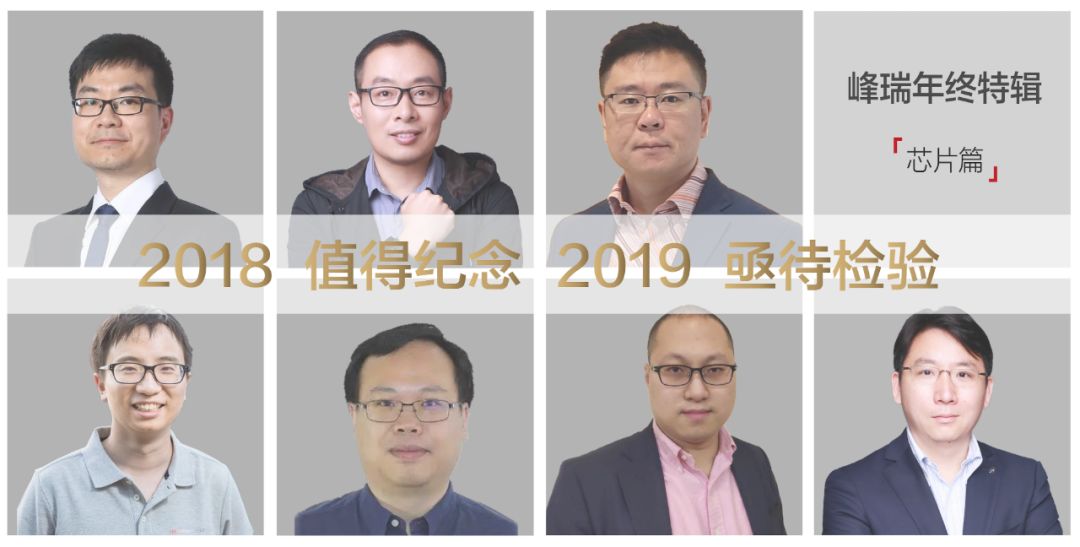
If there were a buzzword ranking for the tech world, "chips" would undoubtedly make the list. Regardless of how complex the causes, and whatever "truths" people have read into this headline-grabbing term — the emotions they've actively embraced or passively had stirred up — one fact remains: after decades of flying under the radar, the chip industry burst into mainstream consciousness in 2018 with unprecedented intensity, bringing with it policy incentives, capital attention, and market shifts.
So what did 2018, just passed, and 2019, just ahead, mean for chip entrepreneurs? How do they view the controversies and heated discussions, and the sweeping changes? How do they confront the gaps and opportunities, and run steadier, faster, and more confidently on this long track? And how do they perceive and respond to the uncertainties facing globalization?
With these questions in mind, we spoke with CEOs from seven chip companies in FreeS Fund's portfolio. Most of their products are at the sample or mass production stage. We hope their answers offer you a closer perspective on China's chip industry.

Q1
How are chips connected to our daily lives? Please use your products as examples.
Feixin Electronics CEO Shuyu Lei: Though chips aren't easily perceived, they're the underlying physical foundation for many applications. Whether it's AI or consumer applications, the underlying layer uses large numbers of components, especially sensor chips. You don't see them, but you're "using" them all the time.
Feixin's main product is 3D camera chips for smartphones. They don't just record objects in space — they also display 3D information like distance and movement speed.
Lightelligence CEO Yichen Shen: We're developing photonic circuits, hoping to replace traditional electronic circuits with them to boost computing power and reduce energy consumption. Higher computing power and lower energy consumption will help machine learning and AI applications reach new levels — more accurate voice translation with shorter latency, faster and safer autonomous driving, and smarter machines overall.
CoreXVision CEO Cheng Li: We mainly develop 3D vision chips. Simply put, we give machines a 3D visual system so they can perceive their real surroundings. This can be used for 3D imaging in phones, as well as in robot vacuums, security monitoring, autonomous driving, and other fields. Recently, we established an autonomous driving joint lab with BAIC Group in Silicon Valley to develop next-generation multi-sensor fusion autonomous driving systems centered on solid-state LiDAR.
Xinyi Technology CEO Jianhong Xiao: Xinyi develops chips for IoT terminals. You can think of it this way: in the mobile internet era, everyone had a smartphone for data exchange. In the IoT era, every object might carry a "phone" to connect to the network — we make the "phone chips" for these objects. The range is broad: wearables, smart medical devices, smart locks, smart home appliances, and even industrial, agricultural, and livestock applications.
NextVPU CEO Xinpeng Feng: While you may see almost no robots around you now, in 15 years they could be everywhere — in various forms like cars, wearables, household robots, unmanned factories, and farms. The future world will have more and more mobile electronic devices that can autonomously perceive their environment. NextVPU provides visual capabilities for these devices.
Duosense Technology CEO Teng Wang: We're a fabless company aiming to provide extremely miniaturized, cost-effective biometric chip solutions. Our first product is an "ultra-thin optical fingerprint recognition chip" for full-screen phones to improve the unlocking experience.
SoundAI Technology CEO Xiaoliang Chen: We mainly provide acoustic voice technology and language intelligence services. A typical application is integration into smart speakers. Our partners include Huawei, Tencent, Alibaba, Xiaomi, 360, and other well-known tech companies.
Q2
What major events or keywords shaped the chip industry in 2018?
(The ZTE incident won unanimously, but it wasn't the only thing on their minds)
Lightelligence CEO Yichen Shen: Two other things in 2018 are worth noting:
- NVIDIA introduced the Tensor Core GPU architecture in its Volta GPU, "equivalent to NVIDIA officially announcing it's making dedicated AI chips"
- Alibaba fully acquired Zhongxing Micro ("Mainland China's only independent embedded CPU IP Core company") and established the independent chip company "Pingtouge Semiconductor"
Duosense Technology CEO Teng Wang: Besides the ZTE incident, there was Jinhua being sanctioned. At the end of October 2018, the US Commerce Department announced sanctions against Fujian Jinhua Integrated Circuit Co., citing threats to US national security. US companies were prohibited from selling software, technology, and products to Jinhua.
Feixin Electronics CEO Shuyu Lei: The core word is "localization."
SoundAI Technology CEO Xiaoliang Chen: There's also the Huawei incident, which is still unfolding.
NextVPU CEO Xinpeng Feng: Within China, definitely the ZTE incident — the state began attaching unprecedented importance to the semiconductor industry. Globally, I'd say AI — AI has driven the chip industry to advance by leaps and bounds.
CoreXVision CEO Cheng Li: Rather than the ZTE incident, I'd call it the US-China tech competition.
Q3
How do industry insiders view the ZTE sanctions and their impact?
CoreXVision CEO Cheng Li: The ZTE incident is just the surface. Essentially, while the trade war may slow, US suppression of Chinese technology is inevitable. My view is that the ZTE incident may just be the beginning of US-China tech competition. Over the next decade, the two countries will necessarily remain in confrontation in high-tech fields, especially in integrated circuit design and manufacturing where we're relatively weak — areas where the US will impose corresponding blockades.
SoundAI Technology CEO Xiaoliang Chen: The "ZTE incident" should be the main reason chip markets received so much attention in 2018. Combined with the escalation of the US-China trade war late last year and the "Huawei incident," the state has also placed greater emphasis on core technology investment, which further drove capital markets' attention to hard-tech enterprises. Many chip companies received funding this year — it's a very memorable year.
Xinyi Technology CEO Jianhong Xiao: We can feel that most investment institutions, customers, and ordinary people have much higher awareness and support for chips than before. However, in my view, the reason for widespread attention is that people always knew chips were important, but never realized it was so urgent. To some extent, last year's external environment changes made everyone realize this must be addressed immediately.
Feixin Electronics CEO Shuyu Lei: I've been in the chip industry for 20 years. While the ZTE incident was absolutely the biggest event of 2018, if we look at it in isolation, it may just be individual corporate behavior. Looking across 20 years, an objective fact is that in the rapidly developing microelectronics industry, compared to international leaders, China lags significantly in core chips and core semiconductor equipment — the gap is large.
Q4
So does China have a chance to make internationally competitive chips?
Lightelligence CEO Yichen Shen: In traditional digital chips monopolized by Intel and others, China has a long road to catch up. One typical reason is the technology blockade against China — for example, 7nm process lithography machines currently cannot be imported to China. This means domestic chip manufacturing technology basically lags two to three generations behind. The ultimate performance of digital electronic chips is directly determined by process technology, which demands very high technical standards across the board. From this direction, it's very difficult for Chinese startups to make globally leading domestic digital chips.
Therefore, our opportunity may lie in targeting new chip technology directions, allowing us to avoid the huge gap in process technology with foreign competitors. For example, analog circuit chips, or optical chips like ours — these technical paths don't depend on process technology, but rather on design and understanding of physical phenomena. This gives us room for innovation.
Feixin Electronics CEO Shuyu Lei: Our gap with the US is in three aspects: first, they started earlier and have first-mover advantage — many chips they began developing three or four decades ago; second, their investment is larger than ours, and they're still increasing investment in key areas; third, their foundations in process, equipment, and all aspects are better than ours. This is a systematic project, not just about chip design. These three aspects are difficult to surpass in the short term — there's not only no possibility of corner overtaking, but basically no possibility of lane changing either.
So opportunities may lie in some distinctive fields that don't rely heavily on process and equipment technology, don't require such massive capital, but place high demands on people and designers' capabilities. In sensor chips, analog chips, and similar directions, we still have considerable potential and can compete with foreign players.
There are also opportunities in application-specific chips, because the technical requirements aren't as high, but they're closer to your application. However, customized chips for vertical segments actually test teams' business sensitivity more — how to improve cost-performance and performance will be where competition is fiercest.
Duosense Technology CEO Teng Wang: In many fields — mobile processors, communications, sensors, biometrics, and more — China has already made competitive chips.
But undoubtedly, compared to global leading chip companies, we still have a large gap. Facing the gap squarely and reflecting on how to cross it is what entrepreneurs must think about.
Xinyi Technology CEO Jianhong Xiao: Chips come in many types: general-purpose, specialized, or for specific applications. China's chip industry development must walk on two legs.
One leg is companies facing general-purpose chips — memory, power consumption, CPUs, storage, and so on. International competitors in this space are extremely strong. To compete here, whether from market environment or resource investment, you need the determination to build an atomic bomb. This isn't something one person or one startup can accomplish in the short term — the task is heavy and the road is long.
The other leg is some specialized tracks. Many small startups are actually positioned here. Without massive state funding, you can't have tens of billions in investment from the start. In this situation, you must tightly integrate your technical advantages with industrial application needs, taking a differentiated route. Making competitive chips in such arenas is beyond doubt.
Opportunities definitely exist, but patience is essential. More effort is needed in strategy formulation, market grasp, technology investment, and talent acquisition.
CoreXVision CEO Cheng Li: The design thinking for integrated circuits and software is actually similar — both use top-down design: first understand customer needs in the market, then define a product's parameters and performance accordingly, then define the entire chip, divide into subtasks, and have designers complete them one by one. As long as we change some unscientific design habits, supplemented by advanced management and excellent talent, this industry will certainly develop positively.
So for whether China can make competitive chips, my answer is affirmative, and the opportunity is large.
China is a massive market. According to customs data released in January, in 2018, China's integrated circuit imports exceeded $312 billion, up 19.8% year-on-year. With such large import volume, if China can first achieve self-sufficiency in mid-to-low-end integrated circuit chips, we could capture at least about one-third of import volume. Completing this阶段性超越 would help the domestic integrated circuit industry rapidly build a good industrial chain cycle.
Another advantage is China's very strong system integration capability. If integrated circuits can form a certain ecosystem, Chinese products' competitiveness in the global market will be greatly enhanced — this also aligns with our country's direction of developing from low-end to high-end manufacturing.
Q5
How do you view domestic chip industrial chains, talent, and policy?
Duosense Technology CEO Teng Wang: The industrial chain is quite complete. Duosense is headquartered in Suzhou, and within 100 kilometers we have almost all the resources we need. Everyone in the chain moves fast, but many links still lack accumulation and are relatively rough. Talent is the biggest problem — all types and levels of talent are lacking. Policy can only add icing on the cake for enterprises; it can't improve core product strength and competitiveness, so we're not particularly focused on policy.
Xinyi Technology CEO Jianhong Xiao: The chip industrial chain is better than I imagined — increasingly mature, you could say. Upstream and downstream in the chain, from tooling and testing to processing, and even customers, are internationalizing. If they can't internationalize, they have no future.
But the talent gap is still quite large. Talent comes in many layers. Top-tier talent requires rich work experience — currently this type is very scarce in China. Chip companies also need large numbers of foundational talent, but a challenge for startups is that most of these people are recruited by large companies like Huawei. Moreover, even if you can recruit many excellent people, how to get these capable individuals together to maximize their effectiveness is also an important challenge.
Regarding policy, frankly, having policy support is definitely good — icing on the cake. But startups must always do well themselves first.
Q6
For the highly globalized chip industry, how to respond to geopolitical factors?
Xinyi Technology CEO Jianhong Xiao: Competition in the chip industry has always been international. We often talk about domestic substitution, which comes from multiple considerations. For chip companies, even at the startup stage, you must clearly understand how many global players there are, their levels, and your relative advantages. You must think deeper and longer-term. If you just define yourself as a small Huaqiangbei enterprise, elimination is inevitable.
While startups often face disadvantages compared to international giants in talent reserves, brand, and intellectual property, local opportunities are also large. For example, many downstream equipment manufacturers also have ambitions to go global. When they compete with overseas peers, they often have unique chip needs that we can actively follow and satisfy. Also, against the backdrop of domestic manufacturing industry upgrading, manufacturing leaders that first rose through demographic dividends or OEM work need to upgrade and necessarily need component companies to provide more ammunition — this is also an opportunity for local chip companies to go overseas together with partners from different industries.
Lightelligence CEO Yichen Shen: Chips should be an international business. Whether design or packaging, various links often involve global cooperation — wherever there are better resources and technology, that's where you do it. The notion of upgrading the entire domestic chip industrial chain is really more of a consideration under trade friction circumstances.
I have two companies — Lightelligence and Lux Labs. Though Lux Labs was founded in the US, it has now moved back to China. Its main business is making optical materials. Because it doesn't involve cutting-edge R&D, it doesn't particularly depend on American things. So whether from manufacturing costs, talent reserves, or policy support, developing in China is faster and better. But for Lightelligence, we still choose to remain in the US, because in the chip industrial chain, especially in process technology, China is still very immature.
CoreXVision CEO Cheng Li: Technology should be shared by all humanity. Take us as an example: theories like optical variation theory, integrated circuit theory, analog circuits, and digital circuit theory — most of these foundational theories we learned while studying abroad. But relying on these foundational theories, we returned to China to innovate, and all intellectual property belongs to Nanjing CoreXVision, belongs to the domestic company.
But we also established an R&D center in Silicon Valley, which has attracted many integrated circuit designers from American chip companies with over ten years of experience.
Q7
How do you view 2019 for the chip industry?
Lightelligence CEO Yichen Shen: A critical year. One, the US-China博弈 may directly affect the chip industry — how far domestic chips can develop, whether it's possible to make our own lithography machines.
For us, in 2019 we'll launch initial optical chip samples, hoping to intuitively verify that the optical chip path is superior to electronic chips. If results are good, it will bring relatively large impact to the entire industry, especially the AI chip sector.
Feixin Electronics CEO Shuyu Lei: The industrial environment in 2019 is definitely continuously improving. First, there are many large domestic customers — whether in phones or security, market demand is large. Upstream and downstream in the industrial chain, whether foundries, packaging, testing upstream, or downstream supporting companies, are also increasingly完善. In terms of capital, investment in the chip sector has also become much more active.
But an important point is that making chips is definitely a very long-term entrepreneurial endeavor. Compared to other business model startups, chip startups require larger upfront investment and longer development cycles. So in 2019, there won't be any sudden changes in the chip industry landscape — it注定急不来.
If you just hope short-term policy will bring you much help, you definitely won't achieve good results. Having policy is of course good, but what lies before you is a protracted war, so you can't rely too much on short-term positives. Some views think that once the state advocates vigorously developing the chip industry, there will be major takeoff in three years — to me that's basically bullshit.
Xinyi Technology CEO Jianhong Xiao: My feeling is that in 2019, many chip startups may be eliminated due to fierce competition.
In China there are actually large numbers of chip design houses, possibly just a few people working, with not very strong product competitiveness and not high gross margins — such enterprises will face great challenges. On the other hand, some chip companies that have remained distant from applications will also be screened out.
NextVPU CEO Xinpeng Feng: In 2019, the chip industry should continue to be hot, and become even hotter. Specifically for AI chips, next year is the key year to watch for落地. In 2018, many companies were still telling stories, writing PPTs, pushing forward. But from the second half of 2018 into 2019, people began needing to hand in their papers — they need to produce chips that actually work, prove their capabilities, and advance together with customers. So 2019 to 2020 is basically when we'll see commercial落地 and large-scale industrial落地.
CoreXVision CEO Cheng Li: In Europe and America, chips are monopolized by large companies with relatively stable situations. But China currently has no integrated circuit design giant. Though Huawei HiSilicon does relatively well, it only makes specialized chips for Huawei phones. Integrated circuit chips come in numerous varieties, so in China, I believe it will be a scene of百花齐放 among small companies. For a certain type of chip, several small companies may be working on it, and outstanding performers will necessarily emerge.
On the other hand, where will our country's entire integrated circuit industry develop? Very likely like Europe and America, with a wave of large companies acquiring small ones, eventually forming massive groups owning hundreds of types of integrated circuit businesses. Only at this scale can we compete with European and American integrated circuit giants.
Q8
What do you think of the notions that "models are cooling while hard tech rises" and "capital winter"?
Duosense Technology CEO Teng Wang: Innovation is an abused word. I very much agree with Linus Torvalds' (creator of Linux and Git) view on innovation: innovation is getting the work done. So whether model innovation or technology innovation, what matters is solving specific problems. Innovation that solves problems and meets needs will have commercial value.
As for "capital winter," I think in industry, commerce, and life, problems constantly emerge. Startups that can discover and solve problems will survive and grow; those that can't solve problems, or only solve pseudo-problems, will die.
Feixin Electronics CEO Shuyu Lei: Over the past 20 years, whatever the winds, spring or winter, I've only done one thing — chips. I've always worked on very底层 technology, so hard tech is my daily life. We don't pay much attention to trends because we always have enough problems before us that need solving.
Chip entrepreneurship can't be too急功近利. This industry is hard to take public in three or four years like model innovations. What often drives us isn't financial freedom or IPO, but creating value and contributing to society.
SoundAI Technology CEO Xiaoliang Chen: Technology innovation and model innovation are interdependent. Model innovation is relatively nimble and quick with faster monetization, while technology innovation is more difficult and has longer cycles. When technology innovation matures, model innovation can quickly gain commercial returns on that foundation. But if you only pursue model innovation, the market easily loses its foundation and basic momentum.
Regarding "capital winter," I think there are entrepreneurial opportunities at any time, but entrepreneurship must read the rhythm correctly — it's better to have accumulated conceptual or technological innovation before trying. Indeed many great companies rise wave by wave, related to economic cycles. But each wave has produced many great enterprises, so every economic cycle is actually a golden age for entrepreneurship.
Xinyi Technology CEO Jianhong Xiao: From the innovation perspective, previously you didn't need to make major technical changes — innovation in models alone could achieve great success. But when society develops to a certain stage and model innovation hits bottlenecks, you must return to essence and rely on technology to improve productivity — this is so-called "technology innovation." In my view, society's spiral ascent almost always results from the alternating roles of model innovation and technology innovation.
"Applications determine technology development direction; technology development extends application boundaries." As a chip company, undoubtedly the chips we develop must serve applications. But more importantly, we must seek more breakthroughs in key technologies to help applications leap to new scales, and on that basis facilitate new model innovations.
Regarding winter, different individuals perceive different degrees of cold. I think "winter" filters out some market noise — truly competitive teams and applications with real needs will stand out.
NextVPU CEO Xinpeng Feng: Unlike model innovation, technology innovation's foundation is technology. Historically, technological evolution requires certain accumulation, requires relatively sustained investment, requires perseverance in drilling deep in one direction — so its threshold only gets higher.
As for "capital winter," globally it's not so bad — it's more of a domestic saying. Entrepreneurship's risks were already relatively high. The so-called winter is just a process from overheating to normal. I don't agree with the "end of entrepreneurship's golden age" notion. Because in any period, under various environments, there are always opportunities. Entrepreneurship itself is about changing current conditions, making the world better. And the world can never be perfect — there's always room for improvement and perfection, and these imperfections mean opportunities.
Lightelligence CEO Yichen Shen: I mainly do technology entrepreneurship; I've never done any model innovation. Regarding hard tech and model innovation, first, hard tech definitely has enormous value. But we must also recognize that many technology innovation teams have excellent technology but aren't good at business. This reminds me of a debate topic at a public event — whether technology or sales is more important. My view is both are important, neither can be missing.
Summary
1 "Chips" may sound高冷, but they're actually quite close to our lives — the underlying foundation for many applications.
2 Because of the ZTE incident, the chip industry began attracting more attention from ordinary people. Policy tilts and support are beneficial for enterprise development, but we must face squarely that policy is icing on the cake. The gap between current domestic chip industry development and international advanced levels remains significant. In the future, US-China tech competition will intensify.
3 Though gaps exist in all aspects, China absolutely has the capability to develop world-leading chips. Opportunities for domestic startups lie in:
- Breaking through in some new technology directions
- Distinctive fields that don't rely heavily on process and equipment technology but value designers' capabilities more
- Customized chips for specific application scenarios
- Vertical chips for segmented markets
4 Whatever the variables, choosing chip entrepreneurship means choosing a protracted war. For many practitioners, 2018, accompanied by various泡沫 amid trade war winds, brought new development opportunities to the chip industry. 2019 will be the critical year when PPTs become products, when the market urgently needs real验证. The market will grow larger, the industrial chain is also moving toward完善. In this process, startups need persistence and patience, and also need to work harder on strategy formulation, market grasp, technology investment, and talent acquisition.
5 Solving real problems and meeting real needs never goes out of style. Such innovation is seasonless.
Feel free to share to Moments. For republication on other official accounts, websites, or mobile apps, please reply "reprint" to learn reprint rules, and contact "Feng Xiaorui" (id: freesfund) for authorization. Copyright belongs to FreeS Fund.