2020: Consumer Goods Entrepreneurship Enters an Era of Multiple Simultaneous Drivers | Frees Fund

How does content drive brand growth? Let's talk in person this Saturday.

From Kuaishou, Douyin, Bilibili, and Xiaohongshu to today's livestreaming, "redistribution of dividends" has been the defining keyword of the consumer goods industry over the past two years.
"At the time, I hadn't fully realized how much the rise of content platforms — especially video — over these two years would drive growth across the entire consumer industry," recalled Huang Hai, executive director at FreeS Fund, of his mindset in 2018.
But as major brands grew familiar with the playbook, the low-hanging fruit gradually disappeared. What new changes will emerge in the consumer space in the second half of 2020? What will be the new growth keywords for consumer enterprises?
Recently, at a members-only event hosted by Langchao Xin Xiaofei (Wave of New Consumption), Huang Hai, executive director at FreeS Fund, spent over an hour in deep discussion and Q&A. Drawing on cases including Li-Ning, Saturnbird, and Perfect Diary, he explored how traffic dividends had emerged over the past two years and what new paths consumer entrepreneurship would take in 2020.
Huang focuses on consumer and retail investments, leading and participating in deals for Club Factory, Saturnbird, VPhoto, and others. He has conducted extensive research on how consumer brands get off the ground, scale up, and how content dividends have evolved.
In his view, 2020 will mark an era where multiple growth drivers operate simultaneously for consumer entrepreneurship. Content dividends gave brands the opportunity to rise from zero to one, but going forward, the decisive factor for long-term success will be the overall closed-loop efficiency of customer acquisition, product, and supply chain.
Below are selected highlights from the event, offered in hopes of sparking fresh perspectives.
Event Preview
This afternoon (June 6), we're hosting a closed-door gathering for consumer entrepreneurs in Beijing. Huang Hai will be joined by four or five brand founders with deep experience across different categories and stages, for in-depth discussion on how consumer startups can find defensible advantages. We also welcome founders and executives with perspectives on branding, distribution, and content traffic to participate deeply.

(Welcome to scan the QR code to register 👆, see you in Beijing on June 6)

2020: Traffic Dividends Enter Their Final Phase — FreeS Fund's Huang Hai on Where Consumer Companies Go Next
Source: Langchao Xin Xiaofei (Wave of New Consumption)
Speaker | Huang Hai Transcription | Cao Rui
Hello everyone, I'm Huang Hai from FreeS Fund. We've been investing in new consumption since 2015, with consumer brands as my primary research focus.
At the time, far fewer institutions were paying attention to early-stage consumer investment opportunities than today. But over the past year, the entire consumer industry has been heating up continuously, and new consumption has become a mainstream focus for many funds this year.
What changed during these years? FreeS Fund is now five years old. We've invested in various projects and witnessed the development of the consumer industry as a whole. So I'm especially glad to partner with Langchao Xin Xiaofei today to share with you:
How do we view the consumer industry? What happened in 2018 and 2019 to create more opportunities across the sector? And in 2020, will these opportunities continue to expand, or have we reached the harvesting stage?
/ 01 /
2018–2019: The Rise of Content Platforms and the Birth of Dividends
▍Where lies the opportunity for consumer goods to stage a comeback?
Consumer goods wasn't actually a sector that mainstream VCs paid much attention to, because it's historically been an industry where the strong get stronger. What does that mean?
Procter & Gamble has been around for nearly 150 years, Coca-Cola for over 100, Nike for more than 50. Starbucks is the youngest member of the US hundred-billion-dollar consumer club, and even it has over 30 years of history.
These companies rolled their snowballs down long slopes to reach their hundred-billion-dollar market caps today.
They've long since exited the primary market and entered the realm of secondary market investing — which is why investment masters like Warren Buffett have substantial portions of their portfolios in consumer goods.
It's a winner-takes-most industry because on such a long slope, snowballs only get bigger. But VC is the business of finding disruptors — so where exactly lies the opportunity for an underdog comeback?
Our answer goes like this:
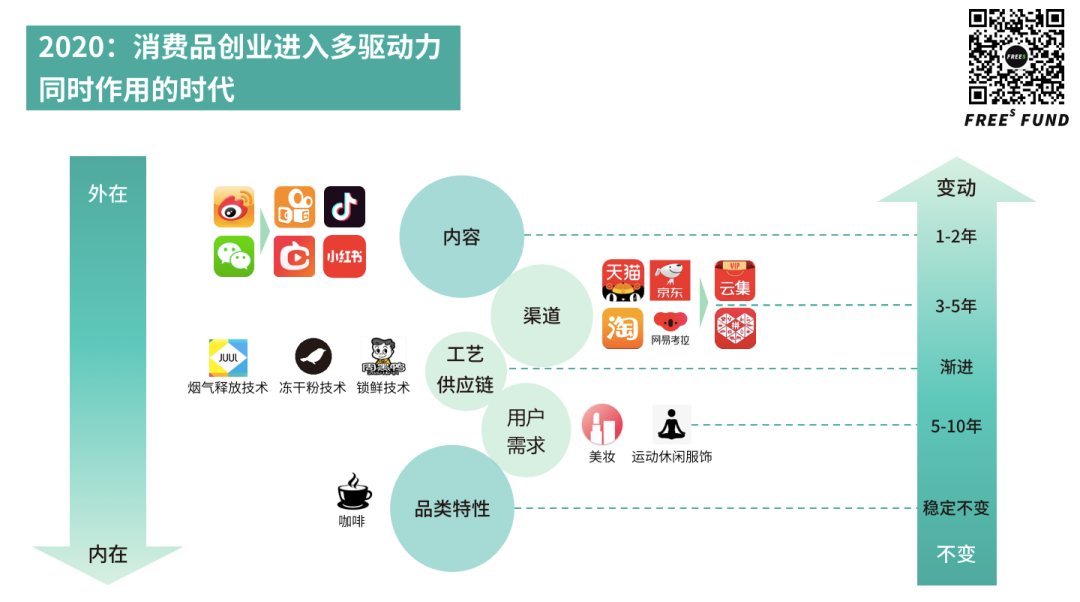
The consumer goods industry contains countless upstream and downstream links and variables. When certain variables in this system change suddenly, they typically create opportunities for latecomers to rise quickly. If such changes don't exist or happen very slowly, incumbents just keep getting bigger.
Take the most typical example: when you first start looking at the consumer industry, many people will tell you that controlling offline channels is the key to success. This remains true today, since offline still accounts for over 70% of China's total retail sales.
But looking back, where has the incremental growth been in recent years? Online. If online growth is fast enough, opportunities emerge for latecomers to rise from small to large.
When did this first wave occur? 2013 to 2015 — what we call the channel dividend. If you look at P&G's financials, you'll see their growth was sluggish in 2014 and 2015, because as Tmall rose, many emerging brands began rising online.
Including Three Squirrels, which FreeS invested in — it seized that previous wave, the rise of Tmall, from 2013 to 2015, and has since become a company with over 10 billion RMB in sales and a market cap exceeding 30 billion.
But pure channel change, namely the rise of the Tmall platform, is already history. So what was the variable starting from 2018? The rise of content platforms: Douyin, Kuaishou, and Xiaohongshu.
If you go back two years, few people knew who Austin Li was. Go back six months, and he had become an IP known across all of China.
All this happened incredibly fast. In 2018, the industry wasn't actually that hot.
At the time, I hadn't fully realized how much the rise of content platforms would drive growth across the entire consumer industry, creating such a massive dividend period in such a short time.
This was the second major driver well-suited for new consumer brands to rise quickly in a short period, following the channel dividend brought by Tmall's rise in 2013 and 2014.
We pay attention to the development of various variables simultaneously — channels, supply chain, changes in user demand, growth of categories themselves, and so on. But without question, in 2018 and 2019, the variable that drove the industry most powerfully was the rise of content platforms.
Thinking & Interaction
Q: How do you judge whether a company's product innovation capability is sustainable? Welcome to hit "Like" at the end of this article, and reply "innovation" in the WeChat official account backend to learn our preliminary answer.
▍The essence of dividends is a wave of efficiency upgrades
What specific help did this bring to the consumer industry?
First, definitely traffic dividends. Small brands may not have many followers and can't afford expensive KOLs, but Douyin is an excellent "megaphone" because its传播势能 can be disproportionate to follower count.
With traditional TV advertising, whoever had more money could influence more people. A small brand could never out-advertise P&G on television. Your budgets weren't on the same level, so neither was your influence.
But the rise of content platforms gave consumer brands a new opportunity. Even without much budget, you might go viral from a single piece of hit content — a crucial change in the entire ecosystem.
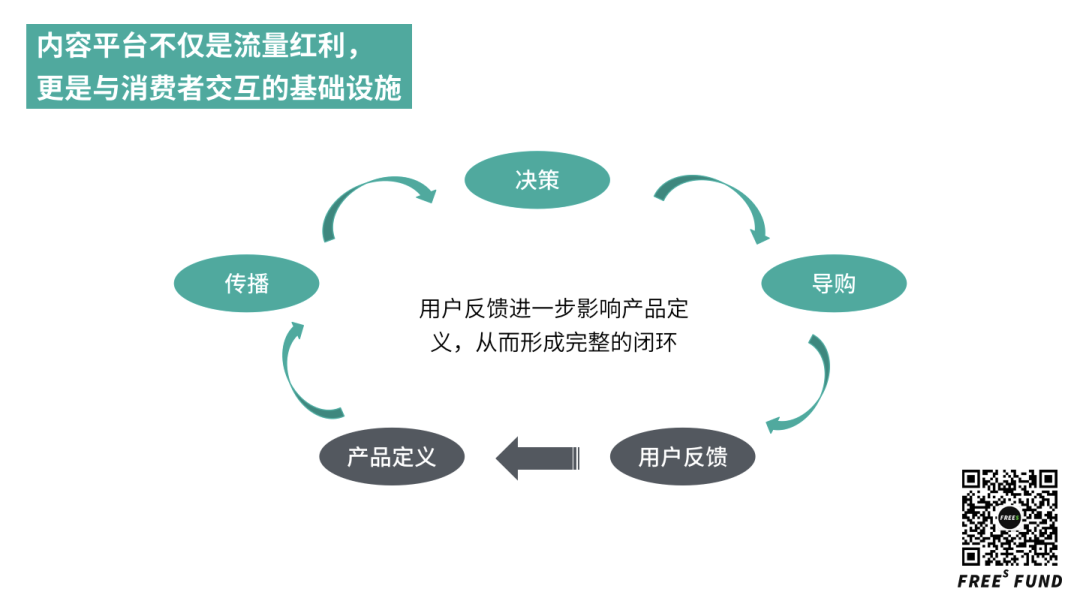
Second, decision-making. For some products, the path from discovery to purchase is extremely fast. On Douyin, the best-selling items are in the 50–80 RMB range, because you don't need to think too hard — you watch the video, find it novel and interesting, and buy on impulse. What you see is what you get, with extremely high closed-loop efficiency.
But for other products, beyond discovery, users need to do some research and deliberation before buying. Before Xiaohongshu, how did we make these decisions? We'd ask people, read reports.
Of course, Xiaohongshu has plenty of sponsored posts too, but undeniably, its UGC content can greatly improve user decision-making efficiency. What made Xiaohongshu worth billions of dollars is precisely how tightly its community content connects with purchase decisions.
Third, sometimes beyond discovery and decision-making, you need someone like a专柜姐 (counter sales associate) to tell you what's great about something. You might not have intended to buy, but the more you hear, the more interested you get. Plus the livestream atmosphere is electric — when everyone's buying, you easily get swept along.
The most successful livestreamers in China today aren't internet celebrities by background. Austin Li used to sell lipstick at a counter, so his product knowledge exceeds that of typical influencers by 100 times. Viya ran offline stores from the mid-2000s and started her Taobao shop around 2011–2012, so she knows her merchandise deeply.
So livestreaming is essentially the digitization of in-store sales guidance. Livestream content platforms gave people like Austin Li and Viya — who have professional sales skills — space to exercise their talents, letting them serve national consumers instead of just a handful.
I watched the Thirteen Invitations episode where Xu Zhiyuan interviewed Viya. One line stuck with me deeply. Xu said to her: "There are many capable people in the world, but your greatest luck is that your abilities happened to align with what the times demanded, which is why you've achieved such enormous success."
Actually, discovery, decision-making, sales guidance — these have always been part of the consumer shopping journey. Counter associates have always existed, as have shopping directories. It's just that Douyin, Xiaohongshu, and livestream platforms have made these steps more efficient.
And in this wave of efficiency upgrades, new companies react and move faster than big corporations — which is why opportunities arose for new brands to rise.
▍With Douyin's rise, which consumer companies benefited most these past two to three years?
I'll spend the first third of my time explaining how these platform dividends emerged, and the remaining two-thirds on the post-dividend era — what comes next.
Let me finish the origin story first. Every platform has its follower-growth dividend. If you were writing on WeChat Official Accounts in 2015 or 2016, you could gain massive followings through articles alone. By 2017, once growth plateaued and monetization became the priority, the dividend shifted to paid advertising.
So the advertising dividend always arrives slightly after the follower-growth dividend. When was Douyin's follower-growth window? Roughly 2018 through the first half of 2019. But because the platform was so large, and livestream commerce emerged as a new format in 2020, the tail end of that dividend persisted.
A dividend is like a hidden pool — you can swim comfortably while nobody knows about it, but once everyone piles in, it gets crowded, and the advantage gradually dissipates.
Every content platform's rise follows this developmental arc. So as Douyin surged these past two to three years, which external company benefited most?
My answer: Perfect Diary. In 2016, it was still an angel-stage startup. Four years later, it was a unicorn valued at over $2 billion.
And it wasn't just Perfect Diary. 2018 to 2019 were banner years for the cosmetics industry overall, color cosmetics especially. The entire intermediary chain spawned countless MCNs, livestreamers, and brand companies — the platforms themselves got their cut too.
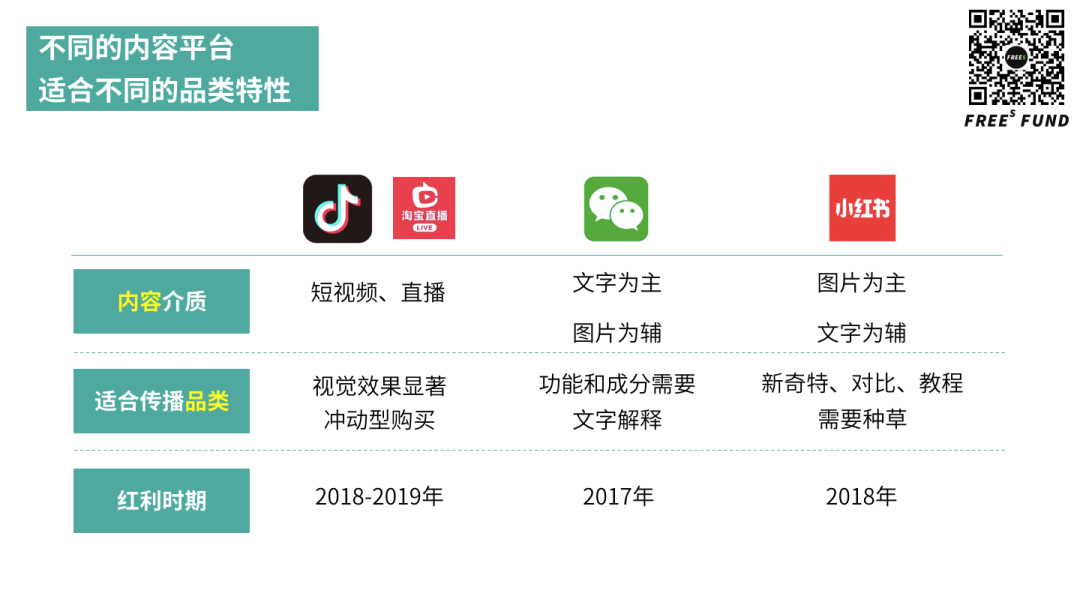
Why cosmetics? Because its category characteristics genuinely align most tightly with short video.
The before-and-after makeup transformation delivers dramatic visual impact. The price points are appealing — Perfect Diary sold lipsticks for as little as RMB 9.90. These factors made cosmetics the industry best positioned to ride short video's rise.
A quick aside on WeChat Official Accounts. This text-primary, image-secondary format actually suits explaining functions and ingredients well — HFP (HomeFacialPro, a skincare brand) rode that wave to rapid growth back in the day. But that dividend faded earlier.
By contrast, Xiaohongshu is image-primary, text-secondary — though video has emerged too. Its defining trait is "planting seeds" (zhongcao): color shade comparisons, eyeshadow application tutorials. This instructional content performs better in image-centric formats.
That's the most common content you'll see on Xiaohongshu. So whether Xiaohongshu or short video, both mesh exceptionally well with cosmetics as a category. Combined with high gross margins, this drove the industry's leapfrog growth these past two years.
This was always a game with clear targets. From 2018 onward, peaking in 2019, and continuing into this year as players hunt for the next dividend — Kuaishou, Bilibili, and others.
That covers the backstory. Now for what matters most: what's different in 2020?
02
2020: Dividends Enter Their Final Phase, Where Do Consumer Companies Go Next?
Consumer entrepreneurship enters an era of multiple simultaneous growth drivers
In 2020, the first shift is that distribution dividends on new platforms — traffic dividends — have reached their mid-to-late stage.
One clear signal: major corporations have woken up to these opportunities. Once they charge in, that advantage stops being exclusively yours.
But there's good news too. Previously, it was hard to tell whether a company was succeeding because of genuine capability or simply riding a massive wave. Now, with dividends in their late stage, you can no longer build something meaningful on wave-riding alone.
You'll find that in 2020, consumer entrepreneurship has entered an era where multiple drivers must work simultaneously. Single-point breakthroughs are no longer enough to build a strong new consumer brand from scratch.
Maybe you're exceptional at Douyin, at livestreaming — but who isn't these days? Consumer brands line up daily outside Austin Li's office for meetings, and giants like Estée Lauder and L'Oréal are in the queue too. When I visited his company, cardboard boxes of merchandise carpeted the floor so densely you could barely walk the hallways.
You might fight your way in, pay hundreds of thousands in slotting fees, plus 30%+ revenue share, just to get on his livestream — but how does that differentiate you from anyone else?
These past two years, many approached problems with a single-point-breakthrough mentality: chase whichever dividend looked largest.
That doesn't work anymore. Breaking through on one dimension alone is now impossible. You need a systems lens — examining whether content, distribution, manufacturing, user needs, and category dynamics are mutually reinforcing, constructing a positive feedback loop.
I'll simplify this into three links: customer acquisition, product, and supply chain. Whether you can achieve breakthrough innovations across all three becomes the key to building systemic competitive advantage.
So today becomes a contest of comprehensive capabilities. Much of what I've discussed relates to customer acquisition — these channels still matter, livestreaming remains essential. But you can no longer treat them as your secret weapon; they're simply one component of the system.
Event Preview
(June 6) This afternoon, we're hosting a closed-door consumer entrepreneurship gathering in Beijing. Huang Hai and four to five brand founders across different categories and stages, with deep operational experience, will explore how to identify systemic competitiveness in consumer entrepreneurship. We sincerely invite founders and executives with perspectives on branding, distribution, and content/traffic to participate in depth.
(Scan to register 👆 — see you in Beijing on June 6)
Customer acquisition innovation VS product innovation
Within the operating system of a consumer business, different industries require different emphases. I'll roughly divide them into two categories:
The first is industries with relatively mature supply chains — cosmetics being the clearest example. Opportunities here typically stem from front-end changes.
Take cosmetics: run through Guangdong and the Pearl River Delta, and you'll find factories everywhere. Production holds no proprietary secrets; you won't find opportunity in the back-office. In such industries, supply chain has become platformized.
The front-end shift is clear: more young women are embracing makeup, layered with the customer-acquisition dividends I described — together, these rapidly unlocked category growth.
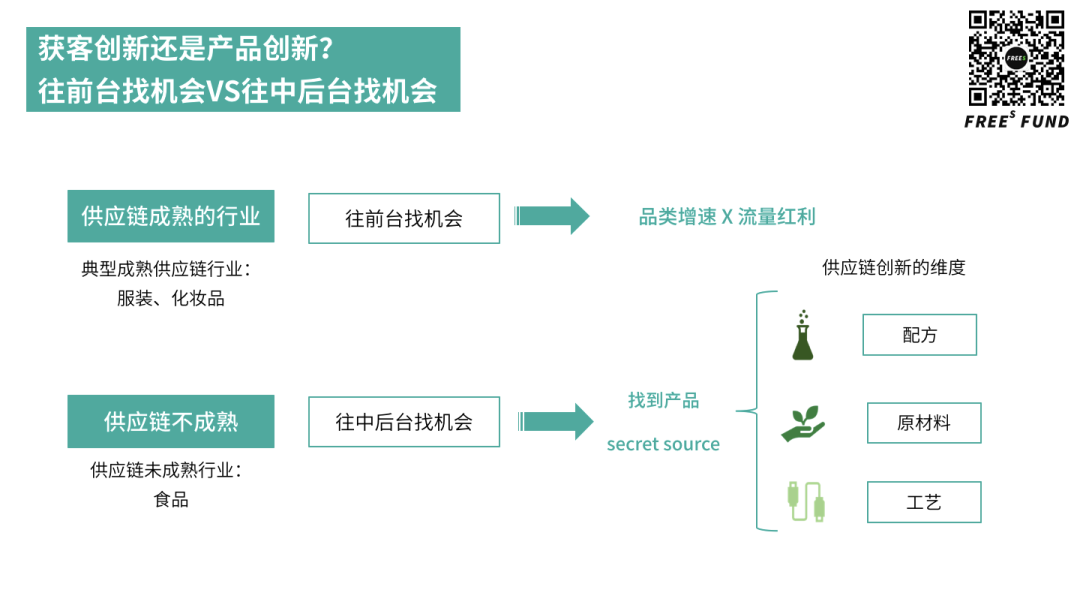
The second category, by contrast, is industries with immature supply chains — food and beverage, for instance. Take NFC juice: entrepreneurship in this space began roughly six or seven years ago, yet no brand has achieved major scale to this day.
The core reason is supply chain immaturity — extraction and preservation during production, cold chain logistics, and more. Stable supply isn't a generic resource you can source easily. So companies have opportunity to find proprietary, defensible advantages in the back-office: product formulation, raw materials, processing techniques.
This exclusivity won't be Nobel Prize-level — something no competitor could ever replicate — but it can at least be a meaningful advantage for a meaningful period.
Three dimensions of product differentiation
I've spoken extensively about customer acquisition; now I'll focus on product. Product differentiation has three dimensions:
First, identify an empty price band. Take coffee: Starbucks at RMB 30, Luckin Coffee at RMB 10-20, and below that Nestlé at RMB 1. Who can own RMB 5-8? That's price-band differentiation. Saturnbird carved out an e-commerce-appropriate price band.
Second, consumption scenario differentiation. Starbucks carries business and spatial experience attributes. Luckin's scenario is more office-building focused — many locations close by 7 PM.
Saturnbird's scenarios are more everyday: at home, or traveling on business or vacation, when you want coffee but don't need space and can't easily order delivery. So it uses FMCG format to serve these needs.
But FMCG is merely the surface. Fundamentally, Saturnbird created a new coffee consumption scenario better suited to certain user situations — distinct from every major incumbent.
Third, functional design. Saturnbird dissolves in cold water with excellent solubility, no stirring required. From a product perspective, "dissolves in cold water, no stirring needed" is more compelling and scenario-flexible. But this requires supply chain support — a great idea you can't manufacture is worthless.
This is the classic case of optimizing product and supply chain simultaneously. Start from the user: what do they need? Then work with your supply chain to grind out the product.
So from a product lens on systemic competitiveness, different differentiation methods yield numerous breakthrough points. And crucially, product breakthroughs themselves aid customer acquisition.
Dividends expire; products don't
- Li-Ning: brand upgrade through product
This is what I often mean by "product is content." Li-Ning executed this brilliantly, almost by accident. They needed product for New York Fashion Week, so they developed a collection.
The "China Li-Ning" concept wasn't originally intended for mass production — it was created to showcase Chinese branding at an international fashion event.
But the product ignited on social media. Young people's patriotic sentiment ran high; they bought deeply into the China Li-Ning narrative.
It instantly became powerful shareable content, even driving substantial brand upgrade for Li-Ning overall.
For Li-Ning the company, this became a larger opportunity than anticipated. It eventually evolved into a standalone brand with its own stores, able to enter higher-tier shopping malls.
Meanwhile, China Li-Ning products command higher prices and project greater fashion-forward, streetwear energy. This product differentiation created a genuine brand upgrade opportunity — Li-Ning's stock rose dramatically in 2019.
Throughout this, Li-Ning wasn't operating with a dividend-capture mindset. They simply built a product — but that product generated powerful content distribution and brand upgrade effects, yielding unexpected customer acquisition results.
- HEYTEA's three product lines
HEYTEA is also exceptionally good at this. Why does everyone consider HEYTEA a strong brand? Because it pays attention to so many touchpoints across its entire system.
HEYTEA's founder once told me his company had no marketing department. I puzzled over that for a long time — how could a company with such brilliant marketing not have a marketing department?
Later I realized: he meant they had no department focused on external ad placements or coupon campaigns. Instead, they had a robust content and creative team. In other words, HEYTEA creates content and does marketing in tandem with product development, not through paid media and promotions.
Marketing from a content perspective is tightly integrated with the product. Take HEYTEA's collaboration with Yakult last year — they created an oversized Yakult bottle at the product design level, so users would want to photograph and share it the moment they bought it. Or their drinkable mooncakes — both are creative concepts that stuck with me as a consumer.
Are these marketing activities or product activities? In some ways you can't tell the difference, but fundamentally they originate from product.
From this angle, HEYTEA actually has three product lines. Beyond beverages, its stores, official accounts, and mini-programs are all part of the product.
When your official account pushes coupons daily, it's not a product — that's customer acquisition. But when you're daily sharing design philosophy, brand spirit, and IP meaning, that's more like building a product.
Because these aren't ads; they're simply stating facts. The same applies to stores. Starbucks designs stores for socializing, but HEYTEA designs stores more as content vehicles.
Think about it — have you ever met someone at HEYTEA and chatted for hours? Probably not. Their store design prioritizes shareable visuals over lingering conversation.
All of this represents the fusion of product and customer acquisition. From a systems perspective, consumer brand building is no longer a game of single-point breakthroughs.
This year, you must view it as a system: customer acquisition, product, and supply chain are interconnected and mutually reinforcing. When you link the entire chain together, your competitive advantage multiplies, and competitors must break through every link to challenge you.
- Saturnbird: Product solving customer acquisition from day one
Saturnbird is another classic case. Early on, it cultivated hundreds of seed users on Xiachufang to help define the product. So for consumer companies, content platforms aren't just growth tools — they're also tools for understanding user needs and defining products.
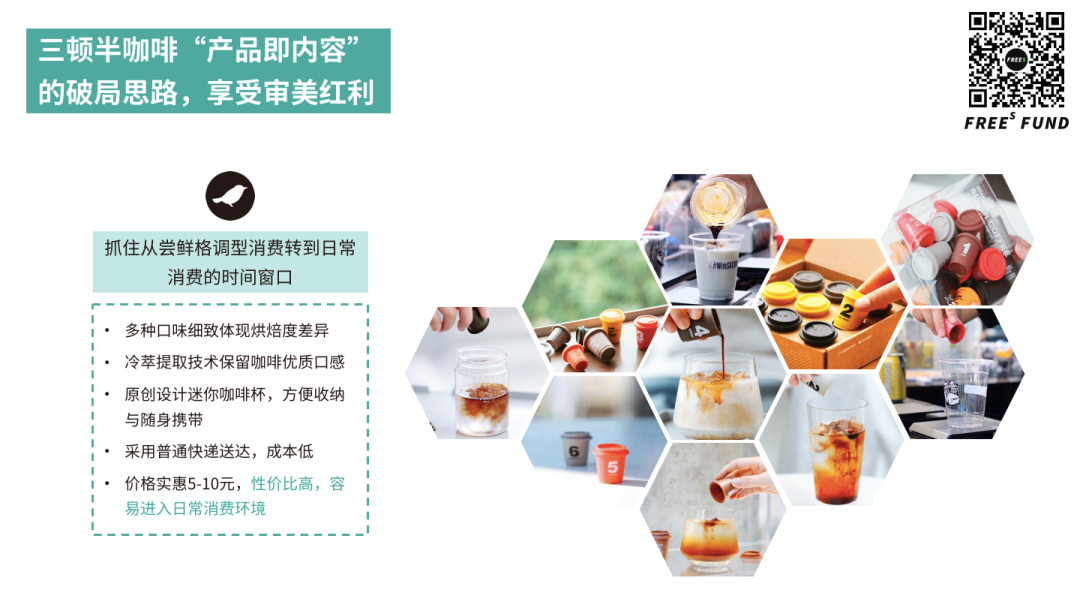
When leveraged well, what you gain from the platform far exceeds growth alone. You'll find the entire product was iterated this way — much like the internet product thinking that was popular in recent years, where everyone discussed how to build internet products, how to develop MVPs based on users, and how to iterate in small steps.
Consumer brand building can apply the same thinking. Why can Saturnbird turn its product into content that people actively share? Because the product was co-created with users. Those attractive images and designs weren't made in isolation — they were iterated step by step.
I think this is worth learning from because it fundamentally has nothing to do with platform红利. Anytime you focus and commit, you can do it well. Taste, cold extraction technology, packaging design, pricing, flavor profiles — all can be approached with internet-style iteration.
For consumption methods, it works with ice water, iced milk, and more. For packaging, Saturnbird's empty cups are sold on Taobao — meaning the packaging itself has standalone value. Its use cases are also diverse: outdoors, photo shoots, hiking, travel.
So differentiation across every dimension of the product chain is critically important today. It also improves "photo-worthiness," solving your initial customer acquisition challenge.
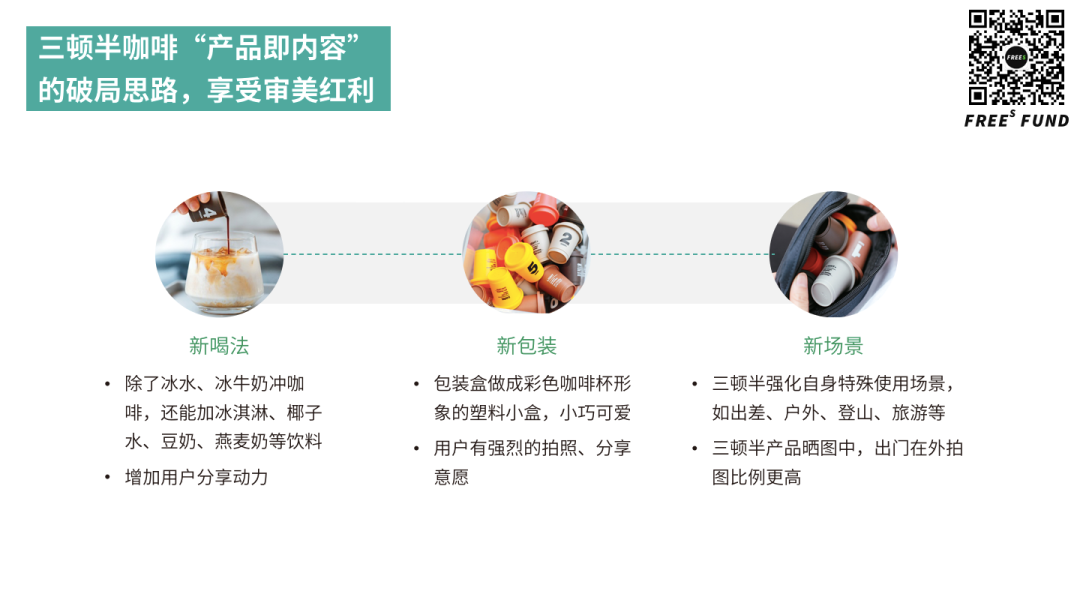
Many people ask me how Saturnbird does paid promotions on Weibo. At this point, Saturnbird hasn't done large-scale paid media or marketing. Most comments and photo posts on Weibo are organic, user-generated content.
In this process, you'll find its advantage doesn't come from platform红利, but from product. Platform红利 has time limits; product doesn't.
Too many people focus on traffic红利 now. The traffic perspective isn't wrong — while红利 still exists, it's also a solid investment logic.
But what I want to emphasize is: if you approach value creation from a systems perspective, from product and supply chain angles, you can acquire customers effectively even when traffic红利 disappears. I've always said companies like Saturnbird enjoy an "aesthetic红利."
To summarize: when your product is well-made, you get organic user-driven传播. As customer acquisition volume grows, it creates reverse pressure to improve supply chain. Increased production capacity then provides more stable support for product.
Once this virtuous cycle among the three is established, the company becomes a self-reinforcing system. Saturnbird is still on this journey — the loop has just completed one cycle, because it should be a spiraling, continuously innovative process.
If it can keep spiraling upward, your product matrix grows increasingly robust, and brand influence keeps rising.
From a systems perspective, pursuing self-reinforcement within the system —切入 from one point to drive coordinated螺旋上升 across other links — is how I believe startup development should be conceptualized looking ahead from 2020.
Because traffic红利 is definitely shrinking. Thinking purely from a traffic perspective will easily lead you into a dead end.
Key Takeaways
1. In 2020, consumer brand building enters an era of multiple simultaneous growth drivers. Content红利 gave brands the opportunity to emerge from zero, but going forward, the overall闭环 efficiency of customer acquisition, product, and supply chain will be the decisive factor in whether brands can sustain long-term success.
2. Within the operating system of consumer companies, different industries may require different points of emphasis. Roughly two categories: industries with relatively mature supply chains, where opportunities usually come from front-end changes; and industries with immature supply chains, where companies can find exclusive advantages in back- and mid-office elements like product formulations, raw materials, and processes.
3. Product differentiation has three dimensions: first, finding an empty price band; second, differentiated consumption scenarios; third, functional design points.
Discussion
Q: How do you judge whether a company's product innovation capability is sustainable? Welcome to hit "Like" at the end of this article, and reply "innovation" in the WeChat official account backend to see our preliminary answer.
**/ 03 / ** Wave of New Consumption X FreeS Fund Closed-Door Session:
How Does Content Drive Brand Growth?
Wave of New Consumption will partner with FreeS Fund for a closed-door new brand session in Beijing on Saturday, June 6, from 2 PM to 6 PM. We'll conduct deep discussions around the relationship between content and brands, methodological learnings, and trends and tactics for the next phase.
Topics we'll explore:
- Retrospective on content traffic shifts, fundamental thinking on content, and current opportunities
- Exclusive experiences and strategies for content-driven brands, and where the biggest pitfalls lie
- Matching with "people": what demand points to hit, how to segment audiences
- Matching with "product": how personalization and aesthetic preferences drive organic product传播
- Matching with "place": how content ignites in livestreaming and new retail scenarios
- The role and self-reinforcing nature of content in the overall brand value chain going forward
...
At this event, Huang Hai and four to five brand founders across different categories and stages, with rich experience, will explore how content drives brand growth with you. We also sincerely invite founders and executives with perspectives in branding, channels, and content traffic to participate deeply.
Details and agenda:
Time: Saturday, June 6, 2 PM to 6 PM Location: Near Liangmaqiao, Beijing Size: 20-30 people Requirements: Consumer brand founders and executives; participation subject to review Agenda:
- Self-introductions, one minute per person (20 min)
- Four to five brand founders and investors share in rotation + deep interaction (1.5-2 hours)
- Participants share experiences, perspectives, and questions; collective problem-solving (1.5 hours)
(Welcome to scan the QR code to register👆, see you in Beijing on June 6)

The Category Logic Behind the Buzz — Using Coffee Industry Investment as an Example
How New Brands Break Through: From Traffic Thinking to Content Thinking | Frees Fund
Where Does E-commerce Livestreaming End Up? | Frees Fund