Li Feng's New Year Outlook | One Chart to See China's Opportunities in 2020

Setting aside emotion and noise, let's take a serious look at the era we inhabit.
Standing at the beginning of a new decade, I want to talk with you about China's advantages and opportunities in 2020.
"China opportunity" is an enormous topic, but it concerns every one of us. At this particular moment, setting aside emotion and noise, let's take a serious look at the era we inhabit: what constitutes opportunity, what constitutes challenge, and what is destined to happen in the next 5-10 years. I'll try to break down this macro topic into several questions:
- Regardless of whether China's economic growth is fast or slow, what advantages has China already established? Why, in the history of global economic development, can these unique economic phenomena be called "miracles"?
- What kind of Chinese innovation will these special economic phenomena bring about? A related question is, can technology-driven industrial upgrading be realized, and will China's position as the world's factory be shaken?
- The idea that all industries (not limited to consumer) can be rebuilt from scratch — what categories of opportunity lie behind this?
I hope to offer fresh perspectives. Happy New Year.


To answer the first question, the unique economic phenomena China has created can be simply summarized as the "three circles" in the image above. The most complete and largest supply chain gives China its position as the world's factory; China is about to become the world's largest consumer market; and the triple overlay of industrial upgrading, category upgrading, and digital upgrading. The convergence of these three circles will bring tremendous efficiency gains.
Last night, Luo Zhenyu's 2019-2020 "Time's Friend" New Year's Eve speech also cited this view, summarizing the advantages within these three circles with a single term: "China dividend."

Indeed, globally and historically, no country has ever possessed even two of these factors simultaneously, yet we are currently holding all three. There is no doubt that the next five years or longer represent a critical window for China's development and innovation, and the results will exceed imagination.
Next, let's explore how China managed to assemble these three advantages.
▍Let's start with the rightmost circle — "the largest and most complete supply chain."
This is an advantage China has long possessed. Behind becoming the world's factory, we have passed through three stages.
The first was the transformation of rural labor. The embryonic form of China's manufacturing supply chain can be traced back to around 1984, with the emergence of township and village enterprises (TVEs).
That year, the household responsibility system increased surplus rural labor, which in turn catalyzed mixed-ownership reform and produced the first wave of TVEs. According to public data, from 1978 to 1992, 130 million agricultural laborers shifted to TVEs, with TVE employees accounting for roughly 30% of total rural employment.
In fact, looking back at global economic history, no country has ever managed to cultivate such a vast, low-cost labor pool with basic skills training in such a short time. It can be said that relying on the vigorous development of TVEs, China accumulated sufficient industrial labor and formed the industrial foundation for manufacturing.
After TVEs, the second wave of momentum arrived in the late 1980s and early 1990s. Due to special circumstances, China at that stage faced joint sanctions from Western countries, with foreign trade and economic relations severed. Unable to buy, we had no choice but to achieve self-sufficiency. The result was a forced lengthening of industrial chains — Chinese manufacturing was compelled to develop extraordinarily long supply chains.
Then, from the late 1990s into the early 2000s. First, the 1997 Asian financial crisis prompted the Ministry of Foreign Trade and Economic Cooperation to issue relevant policies the following year, further breaking the previous monopoly of state-owned enterprises over import-export rights, allowing increasing numbers of private enterprises and research institutes to engage in self-managed import-export business. Then came another major event in 2001 — China's accession to the WTO, which further simplified foreign trade procedures.
This series of pushes brought more and more resources and capital into foreign trade. The resulting change was that China's manufacturing supply chain not only achieved the best global cost-performance ratio and the longest industrial chain, but in order to earn more foreign exchange, it had to satisfy global consumer demand, which made China's supply chain increasingly extensive and excellent over the following decade.
It can be said that China's "largest and most complete supply chain" is the result of adaptation — sometimes proactive, sometimes passive — across different historical stages. This is difficult for other countries or regions to replicate. Beyond the extreme particularity of its historical formation, given the sheer scale and base of labor involved, I believe this chain would be difficult to relocate to other countries in a short time, or rather, this relocation process would be far more difficult and slower than many imagine.
If we don't need to worry about its relocation in the near term, a follow-up question arises: Will China's supply chain stagnate here, or can it further achieve industrial upgrading driven by technology?
In recent years, I've seen Chinese tech companies doing much to increase technological value-added, embedding key technologies — the "nails" on the industrial chain — into the supply chain. Bear in mind that China's industrial value-added is just over 20%, still far from the 35% of developed countries.
A crucial premise for why innovation and entrepreneurship around the grand strategy of "core technology localization" is promising is that we are closer to mature supply chains, enabling rapid response and achieving technology iteration and evolution ahead of competitors.
This partly explains why North American consumer drone manufacturer 3D Robotics lost to DJI. DJI grew up in Shenzhen, the hardware capital, and was able to collaborate with a powerful supply chain around the clock. Whether in response speed, technology application, or innovation iteration speed, it was incomparable to its American peers.
Citing a Forbes report, Colin Guinn, former Chief Revenue Officer of 3D Robotics, once said: "The failure of 3D Robotics made us realize that traditional Silicon Valley companies centered on software can no longer compete with Chinese manufacturers with powerful vertical integration capabilities." 3D Robotics later pivoted to drone software and services, and founder Chris Anderson left a thought-provoking remark: "As for hardware manufacturing, better leave it to the Chinese."
In the context of US-China tech competition, being close to supply chains and adjusting accordingly, rapidly iterating, and pushing to market is an incontrovertible and already-validated Chinese advantage for tech and industrial upgrading. Even when our American challengers are powerful and aggressive.
▍Now let's look at the second circle — "the world's currently largest consumer market," an advantage we are about to possess.
We can go straight to the data. In the first half of 2019, China's total retail sales of consumer goods reached 19.5 trillion yuan, surpassing the United States for the first time. This was a fairly symbolic event. On December 30, the Ministry of Commerce predicted that China's total retail sales of consumer goods in 2019 would exceed 40 trillion yuan, reaching 41.4 trillion. Although US data for the same year was not yet released, the trend was relatively clear: China's consumer market began to rival America's, and has a very high probability of surpassing it to become the world's largest consumer market.
Moreover, China's current average annual growth rate is more than double that of the US. That is, starting from 2019, not only will our consumption capacity advance toward the world's strongest, it will keep getting stronger. This trend is irreversible, until the next populous nation catches up in overall consumption level and income.
So, imagine the significance behind this — entering 2020, we will not only most likely become the world's largest consumer market, but also simultaneously possess the longest, most extensive, and most complete supply chain. This is unprecedented. Take the US as an example: when America began consumer upgrading in the 1960s, parts of its domestic supply chain had already gradually shifted to other countries, without truly achieving stable, long-term convergence of these two factors.
China was able to form this special economic phenomenon primarily because our population base is too large, our development speed too fast, our supply sufficiently large and dense, such that before supply chain shift could occur, we were already infinitely close to becoming the world's largest consumer market. This is China's economic particularity, and also an important source of the "resilience" frequently mentioned in official discourse when referring to "China's economy has resilience."
By now, you should understand why we say possessing "two circles" simultaneously is a miracle.
▍But more fortunately, we also have a third "circle": upgrading.
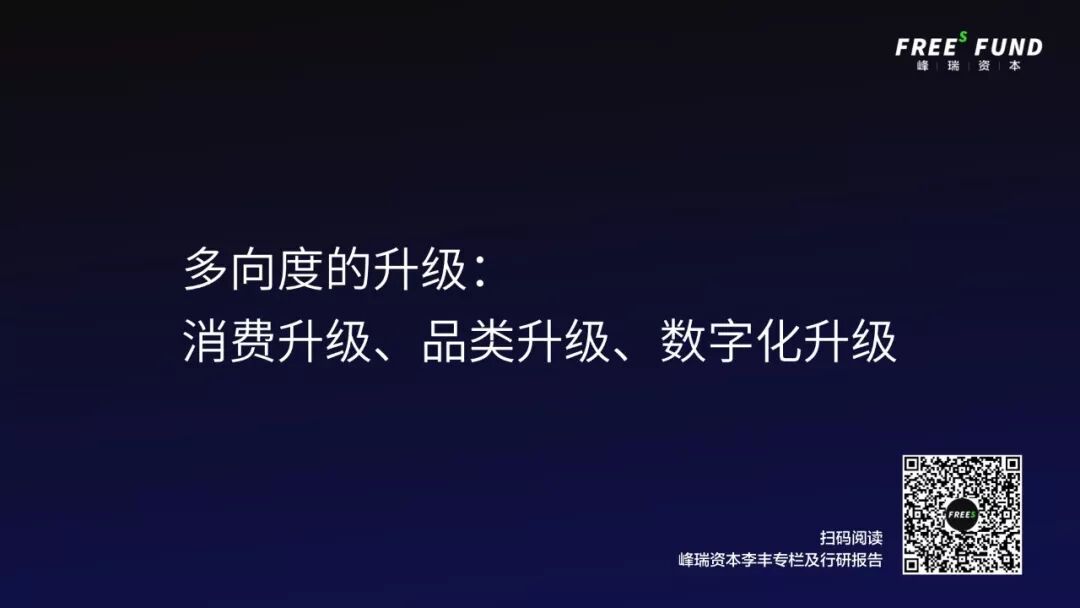
What needs emphasis is that this upgrading is not one-dimensional. I break it down into three meanings of "upgrading": consumption upgrading + category upgrading + digital upgrading.
The first upgrading refers to the overall consumption upgrading of urban populations.
Why emphasize the word "overall"? Let's first look at the composition of China's urban population. According to the National Bureau of Statistics' latest data, China's urban permanent residents have increased to 830 million. If we make a simple division of these 800 million-plus urban residents, it's roughly: first-tier cities about 100 million, second- and third-tier cities about 200 million, and cities below third-tier about 500 million.
Starting from the end of 2018, an obvious trend everyone could notice was "channel下沉 + consumption upgrading" — this downward reach and upward upgrade resulted in urban populations comprising nearly 60% of China's total population (whether first-, second-, third-tier, or fourth-, fifth-, sixth-, seventh-, eighth-tier) all beginning consumption upgrading together. Behind this upgrading lies an enormous incremental market.
Beyond this layer of upgrading, we have superimposed a second layer: product category upgrading. This means many products that originally merely satisfied basic functional needs began achieving substantial improvement and development in quality and function.
With consumption upgrading and product upgrading, we are also currently experiencing digital upgrading.
Digital upgrading includes both ends: the supply chain end and the user end. Supply chain digital upgrading is mainly manifested in automation and intelligence, while on the user end, the most typical example is various forms of e-commerce. Digitization is inherently an efficiency tool, and digital upgrading on both the supply chain and user ends brings compound efficiency gains across the entire chain.
To summarize, China is in a window of "triple convergence," a unique China opportunity. But going further, what kind of China opportunities will "triple convergence" bring?
Let's take the smartphone industry, familiar to all of us, as an example.
Speaking of domestic phones, I believe many would agree that China already has several of its own international brands, such as VIVO, OPPO, Xiaomi, and Huawei. But put yourself eight years ago — you and I probably couldn't have imagined it.
Take my own experience. At the end of 2010 and in 2011, the institution I worked for, IDG, participated in Xiaomi's Series A and Series B investments. At that time, investing in Xiaomi was still a highly controversial decision. Even the most imaginative investors, standing in that environment, would have found it hard to envision China producing more than one world-class brand in the relatively high-tech, high-unit-price consumer electronics sector.
Going back to the beginning, in the phone sector, how exactly did we move from impossible to possible, and how did the three circles mentioned earlier play their roles?
China's phone industry chain can be traced back earliest to the mobile phone production license system introduced in 1999. Before that, China's mobile phone market was almost completely monopolized by foreign phone manufacturers. To support domestic industry, "Document No. 5" was born.
On this policy foundation, China saw its first wave of "phone-making fever." Lacking proprietary technology, most domestic phone brands emerging in this wave engaged in primary manufacturing, namely "OEM production," such as the once-glorious "fighter jet of mobile phones" Bird, TCL, Eastcom, Konka, and so on. Although their sales rose rapidly from 2002 to 2004, most were eventually washed away by the tide. Beyond individual company strategies, the main reason was that neither technology nor product was their own.
But the legacy of this "phone-making fever" was that after a round of frenzied activity, China began importing phone manufacturing chains. However, truly large-scale, full-industry-chain imports came a few years later with the massive emergence of shanzhai (copycat) phones.
The surge of shanzhai phones mainly originated from a chip called "MTK" launched by MediaTek at the time. As a low-cost chip, its performance was remarkably attractive — it could provide phone manufacturers with integrated solutions including motherboard, chip, GPRS module, and system software, greatly lowering the production threshold for mobile phones. You can understand it this way: as long as you purchased this chip, small factories didn't need to master many additional technical capabilities to rapidly produce various phone products. From 2005 to 2008, various shanzhai phones equipped with MediaTek chips not only successfully captured the domestic market but also began flowing overseas in large quantities.
Of course, returning to supply chains, the explosive growth of shanzhai phones enabled us to relocate almost the entire phone manufacturing chain domestically in a very short time, including many precision processing factories that later developed from these small factories, among them Apple suppliers we are familiar with such as Lens Technology, AAC Technologies, and Goertek. According to Apple's 2019 list of top 200 suppliers published on its official website, 86 manufacturers from mainland China, Hong Kong, and Taiwan were selected.
So, after two rounds of tempering through OEM phones and shanzhai phones, by the time we entered the smartphone era, China had already made considerable progress across the entire manufacturing chain, including much precision processing and even in the chip industry — fully possessing the rightmost circle: "the largest and most complete supply chain."
Then what about the second circle — "the world's largest single smartphone market"?
According to data from research firm Canalys, as early as Q1 2012, China first surpassed the US to become the world's largest smartphone market. By 2015, smartphones in China gradually shifted toward a mature market, with the vast majority of consumers already owning smartphones.
This also involves what we call the third circle: upgrading.
This time, unlike the first wave of domestic phone development where first- and second-tier urban users bought Motorola and Nokia while third-, fourth-, fifth-, sixth-, seventh-, eighth-tier urban users bought TCL and Bird, everyone's consumption capacity had strengthened, everyone could afford smartphones, so consumption upgrading叠加 (superimposed with) phone category upgrading created enormous market opportunities. Xiaomi was the first to seize this massive market opportunity and rise rapidly.
Xiaomi's rapid rise in that stage, beyond the explosion of the phone consumer market and the maturation of supply chains, owed more importantly to its digital upgrading.
In 2012 and 2013, Xiaomi's early development coincided with Weibo's rise. Xiaomi placed its product launches, user interactions, and even complaint feedback entirely on Weibo. On the surface, this was leveraging Weibo's early traffic dividend, but looking deeper, it was because Weibo provided Xiaomi with the most suitable digital platform, allowing direct, efficient communication with users without any dealers or intermediaries, and rapid response to user needs. Subsequently, Xiaomi further digitized its sales end, achieving the most extreme retail efficiency at the time. Many should still remember Lei Jun's "seven-character formula" — "focus, extreme, word-of-mouth, fast."
To summarize, Xiaomi's success in that stage represented the path to surpassing taken by a considerable number of Chinese brands, including some e-commerce brands.
When the overall consumption upgrading of urban populations created enormous market demand, there happened to be a vast phone manufacturing supply chain as backing. In principle, brands didn't need to own their own factories — they only needed to understand consumer needs and do well in OEM and ODM.
I call this type of opportunity Type 1 opportunity. That is, facing an enormous incremental market, whoever can translate user needs to the production supply chain end in the most efficient way, turning them into products, and fully utilize digital connections to form product sales, will rise first.
Xiaomi was able to gallop ahead at that time precisely because it seized the Type 1 opportunity.
Having discussed Xiaomi, let's review the development trajectory of another world-class brand, Huawei, in the phone business. Huawei earliest entered the phone field in 2003; before that, its main business had always been telecommunications equipment. When it first started making landline phones, equipment would easily malfunction when it rained, so most equipment was given away; later Huawei made PHS phones, 2G phones, and even up to the early stage of smartphones in 2011, Huawei remained obscure. Around 2013, under considerable pressure, Huawei's team implemented internet strategy as extremely as Xiaomi did.
The result was that Huawei came from behind in the phone industry, with growth becoming faster and faster, while Xiaomi began facing pressure. What had changed?
The turning point was 2017, when China first saw annual total smartphone shipments decline. That year's figure was 459 million units, down 4% from 2016. In 2018, the declining trend continued, with annual smartphone shipments of 397 million units, down 10% year-over-year.
All these data point to one conclusion — although China in recent years maintained its position as the world's largest single smartphone market, Chinese phone sales were adjusting downward. This means that in the phone category, the domestic market had begun shifting from an incremental market to a stock market.
The question arises: why, after the phone market shifted from incremental to stock, did some companies succeed, and why did they only succeed when it became a stock market?
I just said that in an incremental market, the most important capability is being able to quickly and accurately translate user-end needs to the supply chain end. But what about a stock market? Stock means you live or die, I gain what you lose — the underlying logic actually shifts from "whoever is fast gets big" to "whoever is good gets big."

Why "good"? Because after entering a stock market, most users have already bought one or more smartphones. Having had consumption experience, users can now distinguish what is a good product, what is good value for money — they've moved from initially not understanding and trying to buy, to becoming mature users today.
Then, for corporate competition, it's no longer just about translation capability, but more about who can achieve the highest efficiency across the entire industry chain. You must be efficient across the entire chain to make the best product. This is Type 2 opportunity. Against this backdrop, Huawei was best positioned to win, because Huawei not only possessed relatively long industry chain resources, but also owned the key node technologies. So when it integrated its own products, technologies, and resources, compared to enterprises relying on external industry chain resources, it could better achieve highest efficiency across the entire chain and produce optimal cost-performance.
And compared to international rival Apple, which similarly possessed relatively long chains and proprietary technological capabilities, Huawei could be closer to China, the world's largest single smartphone market. Moreover, manufacturing chains were all nearby, with higher efficiency in responding to user needs and coordinating with industry chains. Both internally and externally, Huawei had clear relative advantages. Therefore, Huawei became the winner of this stage, and in just a few short years, rose to become one of the leading brands in global phone sales.
To summarize, we can see that phones, as a consumer category very familiar to us, experienced a complete development cycle: from extreme backwardness to initial development, to after assembling the "three circles," rapidly giving birth to several international-level brands. This was something we completely couldn't imagine eight years ago, five years ago.
Whether in consumption or technology, every industry has the opportunity to be rebuilt from scratch
Once conditions mature, what happened in the phone industry will certainly play out again in other industries. In many fields, "Xiaomis" and "Huaweis" of those industries will be born. It's no exaggeration to say every industry has a share, every industry has the opportunity to be rebuilt.
Moreover, like phones, every category will experience the shift from incremental category to stock category. In the incremental era, whoever is "fast" gets big; in the stock era, whoever is "good" gets big. Being fast requires the efficiency and capability of rapid "translation"; being good requires the efficiency and capability of the entire industry chain.
Snack brand Three Squirrels initially took advantage of Type 1 opportunity; now they are comprehensively transforming, hoping to improve efficiency across the entire chain to seize Type 2 opportunity. The cosmetics category, which has been very hot in the past two years, is still in the incremental market stage.
I'll leave an open question: what will be the future of color cosmetics, and what will enable a color cosmetics company to build a sustainably competitive brand?
Stock market competition is brutally fierce — does that mean once you enter a stock market, there's no opportunity? No. The apparel industry stubbornly provides the answer. Undoubtedly, apparel has entered a stock market; you and I have both passed the first wave of novelty, cheapness, and variety. Since Q4 2017, overall apparel category sales volume has declined year-over-year to varying degrees; 2018 apparel sales volume dropped 24.8% compared to 2017. But we see a sub-category rising — athleisure. Sportswear grew 19.5% in 2018.
Here's another thinking question: in the fast-growing athleisure apparel sector, Li-Ning or ANTA Group — who is more likely to seize Type 2 opportunity and become the "Huawei" of apparel?
Final conclusion
Whether you are pessimistic or optimistic today, however you view China's economic trajectory going forward, it's hard to deny that China is currently, unprecedentedly, simultaneously possessing these three elements: "the largest and most complete supply chain, the largest consumer market, and upgrading." We have already witnessed in phones and other fields the astonishing effects of these three elements叠加 (superimposed and) working together.
Then, within the next five years, whichever industry can assemble these three elements will produce world-class companies that are both brands and technology. This massive "China dividend" belongs to every industry; various different categories will produce more than one opportunity — one opportunity in the stock stage, and another after entering the incremental market.
Moreover, user needs are not static; accompanying user need upgrading, former stock categories may become incremental categories. At the very least, in the typical stock market — apparel — you and I have both seen the rise of the athleisure sub-category, and seen Li-Ning, after years of silence, stage a beautiful comeback.
Happy New Year, let's encourage each other, and together create and await the future that will arrive in full splendor.
(Welcome to read, share, and like. For reprints, please reply "reprint" to understand reprint rules, and contact Feng Xiaorui [ID: freesfund] for authorization. Copyright belongs to FreeS Fund.)

Li Feng Column | Why Should We Thank Chinese Manufacturing?
Li Feng Column | How Long Can Live E-Commerce Stay Hot?
Li Xiang x Li Feng: Removing Emotion, What Did China Look Like in 2019?