Veteran Entrepreneurs: Surviving the Darkest Hours While Spotting the Windows God Opens | FreeS Fund 2020 CEO Annual Meeting

Original Convictions, Darkest Hours, and Moats
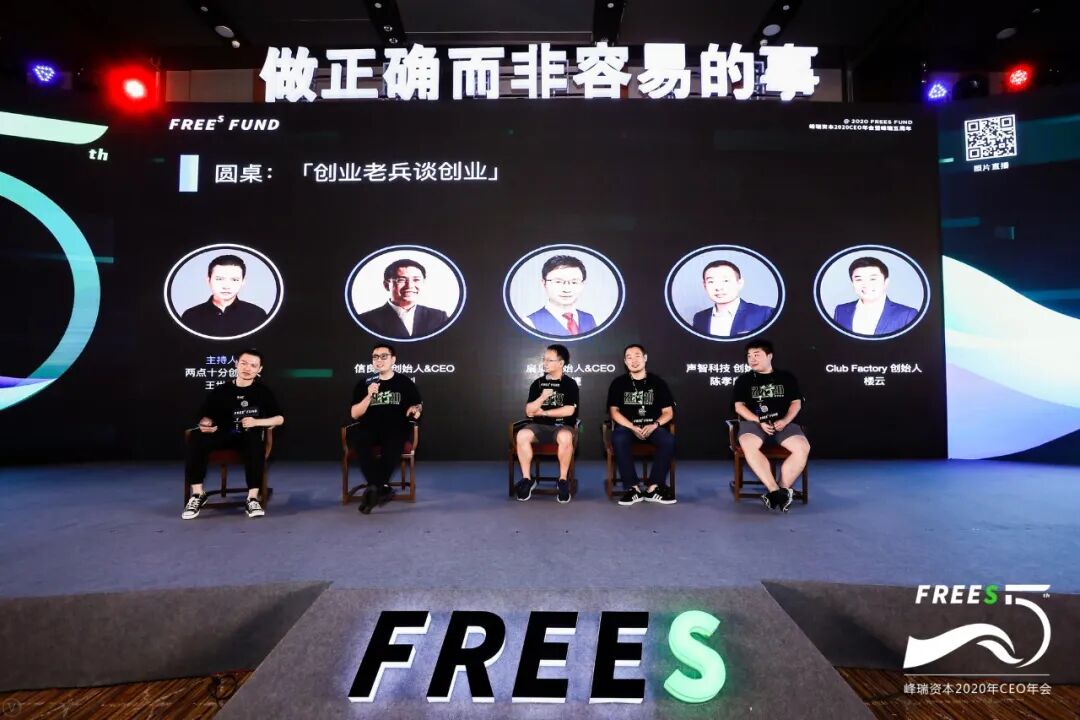
At the "FreeS Fund 2020 CEO Annual Meeting & FreeS Fifth Anniversary," five entrepreneurs joined attendees to explore the original intentions behind starting companies, competitive moats, and the "darkest hours" they've endured.
Some experienced overlapping darkest hours across two entrepreneurial stages. Some restructured their organizations from the ground up. Some pivoted four times in five years. Some were hit by successive uncontrollable events — the US-China trade war, the COVID-19 pandemic. Some endured countless moments of wanting to quit over thirteen years of entrepreneurship. None of them left the arena.
Beyond the early freshness and热血情节 of starting up, these founders have come to treat entrepreneurship as a long-term way of life. They find genuine joy in the process of "leveling up and defeating monsters," developing a self-consistent entrepreneurial dialectic: "It's no longer that the business needs me — I need the business"; "The original intention and the moat are actually the same question"; "Choice and effort aren't a blue pill/red pill either-or"...
They are:
- Jian Li, founder and CEO of Xinliangji, founder of Xinladog
- Xiaoliang Chen, founder of SoundAI
- Jie Wang, founder and CEO of Shanbay
- Yun Lou, founder of Club Factory
- Shiyong Wang, chairman and founder of 2:10 Animation (moderator)
They shared:
- The darkest hours they experienced and how they got through them.
- How to build core competitiveness and what the greatest dividend for business growth is.
- What they dreamed of when they first started out, and whether that dream has changed. How they view the relationship between "choice" and "effort."
- How they view their company's moat and what the secret weapon is for building one.
We've compiled these veteran founders' genuine reflections into this piece, hoping it offers some inspiration. May your own entrepreneurial journey bring more moments of beauty and self-discovery.
Contact Us We always look forward to meeting more innovators. Send your pitch deck to bp@freesvc.com, and for those interested in joining our investment team, reach out at hr@freesvc.com.

/ 01 / Living Through the Darkest Hours While Spotting the Window God Left Open
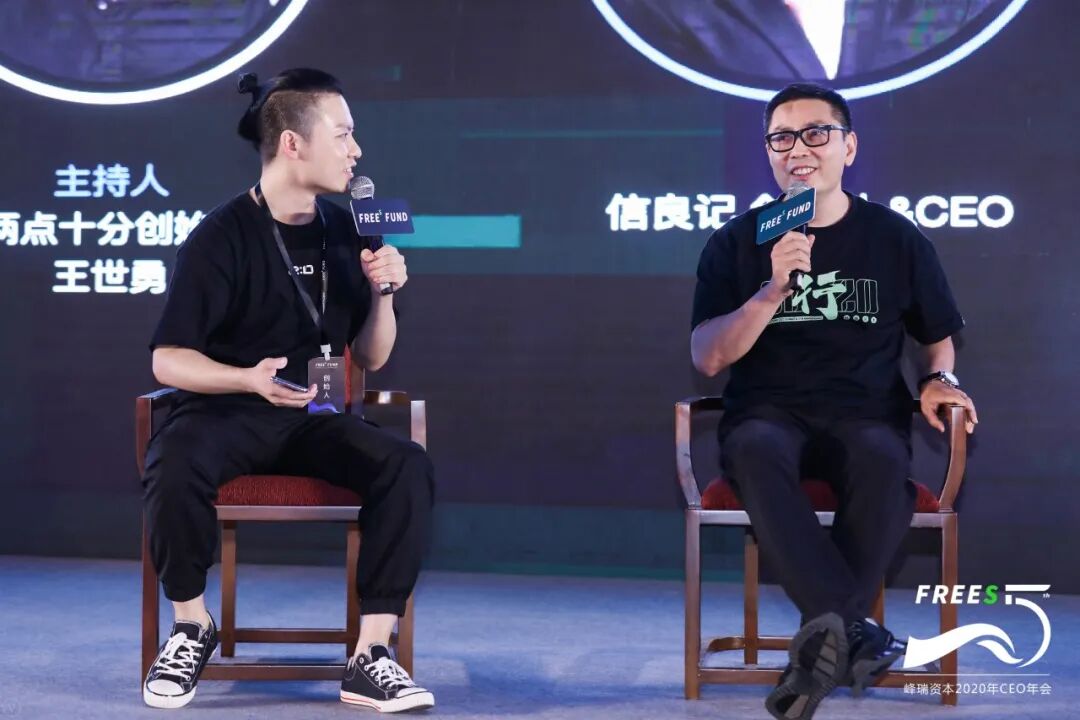
Shiyong Wang, chairman and founder of 2:10 Animation (left); Jian Li, founder and CEO of Xinliangji, founder of Xinladog (right)
Shiyong Wang: Uncle Feng just interviewed the younger generation, so I'll interview the veterans.
First question: please introduce your company, share one or two darkest hours from your entrepreneurial journey, and tell us how you got through them.
Jian Li: I'm Jian Li, founder of Xinliangji. I've been an entrepreneur for over 20 years, constantly on that path. Xinliangji is my third venture. Once, chatting with Uncle Feng about the feeling of starting up a third time, I said: "If I start another company, I'm a complete idiot. I'd already made it to shore, and I jumped back in."
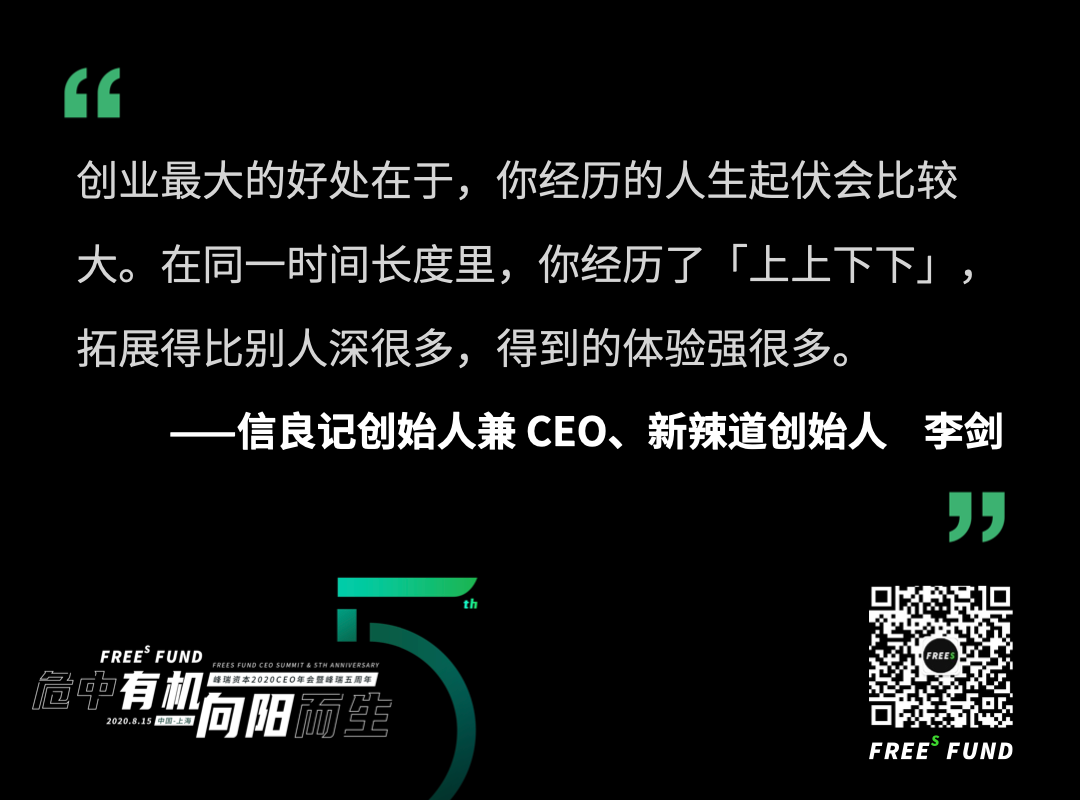
But if you asked me to choose again today, I'd still pick entrepreneurship. The greatest thing about it is the magnitude of life's ups and downs you experience. In the same span of time, you go through peaks and valleys, diving deeper than others and gaining far richer experiences. Especially for someone like me who values life experience, entrepreneurship is a good choice.
"Darkest hours" are part of that experience. Since founding Xinliangji, I've had quite a few.
At last year's FreeS CEO annual meeting in March 2019, I shared one such period.
At the time, Xinliangji had just completed its Series B. We launched an acquisition, using the roughly 100 million RMB we'd raised to simultaneously merge three upstream factories.
I'd never done an acquisition before, and this one was in an industry I wasn't familiar with. Most critically, behind these factories were two entrepreneurs in their 60s who'd navigated the business world for decades — extremely shrewd operators.
I faced enormous challenges, caught in an overlapping darkest hour across two entrepreneurial stages. The money from selling my previous company hadn't come through yet, while my new company's cash flow was on the verge of collapse. The cash on hand was being allocated on a daily basis.
From the final closing of the previous company to the cash flow crisis at the new one, this phase lasted over six months. During that time, I barely slept four or five hours a night.
I just endured each day. Many problems were beyond my control. No matter how great the difficulty, I had to stick it out.
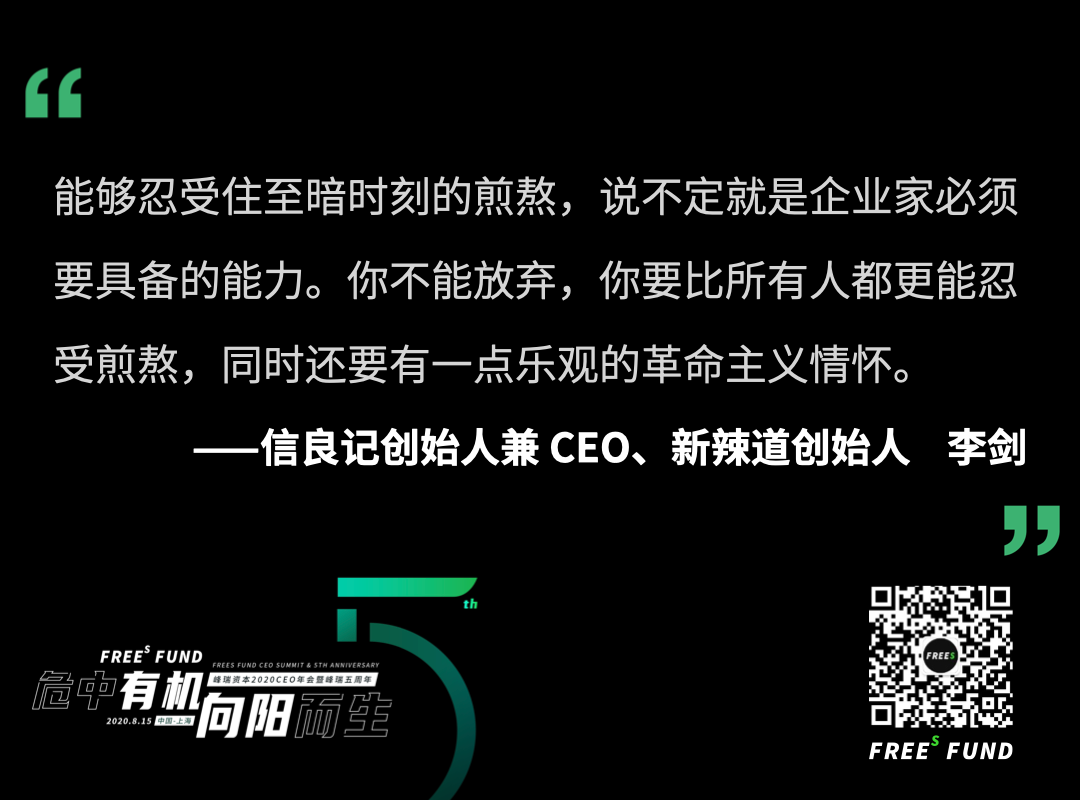
I think the ability to endure the torment of darkest hours might be a necessary quality for entrepreneurs. You can't quit. You have to outlast everyone else in bearing the hardship, while maintaining a touch of optimistic revolutionary spirit — able to tell your employees encouraging things about the future. Though perhaps you go home and secretly cry, feeling utterly miserable.
This was probably the hardest darkest hour I experienced in building Xinliangji.
I also went through a smaller darkest hour: the COVID-19 pandemic.
We're in the B2B foodservice business. During the pandemic, the restaurant industry suffered terribly. After the Lunar New Year, I told everyone at a meeting: "If this lasts six months, the company could die." This was the first time I warned my colleagues about the severity of the pandemic. In the second phase, I communicated: "We may need to cut everyone's salary by half." In the third phase, we decided to pivot entirely to B2C. Because even if consumers couldn't eat at restaurants during the pandemic, they still had to eat at home. By a fortunate coincidence, we also partnered with Yonghao Luo for a livestream to promote crayfish.
During the pandemic, Xinliangji's B2C business flourished — truly "opportunity within crisis." Starting from zero, we reached monthly revenue in the tens of millions.
You could say that just as our B2B business was nearly dying, we launched B2C and seized the opportunity to transform into a consumer brand.
When you go through an unbearable darkest hour, you discover that while God may have closed one door, He still opens a window.
/ 02 / The Greatest Dividend for Growth Is Organizational Dividend
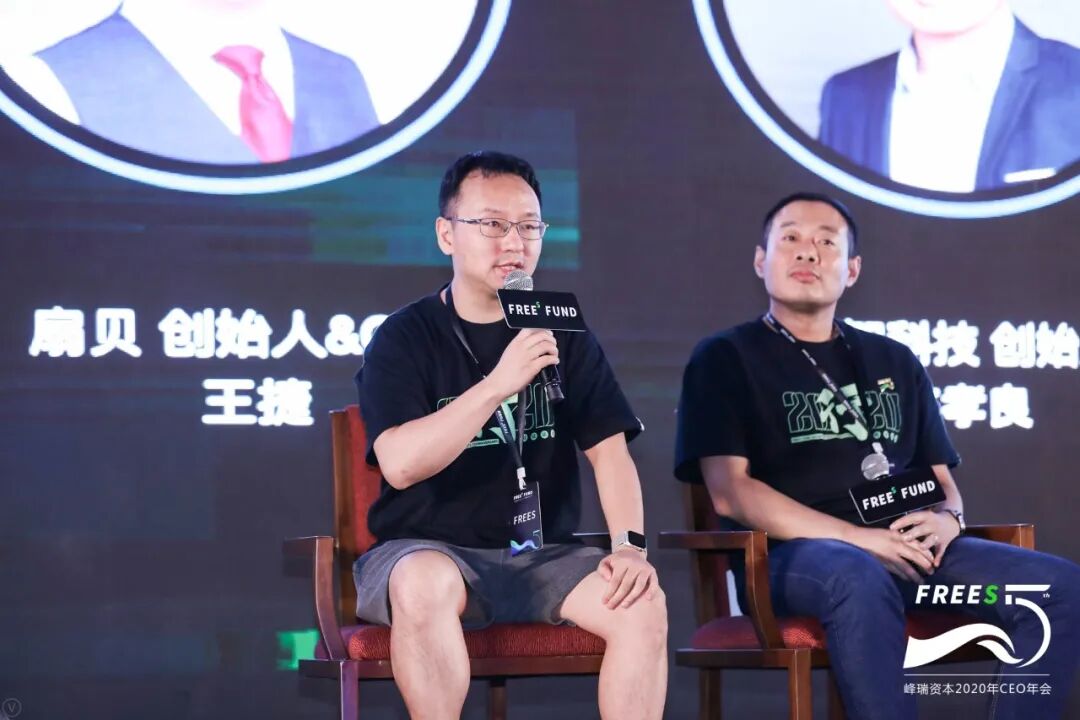
Jie Wang, founder and CEO of Shanbay (left); Xiaoliang Chen, founder of SoundAI (right)
Jie Wang: I'm Jie Wang, founder of Shanbay. Our goal is to become a lifelong learning platform serving young people. Shanbay currently has roughly 130 million registered users. We have three main business segments: test preparation, vocational education, and self-improvement, accompanying many users through middle school, university, graduate school, and into their careers.
Shanbay's darkest hour happened two to three years ago.
In the early days, things went relatively smoothly. We had good ideas about product features. And riding the early mobile internet wave, we gained substantial organic traffic without large-scale marketing spend.
That early success planted some seeds for future trouble. We were essentially running a company like a small workshop. By 2017, we'd suddenly expanded to over 150 people, and all sorts of problems emerged.
"We didn't have the fate of a big company, but we had the diseases of one." Proven business models from the market couldn't be implemented internally. Some employees' motivation and fighting spirit were low.
During that period, though the company still had money in the bank and users on the platform, I always felt something unstable about it. This was probably the lowest point in the company's entire history.
There's no shortcut for solving hard problems — you just do what's correct but extremely difficult. We restructured our organization, using fundamental business principles to diagnose our issues: Where do users come from? How do we convert them into paying customers? How do we retain them? How do we drive repeat purchases?
Following this end-to-end chain, we examined the company's problems and restructured accordingly.
This process lasted from roughly 2017 through late 2018 — long and grueling. During the restructuring, we had countless arguments and experienced employee turnover. But fortunately, these problems were eventually resolved, and "the skies cleared."
Starting in 2019, I felt the company was on a more correct path.
During the pandemic, online education enjoyed certain tailwinds. We doubled in size, but compared to K12 products, this growth wasn't particularly dramatic.
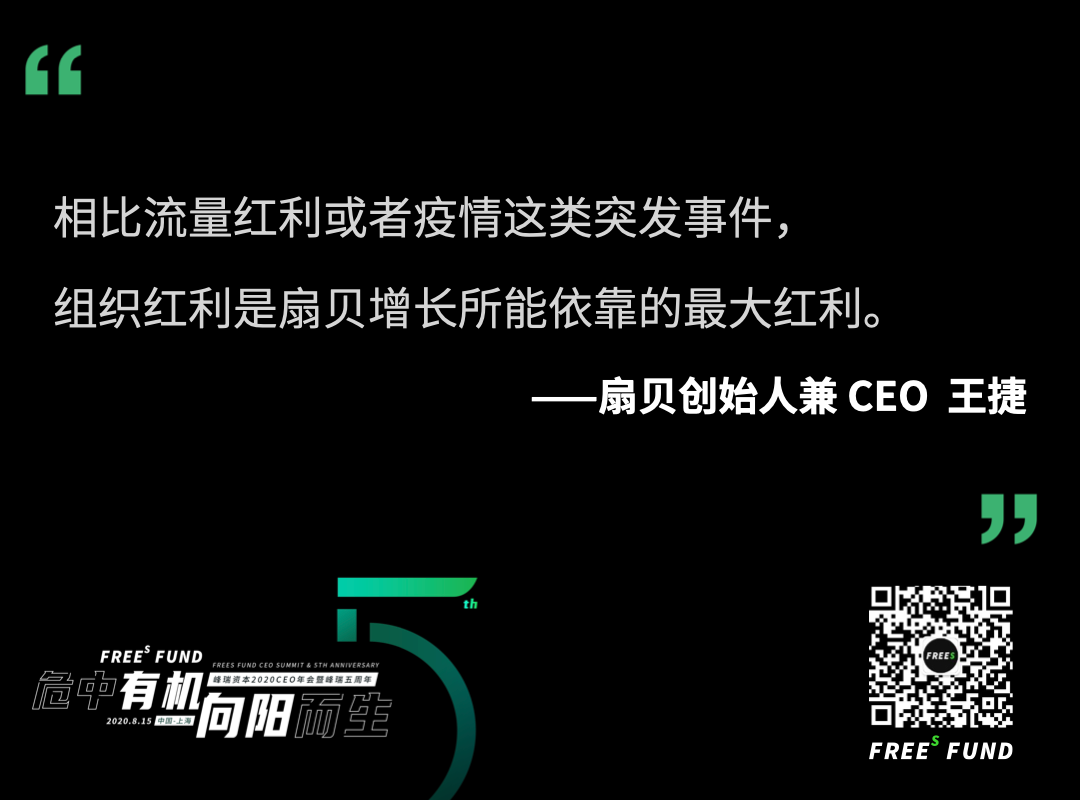
Overall, compared to traffic dividends or black swan events like the pandemic, organizational dividend is the greatest dividend Shanbay can rely on for growth.
/ 03 / The Darkest Hour Is Simply "Not Easy"
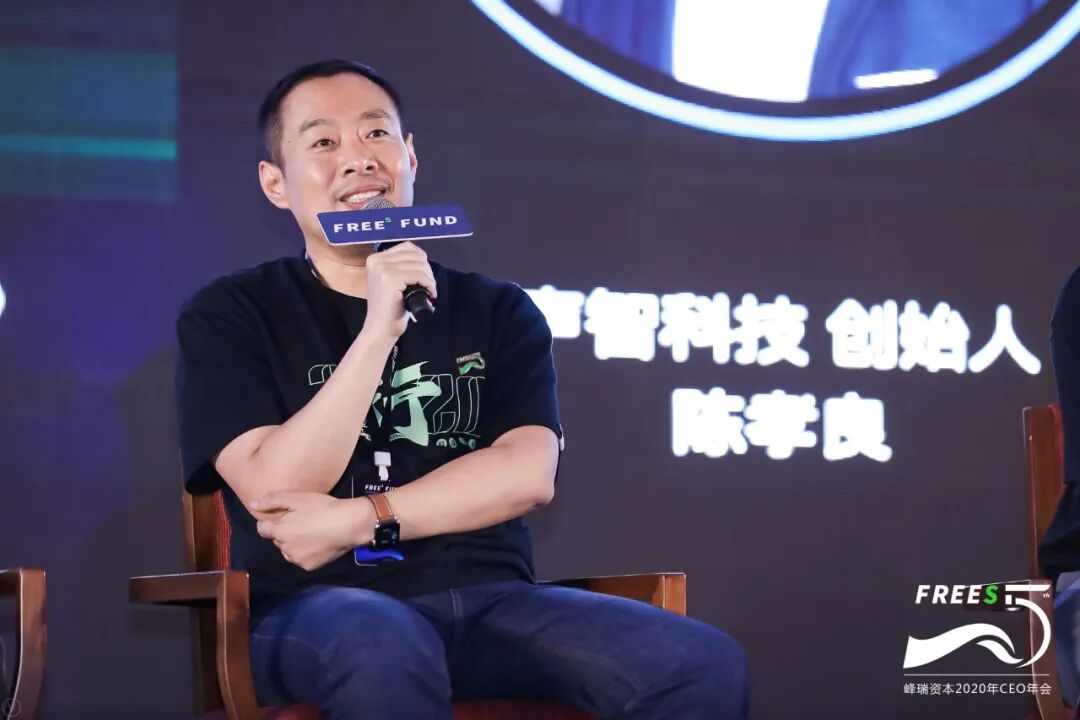
Xiaoliang Chen, founder of SoundAI
Xiaoliang Chen: I'm Xiaoliang Chen, founder of SoundAI. I'll share two things — one a bit romantic, the other about my darkest hour.
FreeS Fund's slogan is "Do what's right, not what's easy." "Right" means direction, and finding direction alongside FreeS Fund has been a rather romantic experience.
SoundAI came together with FreeS Fund in April 2016. Our team had just left the Chinese Academy of Sciences and was getting started. What won us over was FreeS Fund's professionalism and logical rigor.
After we were founded, we held an event in Shenzhen with Ping An Bank and FreeS Fund — very romantic. It was our first event ever, and we even ran into a typhoon, so we have plenty of typhoon memories.
We've been genuinely happy with FreeS Fund, because Uncle Feng helps keep us pointed in the right direction and shares his thinking on macroeconomics.
Maybe the "later waves" don't need to worry too much about direction yet — that's the sweet part. In the entrepreneurial journey, if you're searching for direction every single day, it's agonizing.
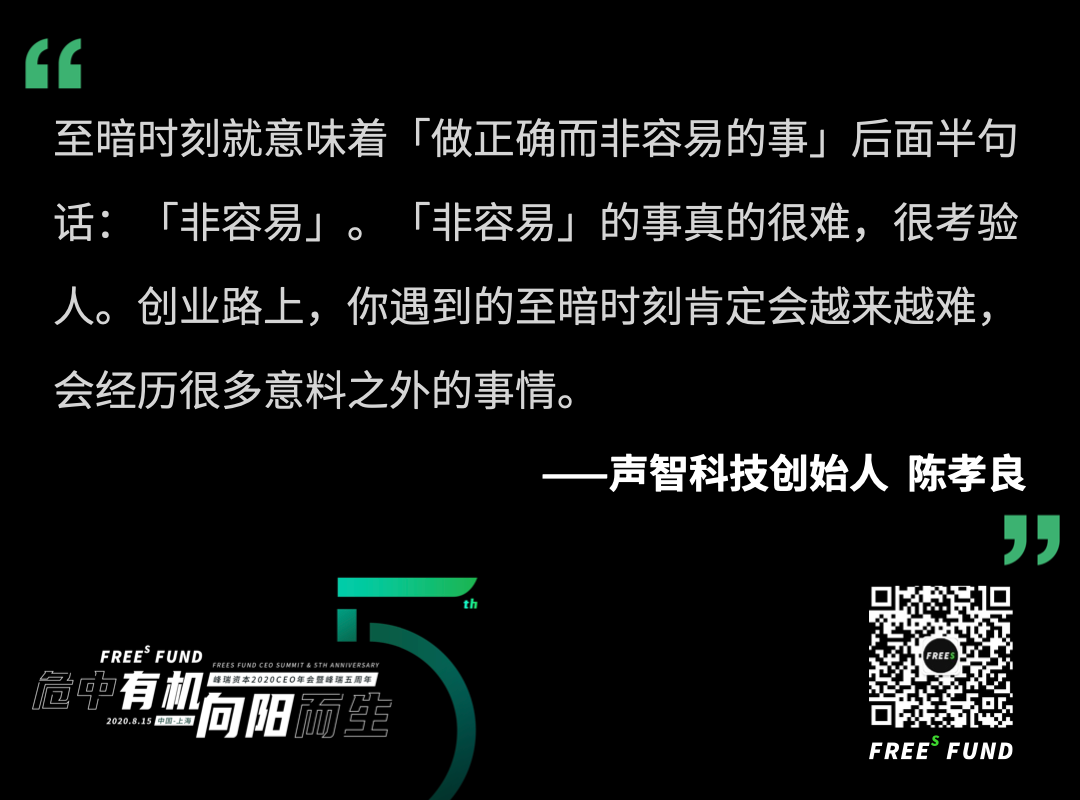
But the darkest hour means the second half of that slogan: "not easy."
The "not easy" part is genuinely hard. It tests you. The dark moments you encounter on the entrepreneurial path will only get harder, and you'll experience many unexpected things.
Looking back at the first four years of our startup, what impacted us most was the pandemic.
During COVID, our entire team's mindset shifted dramatically.
When we first started, as a technology company, we naturally chose a "hug the big leg" strategy. For the first three years, most of our revenue came from major clients. The advantage was rapid early growth.
Then, during the pandemic, when our major clients' performance declined, we discovered the limitations of our model: we were overly dependent on big clients and had neglected building out our sales and marketing team. Without a solid channel system, technology and products are hard to sell.
That period was deeply disorienting. I had several drinks with Uncle Feng and talked through our future development. In recent months, we've rapidly built out our marketing channels while expanding into new business areas.
/ 04 / Four Pivots in Five-Plus Years of Entrepreneurship
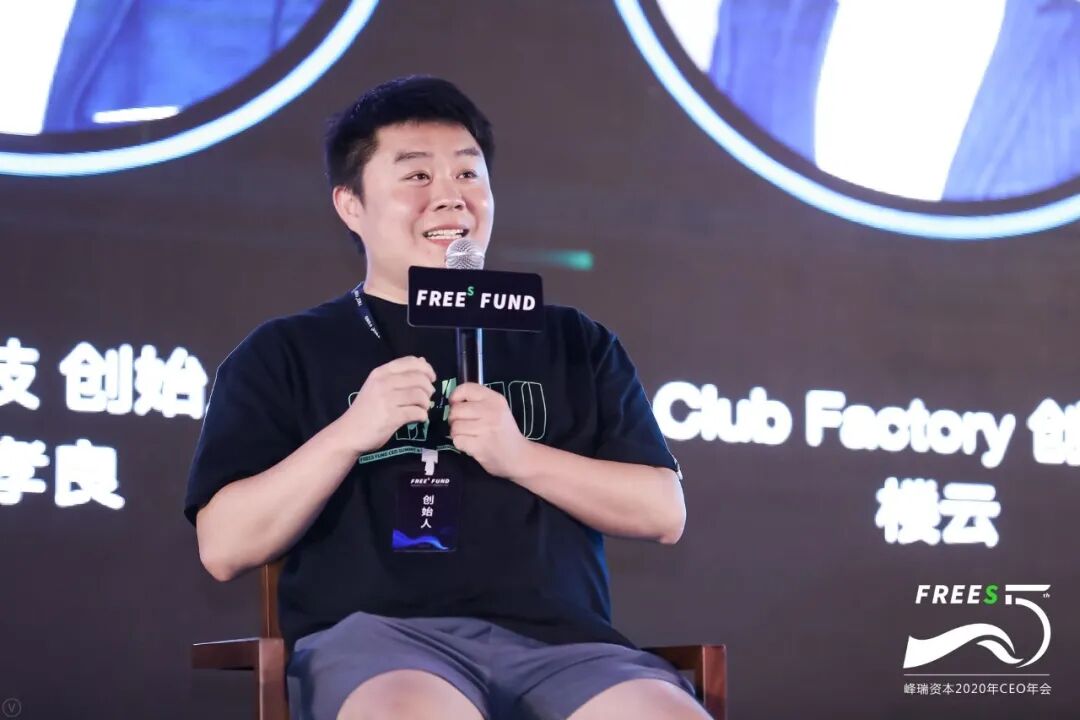
Lou Yun, founder of Club Factory
Lou Yun: I'm the founder of Club Factory. We've been at this for over five years and gone through four pivots, each one a dark moment.
Our original vision was quite abstract: to build a data model for non-standard goods supply chains — tops, pants, shoes, kitchenware, power banks, headphones — and use algorithms to allocate resources in the foreign trade industry, improving efficiency. I'm very grateful that FreeS Fund invested in us.
Five years ago, we were China's largest export data analytics company.
Soon enough, we hit our first dim moment. We realized that at that point in time, SaaS services were hard to push past 100 million RMB in annual revenue. The market ceiling was probably a few tens of millions per year. Revenue was "stuck," and we were in pain.
Then we remembered: the core of our vision was improving industry efficiency, not necessarily doing SaaS. So we quickly pivoted from data analytics services to building Club Factory, an e-commerce platform. Based on our industry understanding and data modeling of the entire sector, we built a new e-commerce system to sell Chinese goods worldwide.
We soon discovered that India was a very promising market — one that lacked a "Taobao" — so we went all-in on India. Within a year, Club Factory reached monthly GMV of over 200 million RMB.
Then came our second dark moment.
Once in India, we realized the market was actually quite small. Though Club Factory held 80% to 90% share of the China-India cross-border market, breaking through to monthly GMV of 700 million to 1 billion RMB proved extremely difficult.
So we used our data-driven system to empower India's supply chain, building up what had been a weak local infrastructure. Eventually, Club Factory reached monthly GMV above $100 million USD, with 100 million monthly active users.
When COVID hit, India went into nationwide lockdown.
This was equally fair to all competitors — everyone faced lockdown. We had no choice but to hunker down and wait to push hard once it ended.
Even during the pandemic, we found that Club Factory was growing faster than peers. Because our data-empowered system was ahead of competitors, we achieved faster growth and better user experience.
Then on the evening of June 29, the Indian government banned Club Factory along with 58 other Chinese apps, launching the first wave of anti-China app restrictions.
When I first got the news, I was stunned. With the time difference, it was past 11 PM and I was about to sleep. Seeing the message from my Indian colleague, I even thought he was playing a prank. Only after searching online did I believe it was real. This was an absolutely massive dark moment.
After communicating with the Indian government, we realized this wasn't something we could solve ourselves — it would require government-level resolution.
After the ban, we spent considerable time thinking about what kind of company Club Factory truly is.
We discovered that through all our past pivots — whether data analytics, cross-border e-commerce, or local e-commerce in India — we relied on one constant: using technology and data to model the entire supply chain system.
So we decided to export this supply chain modeling system to Europe or the US. Just over a month after the ban, we're already seeing promising momentum in our new target markets.
Through these dark moments, I learned two lessons.
First, you must be crystal clear about your company's core competitiveness.
Over the past five years, we invested enormous energy building a supply chain system. I believe it's a fundamentally new, more efficient cross-border supply chain for non-standard goods. Fortunately, we invested four years in this system. Unfortunately, last year we stopped investing in it and instead went all-in on localization in India.
When you spend five or ten years investing in something, you'll find others can hardly catch up. It's not necessarily that your technology is better — you've simply been at it longer.
Second, the team is always crucial.
I'm particularly fond of the word "company." It's such a good English word — it means both the firm and companions, the team. What's your company worth? I think the more important question is: what's your team worth?
We spent years building an exceptionally strong cross-border e-commerce team in India. So we can take our accumulated technology and team strength and "pour" it into new markets.
After India's mass ban on Chinese apps, I spoke with many banned peers. Among them were highly valued public companies. Everyone said that in today's business environment, building a company in two years and sticking with something is quite common. With a good team, you can constantly seize new opportunities.
This closely resembles what JK, founder of Insta360, shared at the "Later Waves Arrive" forum. It's very difficult for a company to reach $10 billion or $100 billion market cap through a single product — it typically requires multiple iterations.
Whether or not Club Factory had been banned, we need continuous iteration to keep growing. And iteration requires team, requires technology. That's my understanding of navigating dark moments.
05 It's No Longer That Entrepreneurship Needs Me — I Need Entrepreneurship
Wang Shiyong: I've been an entrepreneur for 13 years. I've wanted to give up countless times, feeling like I was doing something that just doesn't make money. Having persisted, I feel like I'm doing okay now.
I'd like to ask everyone three questions — please choose one to answer.
First, what was your dream when you first started out, and is it the same now? How do you view the relationship between "choice" and "effort"?
Second, which stage of your company's growth was fastest, and what did you do to make that happen?
Third, Jack Ma said: "The upper three paths of strategy are mission, vision, and values; the lower three are organization, talent, and KPIs." Warren Buffett said: "Good businesses have four moats." How do you view your company's moat, and what's your secret weapon for building it?
Li Jian: I'll take the first question. "What was your original dream in entrepreneurship, and is it the same now?"
I started my first business right after graduating university. I'd just come from a small city in Shandong to Beijing, and suddenly realized that before even talking about quality of life, survival itself might be a problem.
What drove me to entrepreneurship back then was simply wanting to make money, to have wealth, to change my fate.
By my second and third ventures, I'd been tested by money and experienced what it could bring. So my primary motivation was no longer personal wealth.
The original intention in entrepreneurship still matters. With Xinliangji this time, I wanted to use food technology to bring wonderful products to consumers. We have a vision of "joy through food." Food satisfies more than physiological needs — delicious food brings emotional pleasure. When I had no money, enjoying a great meal gave me an indescribable happiness and delight.
From where I stand today, entrepreneurship is a profession. Besides starting companies, I don't know how to do anything else. Even if I could achieve financial freedom through some capital means, I couldn't not work while I'm still able to. And the only profession I would choose is entrepreneurship.
I've realized it's no longer that entrepreneurship needs me — it's that I need entrepreneurship. I need this work to rediscover my sense of purpose, to fill my days, to experience a richer life again.
This time around, what I'm experiencing is genuinely different from my previous ventures: the industry has shifted, funding has changed, the people I'm meeting are different. I find it absolutely wonderful.
This time, it's truly just because I need entrepreneurship itself that I'm doing it.
06 Choice and Effort Aren't Binary Opposites
Wang Jie: Which matters more — choice or effort?
This question seems to carry an implicit assumption, as if making a good choice means you don't need to work as hard.
But choosing itself is extraordinarily difficult. Take chess: every move is a choice, and each choice can affect the entire game. A strong player has put in years of effort behind the scenes.
Only by continuously working hard in certain areas — refining your understanding, building skills, cultivating your mindset — can you make good choices.
So choice and effort aren't a "blue pill or red pill" either/or proposition. They reinforce each other. Apart from maybe picking lottery numbers, most situations in life require sufficient effort before we can make sound decisions.
Chen Xiaoliang: Let me offer a slightly different perspective. In my view, effort is the foundation, but choice matters more.
In 2017, we partnered with a major domestic tech company to aggressively expand into the European market. Then in 2018, right when we started our marketing push, the US-China trade war hit — essentially a year's worth of R&D from our team went down the drain.
We've since accumulated substantial technical capabilities, with voice recognition for 15 languages including German, Spanish, and Arabic. But that market is no longer viable. We still get some new orders, but nothing at scale.
In 2019, we pivoted hard to partner with a major foreign company to crack the US market. We poured significant R&D resources into it, then the pandemic hit this year and that market never took off either.
From my personal experience, as CEO, when choosing a market or a new strategic approach, you really need to think carefully about the direction.
Because your decision, or the encouragement you give your team, becomes something they're going to invest substantial time and money into executing. There will certainly be accumulation, there will be results — but the question is whether that accumulation can quickly translate into commercial returns. If not, it erodes team confidence.
07 A Startup's Original Intention and Its Moat Are Actually the Same Question
Lou Yun: Let me address both "original intention" and "moat."
In my view, a startup's original intention and its competitive barrier are actually the same question. The ideal scenario is making your original intention the company's long-term core moat. Conversely, you'll find that things that weren't part of your original intention rarely become true barriers.
For example, our original intention was to use algorithms to model our industry, to dispatch industry resources algorithmically, to improve industry efficiency. We've persisted in doing this for years, and now it has become our moat.
So original intention is a truly fascinating thing.
▲ FreeS Report 19 | The Tipsy Era: Where Are the Opportunities for Low-Alcohol Startups? ▲ Tang Ning x Feng Li: How Can Startups Seize the Million-Trillion Wealth Management Transformation Opportunity? ▲ The First Wave of Post-90s Entrepreneurs — Where Are They Now? | FreeS Fund 2020 CEO Annual Meeting ▲ Three Squirrels' Zhang Liaoyuan: A Once-in-20-Years Brand Opportunity — How to Win in Three Steps? | FreeS Fund 2020 CEO Annual Meeting ▲ Entering Our Sixth Year, FreeS Fund Is Hiring Investors | Doing What's Right, Not What's Easy ▲ FreeS Fintech Venture Summit 2020: What New Opportunities Will Emerge in Fintech?