Are Returnee Entrepreneurs Losing Their Edge? | 2021 FreeS Fund China-US Venture Forum Transcript

Launch a Startup or Take the "Soft Landing" Through Employment?

On April 18, the third session of the 2021 FreeS Fund China-US Venture Capital Forum series Seizing New Opportunities in China's Era went live. Centered on the theme "How Can Returnee Entrepreneurs Maximize Their Advantages?", founders from FreeS Fund's portfolio — Albert Wang, founder and CEO of PatPat, and Xiaobo Wan, co-founder and CEO of ComMedX Technology — discussed the following topics:
- What sparked their decision to start companies? How did they find people and direction?
- What advantages do returnee entrepreneurs have? What challenges do they face?
- Should you dive straight into entrepreneurship or "soft land" through employment first?
- Since starting their companies, what has struck them most deeply? What have they gained the most from?
- What opportunities exist in cross-border e-commerce and AI drug discovery?
The fearlessness and conviction of entrepreneurs are always the most moving qualities.
In Albert Wang's eyes, to succeed in entrepreneurship, "you need thick skin. Face doesn't matter — what matters is getting things done. And don't leave yourself any escape route."
For Xiaobo Wan, returning to China to start a company wasn't an easy decision. He admitted: "From first meeting investors and developing the intention to start a company, to finally making the decision, I went through about three years." But once he made up his mind, he was prepared to "face any possible difficulties and economic cycles."
We've compiled their authentic insights and experiences from the front lines of entrepreneurship into this article, hoping it offers some inspiration.
Event Preview
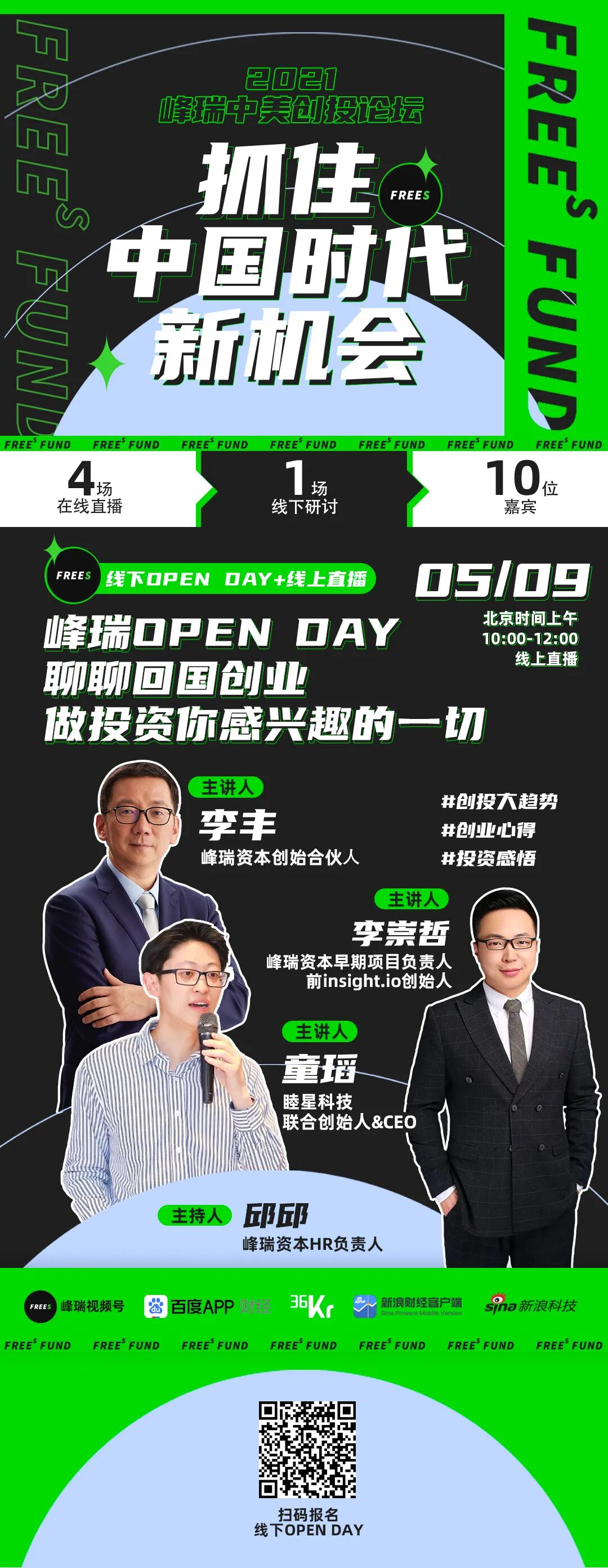
The fourth session of the 2021 FreeS Fund China-US Venture Capital Forum series, FreeS OPEN DAY — Come Sit With Us, will go live at 10:00 AM on May 9. Feng Shu (Li Feng) will be joined by Tong Tao, co-founder and CEO of MizarVision, and Chongzhe Li, early-stage project lead at FreeS Fund and former founder of insight.io, to chat about returning to China for entrepreneurship or investing — anything you're interested in and care about.
If you're interested in signing up for our May 9 offline event "FreeS Open Day," please scan the QR code below.
Scan to register

This session's two guests and moderator:
- Albert Wang, CEO and founder of PatPat, the world's largest children's clothing D2C brand. Graduated with Distinct Honor from CMU's Information Systems program. Former senior engineer at Oracle's business intelligence middleware division.
- Xiaobo Wan, founder and CEO of ComMedX Technology. PhD from Tsinghua University & Peking Union Medical College. Postdoctoral researcher at UCSF.
- Weili Dong, head of FreeS Fund North America, focused on technology-enabled business services. Holds an MBA from Stanford Graduate School of Business and bachelor's and master's degrees in civil and environmental engineering from Imperial College London.
**/ 01 / **
How to Find People and Direction in Early-Stage Entrepreneurship?
Weili Dong: I'd like to ask what circumstances led you both to choose entrepreneurship?
Albert Wang: In 2014, we initially just wanted to sell some things on Amazon to supplement our income. Then I met Feng Shu, who said that with our background, we should do something bigger — we could build a large D2C platform. Feng Shu gave us our first investment and suggested we look at how cross-border e-commerce platforms like Wish operated. We got to work, and things kept evolving until we became a children's clothing D2C brand.
Xiaobo Wan: In 2017, while I was doing postdoctoral research in San Francisco, I learned that FreeS Fund was already paying attention to the AI drug discovery track and had invested in XtalPi. The lab where I did my PhD in China was very strong in computational chemistry. Once, my PhD advisor and FreeS Fund investor Rui Ma came to San Francisco for a conference, and at a Japanese ramen restaurant near the city, we first discussed starting an AI drug discovery company.
From meeting investors and developing the entrepreneurial intention, to finally deciding to start a company, I went through about three years. After returning to China at the end of 2019, I had in-depth discussions with Rui Ma about whether entering the AI drug discovery track at this point was too late, and whether there was still opportunity to make an impact. I then conducted extensive research and realized that China's new drug R&D industry was entering a historic development phase, especially in the tight integration of AI technology with drug discovery. We saw the opportunity there.
Weili Dong: Generally, the most important issues for a CEO are finding people, finding money, and finding direction. Regarding finding people and direction, what advice do you have for those considering entrepreneurship? What has your own experience been like?
Albert Wang: I quite admire Feng Shu's approach to evaluating people and direction. First, look at the big direction — if the big direction is right, there won't be major problems. Second, the people need to be smart enough and resilient enough; if the big direction is right, they'll eventually find success through persistence.
Don't limit yourself to drilling down in a very narrow direction. Position yourself in a smaller direction within a big one, so you can pivot if there are problems. When we first entered cross-border e-commerce, we weren't doing what we do now. Fortunately, cross-border e-commerce is a big enough direction with so many opportunities and dividends that it didn't matter if we took a wrong first step. You don't even need to be that smart — as long as you think carefully, you can generally find the right methods and path.
When it comes to finding people, after going through quite a few pitfalls, we realized that you must find people whose values match yours. Especially for the core executive team, you must find people with similar backgrounds and shared values. In the end, all of our executives are returnees. The bigger the company gets, the more you need to emphasize unity of values across the team.
Seeking Like-Minded Partners
PatPat is also hiring recently. Welcome to send your resume to albert.wang@patpat.com. Work locations are in Shenzhen, Guangzhou, and Hangzhou.

Weili Dong: How do you judge whether someone's values match yours?
Albert Wang: One aspect is their attitude toward money and career. Several of us partners are the type who studied hard and don't care that much about money — our core focus is on how to get things done, not on quick profits. We've worked with some more profit-driven people before, and problems arose.
Also, we value integrity — these Confucian values. Getting things done matters, but definitely not through illegal or corrupt means. If someone's bottom line is too low, no matter how much experience or resources they have, they'll likely end up causing more harm than good.
Xiaobo Wan: When it comes to finding people and direction, especially in technology-intensive fields, your first step must be finding core team members you can trust and know well. Our company's earliest technical team mostly came from close friends and partners from labs at home and abroad that we knew very well. This was a good start — we'd worked together before and knew each other's character.
I also very much agree with what Mr. Wang shared about needing shared values. Early-stage partnerships are more value-driven. We hope to find people with very matching values who are complementary in business. For example, since I work on method application, I definitely need to find a team for algorithm development to form a complementary relationship.
Regarding finding direction, people may be very willing to try in blue ocean areas. If you enter an emerging field or one with some competitive intensity, you need to deeply consider your capabilities and determination before entering. You need to think about whether, if you commit to this track for the next 5 to 10 years, you're prepared to face any possible difficulties and economic cycles.
After returning to China, I didn't immediately decide to start a company. During the early 2020 pandemic, I spent several months evaluating the technical characteristics of current market leaders, my own capabilities and characteristics, and where I could be more refined or push out better technical applications than them. I needed to fully evaluate and find differentiation — only by bringing out weapons different from others can you stand out in such a track.
Seeking Like-Minded Partners
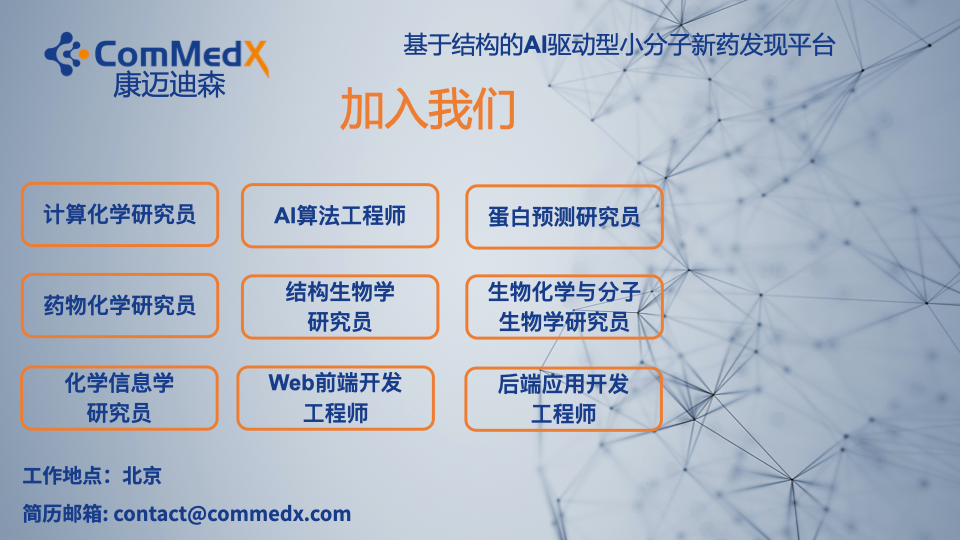
ComMedX is also actively hiring, including computational chemistry researchers, AI algorithm engineers, protein prediction researchers, and more. Work location is in Beijing. Interested friends can send your resumes to contact@commedx.com.
Weili Dong: If you're not from a technical background yourself, but need to find technical people when starting a company, how do you find them?
Xiaobo Wan: Our current management team is all from technical backgrounds, and we've been wanting to bring in people from non-technical backgrounds with more management experience.
Conversely, for someone without a technical background, how do you find good technical people?
At minimum, you need to know who is working in this field and who the leading companies are, then find friends at these leading companies to chat with. If you have a background doing research abroad, it's relatively easier — you can use Google or other search engines to find the most-cited papers in a specific technical subfield, who the authors are, or which labs they came from.
**/ 02 / **
What Advantages Do Returnee Entrepreneurs Have?
Weili Dong: From your own experience, what advantages does returning to China to start a company offer for returnees?
Albert Wang: Compared to starting a company in the US, it's easier in China to develop close connections with important resources in Chinese society. For example, I connected with Feng Shu through several good friends in Silicon Valley. But as a Chinese person in the US, it's very difficult to directly reach founders of well-known VC firms in Silicon Valley. Moreover, communication between Chinese people easily generates mutual recognition. Feng Shu might have recognized me based on just a few points.
I arrived in the US in 2005. During that period, those abroad may have had more exposure and accumulation in engineering technology and management than those domestically. But now, if you haven't mastered core technologies, you may lack competitiveness. Many things in China are already very internationalized and done very well, with many impressive people.
A new opportunity is that more and more Chinese companies now want to go global. Not just startups, but many traditional domestic brands are trying to find ways out. China has strong manufacturing capabilities, and domestic consumer market competition has already become extremely fierce — a red ocean. Expanding outward can open new markets.
At this point, the advantages of those who've studied and lived abroad become apparent. Some Chinese companies hope returnees can help them expand outward, needing large numbers of people with artistic expertise, strong copywriting skills, and social media knowledge.
Xiaobo Wan: In 2014, I first came to the US. Getting off the plane in San Francisco, I immediately felt — is this really America? It felt inferior to a Chinese second-tier city. It was truly shocking. What immediately came to mind was that US infrastructure definitely lagged behind China's. However, in life sciences, especially in the Bay Area atmosphere (Stanford, San Francisco, and Berkeley — these top institutions), the US demonstrated its true soft power.
In technical fields, you must master more cutting-edge core technology than what's available domestically to establish yourself in China. Because with strong national support for life sciences research, many domestic labs can now produce work approaching the level of foreign labs.
If you master technology that is just emerging domestically or represents a new business model, this may become your greatest asset for entrepreneurship in China. No one else has done it — only you know how.
Even with such an asset, you must remember to move fast enough and maintain continuous learning ability, constantly exploring in your specialized field. Otherwise, you may gradually be surpassed by domestic peers.
After returning to China for entrepreneurship, you also need to adjust your mindset, adapt to domestic rhythms, and accomplish what you want to do. China's entrepreneurship scene is now dominated by young people. In Beijing, Shanghai, and other places, everyone comes to work early and works six or seven days a week. This is something unlikely to happen in the US.
**/ 03 / **
What Challenges Do Returnee Entrepreneurs Face?
Weili Dong: What have been the biggest challenges you've faced since returning to China to start companies? How should you adapt to the domestic entrepreneurship environment?
Albert Wang: The challenge we faced was needing to interact with large numbers of people we'd never dealt with before.
Here's a small example. Our company now has several thousand people working in factories. The logic of interacting with them is quite different. We even encountered a situation where we needed to fire an employee, he got upset, and walked around the company entrance with a knife, shouting that he'd stab someone.
In situations like this, we really didn't know how to respond.
Xiaobo Wan: Overall, entrepreneurship requires quite a bit of patience. You need to consider from the pharmaceutical company's (customer's) perspective what team configuration you need and what services you can provide to capture customer pain points and truly help solve their problems. These issues require time to think through — they can't be accomplished overnight.
Especially when returning from abroad, what worked abroad may not work domestically. We need to hire people who have been deeply rooted in the domestic industry for a long time, or find scientific advisors to consult for solutions. We recently had a very productive exchange with the CEO of a CRO company. In just one or two hours, we gained insights from decades of his accumulated experience.
**/ 04 / **
Direct Entrepreneurship, or "Soft Landing" Through Employment First?
Weili Dong: For those who've lived abroad for many years, some are considering whether to start a company directly after returning or to choose an industry to develop in deeply first — a soft landing. What do you both think about this choice, and what advice do you have?
Albert Wang: I think both can work — it depends on what you want to do.
If you want to do something like PatPat, using China's supply chain to output to the world, I suggest you can just start directly. Now, this outward-output model is very hot domestically — not just e-commerce going global, but also software going global and games going global.
One observation of mine is that founders who can make cross-border e-commerce work are usually returnees, and they must thoroughly understand domestic supply chains.
The way domestic supply chains work, the details, and the people you need to deal with are different from abroad. You need to learn what makes a good product, how to operate supply chains in China, and how to refine products. Once you figure out supply chain issues, your competitiveness becomes relatively strong.
If you want to work in the domestic market, you need some accumulation. Because domestic operations and traffic methods are more advanced, foreign experience is less applicable.
Xiaobo Wan: In the pharmaceutical track, the older you get, the more valuable you become. A senior expert in medicinal chemistry will still be in high demand even near retirement. In traditional fields like pharmaceuticals, I personally think deep cultivation is more important than direct entrepreneurship.
But in emerging fields like AI drug discovery, where no one is quite clear about future directions or specific landing scenarios, if you have enough courage or your own innovative ideas, I suggest implementing and trying them out as soon as possible.
Weili Dong: For those wanting to go back directly to prepare for entrepreneurship, what advice do you have?
Xiaobo Wan: First, you definitely need a landing point — when you go back, you need to have thought through the direction you want to pursue, so you can organize your team. Second, you need to leverage all resources around you as much as possible to help you. If you're entering a new field as a newcomer, you need someone to vouch for you and provide resources — you must fight for these.
Finally, you need persistence, the quality of not giving up when facing difficulties. Entrepreneurship involves many difficulties along the way. The CEO cannot fall — once the CEO falls, the whole operation can't be managed. Even if you feel uncertain and lack confidence inside, you can't tell others. You can only tell yourself.
Albert Wang: The path of entrepreneurship itself is quite winding. First, as I mentioned earlier, it helps to chat with investors. Each fundraising round is also a test of our overall company strategy. You must clearly explain your company strategy to investors, and through round after round of investor feedback, adjust how you communicate.
In this process, I recommend chatting with Feng Shu or other FreeS Fund investors — it will definitely help you understand how investors think. They've seen so much and have clear vision of trends, which can help you think through the big direction.
Second, prepare yourself psychologically for entrepreneurship: burn your boats and go all in boldly. It's best not to give yourself too many escape routes. Always thinking about having a way out, always thinking about going back — generally doesn't work.
Also, definitely don't do part-time entrepreneurship. From 2007 to 2014, I stayed in Silicon Valley. Many friends there wanted to start companies. I found that almost all part-time entrepreneurs failed. Mainly two types succeeded: one was those who returned to China early to start companies. The other was those who worked solidly at companies — for example, Xiaoliang Wei at Facebook, who came to Silicon Valley around 2007, about the same time as me. Xiaoliang Wei is now VP of Engineering at Facebook, the highest position held by a Chinese person at Facebook.
So if you're going to return to start a company, do it full-time — this actually makes success more likely.
**/ 05 / **
"You Need a Fearless Heart" "Face Doesn't Matter"
Weili Dong: I'd like to discuss with you both what has deeply moved you in entrepreneurship, and what has been your greatest personal growth since starting your companies?
Xiaobo Wan: One thing that struck me deeply is that you need a fearless heart. Early on, when my co-founder hadn't returned due to the pandemic and the team wasn't fully built, many things had to be done by me alone or with just a few people. At that time, you really need to tirelessly ask everyone around you who might help, though not everyone is willing to help. You have to bear all this pressure.
Second, you need to keep learning. Starting a company isn't like doing an experiment where you just need to do that one experiment well. It involves all aspects — fundraising, hiring, business, even a specific contract. For someone like me starting a company for the first time, I wasn't prepared for many things, made many mistakes, and paid a lot of tuition.
Some things seem very small, but the entire company is built up from many very small things. If you make a mistake on one small thing, the whole company may change significantly. You really have to start from small things.
You need to review these matters, reflecting in the process: where, if I were to do it again, could I do better? And you need to maintain a certain pace — not too slow.
Albert Wang: What Mr. Wan said resonates with me too — we share many similar feelings.
In the entrepreneurial process, first, you need thick skin. Face doesn't matter. Under the premise of abiding by social morality and law, do whatever is better for the company.
At our company, that's how it is — when it's time to criticize, we criticize directly. Many people can also criticize me — it doesn't matter. What's important is how to get this thing done well. That's number one.
Some people in leadership positions want to put face and authority first. But the further I go, the more I want to get things done well. Caring about face constrains your ability to get things done, but entrepreneurship itself is a process of getting things done.
Second, rapid learning. Since starting the company, this may be the most intensive learning period of my life. At first, I listened to others share experiences, then attended lots of training, and later bought many books, reading every day, every week — definitely making time to read.
Interactive Benefit
We welcome you to share your thoughts on entrepreneurship at the end of this article. We will give Richard Rumelt's Good Strategy Bad Strategy — one of Albert Wang's recommended books — to the 5 readers with the most heartfelt comments. (Deadline: 9:00 PM, April 29.)
The further you go, the more you need to learn. You'll discover that the CEO is truly the ceiling of the company — if your cognition doesn't rise, the company can't develop long-term.
When you're hiring an industry expert, first you must ensure you have sufficient understanding of that matter yourself. If your understanding of management, organization, marketing, and other sections is inadequate, you won't choose the right people either. I'm from an engineering background, so if I need to hire a CTO, programmers, or product managers, that's relatively easy. But PatPat needs to build a brand, so we need to hire for marketing, operations, HR, finance, and administration. If you don't understand these things at all, the results will be very bad.
Third, the ability to prioritize. As you go deeper into entrepreneurship, you'll find there are extremely many things to handle.
Of course, I was also a good student — good students want to score 100 in every subject. At CMU, I was an all-A student. But for entrepreneurship, mostly getting 60s while core capabilities get 80s is actually more important. You need to focus on the big and let go of the small — even if you manage unimportant things, they may contribute little to the whole company. A company should only do 3 to 4 things a year. If you set 6, that's wrong — find a way to cut 2 more.
In the process of prioritizing, the cognition of the founding team is very important. Without reaching a certain level of cognition, you can't grasp priorities.
You need to constantly ask yourself two questions: among the dozen things to do, what are the three most important? Among these three, what is the single most important one?
Many things are essentially one thing and can be combined. For example, when we talked about supply chain informatization and re-managing suppliers, we eventually realized these projects addressed one problem: getting the supply chain process right. It was only after the executive team understood concepts like lean engineering and lean thinking that we realized we could solve problems this way.
**/ 06 / **
Industry Observations on Cross-Border E-Commerce and AI Drug Discovery
Weili Dong: I'd like to chat with you both about what opportunities and challenges you see in your respective industries. Mr. Wang, in cross-border e-commerce, for C-end brands wanting to acquire customers overseas versus in China, what similarities and differences do they face?
Albert Wang: The differences are quite significant. For customer acquisition, China and the rest of the world are at two extremes — China is ahead, the situation is more complex, while the rest of the world is actually simpler. Domestic customer acquisition costs are relatively high; some leading e-commerce platforms' customer acquisition costs have already reached over 1,000 RMB. Now the main tactics are on platforms like Douyin and Kuaishou, using influencers and fan economy to acquire customers.
Abroad, after years of development, traffic is mainly concentrated on Facebook, Google, and Instagram, with TikTok also having traffic.
On the foreign traffic side, the biggest variable is TikTok — how far this batch of Chinese software going global can go. TikTok's current traffic diversion effect isn't particularly good yet, but its commercialization is advancing very rapidly. If it succeeds in the next two to three years, it may bring a huge wave of dividends.
Weili Dong: Do you think antitrust actions will affect global traffic platforms like Facebook and Google?
Albert Wang: Recently Apple introduced a policy allowing people to hide their ID. If advertisers run ads on Facebook or Google, it's harder to precisely target individuals. This policy does significantly limit precision traffic tactics.
But currently, only about less than 30-40% of users have chosen the hide ID option.
But if privacy policies become stricter in the future, what should we do? We can learn from domestic brand-building methods — using "brand bombing," which is intensive media collaboration, can similarly generate traffic. Localizing this "brand bombing" approach works relatively well.
Weili Dong: What challenges do such cross-border teams face in two-location coordination? What strategic deployment is needed?
Albert Wang: PatPat is fundamentally a global company. Previously in Silicon Valley, companies might consider going global even when very small — this is Silicon Valley company inertia. Japan and Korea have gone through this phase too.
China will certainly have similar inertia; probably in two to three years, companies will start considering how to do global markets and build overseas teams. You need local overseas resources for BD, but minimize deployment.
We still hope to concentrate people in China. On one hand, China now has good pandemic control and more convenient living. More importantly, when we work together, we can coordinate better, execution efficiency is higher, and everyone can more strongly feel the company culture.
Moreover, due to the pandemic in the US, everyone is working from home. There's no point in recruiting Chinese people to come to the US. For our US operations, we try to hire people who grew up in the US — they have more intuitive, deeper understanding of US conditions.
Weili Dong: I'd like to ask Mr. Wan — AI drug discovery has been very hot recently. The pharmaceutical cycle is very long, with very large upfront investment, which naturally gives large companies many advantages. As an innovative drug R&D platform, how does ComMedX Technology interact with large companies?
Xiaobo Wan: New drug R&D is extremely difficult, and costs keep rising. According to Deloitte's 2019 Measuring the Return from Pharmaceutical Innovation report, in 2019, the pharmaceutical industry's return on investment was only 1.8%. If you have new technologies or methods that can improve new drug R&D efficiency and shorten R&D cycles, this can greatly accelerate the entire new drug R&D process.
Large companies may also be deploying technologies to improve new drug R&D, but due to their scale and massive management systems, they can't organize personnel for development as quickly as small companies. This is where platform companies like ours can establish ourselves.
When cooperating with large enterprises, we enter through the drug screening环节, using our platform's computational advantages to rapidly identify lead compounds, meeting the urgent need for small-molecule innovative drug R&D from 0 to 1 — previously this was solved through patent searches and fast-follow models.
When communicating with pharmaceutical companies, we recommend our platform's technical advantages, that we can provide novel lead compound scaffolds. After establishing mutual trust, we discuss whether to proceed with subsequent development and cooperation.
Weili Dong: What will the pharmaceutical industry look like in three to five years?
Xiaobo Wan: Undoubtedly, in three to five years, the pharmaceutical industry will experience rapid development. Pharmaceutical industry CROs (Contract Research Organizations) — research outsourcing — are growing at over 20% annually, and these organizations are also developing rapidly. Platform companies like ours that provide new technologies will have many potential opportunities.
Second, we're at the intersection of two rapidly developing technologies — artificial intelligence and pharmaceuticals — where people are exploring how the two technologies can combine and be applied. It's expected that in the future, AI drug discovery will become an indispensable part of drug R&D.
Third, the pharmaceutical industry is facing a moment of going international. China already has large CRO enterprises like WuXi AppTec, and very good companies like BeiGene. In the future, can China produce globally leading AI drug discovery companies? This is also our goal.
Weili Dong: In the process of AI drug discovery going global, what challenges and opportunities do you see? What is the strategic deployment?
Xiaobo Wan: On one hand, there are technical challenges. Current AI technologies aren't mature enough to completely solve all aspects of AI drug discovery. You need strategic deployment to find core technologies to solve these problems and concentrate resources to develop them.
Second, once you find core technologies, you need to think about their landing points or application scenarios. You need extensive in-depth communication with teams or customers to clearly understand where customers' real needs lie, rather than just delivering results to customers.
Third, drug R&D goes through a very long cycle. In this process, you need to build mutual trust with customers to be able to participate in more entry points throughout the entire process and help customers improve efficiency.
Weili Dong: To welcome technological breakthroughs in the AI drug discovery field, what strategic deployments does ComMedX have in technology and business?
Xiaobo Wan: On the technical level, on one hand we need to break down big problems into small segments, and in each small segment, spend a lot of time finding team members who can solve that problem.
Additionally, relying on cooperation between overseas and domestic labs, we can integrate resources from all sides, use existing data to rapidly launch first-generation methods, then continuously improve and iterate.
We're also deploying commercially. We're communicating with pharmaceutical companies at home and abroad, finding companies that truly want to use these technologies. We're even considering joint development or strategic cooperation approaches to develop suitable software or methods together with pharmaceutical companies.
Interactive Benefit
We welcome you to share your thoughts on entrepreneurship at the end of this article. We will give Richard Rumelt's Good Strategy Bad Strategy to the 5 readers with the most heartfelt comments. (Deadline: 9:00 PM, April 29.)

The fourth session of the 2021 FreeS Fund China-US Venture Capital Forum series, FreeS OPEN DAY — Come Sit With Us, will go live at 10:00 AM on May 9.
Feng Shu will be joined by Tong Tao, co-founder and CEO of MizarVision, and Chongzhe Li, early-stage project lead at FreeS Fund and former founder of insight.io, to chat about returning to China for entrepreneurship or investing — anything you're interested in and care about.
Welcome to watch the livestream on FreeS Fund's video channel, Baidu, 36Kr, Sina Finance, and Sina Tech!
If you're interested in signing up for our May 9 offline event "FreeS Open Day," please scan the QR code below. Specific location will be emailed after your registration is approved.
We are currently seeking biotech/medical, deep tech, and consumer/TMT investors in Beijing, Shanghai, and Shenzhen. If you're interested in joining, we especially welcome you to sign up for our offline open day. How to participate: scan the QR code above. Of course, you're always welcome to send your resume directly to hr@freesvc.com.