Why Was It So Hard to Make Money in 2021? | Li Feng Column

If the stock market roller coaster has left you a bit dizzy, you might want to read this.

Where will global money flow in 2021? Which regions and countries, which sectors, and which asset classes stand to benefit over the medium to long term?
Recently, Feng Shu (Li Feng) sat down twice with Cai Yu of Dedao — host of Cai Yu's Business Reference — for in-depth discussions on the many changes in financial markets lately and the possible logic behind them.
We've selected three main questions to explore here, mixing observations with forward-looking analysis. We look forward to exchanging ideas with you.
- What's the deal with the equity-bond balance? Why does the entire global capital market shudder every time U.S. Treasury yields fluctuate?
- How should we view volatility in A-shares and Hong Kong stocks?
- What lies ahead for China's domestic capital markets?
Before diving in, here are the key takeaways:
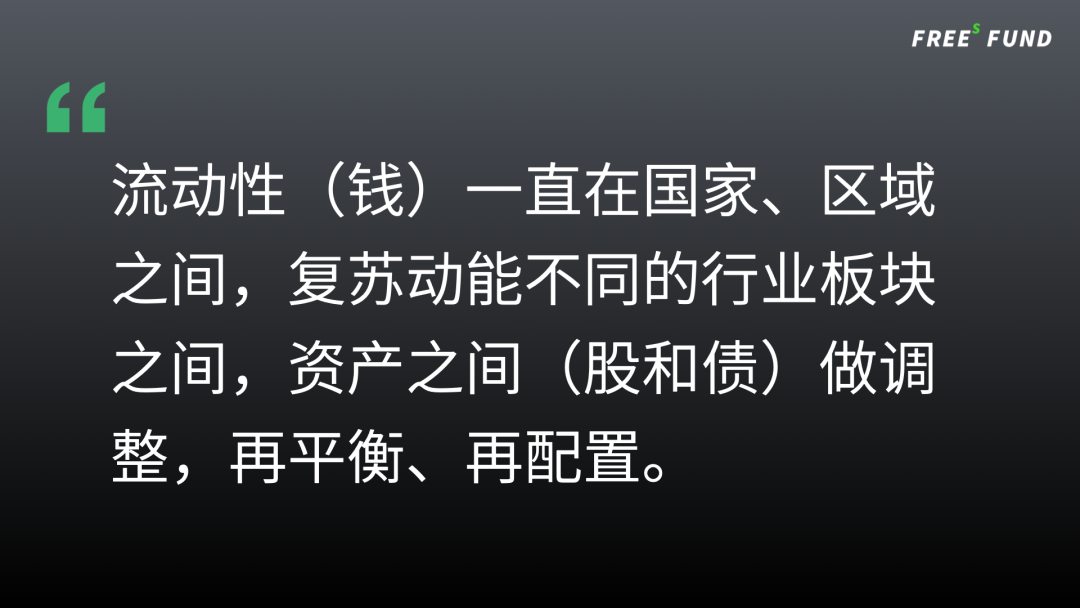
- Liquidity (money) is constantly being adjusted, rebalanced, and reallocated between countries and regions, between sectors with different recovery momentum, and between asset classes (stocks and bonds).
- Risk-free investments previously absorbed the vast majority of global capital. But in response to interest rate changes, some portion of that capital must inevitably adjust its allocation ratios among risk-free, low-risk, and high-risk assets. Combined with massive liquidity expansion, this has produced significant rallies across U.S., A-share, and Hong Kong markets for a considerable period.
- Whether it's regional capital rebalancing or asset rebalancing, both involve massive fund flows and reallocation, which inevitably creates market volatility. In the short term, if other regions see larger economic rebounds than China due to lower bases or more aggressive short-term stimulus, they could become destinations for big money chasing quick gains. So after entering mainland China or Hong Kong, capital will flow back out again, causing stock market fluctuations.
- By Q3-Q4 2021, if no major new uncertainties emerge, large capital should shift from targeting "quick rallies" and "rebounds" toward identifying and nurturing long-term prospects — meaning money will flow back into economies and asset classes with stronger long-term growth potential.
- The current policy backdrop of "prioritizing stability and avoiding sharp turns" means China can neither massively expand debt nor deleverage too quickly. Over the long term, capital markets representing direct financing will become increasingly important. Meanwhile, as China's domestic capital markets open further, they will attract more foreign inflows this year — though we must also stay alert to potential outflows.
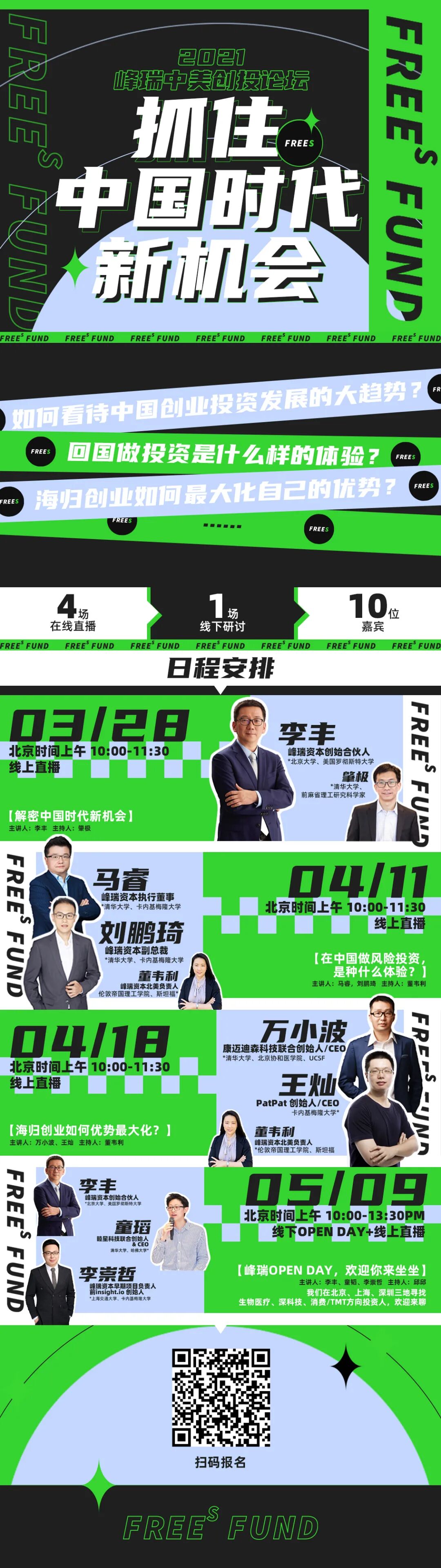
Here's the detailed analysis. We hope it offers some useful insights. We also welcome ongoing dialogue — this Sunday, March 28, we'll be hosting a sharing and discussion session.
Livestream Announcement
The 2021 FreeS Fund China-U.S. Venture Capital Forum series, Seizing China's New Era of Opportunity, continues with Decoding China's New Opportunities this Sunday, March 28 at 10:00 AM. Li Feng, founding partner of FreeS Fund, will continue his analysis of macro opportunities in China's venture capital space.
Tune in via FreeS Fund's video channel, Baidu, 36Kr, Sina Finance, or Sina Tech! Message "01直播" to the FreeS Fund WeChat official account to get the livestream link instantly.
If you're interested in joining the Zoom webinar or signing up for our subsequent offline Open Day, please scan the QR code to register.
Scan to register

01 Why Does the Global Capital Market Shudder Every Time U.S. Treasury Yields Fluctuate?
On March 17, 2021, the Federal Reserve announced its March rate decision, keeping the federal funds rate target range at 0 to 0.25%. On March 18, during European trading hours, the benchmark U.S. 10-year Treasury yield broke above 1.70% for the first time since January 2020, rising past 1.75% in pre-U.S. trading. All three major U.S. stock indices closed lower. By March 19, China's three major stock indices had also fallen in unison.
Why does the entire global capital market shudder every time U.S. Treasury yields fluctuate?
We can break this into two questions:
Why Do Treasury Yields Fluctuate?
First, what are government bonds?
Typically, sovereign debt from major global economies like the U.S. and China serves as the "anchor" for pricing assets, especially risk assets. Because there's virtually no sovereign credit risk, these bond yields are generally treated as the "risk-free rate," forming the basis for asset pricing.
In other words, assuming a major economy's government bond yields 2%, any capital invested in those bonds can earn 2% annually without any risk. We often say that risk and return are proportional in investing. This is calculated relative to the risk-free benchmark.

However, because government bonds are tradable, their yields fluctuate. When you sell a bond you hold, you're also selling its future years of returns to the buyer.
For example, the Fed began cutting rates in April 2020. If a bond was issued before the rate cuts, when the benchmark rate was say 2%, that bond might have carried a 2.5% coupon. By April, with the Fed slashing rates to 0–0.25% to stimulate the economy, newly issued bonds would see their coupons drop to around 1.5%. For investors holding pre-cut bonds, their effective yield has clearly improved.
The reverse scenario: if investors bought large amounts of U.S. Treasuries during the pandemic to hedge risk, but the U.S. printed too much money to stimulate the economy, eventually that massive liquidity brings inflation and rising prices. If people expect inflation to persist over a longer cycle — say at 2% to 4% — then the 1.5% coupon on bonds you bought earlier gets overtaken by inflation. At that point, you might rather sell your bonds at a discount and use the proceeds to invest in goods or assets that can at least match inflation in returns. Hence, Treasury yields rise.
How Do Treasury Yield Fluctuations Affect Stock Markets?
For ordinary investors, capital is typically divided three ways: bank deposits (fixed or demand); bank wealth management products (capital-guaranteed at minimum); and stocks or funds. Treasury yield fluctuations affect this allocation structure.
For instance, when Yu'e Bao first launched in 2013, its guaranteed annualized yield briefly hit 4% to 5% — excellent. When even low-risk investments could earn 4% to 5%, naturally expectations for risk assets like stocks rose higher. Assuming you had 1 million yuan to invest, how you split it among the three buckets (deposits, capital-guaranteed products, stocks/funds) largely depends on the lowest-risk investment's yield. If that yield is high enough, your required return on riskier investments goes up; if it can't meet your threshold, you reduce your allocation to risk assets.
That said, the primary capital in markets comes from institutional investors, whose assets under management often reach hundreds of billions or even trillions of dollars. The vast majority of this "big money" is still allocated to low-risk assets — that is, bonds.
But since 2020, a peculiar economic phenomenon has emerged: the "anchor" function of risk-free assets in pricing has been broken. This is because after the pandemic hit, most major economies adopted zero or even negative interest rate policies to stimulate growth. This means risk-free investing lost its meaning.
Yet as we've discussed, risk-free investments previously absorbed the vast majority of global capital. In response to rate changes, some portion of this money must inevitably adjust its allocation ratios among risk-free, low-risk, and high-risk assets. This shift coincided with massive liquidity expansion, and as everyone has seen: for a considerable period earlier, U.S., A-share, and Hong Kong markets all experienced significant rallies. This is the impact of U.S. Treasury rate fluctuations on capital markets.
But the question is: how long will this "anchor failure" last?
This is currently difficult to answer. Compared with the 2008 financial crisis, the difference this time is that many countries printed too much money in too short a time, yet there aren't massive underlying financial assets needing repair — most of the debt sits at the national level. It's as if the Treasury borrowed directly from the central bank, then distributed the money itself: some for pandemic response, some as stimulus checks to citizens, some to buy other bonds including government and corporate debt. In the U.S., for example, the Congressional Budget Office (CBO) stated in February 2021 that its baseline estimate showed public debt reaching $21.019 trillion in FY2021, equivalent to 102.3% of GDP.
The trouble behind this: countries have borrowed heavily, and if benchmark rates rise, their financing costs rise. Assuming government debt equals GDP, every 1% rate increase means spending 1% of GDP on debt service. Most developed countries' annual GDP growth is under 3%. The result: countries can't simply or easily raise rates, or they likely couldn't pay their debts; even if they could, bearing such increased financing costs would create major problems for economic growth. This seems like a "dead loop."
So we can judge that this cycle will last a long time, but it cannot continue forever.
02 How Should We View Volatility in A-Shares and Hong Kong Stocks?
We've previously shared a view: by the end of 2020, the biggest shift was that the massive uncertainties we'd been forced to accept over the past two years were mostly moving toward relative certainty. As internal certainty strengthens, people tend to make longer-horizon decisions and gain confidence to explore better-growing but previously unfamiliar or intimidating asset allocations. Hence we've seen strong performance recently in gold, equities, and even U.S. real estate. This also explains the surge in stock and fund investment enthusiasm earlier.
These allocation shifts also display certain regional characteristics. For example, if expectations for China's economic growth are positive, theoretically those with the ability and access will want to allocate more assets to China; correspondingly, if you're bullish on future recovery in the U.S. or South Korea, you'll allocate to those regions.
For "big money," allocations are typically global. When uncertain, you first seek what you're most certain about. This is why many stocks in U.S. and Chinese asset markets performed very well last year.

And as certainty generally improves, that "big money" also begins chasing better investment returns — meaning beyond allocating across asset types, it also allocates across geographic regions. So we see U.S. money going to Europe, European money coming to China, Chinese money going to the U.S. — achieving better returns through superior global allocation.
Notably, however, foreign capital actually utilized in China's capital markets in 2020 saw little growth compared with 2019. This means that despite massive global money printing, large amounts haven't yet flowed to China. China was the world's only major economy to achieve growth last year, and is widely seen as having good medium-to-long-term growth potential. We can see that this money first flowed to the Hong Kong market toward year-end. This is because Hong Kong's market is large enough and capital moves freely enough, so the Hong Kong rally certainly partly reflects global capital seeking better return opportunities.
However, as this newly printed money flows in, whether regional capital rebalancing or asset rebalancing, the process involves massive fund flows and reallocation. Money switches between different stock types within the same capital market, or between capital markets in different regions, or between asset types in different economies. This is why volatility is unavoidable.
For instance, in the short term, if other regions see larger economic rebounds than China due to lower bases or more aggressive short-term stimulus, they could become destinations for big money chasing quick gains. This is one reason for the recent stock market declines.
As major economies mostly return to relatively normal levels and the effects of Biden's fiscal stimulus fade, theoretically by Q3-Q4 this year, if no major new uncertainties emerge, capital will shift from targeting "quick rallies" and "rebounds" toward identifying and nurturing long-term prospects.
Most likely, this money will tend to flow into economies or asset classes with stronger long-term growth potential. Asia, for example, with China as a solid destination — though China's growth this year may not be as large given the high 2020 base, our long-term structure is sound.
"Sound structure" means China has returned to its proper growth trajectory and speed. On this foundation, frankly, we still need to believe that industries that should do well will do well, directions that should do well will do well, and companies that should do well will do well.

Specifically for capital markets: last year's high-growth consumer sector faces challenges maintaining high growth on top of a high base this year; while industries that theoretically should have grown last year — such as non-essential goods representing consumption upgrading, including culture, education, tourism, and entertainment — may see more obvious growth this year, possibly even making up for two years of growth at once.
03 What Lies Ahead for China's Domestic Capital Markets?
China's Capital Markets Are Playing an Increasingly Important Role
First, let's look at direct financing markets.
On May 9, 2016, People's Daily published "Asking About the Big Picture in the Opening Quarter — An Authoritative Figure on China's Current Economy," which formally proposed the "five major tasks" of cutting overcapacity, reducing inventory, deleveraging, lowering costs, and strengthening weak links — including "deleveraging."
Why deleverage? Macroscopically, according to a 2017 Institute of International Finance report, by Q1 2017 China's total debt had already exceeded three times GDP. Debt comprises roughly three parts: government debt, non-financial corporate debt, and household/personal debt. Per National Bureau of Statistics data, China's GDP first surpassed 100 trillion yuan in 2020.
Measures including 2018's asset management new rules and strengthened regulation of internet finance institutions were all manifestations of "deleveraging." But in 2020, the sudden pandemic outbreak caused China's macro debt scale to rise again.
So we saw: first, in January 2021, the State-owned Assets Supervision and Administration Commission (SASAC) stated that "next steps, building on three years of deleveraging achievements, will shift from deleveraging to stable leverage, ensuring most enterprises' debt ratios remain stable, high-debt subsidiaries' ratios return to reasonable levels quickly, and resolutely guarding against major debt risk." Then in February, the People's Bank of China proposed that "prudent monetary policy should be flexible, targeted, and reasonably appropriate, prioritizing stability and avoiding sharp turns, grasping policy timing, degree, and effectiveness, and balancing economic recovery with risk prevention."
In other words: neither massively expand debt nor deleverage too quickly. This means that over the long term, capital markets representing direct financing will become increasingly important.

China's Capital Markets Will Attract Significant Foreign Inflows, But We Must Also Stay Alert to Potential Outflow Impacts
China's capital markets are gradually accelerating their opening. On June 28, 2018, the National Development and Reform Commission and Ministry of Commerce released the Negative List for Foreign Investment Access (2018 Edition), removing foreign ownership caps for banks and financial asset management companies with equal treatment for domestic and foreign capital; raising the foreign ownership ceiling for securities firms, fund management companies, futures companies, and life insurers to 51%, with no limits after three years. By 2021, that three-year period is approaching, and financial opening will deepen further.
As domestic financial markets gradually expand their opening, we also face the situation of the U.S. and other developed countries releasing massive liquidity in the short term. So we can be certain that, as the world's only major economy achieving positive growth in 2020, especially when global low-risk or risk-free yields are extremely low, in 2021 we'll likely see global capital market money flowing into China. The question we face is: how will this money exit, what we often call free flow and convertibility of capital accounts.
Behind this lies a huge systemic and policy challenge. When this money enters, it brings many benefits to our country's overall financial system and structure. But if capital accounts move to complete free flow and convertibility, once it sweeps away just as quickly, it will also bring massive shocks to the system. We need it, but must also be wary of it — this tests policy response and management capabilities.

Social Investment Is Shifting from Physical to Virtual Assets
Another change occurring in China's capital markets is that societal wealth is beginning to move in the direction of economic and financial structural adjustment.
According to the People's Bank of China's full-year 2020 financial statistics report released in January 2021, by end-December 2020, Chinese household deposit balances reached 93.44 trillion yuan. In fact, if savings can be guided toward investment and consumption, it would greatly help China's economic growth — this can be understood as following policy direction.
Looking back at 2020, several data points merit attention. Per National Bureau of Statistics data, 2020 national per capita disposable income grew 2.1% in real terms, basically in line with economic growth, but per capita household consumption expenditure was 21,210 yuan, down 4% year-on-year. Simply put: people earned more but spent less. Pandemic-induced uncertainty was the main cause.

Without the pandemic, given China's current stage, a typical shift would be social investment moving increasingly from holding physical assets to holding virtual assets — physical assets being most typically real estate, virtual assets being represented by financial assets.
If we don't choose the path of massive stimulus, then our available capital mainly comes from three sources: monetary policy; foreign capital attracted by financial market opening; and mobilizable social idle funds (household deposits participating in investment).
Regarding "mobilizable social idle funds." Currently, capital markets are relatively hot, which has some attraction for this capital; additionally, since October 2016, national-level policies have restricted investment in real estate, advocating "housing is for living in, not speculation." This essentially guides household idle funds from physical assets toward virtual assets like financial assets.
Given household savings of nearly 100 trillion yuan, if our savings rate could drop 20% to approach U.S. levels, this capital once deployed into financial investment would certainly bring changes to China's financial markets.

The 2021 FreeS Fund China-U.S. Venture Capital Forum series, Seizing China's New Era of Opportunity, continues with Decoding China's New Opportunities this Sunday, March 28 at 10:00 AM. Li Feng, founding partner of FreeS Fund, will analyze macro opportunities in China's venture capital space.
Tune in via FreeS Fund's video channel, Baidu, 36Kr, Sina Finance, or Sina Tech! Message "01直播" to the FreeS Fund WeChat official account to instantly get the livestream link.
If you're interested in joining the Zoom webinar or signing up for our subsequent offline event "FreeS Open Day," please scan the QR code in the poster below.
We are currently seeking biotech/medical, deep tech, and consumer/TMT investors in Beijing, Shanghai, and Shenzhen. If you're interested in joining us, we especially welcome you to register for our offline Open Day. To participate: scan the QR code in the poster below. Of course, you're always welcome to send your resume directly to hr@freesvc.com.