2023: What New Opportunities Did AI Bring to the Gaming Industry? | FreeS Fund Venture Dialogues

From *Eggy Party* to *Justice*, How Is AI Reshaping the Gaming Industry?
In 2023, AI-powered games exploded onto the scene. With AI's help, Eggy Party kicked off the year with a milestone — daily active users surpassed 30 million, making it NetEase's most active game by DAU. By August, Eggy Party's monthly active users broke 100 million. Justice, launched in June, featured interactive NPCs with "emotions" and raked in over 2 billion yuan in its first month. On the content production side, AI's momentum was equally unstoppable. According to Maimai's 2023 Gaming Industry Mid-to-High-End Talent Insights, nearly 95% of gaming professionals are actively embracing AI, with over one in five already treating AI tools as work partners. Meanwhile, players are using AI tools to participate more deeply in content creation, fueling an infinite loop of content supply and consumption.
At this inflection point for AI games, we invited Baizhi, CEO of Funmangic; Wufeng, CTO of Funmangic; "Teacher Yang," publishing lead at a top-tier esports PC game brand; and Fan Mingwang, early-stage project lead at FreeS Fund, to discuss how AI is reshaping the gaming industry.
Baizhi, founder of Funmangic, previously headed metaverse incubation at ByteDance and served as lead game designer on Mr. Love: Queen's Choice. Her company is building an AI social product driven by gaming content. Wufeng, Funmangic's CTO, formerly led NetEase's Fenglei Studio and served as product lead for NetEase Fuxi, the company's AI platform. Fuxi powered major IPs including A Chinese Ghost Story, Justice, and Naraka: Bladepoint — all of which explored AI extensively. Teacher Yang is a publishing lead at a top-tier esports PC game brand and a veteran industry professional. Fan Mingwang leads early-stage projects at FreeS Fund, covering consumer, TMT, and entertainment sectors.
Their discussion touched on topics including:
- Why "AI and games have been combining for a long time"
- What Eggy Party did right to surpass 100 million monthly active users
- Whether AI tech acts as a "buff" or a "bug" for gaming professionals
- Why giving AI long-term memory with individuals remains hard, despite large models' impressive recall
- Why "AIGC can become a perpetual motion machine for content at the sci-fi level"
- What new opportunities emerge when productivity, distribution, and content dimensions all shift simultaneously under AI's influence
We've edited excerpts from their conversation, hoping to offer fresh perspectives. We welcome you to continue observing and exploring with us. You can also find the full episode on the Xiaoyuzhou app or Apple Podcasts by searching for and subscribing to "High Energy." If you're an entrepreneur or professional in the entertainment space, you're welcome to reach out to Fan Mingwang at kikofan@freesvc.com.
Interactive Giveaway: What new shifts have you observed in today's gaming market? We'd love to hear your thoughts in the comments. By 5:00 PM on October 5th, the five most thoughtful commenters will each receive a copy of Finite and Infinite Games by James P. Carse.
Tracing the Roots: AI and Games Have Been Combining for a Long Time
Fan Mingwang: Where does AI technology currently stand in the gaming industry? What's its present state and trajectory?
Wufeng: The marriage of AI and games didn't start this year — it's just getting unusual attention now because generative AI has advanced so rapidly. As we say, you take a nap and wake up to a changed world. For example, NetEase Fuxi was founded back in 2017, making it one of the first in China to experiment with AI + games. The Justice mobile game showed everyone the results. But behind that success lie five years of NetEase's deep roots in the MMO (Massive Multiplayer Online Role-Playing Game) space. That's why NetEase could move so quickly to combine AI with games at the application level when AI heated up.
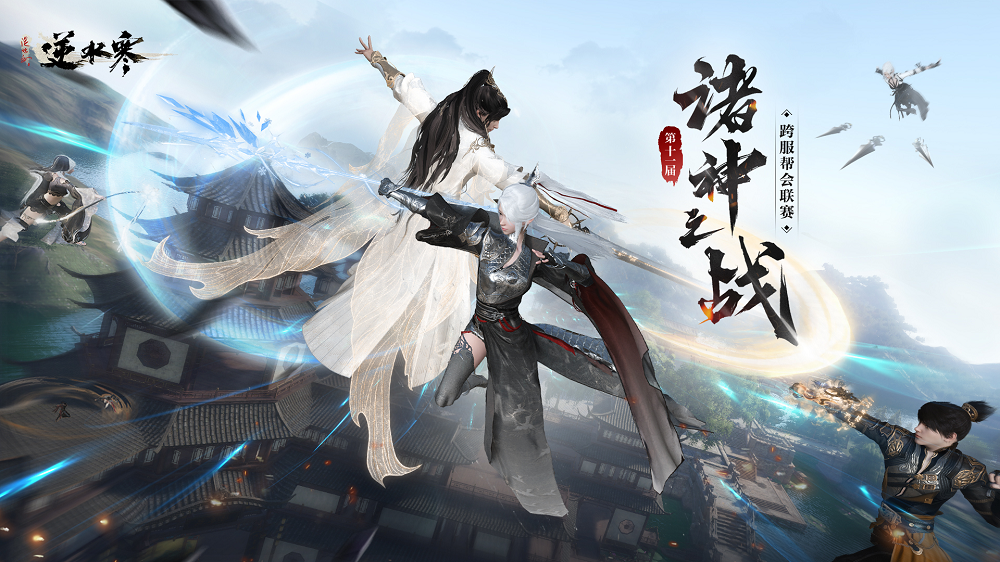
▲ The game Justice. Image source: NetEase
AI has existed in games from the very beginning in the form of computer-driven NPCs (non-player characters). We called their behavior engines "AI." But they were deterministic, pre-programmed. In Super Mario Bros., every non-player-controlled unit was an NPC. The little turtles, walking back and forth in place — they had their own behavior patterns.

▲ The game Super Mario Bros. Image source: 360 Game Entertainment
This was the first stage of AI in gaming: pre-programmed logic units based on behavior trees or finite state machines — we called this AI too.
The second stage was "deep learning." In Naraka: Bladepoint, for instance — a highly mobile, fully 3D game environment — how do you make NPC bot opponents perform as skillfully as humans? We used reinforcement learning to drive highly competitive, highly human-like combat bots. Simply put, making NPCs fight and play more like people.
Similarly, in Honor of Kings or League of Legends, getting AI-controlled heroes to move as nimbly and strategically as human players. Or take AlphaGo — a classic example of a deep learning-based competitive bot, using reinforcement learning to achieve human-level competitive ability in Go.

▲ The game Honor of Kings. Image source: Honor of Kings official website
The third stage pursues NPCs whose words and actions feel human. Language is the hardest part of AI. With the emergence of generative AI, we've gained the ability to create NPCs with personalities, purposes, and their own behavior patterns — more human-like, more personified. Justice is the quintessential example of this gameplay. NPCs now have their own goals, emotions, and personalities. They can converse naturally with players, even develop complex relationships of love and rivalry. Every player's experience with each NPC differs, and none of it can be pre-scripted or encoded.
To summarize, AI application in NPCs has three stages: first, traditional behavior trees or finite state machines — coding-biased AI. Second, deep learning and reinforcement learning — competition and decision-making-biased bots. Third, after generative large language models emerged, personified bots like Justice's intelligent NPCs.
We may be standing in the middle of a "storm." Going forward, we'll see more star-level games emerge, and our production relationships will face more dramatic changes and shocks. But we're relatively optimistic — we believe there are many new opportunities in this.
Teacher Yang: To add to that — in the second stage Wufeng mentioned, beyond competitive bots, AI also leveraged big data to help us understand games better. Dota 2's Plus membership, for example, uses big data to recommend which skills to learn, which talents to pick, and which items to buy during matches — it's enormously helpful to players.
Fan Mingwang: I have a question for Wufeng. Some players developed emotional bonds with AI, then felt devastated when they logged back in and the NPC didn't remember their previous conversations. I'm wondering if future technology can help AI better retain memories of interactions with people — are there any latest research findings or technical approaches in this area?
Wufeng: This is absolutely achievable. Long-term memory, more nuanced emotional analysis, safety — these are the hard capabilities that AI application tracks compete on. It's also what Funmangic wants to build: NPC societies and AI social gaming experiences with emotion, sentiment, and soul. But the trade-offs behind it come down to whether we have enough fine-tuning keywords, sufficient compute, and good enough, large enough models to truly achieve engineering deployment.
Personally I'm more ambitious — I believe general artificial intelligence will arrive faster, and AI will have the opportunity to bring soulful, personified NPCs and societies into gameplay experiences. Though it would still be a "brain in a vat" (a classic thought experiment exploring whether a brain experiencing a world simulated by computer could realize it lives in virtual reality), not like Westworld where hosts physically step off the train to participate in the town.

▲ Still from Westworld. Image source: Douban Movies
But AI can already pass the Turing test — it's becoming difficult to distinguish whether you're talking to a human or AI. The longer-term significance is that AI may eventually possess long-term memory and nuanced emotions, becoming equally personified and soulful existences. These are the points we practitioners want to push further.
Baizhi: General-purpose AIs like GPT lean more toward tools — it's hard for them to develop shallow-to-deep emotional connections with users. We want to use gamified forms to do AI social, creating soulful AI virtual characters to accompany users. They do have certain practical utilities, but more importantly they can provide emotional resonance, allowing socially anxious, introverted people to carry AI-created NPCs into social situations.
Most current products revolve around text. When we have 3D avatars, we also want NPCs to be consistent in word and deed — with behavior patterns and dialogue systems backed by the same LLM (Large Language Model). This way, as NPCs interact with players, they can continuously learn and train, developing a more self-consistent logic. In this sense, they could become soulful AIs within a virtual world.
Regarding long-term memory, we've discussed this extensively internally. We believe long-term memory is actually a prerequisite for digital life. It needs to unfold memories spanning seven days or more based on intimacy levels with users. We hope that when users return to this virtual world or product, NPCs still retain memories from a year ago, five years ago, even ten years ago — remembering those specially meaningful moments with players, possibly even connecting to players' real lives.
Wufeng: When I mentioned AI as a "brain in a vat," it's actually not quite that in games. Traditional large language models are cognitive models — they contain much knowledge and common sense, they're probability prediction models. But they have no concept of right or wrong. They don't know what's correct or incorrect in the physical world, nor do they have physical rules.
But in the game world, if we introduce decision-making models and decision factors into the training of cognitive models, we can make cognition and decision-making complement each other, allowing them to train each other in a fully digitized world. That's why I believe general artificial intelligence and games will be the first to combine, the first to land, and the first to develop — because it can put decision-making ability and cognitive ability together simultaneously, something traditional single-language models simply cannot do.
Yang Laoshi: Shouldn't AI have better memory than normal people? Why worry about AI's long-term memory problem?
Wufeng: Actually, it has different meanings. Current large language models actually have excellent memory — they've memorized nearly all of human civilization's knowledge. This is one level of memory, and it's unrelated to individuals.
But within that vast memory, the things that happen between two people, like what Baizhi mentioned earlier — if you try to train that into a foundation model, it gets drowned out by the massive amount of human historical knowledge. This isn't a problem solvable from the foundation model's perspective; it needs to be addressed from the middleware and upper-layer application angles.
Yang Laoshi: Is it because AI inherently lacks emotions, so when it tries to find the correct answer, it gets confused by the vast amount of information it has stored?
Wufeng: Right. If you want this information to be retrievable in a language model, you need to train it with massive amounts of data, but individual data and collective data aren't the same order of magnitude.
How the "AI Spinning Jenny" Could Spark an "Industrial Revolution" in Gaming
Fan Mingwang: This year we've seen games like A Chinese Ghost Story and Justice develop new gameplay around AI. Additionally, Eggy Party uses AIGC technology to lower the barrier for user creation.
Currently in the gaming industry, we're seeing more and more cases where UGC gameplay time exceeds the built-in main gameplay time. How do you view the impact of AI technology on productivity supply in the gaming industry?
Baizhi: Eggy Party is a casual, lightweight role-playing social game, and also NetEase's highest DAU product ever, with monthly active users recently surpassing 100 million. Its UGC content ecosystem has deep integration with AI, forming a user co-creation content ecosystem.

▲ The game Eggy Party. Image source: Eggy Party official website
A standout feature of this game is its low barrier to entry. Whether or not users know how to play games, they can participate in Eggy Party. The game provides UGC creation tools — players who know how to play can create their own maps, while less experienced players can experience maps created by others.

▲ Player-created maps. Image source: Eggy Party official website
In iterating its UGC map editing features, Eggy Party has also added AI-assisted map creation functionality. It already has creators in the tens of millions, with millions of UGC maps updated weekly. Going forward, more and more creators may be willing to use AI to assist their creation.
Yang Laoshi: There might be another significance. Without AI, UGC would always be UGC, and PGC would always be PGC. Once AI enters, the barrier for UGC drops. With AI, PGC doesn't need to produce content — it only needs to provide "possibilities." More creators can use the content provided by developers and more easily create UGC content with AI.
Current UGC content is centralized — a few people create, and more people just play. With AI lowering the creation barrier, users can solve their own gaming needs rather than waiting for capable creators to make content they like.
Fan Mingwang: For gaming professionals, especially concept artists (concept art refers to hand-drawn illustrations describing key character designs and actions during animation and video game production, used for later processing), how do they view AI tools and the increasing trend of AIGC mechanisms being embedded in games?
Wufeng: This is a particularly interesting topic. Looking deeper, this is a change in production relations — players are shifting from pure consumers toward creators. Creators in the gaming industry will indeed feel the impact.
This change in production relations is remarkably similar to the First Industrial Revolution, when the spinning jenny replaced textile workers. Though the spinning jenny represented advanced productive forces, thousands of unemployed textile workers angrily smashed and burned them.
Artists can't burn AI, but this impact is indeed happening. We saw significant backlash from the artist community when AI painting first entered competitions. Not long ago, when the film Oppenheimer was released, Hollywood screenwriters and actors were striking, marching, and boycotting AI creation.
For industry professionals, this change is definitely a double-edged sword — is it a tool or is it replacing humans? Thinking back to the spinning jenny, it replaced manual laborers, but no one expected that AI's first wave of replacement would target mental workers. But this doesn't mean complete replacement; rather, everyone needs to adapt together. For example, artists also need to learn AI creation and model training.
Fan Mingwang: In the future artistic and creative process, will existing positions evolve and transform as AIGC technology develops?
Yang Laoshi: Right now we might feel that AI is competing with writers and artists for jobs, but in the future, new professions will certainly emerge. There might be positions like AI trainers, and these positions might also require professional specialization.
I recently went back to school and found that many classmates from environmental and materials science backgrounds, after completing their master's and PhDs, have become "code farmers." In the future, art students might become AI trainers, but becoming an AI worker doesn't mean you can no longer paint. I'm relatively optimistic about this. People might choose to resist for a better life, but later they'll accept it and change themselves.
Fan Mingwang: So AI, as a factor in the complete transformation of productive forces and production relations, might eventually become infrastructure integrated into the development of all industries.
Baizhi: The transformation of productive forces and tools can provide momentum for overall human progress. Humans excel at using tools — from drilling wood to make fire to using smartphones, and now even using GPT for basic tasks. AI is a new tool; as long as we use it well, we'll have more comfortable work and living conditions.
Fan Mingwang: Will the application of AI technology have any impact on your teams or gaming companies themselves? For example, might it change your company's form, organizational culture, or production efficiency?
Baizhi: From a game R&D perspective, earlier this year, many concept artists could quickly generate concept designs from a few rough sketch lines. Copywriters also started using keywords to generate worldview visions they had in mind — this is on the art side.
As for 3D art and automated programming, we've been experimenting from February to September, but there's still some gap before it can be presented to players or industrialized.
Wufeng: From a technical perspective, I'm participating in this with maximum enthusiasm. I mentioned so many tools, including assisted creation — previously this was essentially a cost-reduction and efficiency-improvement topic. With AI, it moves from the essence of cost reduction and efficiency improvement to having the opportunity to connect with UGC and user creation, becoming a bridge.
Second, I mentioned the spinning jenny earlier — it didn't start fully formed either. It went through stages from human power to water power, then to steam and electricity. We feel this "AI spinning jenny" isn't good enough yet, and we're thinking of various ways to make it better, improving R&D processes and production relations, ultimately reaching the ideal ecosystem of user co-creation.
Yang Laoshi: I'll add an observation. We've been discussing whether AI's integration into the creative process will impact practitioners, but Justice hasn't caused any such reaction.
My analysis: first, because it doesn't use pre-generated AI (like the early game NPCs that could only perform simple actions), players don't feel anyone is cutting corners in the workflow. Instead, they can sense that many hardworking developers have invested heavily in the gaming experience, whether in big data or creative content aspects.
Is it that any AI generated on-the-spot is workplace-non-threatening AI? Or AI that allows players to participate in creation, including dialogue creation, can solve the AI-related problems we've observed in the market?
Wufeng: Completely agree. Whether it's screenwriters or the previous "NO AI" movement, it feels like they're playing a zero-sum game. For example, with a card game's card art — it was originally hand-drawn by humans, and I might spend several 648 RMB (648 yuan is the upper limit for many mobile game single recharges) to get it. Now you tell me it's AI-generated, maybe just consuming some electricity, and consumers find that hard to accept.

▲ Hollywood strike action, May 2023. Image source: NPR
Justice actually provides a new gaming experience that couldn't be provided through static methods before. Whether for consumers or creators, they're encountering something entirely new.
Yang Laoshi: What Wufeng said is quite inspiring. I can even imagine that as players' understanding of AI gradually solidifies, I as a copywriter can more creatively and distinctively package keywords for certain responses, making players marvel "it can even say that," further elevating the gaming experience.
Actually, we're doing all this to serve the game, not to serve the concept of AI — I think this is non-zero-sum operation.
Additionally, like the AI trainers we mentioned earlier — in such work, when we better establish the language framework for NPCs in each scene, there's still workload involved, and it can still be recognized. Players can also feel the hard work behind the planners' efforts. I think these are all good inspirations for non-zero-sum games.
Fan Mingwang: From what was just mentioned, I'm reminded of a very similar concept called the infinite game. Traditionally, games have clear boundaries. In a zero-sum competitive relationship, we compete for wins or rankings — this is the framework for many competitive game types.
But with the introduction of AI, as more NPCs join the gaming ecosystem, we do feel gameplay gradually evolving from finite games toward infinite games. Many people say Justice is a "super frankenstein" — it's hard to explain what its core gameplay actually is, and everyone in this ecosystem can find the fun they want.
Games are becoming increasingly inclusive platforms or worlds, where every player, including NPCs, has their uniqueness and personality fully respected. This is also the "AI for good" side that was mentioned earlier.
We've also seen a surge of innovation around AI-integrated gameplay in the past couple of years. From a player's perspective, what new experiential changes and challenges does AI bring to games?
Wufeng: Justice was a relatively early and strong example — it cleared away some of the fog. Will players actually chat with NPCs on their phones? How many barriers exist in this process? Are there real technical moats along this path?
Justice also reaped the benefits of combining AI with gaming. Everyone was anxious about whether Westworld would quickly become reality. On one hand, Justice pioneered new gameplay experiences, allowing players to freely interact with NPCs in a small society of intelligent agents (a concept in AI referring to software or hardware entities capable of autonomous activity) rather than rigidly scripted characters. Players could even develop love-hate relationships with NPCs: some would flirt with Ni Xiao Han, get engaged to her, engage in long-term emotional exchanges, feel heartbroken when forgotten by an NPC, and then produce fanfiction and videos that circulated online.
These were experiences people had long anticipated — whether in films like Ready Player One or shows like Westworld, which served as advance expressions. Once a product crosses that golden threshold of experience, it generates powerful marketing effects organically.
03 What Impact Has AI Had on Game Publishing and Distribution?
Fan Mingwang: Teacher Yang has extensive experience publishing games domestically and abroad. From a publishing or market perspective, do you think AI has also brought changes to how games are distributed?
Teacher Yang: We can look at this from two angles: user acquisition and game publishing.
On one hand, AI has many applications in user acquisition. Simply put, user acquisition breaks down into what you use to advertise (the creative assets) and how you advertise (the channels).
For creative assets, people now input selling points into large models to generate various AI videos and AI banner images, streamlining workflows. That's what's changing on the user acquisition side.
Channels aren't something the gaming industry controls — that's the traffic platforms, like Google, which have long used their own AI algorithms to optimize ad delivery logic. Better data means advertisers keep spending. On data analysis, large models now let people understand much more deeply. For example, "users who play basketball might prefer World of Warcraft" — this kind of insight was hard to get from data alone. Big data and large models help everyone further refine their user segments.
Then on game publishing: Justice uses real-time generated AI, and players don't find it off-putting. This shows that the reputation risk we constantly worried about has been resolved. If a game crudely used AI and caused industry artists or other professionals to feel their labor wasn't respected, the resulting controversy would affect how players perceive the game. Many game professionals have been trying to avoid this issue.
04 Will AI Social Games Affect Real-World Social Relationships?
Fan Mingwang: When we used to recommend friends to players, we relied on social relationship algorithms to maintain and recommend connections. I'm wondering if, with AI technology introduced, new changes might emerge in how relationships are distributed within games?
Bai Zhi: We have our own internal social network algorithm. Its principle is based on a value-flow network entity value assessment algorithm. This algorithm treats interactions between individuals as a form of value-recognition relationship, considering both interactive behaviors and individual characteristics. Within the social network, the algorithm performs collaborative evaluation of value between entities, providing underlying support for gamified incentive systems.
We hope AI can continuously construct new content, allowing human relationships to warm up through content and even establish long-term intimate relationships. We also want intimacy to have quantifiable metrics that can record content both parties enjoy.
Our OpenRank algorithm can also feed back into real-world social relationships — it can toss out a conversational hook when two people are chatting, something extracted from the algorithm that's relevant to both. At this level, machine learning based on social networks can better extract entity features from relationships and perform similarity matching in high-dimensional space. Through algorithms, we can construct more people who seem to meet by chance but actually click with you.
Fan Mingwang: If I understand this simply — whether it's the OpenRank algorithm or the new AI-driven algorithms Funmangic uses — they essentially help extract the social assets players accumulate within games, then use that extraction to help two strangers or players from different backgrounds start communicating. So it sounds like technology is once again playing a facilitative role, right?
Bai Zhi: Right, bluntly put it's an "AI algorithm matchmaker" — except in-game socializing isn't just 1v1; people might gather simply because of a shared interest.
Wufeng: In games leaning toward social and language elements, language models naturally have a complementary role. Whether it's long-term memory or personal interests, these become data that's comprehensible, summarizable, reviewable, and abstractable. Language models and generative models give us entirely new opportunities to better utilize this data.
Fan Mingwang: The feature you just mentioned reminds me of an episode of Black Mirror where everyone's social assets are quantified, floating above their heads, circulating as social currency.
Expanding from this point — with more data about personal characteristics and personalities being recorded by games or various product forms across multiple terminals — could this genuinely feed back into social interactions outside of games? To put it abstractly: could the social assets accumulated in virtual game worlds ultimately reshape real-world relationships?
Teacher Yang: When you mention AI collecting this data and feeding it back into real life, I don't get good mental images — all I see is someone forging my identity and asking my parents for money.
As for whether "digital social behavior feeds back into real-world socializing" — I think this was already happening without AI. Especially in heavily social games like A Chinese Ghost Story and Justice, quite a few real-world romances are formed every year. Several of my good real-life friends started from WoW guilds. That's been ongoing.
At this point I'm less supportive of AI. I feel like virtual worlds have done about enough good for us — helping us make friends, find partners, and find playmates in our spare time. If I examine myself more honestly, the things I can imagine don't seem too great.
Bai Zhi: I think Teacher Yang's view is somewhat limited. For example, a navigation system with Lin Chi-ling's voice provides a better experience than a pure robotic voice. When AI is integrated into online products, it can serve both functional purposes and provide emotional value.
When we make an AI assistant or AI butler, it might be a small alarm clock, a memo pad, telling you about important matters when you're so immersed you've lost track of time. In this process, AI combines entertainment, practicality, and emotional value.
Second, even without artificial intelligence, online virtual products already served as bridges for offline friendships and even finding partners. If a product has a good guidance model that connects its functionality and emotional value between online and offline, it can become a better assistant. As long as we avoid the risks Teacher Yang is worried about and don't go in that direction, there are always better possibilities.
Wufeng: My view on this is somewhat neutral but leans optimistic.
First, whether we like it or not, this has already happened. Douyin already knows your preferences. In the previous internet revolution, privacy was already a concern; in the AI world, privacy issues become even more sensitive and deserve more attention. In fact, engineering and policy standards in this area are quite high — especially if you're releasing products in Europe, where you face extremely strict privacy standards and regulations.
Second, on emotional value: current technology is far from adequate in exploring and supporting human emotions. Teacher Yang may be very self-consistent and doesn't need AI's help. But some people I've encountered with social anxiety — for them, tools for self-understanding are far from sufficient. I think AI has an opportunity to play an unprecedented supportive role.
Fan Mingwang: We've indeed seen tools using AI to help disadvantaged groups communicate — for example, using voice samples from people with hearing impairments to synthesize and generate their actual speaking voices, helping them better express themselves.
I believe such benevolent applications, in future social products and game forms, can help remove people's innate differences as much as possible, allowing everyone in social interactions, especially in virtual worlds, to more freely choose how they want to express themselves. This is where I think AI can deliver its greatest value.
Teacher Yang: I have a question: is AI socializing actually socializing? Because I'm actually quite introverted — I need someone to take over for me to speak more comfortably. I think AI would struggle to do this. So is AI socializing socializing? Or, "whether androids dream of electric sheep doesn't matter" — does Teacher Bai want us to dream of androids?
Bai Zhi: I hope that through AI social products, AI becomes an ice-breaking tool for emotional and intellectual exchange between people. I want to position AI socializing as a bridge, not a complete replacement.
Fan Mingwang: Bai Zhi, you must have special settings in your games, right? Between AI and players, players and players, AI and AI — are they clearly distinguished or mixed together?
Bai Zhi: We still have clear distinctions. We distinguish between the real Teacher Yang and the AI avatar Teacher Yang might delegate to. Humans are ultimately carbon-based beings who need to eat, sleep, and have the various offline lives they should have.
05 When Production Supply, Distribution Methods, and Content Change Due to AI, What New Opportunities Will Emerge for the Gaming Industry?
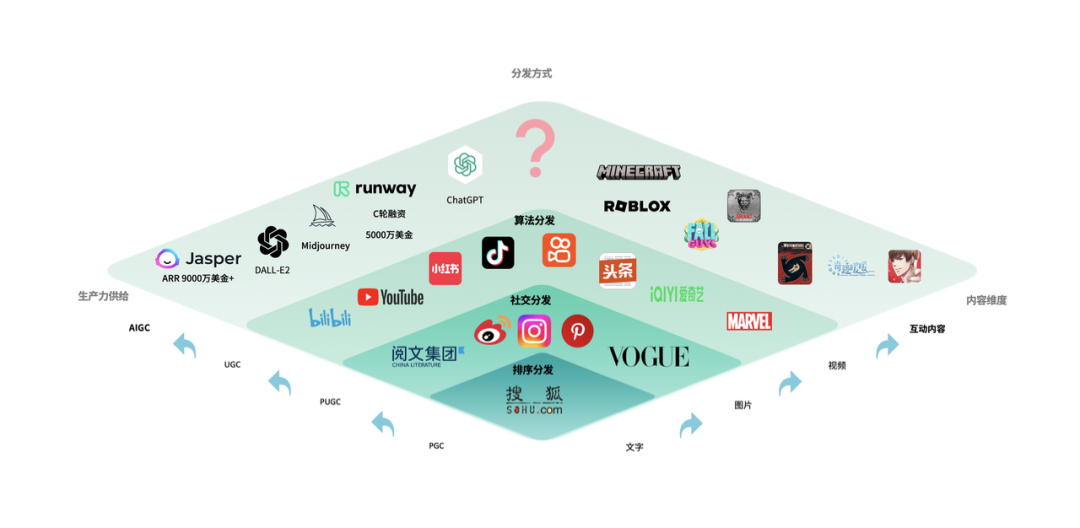
Fan Mingwang: Today, following the threads of production supply, content, and distribution methods, we've discussed AI's impact on the gaming industry. Early on, we internally created a diagram discussing the evolution of digital content. Feng Shu also previously explored internet-related business models from the perspective of information digitization on the Gao Neng Liang program. (For more on information digitization, see Li Xiang x Li Feng: Why Did ChatGPT Emerge Today? What Happens Next? | Li Feng Column.)
From today's vantage point, when all three variables — production supply, distribution methods, and content dimensions — are simultaneously changing under AI's influence, what new opportunities and content product forms will emerge for the gaming industry?
Baizhi: I'd summarize this new opportunity as the expansion of digital culture. AI is genuinely accelerating content production and co-creation with users. For example, Eggy Party leverages its UGC map editor to encourage players to create content related to public welfare and environmental protection, cultural heritage, and aerospace science popularization. Eggy Party also partners with specialized funds like "Love Ocean" to organize charitable activities.
Games can actually combine with AI to become products that are both educational and socially valuable. Games have role-playing elements — if you integrate education into gaming, with some people playing teachers and others students, you can achieve real learning outcomes.
Wufeng: I've heard a saying: "All SaaS services will be rewritten by AI." Looking broader, I believe all professional barriers and thresholds for work will be lowered. I'm particularly bullish on Copilot. AI will make it easier for us to draw, design game levels, create storylines, and so on.
What we're building with Funmangic is something like a Copilot for social. AI lowers the barrier to social interaction, making people more willing to speak up, more willing to communicate with each other, and more willing to collaborate toward shared goals.
Teacher Yang: Let me get a bit sci-fi here. If we treat productivity as supply and content as output, another domain that talks about supply and output is energy. The highest balance of energy supply and output is a perpetual motion machine. AIGC's end result might not get there, but in a sci-fi dimension, we could achieve a content perpetual motion machine.
The concept of a perpetual motion machine is that as long as there's demand, there can be supply. Whatever content I want, AI can supply it, and it will iterate infinitely on its own. Maybe I want to see something weird — say, a bunch of furries shaped like Coke bottles playing soccer — and then this weird thing becomes productive supply content, ceases to be weird, and stimulates more output, which in turn becomes supply again.
At that point, AI games will become industrial assembly-line products, while games made by creators will become luxury goods, like handmade bags today.
Fan Mingwang: In fact, when Baizhi founded Funmangic, the positioning was precisely a new product form at the intersection of production supply, distribution methods, and content. I'm curious, Baizhi — how do you define what you're building now? Where are the challenges?
Baizhi: We still want to drive AI social through gaming.
From the production supply dimension, beyond the high-quality content we produce ourselves, we hope to achieve user co-creation through artificial intelligence and our self-developed AI engine. From the content dimension, we want the product to offer both 1v1 companionship and the ability for players to make friends, socialize, or develop intimate relationships with others — or simply express themselves better through content. On distribution, we hope AI network distribution algorithms can better serve virtual online social, creating comfortable ecosystems for both gamers and non-gamers.
We also hope to apply our previous accumulated experience into Funmangic and explore a new product form.
Fan Mingwang: Whether from a technical perspective, player experience, or the evolution of distribution relationships, "people" are ultimately the purpose. As AIGC technology matures, it may make personalized, differentiated, and highly interactive gaming experiences a reality. Everyone might open the same game, yet the gameplay, story, experience, and emotions are all different. Everyone might be not just a player but also a creator, generating new stories, gameplay, and game content.
We very much look forward to seeing a platform product emerge that embraces infinite possibilities and accommodates every individual's personality and needs.
Reader Engagement
In today's gaming market, what new shifts have you observed? We'd love to hear your thoughts in the comments. By 17:00 on October 5, the 5 users with the most thoughtful comments will receive a copy of Finite and Infinite Games by James P. Carse.

FreeS Fund's 8th Anniversary — Join Us and Go Further Together
A Trip to the US: 6 New Opportunities in Consumer Sub-Sectors | FreeS Research
Follow & star the FreeS Fund WeChat official account for timely business insights.