From "How Did the World Get Here" to "Where Are We Going" | FreeS Fund 2024 Annual Investor Summit Recap

AI and the World

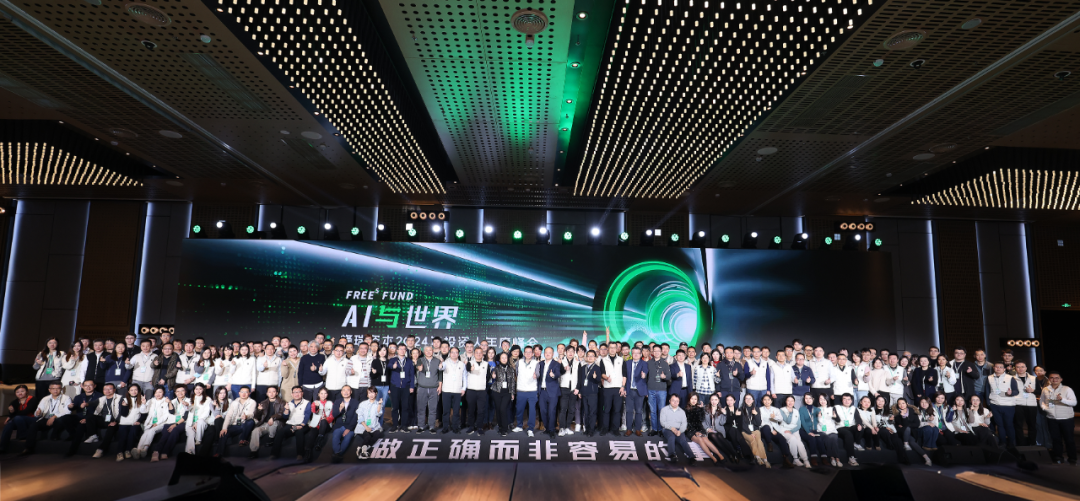
On December 17–18, we held the FreeS Fund 2024 Annual Investor Summit in Beijing, themed "AI and the World." FreeS Fund's investors, founders of select portfolio companies, and our team gathered to discuss China's future industries, embodied intelligent robotics, AI for Science and interdisciplinary innovation, and globalization.
AI is entering a new cycle of development. The questions we keep asking ourselves are: What does the future of AI look like? How can we make AI "human-centric" and create a better future world for all? Looking back from that dreamed-of future, what small but destined-to-be-great business opportunities exist today?
The mere act of contemplating these questions is exhilarating. Even more exciting is that we see such opportunities. Beyond the currently hot topics of embodied intelligence and AI hardware, we believe AI's advances will shine on numerous important industries and fields like sunlight.
The breakthroughs of AI over the past two years crystallize shared human experience across the globe. Similarly, globalization has benefited from collective human progress. The present moment may well be the prelude to the next wave of globalization. We need to deeply understand this increasingly complex and diverse world, better clarify where we've come from and where we're headed, and bravely engage with it.
As Feng Shu (李丰) mentioned in his annual meeting remarks: "A profound realization I've had at the thinking level concerns two phrases from Professor Cho-yun Hsu's two books: 'Where are we going?' and 'How did the world come to be this way?' We tend to habitually care only about the first question, full of concern for our forward direction. Yet in fact, we need to first deeply explore the second question — how we arrived at today — in order to better answer the first."
We're sharing perspectives from entrepreneurs at the summit and from Feng Shu, hoping to offer fresh angles for your consideration.
Click the video above to watch highlights from the summit 👆
Reader Giveaway
What new challenges and opportunities do you see in your industry? Share your thoughts in the comments.
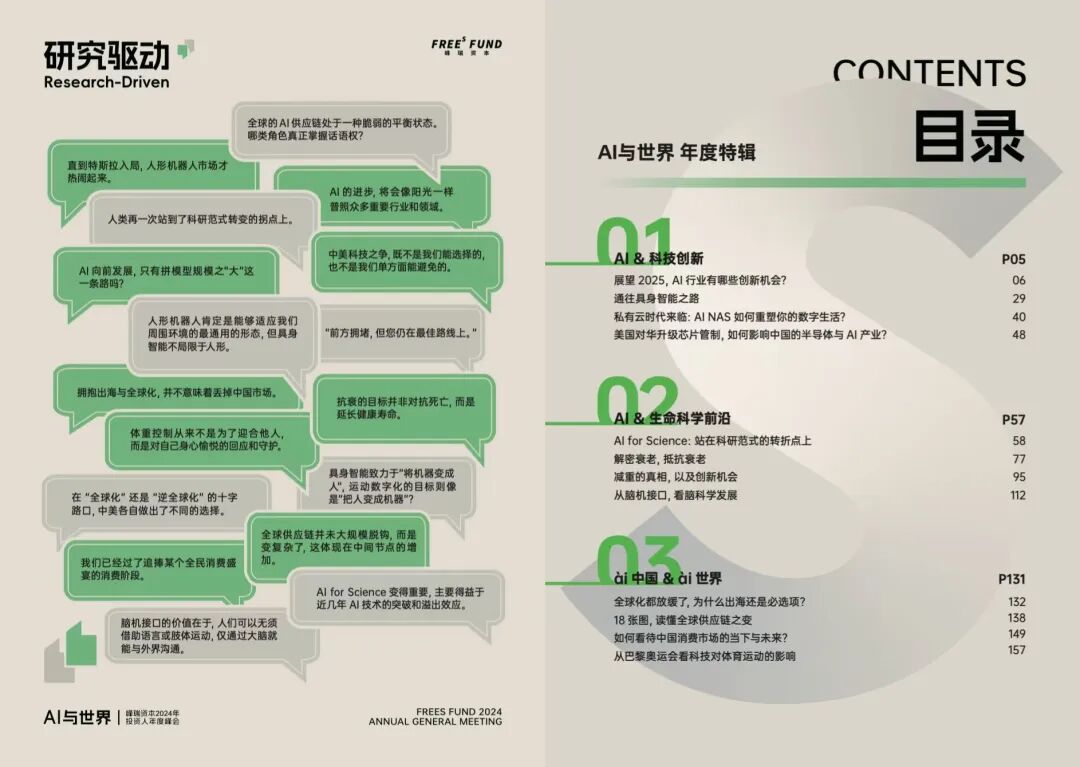
By 5:00 PM on December 31, the 9 most thoughtful commenters will receive the new edition of FreeS Fund's industry research handbook, compiling 12 reports published over the past year.



How can AI and the computer industry reinforce each other? Our thinking: bring the premium large model experience currently requiring supercomputers down to consumer-priced computer form factors; use new-generation supercomputing to elevate both the computer industry and AGI to greater heights.
Today's chip industry is trapped in the "AI mainframe" paradigm. We aim to reactivate the legacy build-to-order PC ecosystem, introduce chips with entirely new specifications, and return control over servers and cloud from hyperscalers back to server manufacturers, cloud providers, and end customers — pushing the industry back to an era where people cost more than machines.

Every revolution in power systems spawns new entrants. In transportation, China has gradually achieved leapfrog development through high-speed rail and electric vehicles. The next leapfrog opportunity is likely electric aviation.
eVTOLs can solve at least two problems: no longer being constrained by ground traffic congestion, and avoiding the massive infrastructure investments required for high-speed rail.
eVTOL sits at the intersection of three core industries: transportation, energy, and information. It can drive vehicle development, advance new energy battery technology, and accelerate autonomous driving — ultimately transforming how humans travel.
Aerospace has always been about "anti-gravity," fighting against gravity. eVTOL is anti-gravity 1.0. I believe that in the future, each of us will be able to take off like a bird, anytime.

Bio-optical imaging is where light and life converge in wonder. When faint photons penetrate the microscopic world of living things, we glimpse the dance of cells, the breath of tissues, the germination of disease. It is humanity's tender gaze upon life's mysteries, a poem written in light, recording the silent dialogue between life and death, health and sickness.
Because of this light, we can ignite hope for patients, open broader frontiers for science, and deepen our understanding of life with greater warmth.
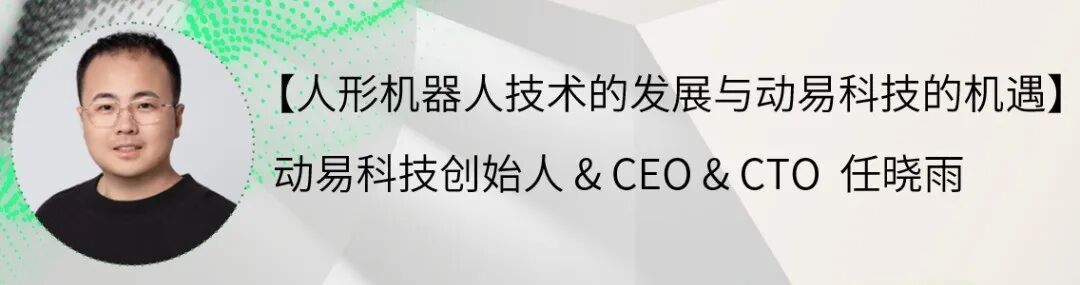
Why did humanoid robots first emerge and flourish in Japan in the 1970s, rather than the US? Because Japan's manufacturing sector was highly developed at the time, and the advanced manufacturing supporting humanoid robots arose accordingly. Today, China's manufacturing is highly developed, providing similarly fertile soil for humanoid robot development.
Since 2022, machine learning, reinforcement learning, and imitation learning have been introduced to robot motion control, raising intelligence levels and accelerating progress.


People often joke that China has no value investing, no long-term investing, and certainly no Warren Buffett. Another saying goes that 99% of Buffett's wealth was earned after he turned 50. I disagree with the former claim, but deeply agree with the latter.
The opportunities Buffett encountered and seized after 50 were intimately connected to what we call "patient capital."
Before the 1970s, retail investors accounted for as much as 80% of trading in US secondary markets, leading to rampant market manipulation and wild volatility. Then in the 1970s–80s, as new regulations were introduced — especially the 401(k) plan, which allowed companies and individuals to invest through annuity accounts with specific tax advantages — these capital market adjustments and the resulting inflow of medium- to long-term funds transformed American capital markets. By the 1990s, retail investor share had dropped to roughly 50%, and institutional investors gradually became dominant.
This past year, the financial term "patient capital" has garnered widespread attention in China. We've seen relevant policies emerge: the new "National Nine Guidelines" formally implemented in April 2024, and the full rollout of the personal pension system in mid-December 2024. All these policies focus on encouraging medium- to long-term capital to enter the markets, bringing stability and positive development to capital markets.
Looking back on the past year, a profound realization I've had at the thinking level concerns two phrases from Professor Cho-yun Hsu's two books: "Where are we going?" and "How did the world come to be this way?" We tend to habitually care only about the first question, full of concern for our forward direction. Yet in fact, we need to first deeply explore the second question — how we arrived at today — in order to better answer the first.


In market expansion, we've identified several key points: first, persistently strengthen the comparative advantages in batteries and industrial chain capabilities we've established in China; second, identify differentiated market demands; third, integrate local market innovation capabilities and manufacturing capacity.
In the second half of the new energy vehicle competition, a long-term contest between two distinctly different camps will persist. One camp, represented by new entrants and internet-backed EV companies, leads in intelligence, AI, computing power, and software. The other camp, traditional automakers, holds advantages in energy systems and chassis.
Solid-state batteries entering the NEV industry won't be a simple one-to-one replacement of conventional batteries. It will represent a major vertical integration opportunity encompassing vehicles, demand-side needs, and the entire industrial chain.

The goal of embodied brain R&D isn't to obtain some large model, but to build learning capabilities that improve generalization performance through data. The key competitive battleground is the conversion efficiency from data to performance.
In the B2B realm, delivering robot value requires not just good hardware, but data, training, deployment, maintenance tools — this entire efficiency system is what determines competitiveness.
Embodied algorithms define hardware, but data defines algorithms.

Is data for training large models really drying up? From a linguistic perspective alone, there are roughly 7,164 languages still in use globally. The world continuously generates all kinds of data, some beyond human perception.
Today's large model voice interaction still can't fully satisfy user needs, perhaps because the industry's focus on large models has overlooked voice and acoustics. AI hardware needs to integrate all three: large models, voice, and acoustics.

What we pursue isn't local optima for each component, but a globally optimal drug discovery pathway that gets medicines to market in time to benefit patients.
In the future, in biomedicine, data will remain the key factor affecting AI technology implementation and value realization. How to enhance data value? First, improve data quality through automated, standardized, high-throughput experimental methods; second, develop new experimental methods to increase data dimensionality; third, have matching data analysis methods.
If AI can help drug discovery cross the "valley of death" from preclinical to clinical translation, it means AI will reshape modern drug discovery processes and methods.


We want to achieve true intelligence, enabling robots to quickly and reliably adapt to any combination of "objects," "tasks," and "complexity" — balancing this "impossible triangle" to achieve truly general-purpose deployment.
Large models or robots typically acquire data passively, unable to directly extract abstract symbolic concepts. We're experimenting with having robots learn structured knowledge, building knowledge graphs to enhance task comprehension capabilities.

Robot dexterous hands have several key technologies: first, actuation; second, transmission; third, sensing; fourth, control.
The humanoid robot industry has just emerged, with relatively limited market volume that can hardly support large-scale manufacturing. So we adopt a general-purpose, modular product approach, applying core dexterous hand components in bulk across other mature industries to reduce costs, improve quality, and advance humanoid robot development.

Embodied intelligence faces generalized scenarios, meaning end effectors or grippers also need generalized capabilities through integrated sensors. First-generation dexterous hands lacked tactile sensors; second-generation dexterous hands using multi-dimensional force sensors will have stronger generalization capabilities.


We position ourselves as the SpaceX of pharmaceuticals, designing various nano-rockets to deliver drugs developed by pharma companies to target organs and tissues, seizing the opportunity of a new generation drug revolution.
The biopharmaceutical industry is undergoing massive transformation, and China is poised to become a global drug R&D engine. What we need to pursue is no longer "me-too" drugs, but products with global competitiveness — this is the new opportunity facing biotech.
Programmable drugs will become a new R&D paradigm with very large incremental markets. Perhaps in the future, human drug development will be like writing code: first analyze where the "code" has problems, then deliver drugs to corresponding cells, fix the "code," and the disease is cured.

Protein sequences in nature are basically linear backbones. When we map linear proteins to multi-topology protein sequences, we can enhance protein stability and activity, carving out our own exclusive "territory."
Enzymes are like the chips of material science, but practical applications still have shortcomings: first, natural enzymes have relatively low stability; second, overseas giants have built patent barriers around enzymes; third, enzyme engineering efficiency is low, not matching the pace of innovative drug development.

What's the purpose of protein design? Previously, the human body acquired needed proteins step by step through evolution. If we can't obtain a certain protein through evolution for now, we need to design that protein from scratch, using algorithms to more precisely predict protein structure.

What perspective of content we can see depends on the hardware device in front of the camera. Traditional cameras provide limited information, merely presenting a projection from high-dimensional physical space to low-dimensional sensors. When designing new optical devices, we can view the lens as an encoder for integrating high-dimensional light field physical information, and AI algorithms as the decoder — using this encoding-decoding process to restore high-dimensional information.
Encoding and decoding light field signals to overcome camera perspective limitations is the core of computational imaging. To fulfill its mission, computational imaging requires co-design of hardware and software.
We hope to expand the boundaries of human vision through innovative technology, providing high-dimensional image data that feeds back into AI algorithms.


Regarding going global, our discussion topics included: what scale of companies are suitable for overseas expansion; what problems different types of companies targeting different regions might encounter; how to consider the balance between domestic and overseas market share — whether going global is supplementary or primary.

Initially, we were actually "passively going global." Many Chinese companies along the Belt and Road became overseas infrastructure builders and manufacturers. These companies had already developed user habits through our cultivation. When they encountered "gray market" issues abroad, they similarly needed our products and services.

For the IoT industry, when developing markets in Europe and America, emphasizing how cheap your products are rarely interests customers. You need to spend more energy thinking about how to embed yourself into already-formed systems.
After seven or eight years of entrepreneurship, I've found new passion and hope in the going-global process, entering the second phase of my entrepreneurial journey.

Entrepreneurs can't educate the market; they mostly adapt to it.
Chinese companies going global must insist on originality, focus on their own brand reputation and voice, build patent moats, and as much as possible avoid being constrained by patent litigation.
The eyelash extension tool kits we sell are quite unique consumer products — products replacing services. Even in regions with low labor costs, our products can still be cheaper than human labor.
Currently, Southeast Asian markets haven't shown such pronounced consumption stratification. In a rising economy, consumers dare to spend on everything. So when going global, I first capture the highest price segment, then launch more brands when the market enters a consumption stratification phase.
We don't station Chinese teams overseas permanently. When hiring, we look for young people who best represent trends, and all localization decisions are left to local employees.
Although being "involuted" in China is quite painful, the product advantages you develop in this environment can help you challenge many strong overseas competitors.
How to build business teams in local markets may be a common challenge for Chinese companies going global. Our approach: leverage employees' alumni networks to reach more AI enterprise clients, reducing our business gap with competitors.
Reader Giveaway
What new challenges and opportunities do you see in your industry? Share your thoughts in the comments. By 5:00 PM on December 31, the 9 most thoughtful commenters will receive the new edition of FreeS Fund's industry research handbook, compiling 12 reports published over the past year.
▲ The Road to Embodied Intelligence | FreeS Report 37
▲ AI for Science: At the Turning Point of a Research Paradigm | FreeS Report
▲ How Can Tech Consumer Products Go Global?
▲ Stronger Through Nine Years — Join FreeS, Let's Go Further Together
▲ Embracing a New Cycle, Discovering New Paradigms | FreeS Fund 2023 Annual Investor Summit Recap
Star the FreeS Fund WeChat Official Account for timely business insights