360 Finance CEO Jun Xu: Three Things I Got Right in Five Years of Entrepreneurship | FreeS Fund 2019 CEO Annual Meeting

Pick the right track, manage your team well, and expand your coalition of shared interests.

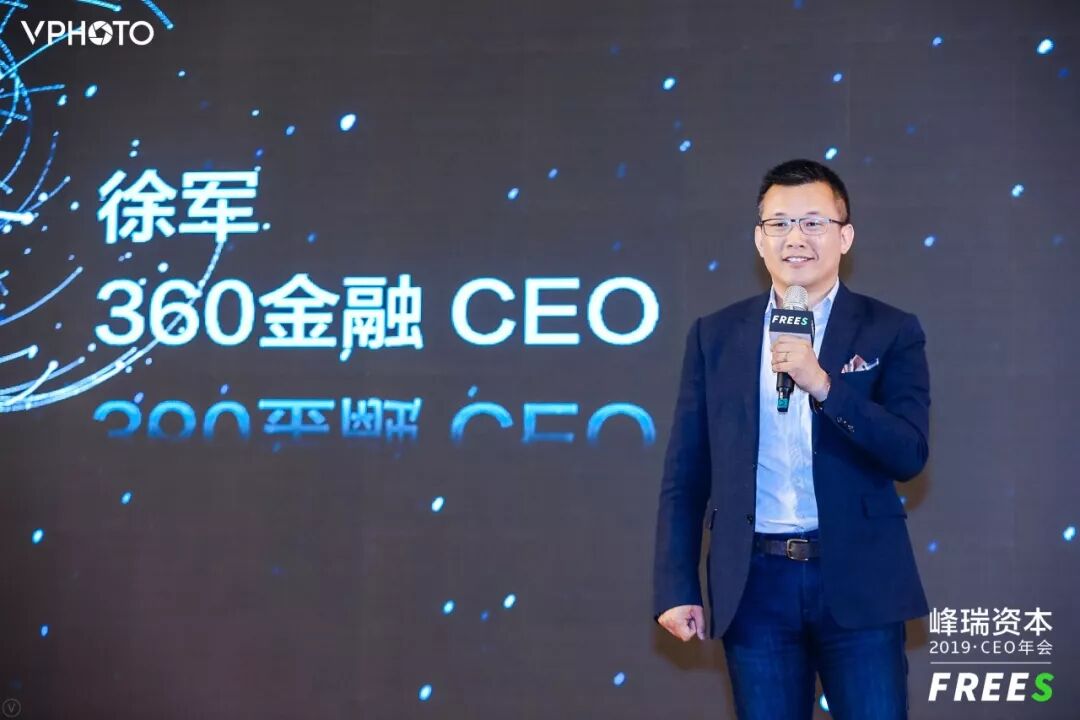
Don't rush entrepreneurship. Too many articles love to dramatize the moment a company goes all-in, makes an extraordinary decision, and breaks through. But what companies really compete on is the unglamorous work of team building and day-to-day management — the CEO's ability to keep a steady, level head and move forward methodically.
This is what Xu Jun, CEO of 360 Finance, has learned from five years of building his company. Founded in 2014 and listed on Nasdaq in December 2018, 360 Finance became the first fintech IPO from a major Chinese internet conglomerate.
At the FreeS Fund 2019 CEO Summit, Xu shared three key lessons from taking 360 Finance from zero to a top-tier industry player, along with his philosophy of maintaining equanimity as CEO. His advice:
- Don't let your current capabilities limit your vision. Pick a large, wide赛道 with long-term value, find a roughly right direction, and build slowly.
- In critical moments, trust systems, not people.
- Owning 100% of a small cake is worse than owning 1% of a large one. Dilute equity if it means expanding your coalition of shared interests.
- Drink less鸡汤, take fewer courses, cut out无效社交.
- Don't go all-in.
We've edited his remarks into the article below. We hope you find it useful.

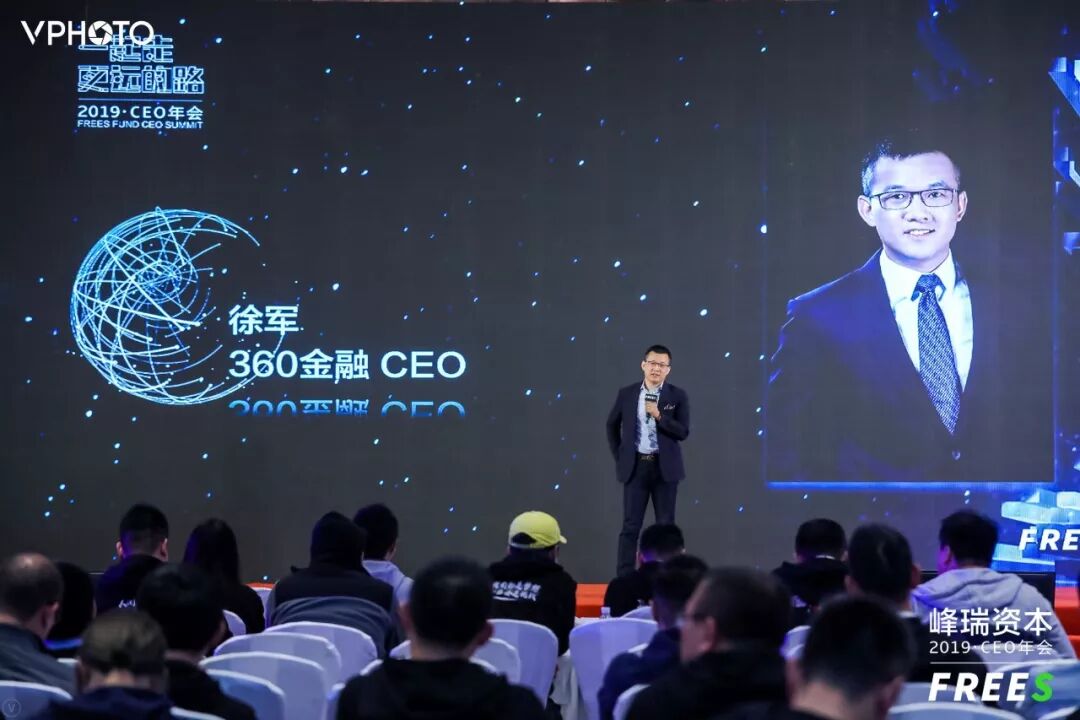
360 Finance's Xu Jun: Believe in Long-Term Value, Keep Your Eyes on the Horizon
Source: Xu Jun's remarks at the FreeS Fund 2019 CEO Summit
Hello everyone in the FreeS Fund family. It's an honor to be here with you today.
I started my company in 2014 — time flies, it's already been five years. Li Feng was our first investor. Back then we all called him "Commander Feng." When we had nothing but three slides, he invested in us at a very high valuation. Later, when we were negotiating our merger with 360, he stepped in at the most critical, tense moment to help us communicate with Zhou Hongyi and accelerate the deal. Throughout our fundraising and IPO process, Huan (Zhang Huan, partner at FreeS Fund) also gave us tremendous support. Huan has an extensive network and always managed to introduce us to heavyweight resources. I'm especially grateful to FreeS Fund.
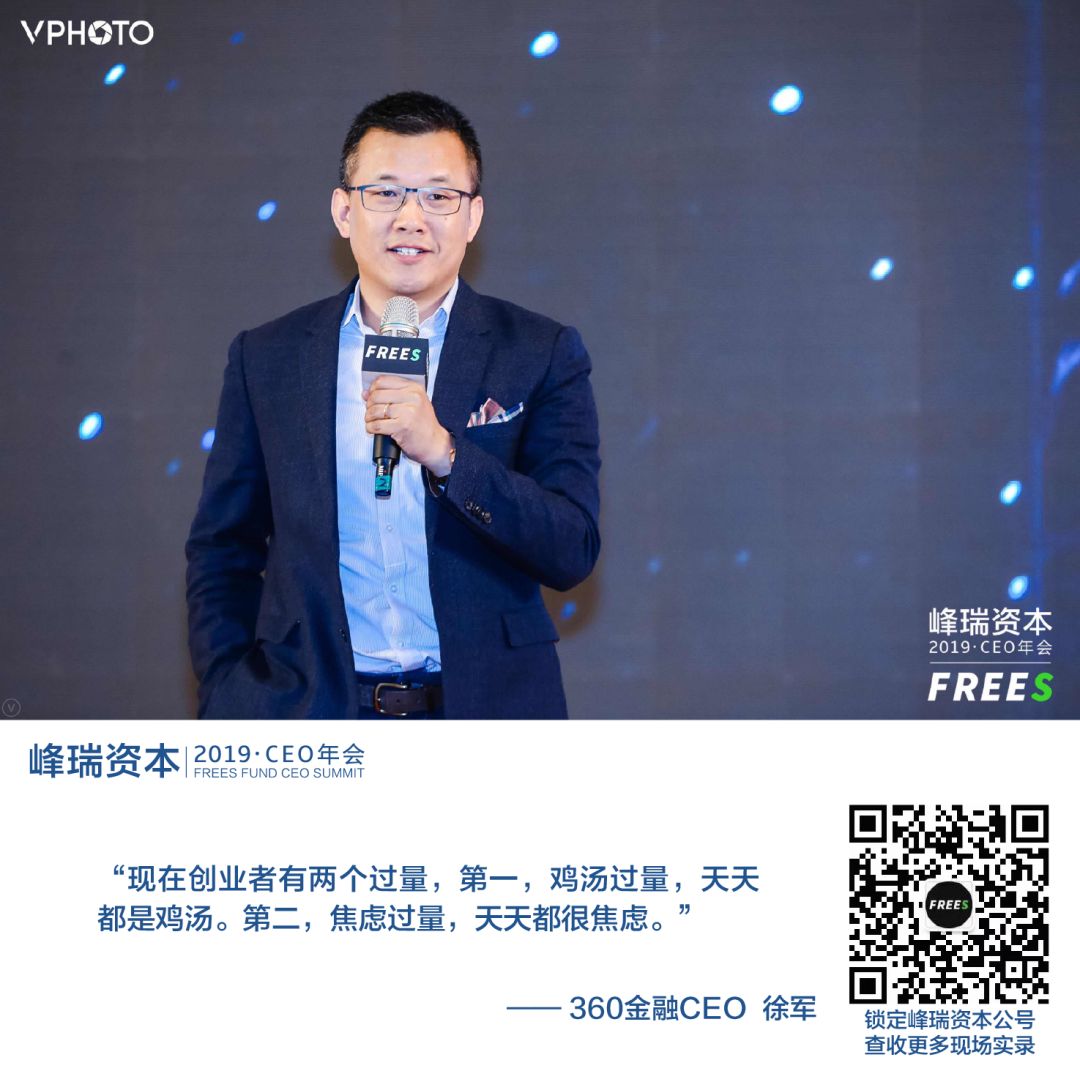
I think right now, entrepreneurs face two excesses. First, an excess of鸡汤 — it's everywhere, every day. Second, an excess of anxiety — it's constant, every day. Many courses on the market are products of the anxiety economy. One of our partners recently took a course and didn't seem to learn much, but came back completely anxious, worried that our company lacked disruptive innovation.
As CEO, my advice is: drink less鸡汤, take fewer courses. These things basically don't solve problems. If you have time, spend it doing foundational work inside your company — that's far more valuable.

What foundational work? Looking back on my five years, I've identified three particularly critical things: picking the right赛道; managing the team well; and expanding your coalition of shared interests.

Picking the Right赛道
Research shows that the world's greatest companies create value through three main mechanisms: first, picking a good赛道; second, outperforming others in that赛道; and third, growing through M&A. Their respective contributions are 42%, 35%, and 32%. So picking the right赛道 is a CEO's most important mission and responsibility.
What kind of赛道 and model should you choose? My feeling is: pick one that's large enough, wide enough, broad enough, with long-term value; then find a roughly correct direction within it. Business models can't be precisely defined upfront. As you execute, the model will continuously adjust and optimize — sometimes the best models are discovered by accident.
This doesn't have to be a so-called disruptive innovation赛道. Most disruption is identified in retrospect, a matter of "hindsight bias." For example, 360 originally built software with Kaspersky; when Kaspersky stopped cooperating, 360 built its own free software that ended up disrupting Kaspersky's paid model. Zhou Hongyi later described this as "pure coincidence."
But the赛道 must be focused. For any startup, a CEO's time and energy are the scarcest resources. I've seen many startups, including our own, make the same mistake: spreading product lines too wide, stretching the battlefront too long. When a company has too many businesses, the CEO can only devote limited time and energy to each, and risks accomplishing nothing. By contrast, a company like Huawei spent 30 years focused on just two or three areas — telecom equipment, mobile devices, and more recently cloud — staying highly concentrated, which gives it a greater chance of success.
How do you judge whether a赛道 is good?
First, look at gross margin. Before entrepreneurship, I worked in management consulting. Top-tier firms in this industry might generate 3 million RMB monthly revenue, while others make only 300,000. Costs are similar, but gross margins differ enormously. Other industries may show different patterns. Pay attention to this metric.
Second, look at unit economics. How much does it cost to acquire a user? How much value does that user generate over their entire lifecycle? How much can you ultimately earn from them? If this math doesn't work, the business model isn't viable.
Third, dare to think and dare to act. If you believe something has long-term value and can become big, do it — don't be constrained by your current capabilities. We once spent a long time纠结 about whether to pivot toward credit business. In hindsight, we should have launched it sooner.

Of course, if you've been grinding away in a赛道 for a year or two and still feel completely lost, you should consider adjusting your model. Guys, don't be embarrassed to tell investors "I want to switch赛道s." Very few startups stick to the business model in their original pitch deck. The model we first discussed with Feng has since changed.
Doing Just-Right Management
Once the赛道 is set, a CEO's time and energy should overwhelmingly go toward people and organization. If your team has fewer than 12 people, you can lead them directly. Beyond 12, you need some basic processes. Management should be roughly right — too much is wasteful and hurts efficiency.
The four basics — performance management, goal setting, talent planning, and operations management — are necessary for any startup. Entrepreneurship is full of challenges, and human nature doesn't withstand testing well. Build the systems, and in critical moments you can trust the system rather than relying on people.
Over the years, I've developed a few principles for team building and management.
First, hire "veterans." Competition is too fierce now; hiring rookies doesn't work.
Second, don't hire "superstars." Every "superstar" we brought in has since left. Some initially seemed capable, but gradually revealed value problems. In retrospect, I should have been more decisive in removing toxic people. They were relatively negative, played politics internally, didn't produce good work, and caused serious damage to organizational culture. Now, our core positions are filled by doers — people who were also backbone contributors at their previous companies.

Finally, reduce无效社交. We have endless dinners, salons, and parties we could attend, but looking back, none of our business came from these gatherings. We've been around for several years now and have many partners in the market. If someone at another company wants to do business with us and still needs to pull strings at social events to get a WeChat group started, the result is usually that everyone spins their wheels and discovers we can't actually work together.无效社交 wastes time and resources; it should be eliminated.
Building Alliances, Expanding Your Coalition of Shared Interests
With the right赛道, model, and team, another critical issue is stakeholders. Many startups push hard now, doing 996, exhausting themselves. You can work 7×24 yourself, but if you haven't solved the stakeholder problem, you'll probably still fail.
What are stakeholders? People who succeed when you succeed.
When you have such a group, your probability of success increases dramatically. For example, Microsoft's early Windows OS was essentially copied from Apple, but Microsoft allied with IBM, won IBM's orders, and surpassed Apple — after which Apple was largely irrelevant in that market. In China today, many创业领域 work the same way. Ride-hailing, O2O, e-commerce — these battlefields were ultimately won by companies with powerful shareholder backing. When you have enough stakeholders, you can use capital to consolidate the entire industry. When you hit trouble during fundraising, M&A, or IPO, only those deeply bound to your interests will help you.
So choose your shareholders carefully. Choose shareholders with resources. Choose shareholders who can provide value beyond money in your industry chain. You should befriend these people, ally with them — even if it means diluting your equity more — and expand your coalition of shared interests first, so everyone can grow the pie together. Is it better to own 100% of a small cake, or 1% of a large one? The large cake is actually better; it has a higher probability of success.
Ten years ago, we could succeed with just a good product. But today's market competition and capital forces are too mature — you must do these three things well: pick the right赛道, build basic team management systems, and find the right key stakeholders.
Historical Perspective and Equanimity
One final point: maintain a historical perspective and equanimity. Medical advances have greatly extended our lifespans. Companies like Google and Alibaba have invested heavily in life sciences. Perhaps we'll live to 120. In the long run, starting a company today is just one stop on life's journey.
Much鸡汤 encourages us to go all-in, to do things at any cost. This is misleading.
Don't go all-in.
Over these five years, I've seen many entrepreneurs work themselves sick, developing health problems or family problems. In the finance industry where I work, many people who mismanaged financial risks are now behind bars. You have 120 years to live; you're only 30 now. There's no need for so much pressure — keep a level head.
As long as you stay focused in one direction, opportunity will come. Because opportunities change, industries change. Return to first principles: less anxiety, a calm mind, finding a good赛道, building a good team, and doing things slowly. I believe everyone will ultimately succeed.

Feel free to share to your Moments. For republication on other公众号, websites, or mobile apps, please reply "reprint" to learn the rules and contact "Frees Xiaorui" (ID: freesfund) for authorization. Copyright belongs to FreeS Fund.

▲ How Is New Technology Reshaping the Trillion-Dollar Education Market? | FreeS Fund 2019 CEO Summit
▲ MiningLamp Wu Minghui: Every New Data Point Drives Business Model Iteration | FreeS Fund 2019 CEO Summit
▲ In the Post-Dividend Era, How Can Early-Stage Consumer Companies Break Through? | FreeS Fund 2019 CEO Summit
▲ Tang Ning × Li Feng: Truly Great Companies Are Controversial | FreeS Fund 2019 CEO Summit
▲ Be Long-Term Greedy, Be a True Hero | FreeS Fund 2019 CEO Summit