Lightelligence's Yichen Shen in Conversation with FreeS Fund's Li Feng: The Present and Future of Chip Industry's World-Class Challenges | 424 Livestream Registration

Let's Talk About That Chip
Photonic chips have long been a strategic priority for FreeS Fund as a critical infrastructure and technology direction for the future of the global information industry. Since our founding in 2015, FreeS has invested in companies including Shenzhen Licheng, Duogan Technology, Lightelligence, Xinshijie, Luowei Microelectronics, and Alpha Optoelectronics in this space — accompanying these projects through their growth and witnessing both the promise and the challenges this direction faces.
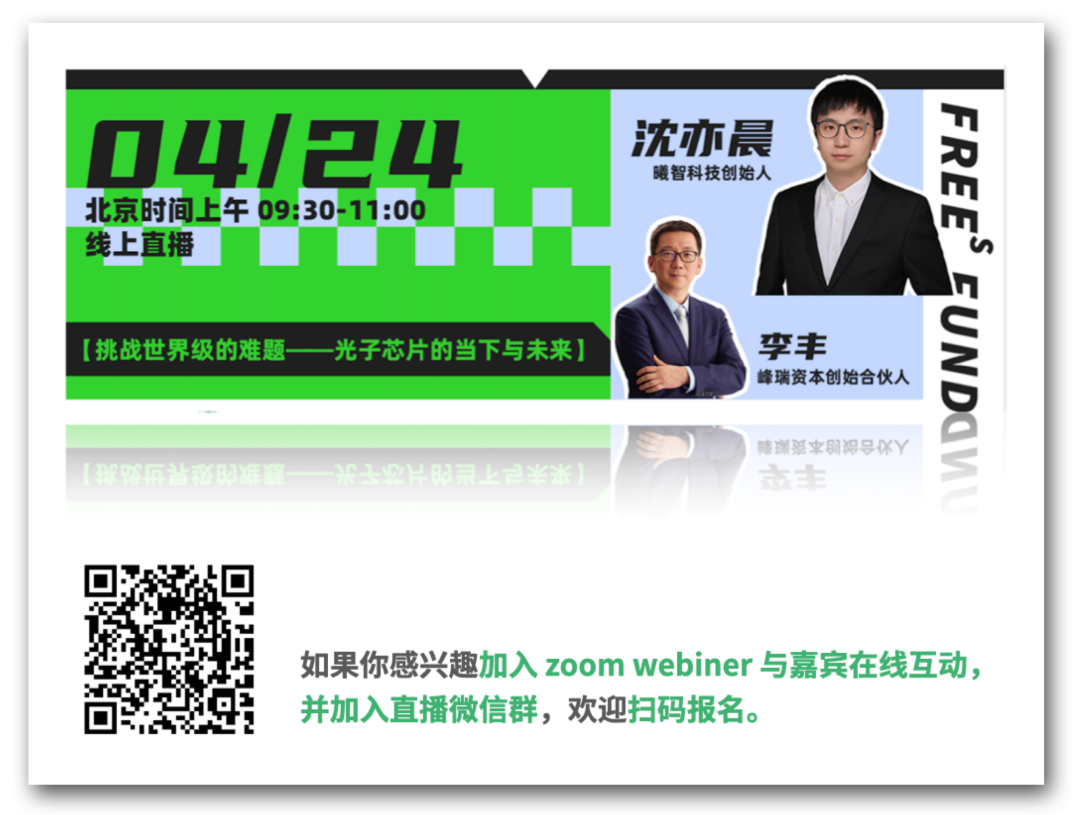
On April 24, from 9:30 to 11:00 AM Beijing Time, the first episode of the "FreeS Fund Dialogues: Chips & Semiconductors" livestream series — Challenging World-Class Problems: The Present and Future of Photonic Chips — will feature Yichen Shen, founder and CEO of Lightelligence, in an in-depth conversation with Li Feng, founding partner of FreeS Fund. They'll take you deeper into the stories from the frontier of tech entrepreneurship.
▍Why tune in?
Speaker Yichen Shen holds a PhD in physics from MIT, where he was named to the MIT Technology Review's global "Innovators Under 35" and selected as a Davos "Young Global Leader." He completed his undergraduate studies at Johns Hopkins University with a double major in mathematics and physics, graduating with first-class honors and a top scholarship.
Dr. Shen has published over 40 papers as first author in leading journals including Nature Photonics and Science, as well as at top machine learning conferences such as ICML, and has filed more than 100 global patents. In 2017, he published a cover paper in Nature Photonics as first and corresponding author, proposing for the first time a novel computer architecture based on optical neural networks — pioneering photonic computing as a new industry direction. The paper has been cited over 1,400 times, making it the most-cited paper in nanophotonics over the past five years. Building on this breakthrough, Shen founded Lightelligence that same year, a company focused on photonic computing and AI semiconductors.
To sum up Lightelligence's mission in one sentence: "Using photonic technology to provide faster, more energy-efficient chips and algorithms for big data and high-performance computing" — or put another way, empowering next-generation high-performance computing through self-developed photonic chip technology.
In 2020, Lightelligence was named one of MIT Technology Review's 50 Smartest Companies, alongside Alibaba Cloud, Baidu, and Huawei. Compared to traditional electronic chips, Lightelligence's photonic chips represent a step-change improvement in speed, latency, and power consumption.
By using photonic integration technology to accelerate information processing, Lightelligence can break free from the dependence on advanced process nodes that constrains electronic chip performance gains, while dramatically reducing the energy consumed by electrons traveling through copper wires. This enables substantially higher hardware compute power with lower energy use, cutting overall data center operating costs and contributing to carbon peaking and carbon neutrality goals.
Beyond AI computing, Lightelligence plans to embrace interdisciplinary applications as broadly as possible in the future, deploying its optoelectronic hybrid chips in financial trading, biomedicine, materials research, traffic scheduling, autonomous driving, and other fields.
How will photonic chips evolve, and what transformations will photonic computing bring to the computing industry? Join this livestream to hear Shen's perspectives from years of work in the field.
▍How to register?
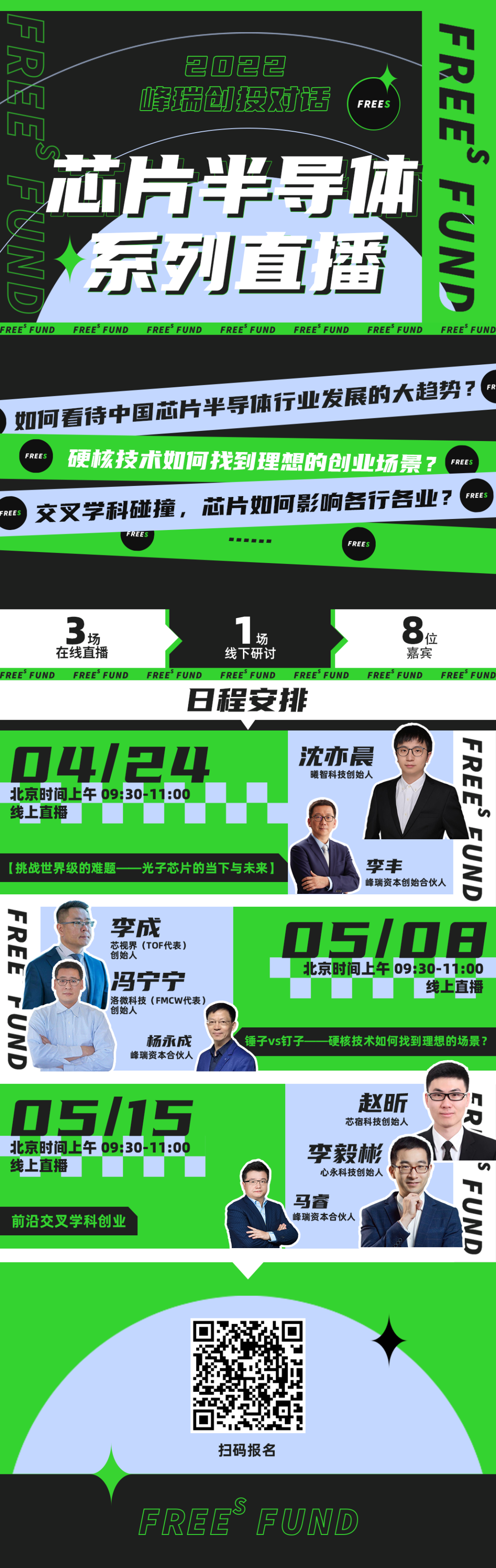
The "FreeS Fund Dialogues: Chips" series will include three livestream episodes and one planned offline seminar. The first episode, Challenging World-Class Problems: The Present and Future of Photonic Chips, will go live on April 24, featuring Yichen Shen and Li Feng discussing opportunities and challenges in photonic chips.
If you're interested in joining the Zoom webinar to interact with the speakers live and joining the WeChat discussion group, scan the QR code in the poster or click the "read more" link at the end of this article to register.
▍Further Reading
This collection captures FreeS Fund's thinking on the chips and semiconductors industry. We explore the stories behind China's chip ambitions and why we're bullish on the photonic chip sector; whether domestic semiconductor materials can compete; and our predictions for the endgame of sensors behind autonomous driving.
- Why We're Bullish on the Photonic Chip Industry | FreeS Chips Series
- Can Domestic Semiconductor Materials Compete Globally? | FreeS Chips Series
- FreeS 2021 Outlook ④ | Predicting the Endgame of Sensors Behind Autonomous Driving
- Li Feng Column | A 2 Trillion Market and 10 Trillion Output Value: Why We're Bullish on China's Chips
Looking forward to seeing you online on April 24 for a conversation about that chip.