How did Saturnbird surpass Nestlé and Starbucks to become No. 1 in the instant beverage category during 618? | Frees Fund — Learning from Investment

From 7-Eleven, Zhou Hei Ya, Three Squirrels, and Saturnbird: Understanding the Fundamentals of Consumer Goods Entrepreneurship

"Learning from Investment" is a column FreeS Fund launched in 2020. It mainly reconstructs our thinking, debates, and learning process from the initial stage to the present when we invested in some representative projects; it is also a tribute to entrepreneurs, witnessing how their leadership in driving companies forward and continuously overcoming difficulties has given us more understanding and knowledge of industry and business patterns. Now, we are sharing the insights we have learned from them, hoping to provide some inspiration, and paying tribute to the many entrepreneurs who work as hard as they do.
In the fourth installment of the "Learning from Investment" series, we want to share with you what we see as the competitive essence of the coffee and consumer industry, and how to build moats, from the exploration and innovation of the specialty coffee brand Saturnbird Coffee.
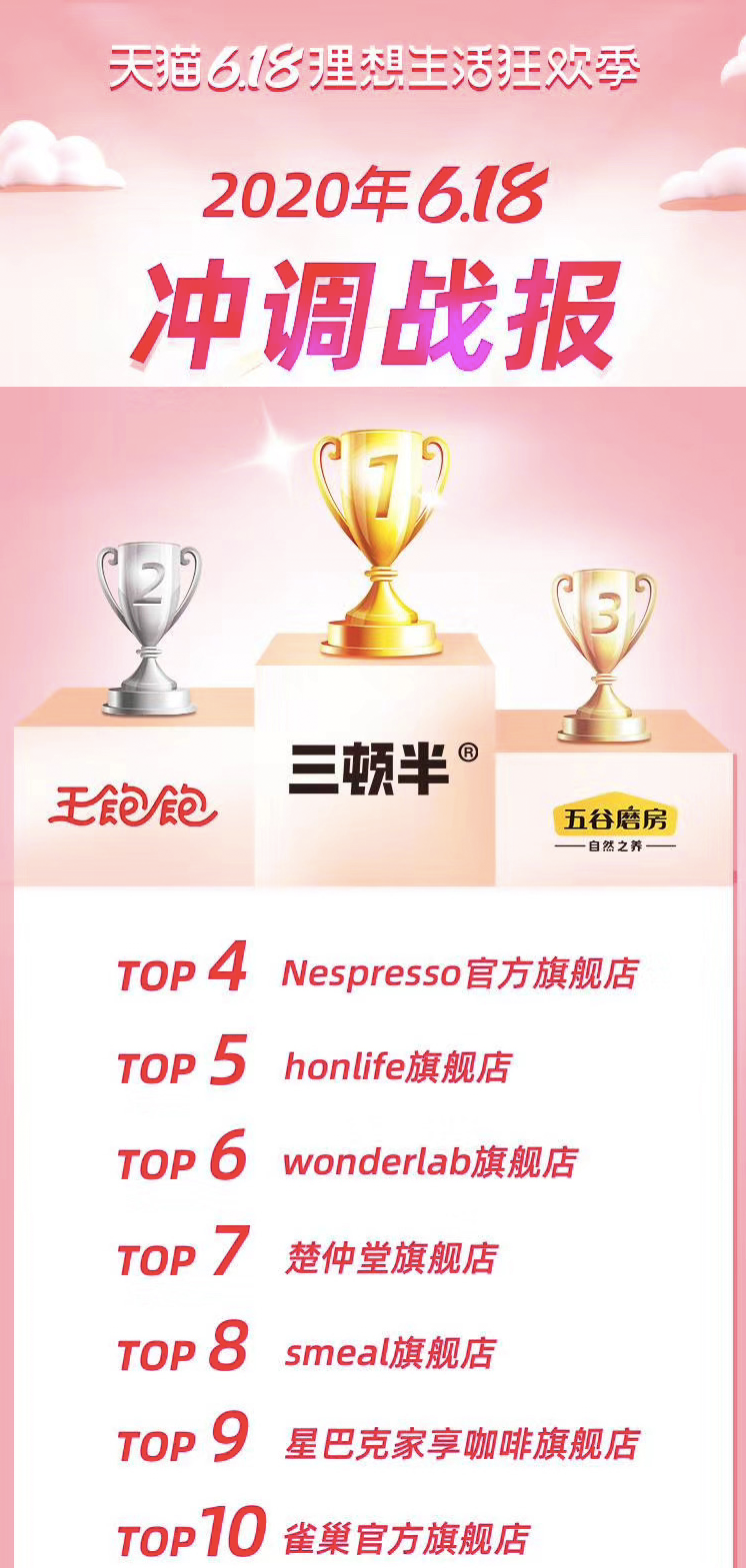
Coffee has been one of the most fiercely contested retail battlegrounds in recent years. Starbucks' main stronghold — the fresh-ground coffee market — is blazing with competition. Saturnbird Coffee sidestepped this market and made阶段性 progress in the instant coffee domain where the giant Nestlé resides. During the 2019 Double 11 shopping festival, four-year-old Saturnbird surpassed the century-old brand Nestlé to become the first domestic brand to top the Double 11 coffee rankings on Tmall.
In 2020, China's consumer market, battered by recurring pandemic waves, was filled with uncertainty. According to Tmall 618 Ideal Life Carnival data, Saturnbird rose from first place in the coffee category during the 2019 Double 11 to top the entire冲调 (instant drink) category in the 2020 618 festival. Coffee is a sub-category of冲调. In the most recent 618, the stores ranked behind Saturnbird included Nestlé and Starbucks At Home.
What did Saturnbird Coffee do right?
Since exclusively leading Saturnbird's Series A round in 2018, FreeS Fund has doubled down twice more. In this piece, we will explore:
- When we first searched for "addictive product" investment targets, how did we find Saturnbird?
- Two years of investing in Saturnbird — our observations and reflections: In an era of expensive traffic, how can consumer brands achieve differentiated innovation? How can you create传播抓手 (viral hooks) to drive user-initiated传播?
- For consumer product entrepreneurship, single-point innovation is no longer enough. Regarding full-chain efficiency improvement, what can we learn from Zhou Hei Ya and Three Squirrels?
Before diving in, here are the four most valuable conclusions we've learned from our investment in Saturnbird:
-
Consumer product entrepreneurship has become a full-chain efficiency competition. The more a company can improve efficiency across its front-end, mid-end, and back-end, the greater its competitive advantage. We've seen many companies that reformed their supply chains (back-end) to achieve differentiated product innovation, thereby enhancing user experience (mid-end); if they can also capitalize on changes in traffic and media formats (front-end), making their products suitable for传播 on the fastest-growing media platforms in terms of user attention, they will expand the reach of product传播 and improve传播 efficiency.
-
Technological innovation in consumer product supply chains is usually not原始科技创新 (original technological breakthroughs), but rather taking existing technologies and, through careful refinement, adaptation, and upgrading, applying them to new products and categories while achieving industrial-scale production.
-
True innovators will always receive their due rewards and win a time window in market competition — this is the "innovator's advantage." Once a consumer product company that has completed full-chain efficiency improvement takes the lead, others will find it difficult to replicate its development path, because it is nearly impossible to reassemble all the right timing and factors that enabled its success.
-
The founder is always the most important factor, bar none. Only a founder who is deeply immersed in the industry and understands its essence can have profound user insight — that is, knowing what kind of products users like; only with the determination to make great products can one find ways to improve supply chain efficiency; moreover, only by staying sharp can one capture shifts in traffic, pay attention to the rise of new media platforms, and leverage them effectively.
We hope this provides fresh perspectives. We look forward to ongoing exchanges with entrepreneurs and industry experts in the consumer sector. Feel free to reach us at hai@freesvc.com, or add FreeS Xiao Rui on WeChat (ID: freesfund).

01 How Did We Find Saturnbird Coffee? Starting with Addictive Product Investment
Globally, addictive products have consistently generated enormous economic value. At FreeS, addictive products function as a distinct investment theme. We have consistently sought to identify new brands with brand-building capabilities and product innovation potential within addictive categories like alcohol, tobacco, sugar, and tea (psychoactive stimulants).
Within the addictive product family, while cigarettes and fine wines enjoy widespread popularity, caffeine is the most widely consumed globally.
Modern American coffee-drinking experience demonstrates that "once certain psychoactive addictive products become widely available, actively promoted, and affordably priced, they gain immense popularity among the masses. If these people develop dependency habits, these products become virtually unstoppable."
In 2018, coffee once again swept across China, with Luckin Coffee as the trailblazing disruptor. Luckin pursued a low-price subsidy strategy, essentially "treating" users to coffee, while an increasing number of new coffee players entered the market. We judged that this would make coffee consumption in China follow the American pattern — after prices fell, it would gradually become popularized and accepted by more people.
Although at that time we still could not see the full picture or future direction of the coffee market, as coffee consumption continued to expand, FreeS actively searched for coffee industry investment targets through a top-down approach.
Our research into the coffee market revealed that even with rapid growth, the fiercely contested fresh-ground coffee market accounted for only 15-20% of China's coffee market. The relatively unassuming instant coffee segment, however, held 60-70% market share. Thus, we focused our targets on the instant coffee domain.
We first met with a domestic instant coffee brand that ranked among the top sellers on e-commerce channels. Its value-for-money was indeed impressive, but it resembled Nestlé's 3-in-1 instant coffee too closely, lacking differentiation from international giants and making long-term success unlikely.
We hoped to find a new brand with more texture, one that could move consumers through its product. In July 2018, a coffee-knowledgeable friend recommended Saturnbird to us.
At that time, Saturnbird's original super-instant coffee had just launched, upgrading traditional instant coffee in terms of packaging and taste.
Its packaging featured brightly colored, mini Lego-like coffee cups with extremely high recognizability. When we conducted user research by calling over 300 Saturnbird users, we found that "cool," "premium feel," and "aesthetic appeal" were key factors in winning over users.
Its star product was freeze-dried coffee powder packaged in mini coffee cups. Users could pour the powder into ice water or milk and instantly obtain a tasty cold brew or latte. The realization of taste还原度 (fidelity) and convenience stemmed from Saturnbird's innovation in production工艺. In the next section, we will elaborate on the enormous impact of this工艺 innovation.
Overall, besides its attractive pricing (average price under 10 RMB), it was completely unlike the previous generation of 3-in-1 instant coffee in our minds.
We were optimistic about Saturnbird's growth potential amid the wave of coffee's popularization in China. In the second half of 2018, FreeS exclusively invested in Saturnbird — also the company's first institutional investment.
Reflection Question: What lessons have we learned in the process of investing in consumer brands? Feel free to hit "Like" at the end of this article, and reply "coffee" in the WeChat official account backend to learn our preliminary answer.
02 When Traffic Dividends Disappear, How Can User-Initiated传播 Become Possible?
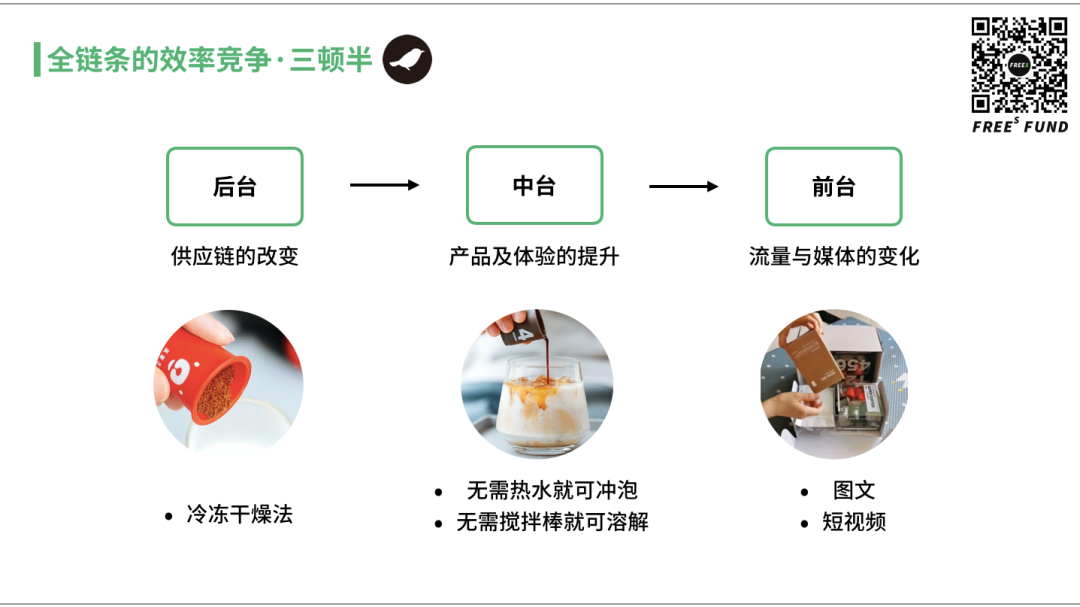
If you truly achieve differentiated innovation in your product, create value for users, and genuinely move them, users will find every possible way to spread the word about you.
Therefore, the prerequisite for user-initiated传播 is that the product itself must be good enough. Product strength is the foundation of everything.
Beyond product "goodness," you also need to create some differentiated characteristics and prepare sufficiently unique,传播-worthy material and entry points for users, so they can easily articulate what makes you different from other products.
Take 7-Eleven as an example. "Always Open for Your Convenience" was the advertising slogan 7-Eleven consistently used from 1976 to 1982. 7-Eleven's products were certainly of reliable quality, but its selling point was distilled into these four characters: "always open." This selling point gained broad support among the Japanese public, especially young people.
Haidilao's hot pot is certainly delicious, but传播ing that a restaurant is "delicious" is hard to reach consensus on, because everyone's tastes differ — what you consider delicious may not match my understanding of delicious. What makes Haidilao spread by word of mouth is its service. This service might mean complimentary manicures, providing baby cribs, unlimited drink refills, or other touches.
There are many such examples.
For instance, when we talk about New Oriental's English teachers, we might say this teacher is humorous and entertaining, that teacher discusses life philosophy, and another teacher sings and dances.
Beyond teaching English well, these teachers showcase their personalities and individual characteristics, making it easy for students to talk about and recommend their teachers to others.
Saturnbird Coffee is also a new brand we've seen that enables user-initiated传播.
"Some users assume that if something sells explosively, there must have been massive spending behind it. But on Xiaohongshu, we have nearly 2,000 posts, and 90% of them weren't written by us." In September 2019, Saturnbird founder and CEO Wu Jun said in an interview with Yicai YiMagazine.
First, it must be acknowledged that beyond "tasty," Saturnbird's small cup design is highly eye-catching. Many people, even those who haven't tried it, have likely seen it on various social platforms. This is product-as-advertising.
However, what many people haven't seen is the effort Saturnbird puts into its back-end supply chain.
Take super-instant coffee as an example. Originally, making instant coffee required hot water, and there was another inconvenience everyone had grown accustomed to — you absolutely needed a stick (stirring rod) to accelerate dissolution.
Because of back-end production工艺 optimization, Saturnbird's freeze-dried coffee powder can quickly dissolve in liquids of any temperature, not limited to hot water. The product工艺 is so refined that it dissolves without needing that stirring rod, while最大程度地 retaining the coffee's flavor.
The impact of工艺 innovation is so significant, so let's return to工艺 itself.
Freeze-drying (lyophilization) is widely used across the food and pharmaceutical industries. It removes moisture through sublimation after freezing, offering high fidelity and excellent solubility. Since 2017, China's instant noodle market has rebounded, with consumers buying up varieties loaded with real vegetables and meat — a shift driven by supply-side process evolution that, simply put, also comes down to freeze-drying.
The Saturnbird team innovatively applied freeze-drying to coffee at scale. Because the process occurs at low temperatures, volatile compounds in the coffee powder are preserved. Because drying happens in a vacuum with minimal oxygen present, oxidation-prone substances are protected. The result: coffee powder with high fidelity, both in aroma and taste.
Compare this to the other common instant coffee process — spray-drying. It uses centrifugal spray dryers where high temperatures instantly evaporate moisture from coffee droplets. While output is high and drying effective, the coffee's aroma, color, and flavor all take a hit.
Moreover, with freeze-drying's help, once moisture is extracted, the coffee powder becomes sponge-like with a porous structure — highly absorbent, dissolving quickly and completely.
And it is precisely because freeze-dried coffee powder dissolves so easily that the user experience changes — no hot water needed, no stirring rod required. These two factors, combined with attractive packaging design, create media-friendly properties — making it ideal for all kinds of video content.
As we mentioned in Li Feng's Column 15 | How Long Will Live E-Commerce Last?: "For consumer-facing companies, the hardest thing right now is that even if you've picked the right category, you still need to make your product, content, and advertising into one thing — and make it suitable for display in the fastest-growing media type in terms of user time."
Today, short video is the fastest-growing media type in terms of user time. If your product's differentiated features happen to lend themselves to short video platforms, your distribution efficiency will be much higher.

▲ Creative ways to drink Saturnbird, from its "Navigators" community.
Saturnbird's freeze-dried coffee powder can be brewed with liquids of any color or form — mix and match as you please. Imagine dropping the powder into ice water, milk, juice, cola, or tonic water, giving it a gentle shake, and voilà — a cold brew, latte, or coffee beverage is born. The brewing process itself becomes playful, visually striking, and aesthetically pleasing — perfect for short video.
To summarize: because Saturnbird made process innovations on the back end, it achieved differentiated features in product and experience. These differentiators resonated with users and became leverage points for distribution on short video content platforms.
03 Consumer product innovation increasingly requires efficiency gains and experience upgrades across the entire chain
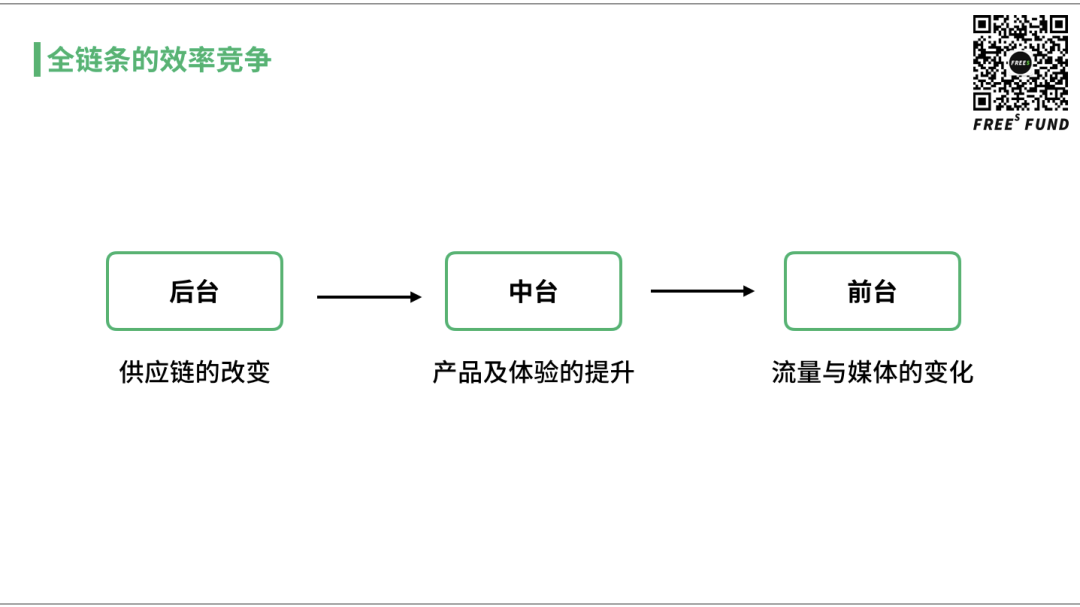
Today's consumer product innovation increasingly requires efficiency gains and experience upgrades across the entire chain — supply chain optimization (back end), product and experience improvement (middle layer), and capturing traffic and media shifts (front end).
However, these three do not naturally connect on their own.
When you find a way to improve supply chain efficiency or refine supply chain processes, you must build on that to enhance product quality and user experience. If you happen to catch the "tailwind" of a shift in media expression formats, you can leverage new media and traffic changes to let users spread the word about your quality and experience upgrades at scale.
Even without catching that tailwind, as long as you create value for users through user experience and product quality, they will still perceive your uniqueness and spread the word — just not as quickly as with new media amplification.
Back end: improving supply chain management efficiency
In consumer products, there are two ways to improve supply chain efficiency. The first is improving supply chain management efficiency across production, circulation, and storage. The second is introducing "new" technology to achieve product and experience upgrades.
Three Squirrels' alliance factory model falls into the first category.
In a park in Wuwei, Anhui, Three Squirrels invited roughly 20 core supply chain partners — together accounting for about 80% of Three Squirrels' sales volume. They share a system incorporating all online data plus East China offline store data, from which they derive sales forecasts and production schedules. They also use a unified logistics system: all products in the park are consolidated into one warehouse and shipped based on forecasted and real-time orders.
The significance of the alliance factory is that Three Squirrels has minimized production-side inventory, shortened the path from front-end demand to back-end production to the extreme, and through forecast-guided production, minimized delivery time to consumers. By restructuring the entire chain's efficiency, it may become possible for Three Squirrels to shorten the shelf life of all offline retail products to under four weeks.
From back end to middle layer: introducing new processes to improve supply and elevate user experience
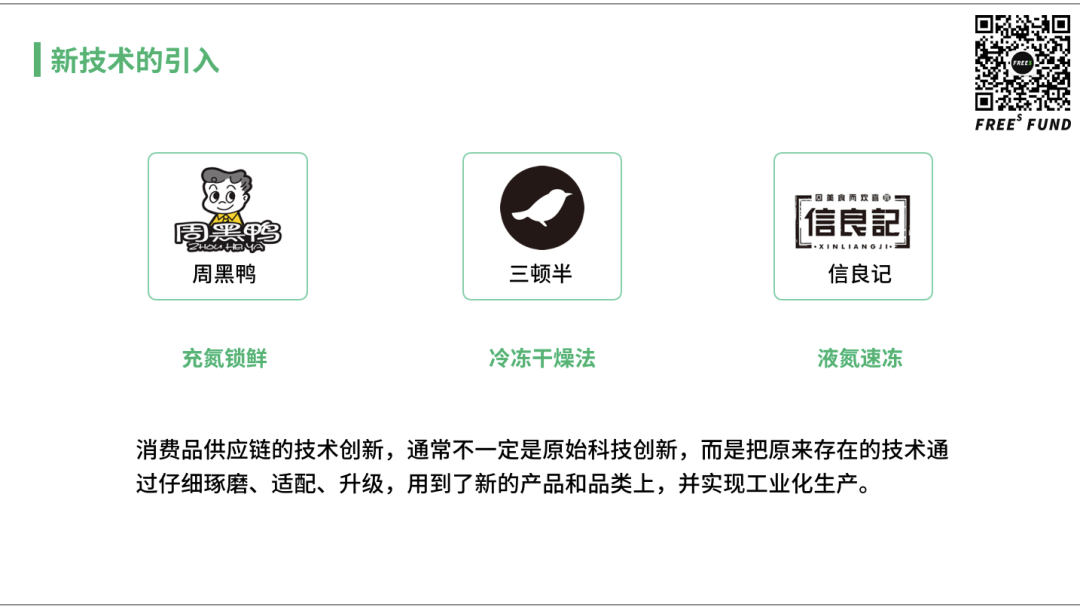
Supply chain technology innovation in consumer products is usually not original scientific breakthroughs, but rather taking existing technologies, carefully adapting and upgrading them, applying them to new products and categories, and achieving industrial-scale production.
Let's look at Zhou Hei Ya, Three Squirrels, and Xinliangji as examples.
One of Zhou Hei Ya's innovations was applying existing "nitrogen flushing for freshness" technology to braised food production.
Starting May 2014, Zhou Hei Ya removed all unpackaged products from stores and upgraded to "freshness-locked" packaging with a 3-5 day shelf life. Before this "freshness-locked" Zhou Hei Ya became widespread, if you wanted braised duck neck, you either bought it from a street vendor made that day, or from a supermarket with preservative-laden, two-month shelf-life versions. The preservative-free, short-fresh "freshness-locked" packaging came from Zhou Hei Ya spending tens of millions and two years developing its "nitrogen flush freshness packaging" process. Filling food packaging with inert gas for preservation and achieving industrial application is not new science. Zhou Hei Ya successfully applied it to industrial braised food production.
FreeS Fund portfolio company Xinliangji is similar. Its seasoned crayfish are springy and delicious partly thanks to the flavor formulation by Xu Bochun, a Sichuan Zigong salt-bang cuisine inheritor and Chinese culinary master, and partly due to Xinliangji's use of liquid nitrogen quick-freezing to achieve original-flavor frozen preservation. Previously, liquid nitrogen quick-freezing had been applied to preserving seafood like swimming crab, hairtail, and silver pomfret.
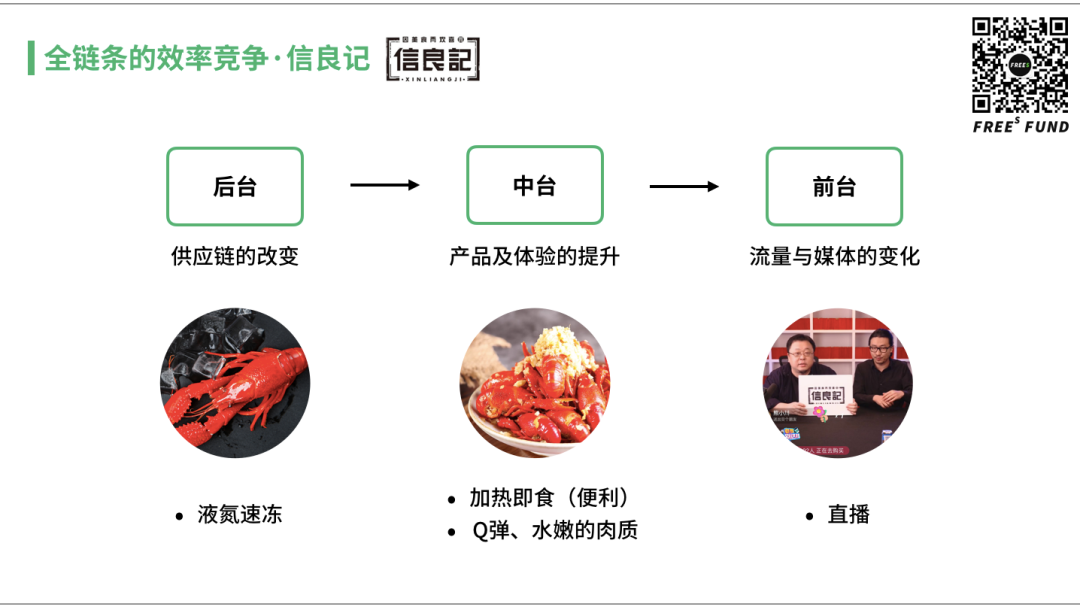
Xinliangji founder Li Jian told The Beijing News in April 2020: "After live crayfish are harvested, they're sent to the factory same-day for cleaning and seasoning, then rapidly frozen with liquid nitrogen at -196°C. Liquid nitrogen quick-freezing provides instant preservation and locks in moisture, while also effectively reducing self-generated bacteria during circulation and transport, maximizing food safety."
Before understanding liquid nitrogen quick-freezing, let's look at the concept of the "maximum ice crystal formation zone," closely related to food preservation.
The "maximum ice crystal formation zone" refers to the temperature range during freezing where food moisture generates the maximum amount of ice crystals. Between 0°C and -5°C, water in most foods rapidly condenses into relatively large ice crystals. These ice crystals can easily pierce cell walls and membranes, causing cytoplasm to leak out. Without intact cells for support, food loses its original texture.
Liquid nitrogen freezes extremely fast — 30 to 40 times faster than conventional freezing methods. Once liquid nitrogen makes full contact with food, it can "pass through" the food's "maximum ice crystal formation zone" in a short time, allowing intracellular and extracellular nutrient juices to quickly form countless uniform tiny crystals about 5 microns in diameter.
The crystals formed by liquid nitrogen freezing are far smaller than cell diameters, so they won't easily pierce cell walls and membranes or cause large-scale cytoplasm leakage.
From a somewhat geeky, microscopic perspective: when we bite into a Xinliangji crayfish and experience that "springy," "juicy," "flavorful" sensation, it's largely because the crayfish's cell membranes weren't punctured during freezing — the essence of the food was kept inside the cells.
Let's also look at how Three Squirrels' nut product series uses technical methods to achieve continuous supply chain innovation and optimize user experience.
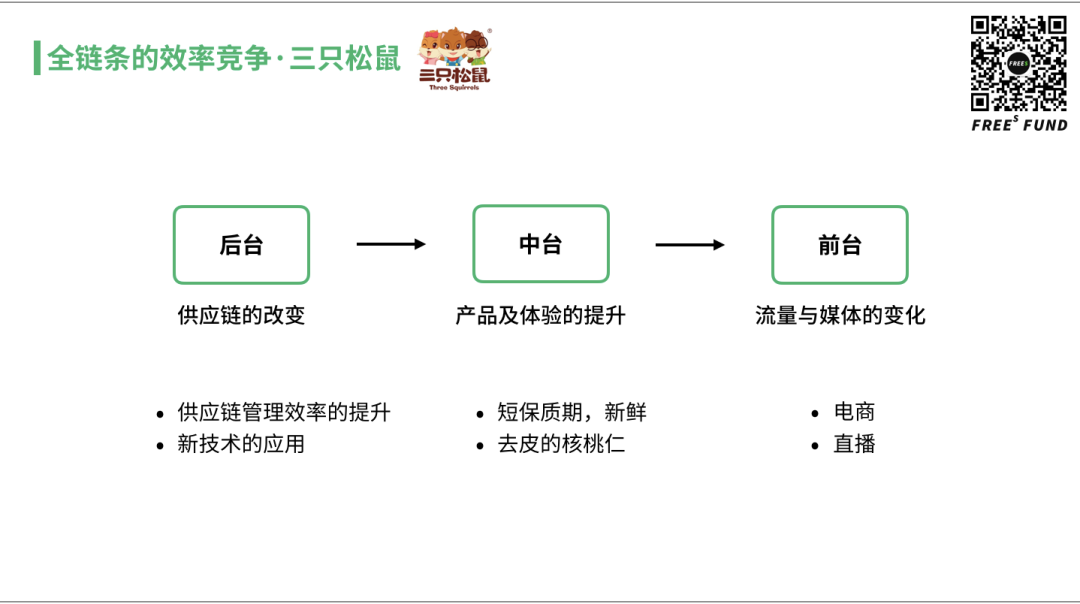
Take Three Squirrels' "Daily Nuts" as an example. When you tear open the package, you'll notice a "Chu River Han Border" style seam in the middle, neatly separating six types of nuts from three types of dried fruit on either side.
Because nuts and dried fruit have different moisture contents, mixing them together causes mutual influence — higher-moisture dried fruit transfers moisture to lower-moisture nuts, making nuts soft and dried fruit hard. Three Squirrels' innovation was using zone-based freshness-locking technology with a moisture-separating package design. Users tear open the middle seam, shake to mix, and can enjoy fresh-tasting dried fruit and nuts. This approach was later adopted by many dried fruit brands.
When you start eating the nuts, you'll find them uniform in size, without impurities. Behind this is the support of color sorters and weighing-quantification equipment.
Color sorters use photoelectric detection technology to automatically separate off-color particles from bulk materials based on differences in optical properties. Three Squirrels' chosen color sorters employ core technologies including visible light, X-ray, infrared, and mass spectrometry for food safety detection and sorting — letting users eat nuts with uniform granularity, free of bad seeds or stale pieces.
You might also notice that the walnut kernels in Three Squirrels' "Daily Nuts" have their thin skins removed in advance, eliminating any bitter aftertaste. Behind this improved consumer experience lies extensive R&D experimentation — Three Squirrels developed a walnut peeling and cleaning production line to restore the nut's optimal texture.
Front Stage: Seizing Opportunities in Traffic and Media Shifts
As mentioned earlier, if you've completed the first two steps — restructuring and improving supply chain efficiency in the back stage, and enhancing user experience in the middle stage — then catching the wave of traffic and media format changes represents a massive growth opportunity.
When Zhou Hei Ya was refining its "nitrogen flush freshness-locking" process innovation, it didn't noticeably benefit from traffic or media platform shifts. But it did transform braised snacks from street-side stalls into scalable chain stores.
Saturnbird, on the other hand, rode the rise of WeChat, Xiaohongshu's visual sharing culture, and the short-video era. Users posted elaborate brewing methods, aesthetically designed cups, and their participation in the "Return Program" for recycling empty coffee cans — earning likes and comments of "beautiful" and "cool." In this process, Saturnbird became a form of "social currency."
Xinliangji and Three Squirrels caught the livestreaming wave. On livestreams, food's color and texture can be displayed with striking clarity. Add to that influencers' precise descriptions, the satisfying sounds of enthusiastic eating, and creative consumption methods — all of which trigger impulse purchases.
The result: Xinliangji rapidly expanded its B2C market influence through Luo Yonghao's e-commerce livestream debut, with 510,000 boxes of crayfish selling out that night. After Luo, hosts including Viya, Xueli, and Joker Xue all promoted Xinliangji crayfish. Today, Xinliangji crayfish enjoys strong popularity across e-commerce platforms.
Three Squirrels also treats livestreaming as a transformative marketing opportunity and is actively exploring new approaches. In early 2020, ahead of Lunar New Year, Three Squirrels leveraged the hit IP Joy of Life, inviting Tian Yu (who played Wang Qinian in the series) to join Viya for a one-hour branded livestream special promoting Three Squirrels' Chinese New Year gift boxes and other products.
To summarize, the common thread among Saturnbird, Zhou Hei Ya, Xinliangji, and Three Squirrels is this: through back-stage supply chain technology innovation, they elevated product quality and user experience. With significantly improved user experience, customers genuinely loved the products and became willing organic promoters. When this coincided with the rise of new traffic platforms and media format shifts, the product innovation and experience improvements gave users something compelling to share.
04 True Innovators Will Always Earn Their Due Rewards
Single-point innovation in consumer goods is becoming increasingly unsustainable. When consumer companies achieve full-chain efficiency improvements, competitors struggle to copy or replicate their path — because it's nearly impossible to recreate all the favorable conditions that aligned at the right time. This is the "innovator's advantage."
Worth noting too: nothing about this comes easily. The prerequisite for consumer companies to achieve such full-chain efficiency is that the founder must be a true industry expert:
- Only founders with deep industry expertise and understanding of its fundamentals can develop profound user insight — knowing what users truly want;
- Only with genuine commitment to making great products can one find methods to improve supply chain efficiency;
- Only by staying sharp can one capture traffic shifts, pay attention to emerging media platforms, and leverage them effectively.
When Xinliangji founder Li Jian launched his restaurant chain brand Xinladoo, he pushed for pre-seasoning to improve kitchen staff efficiency. Xinladoo specialized in fish hot pot, requiring high freshness and optimal texture — so he delved into the nuances of flash-freezing. This experience carried over directly when he founded Xinliangji.
Three Squirrels founder Zhang Liaoyuan entered the nut business at Zhan's Food back in 2003. Fourteen years later, in 2017, when Three Squirrels launched "Daily Nuts," a series of innovations came naturally.
The same applies to Saturnbird founder Wu Jun. A coffee enthusiast, he spent seven years running offline cafés, familiar with every link in the coffee chain: bean trading, roasting, and café operations. Before launching Saturnbird, Wu and his founding team ran a one-stop home baking service brand, during which they deepened their supply chain expertise, manufactured over 200 SKUs, and accumulated e-commerce operations experience. Wu also studied advertising and has brand management experience.
Founder expertise, combined with back-stage supply chain innovation and middle-stage user experience improvements, has built Saturnbird's current brand momentum and sales volume.
Looking ahead, Saturnbird's opportunity lies in leveraging its current competitive advantages to evolve from a single-product-series brand into one that represents a specific category in users' minds. As brand meaning expands, Saturnbird will need to increase SKUs, broaden categories, and deliver more experiences to users.
Throughout this process, we believe that consistently grasping user needs while continuously expanding and scaling the supply chain will drive sustained product innovation.
Key Takeaways
1. Product strength comes first. If you truly achieve differentiated innovation that delivers value to users, they will find every way to spread the word. Moreover, if your differentiated product innovation is well-suited to spread on the media platforms where users' time is growing fastest, you'll expand your reach and improve传播效率。
2. Retail ultimately competes on full-chain efficiency.
3. Supply chain technology innovation in consumer goods typically isn't original scientific breakthroughs, but rather taking existing technologies, carefully adapting and upgrading them for new products and categories, and achieving industrial-scale production.
4. Founders are always the most critical factor — bar none. Only founders with deep industry expertise and understanding of its fundamentals can develop profound user insight, knowing what users truly want; only with genuine commitment to making great products can one find methods to improve supply chain efficiency; and only by staying sharp can one capture traffic shifts, pay attention to emerging media platforms, and leverage them effectively.
Discussion Questions
Q: What lessons have we learned from investing in consumer brands? Feel free to hit "Like" at the end of this article, and reply "coffee" via our WeChat official account backend to see our preliminary answer.
Reader Perks
Readers who made it to the end — share your thoughts on consumer entrepreneurship in the comments. We'll select the 3 most thoughtful responses to each receive Saturnbird's star product: a 24-cup box of "Super Instant Premium Coffee," the blockbuster that sold over 8 million cups during this 618 shopping festival. (Deadline: 9:00 PM, July 1.)
Contact Us
We look forward to ongoing exchanges with consumer sector entrepreneurs and industry experts. Reach us at hai@freesvc.com, or add Frees Xiaorui on WeChat (ID: freesfund).
Why We're Bullish on Virtual Idols | Frees Fund
2020: Consumer Entrepreneurship Enters an Era of Multiple Simultaneous Growth Drivers | Frees Fund
The Category Logic Behind the Hype — Coffee Industry Investment as a Case Study | Frees Fund
Breaking Through as a New Brand: From Traffic Thinking to Content Thinking | Frees Fund
From Rise to Plateau: Is E-Commerce Livestreaming a Feature or Business Model? (Part 1) | Frees Fund
Where Does E-Commerce Livestreaming End Up? | Frees Fund