What Did This Company Do Right by Walking Away from a 600 Million RMB ODM Business to Build a Smart Wearables Brand? | A Conversation with COROS Founder Lewis Wu

What's changing in the sports tech industry, and where are the future opportunities?

At a time of rapid technological advancement, tech-enabled consumer brands are finding new opportunities in global markets. Wearables, smart musical instruments, AI fitness coaches — these innovative products are capturing the attention of consumers worldwide. Yet simultaneously, under the shadow of US tariff policies, brand globalization faces formidable headwinds.
Around the theme of "The New Path to Globalization for Tech Consumer Brands," FreeS Fund recently held a forum in Shenzhen's Nanshan District. (Welcome to revisit the highlights: "Globalization Is Not Americanization," "Advanced Markets Birth Advanced Brands"... | Here's What They Said in Shenzhen) At the event, FreeS Fund Executive Director Ying Shen spoke with Haotian Niu, founder of COROS, in a discussion titled "A Decade of Change in the Sports Tech Industry."
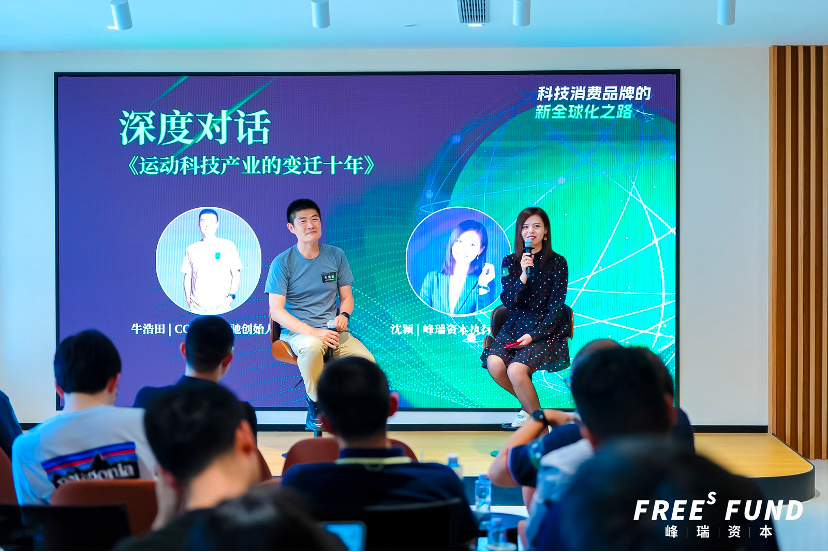
Founded in 2014, COROS focuses on sports technology to support athletic training and outdoor exploration. The company has entered markets across Europe, the US, Southeast Asia, Japan, and China, ranking among the global leaders in the sports watch category. Their conversation covered topics including:
- How do tech consumer brands navigate volatile tariff policies?
- Why does it matter to "build advanced brands in advanced markets"?
- What new consumer trends are emerging in sports? And why do chefs in Japan enjoy golf?
- What drove the decision to walk away from a 600 million RMB ODM business to build a smart wearable brand?
- In the sports watch space, why is emulating established players like Garmin a recipe for failure?
- How should Chinese tech consumer brands approach globalization?
- How can startups differentiate themselves from large corporations?
We're sharing selected excerpts, hoping to offer fresh perspectives and food for thought. Entrepreneurs and industry experts in tech consumer goods are welcome to reach out to FreeS Fund investor Ying Shen at shenying@freesvc.com.
Engagement Giveaway
What do you think about innovation opportunities for tech consumer brands? Share your thoughts in the comments — the three most thoughtful responses by May 14 will receive a copy of The World Pattern (Tianxia Geju).

COROS Founder Haotian Niu: The Power of Focus, Building Advanced Brands in Advanced Markets
Source: Ebrun
Author: Haoran Wang
/ 01 /
Tariffs Are Only Short-Term Volatility; What Cannot Be Replaced Is a Company's Core Value
Ying Shen: Right now, tariffs are a new variable in globalization that cannot be ignored. Our theme today is the new globalization path for tech consumer goods. This "new globalization" is unfolding against a backdrop of extreme uncertainty and fundamental shifts from the previous era's global order. Every industry is affected, especially brands and enterprises already on the globalization journey.
I'd like to ask you, Haotian, how your company is responding internally. The situation keeps evolving — maybe a new policy drops tonight. How are you thinking about and handling this?
Haotian Niu: First, I think we need to ask whether this is a long-term trend. For instance, can the US replace China as a manufacturing base? That's one question.
Another is: what would the end state look like that would actually be good for the global economy? We may take many detours, but eventually things will return to where they should be. And what should that look like? It should be good for everyone, right? If either China or the US ends up a loser in this, that's bad for everyone. Because the loser will drag the other down too, correct?
So I believe everyone understands that not many Americans would be willing to work on assembly lines the way people in our country do. It's not a capability issue — it's a willingness issue, and solving that willingness problem is extremely difficult.
Moreover, America's social structure differs from ours, so it's very difficult to change the reality of "Made in China." Turning "Made in China" into "Made in America" is impossible, and it wouldn't benefit the US either.
Looking back, take Southeast Asia for example. Whether it's Vietnam or eventually India, they're essentially secondary supply chains for Chinese manufacturing, right? Because any industry is a system, a supply chain.
For example, many phones are now assembled in Vietnam, but you'd be hard-pressed to find a high-precision metal processing factory there. In China, by contrast, take our mobile phone industry today — powder metallurgy is widely used, and China has developed considerable R&D capability in powder metallurgy materials.
This is a supply chain issue.
Even before the trade war, supply chains were already shifting to Southeast Asia. We saw many industries, like footwear and apparel, move there early on because of lower labor costs. As these countries' infrastructure improved — take Vietnam's energy infrastructure, for instance — they naturally developed certain advantages over China in specific areas.
Moreover, for large global brands, placing production lines in Vietnam is essentially a way to hedge against potential trade risks.
This is a major trend, and in the long run, it will only become more pronounced. So based on our industry's situation, we're trying to take action. Last year, we already began working on this.
But when the market shifted in April, it still felt sudden. The US imposed high tariffs, China retaliated, and the situation escalated rapidly.
Still, I believe this is just short-term volatility.
COROS is in a relatively easier position facing this. Over the past six years, we haven't confined our business to a single market — we have meaningful operations in the US, Europe, China, Southeast Asia, and other parts of Asia. Even if any one market is affected, it won't directly threaten our survival. This means short-term fluctuations, say within 12 months, are merely temporary irritants that will pass quickly. If worse comes to worst, so be it — some things are beyond our control, and we just do what we can.
I also know some friends whose businesses derive 90% of their revenue from the US. That situation would be tougher. But I believe that as long as you have quality products and can think clearly about long-term and short-term next steps, even if you're short on funds in the near term, smart investors should recognize that this is viable.
Because what cannot be replaced is a company's core value, right? What cannot be replaced is a group of people who can research and solve problems, winning market recognition. That doesn't change. The rest is just cyclical volatility, and I believe this volatility may actually make companies better. Going through setbacks can make a company more focused.
Sometimes having too much funding isn't good for a startup. A healthy state for a company is being able to do ten things well but choosing to do nine — and doing those nine exceptionally. Of course, those nine things must deliver unique value. I've found that such companies tend to develop steadily and ultimately have very high odds of success.
The scariest thing is when a company, flush with resources, takes on twelve or even fifteen things when it could only handle ten well. In reality, organizational capacity is a company's boundary, not how many resources it holds.
Building Advanced Brands in Advanced Markets
Ying Shen: Do you have any benchmark or mature consumer brand whose development path you consider worth learning from?
Haotian Niu: We need to understand what globalization actually means — it's not something we simply declare we want.
Japan saw many global brands emerge in the 1980s, like Sony. Sony's Walkman became popular worldwide because the product itself was a massive innovation — turning a tape recorder into something so small that ran on two batteries. Sony pioneered this. Once the Walkman was created, it could sell globally.
Many Chinese tech consumer products we see today follow the same logic. China's talent accumulation and supply chain completeness have given us the capability to develop new products that meet or exceed global standards — making our globalization inevitable.
But initially, the dimensions along which we pursued globalization differed. Our sports tech industry is different from others. In outdoor sports, China has largely been a follower market; our users have mostly been learning from overseas outdoor sports communities.
For example, our top trail runners initially all went abroad to compete and experience marathon culture. Because China entered this space later, much of what we built came through reference and learning. That's very understandable.
So when we entered the sports industry in 2016 and 2017, we realized we had to start from the US, Europe, and other regions to win those markets. It wasn't about succeeding overseas first and then "returning in glory" — we genuinely believed that "advanced markets birth advanced brands."
In sports, there are many examples of this. Looking back today, brands like Nike and Adidas have considerable influence in China, but crucially they represent sports culture and the trends in competitive athletic technology. Yet their market advancement matters more. They had more basketball players, understanding how to improve basketball shoes; more runners, knowing how to make running shoes perform better.
This is why we chose to develop products for the US and European markets. So among our first 200 angel users, 150 were from overseas and 50 from domestic markets.
When Chinese brands go global today, it's fundamentally because our capabilities have matured. I see this as the pathway to achieving globalization.
As for which company to learn from — it definitely shouldn't be your direct competitor. In our industry, Garmin is the most established company, along with some European firms. If I copied them, that would be like the ugly imitator aping a beauty's frown — they have their own reasons for success. You must have your own taste, because that's your value in the market. If you don't know what's unique about you, don't know who you want to become, you can consider many constituent elements.
At COROS, when we discuss products, we often talk about how Apple innovates. In business discussions, we explore how Nintendo approaches products and markets. Nintendo has a very classic principle of "lateral thinking with withered technology" that I think is excellent.
After COROS products launch, our hardware iterates only once every two years. This ensures our products are sufficiently reliable and solid, gives us adequate cycles to think about products, and greatly improves operational efficiency — we're not constantly pushing new products for the market's sake. We launch new products for the product's sake.
How do we increase product value during those two years? We do it through software and application innovation. It's not about purely pursuing technology, but about seeing what user problems we need to solve. There are many good examples. When we visited Murata Manufacturing in Japan, we found they had completely rethought their barometer, solving certain problems in the process.
Behind problem-solving, they studied application scenarios and proposed many we hadn't considered. Murata is a B2B company; I make products. But it provided me tremendous support. Then you understand why it can firmly hold onto customers like Apple. So I think we should observe good companies more and study the principles behind them.
Ying Shen: I've noticed that COROS doesn't have many products, but places great emphasis on product refinement, spending considerable time on consumer insight and communication. Could you share how consumer behavior has changed in recent years?
Haotian Niu: Regarding changes, first, when we look at any market's evolution, it consists of two things:
One is the inevitable mega-trend. For example, when a society's per capita GDP and income reach certain levels, people gradually shift from early pursuit of material enjoyment toward emphasis on personal emotional fulfillment — something more lasting and sustainable. Thus sports and outdoor activities, which can carry people's emotional fulfillment, will gradually grow. This is the big trend.
Looking overseas, whether at established capitalist countries like those in Europe and America, or regions like Japan and Southeast Asia, we see this mega-trend.
But certain events or regional particularities create differences across markets.
For instance, China's marathon boom actually resulted from pandemic-induced changes — different from other countries' situations.
I was in Japan recently and learned that even chefs there enjoy golf. That differed from my previous impression. Before, I might have thought golf was something even entrepreneurs like us couldn't afford — just kidding.
But why? Because Japan built enormous numbers of golf courses during its bubble economy, leading to oversupply. Though golf course construction costs are high, operating costs aren't that high — they can be democratized. This brought golf courses into the affordable range for working and middle-class people during normal operations. In Japan, you can hit at a practice range for 50 RMB per hour — somewhat unbelievable. This made golf extremely common in Japan.
So in each market, we first need to understand the big trend, then observe special events. If you can do this, you may discover hidden opportunities.
Ying Shen: What COROS does sits at the intersection of sports and technology. In fact, sports tech has experienced vigorous development and continuous evolution globally in recent years. As a veteran entrepreneur in this space, having been deeply involved for over a decade, could you share what changes you've observed in this industry globally and where it might evolve in the future?
Haotian Niu: I believe sports tech will focus more on human physical training itself. The main component of this is endurance, but also includes the body's internal chemical functional systems. It may also extend to some mechanical technique aspects. I see this as a democratization process, because we find this phenomenon in any industry.
Initially, this physical training served only a small minority because costs were high. From a sports science perspective, it mainly served professional athletes and Olympic teams, requiring experts and laboratory equipment for data collection, then a group of experts making training decision feedback. Finally athletes implemented, data was recollected, and the cycle repeated.
But with sensor and algorithm development, we no longer need specialized medical equipment for data collection — we can handle foundational parts directly. Cloud services, data processing capabilities, and artificial intelligence can help analyze data, replacing expert analysis.
The expert analysis part may continuously generate new intelligent algorithms from research institutions, eventually becoming democratized. It gradually develops from high-end professional users toward ordinary users, spreading step by step. This is what I see as the future trend of sports science, and our company's mission is to better accomplish this — serving professional users with strong needs who can bear higher costs, while also enabling ordinary people to access and benefit at lower costs.
"If You're Special Forces, Don't Do What Armies Do"
Ying Shen: You mentioned that your entrepreneurial journey has spanned 11 years, with many difficulties along the way. We previously discussed that COROS's initial product wasn't watches but fitness bands, and after persisting with bands for a while, you pivoted to watches. Please share why you started with bands, why you switched to watches, and how you persevered to reach today's globally leading position.
Haotian Niu: We started as an ODM company. Back in 2012, we provided services for some early overseas smart wearable companies. At that time, we were among the first Chinese companies capable of handling everything from hardware development to mass production.
By 2014, we felt the ODM business no longer fit our development trajectory. You could sense that many of China's previous OEM and white-label businesses were becoming increasingly difficult. We realized that without transformation, we'd be eliminated.
Another reason: we felt we could never excel at supply chain businesses to the scale of companies like Huaqin Technology and Longcheer Technology. Because ODM business is fundamentally supply chain management, particularly emphasizing organizational efficiency, with high demands on internal management and process management — meaning people feel constrained. Our company has a strong engineering culture; people love innovation and inherently resist the rigor and strictness ODM requires.
So even though we had some business foundation at the time, we decided to pivot to a brand business. We believed building a brand could leverage our inherent product design capabilities. Because the money we earned from ODM came from product innovations we made on the ODM side, given to clients willing to pay for innovation.
Here's something crucial I want to emphasize: when you realize something is right or wrong, don't cling too tightly to what you had before. We shut down our ODM business even when annual revenue was approaching 600 million RMB, because once we decided, we stopped. Letting go was key. We accepted no new ODM orders and poured all energy into the brand business.
In 2014, we started building a brand called Weloop. Actually, last year we finally shut down Weloop's online services entirely. We'd stopped sales years before, but kept providing online services to users.
Initially, we hadn't fully figured out how to approach this space. But we knew one thing: from wearables' essential nature, they were the first electronic products capable of collecting both behavioral and physiological data. Both data types were entirely new and would tremendously improve efficiency for human society.
You'll find many industries relate to these two data types — healthcare and insurance, for example. Thinking further, you see this data everywhere. For instance, most colleagues here probably have companies offering health checkups, right? Fundamentally, this views health from an enterprise management perspective. Imagine having this data — could this be done more cost-effectively and with better results?
That is, you can see this is a long-term industry of enormous value. Under such a long and large wave, small companies have opportunities. Market space alone isn't enough; you need to look at cycle length.
If the cycle is too short, large companies will quickly capture it because the certainty is too high. But if the cycle is long, the industry's development requires involvement from various ecosystem players. Then we believed this was right. So we simply started.
In the process, in 2016, we encountered a major problem. At that time, we released a fitness band product that was extremely successful during the 618 shopping festival. We quickly became the third-ranked company across e-commerce in China. There were two companies ahead of us: Huawei and Xiaomi.
At that point, we had basically reached the forefront among innovative companies. By 2016, most smart wearable companies that had emerged under capital incentives in 2012-2013 had essentially disappeared.
Because we had transformed from our own ODM identity — we were our own factory, could conduct our own R&D, the entire process was self-contained — we had somewhat easier going in making good products. Of course, it was also more difficult because your costs, your foundational investments were all tied up there.
During Singles' Day, we thought we were about to become profitable. Why? Because only Xiaomi and Huawei remained ahead of us, right?
After Singles' Day, we found the situation completely unexpected — we realized this business was unsustainable. Why? Because the cost for a single keyword alone tripled, and margins were razor-thin.
At that time, we recognized problems with this business. Actually, we had both bands and watches then, though the watches were also low-priced. We began thinking: where was the problem? In this industry, did we have a chance building a brand?
At that point, we felt we needed to fundamentally overturn and rethink the entire business — not looking at what we had, but at what was correct.
Upon reflection, we concluded we couldn't do what large companies did. If your product had no essential difference from large companies' products, what entitled you to beat them? That logic was flawed.
Moreover, in wearables, large companies weren't actually profitable, nor did they expect this business to make money. For Xiaomi, bands were a traffic source; for Huawei, they were a defensive system to maintain leadership in mobile phones. As a small company doing only wearables, nothing else, you definitely couldn't beat them.
We later discovered that in the sports domain, some companies indeed made excellent products because there were essentially different needs. When we began our transformation, it wasn't simply bands to watches — it was shifting from what large companies did to what large companies couldn't satisfy. Why couldn't large companies satisfy it? Because in such a niche market, large companies' organizational structures and business models prevented them from doing small business.
For example, our industry peer Garmin has very extensive global sports watch operations. Their single best-selling model, if placed in a mobile phone company, would be eliminated. A case considered very successful in a sports company would actually be a failure case in a phone company.
Why? It's like special forces versus an army fighting wars — these are two types of campaigns with different needs on different battlefields. Some battlefields need special forces; some need armies. Send special forces to an army's battlefield and they're wiped out; send an army to a special forces battlefield and they're ill-suited. That's roughly the idea.
Ying Shen: A very profound and vivid summary. So it's about clearly understanding what positioning suits you — if you're special forces, don't do what armies do. Persist in doing what's right rather than what's easy in your suitable domain. When you need to stop, even at certain cost, you must embark on a new journey for what's ultimately correct.
Next I'd like to ask: during COROS's business transformation, from ODM to fitness bands, then further focusing on watches, you went through very difficult periods in 2018 and 2019. How did you pull through? What were the most important things in this process?
Haotian Niu: First, the entrepreneurial direction must be correct; otherwise, no matter how hard you work or how excellent your team, you can't win. Even with the right direction, entrepreneurial success actually depends to some degree on luck. A considerable part of how the company reached today relied on luck. Many times, if luck had tipped the other way, the company might not exist.
From late 2018 to 2019, our company experienced a very severe crisis. The main problem was cash flow. Though products had entered testing and begun receiving user feedback, profitability remained distant.
We finally saw our first profitable quarter in Q4 2020. Before that, the company had been losing money, with at least 18 months until profitability. At that point, our cash was nearly exhausted, forcing very painful decisions.
The decision was first to cut 30% of staff — each department had to find ways to reduce headcount. We believed some people's work could be absorbed by others; remaining employees would need to take on more workload. We hoped employees would voluntarily reduce salaries, but we'd record the reductions and compensate with company stock.
Afterward, we not only granted stock but also paid corresponding amounts. Getting through that difficult period wasn't easy. Additionally, we had to assure suppliers that even if the company failed, they wouldn't lose a penny — we'd pay what we owed on time.
Moreover, shareholders gave us steadfast support. They felt that although we may have made many mistakes, including taking many detours, they never doubted our pursuit of sports watches and believed our eventual product was still very good.
During this process, we didn't take external investment — which may be somewhat easier compared to entrepreneurs today. Our shareholders were all old shareholders from our ODM business days; we founded this company together. I believe this is how we got through the difficulty.
Focus is particularly important. Don't enter a market just because it's very profitable — overcome the temptation of larger markets, understand that you can only excel at certain things, then go all in. It's never about being better than other market products; it's about finding an exceptionally strong scenario, just that one point.
When we developed sports watches, we believed that to be excellent, we had to satisfy triathlon users' needs. So we tried covering various sports types — cycling, running, swimming, etc. However, examining each sport in detail, we found compared to the best products on the market, our product still had noticeable gaps overall.
But we did one thing exceptionally well: battery life. We invested heavily in low power consumption, achieving the world's lowest power consumption under equivalent system performance requirements. This enabled our watches to use GPS continuously for over 28 hours. At that time, this was significantly ahead of the market, as most products could only manage around 20 hours.
Because of battery life, we found our highest-praising, best-word-of-mouth users were long-distance runners. Another group was trail runners. They all ran with power banks; many users asked our customer service: can this watch charge while in use? We realized they might need our product most. We focused all marketing resources on this group, and marketing efficiency immediately improved because we found our real lever.
But reflecting today, our internal requirement now is to think this way when making products. When building a product, think this through clearly before doing it. When we developed our first sports watch, we hadn't actually thought this through clearly — we just felt there was opportunity in sports and went for it. Moreover, looking back today, the growth we should have is: don't wait until the marketing layer to think about what selling point you should have. I think we do this better today than before.
This was the external focus point we found.
As for internally, during that difficult time, rallying related colleagues, suppliers, and shareholders when we were in such danger — this mattered. But how do you rally people during crisis? I think what you do normally matters. That is, this isn't something you only do when crisis hits and expect it to work.
From our ODM days to building a brand, we've never told employees unreliable things; what we say, we deliver. With suppliers, we don't try to take advantage; what we promise, we deliver. Same with shareholders. I believe this built organizational trust, and trust is paramount. Today we still treat trust as our company culture. Whatever management methods or systems we implement, we examine whether they affect internal trust. If there are no secrets in the company, everyone knows what the company is doing, that's good.
When company managers speak publicly, whether externally or internally, to senior or junior levels, they say the same things, about the same matters, with consistent attitude. Then I think you may have more opportunities for luck when facing crisis.
Some investors or shareholders demand faster growth, wanting next year's valuation to climb another level, up 50%. I think this approach may not suit us. I believe we should have consensus with shareholders that company development should be viewed through the lens of company capability and market demand. If capability is insufficient, build it first; growth follows capability. But even with strong capability, market pace should be a constraining factor.
Perhaps when starting a company, some people choose entrepreneurship because of investment environment and certain opportunities (trends, etc.). I'm not opposed to such entrepreneurship, but I believe we should think deeply in the process. Because entrepreneurship is a very long-term endeavor — we're not doing it to quickly make money then stop working. Actually, we're doing it to find a more fulfilling job for ourselves, in my view.
Looking back, although we encountered many difficulties, and today is as hard as day one, what's rare is that I increasingly feel my sense of happiness has grown stronger.
I sometimes discuss with colleagues: if the company ultimately fails, would you regret joining? I'm glad to find many say they wouldn't, because they feel this experience helped them grow enormously.
Post-80s are now China's entrepreneurial mainstream; whether post-80s or post-90s, I think we're in a fortunate era and should have some pursuits beyond business. I believe this makes entrepreneurship ultimately become something you do "for its own sake."
Engagement Giveaway
What do you think about innovation opportunities for tech consumer brands? Share your thoughts in the comments — the three most thoughtful responses by May 14 will receive a copy of The World Pattern (Tianxia Geju).

▲ "Globalization Is Not Americanization," "Advanced Markets Birth Advanced Brands"... | Here's What They Said in Shenzhen ▲ Sex Differences in the Immune System and Their Implications | FreeS Research ▲ How Can Tech Consumer Goods Go Global? ▲ 18 Charts to Understand Global Supply Chain Shifts | FreeS Research ▲ Globalization Has Slowed, So Why Is Going Global Still Essential? | Li Feng Column
Star the FreeS Fund WeChat Official Account for timely business insights