A Visual Guide to How New Platforms Are Born | Li Feng Column

The Importance of Datafication to Platform Ascendance

This is the 22nd installment of Li Feng's column. This time, we're talking about how new platforms are born.
What does it really take to create a new platform?
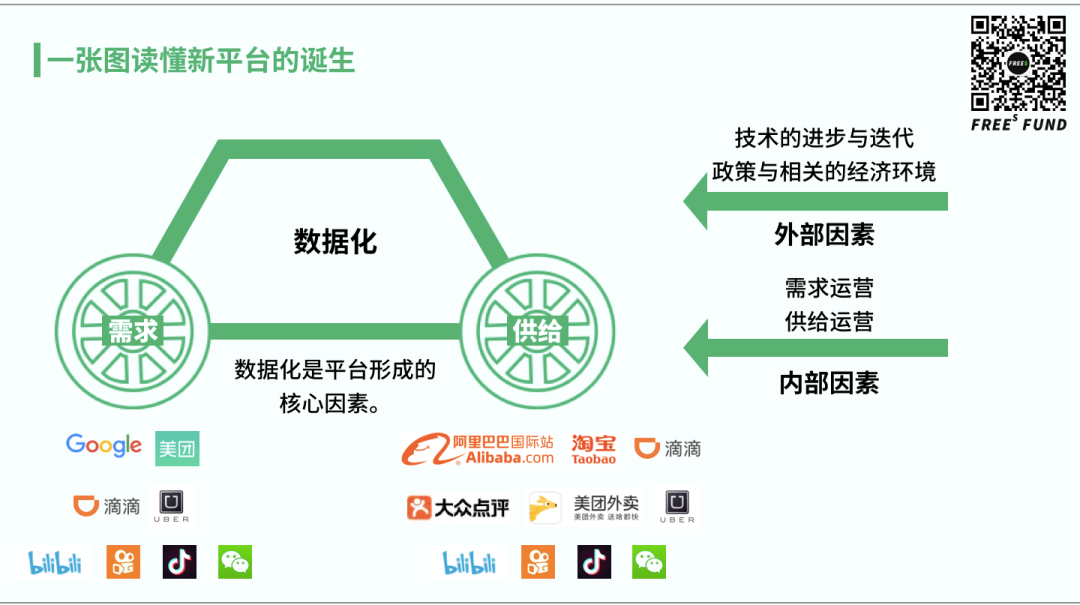
After analyzing the growth patterns of major platforms, we found one core factor behind the formation of every new platform — digitization. Whether it's e-commerce platforms like Alibaba, Dianping, and Meituan, content platforms like Bilibili, Douyin, and Kuaishou, or search engines like Google and Baidu, none could escape this rule.
In this piece, we'll explore together:
- How did the platforms we know leverage digitization to rise and grow into companies worth tens or hundreds of billions of dollars?
- Where are new platforms most likely to "break through" today? How can we capture and seize the opportunities that digitization brings?
Before diving in, here are two conclusions to share:
- Between demand and supply, there's usually a long chain. Within this chain, when the digitization levels on both sides improve significantly at the same point in time, or when a new link in an already-digitized supply-demand chain achieves a breakthrough in digitization, the conditions for a new platform become highly favorable.
- There are two types of forces that drive digitization: external factors (typically technological progress and iteration) and operational forces (typically demand-side and supply-side operations).
We hope this offers a fresh perspective. We emphasize the importance of digitization for platform rise, while also recognizing the complexity and difficulty behind each platform's success. This piece is a tribute to the platforms that create value and write remarkable stories. We look forward to ongoing exchanges with entrepreneurs and industry experts — feel free to add Frees Xiaorui on WeChat (ID: freesfund) to connect.

/ 01 / Back to the Starting Points of Alibaba and Google
Whether it was Alibaba.com, which early on matched supply and demand information, or later Taobao and Tmall, which matched transactions, Alibaba's rise as a new platform owed much to digitization. To understand this logic, we need to go back to 1999.
Alibaba's First Product
In 1999, Alibaba was founded. Its first product was Alibaba.com. The core business of Alibaba.com was helping Chinese SMEs find overseas customers and export their products.
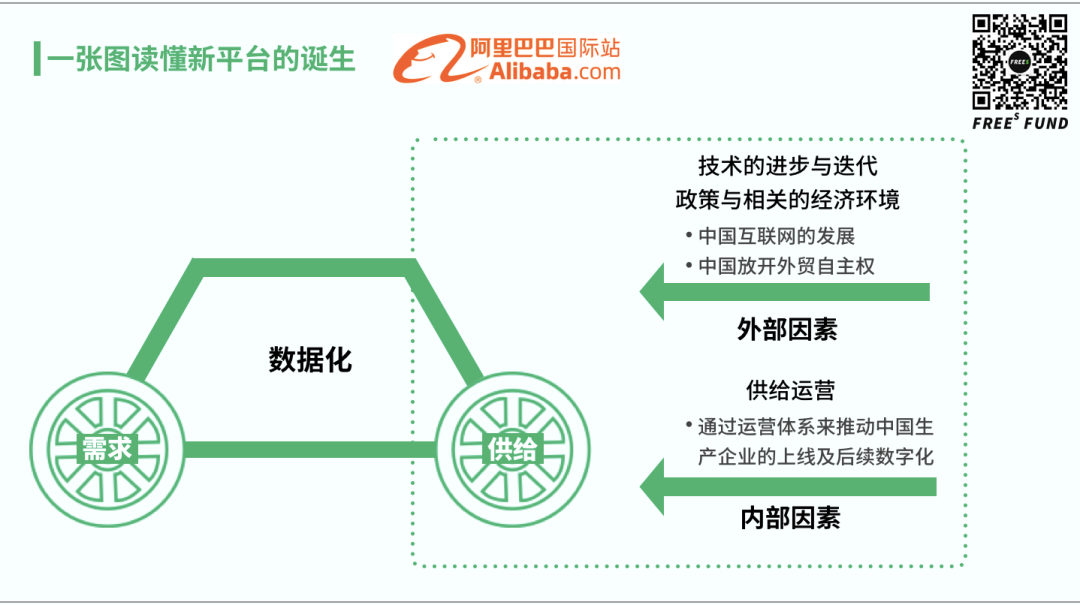
In its early development, Alibaba matched supply and demand information, not transactions, involving a relatively short chain of links. This business worked because it digitized B2B supply and demand information — the supply side being China's vast number of SMEs, and the demand side being active buyers from the US, Europe, and other global regions.
In the process of digitizing China's small and medium manufacturers, Alibaba caught two external tailwinds: China liberalizing foreign trade autonomy, and the development of China's internet.
After the 1997 Asian financial crisis, in order to shield Chinese industries from its impact, China further liberalized foreign trade autonomy. Starting from 1999, all private enterprises could export directly on their own. Once private enterprises gained foreign trade opportunities, plenty of people wanted to earn foreign currency. In short, foreign trade policy brought more Chinese merchant supply to Alibaba International Station — manufacturers wanting to sell globally gathered there.
Additionally, Alibaba caught the first wave of China's internet development. Founded in the same year were companies like Trip.com Group, Dangdang, Shanda, and Tianya. More and more Chinese merchants began going online, learning to adapt to displaying product information on the internet and finding potential buyers.
Beyond external factors, Alibaba also continuously pushed Chinese manufacturers online and toward subsequent digitization through its operational system.
Alibaba International Station's "China Suppliers" e-commerce platform initially relied on a ground-sales model, with salespeople visiting enterprises one by one to win customers. This sales force later became known as the "China Suppliers Iron Army."
After winning customers, the path to digitization was difficult and complex. Take identity verification as an example. According to China Business Network, when Alibaba first asked merchants to complete real-name authentication, merchants had to mail their ID cards and related documents to Alibaba, which then took stacks of files to the public security bureau for verification. Later, Alibaba came up with the solution of having merchants open bank accounts with their ID cards, then transferring money to the merchant accounts to verify their identity information.
Later, through its "OneTouch" platform, Alibaba provided merchants with comprehensive foreign trade services including commodity inspection, customs declaration, logistics, finance, and tax rebates. In the process of providing these services, OneTouch gained access to information about enterprises' sales capabilities and scale. Through the data accumulated by OneTouch, Alibaba came to understand its merchants' data in a way that was both authentic and comprehensive.
How Did Taobao Rise? What Was JD.com's Early Differentiator?
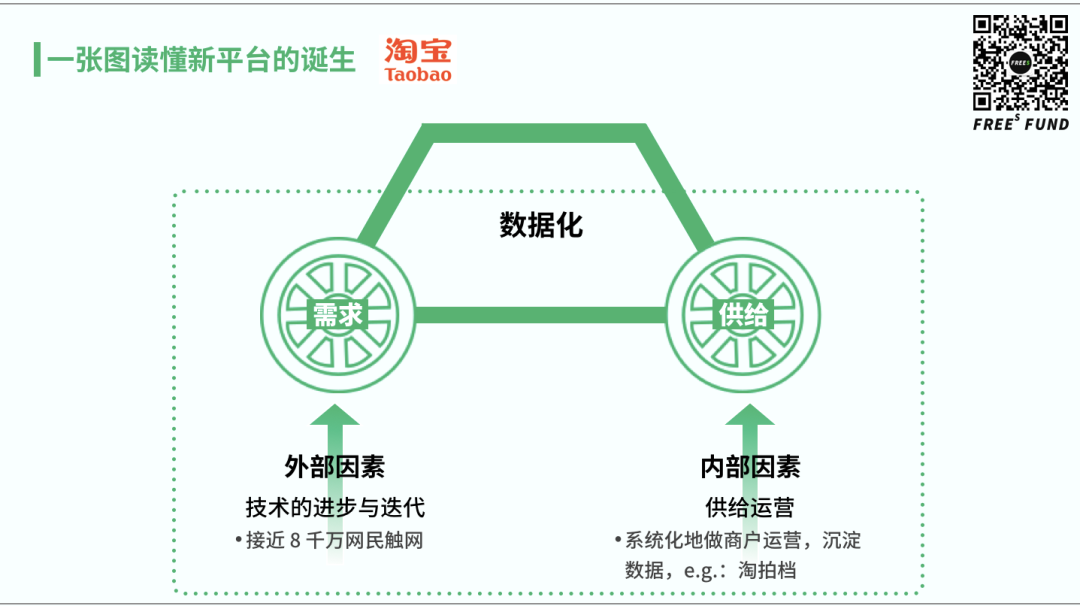
Unlike Alibaba.com, which focused on information matching, Taobao dealt in merchandise transactions. In 2003, when Taobao started out, China's internet user base was approaching 80 million, meaning large numbers of consumers were coming online — yet the vast majority of merchants hadn't gone online yet. This was the primary problem Taobao needed to solve: digitizing supply (merchants) at scale.
Taobao made countless attempts around merchant operations. For example, Taobao Partners (TPs, quality e-commerce service providers offering tools, operational services, research consulting, etc.) would help merchants find models, shoot photos, decorate their storefronts, and so on — doing everything possible to provide services and get merchants and their products online.
Overall, Taobao's approach was C2C (customer-to-customer), relatively asset-light. After digitizing merchants, it let them operate their own products and complete the supply-demand matching.
However, once user demand was fully digitized, users ultimately weren't looking to buy from merchants — they wanted to buy products.
This was JD.com's early differentiator. JD.com directly made the products/services its own. In other words, when a user ordered a refrigerator on JD.com, JD.com knew exactly what model it was, what year it was manufactured, how much inventory remained, and when it could be delivered. Thus, all product/service information was also digitized.
How Did Search Engines Emerge? What Was Google's Core Value Proposition? How Did Facebook Improve Information Distribution Efficiency?
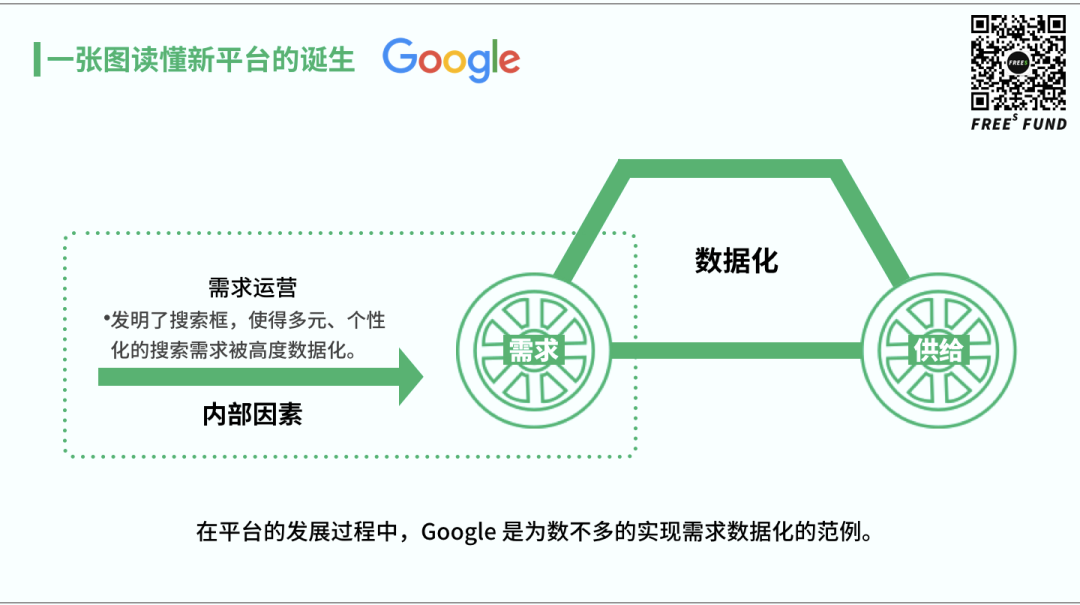
If Alibaba.com and Taobao are classic cases of significantly improving supply-side digitization, then Google is the exemplar of achieving demand-side digitization.
Before search engine platforms emerged, portals and various forums had already digitized text information. However, in the vast ocean of digitized text, users struggled to quickly find what they wanted. Put differently, the biggest problem search engines needed to solve was figuring out what users actually wanted.
Google did something profoundly meaningful. It invented the search box, allowing users to freely input their search queries, thereby highly digitizing diverse, personalized search demand.
Looking across internet history, examples of digitizing demand during platform development are quite rare. Once Google solved the digitization of user search demand, the efficiency of information supply-demand matching immediately improved dramatically. Originally, there wasn't that much information on the internet, and users didn't have that many needs — search engines could simply line everything up in one-dimensional linear order.
But now, not only has information supply increased, user demand has become more segmented and personalized. If search engines hadn't evolved in time, users might need to flip through four or five pages to find what they needed, or have to write increasingly long keyword strings to describe their search intent clearly.
Viewing Facebook through the digitization lens, it added relationship transmission on top of linearly arranged information supply, increasing the dimensionality of information arrangement and thereby improving information connectivity efficiency. In other words, it transformed information from neatly standing in line into various formations — users no longer needed to search row by row, but could simply look up and find what they wanted.
Discussion Question: After digitization, what determines how platforms distribute data? Feel free to hit "Like" at the end of this article, and reply "platform" in the WeChat official account backend to see our preliminary answer.
/ 02 / Why Did Meituan and Dianping Only Become a Super Platform After Merging?
Meituan today has a market cap of over one trillion RMB. The story of Meituan and Dianping developing separately, merging, and growing together illustrates one principle: only when both supply and demand sides have completed large-scale digitization can efficient supply-demand matching become possible, and only then can a new platform be born.
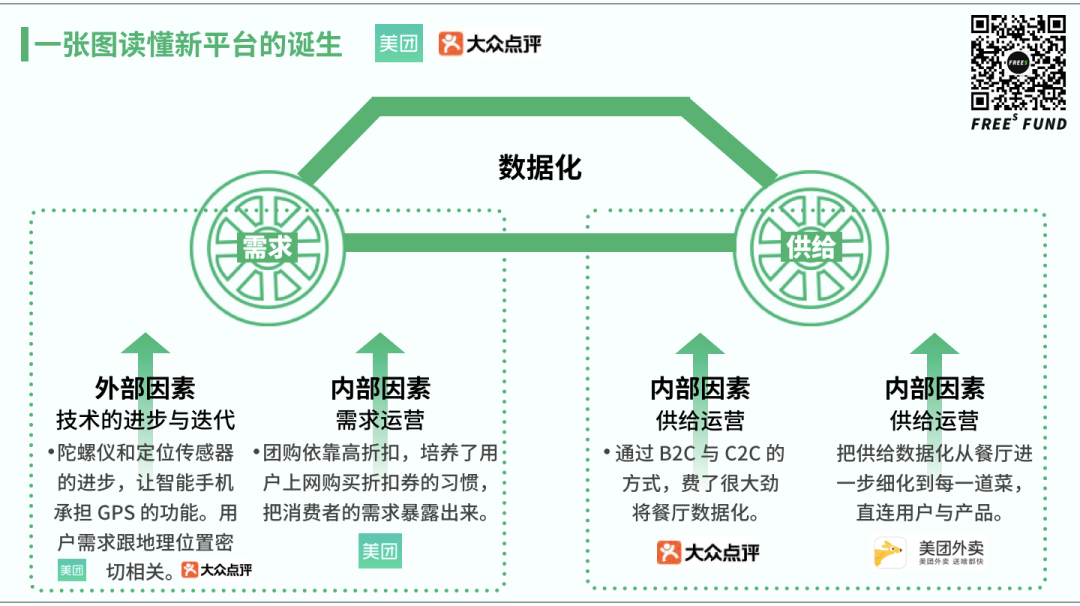
When Meituan was founded in 2010, it mainly did group buying on PC. Group buying relied on heavy discounts to expose consumer demand. When a user bought a restaurant coupon on Meituan, it told the platform: I'm going to eat at this restaurant.
Setting aside that heavy-discount group buying itself was difficult to sustain as a business model. Meituan's group buying didn't grow that large at the time also because getting the demand side digitized was insufficient — it also needed sufficient accumulation on the supply side (restaurants).
This happened to be what Dianping had been painstakingly working on for 7 years before Meituan's founding. Through B2C (business-to-customer) with a bit of C2C (customer-to-customer), Dianping exerted considerable effort to digitize restaurants. The entire process was quite challenging in the early days, and not particularly efficient.
Back then, restaurant information was extremely scarce online, and it wasn't common for restaurants to put their information on the web. Few people had the habit of looking up restaurants online, let alone going online after a meal to write reviews. According to Entrepreneur magazine, Dianping founder Tao Zhang spent days on end in libraries, finding restaurants that had been covered in media and entering them into Dianping's website; Dianping also stationed employees to collect every restaurant's information they could find in a city and add it to the platform.
By 2010, around the activity of "eating at restaurants," Meituan and Dianping had separately used operational means to digitize demand and supply. Meituan and the thousand-group-buying-wars cultivated users' habits of purchasing dining and service discount coupons online, while Dianping educated restaurants about putting their information online.
During the same period, a critical external force — advances in gyroscopes and positioning sensors — enabled smartphones to begin serving GPS functions.
With the added dimension of geolocation digitization, Dianping's previously accumulated digitized supply (restaurant information) suddenly became extraordinarily useful. Because smartphone users carried GPS with them everywhere, user demand could now be closely tied to their physical location. Simply put, finding nearby restaurants or services on smartphones became urgent, practical demand. When these demands connected with supply (Dianping's accumulated restaurant information), the value multiplied.
In 2015, Meituan and Dianping merged. The highly digitized demand and highly digitized supply they had separately created earlier began to fuse, and the merged new platform could significantly improve supply-demand matching efficiency.
Here, let's also talk about Meituan Waimai (food delivery).
In 2013, Meituan launched food delivery. Following the digitization logic we've repeatedly mentioned, what's interesting about Meituan Waimai is that it took one additional step in supply digitization.
Why do I say this? Previously, when users used Dianping, they mainly learned about merchant information; it was difficult to get a complete electronic menu. On the Meituan Waimai platform, however, we can see individual dishes. This is equivalent to supply digitization granularity moving from the restaurant level down to each dish within the restaurant — users could directly purchase products, not just select and find merchants.
To summarize, Meituan was able to become a large platform partly because Meituan got user demand online through group buying, and partly thanks to Dianping getting dining merchants online as supply. After merging, demand and supply connected efficiently.
Meituan Waimai pushed the restaurant industry's digitization path one step further — achieving product digitization through merchant operations.
Additionally, from Meituan's rise, my two key takeaways are:
-
If you do supply digitization ahead of demand explosion, like Dianping did, that alone is sufficiently valuable. Even if no corresponding business model exists yet, you can wait for demand to gradually come online before solving the business model problem. Otherwise, you'd need to invest heavily in market education, telling users why they should use you and how.
-
Compared to Dianping waiting years for demand digitization, the emergence of Uber and DiDi shows that when both supply and demand sides achieve qualitative leaps in digitization simultaneously, it's an excellent opportunity for new platforms to rise rapidly.
As smartphone penetration increased, passengers had GPS in hand, and drivers had GPS in hand too. Passenger demand information that previously couldn't be precisely expressed (where am I, where am I going) became data, and driver-related information (where they are now, how far from the passenger, how long to arrive) also became data. Location information on both supply and demand sides was digitized simultaneously.
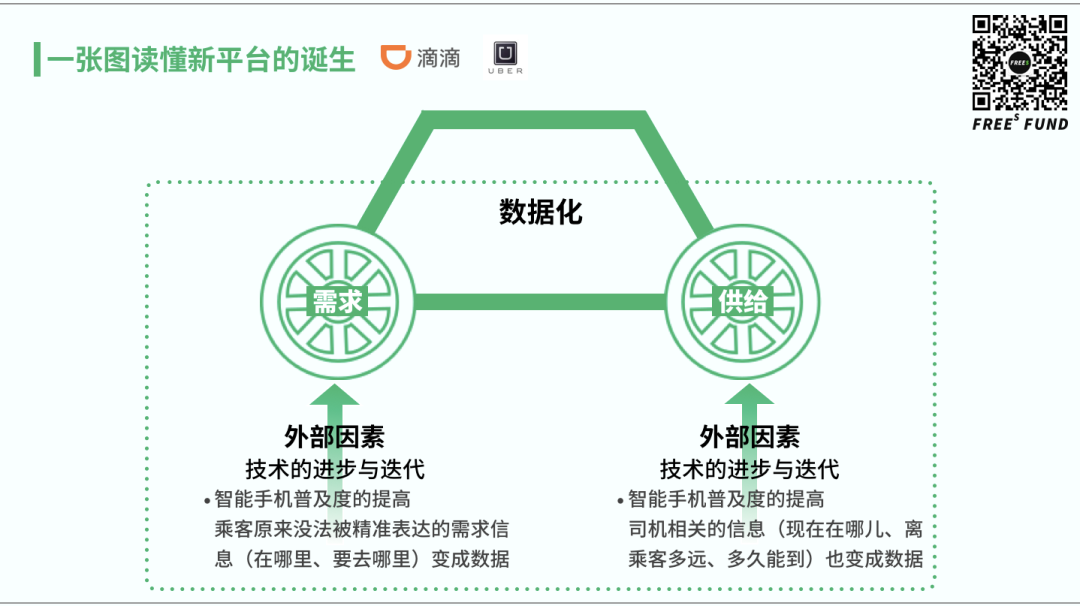
Of course, beyond the GPS positioning systems in phones, other technology-driven external factors like map navigation apps also accelerated the digitization degree on both sides of mobile transportation.
03 Why Doesn't China Have YouTube, Yet Has Bilibili, Douyin, and Kuaishou?
How Did Bilibili Rise, and What Did It Do to Digitize Content?
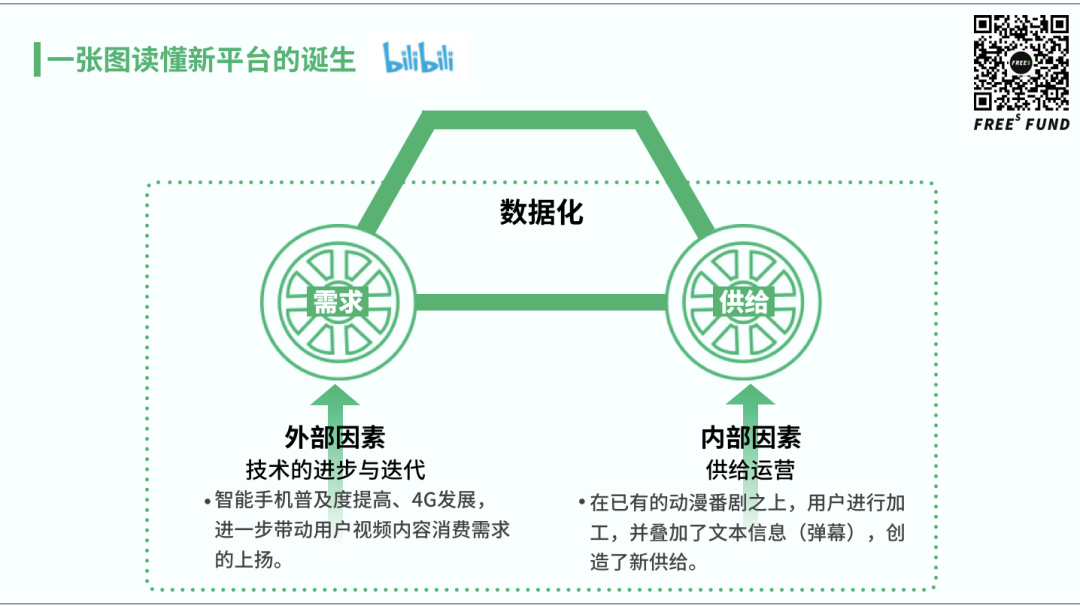
Bilibili's "breakout" momentum has been fierce in recent years, with more and more people consuming video content on the platform.
However, going back to Bilibili's founding in 2009, content supply on the platform was limited, especially UGC. After all, smartphones were just beginning to capture the market then; many people didn't have one yet. In other words, most people lacked portable devices for shooting video (smartphones), so how could they create and upload video content themselves? This is one reason why so many video platforms aiming to become "China's YouTube" failed.
At the time, Bilibili adopted a strategy similar to online video sites like Youku and Tudou — taking already-digitized animated films and anime video content as supply and putting it on its own platform. However, what differentiated Bilibili from other content platforms was that on top of this ready-made supply, it overlaid text information: bullet comments (danmu), which equated to creating new supply. When text information collided with digitized information, information convergence occurred. This became Bilibili's characteristic and culture, and it gradually grew into a platform where ACG (anime, comics, games) communities gathered.
In 2013, when I was still at IDG, I participated in Bilibili's early investment. In my view, the main driver that made Bilibili a new type of content platform with rising valuation came from external forces — various optical sensors with sufficient precision, small enough size, and relatively reasonable cost were being packed into smartphones.
When camera pixels dramatically improved, and optical image stabilization and laser autofocus were added, with continuous improvement in imaging, focusing, and image processing functions, photography and video shooting became one of smartphones' core functions. As smartphones proliferated, users' ability to shoot video gradually strengthened, and video platforms' content supply began increasing. A new demographic became active on Bilibili — UP creators (content uploaders).
The increase in video content supply, along with video content's inherent richness compared to text content, also further drove up user demand for video content consumption. This is also the logic behind the rise and popularity of short video platforms Kuaishou and Douyin.
How Do Kuaishou and Douyin Differ in Their Approach to Capturing Supply?
The number of good books you've read is probably one or two orders of magnitude greater than good movies you've seen. This isn't hard to understand. Producing high-quality video content is much harder than producing text content; people capable of creating quality text content far outnumber those who can create quality video content.
Precisely because the barrier to creating video content is so high, Douyin mobilized substantial operational forces to increase content supply while simultaneously guiding demand.
According to Tencent's Deep Web, in its early days Douyin went to art schools across the country, persuading good-looking young users to produce video content and helping them gain followers. It also used "challenge" formats to output video "templates" to drive user content production. For example, the "bath dance" that helped Douyin break out originated from user "Liu Xizi's" creation. Douyin's music team adapted the music, Douyin influencer "Xia Mu" created the dance moves, and then Douyin attracted more users to create videos related to the "bath dance" through the #bathdance# challenge.
Both approaches were effective, especially during the period when Douyin was guiding users to shift their time toward short video content consumption. Because through centralized distribution, recommending entertaining content and operationally produced mature content that users enjoyed could efficiently complete content distribution or transform user habits.
The challenge is that as user sophistication gradually increases, if average video quality doesn't rise as fast as user sophistication, the problem of video platform supply scarcity becomes prominent. Users start feeling "this isn't fun anymore," and user activity decline may follow.
Conversely, in the process of matching supply and demand, because Kuaishou's recommendation mechanism is less centralized (traffic considers ordinary people too), with strong community attributes and emphasis on building relationships between content creators and users. To some extent, I'm inclined to believe that on Kuaishou, the relationship between creators and users is more "relationship first, content second."
With the stickiness of relationships, users' standards and requirements for content supply can be moderately lowered. When supply is significantly insufficient, relationships can compensate for content quality shortfalls.
A simple analogy: no matter how old we get, we have to patiently listen to mom's "nagging," regardless of what she's nagging about. If someone else nagged like that, we probably couldn't listen to two sentences before walking away. This is relationships at work — for people we're close to and who matter to us, we have higher tolerance for the quality of their content output.
04 Where Are the Opportunities for New Platforms to Emerge?
From the development histories of platforms like Alibaba, Google, Meituan, and Bilibili, the enterprises that ultimately grew into large platforms all significantly improved the digitization level of at least one side of supply and demand, under different environments and conditions. Because demand generally runs ahead of supply, what most platforms do is substantially improve supply-side digitization. This is one angle we can consider when building a new platform or evaluating a platform's value.
The digitization process can be achieved through operational means and external factors. And these external factors are often new technologies. This is why we see that the birth of many new platforms is connected to new sensors installed on various devices. Or rather, when a new sensor is installed on a new device, or on a device that previously didn't have this type of sensor, it generates new data dimensions, which in turn bring new digitization.
Beyond the GPS positioning systems for Uber and DiDi, and high-definition cameras for Douyin and Bilibili that we mentioned earlier, WeChat's launch in 2011 followed the same pattern.
When WeChat first appeared, before it automatically matched phone address books, large numbers of users treated it as a walkie-talkie, sending voice messages to friends. Thus, voice became a new data supply, a new data demand, and new infrastructure.
And WeChat was able to digitize voice because, on one hand, smartphones were equipped with decent microphone arrays, and under good network transmission conditions, voice stream information could be transmitted smoothly. On the other hand, smartphone earpieces and speakers were also good, making it convenient for users to listen to voice messages.
The cutting-edge autonomous driving industry today is the same. We're still at a stage where both vehicle status and surrounding environments urgently need to be digitized. What's most likely to happen first is that more and more new sensors will be installed on current cars, enabling car information itself to be highly digitized. At the same time, more and more sensors will be installed in various places, enabling all kinds of environmental information to also be digitized. Once both types of information are highly digitized, if these data can then be connected and circulated, we'll enter the final stage of driving automation and intelligence.
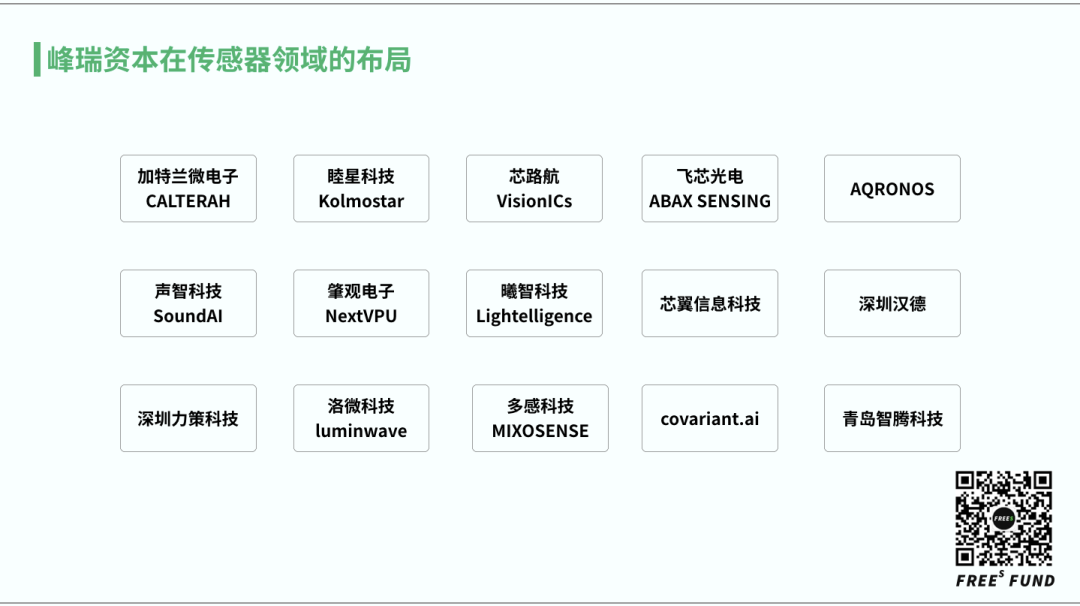
This is also one reason we're currently looking for sensor-related entrepreneurial opportunities. Many factors influence innovation, but without doubt, when new sensors are installed on various new devices, new commercial applications will likely emerge, and within these lie opportunities for new platforms to be born.
Summary
-
On both supply and demand sides, only when digitization levels undergo qualitative change is there possibility for a new platform. Most platforms' value lies in significantly improving supply digitization (when demand-side digitization is already relatively high). Google is an extremely rare example of highly digitizing demand.
-
A platform's own operational means, as well as external factors including political economy and technological development, can all bring new digitization. What we need to pay special attention to are digitization opportunities brought by technological development and iteration — these are also important catalysts for new platform rise.
Discussion Question
Q: After digitization, what determines how platforms distribute data? Feel free to hit "Like" at the end of this article, and reply "platform" in the WeChat official account backend to see our preliminary answer.
Giveaway
Feel free to hit "Like" at the end of this article and share your insights on platform development in the comments section. By 21:00 on July 21, the 6 readers with the most thoughtful comments will each receive a custom Frees Fund notebook.
Contact Us
We look forward to ongoing exchanges with entrepreneurs and industry experts. Feel free to add Frees Xiaorui on WeChat (ID: freesfund) to connect.
(Feel free to read, share, and hit "Like." For reprint requests, please reply "reprint" to learn about reprint rules, and contact Frees Xiaorui [ID: freesfund] for authorization. Copyright belongs to Frees Fund.)

After 618, What's Next for Consumer Brands? | Frees Business School
Why Is New Infrastructure the Most Impactful Stimulus Policy for China's Next 10 Years? | Li Feng Column One Chart to Understand Changes and Opportunities in China's Industrial Chain | Li Feng Column What Did Minister Miao Wei Actually Say About Chinese Manufacturing? | Frees Research Institute One Chart to Understand Globalization or Deglobalization | Li Feng Column After the Pandemic, The New Era of "Good Companies" | Frees Research Institute