The New Era of "Good Companies" After the Pandemic | Frees Fund

Industry Outlook for 2020 Amid the Pandemic

The pandemic continues. One unexpected consequence of COVID-19 has been a broad-based下沉 (down-market penetration) of China's mobile and internet applications across an exceptionally wide population.
Because staying home proved to be an effective and encouraged measure for epidemic prevention and control, people across all tiers of cities found themselves with ample time each day (potentially exceeding 10 hours) to use various internet and mobile internet products. Lower-tier and下沉 markets, in particular, implemented lockdown and stay-at-home measures more resolutely and thoroughly, which will significantly narrow the gap in internet usage habits between consumers in different city tiers. Users everywhere are becoming more discerning.
As a result, once the pandemic passes, the so-called "sinking dividend" will be difficult for any single company to monopolize or exclusively capture, because it was fundamentally derived from information asymmetry and disparities in user sophistication.
At the same time, the pandemic has forced the conversion of several professional, high-barrier, low-frequency, high-value applications — including online education, internet healthcare, and remote work, among others.
In a sense, after this pandemic, the internet and mobile internet will begin to enter a new era of "good companies." Those that truly create excellent products, services, and content — respected companies — will be embraced, recognized, and liked by a much larger consumer base, as the cognitive gap between urban tiers narrows and consumers everywhere mature into being "well-traveled and well-informed."
For companies outside the (mobile) internet sector, the pandemic has been a test of organizational capability, culture, and cohesion — particularly a watershed moment for founders' ability to judge trends, adapt, and even their core values when facing sudden crises. Having weathered this "epidemic," the "good companies" that can build centripetal force and move forward together through difficulties will recover faster and develop better going forward.
Below, drawing from our ongoing conversations with founders on the front lines and our internal discussions and reflections, we explore:
- How 100+ founders view the pandemic's impact
- Short-term difficulties and effects brought by the pandemic
- Long-term opportunities and effects brought by the pandemic
- Outlook on the capital markets for 2020

/ 01 /
Frontline Research:
How Do 100+ Founders View the Pandemic's Impact?
The pandemic still looms over us. On February 3, our first day back to work online, we asked every investment colleague to have in-depth conversations with the founders of their portfolio companies — to understand the CEOs' and companies' states, how they were responding to the pandemic, and what we could do to help. Our mini-survey covered 100+ companies. The results:
The vast majority of CEOs are re-examining their business models and making proactive adjustments. In the words of Three Squirrels founder Liaoyuan Zhang, "Reluctant as we are, crisis contains opportunity — it's precisely a test. A company's greatest responsibility to society is to operate well under any difficult conditions."
Over 20% of founders are trying to find new ideas and breakthroughs from the predicament. In our conversations with them, we heard things like "This might force SaaS development," "We're seeing demand growth and user habits being cultivated," "We've spotted a new direction," "Short-term setback, medium-term positive"...
Risk came suddenly. Thinking about not just "surviving," but spotting "opportunity" within "crisis" — this is the posture and action that excellent entrepreneurs should have.
That said, over 30% of portfolio companies candidly acknowledged suffering negative impacts from the pandemic. There's no shame in that.
Currently, the more prominent impacts of the pandemic are concentrated in production, logistics and delivery, and services — key links mainly affected by restricted mobility and delayed work resumption.
Specifically, founders' immediate concern is returning to work: "It looks like end of February is doubtful," "The park is sealed, we're trying hard to apply for work resumption." Delayed work resumption upstream and downstream the supply chain affects project progress: "Our major client is in Wuhan, product testing may be postponed," "Suppliers started late, affecting product delivery." Over 10 portfolio companies have delayed product delivery to clients due to logistics disruptions: "U.S. customs is holding up our goods," "International orders are delayed, we need to catch up or face penalties." Eight portfolio companies are still adapting to online work: "Remote work can only accomplish 60% to 70%," "Work efficiency has dropped considerably."
/ 02 /
How Is the Pandemic Affecting Business?
Based on frontline voices from founders and our preliminary internal thinking, one conclusion is that the pandemic's impact on business comes mainly through physical policies and psychological effects.
Physical policies are primarily aimed at preventing epidemic spread by restricting people's range of activity — encouraging staying home, reducing gatherings, and postponing work and school start dates.
Psychological effects we can all appreciate. Compared to SARS in 2003, social media is now highly developed. Whether good or bad news, the breadth and speed of information dissemination is unprecedented, making the impact on public sentiment direct and intense.
Therefore, in thinking through the pandemic's business impact, the logic comes down to two things: first, what behaviors has the pandemic changed, and second, what psychology has it changed. Whether the impact is short-term or medium-to-long-term depends on whether the effects on behavior and psychology are temporary or lasting.
/ 03 /
Short-Term Difficulties and Effects
In the short term, the pandemic's impact severity by industry is as follows: offline services > offline retail > online retail > other online industries.
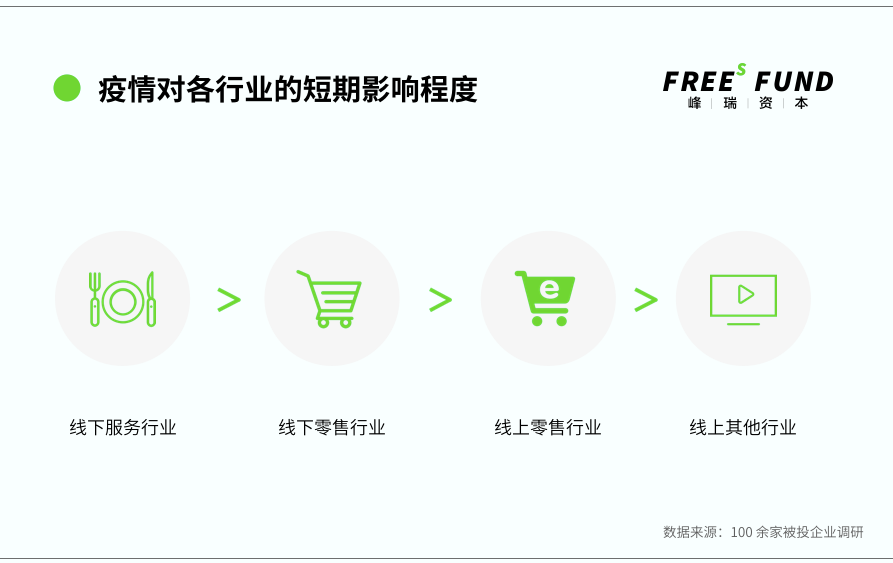
▍ Offline services are currently the hardest-hit sector
Those currently suffering heavy damage are offline service businesses that generate gathering behaviors, such as the restaurant industry that everyone has seen. We invested relatively little in restaurants, so let's analyze other industries we're more familiar with.
- For some rigid demands, even if short-term effects occur, the total volume won't ultimately decrease. Because stock demand will be deferred, and may even bring incremental demand.
Rigid demand category: wedding services as an example
FreeS portfolio company Vivan Bride saw most of its Q1 orders temporarily canceled. There's no way around it — before April this year, there likely won't be many wedding celebrations. The key word is "temporarily," because wedding services are rigid demand, and can likely be postponed.
In other words, what doesn't happen in Q1 can be pushed to May, June, July, August. So their full-year order volume may not necessarily decrease.
A question worth exploring: Will the wedding industry see new incremental demand after the pandemic?
The background to this question is that, affected by the pandemic, we may value family, partners, and things worth commemorating in life more. Those who originally didn't plan to hold weddings, or planned simple ones, may want to hold more elaborate ceremonies, or find ways to make them more memorable.
- For many non-rigid demand services, the pandemic will cause irrecoverable short-term damage. From a rational perspective, this is a time for founders to re-examine new directions for business development.
Non-rigid demand category: photography services as an example
Our other portfolio company VPhoto provides cloud photography services for various offline events. While the company itself is highly internet-enabled, the photography action and portions of service need to be completed offline.
Unlike rigid demand services, VPhoto's clients' originally scheduled offline events may be postponed, or may simply be canceled. Undoubtedly, VPhoto's original cloud photography business will be affected in the short term.
Fortunately, the founder is already thinking about how to develop new businesses aligned with trends. They've observed rapid growth in short video content consumption — a medium-to-long-term trend — yet quality supply of video materials remains scarce. VPhoto has decided to leverage its accumulated materials, video editing and recognition technology, and network of partner photographers to explore short video content production.
▍ In the short term, offline retail is more affected than online retail
- Rigid demand retail is affected short-term, but will see revenge rebounding after the pandemic, recovering most of its losses, and may even stimulate new demand. (Excluding demand lost due to employment and income impacts.)
Rigid demand category: automotive retail as an example
FreeS invested in two companies in automotive retail: Huasheng Haoche and Shima Chuxing. The auto industry had already been in a downturn for over a year; encountering the pandemic, their offline business will be affected short-term. But because auto consumption is rigid demand, once the pandemic passes, this sector will likely see "revenge" rebounding.
On one hand, having experienced the phased shutdown of public transportation in some cities, many people suddenly realized that not having a car is inconvenient. On the other hand, avoiding public transit became consensus during the anti-epidemic period. After the pandemic, besides the recovery of previously accumulated rigid demand, I predict there will be a wave of newly stimulated demand due to the pandemic's influence.
- Non-essential retail will see greater short-term impact, especially for products and services requiring offline delivery.
Non-rigid demand category: coffee and tea industry as an example
Compared to rigid demand goods like automobiles and daily necessities, optional purchases like coffee and tea will see significant short-term impact, especially where products and services require offline delivery.
However, even within the same coffee and tea industry, Starbucks and HEYTEA will fare better than many pure offline coffee and tea shops, because besides pickup, they can also deliver (product delivery completed online). In other words, retailers with online capabilities will suffer relatively less impact.
▍ Among other online industries, entertainment and social saw the most obvious short-term growth
- Games that occupy lots of time and even have light social features are widely favored by users.
Taking Honor of Kings as an example, according to Aurora Mobile data, its DAU during the Spring Festival period (January 23-29) exceeded 109 million.
This is because adults, temporarily stuck at home with abundant discretionary time, are spending more time on entertainment.
What needs consideration is: if these effects come from short-term time allocation, then looking longer-term, people's time allocation will eventually return to normal. When people can no longer spend so many hours daily on entertainment as recently, what impact will this have on the entertainment industry?
Considering that both games and entertainment heavily use video, we can be fairly certain that even as time allocation normalizes, video-related formats will increasingly become mainstream.
- Various types of social activities will also see short-term爆发 after the pandemic.
Similar to entertainment, social activities have an equally large base. After the pandemic, although we'll need a psychological缓冲 period, there will definitely be "revenge growth," especially in emotional social fields. Spring Festival gatherings that couldn't happen will likely be made up for and then some. Additionally, suppressed social demand from being cooped up at home will be released, stimulating various online and offline social activities.
/ 04 /
Medium-to-Long-Term Effects and Opportunities
Compared to fleeting opportunities, we should pay more attention to the pandemic's medium-to-long-term effects. That is, certain behavioral patterns and psychological changes caused by the pandemic will persist for considerable time, bringing medium-to-long-term effects to many industries.
We've found that because people are spending more time at home recently and more time online, we're using more heavily the goods and services we already trusted, and we're actively or passively trying those we previously didn't.
In this process, new behavioral habits and mindsets are forming, creating development space for related product/service categories and industries.
▍ Online retail has new category opportunities
- The most typical is fresh groceries
Undoubtedly, the fresh grocery industry, which previously had low online sales penetration, has seen explosive online growth during the pandemic. This isn't hard to understand — affected by the pandemic, users reduced outing frequency, shifting grocery shopping, especially vegetable buying, from offline to online.
According to Ebrun reporting, Dingdong Maicai exceeded 4 million orders during the 7-day Spring Festival period; citing Securities Daily, Missfresh's actual transaction value from New Year's Eve to the 8th day of the lunar new year grew 350% year-over-year.
But there are two points that may differ from what people expect.
One is that besides online, offline traditional supermarkets with supply chain accumulation and good brands have also performed well recently.
Lianshangwang reported that in January 2020, Better Life supermarket's sales revenue grew 43% year-over-year. CITIC Securities data shows: Wumart supermarket's normal daily vegetable volume is about 700 tons, with 3x growth during the Spring Festival; during the Spring Festival, Yonghui Life prepared over 200,000 vegetable servings, 3x normal levels; similarly, RT-Mart stores' product procurement volume grew 4-5x year-over-year. (For observations and thoughts on RT-Mart, see Li Feng's Column 16 | The Fresh Retail Battle — Learning Early-Stage Investment from the Secondary Market)
One reason offline supermarkets are doing well is that, traditionally, offline supermarkets stay open during the Spring Festival, so they're more prepared in terms of product supply and staffing, despite also encountering supply shortages. Internet retail companies, even online supermarkets, due to logistics and personnel reasons, often haven't arranged for continuous operation during the Spring Festival, and thus may be more caught off guard.
Another point is that traditional retailers transitioning to new retail — supermarket representatives with both online and offline capabilities are more competitive. Because they originally possessed stronger supply chain and scenario capabilities. We've seen that in Apple App Store's food and dining category, both RT-Mart and Duodian entered the top 5 (definitely not刷出来的), and in App Store's overall download top 100, there are RT-Mart, Yonghui, and Duodian — also likely not刷出来的.
A small topic worth observing: Fresh grocery's explosive growth is clearly caused by nearly everyone staying home to cook — the question is what happens after people return to work?
- Food consumption may reach new levels
One type is alternative solutions for existing major brands.
Taking coffee as an example. Normally easily available Starbucks and Luckin Coffee on street corners became inaccessible, so heavy coffee users sought alternatives. For FreeS angel-round project Saturnbird Coffee, an online brand, this was a rare window period.
After users try it, if they approve of its taste还原度, experience, convenience, and price, it may bring repurchase, and the habit of drinking super-instant coffee may continue. Saturnbird Coffee's January order volume saw substantial year-over-year growth. (Coming up, we'll publish an article about coffee and Saturnbird.)
Another type is upgraded convenience foods, especially upgraded convenience foods that can satisfy single-person dining scenarios.
In our conversations, Three Squirrels founder Liaoyuan Zhang said, "The 18% online penetration rate for snacks may be newly educated through the pandemic; second is the rise of category-upgraded convenience fast foods." Self-heating hot pots, upgraded instant ramen and rice noodles have been favored by users in the past year or two, even more so this past Spring Festival — they're effective supplements to cooking at home while staying in.
But facing the sudden pandemic, the challenge behind this is: production enterprises need raw materials to process, but first, it's hard to foresee such special circumstances, and second, manufacturers can hardly organize sufficient inventory and logistics capacity in such a short cycle. Even if online user demand rises significantly, there will be situations where online demand cannot be fully met.
This also makes the online retail industry more aware that whether in supply capacity or delivery capacity, what it ultimately comes down to is the full supply chain efficiency of retail across the long chain.
▍ Online education and online healthcare development have reached an inflection point, and will benefit long-term
The education and healthcare industries share strong similarities: low user education barriers, relatively medium-to-low frequency, and professional. Through this special pandemic, large numbers of users actively or passively accepted and used online education and internet healthcare, so they've certainly seen sufficiently good growth now and completed initial user education.
But once the pandemic passes, who will benefit most in the long term?
In our view, this mainly comes down to who truly provided better educational and medical value, thereby earning long-term user retention.
Specifically for education, we believe companies that ultimately win users will have these characteristics: high degree of internet-enablement, good user experience, leveraging fragmented time, more intelligent and automated, significantly improving efficiency. This will be the opportunity for FreeS portfolio online education companies Yangcong Xueyuan, Shanbay, and Deer Music.
Conversely, those short-term emergency solutions that differ little from offline education, merely temporarily leveraging special-period time and location convenience while being very time-consuming, will have limited or greatly reduced user retention. The same applies to entertainment.
Online healthcare benefits short-term mainly because it solves the current problem of people with minor ailments avoiding hospitals and instead seeking professional opinions online.
The good enterprises that ultimately沉淀 out will certainly be those that can serve broad families, have high internet-enablement, provide professional opinions, and meanwhile分流 China's scarce medical and diagnostic resources while significantly improving efficiency.
FreeS-invested maternal-infant online platform October Care and online video general practitioner Hehuan Healthcare both fit these characteristics. Hehuan Healthcare trains its own general practitioners, occupies little existing medical resources, and provides family-oriented medical services. October Care provides online maternal-infant consultation with triage and referral functions, improving existing healthcare system efficiency.
▍ As health awareness strengthens, health and wellness-related industries will improve
After this pandemic, our health and wellness awareness will significantly increase, bringing two types of opportunities.
- The fitness exercise industry and food/beverage industry主打 health concepts have development space
Affected by the pandemic, people value improving immunity through exercise more, and combined with longer time at home, weight loss demands for spring/summer will arrive earlier and spread more broadly.
Additionally, as health awareness rises, various industries auxiliary to health, not limited to food and beverage, will also see development space. For example, products with shorter shelf lives, more environmentally healthy product packaging.
- The insurance industry will see a wave of growth.
This is mainly due to the psychological impact of sudden public health emergencies and increased public self-protection awareness.
▍ Remote work-related will see various opportunities from technology to application layers
Remote work is a recent buzzword. Undoubtedly, after everyone's exploration of various online remote work models, those services and applications that can both save costs and improve efficiency will stand out, bringing various changes to this field from technology to application layers.
We'll focus on 3 phenomena we've recently observed.
First, regarding remote work, platforms have already emerged in China, so more enterprise service opportunities lie in being ISVs (independent service providers on platforms). For example, FreeS portfolio company, intelligent background check service provider iBeidiao, after接入 DingTalk, achieved faster growth. Of course, the formation of platform companies will soon involve the issue of startup companies choosing sides.
Second, in the process of experiencing various remote work products and services, some infrastructure and underlying technology challenges and problems have also been exposed, such as unstable video calls, network lag, etc. This means companies that can provide better underlying technical services will have opportunities.
FreeS portfolio company Lightspeed Yilai is making efforts in this field, working on data transmission services optimized based on communication transmission underlying protocols and functions, which can effectively solve the problem of large numbers of users in remote work, online education, and other industries conducting real-time, large-scale data dimension (such as audio/video) interactions across regions, countries, and network operators in complex network conditions.
Third, truly usable internet-enabled remote collaboration tools for various细分 scenarios are also a direction for long-term development. For example, product manager remote collaboration tool MockingBot, which was already profitable with a substantial user base before this, also achieved good growth during this pandemic. Yufu is the same — as we use more and more online tools and products, unified ID becomes important.
▍ Machine substitution of humans will receive more attention
Affected by the pandemic, with difficult开工, difficult hiring, and high labor costs during special periods, both manufacturing and service industries' willingness and scope for adopting automation will increase. When I communicated with founders of several automation portfolio companies, they also confirmed this.
Yi Fei Intelligent Control founder Juntong Qi firmly believes that unmanned systems will become increasingly important going forward, that drone technology is a platform-level opportunity, and that investing effort to build the flight platform well is most fundamental.
Yifei Automation founder Sai Zhang said, "This pandemic will make more enterprises realize the importance of automated production lines and unmanned factories. In the short term, after the pandemic, there will very likely be a wave of automation改造 and rush production, including automation of medical supplies and reagent production related to the pandemic."
/ 05 /
Several Open Questions
We call these "open questions" because we have indeed been less involved in the following industries in our past investments. I'm singling them out, hoping to exchange and learn from founders and industry experts who have long been immersed in these sectors.
▍ The tourism industry, severely hit short-term — what direction will it take next?
Currently, the most directly affected parts of tourism are outbound travel and hotels, due to travel restrictions. For practitioners, the present is very difficult.
However, if we look further ahead, my preliminary judgment is that after the pandemic passes, the tourism industry will also see so-called "revenge rebounding."
Besides the "seize the day" psychology at play after experiencing disaster, if the pandemic ends early, May Day travel may see more增量 than expected. Of course, specifically, this depends on the pandemic's duration and the actual occurrence of revenge consumption.
Besides revenge growth, what I'd like to discuss with everyone is: Will this pandemic accelerate the tourism industry's evolution from group tours to semi-independent travel?
Originally, transitioning to this semi-independent travel form would take considerable time. It relies more on the internet for travel decisions. So, after this pandemic, people's psychological concerns about group tours, combined with revenge consumption coming more from young people (digital natives), semi-independent travel may be a mode more people are willing to try.
▍ After the pandemic ends, will home cooking behavior continue?
For many people, this period has involved a major lifestyle shift: all restaurant consumption has moved home, and basically everyone has been cooking at home continuously for two to three weeks.
Once the pandemic ends and life returns to normal, will we return to the original "restaurant + delivery" format, or will we partially continue cooking at home?
If home eating increases, both restaurant delivery and dine-in may be affected. From another angle, will this drive more development in food supply chains? For example, online vegetable sales, sales of prepped vegetables and pre-made products. Previously neither of these models was easy, especially the latter because China's delivery is so developed.
Xinliangji, a catering supply chain brand, founder Jian Li mentioned in our exchange that Xinliangji's current many distributors and buyers are mainly restaurants. Recently they've found that to C platform sales are rising quickly, and they're accelerating supermarket and home delivery businesses. After all, it will be some time before we return to group dining, and busy office workers obviously don't have much time or are too lazy to buy, wash, and chop vegetables — buying semi-finished products may be an option.
A follow-up small question: If selling prepped vegetables and pre-made products, whose opportunity will this be?
Theoretically, it makes more sense for restaurants to do this than supermarkets. If supermarkets want to sell pre-made products, they need to委托 factories for separate processing, which has uncontrollable factors. Restaurants are different — they generally only have one and a half or two busy periods, so the remaining time the kitchen has nothing to do. Whether you have a central kitchen or back kitchen, they naturally wash purchased fresh vegetables, divide into portions, and even categorize seasonings, like one portion of Kung Pao Chicken, one portion of Fish-Flavored Shredded Pork — this is natural动作.
During this period, we've already seen some restaurants, to clear inventory, selling vegetables at residential complex gates. While this hasn't formed any trend or inflection point yet, it's worth exploring in the future.
▍ Will flexible employment迎来 a small inflection point?
Some time ago, everyone likely noticed a news item: On February 5, media reported that over 1,000 Shanghai Xibei employees would "temporarily work" at Freshippo. According to Freshippo, besides Xibei, employees from over 30 restaurant chains including Yunhaiyao, Shu Da Xia, Wang Xiang Yuan, Nayuki, and Tan Yu also came to "work" at Freshippo.
They reached personnel cooperation with Freshippo in temporary lending form, to alleviate the restaurant industry's personnel idleness and labor cost problems from the pandemic's impact, and also solve the labor shortage in supermarket consumer living goods industry due to demand growth during special periods.
Behind this news, we might consider a question: Will this emergency-generated "flexible employment" and "human resources outsourcing" new employment model be more widely extended in China going forward?
"Flexible employment" hiring models are already quite mature in developed countries. A 2017 CIETT survey report showed that Japan's "flexible employment" already accounted for 40% of the human resources industry, the U.S. ranked second at 34%, and European countries like France, Germany, and Italy all exceeded 30%. But at that time, China's share was only 9%.
The internet has also accelerated the "flexible employment" economy. Along with the emergence of sharing economy platforms like Uber/Airbnb, more and more people are participating in the gig economy.
▍ When offline commerce suffers impact, how will offline commercial real estate reshuffle? Whose opportunity is this?
Along with urbanization, starting a few years after the 1998 commercial housing reform, both residential and commercial real estate began sinking, from first-tier cities to second-tier, to third and fourth-tier, to county towns. Now, commercial real estate in first through fourth-tier cities has experienced at least one round of price increases. When retail projects go offline, there's no longer real estate dividend — they need sufficiently high efficiency.
So, when the pandemic brings impact to offline commerce, and those offline businesses with plummeting foot traffic and devastating losses exit, whose opportunity will this be? Regarding offline stores, it returns to two questions: Why should users go offline, and what categories can bring customers to stores?
/ 06 /
2020 Capital Markets Outlook
2020 is the year China aims to achieve its goal of building a moderately prosperous society in all respects. To ensure economic growth, the state has gradually introduced fiscal and monetary policies to stimulate the economy. This will bring two effects on the venture capital market:
▍ Small and medium enterprises will receive more support.
There should be more policies benefiting SMEs, such as more bank loans oriented toward small and medium enterprises, helping SMEs — especially those affected by the pandemic — solve financing problems.
In our survey of portfolio companies, we found that increased financial security is indeed the most concerning issue for enterprises currently. Some companies have also adjusted their original financing plans due to the pandemic — 5 companies explicitly stated that "financing is expected to be postponed," and "investors we were communicating with before the new year have now switched to online meetings."
FreeS is also working hard to help portfolio companies secure more policy benefits and provide financing support. Currently, we've compiled portfolio companies' financing needs; besides寻找 next-round investors, we've also contacted financial institutions like Ping An Bank and Bank of Hangzhou, reaching cooperation intentions to help portfolio companies obtain credit services.
▍ Assuming national economic stimulus policies further benefit the secondary market, the primary market will also be driven to warm up by the second half of this year.
Because capital markets are directly related to money, their feedback is often the most direct. Looking at stock market performance these past few days, whether A-shares or Hong Kong stocks, the first few trading days of the Year of the Rat saw initial declines followed by immediate rebounds. This can be seen as using stock prices to "state a position," believing that the pandemic will affect the economy, but it should be short-term.
The state has already introduced considerable fiscal and monetary policies. Based on past and present national support intentions, these will ultimately point more toward SMEs and direct financing (capital markets, primary and secondary markets, etc.). Believing that by the second half of the year, as the pandemic ends and the economy recovers, these policies will very likely first drive good performance of good companies in the secondary market, and ultimately transmit from the secondary market to the primary market, making the primary market hotter.
Meanwhile, these proactive monetary and fiscal policies may also make "money" in primary and secondary markets more abundant, which can further promote primary market warming.
Closing words: I believe after this pandemic, everyone will value health more and revere life more; value family warmth more and cherish their work more; and better understand difficulties and others experiencing difficulties.
I also believe that after this pandemic, more and more industries and enterprises will accelerate and deepen digitalization, which will bring enormous efficiency gains and, after pandemic recovery, bring more competitive opportunities to various industries worldwide.
No matter how many "opportunities" in crisis we've discussed, at this moment we are still in the pandemic. Let us together face it bravely.
(Welcome to read, share, and like. For reprint authorization, please reply "reprint" to understand reprint rules, and contact Feng Xiaorui [ID: freesfund] for authorization. Copyright belongs to FreeS Fund.)

▲ Li Feng's Column 16 | The Fresh Retail Battle — Learning Early-Stage Investment from the Secondary Market
▲Li Feng's New Year Outlook | One Chart to See China's 2020 Opportunities