The Era of Private Cloud: How AI NAS Is Reshaping Your Digital Life | FreeS Research Institute

Beyond Traditional Storage: Build Your Personal Cloud

In an era of information overload, as personal storage needs surge and evolve, and as individuals grow increasingly concerned about data privacy and security — with AI adding new momentum — a storage solution many may not yet know well is finding its moment: NAS.
NAS stands for Network Attached Storage. A more intuitive name for it is "private cloud." Once seen as a toy for tech hobbyists, it's now making its way into ordinary consumers' homes and studios, becoming a new favorite in people's digital lives.
This article will cover:
- What exactly is NAS, and what does the industry look like today?
- What factors are currently driving NAS industry growth?
- How is AI giving NAS new wings, enabling it to meet our expectations for data storage, management, and sharing?
We hope this offers fresh perspective. If you're an entrepreneur or professional in the consumer electronics industry, feel free to reach out to the author, Changjie Meng, at mengchangjie@freesvc.com.


/ 01 / Divergence in Consumer Electronics
Looking at the history of consumer electronics, "divergence" has been a constant: as people's needs grow more complex and individual products become more specialized, devices keep branching off.
Insta360 action cameras, for instance, split the camera function out from smartphones for sports scenarios. Apple Watch broke out key health monitoring features into a dedicated device. Vision Pro separated immersive gaming and video consumption from PCs and phones. In every case, these devices take a specific use case and push professional specialization to the extreme, existing as standalone products.
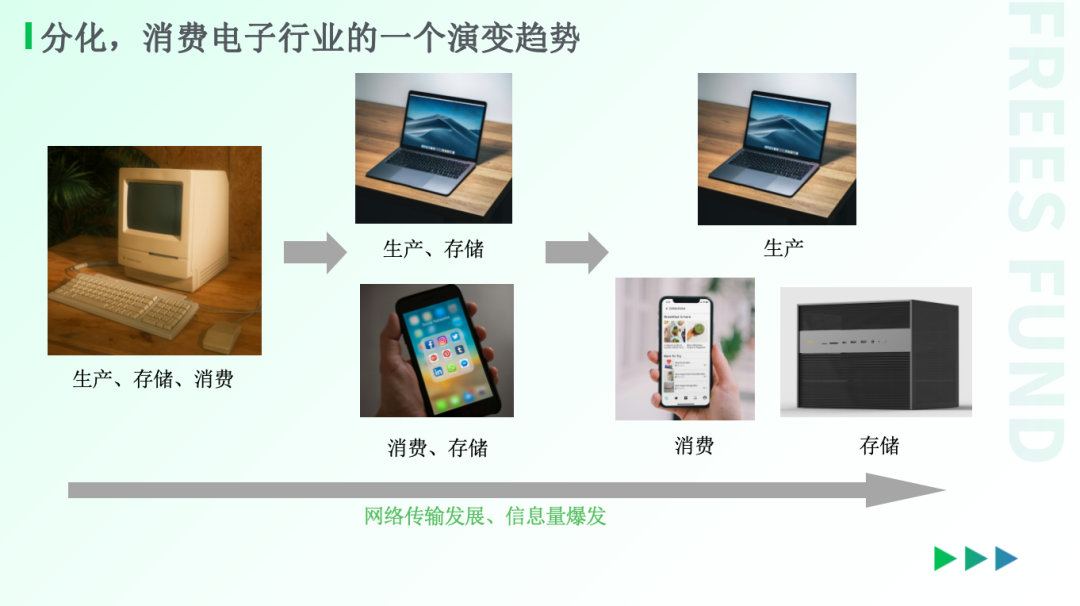
Zooming in on the "information-bearing tools" track: as network transmission technology has advanced and information volume has exploded, the production, storage, and consumption of information have also diverged.
Initially, for individuals, the personal computer was the primary vehicle for producing, storing, and consuming information. Then phones met the need for mobile information access, peeling consumption and production away from PCs. As smartphones proliferated and global data volume exploded, people wanted more storage space — so storage itself was split off, giving rise to dedicated storage devices: NAS (Network Attached Storage), or "private cloud." Many have surely been frustrated by insufficient phone storage; the price gap between a 1TB iPhone 15 Pro and its 128GB counterpart runs to 5,000 yuan. The reason is that cramming massive storage into a compact device carries very high costs — creating demand for "divergence," separating storage from the phone. This is the opportunity for public cloud services like iCloud and private cloud products like NAS.
/ 02 / What Does the NAS Industry Look Like Now?
Technically speaking, NAS is a storage-centric device that can connect to networks and has some computing power. If you owned a NAS product, what could it actually do? Some concrete examples:
- Home scenarios: family photo sharing, home security camera backup, smart home control, building a child's growth archive, buffer-free 4K movie streaming, and more
- Remote work and education: efficient file sharing and collaborative editing; remote access to all local files even when away from your desk or at home
- Creative professionals: whether you're a photographer or designer, use NAS for large-scale file management and backup, with collaborative editing and high-speed transfer for the same project
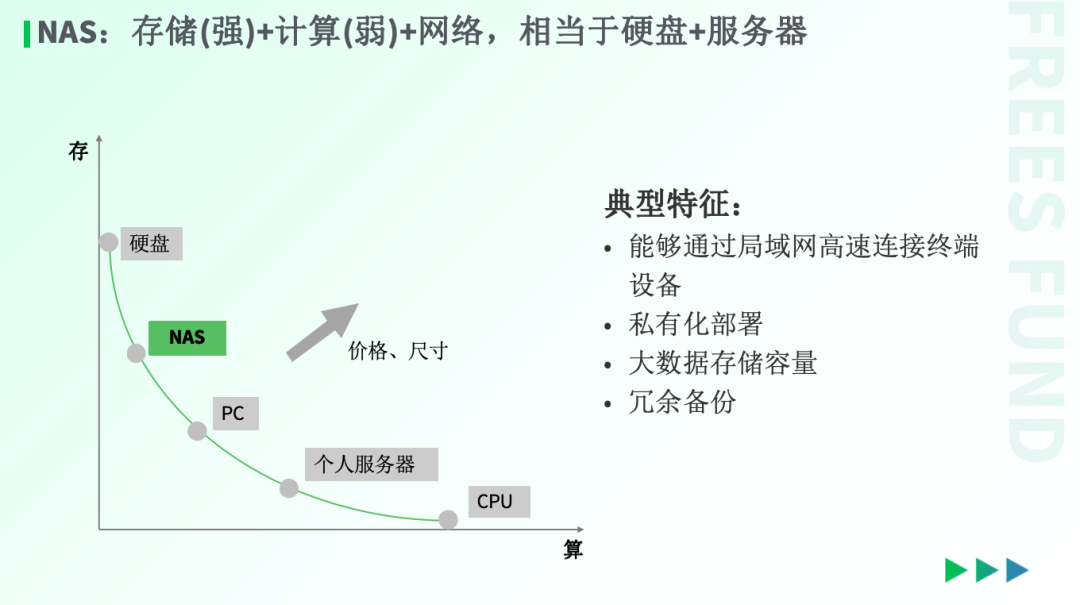
If we map all related devices across storage and computing dimensions, their distribution looks roughly like the chart below. Compared to hard drives, NAS has stronger computing and transmission capabilities. Compared to PCs (personal computers), beyond computing it has stronger storage and transmission capabilities.
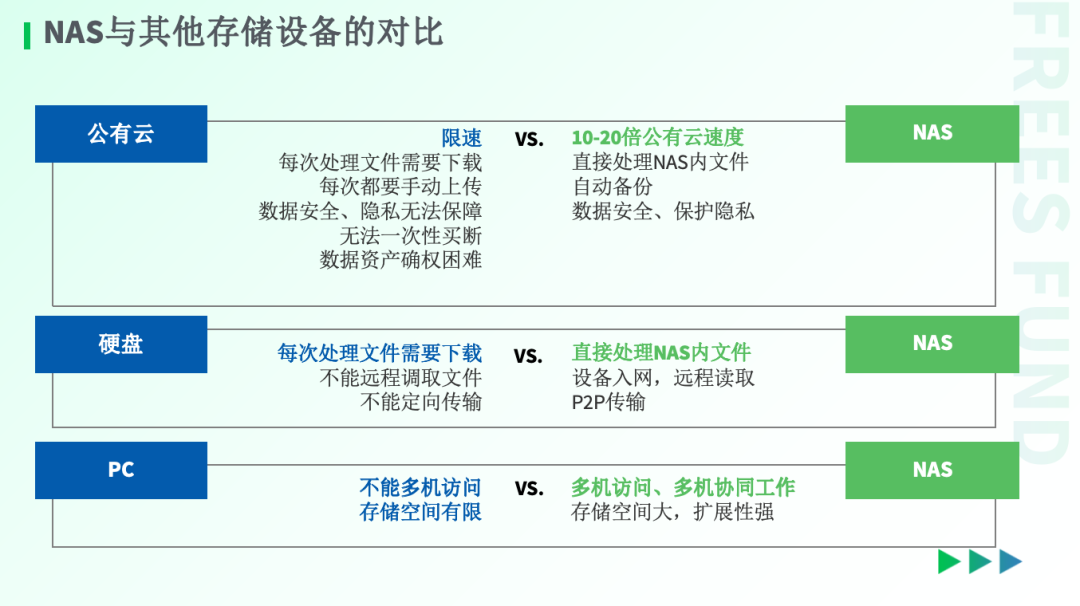
Current NAS alternatives include: hard drives, public cloud, and PCs. Overall, NAS advantages are: massive storage space, direct access, ultra-high transfer speeds, and multi-user collaboration. See the comparison chart below:
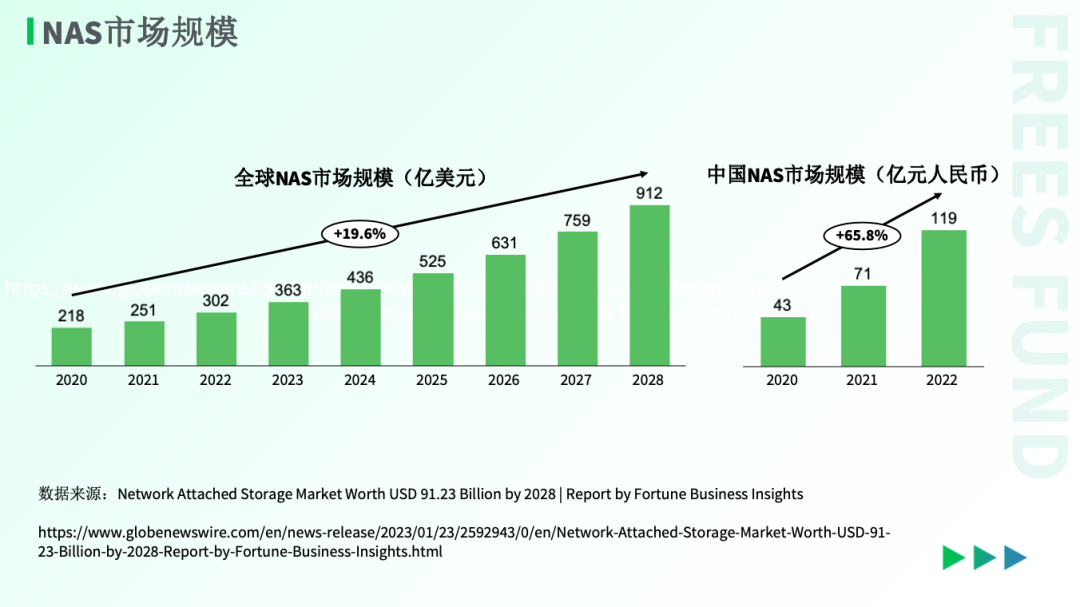
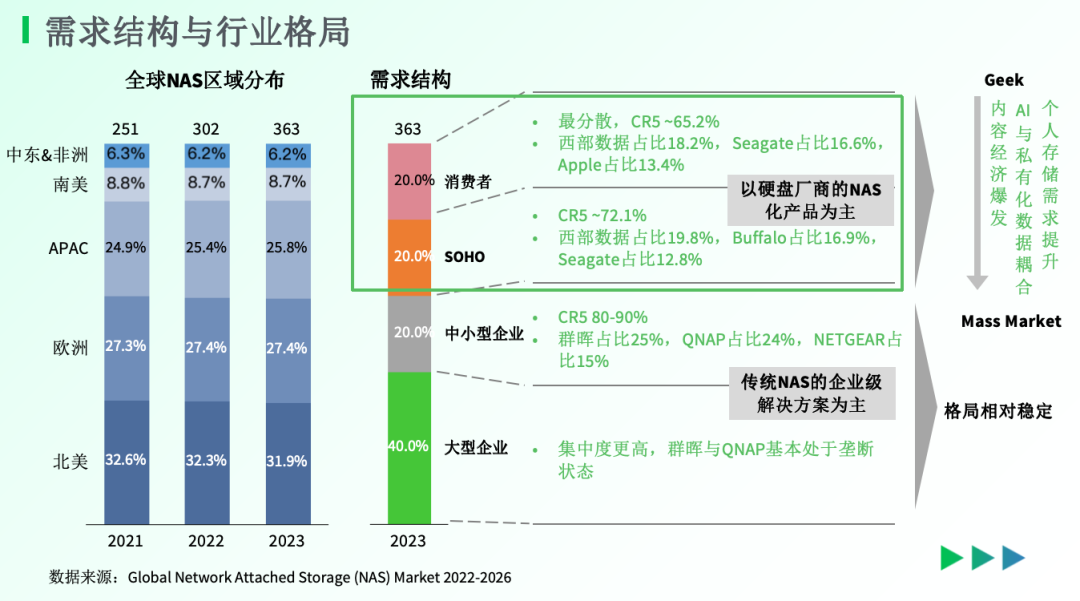
In recent years, the NAS category has been growing globally. According to Fortune Business Insights, the global NAS market was approximately $36.3 billion in 2023, with a CAGR of about 19.6% from 2021 to 2028.
Currently, enterprise users account for roughly 60% of total NAS market size. In this segment, manufacturers from Taiwan hold relatively stable market positions. Leading brands like Synology, QNAP, and NETGEAR command most of the market share. They offer rich enterprise solutions — typically involving exceptionally complex product parameters and configuration options. From another angle, this represents both challenge and opportunity.
The other 40% of the market comes mainly from consumer (C-end) users and small-to-medium studios. This segment is relatively fragmented: enterprise players like Synology hold some share, as do hard drive manufacturers like Western Digital. Typical user profiles here are geeks, home theater and high-fidelity audio enthusiasts, engineers, and content creators — people with frequent needs to access large files and high demands for transfer speed. Yet these needs aren't being met by current NAS products, creating opportunities for new market entrants.
/ 03 / Near-Term Driver: The Rise of Content Creators
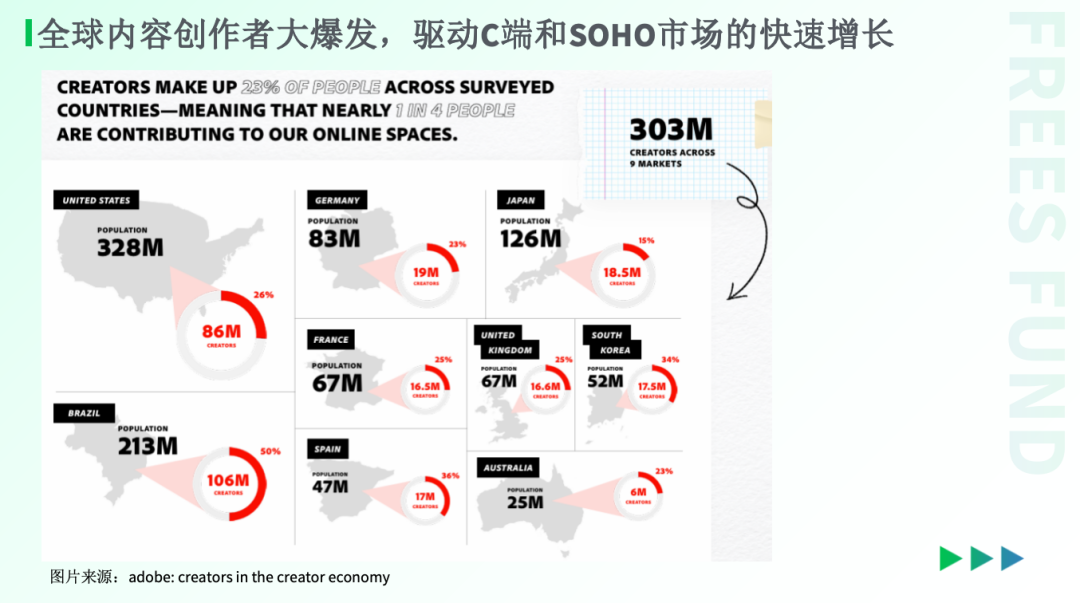
In recent years, with the rapid growth of Douyin, TikTok, Bilibili, and YouTube, content creators have surged globally. An Adobe creator economy report shows that since 2020, content creators across nine major countries including the UK, US, Germany, and Japan have grown by 165 million, reaching 330 million by 2022 (*this report did not include Chinese content creators in its statistics).
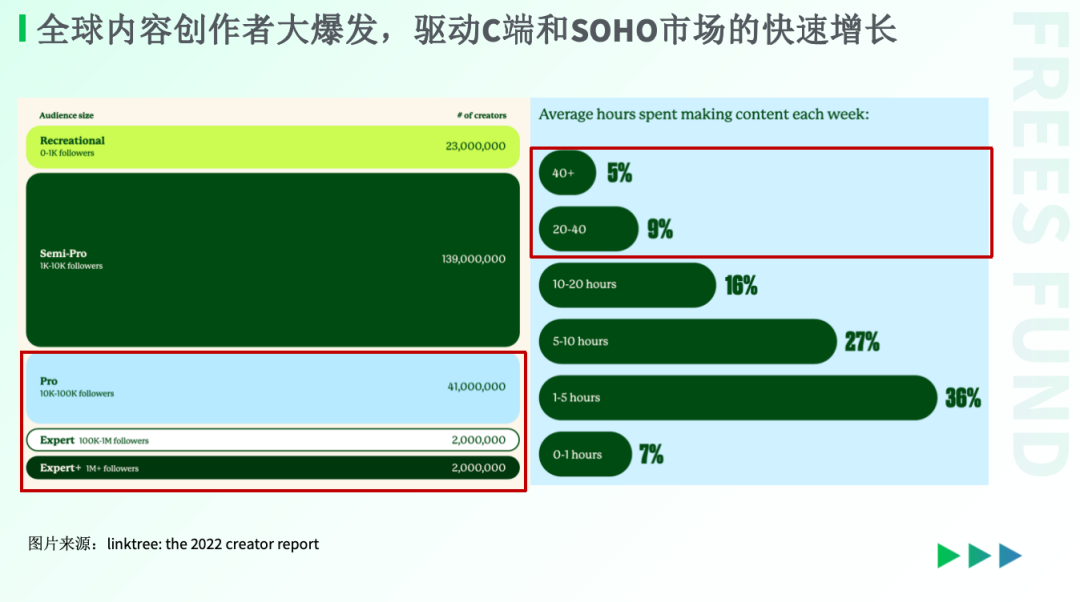
A KOL Radar report covers the state of Chinese content creators. In 2022, across six major content platforms (including Douyin, Kuaishou, and Bilibili), creators with over 10,000 followers exceeded 13 million; creators with over 100,000 followers grew 327% over three years. Among these, professional creators working over 20 hours weekly with more than 10,000 followers account for roughly 15% — about 50–60 million people. These users treat NAS as a productivity tool and have strong willingness to pay. Based on our user interviews, they're willing to spend over $2,000 on a single product.
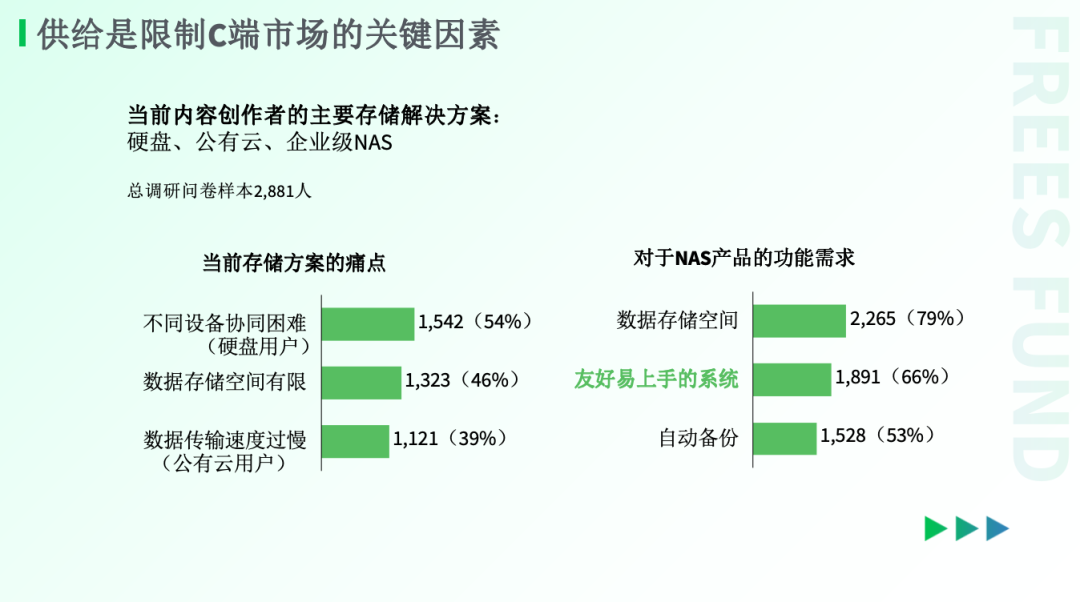
However, traditional NAS products cannot meet their needs. Supply is the key constraint on C-end market growth. Current storage solutions for content creators are mainly hard drives, public cloud, and traditional enterprise NAS products.
Hard drives and public cloud have obvious shortcomings. As we noted earlier, using hard drives requires transferring content to a PC for editing, with no multi-device collaboration; public cloud transfer speeds are too slow. Neither satisfies creators' common needs: fast transfer, massive storage, multi-device access for collaborative work, and direct editing of files within storage without exporting. Additionally, consumer users have privacy concerns.
See our interviews with selected users:
"Usually, the biggest challenge is figuring out how to set up the file system, storage, and file sharing. For me, the biggest issue is often the CPU — it needs to be powerful enough to support multiple video streams." — A YouTuber from the US
"Each partner has different roles, backgrounds, and skills. We need an efficient file management system to store all files scattered across 10 partners, and enable collaboration." — A 10-person studio in Sweden
"We all shoot 4K files; one video is 100GB. Hard drives are simply unusable — not enough storage, no collaboration, insufficient transfer speed. For example, if my editor wants to try an idea, I can't always go to their desk to discuss. Everyone needs to see in real time what others have done with the same material." — A Bilibili creator with 10,000 followers
"After having kids, photos suddenly exploded. Phone storage definitely isn't enough. Multi-device access is a pretty rigid need — relatives need to see them too. I care about privacy; I don't want my kids' photos on public cloud from the start. Also, streaming movies from public cloud is laggy, and upgrading the experience costs a lot, continuously. Better to just buy a NAS." — A consumer user
"We currently have over 1,000 hard drives, with cumulative storage around 2,000TB. Pain points: 1. Finding footage is extremely inefficient — one project spans 5–6 years, and we keep adding new content, so we built a warehouse-style coding system just to manage these 1,000 drives; 2. Afraid of employee turnover — new people don't know what footage is on which drive; 3. Public cloud transfer is too slow — we subscribed to several Baidu Netdisk SVIPs, still terribly slow, once spent over 20 hours just on data transfer during an outdoor shoot; 4. We shoot government projects — much of it cannot go on public cloud, it's highly confidential." — CEO of an advertising company
Enterprise NAS, meanwhile, limits users to a small group of geek creators with setup capabilities due to its cumbersome configuration process. In other words, it blocks the massive expansion of C-end users and small-to-medium studios. This pain point creates opportunity for consumer-grade NAS products.
Let's look at the full process of setting up a traditional NAS:
- NAS product and hard drive selection
- Operating system and software selection and deployment (*high technical barrier — requires some familiarity with Linux-type operating systems, typically engineer-level technical ability)
- Storage technology selection and configuration
- Local network IP address, DDNS, and other network configuration
- Network firewall and SELinux configuration
- Application installation
Many probably won't even finish reading these bullet points — which should help explain why this tedious deployment process deters the vast majority of consumer users. Most content creators lack such technical capabilities; even geek consumers with technical skills need 1–2 days to complete setup.
We partnered with a relevant company to survey 2,881 users globally and found the following: a friendly, easy-to-use operating system is a universal need.
/ 04 / Medium-to-Long-Term Driver: On-Device AI Deployment
At the end of April this year, Meta released the open-source model Llama 3. Even at 8B parameters, it demonstrated remarkably strong capabilities. We previously noted in our article "Toward 2024: How We Think About AI Startup Investing" that improvements in open-source model capabilities will greatly accelerate localized AI deployment.
Localized AI deployment is the counterpart to accessing AI from the cloud. Specifically, when we access large-parameter models like ChatGPT, they typically run in the cloud and can handle very complex tasks. Conversely, smaller-parameter models can be deployed locally, handling relatively simpler, more personalized, and more private tasks on the terminal closest to the user. This is one direction in AI's future development.
For localized AI deployment, the most important thing is fitting AI with privatized data to unlock more personalized value — this is also what personal agents and home agents aim to achieve.
So NAS, as a private data hub for consumers that also possesses computing and network capabilities, is one of the best platforms for hosting localized AI agents. Imagine: with NAS support, your future agent could:
- Automatically classify, deduplicate, and search your photos — no more frustration over lost pictures
- Analyze, summarize, and archive all your files — meeting minutes and data tables, neatly organized
- AI-edit all your image, text, and video assets — you just need to train a stylized LoRA and fixed editing workflow
- Regularly track everything about celebrities, bloggers, restaurants, products, industries and companies, even stocks that you follow — no more agonizing over coupon calculations during 618 shopping festivals
All of this still seems distant, but its ultimate realization depends on your localized agent's access to and analysis of your personal data. "Knowing you better" is the differentiated value of local large language models.
/ 05 / Medium-to-Long-Term Driver: From Smart Home to Home Robots
We're already seeing smart home ecosystems gradually opening up, with more brands willing to open underlying protocols and connect through API interfaces to unified upper-layer operating systems.
As a product with "router" functionality, NAS can support whole-home smart terminal control, data storage and analysis (such as smart cameras — selling storage and computer vision capabilities hosted on NAS), and remote interconnection with phones.
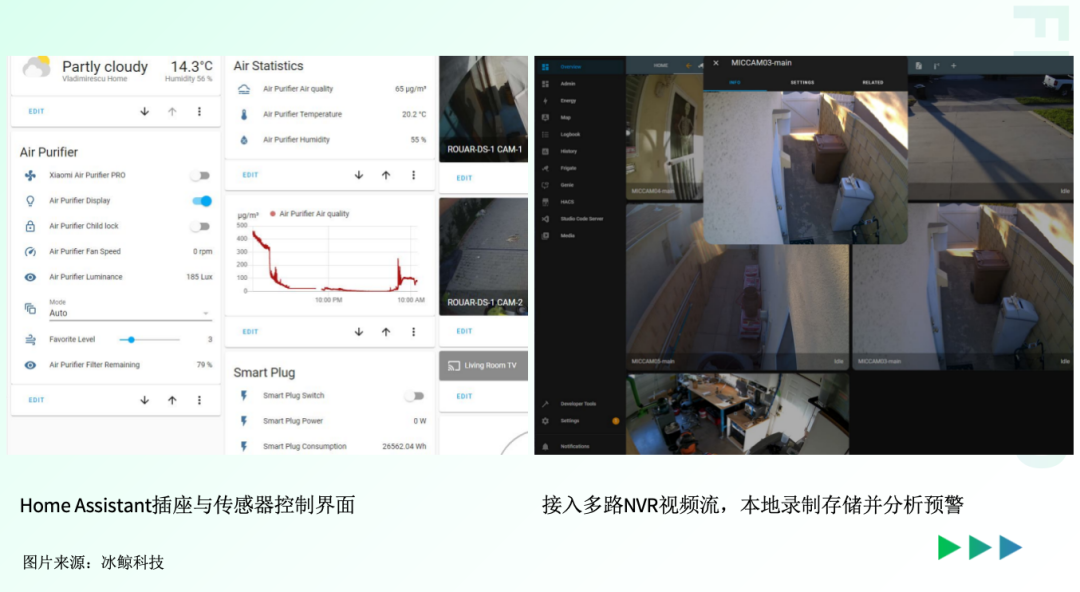
Currently, some homes already have more than one robot vacuum; some North American households have two floor-separate robot vacuums, one lawn-mowing robot, plus one pool robot.
On a ten-year or longer time horizon, assuming most homes deploy two or more robots, computing costs will rise dramatically — especially once robots gain generalization capabilities, when computing demands will increase exponentially. At that point, building separate computing into each robot would create massive waste.
One possible future direction: unified computing dispatch, combined with robot terminal perception and action, to achieve collaborative management of home scene tasks.
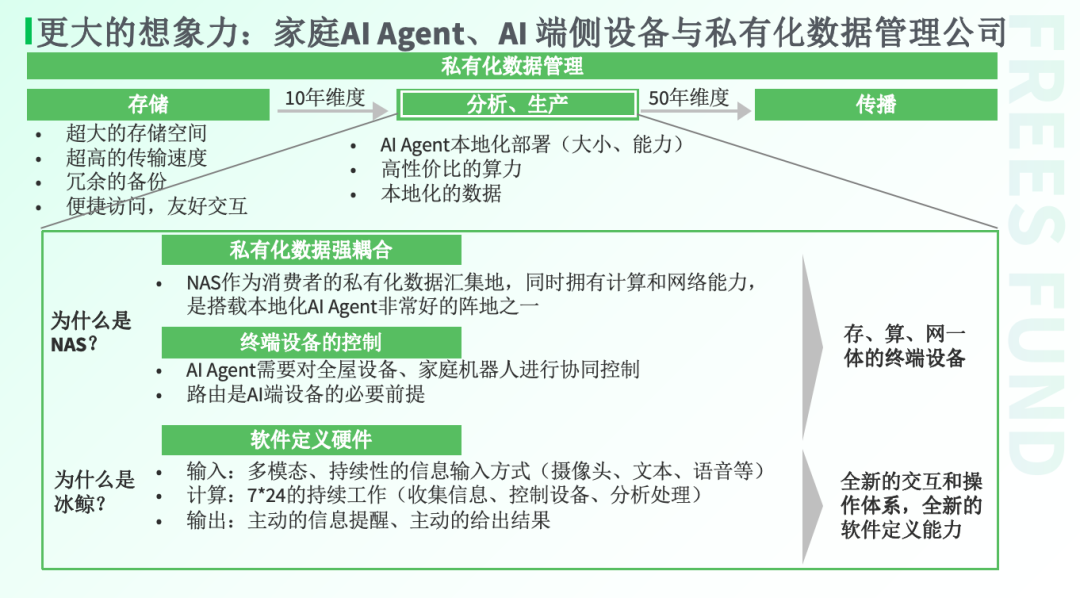
Specifically, home agents may have these key requirements for terminal devices:
- Training on privatized data, and managing, analyzing, and processing new privatized data — meaning powerful storage products are prerequisite
- Having certain computing power, but unlike current PCs, home agents need 24/7 operation and multimodal data input — so power consumption, networking, other sensor access, and control must be addressed
- Collaborative control of whole-home smart devices and home robots, even computing scheduling — so whole-home router capability is also needed
As a storage-computing-network integrated device, NAS is very well-suited for home agent deployment.
/ 06 / Under New Trends, What Kind of NAS Do We Need?
So what kind of NAS can meet current consumer needs, expand from geek audiences to general consumer users, and also adapt to future localized AI deployment?
Currently, I believe these capabilities are particularly important:
- Extremely user-friendly operating system: Compared to traditional NAS's complex configuration, one-click out-of-box use and graphical UI may be baseline standards. Throughout history, all OS competition has been about attention to detail — whether you can deeply perceive subtle differences in needs across customer segments and scenarios, and respond with rapid product iteration, is paramount.
- Rich application ecosystem: Beyond basic functions, handing diverse personalized user needs to developers — and through effective incentives, ensuring developers aren't just "working for love."
- Hardware configuration ahead of traditional manufacturers: For integrated products, hardware is difficult to establish as a lasting core moat, but leveraging mainland China's powerful supply chain capabilities can still create comparative advantage.
- Good design aesthetics: Since NAS can be part of home decor, considering its integration with overall home design is important — not obtrusive, and able to reflect the owner's taste, is a plus.
- Community operations capability: All the above capabilities stem from close observation of and continuous communication with users. Community operations is a critical capability, divisible into developer community and user community operations. The former ensures product frontier-ness and application ecosystem richness; the latter helps with product detail control and crafting极致 user experiences.
Looking further out, AI capability will become central to NAS development, specifically including:
- Localized AI agent application development capability: Product iteration can't be too far ahead — the saying goes "only cross one step, not two." The key is accurately capturing the inflection point between consumer demand for AI and what AI can actually deliver, thereby providing better experiences.
- AI hardware adaptation capability: This includes chip integration, adaptation verification with chip vendors, and resolving overall hardware issues including heat management after integration.
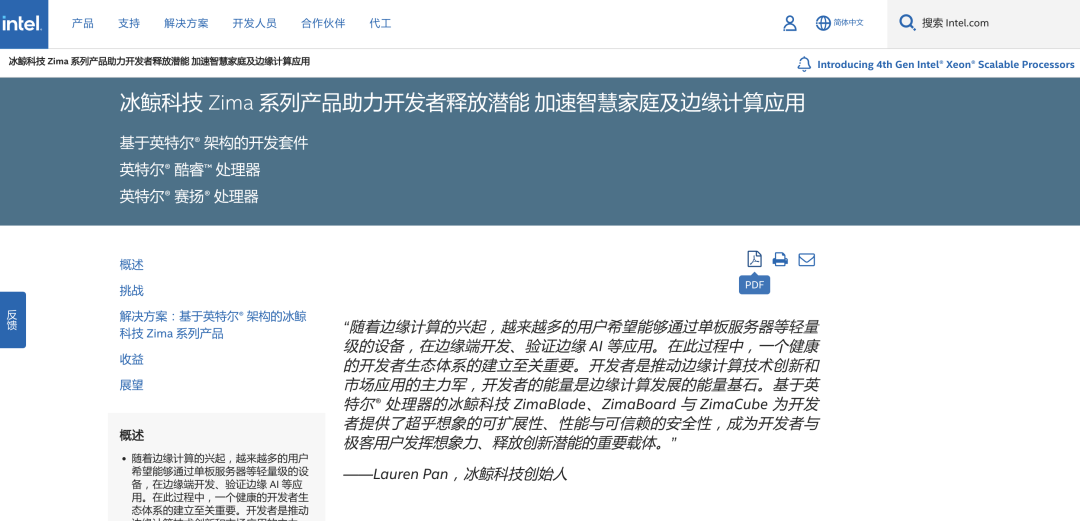
In this direction, FreeS Fund has invested in consumer-grade private cloud manufacturer Ice Whale Technology (冰鲸科技). Founded in August 2020, Ice Whale Technology is gradually expanding from its initial focus on audio-video content creators and geek users toward home users.
Ice Whale Technology's founder and team have rich experience in developer and creator community operations, having built a Discord community of over 20,000 active users. Community users' rapid feedback on hardware and software provides important conditions for product development and iteration. Building on this, Ice Whale Technology released the open-source private cloud system CasaOS on GitHub in early 2022. Currently, CasaOS has over 20,000 stars on GitHub and more than 500,000 downloads.
On the AI front, Ice Whale Technology's NAS products have built-in GPUs and Llama large models, combining RAG and Stable Diffusion technologies to provide creators with convenient script file management, advanced retrieval, file summarization, image library processing, and image generation. Additionally, Ice Whale Technology has established developer ecosystem and edge computing collaborations with multiple leading AI chip vendors including Intel.

▲ Congratulations on XtalPi's Successful IPO: FreeS Fund's Research-Driven Approach, Learning to Invest Through Investing
▲ Tian Xuan × Li Feng: How Patient Capital Is Cultivated | Li Feng Column
▲ Liu Run × Li Feng: In the Future, What Kinds of Companies Will Thrive? | Li Feng Column
▲ The Road to Embodied Intelligence | FreeS Report 37
▲ The Truth About Weight Loss, and Innovation Opportunities | FreeS Report 36
▲ Toward 2024: How We Think About AI Startup Investing
10,000-Word Deep Dive: Deconstructing Changes and Opportunities in NEV Sales and After-Sales Service Markets | FreeS Report 35 "Standing High, Seeing Far": The Origins and Future of the Satellite Communications Space Race | FreeS Report 34 How Far Are We From "Ready Player One"? Technical Challenges for XR From Apple Vision Pro | FreeS Report 33
Star the FreeS Fund WeChat Official Account — timely business insights delivered