Why Is the Pay Gap Between '80s and '90s AI Talent Only 15%? | *2017 Early-Stage Enterprise Compensation Survey Report*

The salary secrets of 19,014 positions across 152 companies.
On November 29, the 2017 Early-Stage Enterprise Compensation Survey Report (hereinafter referred to as the "Report") was released in Beijing. The report was jointly published by ten VC firms — China Growth Capital, Legend Capital, Legend Star, FreeS Fund, Matrix Partners China, ZhenFund, Yunqi Capital, Northern Light Venture Capital, Shunwei Capital, and Sinovation Ventures — together with Mercer and Penguin Intelligence. It comprehensively covers cash compensation, employee benefits, and long-term incentives at early-stage internet companies, and unveils five major findings on 2017 China internet early-stage compensation.
After several years of market turbulence, entrepreneurs have become more rational and mature in their approach to starting businesses, with directions growing increasingly diversified. Enterprise services, AI, and big data have emerged as new hotspots. Data shows that as of September 2017, the number of new startups in 2017 had dropped significantly compared to 2015 and 2016. Yet many outstanding early-stage companies continued to grow rapidly in their respective fields, with strong capital backing.
China's millions of early-stage enterprises have become an indispensable force in the broader internet industry, with sector leaders poised to emerge from their ranks.
The 2017 Early-Stage Enterprise Compensation Survey Report aims to help early-stage companies tackle strategic talent challenges — how to recruit, deploy, and retain employees more effectively — while leveraging big data and scientific methodology to provide authoritative, practical guidance for their development.
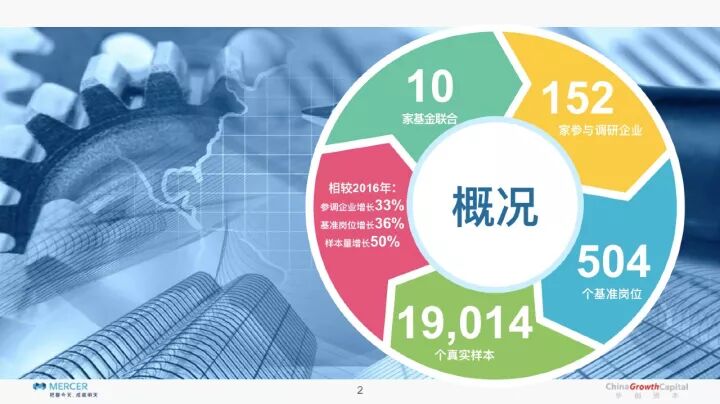
Launched in June 2017, the survey spanned nearly six months. Nearly a thousand portfolio companies from the ten participating VCs, including FreeS Fund, actively contributed. After rigorous verification by the publishers, 152 pre-Series C early-stage companies meeting quality standards were finalized, covering 504 benchmark positions and 19,014 real samples across enterprise services, consumer upgrading, AI/big data, fintech, entertainment, and healthcare. Compared to 2016, participating companies increased 33%, benchmark positions 36%, and sample size 50%.
Key findings include:
- Influenced by broader internet industry trends, compensation growth at early-stage companies is expected to narrow further; over the past year, sales and support functions saw the largest pay increases.
- In AI, scarce talent supply has compressed the pay gap between post-80s and post-90s generations to just 15%; talent in this field is highly educated, with master's and PhD holders exceeding half.
- Early-stage companies heavily skew incentives toward core talent: while M5, M4, and I4-level employees comprise only 31% of headcount, they hold 79% of granted equity.
…
Details below.
Internet Industry Pay Growth Continues to Slow
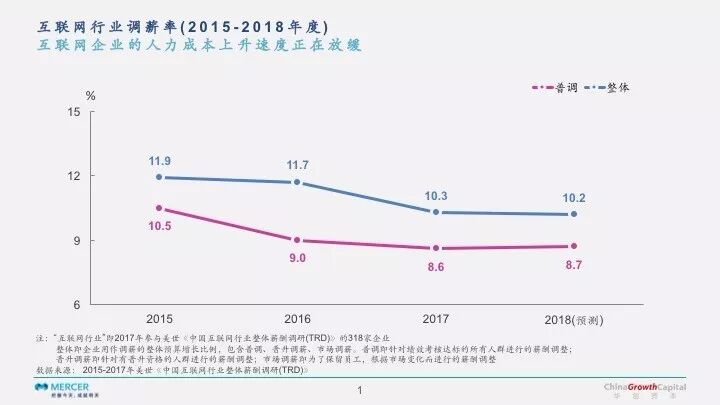
Report data shows that since 2015, the pace of rising labor costs at internet companies has slowed year by year. In 2017, the overall salary adjustment budget growth was 10.3%, with the general pay adjustment rate (for all employees meeting performance standards) at 8.6% — down 1.6% and 1.4% respectively from 2015, and 1.9% and 0.4% from 2016. This downward trend is expected to continue at least through 2018. Influenced by the broader internet industry, compensation growth at early-stage companies is expected to narrow further.
In AI, the Smallest Pay Gap Between Post-80s and Post-90s
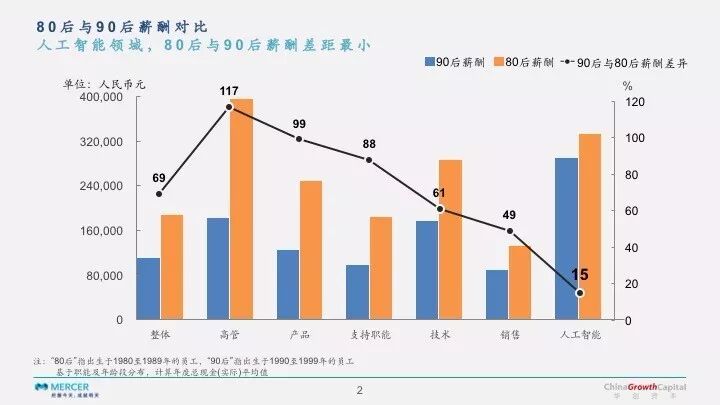
Post-80s (born 1980–1989) and post-90s (born 1990–1999) employees have become the dominant demographic at China's internet early-stage companies. Among nearly 20,000 real samples in this report, the "post-80s + post-90s" cohort accounted for over 90%. When samples were segmented by function, post-80s and post-90s employees showed an overall pay differential of 69%; management experience drove the largest gap at the executive level, reaching 117%. But in AI, scarce talent supply has compressed this gap to just 15%.
AI Becomes a Magnet for Top Students, Master's and PhD Holders Exceed Half
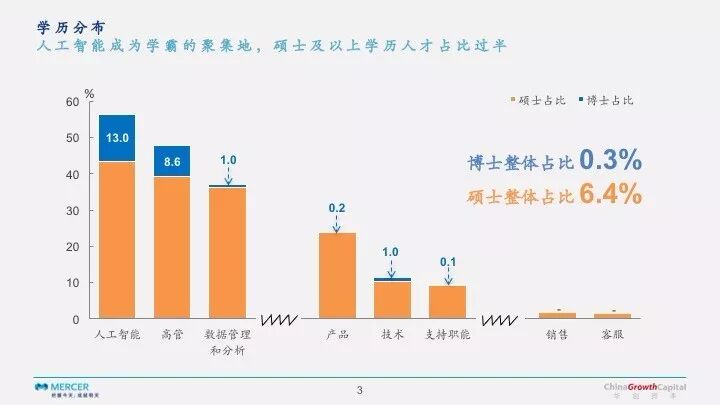
AI has undoubtedly been the hottest sector this year. Explosive demand growth has made foundational research talent the most sought-after, with deep learning, machine learning, algorithms, neural networks, GPUs, cloud computing, and AI chips all facing severe shortages. This report shows that talent in AI-related fields at early-stage companies is highly educated, with master's and PhD holders exceeding half — surpassing even the executive cohort that has traditionally topped this metric.
Sales and Support Functions Saw Largest Pay Increases Over Past Year
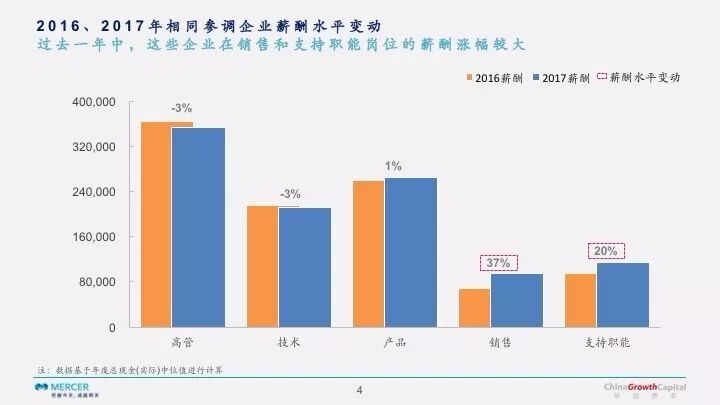
Which functions have seen the biggest pay gains as early-stage companies rapidly expand? Comparing the same cohort of companies that participated in both 2016 and 2017 surveys, sales and support functions posted the largest increases, at 37% and 20% respectively. This underscores how functions directly driving revenue and those improving operational standards have become the two critical groups early-stage companies rely on at this phase.
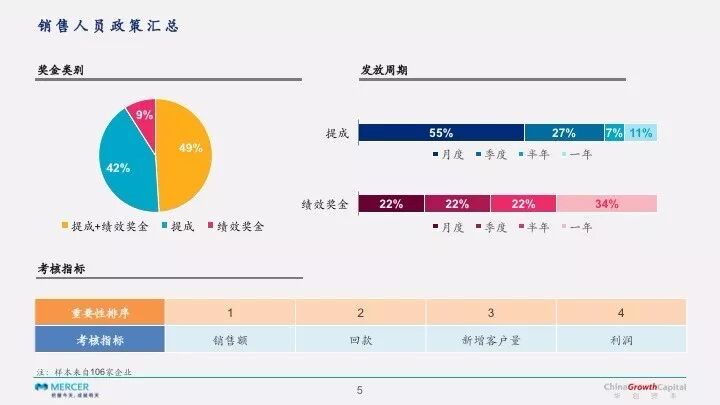
Among sales compensation structures in this report, 49% of early-stage companies provide both performance commissions and merit pay. Meanwhile, 55% assess sales performance monthly and distribute commissions on the same cycle, ensuring timely incentives.
30% of Core Talent Holds Nearly 80% of Equity
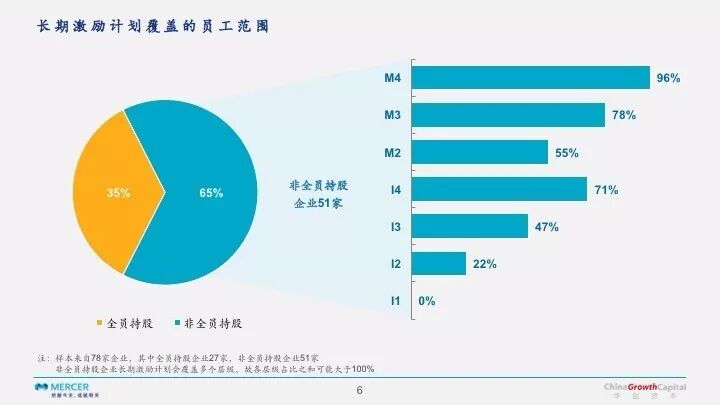
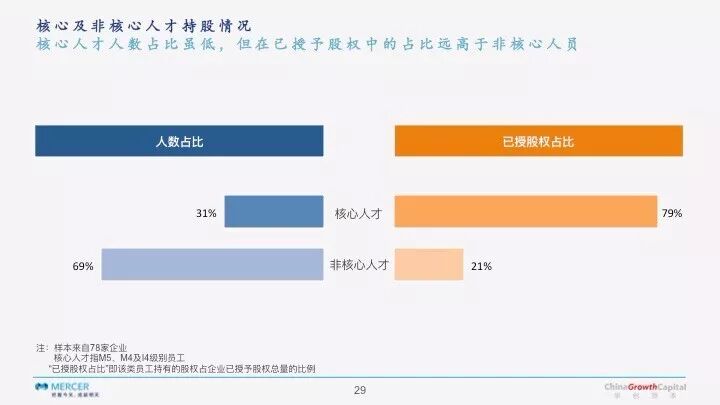
Overall, early-stage companies still lag mature internet firms in cash compensation, making stock options the primary long-term incentive tool. Among companies participating in the long-term incentive survey, 35% adopted company-wide equity programs while 65% used selective programs. More striking is the pronounced tilt toward core talent: while M5, M4, and I4-level employees comprise only 31% of headcount, they hold 79% of granted equity — far exceeding non-core employees' share.
(The above findings are excerpted from the 2017 Early-Stage Enterprise Compensation Survey Report; click "Read More" at the end of this article for the full report.)