From Foundation Models to AI Companions: What Cyclical Patterns Lie Behind the Rotation of AI Hype Cycles?

First figure out how to "make something people love," then consider "what role AI plays."

Just how hot is AI hardware? According to data from 36Kr, in the first half of 2025 alone, China saw 114 investment and financing deals in embodied intelligence and AI hardware, with total funding exceeding 14.5 billion yuan — far surpassing the 92 deals and 9.8 billion yuan for all of 2024. In May 2025 alone, capital flowing into AI hardware accounted for over half of all investment and financing activity.
Ropet is one of the players riding this wave of "hardcore entrepreneurship." On October 17, Ropet officially launched pre-sales on JD.com in China. The product had previously debuted at CES 2025, garnering coverage from Forbes, BBC, CNBC, and other media outlets, generating over 6 billion impressions globally and helping to popularize the AI companionship track to some extent.
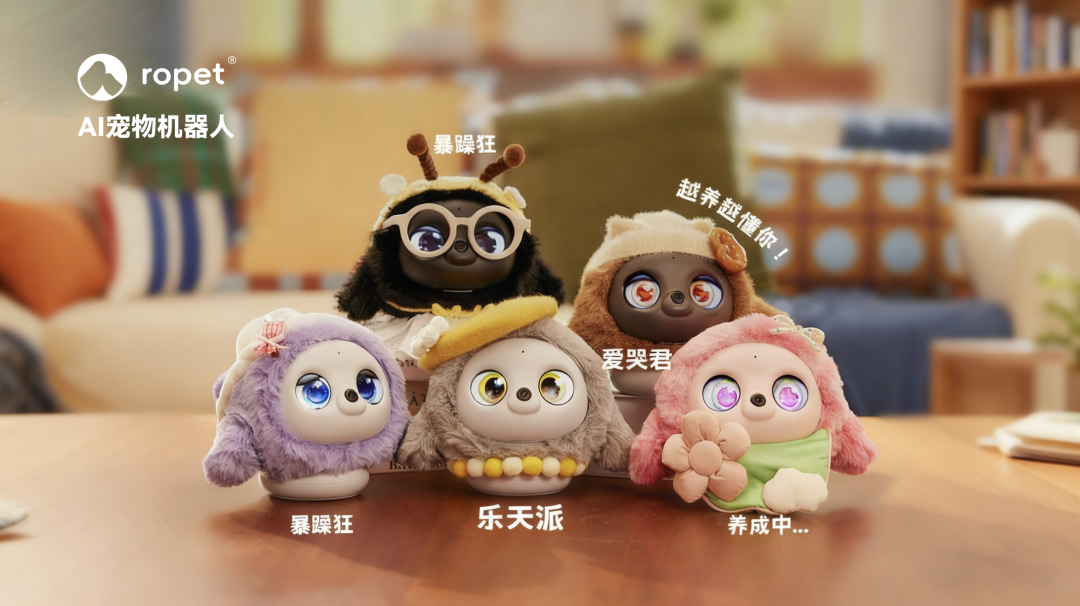
Image source: Ropet
Jiabin He, co-founder and CEO of Ropet (Mengyou Intelligence), positions Ropet as a "weak robot." "Most robots are designed to serve people, but Ropet simulates a living being that needs to be taken care of — and through that care, users find comfort."
He is not your typical AI entrepreneur. He graduated from Beijing Institute of Fashion Technology with a degree in product design, and his career spans Microsoft Research Asia, Baidu, Ling Technology, and ByteDance. He led the development of the LUKA picture-book robot and the PICO 4 VR headset. His background has led him to focus on one question: Why are people willing to form emotional connections with machines?
Recently, at the AI Creators Carnival (ACC) — co-hosted by Silicon Star, Beijing Zhongguancun Science City, and Beijing Zhongguancun Innovation Street — Li Feng, founding partner of FreeS Fund, sat down with He for an in-depth conversation. They mapped out where the current AI wave stands, analyzed how intelligent companionship products are defined, and looked back at Ropet's tumultuous entrepreneurial journey.
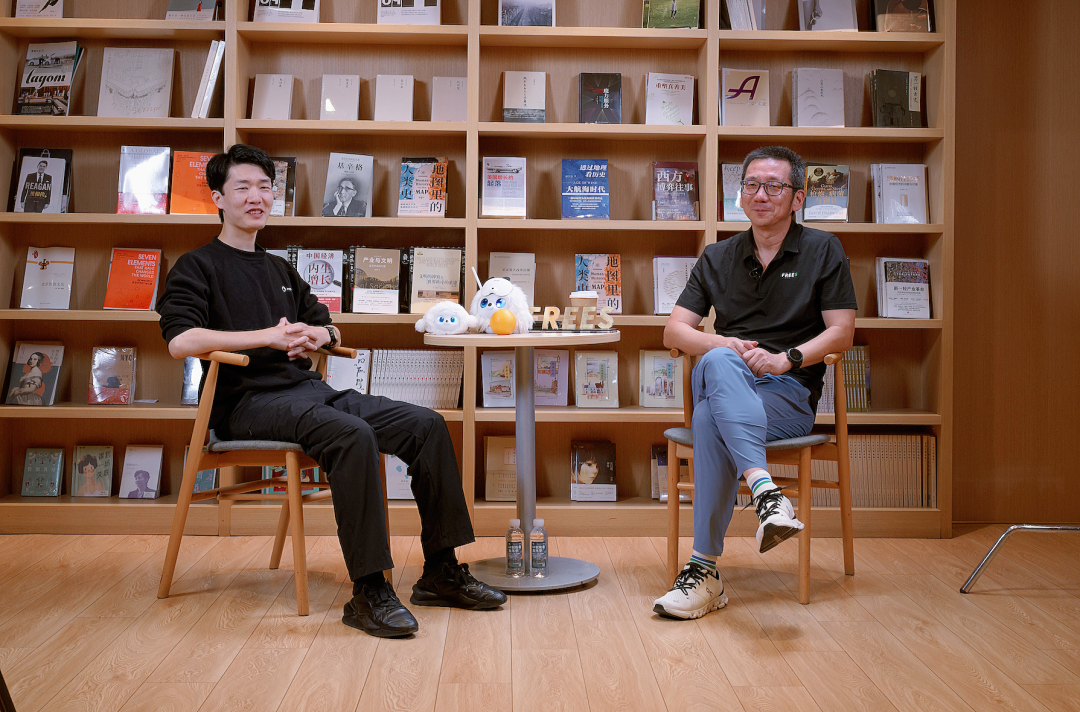
We've edited excerpts from their conversation, hoping to offer fresh perspectives. You can also find this episode on Xiaoyuzhou App and Apple Podcast by searching for "High Energy." This is part of our "AI Industry Observations" series, which will continue to share firsthand practices and insights from AI entrepreneurs.

Here are some key takeaways:
- The future of AI lies in "embodied intelligence." Embodied intelligence doesn't necessarily mean bipedal or humanoid forms; it can be various hardware carriers with the ability to interact with the world and collect data. Such terminals will create new consumer product opportunities.
- "Useful" products have the advantage of low market education costs, but the downside is quick descent into price-performance competition. "Fun" products are harder to educate the market on initially, but once successful, they command premium pricing and build unique competitive moats.
- Revolutionary hardware technologies typically go through three stages: first, underlying technology breakthroughs; second, imagining the technology's possibilities; third, realizing commercial value. In the first wave, the technology is still in the "core." In the second wave, it has some application space. In the third wave, it connects with the wider world and achieves real-world deployment.
Interactive Giveaway Do you think AI pet robots can form emotional connections with humans? Share your thoughts in the comments. By 5:00 PM on October 28, 2025, the two most thoughtful commenters will receive a copy of Warm Technology: Confessions of a Robot Engineer.

/ 01 /
Ropet: 100% "Fun," 0% "Useful"
Li Feng: As AI hardware gets hotter and hotter, the AI companionship toy track has attracted particular attention. We're curious: what form does AI hardware need to take to achieve emotional companionship? Let's start with you introducing the Ropet product.
Jiabin He: Ropet is a brand-new pet-form product designed specifically for women, providing emotional value through AI to help users alleviate loneliness.
Our first step was to create an AI pet with good looks that appeals to female users, something they'd want to take home and place somewhere they frequently appear — like a desk. From college graduation to retirement, people spend enormous amounts of time at their desks. And desktops have stable power sources and fixed positions. If there's a little creature there like a "desk buddy" that provides emotional value and is always present, its companionship duration and uptime will be very high.
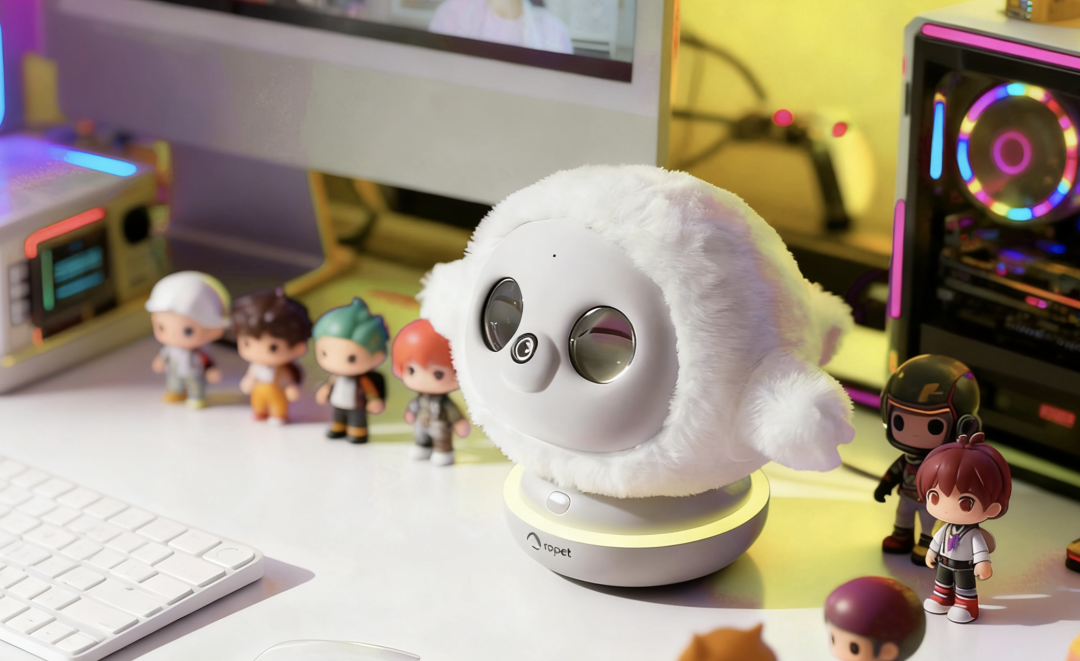
Image source: Ropet
With attentive care from users, Ropet gradually accumulates data about its owner's emotional changes, becoming "more understanding the longer you raise it." It learns the user's pet phrases and may even slowly start calling the user "mom."
We hope to awaken in female users that sliver of feeling about "love" in a lonely world. In contemporary high-pressure urban life, this emotional experience is especially scarce. Our original entrepreneurial intention was to bring more women a technologically innovative new product experience through AI and robotics. That was our initial product logic.
It's worth noting that Ropet also sits at the intersection of AI and designer toys, while incorporating pet elements. We call ourselves a "future pet company," hoping to make Ropet an entirely new "silicon-based pet" breed. In the future, it may exist in different forms — on desktops, hanging from bags, placed in cars, or moving freely around the home.
Li Feng: From a functional perspective, smart hardware on the market can be roughly divided into two categories: "useful" and "fun," with some products combining both. Looking at your choices, how would you score your product between "fun" and "useful"?
Jiabin He: We chose 100% "fun," 0% "useful."
My understanding of "useful" is that the robot helps you solve specific problems and improve efficiency — like cleaning, reminders, or tutoring — this is tool attributes. "Fun," on the other hand, is purely about providing emotional value.
My previous product, the children's picture-book robot "Luka," was an attempt somewhere in between, roughly 50-50. For parents, it was "useful," addressing the rigid need of cultivating children's reading habits. But for children, it was "fun" — through IP characters and interactive mini-games, it made the inherently anti-human activity of "reading" engaging and sticky.
But when a product has to please two different groups (like parents and children) with inconsistent needs, the product definition becomes blurry.
As Ning Wang, founder and CEO of Pop Mart, said: "If MOLLY's head pulled out to be a USB drive, would you still buy so many?" A USB drive is "useful" tool; MOLLY is an emotional carrier of "good-looking" and "fun." Once you have utilitarian expectations for a product, it will inevitably compromise on the "fun" dimension.
So this time I chose to focus on a "female-oriented" product rather than children's education. Because emotional companionship for women is a direction that can be done deeply and purely enough.
Of course, making a "purely fun, purely useless" product is difficult — how do you prove its value to users? Fortunately, we caught a particularly good timing: today, almost all products with emotional value have stronger markets and more pricing power. This is our opportunity, and also what we're good at. Therefore, we firmly defined the product as "100% fun." (See From the Century-Long Evolution of Japanese and American IP Industries: Trends in China's IP Economy | FreeS Report)
I want the product to have the core of something like a "raising game," using AI to make the "pet" more lifelike and interactions more natural.
Li Feng: From an investor's perspective, "useful" products have the benefit of low market education costs, but the downside is quick descent into price-performance competition. Take household appliances — robot vacuums, washing machines — they're all "useful," but nobody "plays" with them. Ultimately, the competition comes down to price and specs.
"Fun" products are harder to educate the market on initially, but once successful, they command premium pricing and build unique competitive moats. You don't compare "which chip my toy uses," but rather whether it's unique enough and whether it moves you.
/ 02 /
From Fashion School Graduate to AI Companion Robot Entrepreneur: How to Build Cross-Disciplinary Advantage?
Li Feng: In 2025, we invested in Ropet. Previously in the "AI companionship toy" space, we'd looked at many projects, but most AI toys seemed more like attempts to ride the AI wave rather than products truly born from consumer needs. At one point I even decided to stop paying attention to this category.
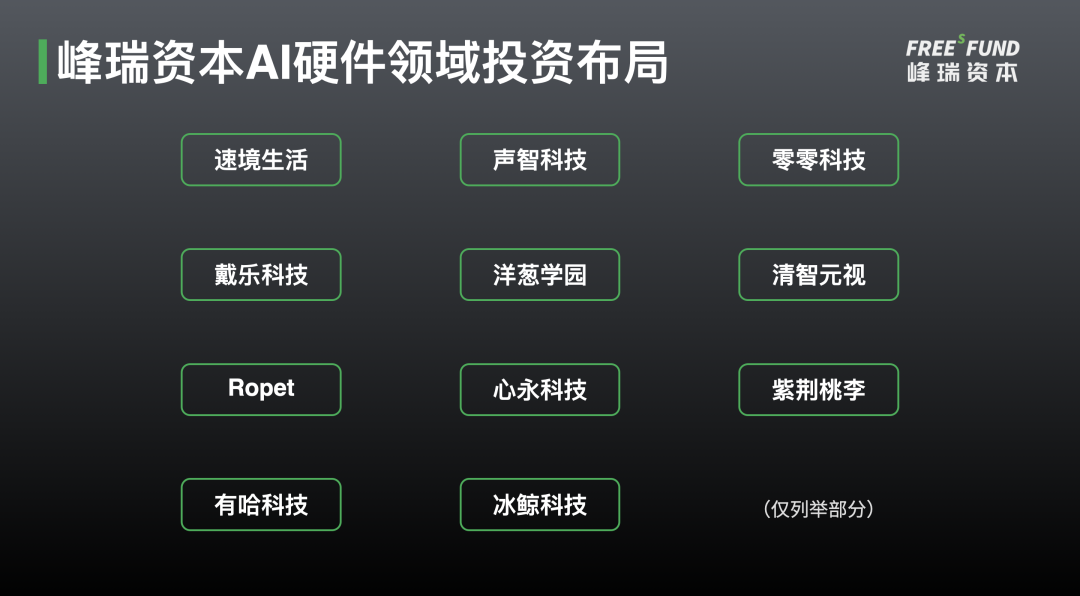
But later, more than one colleague strongly recommended I meet Jiabin He. After meeting him, what impressed me most was this: he first thought about "how to make something people love," and only then considered "what role AI plays in it."
At the time, my biggest question wasn't "can this project succeed?" but rather: "How can a guy think so delicately?"
Jiabin He: Many people are curious why I seem to understand women relatively well?
The original starting point was that I studied product design for four years at Beijing Institute of Fashion Technology. Many programs there — fashion, jewelry, accessories — focus heavily on consumer insights related to women. In that environment, I kept thinking: as a student with an industrial design background, how could I develop a unique cross-disciplinary advantage? The answer I arrived at was: embrace technology. Technology is the primary productive force, and great product transformations often stem from breakthroughs in underlying technology.
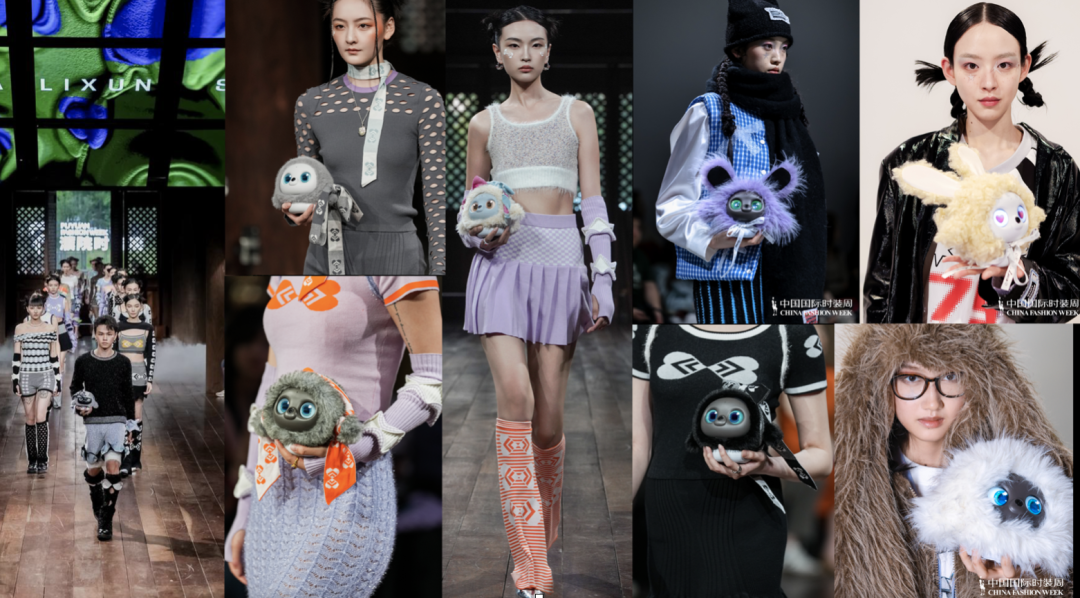
Ropet at China International Fashion Week. Image source: Ropet
In 2014, I graduated right as the "mass entrepreneurship, mass innovation" wave was taking off. We were in the "weak AI" era then, with everyone exploring possibilities across various scenarios. I joined Microsoft Research Asia, working on interdisciplinary research in human-computer interaction, collaborating with scientists to explore how to make technology more "likable," more easily accepted by users — essentially wrapping technology in a layer of "beauty."
For example, we were already developing first-person-view AI assistants, or AI glasses. One key problem we tried to solve: how do you get women to want to wear a device with a camera on their head? Because once you put on AI glasses, at that time you risked becoming a "weirdo," drawing strange looks on the street.
Li Feng: AI glasses are quite popular in the US — Meta's collaboration with Ray-Ban on sunglasses-style AI glasses, for instance. But AI glasses may face some challenges in China.
First, over 80% of American office workers drive to work, with one-way commutes averaging 40-50 minutes. They're already accustomed to wearing sunglasses to and from work, putting them on for two hours and taking them off — completely natural. AI glasses fit neatly in as an add-on feature to sunglasses, embedded in daily routines.
But in China, the situation differs. First, myopia rates are high, and many people wear framed glasses. Second, some female users especially dislike framed glasses, preferring contact lenses or cosmetic lenses. From internal observations at Tongxue (parent company of Kkll), in 2020, fewer than one in ten non-myopic users wore their products — these users chose cosmetic lenses purely for aesthetics. By 2024, that ratio had risen to nearly one-third. Especially during the pandemic, with masks covering faces, eyes became one of the few remaining windows for expressing "beauty."
Against this backdrop, asking women to put on a bulky pair of AI glasses — which not only cover their carefully made-up eyes but also bring discomfort and frequent charging issues — naturally lowers acceptance.
Jiabin He: Indeed, consumer choices are deeply shaped by local lifestyle habits. We're building a global product, and usage patterns vary tremendously across regions.
Initially, we defined our target user as urban single women aged 24-30. This demographic is heavy on platforms like Xiaohongshu and Instagram, eager to share new lifestyles. But after delivering nearly ten thousand units, we discovered more user profiles: in Japan, over 50% of users are women aged 50-70; in North America, many products are bought as gifts for children. Of course, half of users remain young women.
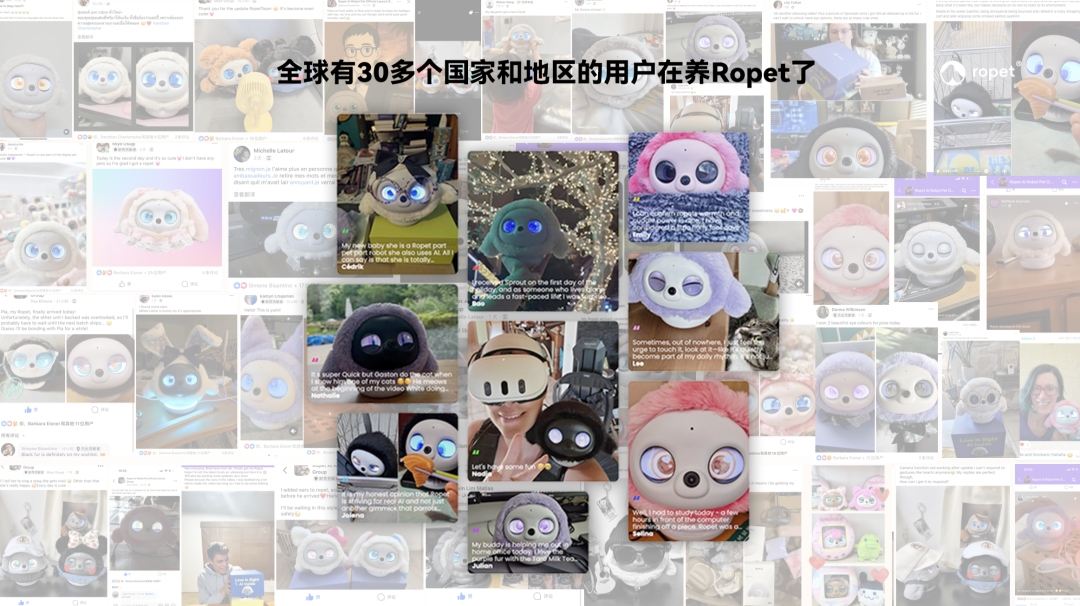
Image source: Ropet
Li Feng: Beyond Microsoft, you've served as product lead at several well-known companies. Before founding your startup, you were at ByteDance, responsible for product definition and design of PICO VR glasses.
You left ByteDance right as the AI boom was heating up. What's the relationship between these two? Did you always plan to start a company and do hardware, and AI just happened to activate that? Or did the AI surge prompt you to start a company?
Jiabin He: I joined ByteDance in 2021 and left in 2023 — exactly two years. My purpose in joining a major tech company was to accumulate experience for my next startup.
Before that, I had explored innovative hardware at Baidu's Deep Learning Lab, then co-founded Ling Technology with my former boss, focusing on children's companion robots for five years with sales reaching millions of units. But we also hit growth bottlenecks.
So I chose to "hibernate" at a major company, building internal capabilities. First, to experience doing hardware with ample budget — PICO 4, for instance, had investments in the billions, unimaginable for a startup. Second, to accumulate supply chain resources. The Apple supply chain resources we use now were earned through "money-paved pitfalls" from that time.
Back to Uncle Feng's question: Did I decide to start a company first and then encounter the AI boom, or the reverse?
My answer: I always wanted to start a company, to do innovative hardware from zero to one. Joining a major company was to fill capability gaps. The real "trigger" was the leap from GPT 3.0 to 3.5, which made me realize: AI's future lies in "embodied intelligence." Here, "embodied intelligence" doesn't necessarily mean bipedal or humanoid forms — it can be various hardware carriers that have the ability to interact with the world and collect data. Such terminals will create new consumer product opportunities.
Before this startup, I was thinking which赛道 and what kind of product could best leverage my ten years of accumulated experience? I vaguely sensed that making something with "useless beauty" that provides emotional value might be the most suitable direction. I started talking to people everywhere, and happened to meet early investor Verity Ventures. They already had some technical积累, dedicated to making machines more biological, but lacked clear product direction. We hit it off immediately, assembled a team within three months, and began Ropet's R&D and refinement.
Li Feng: So to summarize his journey simply: how to combine a design background with industrial technology and internet products, pushing "interdisciplinary" to its extreme, and in the process developing deep user insight. This is precisely the answer to my initial puzzlement — "how could he think so delicately?"
03
What Cyclical Patterns Lie Behind the Rotating Hot Topics in AI?
Li Feng: If we turn back the clock — say, to late 2023, sitting here recording — our topic might have been "large language models"; by 2024, the hottest topic would likely be "embodied intelligent robots" or "AI Agents"; and today, we happen to be focused on "AI companion robots" or the broader "AI hardware."
Why do hot topics in AI rotate in this sequence of "large models → Agents/robots → AI hardware"? Why did everyone fervently discuss large models in 2023, shift to agents and robots in 2024, and this year focus more on concrete hardware implementations? What's the logic behind this evolution?
Jiabin He: Drawing on observations from the tech innovation industry over the past decade, I've found that revolutionary technologies in hardware have strong cyclical patterns, typically going through three stages:
The first stage is the explosion of underlying technology.
This is the "window of innovation," where massive capital and entrepreneurs flood in to explore the technology's potential. The rise of large models, for instance, originally stemmed from breakthroughs in the Transformer architecture, combined with training on massive datasets, ultimately producing underlying models like GPT. Once such technology matures, its growth curve shifts from explosive to gradually flattening.
The second stage is contemplating the technology's imaginative space.
When underlying technology stabilizes, people begin asking: what can it be used for? This stage doesn't require immediate implementation, but rather sufficient grand, imaginative scope for the technology. AI Agents, for example, were envisioned as "digital brains" that could replace humans; embodied intelligent robots were hoped to "replace human generalized capabilities" — doing housework, working in factories, even becoming family members. In 2024, substantial investment concentrated precisely on this imaginative space of embodied intelligence and Agents.
The third stage is achieving commercial value.
When the storytelling is largely done, entrepreneurs must consider: how to create commercial value? How to deliver a product users are willing to use long-term, that solves real problems? At this point, large numbers of entrepreneurs begin building on the accumulation from the first two stages to find specific application scenarios. We're now in this stage — AI is no longer just a "brain" in the cloud, but must through hardware carriers truly enter people's lives.
This closely parallels autonomous driving's development path. Initially, the auto industry's transformation began with the energy revolution — breakthroughs in battery technology. Then, new forces in car manufacturing rose, putting sensors and intelligent systems into mass-produced vehicles. Only when massive numbers of vehicles hit the roads and collected sufficient data did AI-assisted driving become possible to implement. Tech innovation is essentially this three-step process of "technology explosion → imagination expansion → commercial landing."
Li Feng: Very well said. Nearly every technology innovation cycle goes through three waves.
The first wave is the leap in technology itself.
This is a "qualitative change" driven by the convergence of long-accumulating elements. The breakthrough in large models this time, for instance, rests on three key factors: first, the massive textual data accumulated over the internet's past three to four decades; second, significantly improved computing power; third, optimization of that computing power. Under the accumulation of these factors, large models emerged. The starting point of every wave of tech innovation is a revolution in the technology itself.
The second wave focuses on the technology's imaginative space.
When technology has "absorbed the blood and nutrients of the past" and completed a qualitative leap, it's difficult to achieve another breakthrough of equivalent magnitude in the short term — progress becomes linear and gradual. Thus, attention shifts to "what can this technology do?" At this point, the most imaginative directions capture attention: Agents seen as capable of replacing all professional workers, embodied intelligent robots imagined as completing all human physical labor.
But the flip side of the coin: the most imaginative applications are often the hardest to land. Because they're too distant — difficult to confirm or falsify, requiring a long exploration period.
The third wave is the return to commercial reality.
When technology enters a steady iteration phase, the market begins asking: can it be applied across thousands of industries and make money? Can it create new demand? Can it define new products and get users to pay?
The first wave is technology still inside the "nucleus." The second wave reaches the periphery, where technology has some application space. The third wave brings technology to the outermost ring, in contact with the vast world, achieving implementation. In this third wave, what lands best may not be the most technologically advanced, but must be what most closely hugs the market and is most likely to achieve commercial closure.
Take autonomous driving: before 2015, Google Waymo was the leader in autonomous driving — this was the first wave, technology leadership; after 2015, Tesla and Uber became new focal points, because Tesla had mass-produced vehicles with sensors, Uber had a global dispatch network — people recognized the massive potential of "autonomous driving + shared mobility," this was the second wave, technology's large imaginative space; while today, true autonomous driving implementation is happening in closed scenarios — unmanned transport in ports and mines, delivery robots in campuses.
These three waves of tech innovation point to a core question: the first task at the intersection of AI and hardware is figuring out how to make AI actually land. In the second wave, AI had two paths to ground itself: the "soft" path of AI agents, and the "hard" path of embodied intelligent robots.
So why are we sitting here discussing AI hardware today? The answer is clear: we've entered the third wave — the stage of commercial implementation and value creation.
In the embodied intelligent robot space, we've invested in quite a few related companies, and their performance has been striking, with valuations continuing to climb. It's fair to say China has pushed the global timeline forward by a significant step in this field.
In 2024, the industry widely expected Tesla to release a new version of its Optimus robot, along with production plans and order volumes. This could have become a landmark event, accelerating embodied intelligence's shift from the second wave (imagination) to the third wave (commercialization). But Elon Musk delayed the launch due to other commitments, pushing back this inflection point.
In that gap, several highly influential things happened in China: first, dancing robots appeared at the Spring Festival Gala, sparking nationwide discussion; then, at a symposium for private enterprises and in this year's government work report, "intelligent robots" was explicitly written into policy documents, becoming one of the country's strategic directions.
It was likely this series of events that, against the backdrop of Tesla's delay, pushed China's embodied intelligent robot hype up another level.
04
Why choose hardware as the entry point for AI implementation? Why has "companion toy" only become possible today?
Li Feng: Since we're gradually entering the third wave of AI technology implementation, this raises a key question: why hardware? Why does AI hardware become possible with AI, and why is it substantially different from before?
He Jiabin: This reminds me of a debate in the industry: should we stuff existing AI capabilities into a piece of hardware and then look for scenarios, or should we first define the scenario and then gradually build AI capabilities for it?
We chose the latter. Beyond my personal passion and aptitude for hardware product design, the fundamental reason is this: over the next 5 to 10 years, the prerequisite for intelligence to generate massive value is that you need data.
Our research found that it's nearly impossible to obtain cameras with half-meter distance and 120-degree field of view on the market — this kind of "owner's perspective" behavioral data. Current home monitoring uses wide-angle, unfocused lenses that struggle to capture one-on-one micro-expressions and emotional interactions.
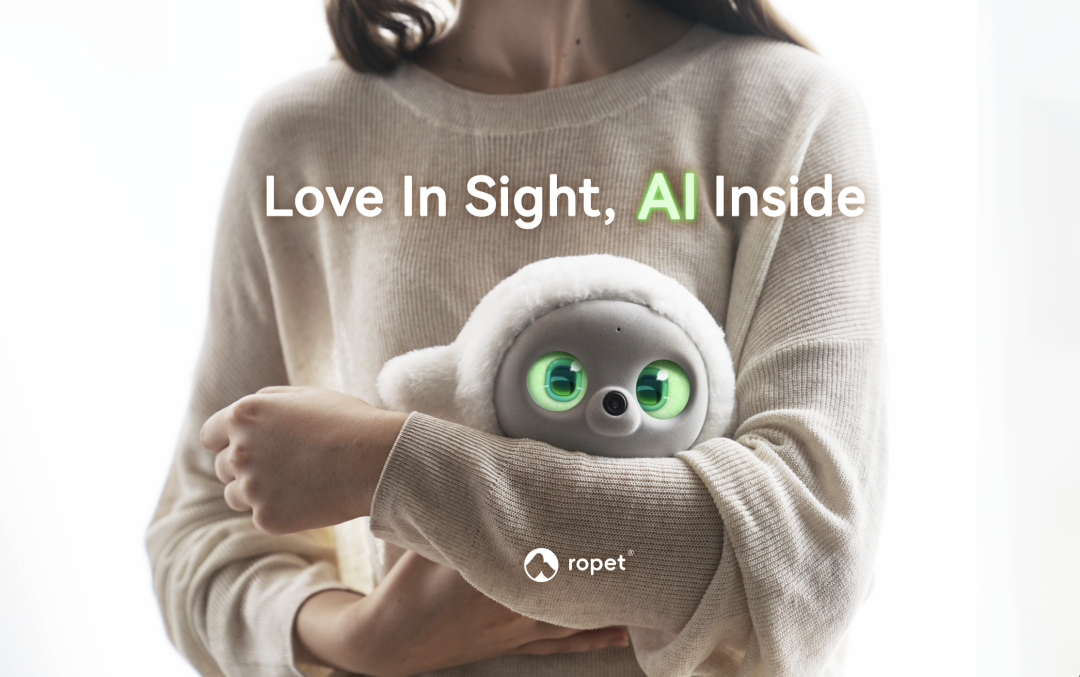
Image source: Ropet
If our hardware were just a "talking device" relying on large model conversational abilities, we could indeed start from software — phones and computers already have microphones and computing power sufficient for voice interaction. But Ropet's scenario is completely different: we focus on collecting human behavioral data, and use that to build a proprietary data structure, making the AI hardware more like a "pet" that accompanies people.
So our logic is: step one, create a cute enough, highly sticky piece of hardware that users are willing to use long-term; step two, through high daily activation rates, accumulate behavioral data about hardware usage; step three, use this data to achieve true AI intelligence.
Li Feng: Why hardware? Let me give a more intuitive example: why didn't the giants of the mobile internet era — ride-hailing, food delivery, short video platforms — emerge during the feature phone era?
In the feature phone era, phones were just communication tools. Smartphones brought high-definition cameras, GPS, gyroscopes, array microphones... these sensors produced unprecedented new data: location data (making food delivery and ride-hailing possible), image data (giving rise to Meitu and short videos), audio data (driving voice-based social networking).
The proliferation of smartphones and sensors wasn't caused by internet platforms; rather, because smartphones became widespread, internet platforms gained new data and thus built new business models.
The same logic applies to large models: their birth depended on the massive text data accumulated by the internet over decades.
Returning to Ropet, He Jiabin mentioned the crucial point: new hardware brings new data types. By deploying more sensors to more users and scenarios, generating and capturing new behavioral data, entirely new products and consumption patterns can be defined.
Moreover, China has unique advantages in AI hardware. In August 2025, the state released Opinions on Deepening Implementation of the "AI+" Initiative, promoting extensive and deep integration of artificial intelligence with all sectors of the economy and society. China happens to have both a complete sensor chip industrial chain and a complete, complex, and precise consumer electronics manufacturing chain. The combination of these two with AI technology forms China's distinctive advantage.
Chinese companies have the ability to "outcompete" globally, putting soft technology and hard products together to redefine new categories. Take robot vacuums — China has competed until only Chinese players remain globally; new energy vehicles may follow the same path. Another example is Insta360, which started as a software company doing image stitching technology. But selling software in China is extremely difficult, so the founder decisively shut down the Nanjing office, moved to Shenzhen, embedded himself in the consumer electronics manufacturing chain, and made panoramic cameras. Today, Insta360 is a company with hundred-billion market cap.
Li Feng: Digging deeper along the question of how AI lands, why has the "companion toy" category only emerged today, when AI application layers are exploding? Why didn't it exist before? What technical capabilities today make it possible?
He Jiabin: I think it's mainly a matter of entrepreneurial cost. Five or six years ago, if we wanted to recognize specific objects (like fruit), we had to collect data and train models ourselves — extremely costly. Now, we can go directly to open-source communities like GitHub, find ready-made models, fine-tune them, and deploy.
Take us as an example: a six-person team, using a chip with only 1 TOPS of computing power, with a plush outer shell creating heat dissipation challenges, pieced together in just 4-5 months a model that can simulate a pet's "four senses" (vision, hearing, touch, gravity sensing). This was unimaginable before. The low barrier to obtaining AI models is what makes this kind of innovation possible.
We're building Ropet very much "against consensus," very restrained — we didn't directly stuff an end-to-end large model into a robot to make it talk. Instead, we did the opposite — we made a "weak robot," letting the robot express emotions through tone of voice and movements, like an animal.
The concept of "weak robot" comes from Japan. Japanese researchers found that when robots are too "strongly intelligent," users are actually reluctant to keep a rigid robot in their home long-term — it's too much like a "person," creating distance and pressure.
So we want Ropet to be "weaker" than humans, positioned like a 0-3 year old child. Children at this stage have limited language ability, but precisely this can trigger humans' "nurturing instinct."
Once users develop the desire to care for it, usage behavior fundamentally changes: it's no longer a novelty toy driven by dopamine (that gathers dust once the novelty wears off), but an emotional object that continuously stimulates oxytocin, bringing a "feeling of being needed." Users are willing to keep it powered on long-term, treating it as a real pet to "raise." Not talking is precisely the core design logic that makes it "weak."
Li Feng: The low cost of obtaining AI models is something we have DeepSeek to thank for, to some extent. It broke the monopoly, forcing the entire industry toward open source, which created today's rich and callable model ecosystem.
So what about the future? Say you've raised Ropet for three months, a year, two years — does this "pet" become increasingly intelligent?
He Jiabin: With current computing power and model capabilities, we can only make Ropet simulate the perceptual level of a 0-3 year old child — recognizing objects, judging emotions. But in the future, as on-device computing power improves (say from 1 TOPS to 10 TOPS) and data accumulation increases (for example, usage data from 20,000-30,000 devices), its "IQ" might grow from 3 years old to 5, 10, even developing simple language communication abilities.
We're not opposed to it "talking" — we worry that once a pet robot starts speaking human language, has logical reasoning, has clear preferences, users will feel it's not like a pet anymore, but like an "agent stuffed in a plush shell," which would actually erode trust. Especially when language models are still imperfect, this gap becomes more pronounced.
Li Feng: It's like raising a 2-3 year old child, and suddenly one day they start debating issues with you — you'd definitely be startled, and your emotions toward them, your perspective on them, would change dramatically.
Based on current technology, doing emotional companionship with open-ended expectations may be difficult to sustainably meet user expectations.
In 2021, Character.AI in Silicon Valley launched a large language model-based emotional companionship app, which was extremely popular for a time and later acquired. Today, the activity level of such applications has dropped significantly.
Phones are closest to us, companions for the longest time. Yet chatbots on phones based on large models still haven't met user expectations. If "talking" could solve emotional companionship, why haven't these pure-chat AI applications sustained?
Like autonomous driving — even though China may be the country most accepting of digitalization globally, we didn't jump straight to Level 5 full autonomy. We went from gasoline to electric, from electric to some simple assisted driving functions, then to advanced autonomous driving features, gradually accepting autonomous driving.
Returning to intelligent companion hardware, are we building a product around AI, or making a product with some originality and gradually adding AI capabilities? I spent considerable time thinking about this, and this was also why I hesitated about the "AI toy" track — too many products are "making toys for AI," not "making products for users."
The "Blood, Sweat, and Tears" of Entrepreneurship: From Technical Ideal to Product Reality
Li Feng: Let's talk about the "blood, sweat, and tears" of entrepreneurship. From conceiving the idea to officially launching the product, and finally receiving positive user feedback — what challenges did you experience in between?
He Jiabin: When Uncle Feng mentions "blood, sweat, and tears," for me personally, this may have been the greatest challenge I've faced in my life.
After leaving ByteDance, I was mainly responsible for the overall product line at Mengyou Technology. Our initial vision was to create an extremely complex robot, benchmarking against Japanese high-end products — a robot that could walk on the ground and complete multiple complex spatial interactions, using our supply chain advantages to take the high-end route.
But later we discovered that if the pricing for this kind of companion robot reached ten thousand yuan or above, whether 10,000 or 100,000, market acceptance for such products didn't differ much. To become a hit product, the price had to come down to within 2,000 RMB. Seeing this clearly, I decided to pivot toward a more market-accessible product, and the company shifted from a technology-oriented company to one driven by product and user experience.
Li Feng: Excellent — we've finally moved from "making products for AI" to the correct path of "to make good products, we can appropriately add AI."
He Jiabin: At the time, fundraising wasn't going very smoothly for us. We were pursuing a non-consensus approach, which made it hard to raise money. The company was in debt, and we borrowed from existing shareholders to stay afloat for four months before we could produce this more market-accessible product form.
In October 2024, we rented a small booth at the Shanghai IP Licensing Expo for less than 10,000 RMB. All six of us went, bringing five prototype units. It was a do-or-die moment.
As it turned out, we became the hottest booth at the show. Passersby would stop and ask, "What is this?" People could intuitively sense it was something "new," that it was "AI," yet they couldn't quite say what it was specifically. We'd managed to make AI "visible" on the hardware level — we hit the "visual hammer." Ropet's eye tracking, tactile feedback, and simulated pet behaviors were completely different from every plush toy at the expo. In that moment, we had a vague feeling we'd gotten some things right.
After the expo, the company secured its first round of funding since I became CEO. We finally had the confidence to move into mass production and started looking for factories to make the molds.
With capital in hand, we worked up the courage to participate in CES 2025. We replicated what we'd done at the Shanghai IP Licensing Expo, and during lulls in people's interactions with the robots, we'd tell them they could scan a QR code to pre-order one on Kickstarter. This show also confirmed that our product could break out of tech circles — we attracted not just tech bloggers, but large numbers of women who stopped to discuss it.

Ropet at CES 2025. Image source: Ropet
Quite a few journalists came to interview me. I barely slept that week. When the Forbes feature on us came out, the product took off rapidly. Over the six or seven days of the expo, Ropet generated 6 billion impressions globally, and to some degree put China's AI companion robot track on the map.
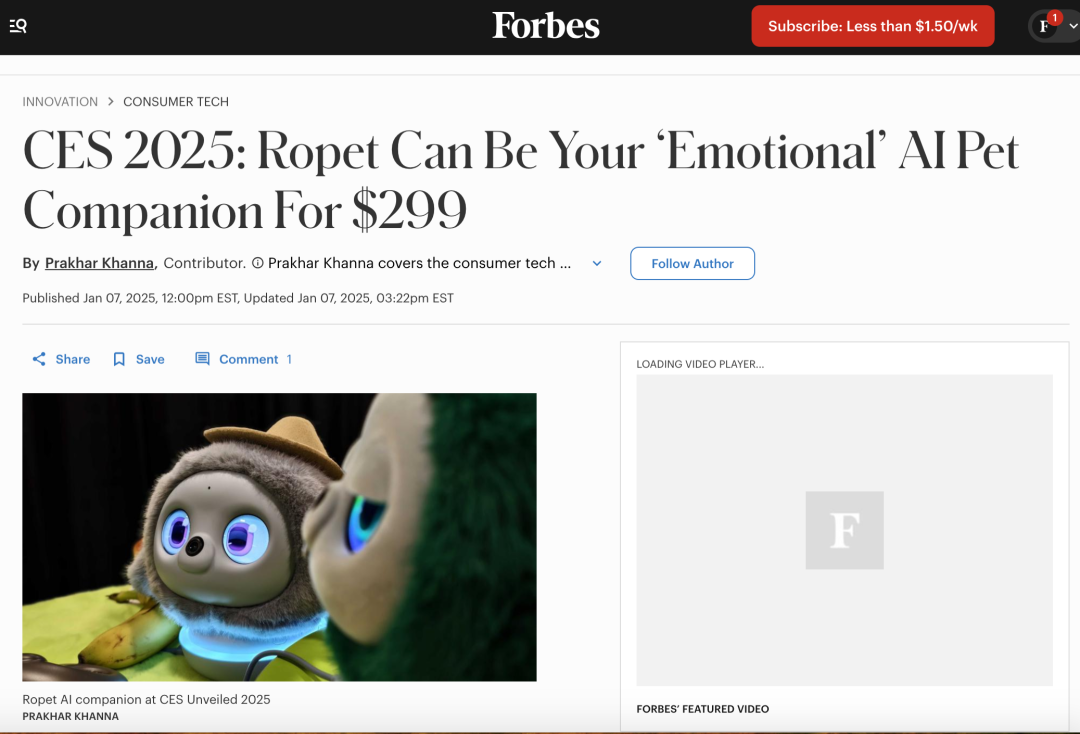
Ropet featured in Forbes. Image source: Forbes
After returning to China, we connected with more institutions, met Uncle Feng, and received investment from FreeS Fund.
Li Feng: Polishing a hardware product is quite a journey from imagined prototype to mass production. You have to think about how to choose chips, cameras, materials, and how data gets transmitted between these components. These things are enormously challenging — otherwise smartphones wouldn't be called the "crown jewel." Whether you're adding or removing a single component in smart hardware, it's incredibly difficult.
What have you learned about defining the companion robot supply chain?
He Jiabin: My biggest takeaway: if you want to do innovative hardware, it's very hard to have everything figured out in the first generation. Our overall logic was to be bold — find hardware platforms and supply chains that could meet our product definition at that moment and were relatively mature, build a framework that might not be perfect, get the product to market, and discover more room for upgrades through the process of gradually delivering to users.
From June 2024 to now, we've delivered nearly 10,000 units and gone through three to four major hardware platform iterations. Each change in platform selection would typically delay delivery by at least two months.
For example, this "pet's" eyes are actually screens, to enable more interaction with users. Our first-generation chip platform could only drive a single screen, not dual screens. A single square screen, plus a cover separating it, would make Ropet look very stiff. If we took two screens and angled them at roughly 15 degrees, we could create a more natural "eye contact" feeling. So we insisted on switching to a chip platform that could drive dual round screens. This also led many AI pet market solution providers to start developing dual round-screen displays.
Similar iterations included upgrading the fan. To make the plush shell achieve silent heat dissipation, we replaced the ordinary few-RMB fans with more expensive silent ones. If you're going to deliver a hardware product, from demo to mass production, you probably need at least a year of refinement.
Li Feng: This would be very hard to achieve in the US. One founder told me that when he wanted to iterate a version of robot hardware there, he could only contact factories in China. Each round of adjustments took three to four months — submit requirements, China customizes a version and ships it to the US, test in the US, then feedback modification suggestions. But after returning to Shenzhen, he felt like "the sun and moon had changed" — send the robot to the factory in the afternoon, get a new prototype by the next evening.
Over the past decade-plus, the Pearl River Delta's precision manufacturing capabilities have risen dramatically with the "Apple supply chain," and brands like Xiaomi, OPPO, vivo, and Huawei have advanced significantly as well. It's this powerful and responsive supply chain that makes rapid iteration of innovative hardware possible. Though some products still get delayed, ideas can at least be turned into reality relatively quickly, at relatively low cost and high efficiency.
Reader Engagement Do you think AI pet robots can form emotional connections with humans? Share your thoughts in the comments. By 17:00 on October 28, 2025, the two most thoughtful commenters will receive a copy of Warm Technology: A Robot Engineer's Confession.

The AI-Era Power Game: Understanding China's New Power System
Is AI Healthcare Having Its DeepSeek Moment? | FreeS Research
The Hotter the Robot Track Gets, the More We Need to Respect the Fundamentals | Li Feng Column
What's Changing in AI Agent in First Half 2025, and Where Are the Opportunities? | FreeS Research
Star the FreeS Fund WeChat Official Account for timely business insights delivered to your feed