Is AI Healthcare Having Its DeepSeek Moment? | Frees VC Research

AI healthcare is becoming an open secret.

AI healthcare is hitting an inflection point.
In August 2025, the Chinese government released its Opinions on Deepening Implementation of the "AI+" Initiative. Under the section on "AI+" for public welfare, the document called for "exploring and promoting high-quality, universally accessible AI health assistants, advancing the orderly deployment of artificial intelligence in assisted diagnosis and treatment, health management, and medical insurance services, to substantially improve the capacity and efficiency of primary healthcare."
Beyond policy tailwinds, tech giants are already accelerating their entry. Ant Group, JD.com, Huawei, and ByteDance have all moved into AI healthcare, targeting core scenarios like consultation, medication guidance, and health management. Among the "AI Six Little Tigers," Baichuan has partnered with Beijing Children's Hospital to develop specialized AI doctors.
They're all chasing a market with enormous potential. According to Frost & Sullivan, China's AI healthcare market is projected to surge from 8.8 billion yuan in 2023 to 315.7 billion yuan by 2033 — a compound annual growth rate of 43.1%. Globally, the World Economic Forum estimates that the worldwide AI healthcare market could exceed $4.91 trillion (roughly 35 trillion yuan) by 2032.
Amid this frenzy, one fundamental question remains: Can AI healthcare actually break through?
Past healthcare reforms attempted to optimize resource allocation; internet healthcare improved efficiency in appointment booking, consultation, and drug purchasing. But the core pain point of the medical industry has always been the severe shortage of quality doctors. Especially at the primary care level, what's lacking isn't equipment — it's physicians who can actually diagnose and treat patients.
If AI can penetrate the core of clinical practice and serve as "intelligent doctors" at the grassroots level — handling initial consultations, triage, and chronic disease management — it ceases to be merely an assistive tool and becomes a lever for amplifying quality medical resources.
In this report, we explore: Can AI healthcare truly solve the supply problem? How will it reshape the existing healthcare system? And beyond technology, what regulatory and implementation challenges does AI healthcare face?
We hope this offers fresh perspectives. We look forward to connecting with more innovators in healthcare. Feel free to reach out to the author, Ying Shen, at shenying@freesvc.com.

Engagement Giveaway How do you expect AI to improve people's healthcare experiences? Share your thoughts in the comments. By 5:00 PM on September 11, 2025, the three most thoughtful commenters will receive a copy of The Age of Co-Intelligence: How to Live and Work with AI.
Event Preview On September 19, the "TCR Technology Development and Translation Salon" will be held in Shanghai. Yi Li, founder of FreeS Fund portfolio company Tisheng Bio, along with FreeS Fund managing partner Ying Shen and vice president Da Xie, will share their insights.
If you're interested in innovation and translation in the TCR space, click "Read More" at the end of this article to register. We also welcome you to share this event with friends who might be interested.

/ 01 / AI Healthcare: The Future "Super Gateway"?
In the mobile internet era, "gateway" was a buzzword — platforms that integrated multiple services, such as information gateways, consumer gateways, and payment gateways. Giants fought fiercely to claim them. Yet throughout the internet's development, healthcare never produced a true "gateway-level" company.
Now, with AI in the picture, AI healthcare could become that "super gateway." Why?
First, healthcare is already highly digitized with solid data infrastructure. As AI technology matures, it can leverage existing data to expand intelligent applications in medicine.
Second, medical decisions are often family-based — with elderly parents and young children, one person's health needs ripple through the entire household. Whoever captures this gateway potentially secures family-level service touchpoints with massive commercial value. AI makes systematic family health management possible: continuously tracking each member's health data and identifying cross-generational hereditary risks.
Third, as a service industry, AI healthcare faces no geographic constraints, giving it natural scalability and overseas expansion potential.
Before diving deeper, we need to establish a holistic understanding of the healthcare industry itself. After all, technology exists to solve problems; understanding the problem is what reveals technology's true value.
/ 02 / No "Model Student" in Global Healthcare Systems
When it comes to healthcare problems, ordinary people summarize them in six characters: hard to access, expensive to afford. These six characters seem simple, yet capture the core pain points of healthcare systems. But this challenge isn't unique to China — globally, there may be no true "model student" in healthcare. Many countries' systems are mired in the intertwined困境 of insufficient supply, uneven distribution, and soaring costs.
Take the United States. Despite having the world's most advanced medical technology and R&D capabilities, it has not achieved universal healthcare coverage. Low-income groups and ethnic minorities still face barriers to care. The healthcare reform proposed during former President Obama's administration alleviated some tensions. But the more prominent issue is exorbitant cost. According to Health Affairs, U.S. healthcare spending growth reached 8.2% in 2024, surpassing the $5 trillion mark.
Or consider the United Kingdom. Its National Health Service (NHS) once achieved universal health coverage at under 10% of GDP — a model others sought to emulate. But in recent years, as healthcare costs have risen rapidly, this system too faces severe challenges. First, service efficiency has plummeted; non-urgent patients waiting months for appointments has become routine, with many international students preferring to return home for treatment. Second, fiscal pressure continues mounting — as populations age and medical costs rise, governments find it increasingly difficult to sustain the burden, and the tax load grows heavier year by year.
/ 03 / Why Does AI Healthcare Have a Chance to Break Through?
I. China's New Healthcare Reform: Improved Equity, But Quality Supply Remains Scarce
Why is healthcare reform so difficult? The fundamental reason is that healthcare carries not only consumption attributes but also strong public welfare characteristics. The industry must sustain itself financially while controlling costs to avoid becoming a burden on people. This inherent tension creates a perpetual dilemma in policy design. Moreover, reform involves three stakeholders — medical services, pharmaceuticals, and medical insurance — each with different interests that are extremely difficult to align. (For more reflections on healthcare systems, see China's Healthcare System Over 40 Years: From Past to Future | FreeS Report)
For the past two to three decades, China has attempted to balance these competing interests through institutional design.
In 2009, the "new healthcare reform" officially launched, gradually establishing a basic medical security system covering all citizens. In 2015, the tiered diagnosis and treatment system began rolling out. In 2017, public hospitals fully abolished drug markups, marking the end of the "profiting from drugs" model. In 2018, the National Healthcare Security Administration was established and launched centralized volume-based drug procurement. In recent years, anti-corruption in healthcare has also become an important part of reform.
These measures were essentially "re-slicing the pie" reforms — optimizing resource allocation and improving equity.
But China's healthcare industry has always faced an unresolved challenge: insufficient supply of quality medical resources. In other words, reform can change how resources are distributed, but it cannot quickly cultivate large numbers of skilled doctors or broadly elevate primary care capabilities.
Overall, the scarcity of quality supply is the core contradiction in healthcare today — and why "hard to access" care remains a persistent problem.
II. Internet Healthcare: Once Full of Promise
Alongside institutional change, technology-driven transformation has proceeded in parallel. The internet healthcare wave, now nearly two decades old, is one such example.
From digital health company DXY's founding in 2000, to the government's 2003 call to accelerate health system informatization, to the 2006 launch of online healthcare platform Haodf.com, and the 2010 establishment of Guahao.com (later WeDoctor) — internet healthcare once carried high hopes.
Policy support followed. In 2013, the State Council issued Opinions on Promoting Health Service Industry Development, which mentioned "integrating with the Internet of Things and mobile internet to continuously improve automated, intelligent health information services."
From 2014 to 2015, internet healthcare reached its peak: Alibaba, Tencent, and Baidu all entered the fray; DXY, Chunyu Doctor, and WeDoctor (formerly Guahao.com) experimented with offline clinics, with WeDoctor opening China's first internet hospital in Wuzhen.
After the boom came regulatory tightening. In 2018, national internet diagnosis and treatment regulations explicitly banned online first consultations, restricting services to follow-up visits. The industry cooled rapidly. It wasn't until the COVID-19 pandemic, when demand for remote care surged, that internet diagnosis saw renewed growth.
Internet healthcare struggled for a considerable period. At its root, the core of medicine is diagnosis and treatment; internet healthcare largely circled around the periphery, mostly remaining in light consultations, health advice, and drug distribution. It adjusted allocation but did not solve the scarcity of medical supply. To put it simply: internet appointment booking improved the booking experience, but couldn't change the reality that quality doctors are limited.
Because the services internet healthcare could provide were relatively narrow, so were its profit models. Alibaba Health and JD Health have since gone public, but their business models focus more on online drug sales than diagnosis and treatment.
III. Can AI Healthcare Break Through?
Can AI healthcare escape internet healthcare's predicament?
In China, medical service pricing has long been kept low, while medical insurance faces enormous payment pressure. If AI serves merely as a "physician's assistant," its value is difficult to demonstrate independently. Hospitals and doctors may lack incentive to purchase and use AI products.
The real breakthrough point for healthcare may be this: whoever can systematically increase doctor supply and elevate primary care physicians' diagnostic capabilities could become the "gateway" to the healthcare system. Moreover, if AI healthcare can achieve widespread adoption in grassroots hospitals across the country, its leverage in amplifying quality medical resources becomes far more powerful.
/ 04 / Early AI Healthcare Failed — Can It Succeed Now?
I. Lessons from AI Healthcare's Past
Looking back, AI healthcare isn't a "new concept."
As early as 2011, Watson, a supercomputer developed by IBM and the University of Texas, surpassed two human champions in total score on the American quiz show Jeopardy!.
Watson's stellar performance on the program led IBM to explore expanding its applications. "Dr. Watson" partnered with Memorial Sloan Kettering Cancer Center to study cancer-related variables. It also collaborated with Houston's MD Anderson Cancer Center, attempting to provide treatment recommendations for cancer patients. Yet these high-profile initiatives ultimately ended in failure. IBM eventually divested and sold most Watson Health assets, marking the exit of the first generation of AI doctors.
Why did "Dr. Watson" fail?
First, AI capabilities at the time were insufficient. Though Watson possessed impressive language understanding, medical scenarios are filled with unstructured, highly specialized clinical data. The AI of that era struggled to process and update this data in real time, limiting "Dr. Watson's" clinical utility.
Second, data sources were severely restricted. Watson's training data was limited, lacking diversity and breadth, which likely led to insufficient model generalization and difficulty handling complex, varied real-world cases.
Third, its positioning was flawed. As industry experts quoted by VB (formerly VentureBeat) assessed: "Over-promoting Watson as replacing doctors, surpassing doctors, transcending doctors' cognition... such hype rapidly inflated external expectations for IBM Watson... Exaggerated marketing is ultimately detrimental to a product's long-term healthy development."
II. Conditions for AI Healthcare Today
Why might AI now be able to change healthcare's supply structure?
First, a leap in technical capability. Medical diagnosis is not fundamentally about strong logical reasoning; it more closely resembles a "knowledge base + experience" model, relying heavily on memory, pattern recognition, and accumulated experience. Today, large language models have shown meaningful improvement over previous-generation AI healthcare products in medical diagnosis tasks.
In 2024, Harvard University, Stanford University, Microsoft, and other institutions jointly conducted a study comprehensively evaluating OpenAI's o1-preview model on medical reasoning tasks. Results showed that o1-preview surpassed attending physicians and residents in the experimental group on diagnostic clinical reasoning (determining the most likely disease) and management reasoning (formulating treatment plans).
Second, improved data quality. As mentioned, China called for accelerating health system informatization in 2003. Over two decades later, China's healthcare industry has accumulated sufficiently rich, high-quality data. This quality data will fuel AI healthcare development — after all, to a significant degree, data quality directly determines an AI doctor's "ceiling."
Finally, a rational return to positioning. According to China's National Health Commission, village doctors comprise roughly one-fifth of the nation's total physicians, while rural populations exceed one-third of the total population. AI doctors may be better positioned as replacements for grassroots general practitioners rather than challengers to research-oriented clinicians. AI doctors are suited to leverage their cross-disciplinary, multi-disease comprehensive judgment advantages — updating medical knowledge in real time, integrating multi-specialty guidelines, and providing diagnostic and treatment recommendations.
In the future, the physician role may gradually bifurcate: some doctors will focus on clinical research and complex, severe cases, becoming top specialists; others, assisted by AI, will transition toward "assistant physicians" or "health managers" centered on patient care and chronic disease management.
AI may fundamentally reshape the physician supply structure — allowing quality medical resources to truly下沉 through technological leverage, reaching broader patient populations.
Future Vision for AI Healthcare
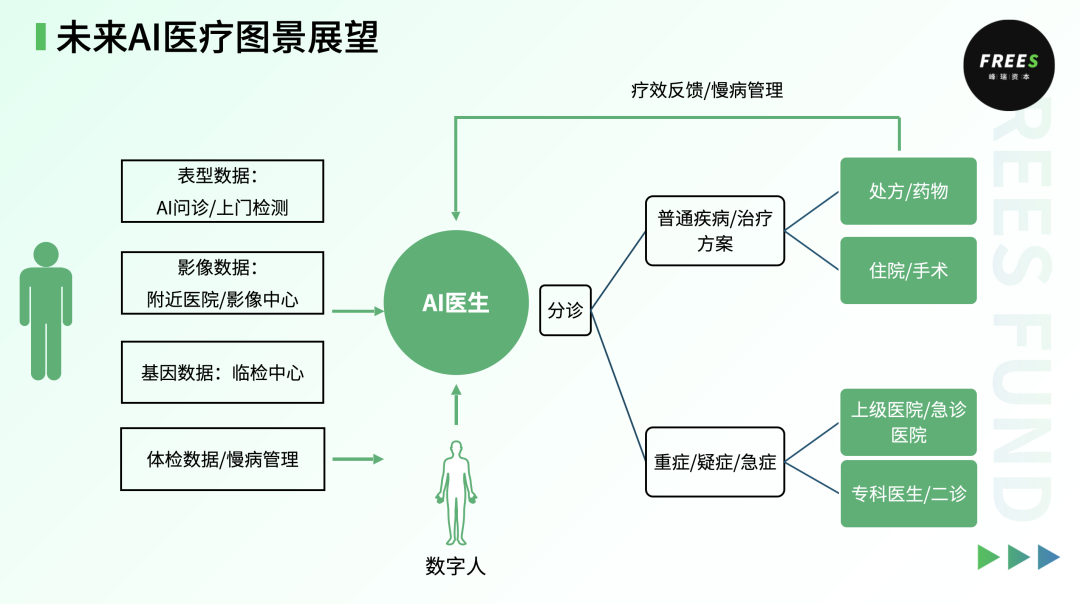
If AI healthcare achieves widespread adoption, we can imagine what seeking care might look like:
You simply consult online, and AI conducts a preliminary assessment based on symptoms. Blood work, urinalysis, and other data collected through at-home testing services or imaging completed at community clinics are automatically aggregated and analyzed by AI.
After AI completes diagnosis, immediate triage follows: common conditions receive direct prescriptions with chronic disease management and dynamic efficacy tracking; acute and severe cases are rapidly referred to higher-level hospitals; complex cases are escalated to specialists, with AI providing decision support.
In short, AI may partially replace doctors across consultation, analysis, triage, and other stages.
AI healthcare could bring changes to existing healthcare systems on multiple levels, mainly in three aspects:
First, AI can help drive systematic integration and utilization of medical data.
As AI's involvement in diagnosis and treatment recommendations deepens, structured data generated during clinical processes will continuously accumulate, forming a "data — model — application" feedback loop. This data flywheel effect could theoretically improve model performance and support medical research and real-world evidence accumulation, though actual effectiveness still depends on data quality and inter-institutional collaboration.
Take American AI healthcare company Tempus AI as an example. Its core business uses AI-driven clinical and molecular databases to provide precise testing and diagnostic tools for healthcare systems, covering oncology, psychiatry, radiology, cardiology, and other fields. Through partnerships with thousands of medical institutions and over half of U.S. oncologists, Tempus AI has accumulated massive datasets for training AI algorithms.
Second, AI holds potential in promoting rational drug use.
Current clinical practice still sees certain instances of over-prescription and drug mismatches. If AI systems can provide recommendations based on prescribing guidelines and latest literature, they may reduce unnecessary prescriptions to some extent and improve prescribing norms. But AI must follow appropriate regulations and cannot use "personalization" as cover for违规操作.
For example, telehealth platform Hims & Hers Health develops personalized treatment plans for users — each patient's dosage, drug combinations, even ingredients are tailored to individual needs. But market voices have raised concerns. In June 2025, partner Novo Nordisk accused Hims & Hers Health of violating laws prohibiting mass sales of compounded drugs, using false "personalization" to circumvent regulation, with marketing practices endangering patient safety.
Third, AI may indirectly influence commercial insurance and medical payment models. Current commercial health insurance faces high premiums and low enrollment rates, partly due to difficulty in risk control.
If AI can participate in full-cycle health management — penetrating prevention, screening, chronic disease follow-up, and other stages — it could theoretically help reduce overall medical expenditure and provide more granular risk stratification for insurance actuarial purposes, thereby lowering premiums. However, the sustainability of such models remains to be validated, and involves complex issues of ethics, equity, and algorithmic transparency.
Overall, AI has certain application prospects in medical data integration, prescribing norms, and payment mechanism optimization. But actual effectiveness is constrained by technical maturity, system integration capabilities, regulatory frameworks, and clinical acceptance. It is more likely to serve as an assistive tool gradually embedded into existing systems, rather than rapidly disrupting or replacing traditional models.
Regulatory Challenges in AI Healthcare
The technical path for AI healthcare is gradually clarifying, and its potential in improving diagnostic efficiency, optimizing medication use, and accumulating data is becoming apparent.
However, what will truly determine whether it can achieve large-scale deployment is not technology itself, but regulatory attitudes and institutional follow-through. After all, healthcare concerns human health and lives. For example, in February 2024, Hunan province issued a Notice on Further Strengthening Management of Basic Medical Insurance-Designated Retail Pharmacies, explicitly stating that "using artificial intelligence and other technologies to automatically generate prescriptions is strictly prohibited."
Moreover, a major unresolved question in AI healthcare is: when medical disputes occur, who bears responsibility? The doctor, the hospital, or the algorithm developer?
If AI is clearly defined as an "independent decision-maker" rather than an "assistive tool," liability attribution might actually become clearer. If a "pure AI doctor" model emerges in the future — where AI independently completes first consultation, triage, and prescriptions — then when errors occur, responsibility would likely fall on the developer or operator.
In January 2025, the FDA released a regulatory framework for AI applications in drugs and biologics: Considerations for the Use of Artificial Intelligence to Support Regulatory Decision-Making for Drug and Biological Products: Draft Guidance for Industry and Other Stakeholders. This may serve as a useful reference. Its core approach is not to simply classify tasks as "high-risk" or "low-risk" — for instance, blanket prohibitions on AI prescribing — but to conduct dynamic assessments based on AI models' application scenarios and potential consequences. This "risk-context-based" regulatory model may offer greater flexibility.
Despite numerous challenges, AI healthcare's development trajectory is increasingly seen as a "known direction." Domestic tech enterprises including Alibaba, Huawei, and Baichuan have all established positions. AI healthcare may not be a panacea, but it does offer new possibilities for enriching medical resource supply.
Engagement Giveaway How do you expect AI to improve people's healthcare experiences? Share your thoughts in the comments. By 5:00 PM on September 11, 2025, the three most thoughtful commenters will receive a copy of The Age of Co-Intelligence: How to Live and Work with AI.
Event Preview
On September 19, the "TCR Technology Development and Translation Salon" will be held in Shanghai. If you're interested in innovation and translation in the TCR space, scan the QR code in the poster below or click "Read More" at the end of this article to register. We also welcome you to share this event with friends who might be interested.

Deciphering Aging, Resisting Aging | FreeS Report
Everything Has Two Sides: How to Use "Nuclear Radiation" as an Anti-Cancer Drug? | FreeS Report 28
AI Virtual Cells: Exploring Digital Life | FreeS Report
Sex Differences in the Immune System and Their Implications | FreeS Research
Star the FreeS Fund WeChat official account for timely business insights delivered to you.