Let's Talk AIGC: How Vertical Niches Can Find Opportunity in the AI Wave | A FreeS Fund Conversation

How do you build your own competitive moat?

Recently, the AIGC (AI-generated content) wave has surged into our lives and the business world.
OpenAI released the multimodal GPT-4 model, enabling GPT to understand the meaning of images. Midjourney launched its fifth commercial AI image generation service, solving the longstanding problem of AI tools failing to render hands correctly. Baidu released ERNIE Bot, featuring capabilities in literary creation, commercial copywriting, mathematical and logical reasoning, Chinese language understanding, and multimodal generation.
The technical questions surrounding AIGC have already been discussed in considerable depth. What we're curious about is: what tributaries might this flood create? Which smaller paths might it flow into? Which directions will entrepreneurs immersed in it choose to pursue?
Already, many teams have chosen to build at the model layer, creating language models or image generation models. Beyond that, entrepreneurs might also ground themselves in vertical industries and push deeper into industry-specific applications.
At "Trends 2023 — FreeS Fund China-US Venture Capital Summit," Chen Shi, investment partner at FreeS Fund, sat down with Alex, founder and CEO of BodyPark (an AI-powered fitness company), Qiuqiu Liu, founder and CEO of Gelt (阁楼), and Chunsong Wu (Lesheng), founder and CEO of TeKan (特看科技), for an in-depth discussion on how AIGC is impacting vertical industries.
Moderator Chen Shi has over 15 years of continuous entrepreneurial experience. As a core management team member, he was deeply involved in the founding of UCWeb and third-party payment company Lakala, serving as VP and CTO respectively. He previously served as a senior executive at Alibaba's digital media and entertainment group and mobile business group, with deep involvement in business decision-making and management execution for product lines including UCWeb, Amap, Youku, Tudou, Shenma Search, and UC International.
Guest Alex founded BodyPark, which combines "AI algorithms + live personal coaching + gamification" to launch "AI + live coach" online personal training sessions. Guest Qiuqiu Liu holds a master's degree in computer science from USC. He founded Shenzhen Jinqi Technology, whose app Gelt provides online psychological services. Guest Chunsong Wu is founder & CEO of TeKan Technology, former head of Alibaba's AI Design Lab, and founder of Alibaba Luban. TeKan operates in the short video and live streaming SaaS space.
We've edited portions of their discussion into this article, hoping to offer fresh perspectives. Topics they covered include:
- How does the current AI wave differ from the previous one? What are the differences in use cases between analytical AI and generative AI?
- What sparks will fly when AI meets vertical industries?
- What other implementation scenarios and opportunities exist for AIGC?
- How can you build competitive moats in vertical AIGC tracks?
- Is it necessary for startups to build their own large AI models?

Interactive Giveaway: In your view, which vertical industries offer the best implementation scenarios and opportunities for generative AI? We look forward to hearing your thoughts in the comments. The 5 most thoughtful commenters will each receive a copy of AI 2041: Ten Visions for Our Future, recommended by Elon Musk. We hope this book will help everyone better understand AI's past and future.

/ 01 /
What Are the Differences in Use Cases Between Analytical AI and Generative AI?
Chen Shi: In recent years, there have been two waves of AI. The first is called analytical AI, the second generative AI. How have you experienced these two entrepreneurial waves? What are the differences in use cases between them?
Chunsong Wu: I've been through both waves. During the 2015–2016 AI wave, I happened to be inside Alibaba building the product "Alibaba Luban" (later renamed "Luban"). This product used AI to generate posters, enabling automatic layout and resizing.
At that time, we mostly worked with small models within limited scopes. To make posters, we still had to manually prepare large quantities of basic design elements and materials. The generated images were essentially combinations of elements. Today's large models can truly generate at the pixel level — a major shift in the image domain.

▲ Image generated by Midjourney, with the prompt "Chinese couple in the 1990s."
Additionally, in terms of controlling generation, in the last wave we had to tag many elements extensively and use expert-supported methods to combine and optimize them. This wave's models like Midjourney or Stable Diffusion have shifted to prompts — a method close to natural human language — to generate images. So this wave of AI products has also seen major changes in interaction patterns.
I feel that this wave of generative AI stands on the shoulders of giants. It aggregates information accumulated throughout human history and reassembles and upgrades it through deep AI large model methods. So I believe this AI wave's impact runs deeper than the last.
Chen Shi: Alex is a "veteran" of the AI industry. Previously VP of Product at AI unicorn Mobvoi, he happened to experience both AI waves.
Alex: The previous wave of voice assistant AI and visual AI was more oriented toward passive analysis — simple Q&A in preset task scenarios, mostly aimed at improving search interaction efficiency for specific tasks.
Over the past year or two, especially with the recent generative AI wave, AI has shifted from passive analysis or response to more actively generating content, opening up many new possibilities in vertical application scenarios and structurally changing user experience and industry ecosystems.
We've indeed seen that this wave of new infrastructure, or breakthroughs in underlying technology, can bring new possibilities to many vertical application scenarios.
Chen Shi: Indeed, we used to think AI could only handle relatively localized technical tasks. Now generative AI has opened our minds to discover it can do much more. (For more on AIGC technology and entrepreneurial investment opportunities, read "After ChatGPT's Explosive Rise, Where Is AIGC Headed? | FreeS Report 28".)
Qiuqiu Liu: I haven't experienced both complete AI waves, but we've been continuously using AI-related products. Today's language models are more general-purpose. We no longer need to use a product in just one niche domain to generate content. Now you can use GPT to generate anything you want. I think it will become infrastructure for everyone's work, not just for scientists or engineers.
/ 02 /
How Can AIGC Empower the Psychological Counseling Industry?
Chen Shi: Now let's move into discussing vertical industry tracks. Our three guests come from three different vertical industries — Qiuqiu from psychological counseling services, Chunsong from content marketing, and Alex from online fitness. All quite different. Let's take this opportunity to have each of you introduce your respective tracks. Starting with Qiuqiu — I'm particularly interested: what's the current state of the psychological counseling services track? How can AIGC help it?

▲ Image source: Gelt official website
Qiuqiu Liu: The psychological counseling track has actually been developing for a long time, with different products emerging in different periods. But this industry has never solved its non-standardization problem. For example, counselors' schools of thought and educational backgrounds vary widely, and different platforms' service models differ considerably.
This non-standardization creates many user pain points: long waits for appointments; potentially long commutes; the counselor you find may not suit you, requiring multiple trials before finding a good match.
These problems appear to be on the demand side, but ultimately require solutions on the supply side. So the first thing we did was standardize the counseling and service process.
When thinking about how AIGC could help us, we weren't thinking about having it provide psychological counseling directly to users, but rather how it could empower psychological counselors on the supply side.
If we want to treat someone out of a depressed or anxious state, the essence is establishing a new relationship between this person and the counselor — this is emotional interaction between people. While ChatGPT has become very capable in semantic understanding and inference, it's still relatively difficult for it to establish relationships and engage in emotional and ethical communication.
Beyond counseling itself, psychological counselors have much other work to do, such as writing case reports and scheduling. Everyone writes in their own style, but if we use AIGC to write, first it ensures quality, and additionally, AI-generated content has relatively uniform formatting. More importantly, all written materials on the supply side previously had to be done by counselors themselves; now AIGC can generate them directly, allowing counselors to focus more on their core work and improving efficiency several-fold.
In the actual process of applying AIGC, we've also encountered some hurdles, such as how to better generate prompts. One point where the psychological industry differs from others is that it has many specialized terms. You need to try all these specialized terms before you can generate products you find satisfactory.
/ 03 /
How Is AIGC Changing Video Marketing?
Chen Shi: Next let's move to the second track. Chunsong, please briefly introduce what kind of product you're building.
Chunsong Wu: TeKan Technology applies AI and data technology in video and live streaming products — a typical application in the content production track. We're the "GC" (generated content) in AIGC.
In the content production track, the mainstream approaches used to be PGC (professionally generated content) or UGC (user generated content). PGC corresponds to tools like Premiere Pro (Adobe Premiere Pro, or Pr for short, a video editing software developed by Adobe.) — professional, deep tools. UGC mostly relies on lighter, template-based content production tools on mobile. Today AIGC has changed content production methods, with major impact on our domain.
We're in the video and live streaming tools track. Video production can be divided into three stages. First, the planning and creative stage, producing content scripts. Second, the filming and production stage, producing footage and materials. Third, the editing stage, forming the final work.
We try to apply the latest AIGC capabilities at each stage, and are developing one-click video generation tools. Internally, we closely track a metric we call "AI replacement rate." For other industries, whether to use AI might be optional; for us, it's mandatory.
Chen Shi: When FreeS invested in TeKan Technology, it was originally positioned in short video production, particularly in overseas short video — content creation, editing, data aggregation, and business intelligence. Early on, TeKan used GANs (generative adversarial networks) to swap faces for live streamers, meeting cross-border e-commerce overseas live streaming needs. After new language models and image generation models like GPT-3 and Stable Diffusion emerged and gradually matured, TeKan quickly applied these new technologies to its business.
I'd like to ask: in the process of applying new technologies, have there been any interesting situations? Any new discoveries, or difficulties encountered?
Chunsong Wu: What surprised us was that GPT is a master at "copying homework." For example, in writing live streaming scripts and planning video scripts, after we showed it some examples, it learned very quickly. Everyone has felt its general capabilities, but it also learns quickly in specialized domains. For instance, after we gave it several hundred high-quality video scripts in the beauty category, it could produce respectable work. Its generalization and emergent capabilities left a deep impression on us.
The difficulty is that the video domain we operate in is inherently multimodal, involving text, voice, image, and other content forms, while previous language models were mostly unimodal — we need to "assemble" it ourselves. Multimodal language models like GPT-4 are definitely the trend.
/ 04 /
How Can AIGC Boost Online Fitness?
Chen Shi: Now let's move to the online fitness track. Alex, please share what the current state of this industry is and how AIGC can help it.
Alex: Let me share some of our entrepreneurial judgments and thinking, and how they relate to AI.
Many people believe that only face-to-face offline delivery can create good experiences. But we see that whether online or offline, the fitness industry has many urgent problems, such as poor renewal rates and user retention.
Why did we choose to start a company and enter the online fitness track?
First, with the addition of 5G, online audio/video, RTC technology (Real-time communication, the abbreviation for real-time audio and video), and AI technology, online actually has the opportunity to create differentiated user experiences.
Second, we've seen in many technology cycles that when new technologies emerge, old demands find more convenient, better-experienced solutions, unlocking massive new markets. You can't look at new markets through a "historical lens."
At the fundamental logic level, Gelt, TeKan Technology, and BodyPark are all doing the same thing: lowering the barrier for people to access services. This is the core.
We've pioneered an "AI + live coach" online personal training product, which has been in the market for over a year. Our confidence comes from genuinely seeing consumers willing to go online, willing to pay, and showing significantly better renewal and retention than traditional solutions.
We've also built an AI Coach Copilot remote teaching system to help coaches nationwide teach efficiently at a distance, enabling them to receive good hourly income for each class. During the pandemic, this system helped many coaches solve their livelihood problems.
The reason we can do these things is that we've leveraged cutting-edge technology to enter a vertical scenario, transforming the very traditional offline fitness industry through online and intelligent transformation, creating new service delivery methods. This is also the logic behind our belief that AI should go vertical, deep, and thorough. (For more on AI-powered online fitness, read "Beyond Chatting and Drawing, AI Can Also Help You Work Out Online | FreeS VC Dialogue".)
Chen Shi: Same question — in BodyPark's process of applying new technologies, have there been any interesting situations? Any new discoveries, or difficulties encountered?
Alex: The difficulties are, first, how to use AI deep learning to accurately capture human movement. Open-source human pose recognition and motion capture systems on the market aren't accurate enough; we use proprietary models and algorithms with extensive optimization to improve recognition accuracy.
Additionally, the challenge lies in how to deliver motion recognition and real-time audio/video interaction technology to consumers through smooth engineering and product solutions — there are quite a few technical hurdles to solve here.
In the process of applying new technologies, we've also had some interesting discoveries. AIGC can find interesting application scenarios in vertical industries. For example, using the Stable Diffusion algorithm model, we launched an AI fitness filter feature. After users complete a class, BodyPark generates highlight moment images from their session — protecting user privacy while being quite fun, with very high user sharing rates.
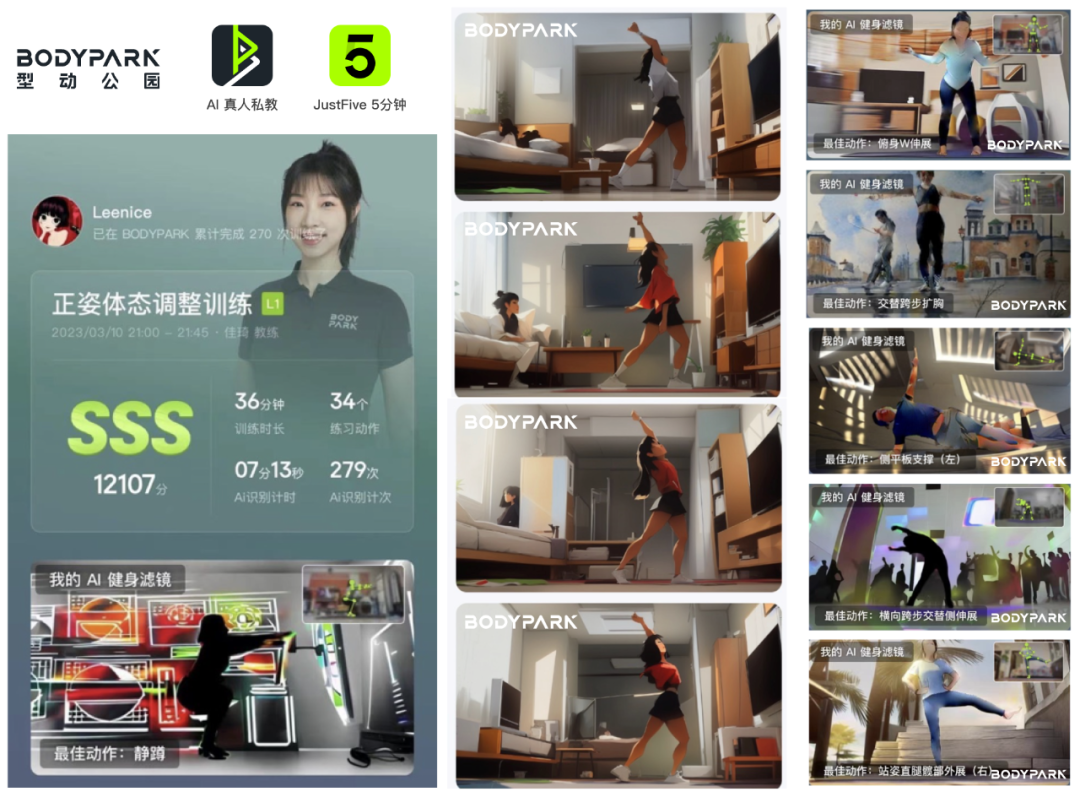
▲ Image source: BodyPark
Another example: our newly launched AI interactive gamified fitness app "JustFive" lets users engage in fun, intense game competitions to upbeat music, unknowingly completing 5-minute aerobic HIIT workouts, while also generating fun, meme-worthy short videos after class for easy sharing.
Chen Shi: Both BodyPark and Gelt are positioned in service industries, and both are undergoing what we call the "three transformations" of service industries: online, digital, and intelligent. On the surface, moving from offline to online entails some loss of service experience. But ultimately, the advantages of digitalization and intelligence can compensate for these losses, achieving better service outcomes and higher service efficiency.
What Other Implementation Scenarios and Opportunities Exist for AIGC?
Chen Shi: Beyond psychological counseling, short video, and fitness, which other vertical industries do you see as offering better implementation scenarios and opportunities for generative AI?
Chunsong Wu: I think first is the content creation industry — whether images, text, or video — which should be the most directly transformed. From an ordinary consumer's perspective, what I'm most looking forward to is replacing the voice assistant on my phone with truly intelligent interaction at ChatGPT's level. For example, I pick up my phone, tap a button, and can ask all my questions and get timely answers. Shortening the "distance" of interaction — this is my most urgent need. Though this opportunity probably isn't in startups' hands, but more likely in the giants'.
Alex: If you're considering starting a company or joining one, I see several major directions. First is infrastructure and large model entrepreneurship. If you're interested in frontier technology, you could join a large model company. But this opportunity will likely be in the hands of a few giants, or well-funded, technically strong startup teams.
For startups, more opportunities lie in the middleware or application layers, or doing both together.
Additionally, you can look more for application-layer opportunities in service industries — whether reconstructing offline experiences, moving offline experiences online, or doing global expansion. Going overseas will also present many opportunities. In new growth cycles, observe whether users have new demand changes, and whether there are opportunities to use cutting-edge technology for structural cost reduction, efficiency gains, or experience innovation.
Qiuqiu Liu: I think service industries at the application layer will have many opportunities — finance, law, medicine — all will have opportunities to flip from offline to online. If AIGC becomes more widely applied in the future, much content and information may require our discernment. For example, how do we judge whether the person we're video chatting with is real? The middleware layer's data security domain is also an opportunity. There's a British series called The Capture, which actually addresses data security, privacy security, and authenticity issues brought by AIGC.

▲ Poster for the British series The Capture. Image source: Douban
How to Build Your Own Competitive Moat?
Chen Shi: Another topic of interest. Now that large models dominate, surrounding applications are to some extent equally empowered. So how do we build our own competitive moats?
Qiuqiu Liu: Many people are using large models today; there's really no such thing as a technical moat. I think several things matter. First is engineering. Engineering itself is a moat — it requires extensive trial and error. Second is forming know-how early on. Know-how can save lots of time; being slightly earlier might put you half a year ahead. Third, you need to find ways to validate model effectiveness — improving efficiency is one aspect, another might be improving the business model. Additionally, you need to verify whether your methods for validating model effectiveness are themselves truly effective.
Chen Shi: AI is indeed empowering equally; everyone's at the same starting line. So in the end, we probably still need to build our moats based on industry know-how and scenarios.
Alex: I think in this round of AI application entrepreneurship, moats may come from your strategic choices. If you're merely building a thin layer of application innovation on top of general large models, the barrier will be relatively low. For our part, BodyPark currently tends toward vertical, end-to-end integration of technology, engineering, and product, using different technology stacks.
For us, the human keypoint recognition engine, the middleware and application layer for virtual coach multimodal interaction with users — these must be firmly in our own hands. But we'll also actively embrace new technologies; we'll openly integrate with new infrastructure like ChatGPT and ERNIE Bot.
In the early stage of industry transformation, at a time when consensus hasn't formed, doing vertical integration makes it relatively easier to deliver products, generate cash revenue, and continuously build moats.
Chen Shi: To summarize, for entrepreneurship based on vertical industries, AI itself may not form too much of a moat. The real moats still lie in scenarios, business models, user scale, and industry know-how. It remains: "technology first, scenarios heavy." Ultimately, you still need your own business depth and scenario moats.
Is It Necessary for Vertical Tracks to Build Their Own AI Large Models?
Chen Shi: A topic many entrepreneurs care about. Currently there are quite a few large models on the market. For entrepreneurs in vertical domains, will they need to build their own models in the future, or is using existing models sufficient?
Qiuqiu Liu: In the long term, we'll definitely need to build our own. For application-layer companies like ours, the journey is actually quite long and requires extensive accumulation. First you need to accumulate a way to validate your model's effectiveness, and then a method to verify whether your validation method itself is effective. Only when you've gone quite far can you build your own large model.
For us, large models serve the application itself; they're not for all general scenarios. I still hope it can ultimately validate business value, not just conversational value. But we don't know how far GPT will develop in the future.
Chunsong Wu: In the short term, we won't consider this. We'll stay more focused on the application layer, going deep and thorough. In the AI entrepreneurship ecosystem, the division of labor and collaboration between underlying large model companies and upper-layer application companies may form new conventions — for example, what should be done by the application side versus what should be done by underlying giants or emerging companies.
In my eyes, large models are the water, electricity, and gas of the new era. We're probably more concerned with how to make good use of new infrastructure. Using the new energy vehicle industry as an example, we're probably more like the role of new car-making forces, not battery manufacturers. We need to consider what customer segments we serve, and what products we make to serve them well? We also try as much as possible not to depend on one type of "battery" — we can't be fully "locked in" by one large model. In the future AIGC ecosystem, a collaborative relationship similar to that between new energy vehicles and battery manufacturers may form.
Interactive Giveaway
In your view, which vertical industries offer the best implementation scenarios and opportunities for generative AI? We look forward to hearing your thoughts in the comments. The 5 most thoughtful commenters will each receive a copy of AI 2041: Ten Visions for Our Future, recommended by Elon Musk. We hope this book will help everyone better understand AI's past and future.

▲ After ChatGPT's Explosive Rise, Where Is AIGC Headed? | FreeS Report 28
▲ Beyond Chatting and Drawing, AI Can Also Help You Work Out Online | FreeS VC Dialogue
▲ How to Turn Black Tech Into Reliable Products? | FreeS VC Dialogue
▲ 2022, Where Are the Next-Gen Consumer Opportunities? | Li Feng Column

