Building a Brand Is Starting to Look Like Building an App — What Can Consumer Brands Learn From Super Apps About Growth? | FreeS Research

Five Brand Strategies for the New Media Era

From mobile internet to consumer internet, traffic has been the dominant theme of Chinese commerce in B2C industries. Most business opportunities have emerged from shifts in traffic structure and user migration.
The rise of new brands over the past two years followed the same pattern. But the content platforms and new traffic sources that fueled their rapid growth are gradually maturing.
When everyone starts flooding into new media platforms like Douyin and Bilibili, and the dividend pool shrinks, how should we think about new value points on content platforms and fresh opportunities for brand growth?
Recently, "Langchao Xin Xiaofei X FreeS Fund" — a closed-door summit on new media and new brands — was held in Shanghai. Over 30 consumer entrepreneurs and investors gathered for more than four hours of deep reflection and discussion on the evolution of media platforms, new value points, and how brands can build core content capabilities.
"Douyin's growth logic is, in some ways, a model consumer companies can learn from, because the transformation of media and traffic platforms has made building a brand increasingly similar to building an app."

Among the speakers, Peter, VP at FreeS Fund, offered an in-depth analysis from the perspective of traffic structure shifts — covering the growth logic of traffic platforms like Douyin, how paths for new brand growth have changed, and five brand growth strategies that still work today.
Before joining FreeS Fund, Peter worked in ByteDance's strategic investment department, and previously at NetEase Games and DiDi.

Below are selected highlights, offered in the hope of sparking fresh perspectives.

Peter, FreeS Fund: Building a Brand Is Increasingly Like Building a Super App — What Can Consumer Brands Learn from Super App Growth?
Source: Langchao Xin Xiaofei
Speaker: Peter
Transcribed by: Huang Sili
Hello everyone, I'm Peter. Before joining FreeS Fund, I was in ByteDance's strategic investment department, responsible for entertainment-related strategic investments. At FreeS, I mainly focus on investment opportunities in entertainment and consumer sectors.
/ 01 /
Consumer Entrepreneurship Opportunities Through the Lens of Traffic Structure Shifts
Today, my topic is new media and new brands. Take a look at this chart:

This reflects a consensus at FreeS on how we view consumer opportunities: Chinese consumer entrepreneurship currently sits at the intersection of three converging forces.
First, thanks to its massive population base and rapid economic development, China has become the world's largest consumer market, with the highest e-commerce penetration globally.
In 2019, China's e-commerce penetration was roughly 35%, and it's projected to rise to around 60% within five years. The US currently sits at only about 10%. From this angle, China's consumer market upgrade is happening very fast.
Second, China has the world's most complete supply chain — a result of occupying the processing segment in mature industrial chains over the past 40 years. This means we can rapidly launch new products across many categories. Impacted by this year's pandemic, many supply chains that had been flowing outward have returned.
The combined effect of these two factors is what we today call consumption upgrading and category upgrading.
There's another variable: the internet has entered the consumer retail space, and infrastructure around consumption has been built out — including online payments, new content platforms, logistics systems, and more — providing solid foundations for China's consumption upgrade trend.
So right now is an excellent time for consumer entrepreneurship in China.
I mentioned that China's e-commerce penetration is high. But this isn't just about the rapid growth of overall e-commerce scale — its internal structure is also dynamically shifting.
We've studied the development and iteration of e-commerce platforms. We can see Taobao's overall market share being compressed, while Tmall and JD.com have taken more leading positions. Meanwhile, Pinduoduo has emerged as a disruptor, its share of the e-commerce market multiplying rapidly.
Here I want you to remember two time points:
The first is 2017, the year Pinduoduo's GMV growth took off. The second is 2015, the inflection point for JD.com's rapid GMV growth.
Beyond changes in e-commerce platforms, traffic structure has been shifting in parallel.
FreeS internally analyzed changes in user time share among China's super apps over the past five to six years. Two critical inflection points also occurred in 2015 and 2017 respectively:
In 2015, WeChat's share of user time first surpassed QQ's. In 2017, WeChat's time share peaked at 51% of total internet time. But starting from 2017, WeChat's share began to decline — mainly due to the rise of Douyin, or more broadly, the short-video industry as a whole.
Looking back at e-commerce, part of why Pinduoduo could achieve rapid growth in 2017 was precisely because WeChat's time share had peaked.
So whenever a dominant traffic platform's time share reaches its peak or hits an inflection point, we can expect new platforms to emerge around it — or new market conditions to form. Pinduoduo's emergence confirmed this pattern.
In June this year, short-video platforms' total usage time surpassed that of instant messaging. So we're very curious what changes and opportunities will come from Douyin's rapid growth.
So why has Douyin been able to grow so fast?
/ 02 /
How Can Consumer Brands Learn Growth from Super Apps?
Let me use a vivid analogy to help you understand Toutiao's business logic:
Strip away Toutiao's two core components, and you have the content recommendation engine and the advertising engine.
Using a car as metaphor, these two engines are what drive the ByteDance vehicle. The consumer-facing apps launched previously were like car shells — using these two engines to power them.
A good-looking shell can make the car more popular, but what makes it run faster is the engine inside.
Douyin is no exception. It essentially relies on these same two engines, combined with the "good-looking" shell of short video, to form a high-speed racing car.
Their development logic is, in some ways, a model consumer companies can learn from, because the transformation of media and traffic platforms has made building a brand increasingly similar to building an app.
Moreover, short video has taken a dominant position in our lives, influencing every aspect. This echoes the major trend I mentioned earlier: video-ization is irreversible, with both users and user time migrating toward video.
Latest data shows that average daily short-video usage has approached 113 minutes — longer than the time people spend on WeChat each day.
How to leverage this trend is something all brands should be thinking about.
/ 03 /
Traffic Shifting from Closed to Open: What Does It Mean for New Brands?
Toutiao's information-feed ads, with Douyin as the representative, essentially pushed traffic from closed to open. We can compare this with overseas markets:

In overseas markets, traffic has long revolved around two internet companies: Facebook and Google. From the very beginning, they didn't lock traffic within their own platforms, but chose to open it up, allowing the entire app ecosystem to use their advertising products for distribution.
Under such an ecosystem, everyone is essentially competing on product quality, because everyone can access all traffic — it's all available to you. So in the end, whoever builds the better product achieves market success.
Benchmarking against the domestic market: China's early mobile internet traffic ecosystem was relatively closed. For example, WeChat had no advertising system for a long time, and Taobao's system was only open to merchants within its platform. Baidu was somewhat more open, but limited to the search advertising ecosystem.
In this situation, many products that were better than their competitors could only grow at a relatively slow pace because they couldn't efficiently utilize this closed traffic.
Toutiao's products referenced Facebook's advertising system logic and model, building an efficient, open, transparent advertising system that everyone could see.
After this, traffic distribution efficiency became very high. More and more games, e-commerce platforms, and brands could rely on Douyin's open traffic system to achieve growth through advertising in the ad market.
This is an important macro trend and new media shift.
Not long ago, Feng Shu (Li Feng, founding partner of FreeS Fund) shared his views on opportunities and challenges facing brand entrepreneurship today, which can be summarized in two sentences:
First, it's easier for niche brands to go from 0 to 1.
Second, while the environment is friendlier to new brands, the challenges are also greater — it's harder to go from 1 to 10.
Previously, to build a national brand, you could only use relatively closed channels for promotion, like television stations. Now there's more open traffic available for everyone. This year, we've seen countless niche new brands emerge — this essentially echoes this trend.
Going from 0 to 1 is somewhat easier. The challenge lies in going from 1 to 10. One important reason is that whether it's Toutiao's ecosystem, Xiaohongshu, or Taobao's algorithm after its redesign — they all rely more on recommendation feeds for distribution, essentially segmenting user groups more finely, making it harder for users to see beyond their own circles.
For brands, your niche target audience becomes more precisely defined, but cutting across the entire network is harder than before. So how to go from 1 to 10 is a massive challenge, and something everyone should be thinking about.
/ 04 /
Three Fundamental Shifts Behind "Brand-Performance Integration"
So in an environment where new media and traffic structures are changing, how should brands approach growth?
First, media choice becomes less important.
Whatever media you choose, the users you ultimately reach on that platform will only be your target users. So all brands need to achieve full media coverage — you can't just pick whichever platform has higher efficiency today.
Moreover, all traffic and media information is now openly available across the entire network. There isn't any platform whose efficiency is inherently higher than others.
Second, building a good product becomes more important.
Because user attention spans are getting shorter, what content you use to capture users' eyes and drive conversion becomes critical.
Let's start by analyzing from the media angle. Why does everyone say we need brand-performance integration when media changes? There are three fundamental shifts behind this:
First, content has changed. From previously hiring 4A agencies to create polished, high-end content that could work across the entire network, to now daily, high-frequency content that enables emotional connection and greater interactivity.
A well-known example is Three Squirrels. They were the first consumer brand to propose "master culture" — all customer service interactions with users adopted this tone.
At the same time, when they made nut snacks, they innovated on packaging by including shelling tools for easier consumption. Beyond that, they created batch after batch of content around the Three Squirrels characters.
All of this was essentially about permeating users' daily lives with the brand, using daily content to guide consumers to remember them.
Second, internal organizational structure has shifted — from relying on marketing departments to relying on sales departments.
Traditionally, companies were marketing-department-centric.
For example, traditional FMCG giants at the level of Procter & Gamble and Unilever — their marketing departments mainly built brand awareness, like air force tactics; while sales departments executed on the brand awareness strategies set by marketing, making channel and sales plans, like ground force tactics.
Because media used to be relatively concentrated — mainly television, print media, and portal websites — marketing departments could use top-tier content that suited mass tastes for broadcast, then push sales departments to do capillary-level penetration, thereby achieving growth.
But today, on new media platforms, most content touchpoints and sales happen at the same moment. For example, when users see good content on Douyin, they may immediately jump over to complete a purchase.
Now mainstream brands are very dependent on daily, high-frequency content. Based on new social hot topics, combined with their own brand and product characteristics, they produce different content daily to engage with users — rather than going to traditional, high-end 4A agencies.
So sales departments need to have their own content capabilities, while also mastering operations and data analysis — combining these three to help brands drive growth.
Third, data-driven growth. All new media and traffic platforms provide very rich data. For brands, how to use data to drive economical user growth is a new challenge.
We need to learn from the internet, using data-driven methodologies to achieve brand growth.

NetEase was among the major Chinese tech companies that explored overseas business relatively early. When I was at NetEase, we discovered a major characteristic:
Domestic mobile game publishing still heavily relied on brand marketing — we had to do all kinds of brand advertising and social PR activities. This traditional approach generated a lot of noise, but it was very difficult to monitor actual conversion effects or optimize.
In overseas markets, everyone used Facebook for growth. That was my first exposure to the sales conversion funnel, and I discovered that Facebook's ad backend provided a very sophisticated system for user targeting and data analysis.
Every ad, every video asset's conversion effect was real-time — I could immediately make adjustments based on this data. So our daily operational strategy adjustments were very rapid.
Domestic platforms like Taobao, Xiaohongshu, and Douyin are now also opening up more data and functionality for brands to use data for refined growth.
Another point is "using rules to drive growth." Platforms like Xiaohongshu and Douyin are now very algorithm-dependent, providing everyone with very standard rules — which in turn means people can leverage these rules to gain more traffic.
When we can direct this precise traffic to other platforms, it helps us build better data accumulation on those platforms.
For example, we attract target users to a platform for conversion. Because this wave of users is very precise, conversion rates are high. When the platform's algorithm sees your conversion rate is so high, it gives you more exposure.
This is in some ways "gaming" the algorithm, and it's one method for improving brand advertising efficiency.
Five Brand Strategies Under New Media
Having covered media, let me now share my views on product selection.
First, category innovation is what creates hit products, so choosing a good category is step one.
Second, focus on a single point to occupy user mindshare. Because user attention is now fragmented, you can no longer push a big, all-encompassing concept like before.
Third, organize brand marketing and content distribution plans around the user.
Next, I'll share some strategies brands can use, organized around these three points:
First, achieve differentiation and precise positioning around specific demographics — like this chocolate made specifically for adults.

Chocolate itself has relatively small differentiation, and traditionally, chocolate products were made for children. But a Japanese brand created chocolate for adults — essentially an innovation around a demographic everyone had overlooked.
Second, upgrade a local specialty product into a new category.
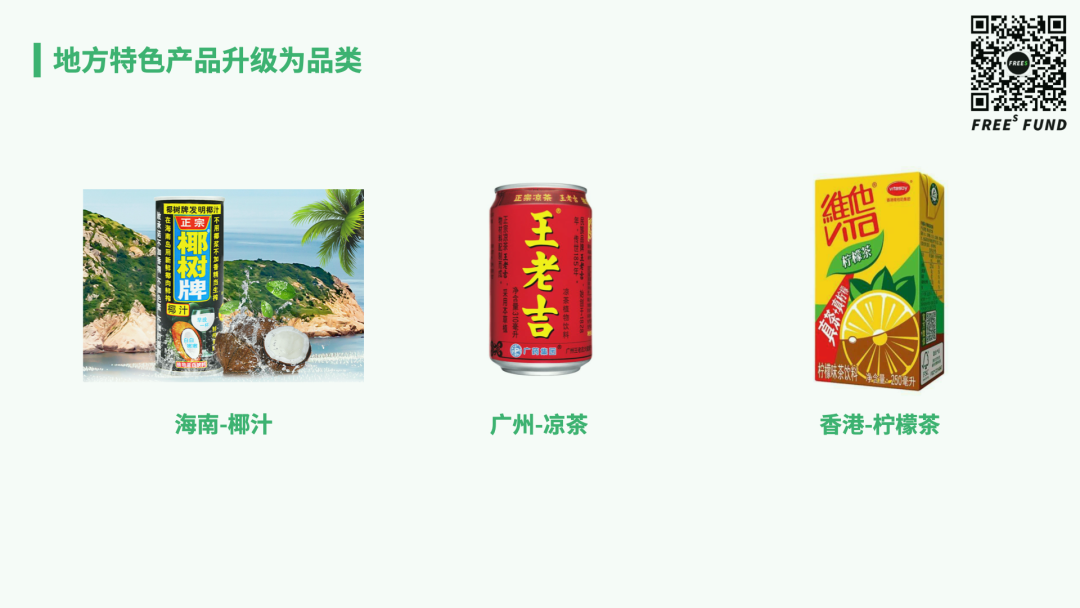
This is a strategy that has worked repeatedly in China — like Coconut Tree brand coconut juice. Recently many new coconut juice brands have emerged, but in terms of user mindshare, Coconut Tree has already occupied a very strong position.
Third, use storytelling to sell a product. Content is increasingly important, and here I want to give a very old example — the anime Bakusō Kyōdai Let's & Go!! that our generation watched as children.

This anime was originally a marketing initiative by a toy company, designed to educate the market and push mini 4WD cars as a product.
Without this anime, mini 4WD might not have become such a hot toy category at the time. We also hope to see someone use content to drive a good product, thereby pushing forward a great brand.
Fourth, use premium ingredients for dimensional advantage.

Here again using chocolate as an example — Japanese chocolate brands have innovated a lot on ingredients, adding things like probiotics and dietary fiber to chocolate — ingredients that are functionally-oriented and premium in traditional terms — thereby distinguishing their chocolate from the sweet chocolate made for children.
The image on the right is Saturnbird. They use freeze-drying technology to turn specialty coffee extract into freeze-dried powder. This means consumers only need to spend about seven or eight RMB to drink instant coffee approaching specialty coffee quality — effectively distinguishing them from traditional instant coffee brands.
Fifth, leverage brand collaborations. This is also a tactic that domestic brands have used repeatedly with success lately. When you collaborate with a well-known brand, it's essentially the combined force of two brands.
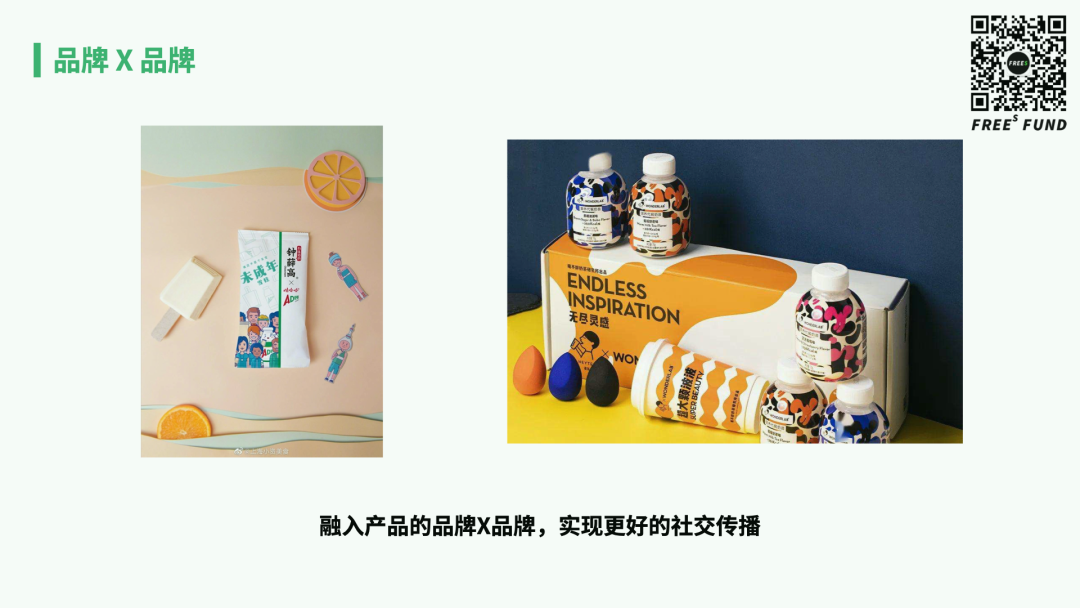
For example, HEYTEA previously did a collaboration with WonderLab that became a viral hit — why?
For WonderLab, collaborating with HEYTEA meant they could simulate HEYTEA's flavors in their products — for some users, this was essentially a healthier version of HEYTEA.
For HEYTEA, many people in lower-tier markets previously didn't know they existed. The emergence of short-video platforms allowed many users who couldn't see HEYTEA to discover the brand. If they had the chance to visit Beijing, Shanghai, or Guangzhou, the first thing they might do is find a HEYTEA.
Conversely, they could now taste HEYTEA's flavors in their own cities through WonderLab.
These two points are why this collaboration became a viral hit. Brand collaboration isn't just about putting two brands' logos on a product — it requires more thought about what this collaboration can bring to both parties, and what it brings to users.

FreeS Report 19 | The Micro-Buzz Era: Where Are the Opportunities for Low-Alcohol Entrepreneurship?