Breaking Through for Early-Stage Brands: From Traffic Thinking to Content Thinking | Frees Fund

If all you do is generate exposure, consumers will forget about you just as easily.
"

Huang Hai, Executive Director, FreeS Fund
Email: hai@freesvc.com
Huang Hai focuses on investments in consumer and retail sectors. He has led and participated in investments in Club Factory, Saturnbird, Vphoto, and Shanbay English, among others. He holds an MS in Management Science and Engineering from Stanford University and a BS in Mathematics from The University of Hong Kong.
"

Simple, Direct Traffic Dividends Are a One-Time Opportunity
In the consumer sector, we are constantly looking for opportunities to invest in excellent new brands.
Reviewing the past to understand the present. Three Squirrels is an outstanding brand that FreeS Fund invested in and that has now reached maturity. Looking back at its seven-year journey, when Three Squirrels was founded in 2012, Alibaba was aggressively developing Tmall, hoping to shift the entire platform's positioning toward mid-to-high-end "consumption upgrading." To this end, Tmall became a platform that nurtured brands (B2C), with strategic importance exceeding Taobao's C2C business.
At the time, Alibaba identified a group of promising merchants from among Taobao sellers who had the potential to become genuine brands, providing them with traffic support and operational preferential treatment. One manifestation of this: when users searched for products in the Taobao mobile app, many of the results that popped up belonged to Tmall stores.
As one of the first brands to join Tmall that year, Three Squirrels enjoyed this crucial dividend. Of course, traffic dividends were never the sole reason for its success.
After 2015, due to the mutual isolation between WeChat and Taobao's systems, many traffic opportunities also emerged within WeChat's ecosystem, giving rise to a wave of large companies.
Today, the era when brand startups could leverage Tmall and Taobao dividends to become large companies has clearly passed. Building a company through a purely traffic-oriented mindset has become extremely difficult.
In recent years, I've rarely heard of startups that can stably achieve an advertising ROI of more than 3x on Taobao. Many companies can't even reach 2x ROI — meaning 1 yuan of Taobao ad spend generates less than 2 yuan in sales.
For consumer companies, high-quality customer acquisition methods today must shift toward a "content mindset," with particular emphasis on short-form video content.
Content Output Can Build Strong Consumer Brand Recognition
If we understand customer acquisition as having different layers, the most basic is traffic — buying traffic to get consumers into the store, then converting them to orders.
In the TV advertising era, consumers were anonymous traffic. Later, typical traffic acquisition methods included Taobao's Direct Train tool, as well as WeChat Moments and group selling. Compared to TV advertising, traffic during this period gained user ID attributes. However, what percentage of users who entered through Direct Train or joined group buys on WeChat actually remembered the brand name after placing an order? Channels and brands have inherent differences: brands need to build moats through strong recognition.
At the current stage, seeing a product and liking a brand have become increasingly separate. If you only achieve exposure, consumers easily forget you because they encounter massive amounts of information daily — your exposure quickly becomes a fleeting impression. Brand marketing no longer equals attracting consumers with a slogan or a story; it requires combining consumer demands to creatively produce content that reflects your brand's distinctive character.
Content creation and output have become the new core capability for consumer goods companies because, in this era of information overload, they can generate consumer recognition, memory, and preference for brands.
Matching Product Characteristics to Different Content Platforms (1): Beauty and Douyin

▲ Austin Li "plants grass" for makeup products on Douyin, with astonishing sales power.
Let's start by discussing the content format that many consumer goods companies have been paying close attention to recently: short-form video.
Cosmetics, especially color cosmetics, are the consumer category that has benefited most from the short-form video era. To my knowledge, in 2018, Tmall's color cosmetics category saw year-over-year sales growth of at least 100%.
On Alibaba's mature platform, how could a not-so-niche category grow over 100% in a single year? Did demand suddenly explode? I think this explains part of it, but it's hard to explain everything. For color cosmetics demand to double within a year, there must be external forces acting as triggers — it couldn't come purely from endogenous user demand.
Beyond young consumers' increasingly mature habit of buying color cosmetics, another more important factor in the category's short-term explosion is that consumers' cosmetics purchasing behavior and usage frequency are easily triggered by short-form video content, which successfully converted a large batch of consumers.
The rise of many domestic color cosmetics brands in 2018 was inseparable from the penetration growth of video platforms like Douyin, Xiaohongshu, and Bilibili. These platforms have become the best methods for cosmetics companies to "plant grass" in users and make themselves memorable. Why?
Because the color cosmetics category needs to make consumers feel strong aesthetic effects. Compared to text and images, short-form video can more intuitively and vividly reflect the before-and-after contrast of cosmetics applied to the face — it's the most effective format for making cosmetics memorable.
Many viral videos on Douyin with themes like "before-and-after makeup transformation" use this method to show you how good the immediate effects of color cosmetics are, and how dramatically they can change one's appearance. There are also many videos showing half the face made up and half bare, making the contrast even more obvious.
Following this logic, we can see that behind the Tmall color cosmetics category's 100%+ growth, platforms like Douyin are becoming effective new customer acquisition channels for color cosmetics companies. And this new method, in terms of customer acquisition effectiveness or conversion ROI, is clearly superior to "pure traffic buying" or image-text output methods.
No matter how many Douyin marketing strategy articles you read, the category most empowered by them is definitely beauty. The reason is: this category has the deepest integration with Douyin's media format.
Matching Product Characteristics to Different Content Platforms (2): Skincare and WeChat Official Accounts
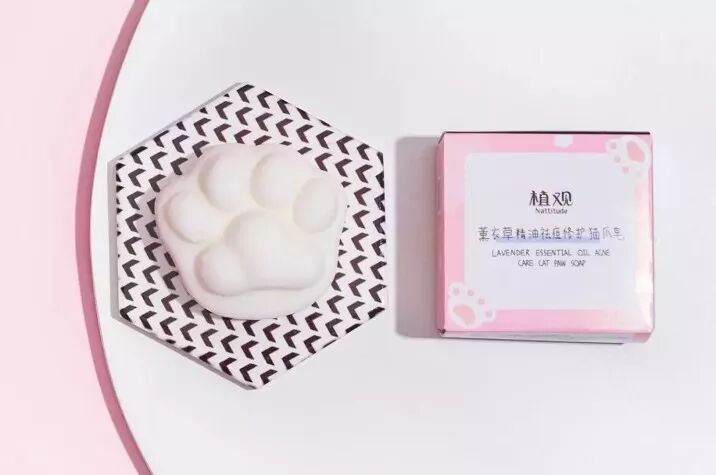
▲ Plant推出新品「猫爪皂」,在公号上图文并茂地介绍其三大有效成分和功效。
Having looked at color cosmetics, let's now examine the other half of cosmetics: skincare. It's a more functional product category — for example, products containing retinol are believed to fight aging; products with vitamin C, kojic acid, and niacinamide are used for whitening; products with salicylic acid have acne-fighting effects, and so on.
Skincare hasn't benefited from video media to the same extent as color cosmetics. The reason is that for describing product ingredients and functions, video doesn't help much.
So the core content output platform for skincare companies remains WeChat Official Accounts. WeChat Official Accounts haven't fully solved the problem of disseminating video content, but they remain the best publishing channel for high-quality image-text content. Because the active ingredients that play the main functions in skincare products, their mechanisms of action, and the clinical research and skin testing behind them — this knowledge can be accurately explained through image-text introductions. Text as a medium is more oriented toward imparting knowledge, able to spell out the benefits word by word.
So we find that some skincare brands focusing on "ingredient party" positioning have become heavy advertisers on WeChat Official Accounts, while fast-growing color cosmetics startup brands are going all-in on Douyin.
Understanding the above issues helps me with my own investment work: when content platforms have become the customer acquisition source most conducive to the rise of new brands in China today, when looking for investment targets, I need to consider which content formats currently most favor the rise of which categories.
This article isn't an industry analysis of cosmetics; in fact, it applies to all brand startups that need to create content.
Its insight for startups is that today's content creation and placement, compared to the "traffic buying" era of Taobao Direct Train (buying traffic from platforms) and WeChat group pulling (buying traffic from people), requires a stronger "creative liberal arts mindset" — moving people through content. In the traffic buying era, teams could obtain traffic and control ROI within a good range simply through "science mindset optimization."
The reason this approach no longer works today is that high-quality content is now created, not optimized. For brand startups, if external content output relies solely on vendors (KOLs, official accounts, etc.) without the company's own creation and control capabilities,突围而出 is absolutely impossible.
Beyond this, throughout the customer acquisition process, content output has strong non-standard attributes. Completing collaborations with KOLs involves many details. For example, teams must at minimum understand: which KOLs are suitable for products with different tones; cross-platform KOLs can't use the same materials to advertise on both Kuaishou and Douyin; and when advertising on 20 official accounts, how to adjust material presentation based on each account's audience differences, and so on.
So today's excellent brand companies must be companies with extremely strong coordination capabilities in multi-channel content output — the output channels they need to manage are increasingly dispersed and diverse, even down to individual units like KOLs. This is an advanced skill for brand companies.
Seizing the Placement Dividend Period of Self-Media Platforms

As mentioned above, the rise of a particular brand, beyond the increase in endogenous category demand, also requires some external push to make demand dividends explode. Self-media platforms are a very typical driving force.
Worth adding is that self-media follower growth dividends and consumer goods placement dividends are two concepts that need to be distinguished. Generally speaking, self-media follower growth comes first, then consumer goods placement dividends.
For example, 2014–2016 was the self-media customer acquisition dividend period for WeChat Official Accounts; 2017 was the advertiser placement dividend period on WeChat Official Accounts; in 2018, placement dividends began to衰减; by 2019, no one was talking about WeChat Official Account placement dividends anymore.
Another example: the Douyin platform launched in 2017, KOL follower growth dividends concentrated in 2018 and have since衰减; by 2019, Douyin had obvious content placement dividends for brand companies, whether for the startups we invest in or large listed companies. Douyin's official "Star Map" KOL order-taking platform only officially launched in the second half of 2018.
Additionally, Alibaba is gradually strengthening its awareness of "supporting brands with original content characteristics." Two brands that FreeS Fund invested in — Saturnbird Coffee and Zhong Xue Gao ice cream — both benefited from this.
The development path we prefer for brand startups, from zero to one, is: first through content creation, or more ideally, through product differentiation forming "product as content," building good口碑 among consumers, then building influence on social media, before fully returning to develop within the Tmall platform. This way, they are more likely to be favored by the platform and form良性互动 with it.
Today's Question
Besides cosmetics, what other categories are particularly suitable for display and presentation through short-form video? Please explain your reasoning.
By 6 PM on June 16, the 6 most thoughtful readers will each receive star products from outstanding consumer companies in the FreeS Fund family.
(Part of this article is derived from a speech given by Huang Hai, Executive Director of FreeS Fund, at the 3rd China Life Innovation Summit on May 18. If you have entrepreneurial ideas in the consumer sector, you can contact Huang Hai at hai@freesvc.com.)

▲ Li Xiang × Li Feng: 200 Million New Urban Residents' Consumption Awakening — Who Will "Harvest" It?
▲ Post-Dividend Era: How Can Startup Consumer Companies Break Through? | FreeS Fund 2019 CEO Annual Meeting
▲ Deeply Tapping Tier 3–6 Markets, Shima Chuxing Announces $20 Million Series A Funding | FreeS Fund Financing News