Onion Math Closes Series C Funding of Over 100 Million RMB to Expand Unmanned K-12 Science Tutoring | FreeS Fund Deal News

You can't reach a new world by following an old map. Onion Math ushers in the Online Education 3.0 era.
On February 28, 2018, Onion Math (洋葱数学), an online K-12 science tutoring brand, announced the completion of a 120 million yuan Series C funding round led by Legend Capital and Tencent. The proceeds would be used entirely to accelerate the arrival of the internet tutoring era.
Founded in late 2013, Onion Math started with animated middle school math courses and has spent years focusing on K-12 science through human-computer interactive tutoring. It has now completed four funding rounds totaling nearly 300 million yuan.
FreeS Fund participated in Onion Math's 30 million yuan Series A+ round in early 2015, and continued to follow on in the 97 million yuan Series B round in 2017, which was led by StarVc and Qingsong Fund.
What the Investors Say

Li Feng, Founding Partner, FreeS Fund
Email: feng@freesvc.com
The hardest thing about education is balancing idealism with the pace of commercialization. By that standard, Onion Math has done exceptionally well.
Yang Linfeng and Zhu Ruochen graduated from Harvard University and Duke University, respectively. Before starting Onion Math, they co-founded a nonprofit called "Sunshine Book House" (阳光书屋) in 2011, dedicated to promoting rural education through technology. Without outside resources, these two young "sea turtles" spent over two years quietly doing公益 education work. We greatly admired this original motivation when we decided to invest in early 2015.
Good ideals need to be matched with good products. Onion Math has solved the problem of sparking students' interest in learning. Its animated videos motivate students to study independently, helping them concentrate better in limited time, which basically improves learning efficiency and delivers good results.
At the same time, education spending is characterized by high prices and low frequency. Service quality needs a "floor guarantee." Only when people know your service won't fall below a certain standard can you build a brand. Onion Math's products have accumulated excellent word of mouth. Its early user growth relied mainly on organic referrals, with customer acquisition costs far below industry averages. In the second half of 2016, Onion Math began experimenting with charging users. In 2017, it achieved scaled revenue, essentially validating the feasibility of paid online education.
The market for K-12 science education is large enough, and demand can scale. We believe that education brands in this space that can achieve organic growth — rather than relying on high marketing and sales spend — will ultimately prove to be sustainable, quality brands.


40 Yuan Monthly Fee, 67.9% Course Completion Rate: How Does Onion Math Achieve "Unmanned Tutoring" for K-12 Science?
Source: Duozhi Network
Author: Shang Changhua
Onion Math had recently moved its offices from an old hutong to Beijing Dentsu Creative Square, near the 798 Art District. Before its transformation into a cultural and creative industrial park, this was the site of the Beijing Electric Motor Factory, established in 1958. Walking through the complex, one could still imagine the scenes of large-scale industrial production — rows of Bauhaus-style factory buildings originally built with East German assistance, crisscrossing outdoor pipe corridors, and faded "Work Safety" slogans still visible on the weathered walls.
Onion Math's office occupies one of the deeper buildings in the complex. Where machines once roared, there now stand rows of Mac computers at workstations, with pool tables, board games, and spinning bikes in the recreation area — an internet education company. Here, Onion Math uses "standardized, assembly-line" methods to produce animated micro-video courses for K-12 science, serving 14 million students nationwide through online "unmanned tutoring."
At the press conference, Onion Math revealed its achievements: over 14 million registered users, 360,000 teacher users, coverage of 63,000+ primary and secondary schools across 419 cities in 34 provincial-level administrative regions; over 10 billion data points covering complete online learning processes; over 100 million minutes of user online learning time per month; and over 200 million cumulative course tutoring sessions.
According to Yang Linfeng, co-founder and CEO of Onion Math, "Onion Math's positioning is not content, not tools, but unmanned tutoring for K-12 science. Onion Math has completed the closed loop of online tutoring, including learning, practice, problem drilling, testing, diagnosis, AI-powered instant tutoring, and grade prediction. In terms of user numbers, we should be the largest internet science tutoring platform in China."
The Series C funding and the emphasis on "online unmanned tutoring for K-12 science" signaled that Onion Math was entering a new phase. But how exactly does this online unmanned tutoring model work?

Under Demanding Learning Conditions, You Must Capture User Interest Within 1 Minute
To achieve online "unmanned tutoring," the first step must be sparking students' autonomous interest in learning.
For Onion Math, the first thing users encounter is its animated short video courses.
Each Onion Math course consists of animated videos and intelligent exercises, lasting about 5-8 minutes, with content broken down from textbook knowledge points. Generally, no teacher appears in the courses; a dedicated voice actor provides the explanation.
"You could say we face extremely demanding learning environment challenges. No teacher or parent supervision; students' physical environments are uncontrollable — they might be in a car, at home; their usage time is uncontrollable — might be between classes, before bed; and they're using phones, tablets, computers — devices prone to distraction. Under these conditions, to achieve a learning closed loop and ensure user stickiness, our margin for error is extremely small."
In Yang Linfeng's view, faced with a new student user, you must capture their interest in the first minute amid all these uncontrollable factors — only then might the student spend a few more minutes watching the video. After watching, you must make the user feel "this was thoroughly explained, I gained insight and understanding" — only then might they do the subsequent intelligent exercises. At this point, only if the user feels they've learned something useful can you retain them. "In these 10-15 minutes, we must complete a simple closed loop of the learning process."
To achieve this, Onion Math has tried three approaches: First, explain in accessible ways so students realize they can understand what the video covers. Second, make the content engaging — present it through animation, introduce scientific history stories, use witty and humorous delivery. At the same time, introduce gamification elements with reward systems and peer rankings to motivate students. Third, ensure learning effectiveness in a short time to solidify students' confidence. "If students only see results after a month, they'll definitely give up. You need to help students master a knowledge point quickly and feel it's helpful."
"All of this aims to enhance the learning experience. We believe students' lack of initiative and self-discipline in learning often stems from problems with the learning experience," Yang Linfeng said.
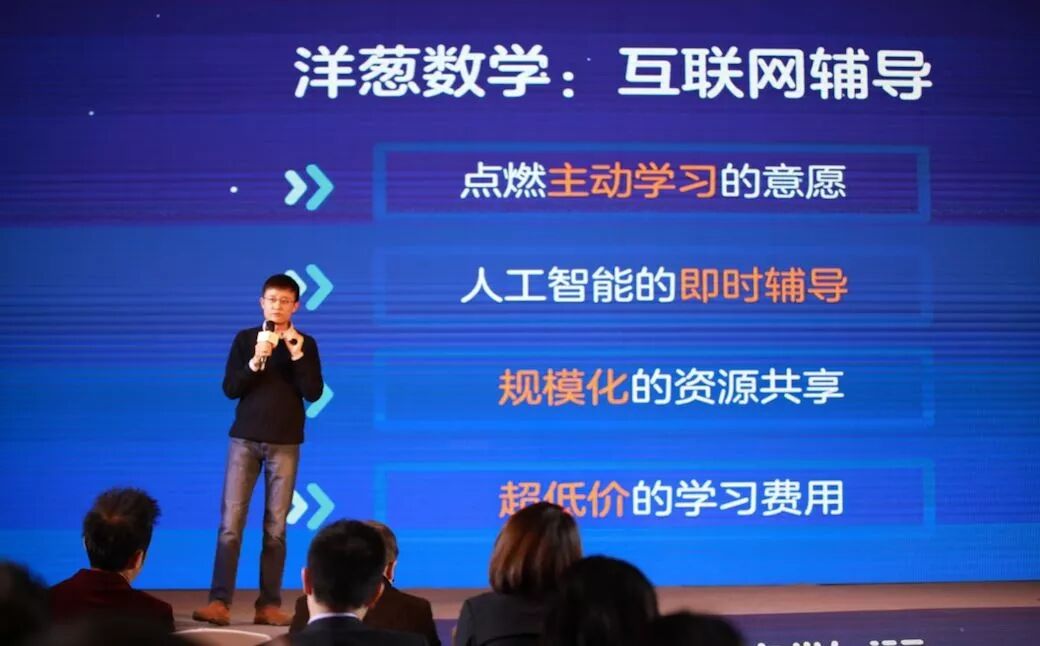
But to achieve online unmanned tutoring, doing only this is far from enough.
Currently, Onion Math has launched over 1,500 animated short videos, with products including 12 versions of middle school math courses, Grade 10 and Grade 11 math courses, Grades 4-6 elementary math courses, and some versions of middle school physics courses.
"In 2017, Onion Math launched over 500 animated short videos. Looking at video production speed, it's indeed accelerating. From another dimension, we've also achieved cross-subject expansion and extending single subjects to different grade levels," Yang Linfeng noted.
How to maintain quality control while increasing video quantity is a key challenge.
Video Production Accounts for Only 30% of Total R&D Time
In Yang Linfeng's view, whether expanding subjects or extending single subjects to more grade levels, there are two challenges: First, there are no precedents to follow — all content must be originally developed, while simultaneously ensuring product consistency and quality control in an assembly-line, highly standardized production process. Second, how to train students' thinking and reasoning methods while imparting knowledge, and further convey the inherent meaning and beauty of the subject itself.
"Initially, we drew on Khan Academy's approach, but our products quickly developed their own characteristics. All content needs to be original, with no precedents to follow; and we must ensure quality control while achieving scaled production. Moreover, the thinking methods and approaches contained in knowledge points need to be conveyed to students — observation, comparison, analysis, synthesis, abstraction, generalization, judgment, reasoning, and so on — while also helping students appreciate the ideas and beauty embedded in the subject."
The solution Onion Math has adopted is: while achieving standardization and assembly-line production, ensure systematic structure at the macro level and closed loops at the micro level, then combine this with data analysis for quality control.
Ensuring systematic structure at the macro level means first grasping the essence of the subject at the teaching research level. For math, this means understanding core concepts, knowledge frameworks, required student capabilities, and learning difficulties from the perspective of math history; then combining this with national curriculum standards, course design, organizational logic, and competency requirements to design a systematic curriculum.
At the micro level, making more detailed, granular breakdowns of textbook knowledge points, deconstructing student cognition at fine granularity, and designing the entire learning process — from learning, practice, problem drilling, testing, diagnosis, AI-powered instant tutoring, and grade prediction — with each knowledge point forming a complete closed loop.
Only after this comes brainstorming and detailed refinement of video content — how to explain knowledge points more engagingly and effectively, including which stories to introduce, which life scenarios to incorporate, and so on.
"This cycle is very long. The video production process accounts for only 30% of the total time."
For quality control, Onion Math uses recorded and analyzed data from the entire learning process to judge course quality and effectiveness.
"Onion Math has over 10 billion data points, including course learning, exercise practice, and user behavior data, covering the complete online learning process. For example, in course learning: completion rates, pauses, drags, rewinds, fast-forwards, and abnormal exits during video watching; in exercise data: answer accuracy rates, problem drilling, learning diagnosis, review, and other session data; and user behavior data, including how much users value points, whether incentive models are effective, and so on."
Yang Linfeng stated: "Onion Math's cumulative course tutoring sessions have exceeded 200 million. Each video has hundreds of thousands or millions of learning sessions. This accumulated data is sufficient for us to identify problems, make timely improvements, and iterate on a weekly basis."
To achieve online unmanned tutoring, after tackling challenges like "sparking students' autonomous interest in learning, building complete learning closed loops, and ensuring course quality," Onion Math still faces the question of how to personalize student learning on a standardized foundation.
For this, Onion Math's solution is leveraging AI and big data. In 2017, Onion Math established an AI lab to develop AI learning engines adapted to online learning scenarios, enabling intelligent analysis of learning data and instant matching.
"Through AI and big data, Onion Math can intelligently locate students' learning levels, diagnose weak points, recommend suitable courses, and adjust exercise difficulty, while also providing pre-exam diagnosis, exam sprint preparation, and weekly learning reports," Yang Linfeng said.
Behind the 40 Yuan Monthly Fee: Marginal Cost Is Nearly Zero
After solving these various challenges, Onion Math faced the exploration of a commercialization model. How to achieve monetization and scaled revenue was the question before it.
2017 was Onion Math's first year of commercialization. It launched the "Gold Medal Score Improvement Course," priced at 198 yuan for 3 months, 298 yuan for 6 months, and 488 yuan for 1 year — about 40 yuan per month. Currently, Onion Math's video courses are divided into free and paid sections, with nearly half of the most basic video courses available for free.
The product's pricing is relatively low, partly considering regional differences across China — Onion Math has priced its courses within reach of most families. On the other hand, this reflects its extremely low marginal costs.
Onion Math emphasizes light operations, with very limited investment in both manpower and capital in marketing and operations. Combined with its "online unmanned tutoring" positioning, it requires no investment in physical venues or teaching staff. While upfront R&D costs are high, once scaled revenue is achieved, low marginal costs can generate sufficient profit margins.
"Our marginal cost is nearly zero. Whether we're serving over 10 million students or 100 million, costs barely change. That's why Onion Math can offer such ultra-low pricing at 40 yuan per month — every family can afford it," Yang Linfeng said.
But the challenge is whether parents will accept this "online unmanned tutoring" model and pay for it.
On this, Yang Linfeng is confident. In his view, first, the market is continuously being cultivated, and parents' acceptance of online education is increasing. Second, compared to other high-ticket online and offline tutoring methods, Onion Math has a relatively low customer price point; and compared to the limited trial courses offered by other tutoring methods, Onion Math users have ample time to experience a large volume of free courses before deciding whether to pay based on results.
At the press conference, Onion Math announced that it has captured over 22% user market share in middle school; commercially, it has achieved scaled revenue.
In commercialization exploration, B2B cooperation with public schools will also be a focus for Onion Math. "Our approach is mainly to provide customized services for public school teaching, becoming an effective aid to instruction."
At the press conference, Onion Math also announced the formation of the "Future Education Practitioners Alliance" with the High School Affiliated to Renmin University of China Xishan School, Beijing Academy, and Guangdong Experimental Middle School, to jointly explore the realization of future education and teaching methods.
(This article is sourced from Duozhi Network. Welcome to share to Moments.)

Can Paid Content Buy Real Knowledge? Can Online Education Solve This? | FreeS Fund Free Talk