Club Factory Raises $100 Million in Series C, FreeS Fund Continues to Follow On | Funding News

Cross-border e-commerce — a market that rivals daigou in scale.
In January 2018, cross-border e-commerce platform Club Factory announced it had recently completed a $100 million Series C round, with FreeS Fund, the lead investor from its Series A, continuing to increase its stake.
" Investor Perspective

Huang Hai, Vice President, FreeS Fund
Email: hai@freesvc.com
FreeS Fund has long paid close attention to export e-commerce. Back in 2015, when cross-border shopping was just becoming a hot topic among investors, we had already begun systematic research into export e-commerce. The first industry research report we published was FreeS Research Report No. 1: Opportunities and Future of Export Cross-Border E-Commerce.
In 2016, FreeS Fund led Club Factory's Series A. We are pleased to see that Club Factory has grown within just a few years into a company with considerable influence in the industry.
China's supply chain can provide high-quality, diverse, and reasonably priced light industrial goods, including apparel, accessories, and home products. Chinese export e-commerce also has a certain level of competitiveness globally. However, because export e-commerce is less competitive than domestic e-commerce, many export e-commerce players have not done well in terms of data-driven and refined operations, and their product selection lacks solid grounding.
Club Factory's advantage lies in using big data for product selection and optimizing the supply chain to improve efficiency across the entire chain. This is also the core difference between them and the previous generation of export e-commerce.
Club Factory focuses on developing regions such as Southeast Asia and the Middle East as its primary markets. These regions have yet to see e-commerce giants on the scale of Alibaba or JD.com emerge, and the e-commerce landscape remains unsettled, making it possible for new platform-type companies to arise. Therefore, Club Factory has enormous room for imagination in its future development.
"

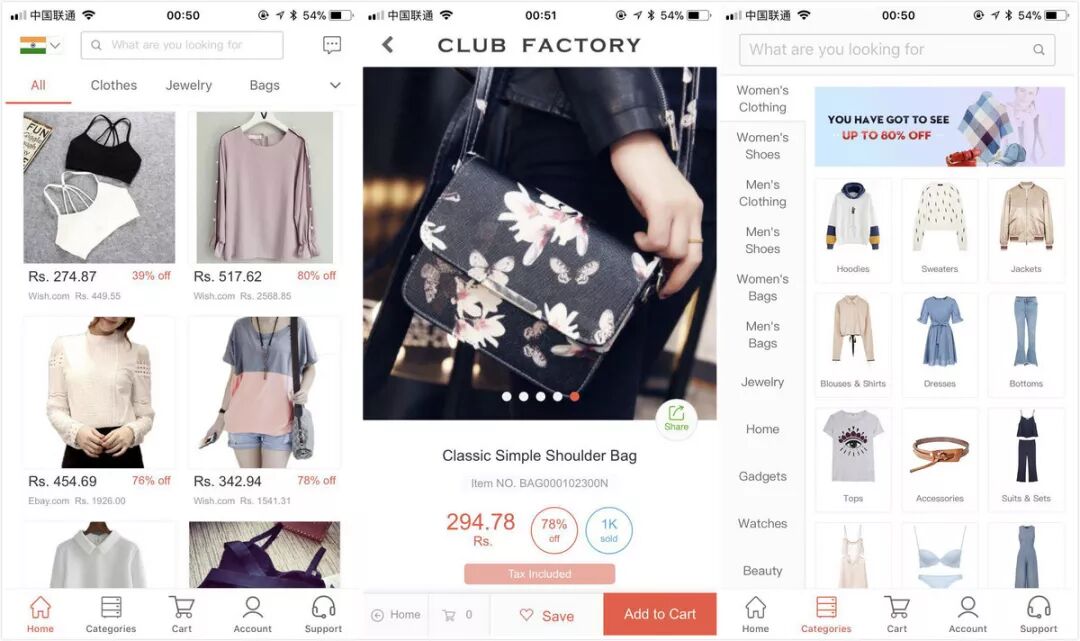
Cross-Border E-Commerce Platform "Club Factory" Raises $100 Million in Series C, Targeting Southeast Asia and Middle East Markets Through Data-Driven Approach
Source: 36Kr
Author: Deng Henhen
Cross-border e-commerce platform Club Factory recently completed a $100 million Series C round, with returning investors including IDG Capital, Bertelsmann, Kunlun Capital, ZhenFund, and FreeS Fund. Club Factory had previously raised nearly $20 million in its Series B in January 2017. It had launched Baokuan Yi, a cross-border e-commerce data service provider serving hundreds of thousands of export enterprises, before launching its B2C e-commerce platform in 2016 to sell non-standardized, mid-to-low-end Chinese goods overseas.
Thanks to China's unique supplier advantages, export e-commerce has always been a market no less attractive than cross-border shopping. According to the 2017 (H1) China E-Commerce Market Data Monitoring Report, in the first half of 2017, exports accounted for over 80% of China's cross-border e-commerce, with export e-commerce transaction volume reaching 2.75 trillion yuan, up 31.5% year-over-year (B2B dominated, though B2C's share was rising).
"Made in China" products typically offer better value for money, more SKUs, and longer tail selections than foreign alternatives, meeting the diverse needs of overseas consumers.
Club Factory's primary markets are developing regions such as Southeast Asia and the Middle East. While e-commerce in Europe and America is already mature, Southeast Asia and the Middle East are seeing gradually improving e-commerce penetration and infrastructure, indicating significant market potential. Club Factory founder Lou Yun told 36Kr that each of these markets has its own characteristics — for instance, Southeast Asia has a large population and significant consumption potential, making it the largest market; while the Middle East has a developed oil industry but lacks light industries such as textiles and apparel, giving it the strongest consumption willingness.
Overall, Club Factory operates a relatively light platform model, connecting upstream with small and medium-sized manufacturers and wholesalers while the platform centrally provides pricing, product-customer matching, customer service, and overseas logistics services. The platform does not stock inventory in advance; after users place orders, domestic suppliers ship to warehouses, where the platform handles quality inspection and packages goods for overseas delivery, using third-party logistics locally.
Currently, Club Factory has integrated hundreds of thousands of upstream suppliers and tens of millions of SKUs downstream, covering 26 countries and regions, with its app ranking in the top 5 for shopping apps in over 10 countries and in the top 14 in 14 countries. India is Club Factory's largest market, and they are also the largest Chinese cross-border e-commerce platform in India. The platform's average item price is $4-5, with monthly GMV in the hundreds of millions of yuan (over half from India), and MAU of 20 million.
For cross-border e-commerce platforms choosing non-standardized products, ensuring sufficient long-tail selection is essential, and Club Factory's supply chain can be considered one of its core moats. However, managing so many SKUs and small and medium-sized suppliers presents considerable challenges. Product selection, listing and delisting, stock-out management, and price fluctuations are all difficult problems requiring substantial data accumulation and robust algorithmic models.
Lou Yun explained that Club Factory has independently developed a supply chain management system and AI-based product-customer matching algorithms. The underlying logic is similar to ByteDance: the more products sell, the better the system understands both users and suppliers. For product selection, Club Factory uses web crawler big data to capture what overseas users like to buy, then searches through its massive SKU pool to analyze and identify products users are most likely to prefer. Suppliers are screened based on their qualifications, production capacity, and track record. For product-customer matching, the platform makes multi-dimensional recommendations based on comprehensive user preferences, achieving personalized recommendations for thousands of users and improving conversion rates through precise information matching.
Behind this big data + AI-driven business model is a technology-driven team. Club Factory's core technical team comes from Facebook, Alibaba, and NetEase, with computer science backgrounds from Stanford, Carnegie Mellon, and Zhejiang University.
Following this funding round, Club Factory will further solidify its business, maintaining sales growth while strengthening customer service, local warehousing, and logistics to improve the consumer experience.