"DJI Is Already So Big — How Do You Survive?" A Story of Taking on a Giant | FreeS Fund Business School

In an industry with no second place, how do you find the possibility of starting a business?
China is a drone superpower, consistently leading the world in technological innovation and application within the drone sector, and commanding the largest market share.
In the consumer drone market, everyone knows DJI, yet a clear number two has never emerged. Many teams have tried to shake DJI's dominance, but most have quietly exited. Zero Zero Robotics is the one that refused to leave the table. Over the past seven years, the company has launched three distinctively innovative products and witnessed the evolution of the drone industry.
This September, Zero Zero Robotics announced the official sale of its new dual-rotor "Falcon" drone. According to the company, this model achieves a 50-minute flight time — the longest-lasting aerial photography drone on the market to date — heralding the arrival of the 50-minute flight era for drones.
Seizing this occasion, we sat down with Wang Mengqiu, founder of Zero Zero Robotics. A returnee with six to seven years of industry experience, Wang has become remarkably grounded. He pulled from his gray backpack the treasure his team spent four years developing — the dual-rotor Falcon drone. This cutting-edge drone was carefully wrapped in a layer of red bubble wrap. Having traveled across multiple cities, Wang hadn't brought the latest model along for the journey, sparing it the wear and tear; he only carried an older version for demonstration.
During our conversation, Wang answered a question he is frequently challenged with: "DJI is already so dominant. How do you survive? Where's your opportunity?" Behind his response lies his thinking and judgment about the drone industry, as well as the reflections of a returnee entrepreneur.
We invite you to listen in on Wang's thoughts and takeaways from his entrepreneurial journey. Topics he covers include:
- What new changes are happening in the drone industry? Why pursue "dual-rotor" technology?
- How can a startup shake up a market with "one dominant player"? How do you find breakthrough points?
- With limited resources, how does a startup manage upstream and downstream partners? What can the smartphone supply chain offer the drone industry?
- Why is "pricing the biggest user experience"?
- Why is "being grounded" the hardest part of being a returnee entrepreneur? How do you become "grounded"?
- How do you get through the "darkest moments" of entrepreneurship?
Before diving in, here are his key points:
- Two obvious changes in the drone industry: growth in the consumer market is declining, while industrial applications are accelerating. What hasn't changed over the years is that no clear number two to challenge DJI has emerged.
- In terms of technical difficulty, if we draw an analogy between drones and automobiles, what we're doing is essentially autonomous driving for aircraft. But because the drone market is smaller than automotive, startups trying to fill capability gaps face obstacles including lack of funding support and insufficient core component suppliers.
- Only by standing on the shoulders of giants can you move faster. With inadequate supply in the drone industry chain, Zero Zero Robotics turned its attention to China's already formidable smartphone supply chain, using phone cameras and becoming the first drone company to use smartphone chips.
- Delivering a good experience at a reasonable price — that is good user experience, and that is respecting the market and consumers.
- The biggest challenge for returnee entrepreneurs is "not being grounded." To do well, you have to embed yourself in the industry.
We hope his reflections offer you some inspiration.

▲ Zero Zero Robotics' new dual-rotor Falcon drone flying through a forest.
/ 01 / An industry without a number two: what changes are underway?
FreeS: What new changes do you see in the drone industry?
Wang Mengqiu: On one hand, there are two obvious changes.
The first is that industrial applications are accelerating. Electronic patrols, crop protection — market scale has noticeably expanded this year. For security applications, influenced by the pandemic, I predict explosive growth in the coming years.
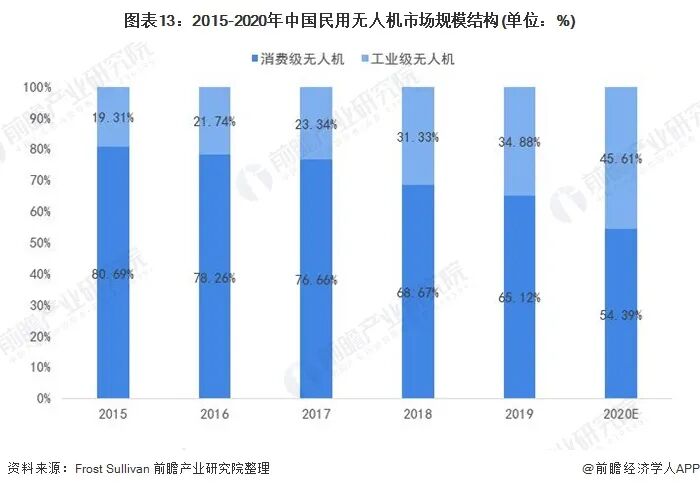
The second change is that consumer market growth is declining. From DJI's revenue composition, consumer drones remain its main revenue source, but the decline in consumer drone market growth is evident. According to a Frost & Sullivan research report, from 2017 to 2019, in China's civil drone market structure, consumer drones dropped from 76.66% to 65.21%, while industrial drones rose from 23.34% to 34.88%.
The consumer drone market is worth tens of billions of RMB. The main consumers fall into three categories: individuals or organizations with aerial photography needs, photography enthusiasts, and general tech enthusiasts. But like the problem Apple faces with iPhones, those who would buy have already bought. Once subsequent products don't show obvious breakthroughs in core technology, replacement rates drop.
On the other hand, what hasn't changed over these years is that no number two capable of challenging DJI has emerged. Xiaomi, GoPro, and others have tried and ultimately given up. The primary reason is that aerial photography drones demand extremely high technical capability. The technologies involved are multifaceted — being able to do flight control, gimbal stabilization, and obstacle avoidance well is truly rare.
FreeS: Specifically, where exactly do the difficulties lie?
Wang Mengqiu: For drones, hardware only accounts for 30-40%. Hardware refers to motors, servos, gimbals, and so on. Compared to smartphones, drones have higher requirements for heat dissipation and power consumption in these components. Hardware is hard; software is harder. Software includes flight control, gimbal control, image quality, and video transmission. Get one wrong, and you lose everything. So the technical threshold is very high.
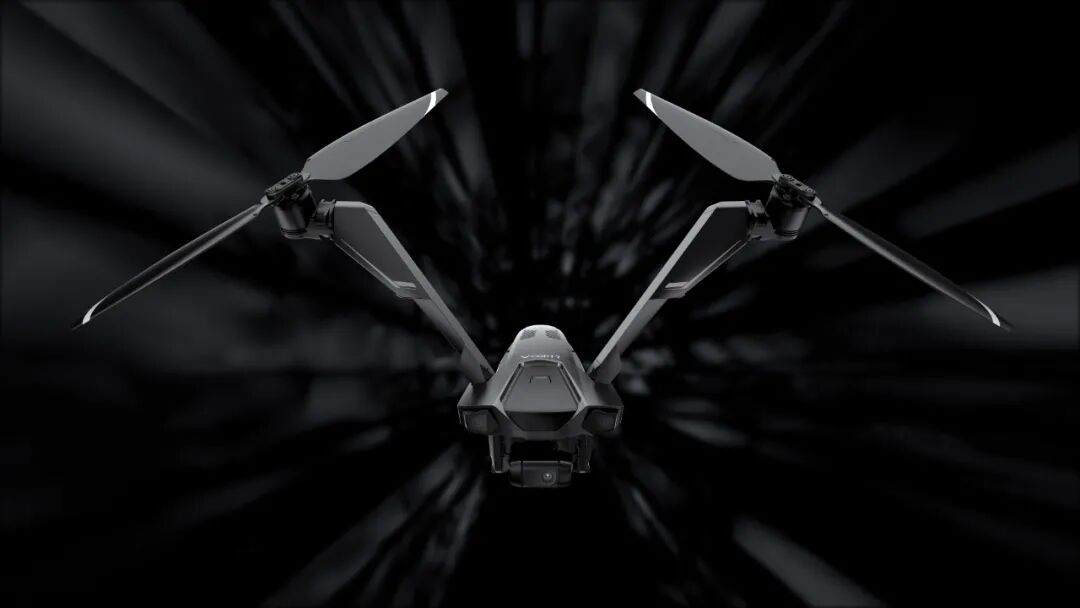
▲ Product image of Zero Zero Robotics' new dual-rotor Falcon drone.
Another issue is market scale. You could say the drone market isn't small — it's in the tens of billions of RMB — but you could also say it's not large enough; it hasn't reached tens of billions of USD. So technically, it's like automobiles in that we're essentially doing autonomous driving for aircraft. But because the market scale doesn't match automotive, commercial drones receive far less funding support, which means our R&D cost constraints are stricter.
Then there's the industry chain problem. Currently, the dominant player's entire R&D and manufacturing system is closed off, which means it hasn't cultivated a batch of core component suppliers that grew alongside the market. For large companies, having tens of thousands of employees is normal, but for startups, our human and material resources are limited. We may have breakthroughs in core technology, but it's hard to cover all system links. Filling the gaps is fraught with obstacles.
For us, one major gap was long-distance wireless video transmission — also a significant barrier in the drone industry. Think about it: a drone flying outdoors faces all kinds of signal interference. Achieving 7-8 kilometers, 1080P quality, under 300 milliseconds latency, viewable on a smartphone — that's very technically demanding. And chip manufacturers don't support this; Qualcomm won't define protocols for you, so you have to do encoding and decoding separately.

▲ Aerial photography from the Falcon drone.
FreeS: It sounds like the drone industry really requires using a sledgehammer to crack a nut — essentially doing "half" of autonomous driving within extremely limited space and battery performance constraints.
Wang Mengqiu: Yes, the difficulties are there, and we've carved out our own path to survival. Of course, we can't develop chips like Qualcomm's ourselves. Only by standing on the shoulders of giants can we move faster. So we turned our attention to China's already formidable smartphone industry chain.

▲ Aerial photography from the Falcon drone.
For example, mainstream drone manufacturers now use smartphone cameras — small enough in size, with sufficient image quality and resolution. The same goes for chips. Zero Zero Robotics is the first drone company to use smartphone chips. We don't have DJI's capability to develop integrated chips ourselves, so we now use two chips: in addition to a Qualcomm chip, we have a dedicated video transmission chip. Benefiting from the smartphone industry's development, the Qualcomm chips we use can cost as little as twenty to thirty USD — something the drone market alone could never achieve. Our video transmission chip comes from a Shanghai-based company.
/ 02 / "DJI is already so big. How do you survive?"
FreeS: I imagine you're constantly compared to DJI.
Wang Mengqiu: Yes, a common question people have is: DJI is already so big, how do you survive, or what opportunities do you still have? Indeed, the current state of this industry is: only first place, no second. So to fight for market share, we can only rely on innovation. When Zero Zero Robotics can offer consumers something new and eye-catching, they'll be interested. This is our only path to survive and develop amid fierce competition.
Of course, we can view the "one dominant player" situation from another angle.
First, "one dominant player" proves this market won't become a red ocean. Once a market becomes a red ocean, with thousands of players "killing each other," no one makes money and marketing costs skyrocket. When the wind dies down, only devastation remains.
Second, a market can't remain "one dominant player" forever. Prolonged monopoly creates opportunities. Looking at many industries' histories, long-term monopoly often breeds dissatisfaction among distributors, suppliers, and customers. This dissatisfaction accumulates and will eventually explode, especially when a sufficiently powerful external force grows. If other players can deliver sufficiently good products with relatively high cost-performance, that's the opportunity for new brands to seize market share.
For example, in the game console space, Nintendo stood alone. But in the former console wars, another company, Sega, developed the first 16-bit machine in the early 1980s to challenge Nintendo's 8-bit market dominance. From the late 1980s to early 1990s, Sega's MD (Mega Drive) once captured 65% of North America's 16-bit game console market. A new technological innovation can potentially take you from zero to very large.
For the next two years, our strategy is simple: close-quarters combat, striving to become number two. Within three years, we hope to capture 20% market share in the aerial photography drone market. We have sufficient capability and conviction.
▲ The Falcon drone's dual rotors.
What people can see now is that we were the first to pursue dual-rotor technology. In the dual-rotor product line, whether in configuration, manufacturing, control, software, or hardware, we're ahead. As our team expands, there's still enormous room for technical enhancement. We're also initiating a new funding round to support the company's development.
/ 03 / Abandoning the industry-standard quadrotor layout for a new dual-rotor approach: what problem is Zero Zero Robotics solving?
FreeS: Why pursue dual-rotor technology?
Wang Mengqiu: The industry-standard quadrotor layout, while having advantages like simple construction and low cost, has the obvious flaw of low aerodynamic efficiency. With current battery technology only improving 10-20% annually, achieving breakthroughs in flight time requires exploring innovative aircraft configurations.
We identified this challenge early on. From project initiation to official launch, we spent nearly four years, directly raising the aerial photography drone's flight time from the "industry default standard" of 30 minutes to 50 minutes.
To solve the endurance problem, the Falcon started with aerodynamic layout design, adopting a V-shaped transverse dual-rotor structure, combined with self-developed control surface tilting technology and nonlinear dynamic model design and control algorithms. Compared to quadrotor structures, the V-shaped transverse dual-rotor aerodynamic layout is more streamlined and more efficient. At equivalent weight and size, the aircraft body itself is lighter, enabling greater payload capacity. Without external payloads, more weight can be allocated to the battery power system, achieving longer flight time and fundamentally changing the definition and experience of aerial photography.
▲ The technology behind the Falcon drone.
FreeS: Longer flight time should be valuable beyond just aerial photography. Will you expand into industrial applications next?
Wang Mengqiu: Yes. To some extent, DJI has indeed brought decent user experience to consumer drone users, but flight time has always been a pain point. Given how singular the current drone market's structure is, our focus on long-endurance technology can offer the existing market more choices and potentially open up new markets.
Looking at the industrial market: the technical and cost advantages honed in consumer drones can potentially bring disruptive changes to traditional industry operations, such as drone-based power line inspection covering substations and towers. Unlike the consumer market, the industrial market hasn't seen a dominant player emerge and is still in rapid growth, so we have significant opportunities.
"The glimmers of light below the canyon are what everyone seeks — reasonableness. Innovation must venture deep into the canyon."
FreeS: In your view, where does your team's advantage lie?
Wang Mengqiu: First, our team is fairly clear about our strengths and weaknesses. My co-founder and I both spent over a decade abroad after graduating from Stanford with PhDs. Our weakness was having no industry resources when we returned to China to start a business — we were essentially "outsiders." Our strength lies in technical breakthroughs; during our PhDs, we researched things no one else had done. So we developed a methodology for innovation and R&D — how to move from theory to practice.
I often joke with my co-founder that these years of entrepreneurship have been like doing another PhD — a new four-year project, just with more hands-on work. In the early days, around 2017, our main task was doing experiments, data analysis, examining theoretical feasibility and the gap with practical application. Compared to some domestic manufacturers whose R&D and production departments are disconnected, though we had fewer people, we were always doing research while building products, tightly integrated. This is probably the most critical reason we've achieved technical innovation.
Another key factor is mindset. Many large companies are unwilling to invest in areas with high uncertainty. Because they're large, they have many concerns. With many projects to choose from, they tend toward more certain options. But as industry challengers, our situation determines our mindset: if we don't push ourselves to make more revolutionary innovations, we have no chance to challenge "number one" or shake up the established market structure. If we merely follow the industry leader with incremental innovations, we'll never rise.
More importantly, if we're content to be followers, we'll struggle to attract capable, ambitious people. The salaries we offer may not be the most competitive in the industry. So why do some excellent R&D personnel stay at Zero Zero Robotics for so many years? The most important reason is that what we do is unique and pioneering. For creative talent, a sense of achievement and honor may matter most.
FreeS: For startups, surviving requires withstanding uncertainty.
Wang Mengqiu: Indeed, this is the greatest test for our team. R&D, productization, then mass production — always facing challenges and changes. Because for many things, you can't determine stability without opening molds; you can't truly validate without reaching mass production. So you might finish the molds, get halfway through volume production, encounter problems, and have to redo everything — extremely painful. For many companies, this is hard to persist with.
Our ability to persist probably relates to our team's values. People who care too much about gains and losses, who fear failure, won't dare to do this. We care more about the process, so we're willing and dare to try. This may sound cliché, but it's true.
Initially, we couldn't be 100% certain that the product we imagined could actually be built. Innovation is like this — you're constantly exploring. Between unreasonableness and unreasonableness lies a deep canyon. The glimmers of light below the canyon are what everyone seeks — reasonableness. Things that are too reasonable have already been done; if you do them, you're copying. That's the easiest path, might earn you quick money, but has nothing to do with innovation. For that glimmer of light, that uncharted territory, you must venture deep into the canyon. That's the process of exploration. Our team likes doing this kind of thing, but it also means you can't fear failure.

When we launched this product, one netizen left an interesting comment: "Finally, a drone manufacturer that can force DJI to stop 'squeezing toothpaste.'" I think this is the meaning of what we do — continuous innovation that drives industry development.
I still believe hard work pays off. When you truly contribute to an industry, you can reap rewards.
Entrepreneurship requires learning to respect business; returnee entrepreneurs must embed themselves in the industry
FreeS: As a technically trained entrepreneur, what has been your greatest growth over these years?
Wang Mengqiu: Learning to respect business. Put more plainly, I understand accounting better now, and I calculate more carefully. Because every cent the team spends is earned back through products. R&D investment is huge — we burn through a lot of money every year — so everything must be spent carefully. So yes, I've become "stingier" than before.
But every company should be "stingy." Making money isn't easy; every expenditure must be worthwhile. My criteria for judging product managers have changed. For a product manager, the most important thing may not even be user experience — it's knowing how to do accounting. So we say, "pricing is the biggest user experience." Delivering a good experience at a reasonable price — that is good user experience, and that is respecting the market and consumers.
Respecting business laws allows a company to go further. But to go further, focusing only on interests is hardly enough to get you through those darkest moments of entrepreneurship.
FreeS: Over the years, you've weathered quite a few storms.
Wang Mengqiu: I believe most startups are like this. One experience left the deepest impression — we almost "fell from the clouds" all at once. At the time, I was completely shocked. I called a friend in China from the US. After I explained what happened, he was silent for about twenty seconds, then asked me one question: "Do you still have fight left in you?" I almost instinctively replied, "Yeah, I've got a lot of fighting will." After hearing this, he hung up. But it was precisely this question that pulled me out of the emotional quagmire at that moment, giving me tremendous encouragement and clarifying that I was still full of fight for this endeavor. That's hell — but with fight, what is there to fear?
I grew up in a military family. From childhood, I knew that death is inevitable. I believe life's greatest misfortune is being born at the wrong time or having talent go unrecognized. Having storms to weather, having things to stir up — that's actually fortunate. Entrepreneurship inevitably encounters setbacks. As long as you're still interested in what you're doing, "heal up" and keep going.
FreeS: You lived overseas for over a decade before returning to start a business. What advantages and challenges do returnee entrepreneurs face? What advice would you give to others wanting to follow the same path?
Wang Mengqiu: Personally, I feel the challenges outweigh the advantages.
Returnee advantages may include: you've received globally leading educational concepts, been exposed to the most advanced technologies and information, your capabilities have been selected and validated.
But the biggest challenge for returnee entrepreneurs is "not being grounded." For example, if you spent fourteen of the past fifteen years abroad, when you return to start a business in China, your accumulation in this industry or sector is certainly insufficient.
So I think the most likely successful team model for returnee entrepreneurs is returnee plus local. Academic R&D capability alone isn't enough; you must deeply integrate with industrial and industry circles — sales, channels, universities, KOLs, and so on.
To do well, you must embed yourself in the industry. Before committing to drones, I knew almost nothing about this industry. Later, I plunged myself deep into the drone ecosystem. I got to know nearly every drone manufacturer and supplier in Shenzhen, and practically tried to recruit every notable player in the drone field to my company.
Education Ups and Downs, Consumer Bubbles, Carbon Neutrality, Commercial Aerospace... "Cool" Reflections on Hot VC Topics | Li Feng Column 7 Biomedical Companies Raise Nearly 4 Billion, 3 Consumer Companies Secure Over 1.4 Billion in Funding | FreeS Family Funding News · August Celebrating Six Years, Looking Forward to More Upward-Striving Partners Joining | FreeS Fund Li Feng: Will Consumer Investment Stay Hot in 2021? | FreeS Research Institute "You Always Need to Balance Desire, Capability, and Resources" | FreeS 2021 China-US VC Forum Transcript Do Returnee Entrepreneurs No Longer Have Advantages? | 2021 FreeS China-US VC Forum Transcript What's It Like Doing Venture Capital in China? | 2021 FreeS China-US VC Forum Transcript
