Embodied Intelligence vs. Sports Tech: One Makes Machines Like Humans, the Other Turns Humans Into Machines? | FreeS Fund Report

How can technology help humanity push the boundaries of athletic performance?

Exercise seems like a topic everyone knows well — but do we really understand it? Probably not.
How does our body function during exercise? What's the underlying logic of exercise science? Why can athletic performance be improved? Does splurging on gear actually work?
When we strap on a smartwatch or attach sensors to an athlete's key joints, what are we really after? Why does the digitization of sports matter?
Is the pursuit of higher, faster, and stronger truly endless? Will extreme digitization of sports turn humans into machines — a kind of embodied intelligence in flesh and blood?
Shortly after this year's Paris Olympics closing ceremony, Pengqi Liu, executive director at FreeS Fund, delivered an in-depth talk at the firm's monthly meeting covering these very questions. Liu is both a tech investor and a seasoned sports enthusiast, and his perspective may offer you a fresh angle. If you're an entrepreneur or practitioner in the "tech+" space, feel free to reach out to him at pengqi@freesvc.com.
Reader Giveaway
Do you exercise regularly? Have you tried using technology to improve your performance? Leave a comment below — we'll randomly select 3 readers to receive a copy of Outlive: The Science and Art of Longevity.


/ 01 / The Underlying Logic of Exercise Science
To understand technology's value in competitive sports, we first need some exercise science fundamentals. The diagram below gives us a bird's-eye view of how movement works.
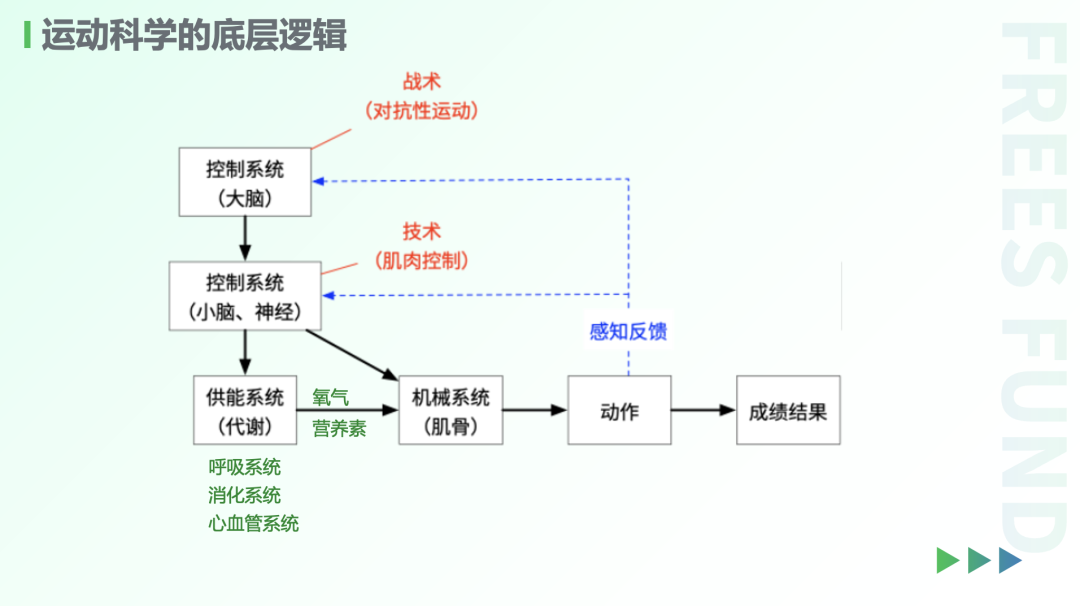
When we begin any exercise — running, playing ball — the brain first sets our movement goals, then the cerebellum directs the body to achieve them. At the execution level, we mobilize our underlying metabolic, nervous, and musculoskeletal systems to perform the actions.
Specifically, the body's energy supply system provides muscles with essential oxygen and nutrients. The cerebellum controls muscle contraction through the nervous system, generating our desired movements. This process involves converting biological energy to mechanical energy, making conversion efficiency critical.
Once our muscles and bones execute the movement, our body perceives itself, the environment, and opponents' states through various senses, feeding this information back to the brain and cerebellum to consciously or unconsciously adjust the next move.
The integrated result of this chain of actions may manifest as a 100-meter sprint time, a game score, a jump height — athletic performance.
This whole-body operating mechanism may remind you of what we discussed in our report The Road to Embodied Intelligence. Indeed, the development of embodied intelligence has drawn partly on how human movement works.
So facing the human body as a complex system, how can technology help us improve athletic performance?
We can draw an analogy to a more familiar complex system — the factory — to explore its optimization process.

To improve operational efficiency and production quality, a factory can either adopt more advanced equipment — high-end machinery, new materials — or enhance overall digital operations, using various sensors to monitor equipment and products, then optimizing system efficiency through intelligent means like improving processes or parameters, optimizing scheduling, and so on.
Returning to human movement as a complex system, we can similarly rely on external equipment to boost capability, while also digitizing physiological and biomechanical indicators to guide training and competition strategy, thereby improving overall athletic performance.

Next, we'll explore in depth what technology can do for us from both the equipment and digitization angles, and where else technology might help humans break through athletic limits.
/ 02 / How Has Equipment Evolution Shaped Competitive Sports?
Sports equipment has undeniably had a profound impact on competitive sports' development.

On the track and field, lighter, more elastic running shoes and faster-drying vests have opened a "second arena" beyond the athletes themselves.
Shooting jackets, through structural and material optimization, now offer greater stability and impact resistance.
Rackets, skis, and rowing equipment continue evolving toward higher strength and lighter weight.
Cycling equipment keeps pushing for lower wind resistance and lighter weight...
Abstractly speaking, all sports equipment — whether worn or used — can be seen as an extension and enhancement of our organs and structural functions (musculoskeletal system, cardiovascular system, skin, etc.). Its fundamental purpose is to improve mechanical energy conversion efficiency from a biomechanical perspective, or to achieve stable energy supply and power output from a metabolic perspective.

And behind equipment evolution lies the application of new materials, new structures, and new processes.

Take carbon fiber composites, widely used in industry. With their light weight, high strength, low thermal expansion coefficient, high temperature resistance, corrosion resistance, and good shock absorption, they've become highly sought-after in sports equipment. Whether in carbon-plated running shoes, tennis rackets, or bicycles, carbon fiber applications are now ubiquitous.
Other common new materials include Kevlar with its impact resistance and tear resistance, used in strings, uppers, and skis; and high-resilience polymer foam materials like EVA, TPU, and Pebax, commonly found in running shoes, skis, and yoga mats.
Beyond materials, equipment structure is intimately tied to functionality. CAD and CAE industrial design software already play roles in sports equipment structural design, with topology optimization applied to structural calculations. For example, nTop's topology-optimized cycling helmets and saddles achieve weight reduction through lattice structures.
As structures grow more complex and materials more diverse, 3D printing has begun playing an important role in sports equipment production. Customizing equipment to an athlete's individual characteristics and needs is no longer difficult.
/ 03 / Apparel Innovation Goes Far Beyond Fabric
Among sports equipment, clothing has the most direct contact with the human body, making its impact on athletic performance critical.
The Speedo FastSkin LZR Racer "shark skin" swimsuit that made waves at the Beijing Olympics used fabric inspired by shark skin's microstructure, mimicking its scale-like protrusions to reduce water turbulence and drag, allowing water to flow more smoothly over the body surface. Many athletes wearing this suit broke world records, but it was later banned by FINA due to the unfair competitive advantage created by its high cost.
This example fully demonstrates how significant apparel innovation can be for improving athletic performance.
For many sports demanding speed and agility, reducing resistance is key to better results. This explains why so many sports use tight-fitting garments — only by being sufficiently form-fitting can wind resistance be minimized, though this requires fabric with good elasticity to ensure comfort during high-speed movement. Additionally, many compression garments use seamless 3D knitting technology to reduce surface protrusions and friction, further lowering drag and improving comfort.
For shooting, a sport pursuing stability, clothing's role lies more in support. Through anthropometric measurement, posture analysis, material R&D, pattern comparison, and mechanical relationships, researchers use specially made canvas and leather materials to achieve high stiffness, high damping elasticity, and slow response characteristics.
Examples like compression garments, biomimetic shark skin swimsuits, and specialized shooting jackets all show how clothing plays important biomechanical roles. In fact, apparel innovation can also support the body's metabolic system, playing significant roles in thermoregulation, blood circulation, and muscle protection.
Take thermoregulation: energy conversion losses are typically dissipated as heat, and skin perspiration is the body's primary cooling mechanism. During exercise, if heat cannot be dissipated promptly, body temperature rises, impairing athletic capacity and even causing heatstroke. Most of us probably own a quick-dry shirt in our closet — its emphasis on moisture absorption, sweat wicking, and fast drying serves partly to keep body temperature in a relatively comfortable range.
In recent years, many thermoregulation "black technologies" have emerged. At the Paris Olympics, women's marathon champion Sifan Hassan and men's marathon runner Eliud Kipchoge both wore Omius cooling headbands. These used highly thermally conductive graphite material, hydrophilic coating, and porous structure to help marathon runners stay cool over long distances.

Interestingly, this graphite material was previously widely used for CPU and server cooling — now finding application in sports, a typical cross-disciplinary technology transfer.
There are many similar industry crossover cases. Technology widely used in medicine to prevent varicose veins has been adapted by brands like 2XU, CEP, and Compressport into gradient compression garments, improving peripheral blood circulation to combat fatigue and accelerate recovery.
To summarize, in apparel innovation we can see how technology helps people improve athletic performance from biomechanical and exercise energy metabolism perspectives.
/ 04 / How Has Sensor Evolution Driven Sports Digitization?
Digitizing human movement processes operates on logic that's essentially the inverse of embodied intelligence R&D.

Embodied intelligence strives to "turn machines into humans," while the ultimate goal of sports digitization seems to be "turning humans into machines" — creating digital twins of people, comprehensively collecting and monitoring key individual and exercise-related indicators, then optimizing these indicators to provide advice on diet, training, rest, and more. Though this may ultimately improve athletic performance, turning humans into machines sounds somewhat brutal.
So how is this "turning humans into machines" process achieved? We need to return to the general patterns of digital development across industries.
The core inflection point for nearly every industry moving from experiential, to standardized, to intelligent is "informatization." Before informatization, we mainly relied on common sense to understand the world and industries. As sensor technology advanced and data became progressively structured, many industries entered stages of online connectivity, datafication, and even intelligence.

The sports industry is no exception. Specifically, sports informatization is achieved mainly through three methods:
- Various sensor data: collecting and monitoring athletes' physiological and biomechanical indicators;
- Various competition-related data: timing, scoring, measurement, technical statistics, etc.;
- Video-related dynamic data: using game and training footage for technical and tactical analysis (AI multimodal understanding).

The online connectivity of this data is mainly accomplished through data aggregation and sharing, remote coaching, and similar processes. Subsequently, big data and AI analysis can evaluate athletic performance, optimize training and recovery plans, and even formulate competition strategies. In the sports digitization direction, we focus on three key areas:
- Evolution of exercise physiology-related sensors
- Using video analysis tools for technical and tactical analysis
- Data analysis and decision-guidance-based exercise science, covering training, competition, nutrition, recovery, and more.
Taking sensor evolution as an example, the application of various sensors has truly enabled the digitization of athletes' various indicators.
Common monitoring indicators fall into two categories. One is metabolism-related indicators, including heart rate, resting heart rate, heart rate variability, blood oxygen, blood glucose, etc., used to monitor exercise intensity, assess aerobic capacity, and adjust exercise nutrition and in-race fueling strategies. The other is dynamic indicators like speed, distance, power, foot strike force, and movement trajectory, more often used to evaluate technical proficiency.

The measurement methods involved are diverse, including ECG and PPG photoplethysmography in Apple Watches, GPS, barometers, as well as CGM continuous glucose monitoring, gas analyzers, accelerometers, gyroscopes, magnetometers, pressure sensors, and more.
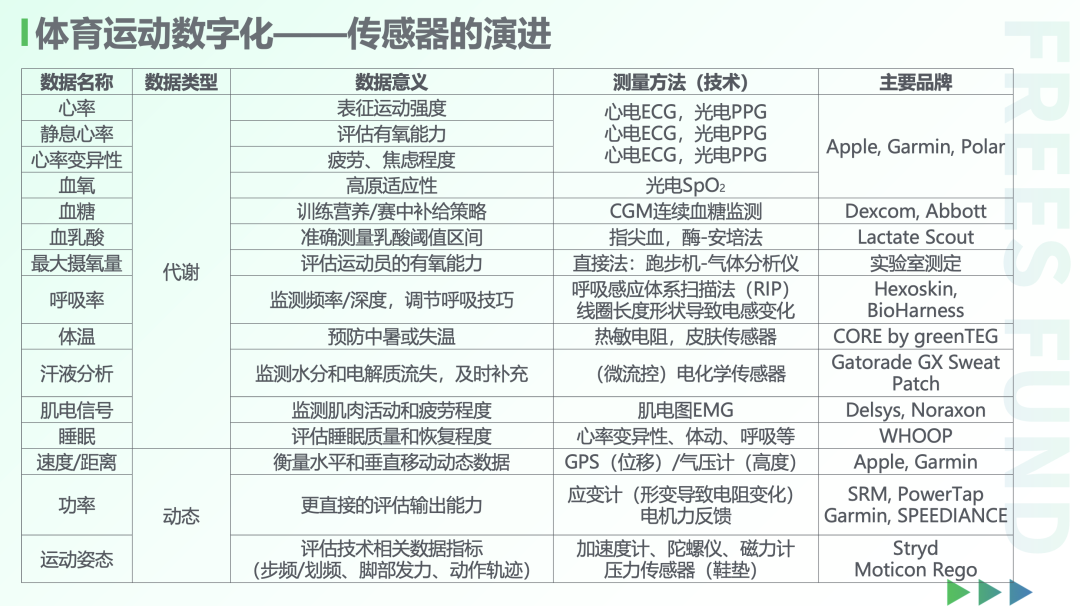
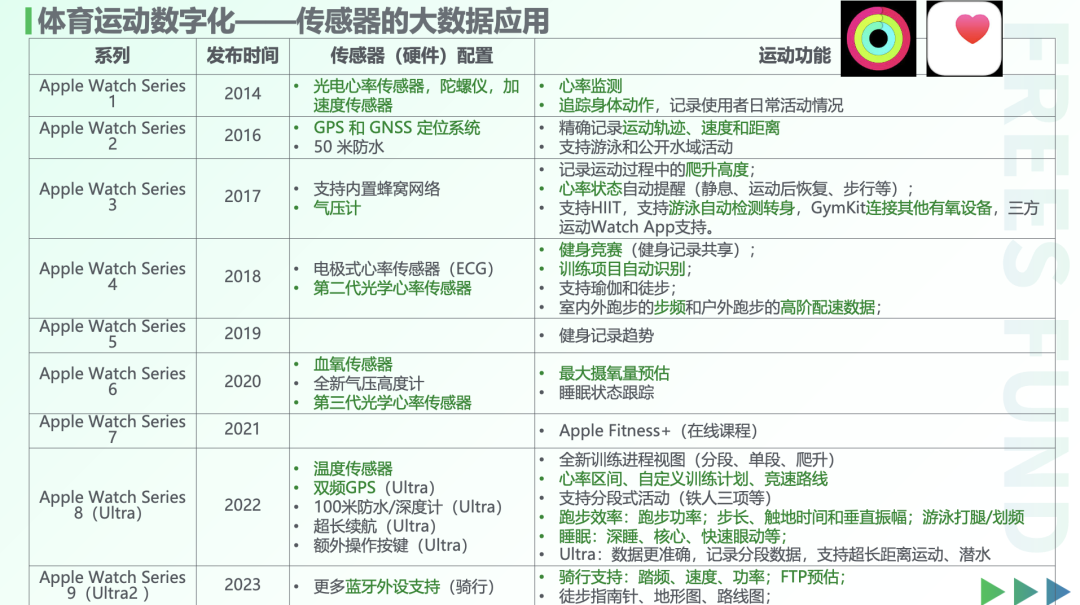
As for specific applications of these indicators, they involve an important training principle — the principle of periodization.
Appropriate load + adequate rest + progressive load + adequate rest + ... = improved athletic performance
Within a certain cycle, first establish an appropriate training load, then give the athlete sufficient rest. Once the athlete adapts to the current training load, increase the load and rest again, repeating this cycle. Under ideal conditions, the athlete's performance will rise in a spiral pattern. If poorly controlled — insufficient rest or excessive overload — athletic performance may decline.
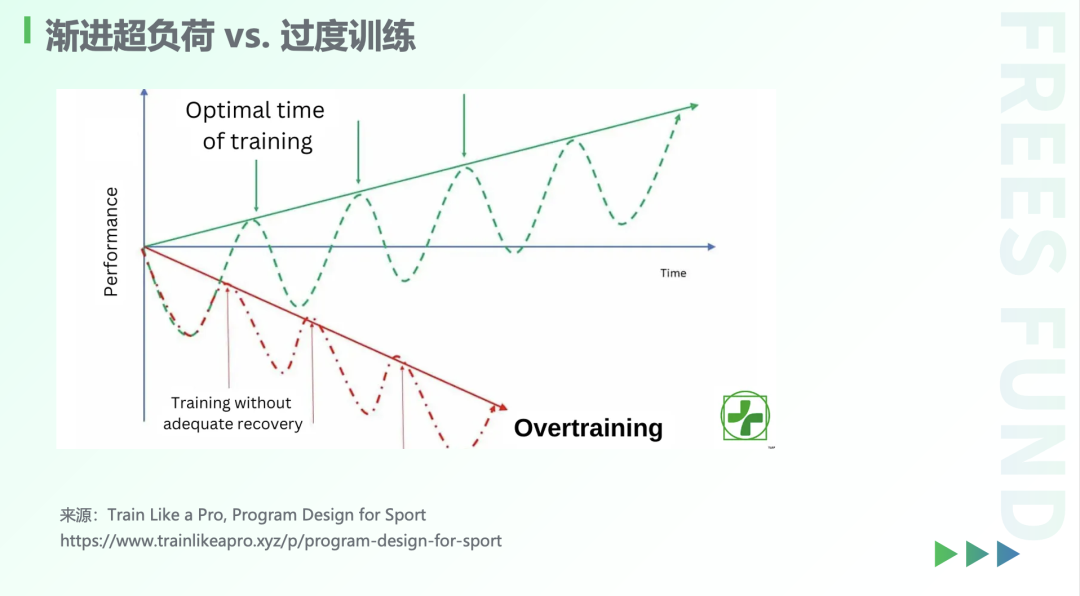
To precisely practice periodization, we need to quantify several key indicators: training load, athletic performance, and fatigue level. For training load, consider this formula: Training Load = Training Time × Training Intensity. Training time is easy to determine, while exercise intensity can be assessed through monitored heart rate, pace, power, etc. To gauge whether performance has improved, look at indicators like aerobic pace, threshold power, resting heart rate, and VO2 max. To assess whether rest has been adequate, heart rate variability is a key metric.

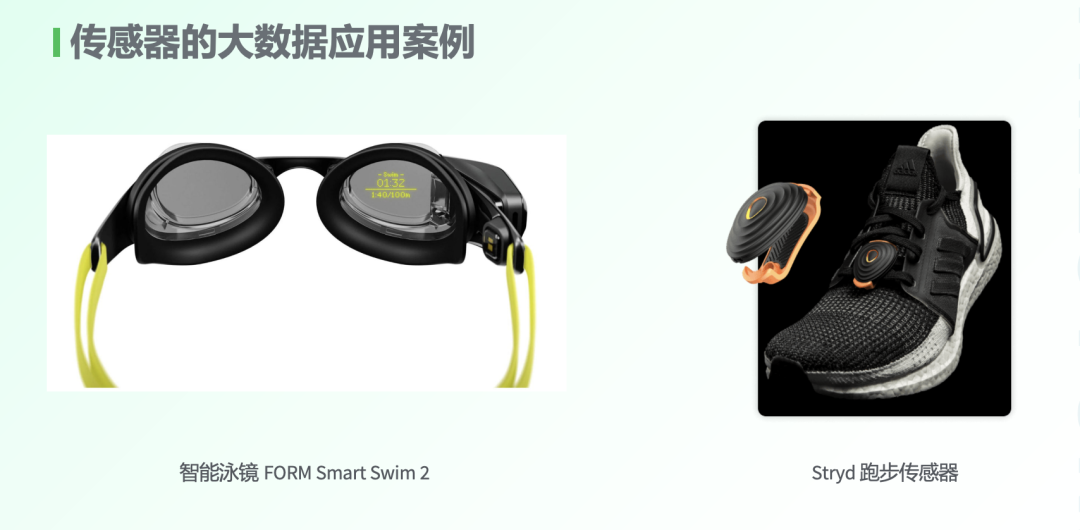
Many companies have made efforts in data monitoring, integration, and analysis. For example, the FORM Smart Swim 2 smart goggles incorporate AR technology through waveguide optics and onboard sensors to provide real-time metrics, training guidance, and live swim coaching. The Stryd running sensor, compatible with smartwatches and smartphones, can accurately (fitted) calculate running power and running dynamics. Compared to pace, its quantification of running intensity is less affected by physical environmental conditions (wind speed, gradient, etc.). Additionally, at this Olympics, some athletes wore a Stryd on each foot to monitor whether bilateral performance was balanced.
Though AI technology in fitness products is nothing new, the wearable device WHOOP — invested in by footballer Cristiano Ronaldo — has attracted millions of subscribers through its high degree of personalization. This screenless device passively monitors activity, strain, sleep, and recovery. Based on this data, WHOOP Coach can customize training plans, workout schedules, and meal plans for users.
Originally developed for diabetics, continuous glucose monitors have now been applied to sports. Under data guidance, athletes can not only avoid in-race hypoglycemia but also understand blood glucose changes during sleep, thereby finding personalized dietary approaches based on their digestive capacity and food insulin sensitivity.
Additionally, video analysis applications also contribute to sports digitization. The underlying technology is similar to computer vision used in security and other scenarios, differing mainly in monitoring targets such as player positions, joint angles, and ball trajectories. Real-time recording and analysis of these targets can help coaches understand athletes' technical movements and further guide tactical strategies.
Overall, at the sports digitization level, sensors generate massive new data, combined with structured information accumulated from video, then analyzed through big data and some AI optimization, helping athletes and fitness enthusiasts find training methods better suited to themselves.
In preparation for this Olympics, the Department of Electronic Engineering at Tsinghua University research team developed near-imperceptible wearable devices tailored to boxing's characteristics. By real-time monitoring of athletes' physiological parameters, combined with boxing-specific endurance and technical-tactical effectiveness analysis and diagnosis in the intelligent training system, the research team digitized athletes' training status, effectively improving training efficiency and athletic performance.

Sports Technology and Humanoid Robots: Do They Converge?
As mentioned earlier, the development of embodied intelligence or humanoid robots has drawn partly on how human movement works. And when technology digitizes human movement to optimize athletic performance, it seems to be turning humans into machines. Sports technology and humanoid robots appear to be two branches of the same technology tree.

Notably, many core components that the humanoid robot industry is striving to develop have already begun finding applications in sports. For example, tactile sensors measuring grip force can help athletes improve racket swing performance — monitoring the specific pressure applied by each finger and joint during the swing motion, then providing specific advice based on this to achieve better striking level. Similarly, smart insoles integrating pressure sensors to measure plantar pressure distribution can be used for running gait analysis and rehabilitation training.
On one hand, this real human data can help athletes improve performance; on the other, it may serve as "nutrient" to help humanoid robots with imitation learning training (as previously discussed regarding "small model" data for embodied intelligence). Because humans acquiring a motor skill and forming muscle memory, like robot imitation learning, both require extensive imitation learning and training, not to mention reinforcement learning.
From this perspective, researching how to digitize human movement actually also helps us better iterate embodied intelligence.
Summary
To briefly summarize, technology's applications in competitive sports are increasingly widespread, mainly manifesting in:
- Materials science;
- Innovative structures and process methods;
- Various high-precision sensor technologies;
- Digitization and AI technology.
These technological applications have driven sports equipment upgrades, improved athletes' competitive levels, and continuously pushed human athletic capability to new heights. We believe these technologies will also gradually be applied to mass sports and fitness, opening broader markets.
Driving these sports technology developments are not only sports brands and tech companies (such as Nike, Adidas, Apple, Garmin), but also many technology transfers from medical, industrial, and other industries into sports. Of course, we've also seen exploration and contributions from startups.
As breaking human limits becomes increasingly difficult and the sports field grows more competitive, more innovation opportunities will inevitably emerge. We remain bullish on frontier technology applications in the sports industry, and look forward to seeing more and more sports technology companies emerging domestically.
Equally worth anticipating is how these innovations may empower other industries, sparking entirely new technology application possibilities.
Reader Giveaway
Do you exercise regularly? Have you tried using technology to improve your performance? Leave a comment below — we'll randomly select 3 readers to receive a copy of Outlive: The Science and Art of Longevity.

▲ The Truth About Weight Loss, and Innovation Opportunities | FreeS Report
▲ The Road to Embodied Intelligence | FreeS Report
▲ Dialogue with Tsinghua Professor Wenguang Chen: What If Large Models Stop Competing on "Large"?
▲ Nine Years and Going Strong — Welcome to Join FreeS, Let's Go Further Together
▲ Decoding Aging, Resisting Aging | FreeS Report
Star the FreeS Fund WeChat official account for timely business insights