eVTOL, China's Next Opportunity to Overtake on the Bend

How do eVTOLs defy gravity, letting us take off like birds at any moment?
If someone needs to get from Shanghai's Lingang area to Hongqiao Station, what's the fastest way possible?
The subway takes two and a half hours. A taxi, an hour and a half. An eVTOL? Roughly 30 minutes.
eVTOL stands for Electric Vertical Takeoff and Landing. The "electric" and "vertical" parts are what set it apart from conventional aircraft. In transportation, eVTOL has emerged as one of the most closely watched frontiers. According to the VFS (Vertical Flight Society) directory, as of October 2023, roughly 900 eVTOL models were in development worldwide.
Commercial deployment may not be that far off. Consulting firm Roland Berger predicts 5,000 eVTOLs in commercial operation globally by 2030, surging to 45,000 by 2040. In November 2024, China's Central Air Traffic Management Commission announced pilot programs in six cities. By year-end, the National Development and Reform Commission had established a dedicated low-altitude economy department — a strong signal indeed.
In the low-altitude economy space, besides eVTOL, other aerial vehicles including drones and cargo aircraft hold some market potential. But when it comes to value-added prospects and room for growth, eVTOL stands out as the most promising path.
Tian Yun, CEO of Yuntu Aircraft, sees eVTOL as the convergence point of three core industries: transportation, energy, and information. It can drive advances in vehicles, push battery technology forward, and accelerate automation and autonomous driving. In the future, he believes, everyone will be able to take flight like a bird, soaring through a "city in the sky."

Tian Yun was fully involved in the supercritical wing design of the C919 and multiple national-level major projects. In 2024, he founded Yuntu Aircraft, focusing on eVTOL power systems and complete aircraft design. The company's core products are electric ducted fan propulsion systems and derivative aircraft, with fully independent R&D capabilities.
At FreeS Fund's 2024 Annual Investor Summit, Tian Yun shared his systematic thinking on the eVTOL industry, including:
- In transportation, why is eVTOL China's next opportunity to "overtake on a curve"?
- With roughly 900 eVTOL models in development globally, what's behind such a large number?
- How can the evolution of large commercial aircraft inform where eVTOL is headed?
- How will eVTOL reshape our lives in the future?
During the dialogue session, Feng Shu also discussed with Tian Yun the localization rate of the C919 and why eVTOL represents the ultimate solution. We've edited that portion and placed it at the end.
We hope this offers fresh perspectives. Feel free to leave a comment sharing your views on eVTOL.
Click the video above to watch highlights from the summit 👆
Giveaway
What do you think about eVTOL? Leave a comment below. We'll randomly select five readers to receive the latest industry research handbook from the FreeS Fund team.

/ 01 /
Start with the End in Mind: Why Now Is the Time for eVTOL Entrepreneurship
My topic today is "Start with the End in Mind: Why Now Is the Time for eVTOL Entrepreneurship." By "start with the end in mind," I mean goal-oriented design. When developing a product, we must first define its performance and specifications, then work backward to the concrete engineering tasks.
This sounds elementary, yet it carries unusual weight in today's eVTOL field.
eVTOL stands for Electric Vertical Takeoff and Landing aircraft. In China, it's commonly called "flying cars." Catchy as that sounds, it's not entirely accurate. The term "electric vertical takeoff and landing aircraft" emphasizes the two defining features — electric propulsion and vertical takeoff and landing — that distinguish this category from traditional helicopters or fixed-wing planes.
I. Transportation's Next "Overtake on a Curve" Opportunity
Looking back, China has already made significant strides in two major transportation sectors — electric vehicles and high-speed rail.
Where will our next opportunity to overtake on a curve come from?
It could be electric aviation. Historically, nearly every revolution in propulsion systems has reshaped industry dynamics, spawned new entrants, and toppled incumbents.
Within electric aviation, eVTOL is one of the most representative branches. Current technology, particularly battery energy density, is already sufficient to support eVTOL development. While full electrification of large commercial aircraft may still be far off, existing technology can meet the needs of short-distance, low-speed urban air mobility.
eVTOL can address at least two major pain points in transportation: First, alleviating ground traffic congestion. Second, reducing infrastructure costs. Compared to building high-speed rail networks, eVTOL requires far less infrastructure investment. The U.S., for instance, never built high-speed rail and is now heavily backing eVTOL development.
II. Why So Many Players?
According to the VFS directory, as of October 2023, roughly 900 eVTOL models were in development worldwide. What's behind such a large number?
1. High sector heat eVTOL has become a closely watched new frontier, attracting investors and entrepreneurs from all walks of life. Beyond traditional aviation companies, automakers, drone manufacturers, and startups have all entered the fray.
2. Lower trial-and-error costs Compared to developing large commercial or military aircraft, eVTOL has shorter R&D cycles and relatively lower capital requirements.
3. Diverse design goals Different developers target different objectives. Some aim for 50 km/h speeds; others target longer ranges and higher speeds — 200 km/h or even 300 km/h. Requirements for safety, comfort, and noise levels also vary widely, leading to a proliferation of designs.
eVTOL is not merely a product of technological innovation; it's an inevitable choice as society and economy reach a certain stage of development. In a country with China's vast population and growth potential, eVTOL could become another transformative force in transportation, following electric vehicles and high-speed rail.
/ 02 /
Learning from History: What the Evolution of Large Commercial Aircraft Tells Us About eVTOL's Future
After reviewing the technical approaches of numerous eVTOL products, we can identify a clear trajectory of development.
Early eVTOL designs mostly adopted multirotor configurations — essentially scaled-up DJI drones adapted for human passengers. Companies like EHang have validated this approach. But widespread practical application for multirotor designs remains distant.
As technology advanced, compound-wing and tilt-rotor designs emerged, including various configurations with ducted fan tilt mechanisms.
Where should eVTOL head in the future?
Like any engineering design, eVTOL must follow fundamental scientific and technical principles — given constraints and design objectives, solutions ultimately converge on one or two optimal configurations.
To understand eVTOL's possible future directions, we can look to the evolution of large commercial aircraft.
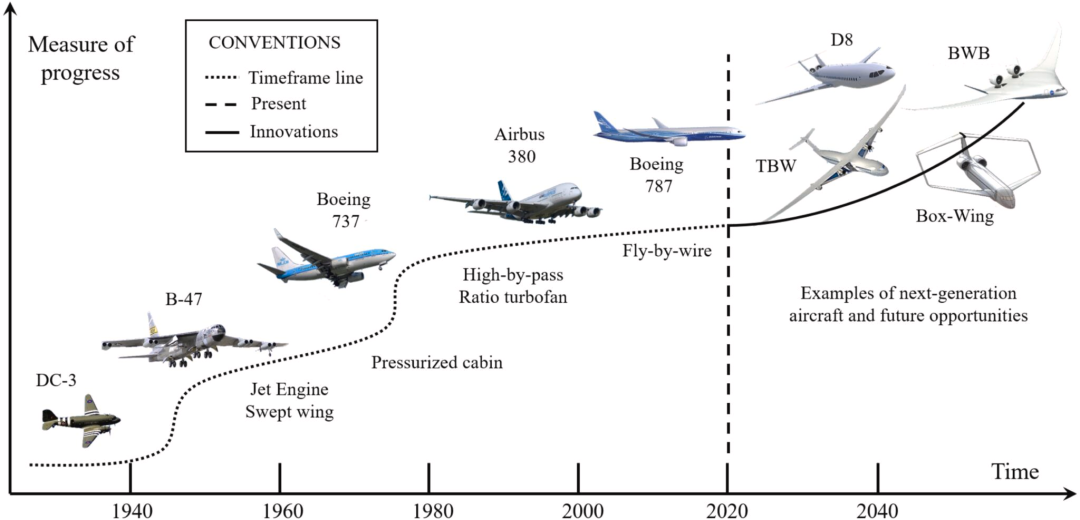
▲ Evolution of large commercial aircraft
Image source: Bravo-Mosquera, P. D., Catalano, F. M., & Zingg, D. W. (2022). Unconventional aircraft for civil aviation: A review of concepts and design methodologies. Progress in Aerospace Sciences.
During World War II, the Douglas DC-3 (military version C-47), powered by piston engines and propellers, set a production record exceeding 10,000 units and flew the Hump airlift route during China's War of Resistance Against Japanese Aggression.
Near the end of WWII, aviation propulsion underwent a revolutionary change — jet engines gradually spread to military and civilian aircraft.
At this time, Britain's de Havilland and America's Boeing were the first to adopt jet engines for large passenger aircraft development.
Pursuing simplicity and elegant form, de Havilland chose to mount four jet engines at the wing roots (roughly the "armpit" position of the aircraft). Boeing, considering overall aerodynamics, structures, and maintenance requirements, decided to hang engines beneath the wings.
Despite de Havilland's good intentions, critical safety considerations were overlooked. Engine vibration caused metal fatigue (repeated cabin pressurization and square windows exacerbated this), particularly at the wing-fuselage junction. This led to three in-flight breakups between 1953 and 1954, forcing de Havilland out of the large commercial aircraft business permanently.
Boeing, by contrast, chose the right path. To this day, whether the Boeing 787 or Airbus A350, modern large aircraft follow the same general layout: cylindrical fuselage, swept wings, and engines suspended beneath the wings. This configuration became the industry standard because it achieves the best balance across multiple dimensions — aerodynamic performance, structural integrity, and maintenance accessibility.
However, as technological progress slowed, the potential of this traditional configuration neared its limits. From the Boeing 737 NG series of the 1990s to the Boeing 787 launched in 2009, despite decades of advancement, improvements in fuel efficiency and overall performance were relatively modest.
With traditional configurations reaching their ceiling, aviation electrification has become an unstoppable trend that will drive new changes in aircraft configuration.
NASA and other research institutions have begun exploring next-generation large aircraft possibilities. Meanwhile, COMAC is actively advancing development of the C919's successor.
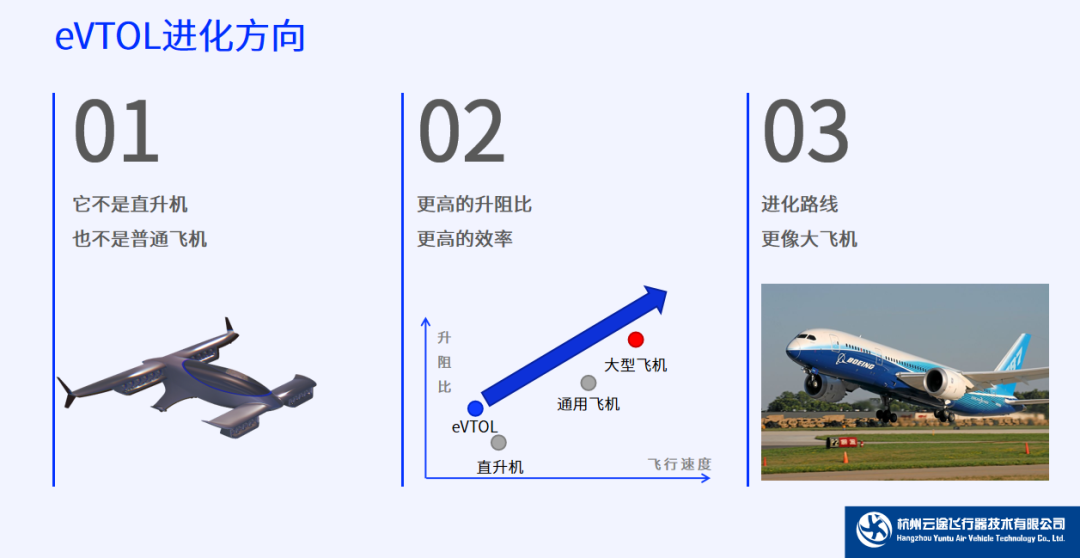
Image source: Yuntu Aircraft, FlightAware
/ 03 /
What Factors Matter in eVTOL Design?
I. How eVTOL Differs from Traditional Aircraft
When discussing eVTOL design, we must first clarify its main differences from conventional aircraft.
While helicopters can carry passengers and fly over cities, they cannot solve the noise problem. Helicopter rotors spin relatively slowly (typically a few hundred RPM), producing low-frequency noise. Low-frequency noise has strong penetration and decays slowly. When a helicopter flies overhead, residents within a 10-kilometer radius can hear it. This is unacceptable for urban environments, eliminating helicopters from this application scenario.
Conventional fixed-wing aircraft require runways for takeoff and landing. One of eVTOL's core advantages is vertical takeoff and landing capability without dependence on large airport facilities. Without VTOL, eVTOL's application scenarios would be severely limited, unable to fulfill its role as an urban air mobility vehicle.
II. Key Design Considerations
eVTOL design must integrate multiple factors to meet practical application needs and deliver good user experience. Here are several critical considerations:
1. Lift-to-drag ratio and flight speed In aviation, lift-to-drag ratio is a crucial concept. The higher the ratio, the less thrust needed to support the same weight. Suppose an aircraft weighs 100 tons with a lift-to-drag ratio of 10; a 10-ton-thrust engine can propel it forward. If the ratio improves to 100, only 1 ton of thrust is needed. The Boeing 787 and Airbus A350, through optimized aerodynamic design, achieve cruise lift-to-drag ratios approaching 20 — nearly double current eVTOL levels.
Flight speed is another critical metric; faster flight means higher efficiency. Large aircraft excel in both lift-to-drag ratio and speed, reaching the highest levels for subsonic fixed-wing aircraft. While eVTOL already surpasses helicopters in lift-to-drag ratio, it still has considerable room for speed improvement.
Industry forecasts suggest eVTOL's initial deployment will likely be for short-range, high-speed intercity travel — China's Yangtze River Delta, Pearl River Delta, and Chengdu-Chongqing city clusters, where demand for fast, convenient transport is strong. If eVTOL can offer roughly 300 km range at 300 km/h, approaching high-speed rail speeds, it will be highly competitive.
2. Safety, comfort, and quietness Current eVTOL products don't pay enough attention to safety, comfort, and quietness, yet these factors ultimately determine configuration design and market potential.
First, safety is aviation's paramount concern. China's civil aviation safety ranks among the world's best, with extremely low accident rates and stringent standards for new aircraft types. After two major accidents involving the Boeing 737 MAX, China's civil aviation authority was the first to ground the model. Additionally, China's commercial fleet has the youngest average age globally; older aircraft are quickly retired. eVTOL design must ensure adequate safety performance.
Second, comfort is critically important. Today's consumers, especially in China's rising middle-class market, demand increasingly high standards for the travel experience. People seek not just efficient transport but comfortable journeys. The C919 design team once considered narrowing the fuselage and reducing seat width for efficiency, but research showed this would hurt passenger experience. Ultimately, the C919's middle seat is wider than those on the A320 and B737. eVTOL design must prioritize user comfort, avoiding cost-cutting that sacrifices experience.
Third, noise control is both a major design challenge and a key determinant of whether eVTOL can be widely deployed in urban environments.
In the 1970s, Britain and France jointly developed the Concorde, humanity's first supersonic airliner. It flew until 2003, but total production barely exceeded 20 units. Despite its speed, the Concorde could never overcome the noise problem and never became mainstream or expanded to broader markets. The U.S., for example, banned civilian supersonic flight over land in the 1970s — a restriction still in place today, representing the biggest technical barrier to commercial supersonic passenger aircraft.
Designing eVTOL, then, is not merely a matter of technological innovation; it requires focused attention on safety, comfort, and noise control.
How to Innovate?
Based on these multifaceted considerations for eVTOL design, we have identified several key technical characteristics to optimize our approach. Here are the specific details and rationale:
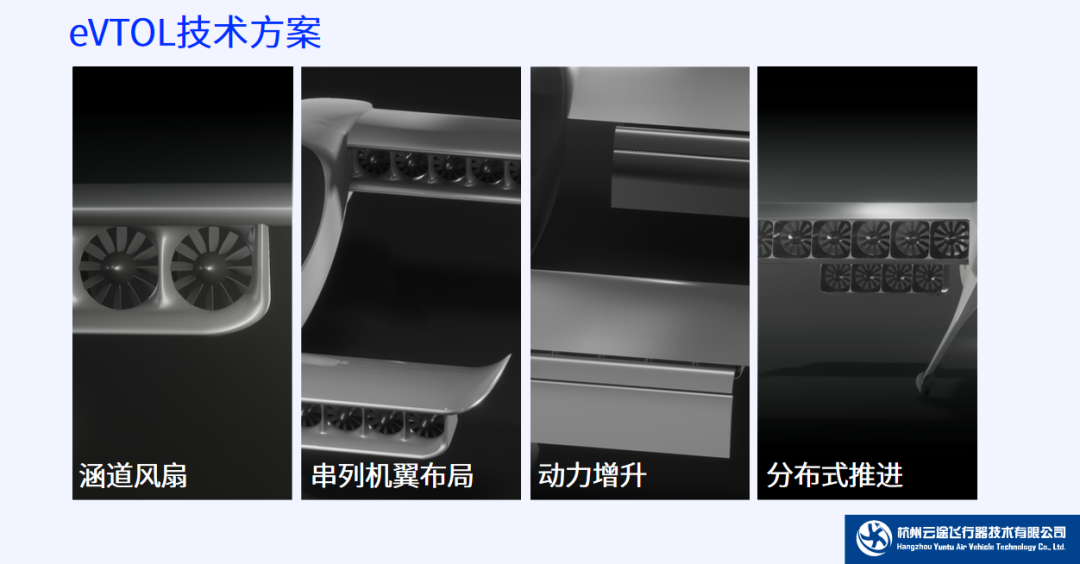
I. Ducted Fan Technology
Ducted fans can be viewed as the electrified version of traditional turbofan engines.
A conventional turbofan engine's core consists mainly of a compressor, combustion chamber, and turbine, whose primary purpose is to drive the large front fan. This fan generates about 80% of thrust; jet exhaust contributes less than 20%.
In 2019, Rolls-Royce introduced its next-generation electric propulsion engine concept, directly replacing the core with an electric motor to drive fan rotation. This simplifies structure, improves efficiency, and dramatically reduces noise.
To replace engines on a large aircraft like the C919 would require motors reaching 20 megawatts. Siemens has already achieved 2-megawatt motors in the lab. While 20 megawatts remains distant, the technology is sufficiently mature for scaled-down eVTOL applications — for instance, using 100-kilowatt motors to drive fans.
Ducted fan technology's main advantage is significantly reduced noise and enhanced safety. Compared to traditional propellers, ducted fans generate markedly less noise — critical for large-scale urban air mobility.
China's civil aviation has developed rapidly, yet the entire country has only about 4,000-plus commercial aircraft. If eVTOL scales up, thousands of aircraft could share the sky simultaneously. If each produced substantial noise, it would severely impact urban living environments.
II. Tandem Wing Configuration
A tandem wing configuration places wing sets at both front and rear of the fuselage, improving flight stability and efficiency.
Traditional aircraft have a single wing bearing all weight, like one person carrying two buckets of water — difficult to balance. With tandem wings, it's like two people carrying one bucket together, making it easier to adjust seat count and fuselage dimensions for different market needs. We can scale from 5 seats to 7, 9, even 16 seats.
III. Powered Lift Technology
Whenever I fly, I prefer window seats so I can watch the flaps extend during takeoff and landing. Flaps are movable surfaces on the wings that change wing camber and area to increase lift.
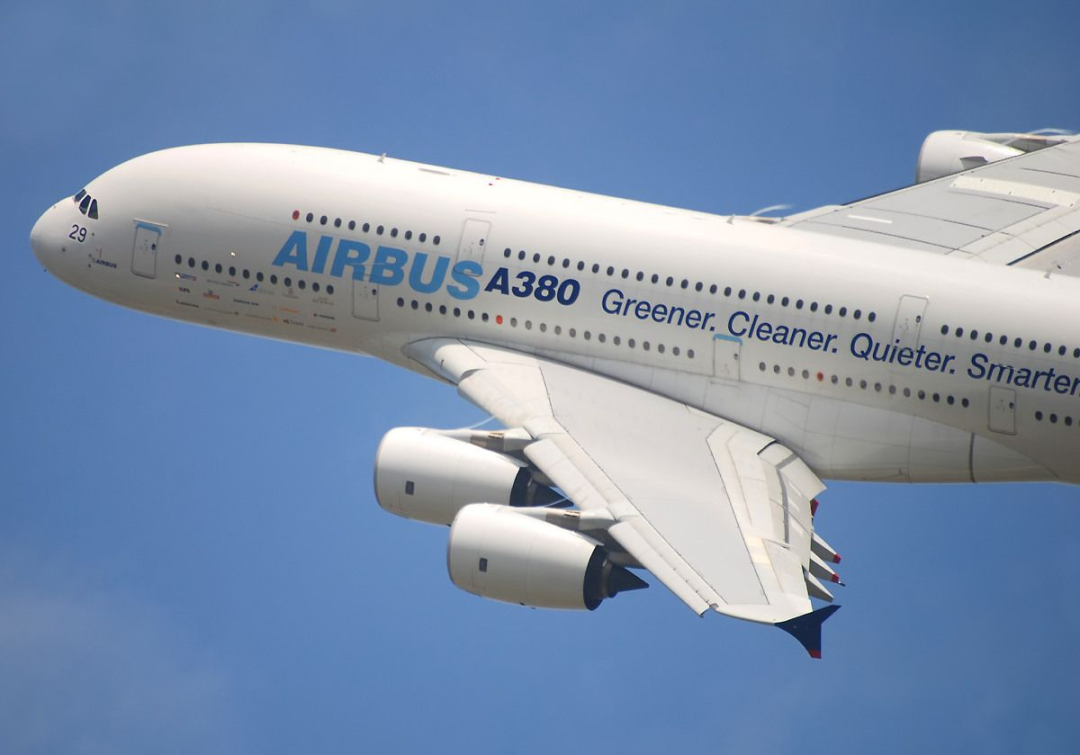 ▲ Aircraft flap diagram. Image source: FlightAware
Powered lift technology draws from large aircraft design, using fan exhaust to blow over flaps during takeoff and landing to increase lift. This enhances eVTOL's short/vertical takeoff and landing capability and allows flexible payload adjustment for different scenarios, expanding applicability. For example, at rudimentary airfields or short runways, eVTOL can adjust flap deflection to take off and land in limited spaces, adapting to more diverse applications.
Our participation in the C919 project involved extensive work on wing high-lift device design, accumulating rich experience. Proper configuration of leading and trailing edge high-lift devices can significantly boost lift during takeoff and landing, compensating for insufficient lift at low speeds.
IV. Distributed Propulsion Systems
Distributed propulsion is a major change brought by aviation electrification.
In the traditional turbofan era, manufacturers sought to minimize engine count for efficiency — larger engines mean higher bypass ratios and better efficiency. The GE90 on the Boeing 777, for instance, delivers 60 tons of thrust per engine, among the world's largest.
Under electrification, motor efficiency is independent of size. If a 10-kilowatt motor weighs 1 kilogram, a 100-kilowatt motor weighs 10 kilograms — the ratio holds. More importantly, whether 1 kilowatt or 10 kilowatts, efficiency remains essentially the same.
Thus, we can flexibly arrange multiple motors as needed. Even if several fail, others continue operating, greatly improving system safety and reliability. Distributed propulsion — multiple power systems — will become a major trend in future aviation design. NASA and others are exploring this direction.
Based on its understanding of the eVTOL sector, Yuntu Aircraft has conducted extensive technical research. We have mastered core technologies including electric ducted fans, distributed propulsion, and powered lift, and will focus on engineering application going forward.
/ 05 /
"Everyone Will Be Able to Take Flight Like a Bird"
In the low-altitude economy, beyond eVTOL, other aerial vehicles including drones and cargo aircraft hold some market potential.
But in terms of value-added prospects and future growth space, eVTOL is undoubtedly the most promising choice.
Because eVTOL sits at the intersection of three core industries: transportation, energy, and information. It can drive vehicle development, push new energy battery technology forward, and accelerate information automation and autonomous driving.
I once watched a documentary mentioning foreign institutions secretly researching "anti-gravity technology." It struck me that aerospace has always been "fighting gravity" — from early balloons to modern jet aircraft and launch vehicles, to today's eVTOL. Each advance represents humanity's ongoing challenge to gravity.
eVTOL could be considered version 1.0 of low-altitude economy's anti-gravity technology R&D. I believe that one day, everyone will fly as freely as birds. This vision isn't far-fetched, because technological innovation often comes in leaps. Humanity will inevitably enter the blue ocean of three-dimensional transportation, and we are now at stage one.
/ 06 /
Q&A
I. C919 Localization Rate
Feng Shu: When industry insiders and outsiders discuss C919 localization, they focus heavily on electronics and engines. Can you share specifics on C919 localization?
Tian Yun: Some online claim the C919 is just a shell with foreign core components.
It's true that C919's engines, avionics, hydraulic systems, environmental control systems, electrical systems, navigation systems, and communication systems come from foreign suppliers.
The reason is straightforward: the C919 is intended for commercial operation. To obtain airworthiness certification, the fastest path is using products already certified. China has built the J-20 and Y-20 with full localization, proving we can manufacture navigation systems, communication systems, and engines.
Even considering only the C919's airframe structure, its difficulty should not be underestimated. Only Europe's Airbus and America's Boeing can manufacture large commercial aircraft globally. China is the third country to master this technology. Whether in design complexity or engineering challenge, the C919 reaches world-advanced levels.
Developing a successful large commercial aircraft is extraordinarily difficult. Japan's Mitsubishi Heavy Industries invested tens of billions of dollars in its MRJ program, only to terminate before obtaining airworthiness certification. Canada's Bombardier and Brazil's Embraer also struggled to sustain independent development — Bombardier was acquired by Airbus, and Embraer nearly merged with Boeing.
II. Why eVTOL Is the Ultimate Solution
Feng Shu: To understand aerodynamic principles in aircraft design, we did some internal research.
One particularly interesting phenomenon: aircraft wings are shaped so air flows at high speed along the wing surface's angle. Specifically, the upper surface is shaped like a spindle, with the rear section angled downward, so large-scale airflow adheres to the surface rather than passing straight through.
Thus, the greater the downward angle of the wing surface, the faster the aircraft speed and the faster the air passing over the wing. And the more pronounced the downward wing angle, the more air is directed downward. Air flowing downward generates upward lift.
Tian Yun: Your explanation is spot-on. In aviation, we call this the Coandă effect. Airflow tends to follow curved wing surfaces; the more curved the wing, the greater the lift.
There's also a saying that "nature abhors a vacuum." Simply put, if airflow doesn't follow the wing surface, a vacuum forms between the airflow and wing. By designing appropriate wing curvature and angle, we ensure smooth airflow along the surface, maximizing lift and minimizing drag.
Feng Shu: The Coandă effect's most common everyday application is probably the Dyson hair dryer — its hollow barrel design uses the Coandă effect to generate powerful airflow.
Back to our topic. We wanted to clearly understand eVTOL's core advantages in the low-altitude economy.
Currently, besides eVTOL, low-altitude options include helicopters, multirotors, and fixed-wing aircraft.
But helicopters and multirotor craft have excessive energy consumption. When flying forward, they must maintain lift to stay aloft while tilting the fuselage to direct some airflow rearward for forward thrust.
Fixed-wing aircraft differ: through aerodynamics, they achieve much higher lift-to-drag ratios. For example, 10 tons of thrust can propel a 100-ton aircraft, or even better ratios, greatly solving the energy consumption problem. This is why most modern aircraft use fixed-wing designs.
However, in China, two difficulties constrain fixed-wing use: first, we can hardly build runways for all fixed-wing users. Second, pilot numbers are limited. Takeoff and landing are the most dangerous phases, requiring highly trained pilots.
Therefore, considering all these issues, the most viable solution may be eVTOL combining vertical takeoff and landing with automation — similar to Level 4 (highly autonomous) vehicles.
Tian Yun: Indeed, eVTOL not only solves vertical takeoff and landing needs but also achieves efficient speed, lower noise, and reduced energy consumption in horizontal flight. Thus, eVTOL is considered the optimal solution for future urban air mobility.
Giveaway
What do you think about eVTOL? Leave a comment below. We'll randomly select five readers to receive the latest industry research handbook from the FreeS Fund team.

▲ From "How the World Got Here" to "Where We're Headed" | FreeS Fund 2024 Annual Investor Summit Recap
▲ Brain-Computer Interfaces and the Future of Neuroscience
▲ Biomanufacturing: Who Can Move Faster Under New Research Paradigms?
▲ Outlook 2025: What Innovation Opportunities Await in AI? | FreeS Report
▲ Dialogue with Liu Yang of LandSpace: SpaceX, US-Soviet Space Race History, and China's Commercial Space Chase
Star the FreeS Fund WeChat official account for timely business insights