FreeS Fund Report 16: The Truth About Early-Stage Healthcare Investing and China Speed | Frees Fund

Is early-stage healthcare investment really as "high-cost, high-risk, slow-return" as they say?

In this 16th issue of the FreeS Fund report, we're talking about tech-enabled healthcare.
On June 25, the 120-year-old MIT Technology Review released its 2019 "50 Smartest Companies" (TR50) list. Life sciences became a standout highlight on that list, with 10 companies recognized across gene editing, new drug development, pharmaceutical services, medical devices, and medical equipment.
On May 24, the U.S. FDA formally approved Zolgensma, the first gene therapy developed by Novartis for treating spinal muscular atrophy in children under two. Before this, most infants with the disease would not survive past age two due to respiratory failure. Zolgensma's approval marked a milestone for treating diseases with gene and cell therapies.
On May 14, GRAIL — an American company dubbed the "Tesla" of early cancer detection — announced that its multi-cancer blood test had received FDA Breakthrough Device designation, taking an important step toward full approval.
In recent years, there have been many more examples of technology beginning to demonstrate its power, realize its potential, and transform medicine. Of course, we've also seen technological ideals crash to earth. On May 27, IBM's AI doctor Watson announced mass layoffs, sparking debate: in the digital age, how far away is AI+healthcare really, and how can AI fully realize its potential to change medicine?
FreeS Fund has been continuously following how technology is driving the healthcare industry. Since our founding, we've been making early-stage investments in healthcare, with more than 30 healthcare innovation companies in our portfolio. Over the past three years, we've witnessed not only the development and momentum of new technologies, but also policy changes, the explosion of new demand, and the market testing of several healthcare startup trends — separating the wheat from the chaff.
This article will address the following questions in turn:
- Biotech and healthcare investment returns in mature markets (the U.S.) far exceed expectations
- Looking at China, is now a good time for early-stage tech-enabled healthcare investment?
- Three major drivers of China's biotech and healthcare industry development
- Five opportunity areas bringing China speed to tech-enabled healthcare
- Summary: How are we positioning for early-stage tech-enabled healthcare investment?
We hope this gives you some fresh perspectives.

"A Retrospective and Outlook on Early-Stage Biotech and Healthcare Investment"
By Lei Wang (lei@freesvc.com)
/ 1 /
Biotech and Healthcare Investment Returns in Mature Markets Far Exceed Expectations
Investing in relatively early-stage healthcare projects has long been controversial. The most common objections: high capital requirements, high risk, long return cycles — seemingly hard to make money. The reality is quite different. Let's look at how biotech and healthcare investments have performed in mature markets like the U.S.
First, biotech and healthcare VC has delivered strong returns in mature markets.
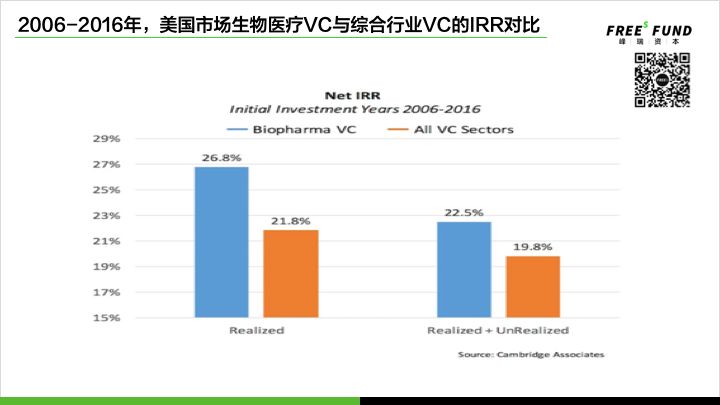
The following data comes from the blog of a partner at a well-known American healthcare VC firm. The first chart compares IRR between U.S. biotech/healthcare VC and generalist VC from 2006 to 2016. Looking at that period, we find that biotech/healthcare VC returns — both realized and unrealized — far exceeded those of generalist VC.
The second chart compares returns between U.S. biotech/healthcare VC and generalist VC from 2004 to 2013. We can see that except in the >50x return range, where biotech/healthcare VC underperformed generalist VC, biotech/healthcare VC outperformed across the 0–50x return range.
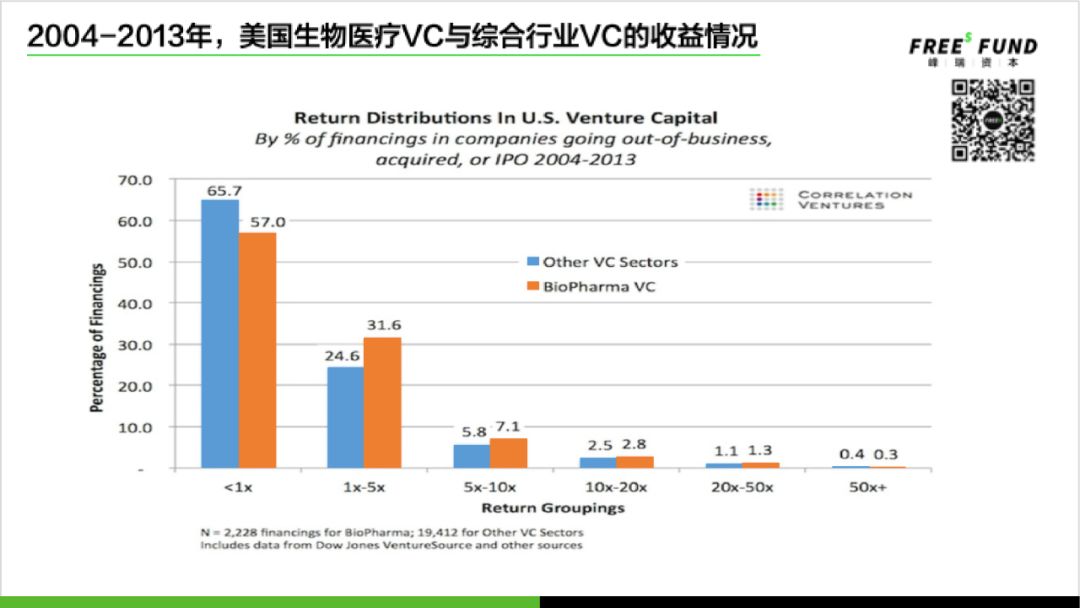
This blog reviewed nearly 16,000 healthcare investment cases. On average, only one in 300 cases produced a biotech unicorn with returns exceeding 50x. From this dimension, biotech/healthcare projects may seem less dazzling than star consumer investments. But from an overall returns perspective, funds investing in biotech/healthcare have always operated as a distinct category, validated over long cycles in mature markets.
Second, in mature markets, biotech and healthcare projects have shorter exit cycles and smaller losses.
The following chart reflects average exit timelines for U.S. biotech/healthcare VC versus generalist VC from 2006–2016. Biotech/healthcare VC's average exit time was earlier than generalist VC's.
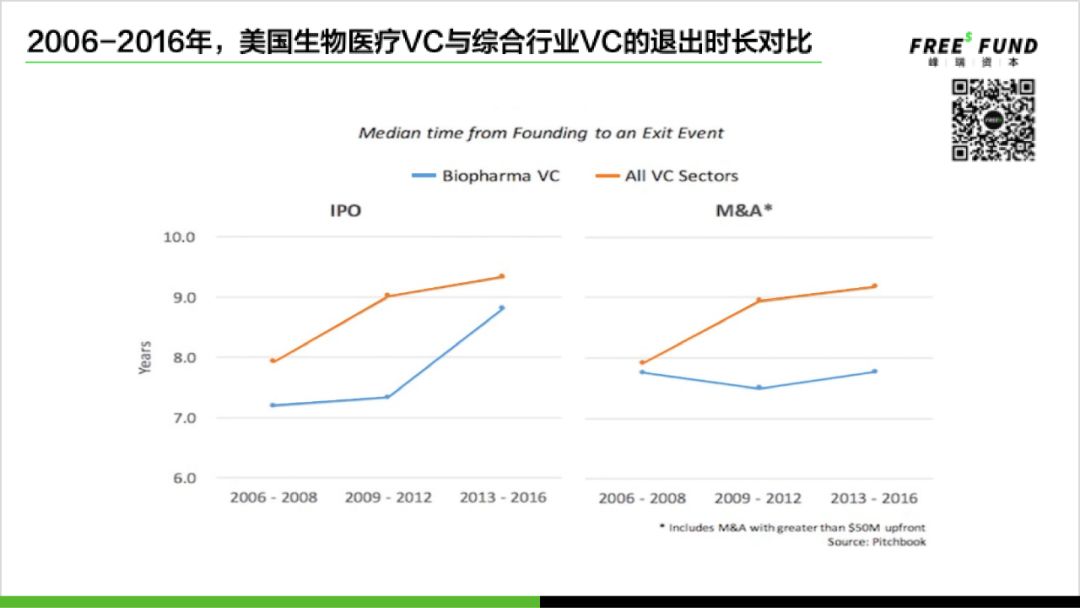
One key reason: drugs and devices generally have long development-to-market cycles. Neither VC nor large PE firms can easily support the massive expenditures required for Phase II or Phase III drug and device development. So major VC firms tend to exit at relatively early stages, with secondary markets and large M&A becoming the primary exit routes.
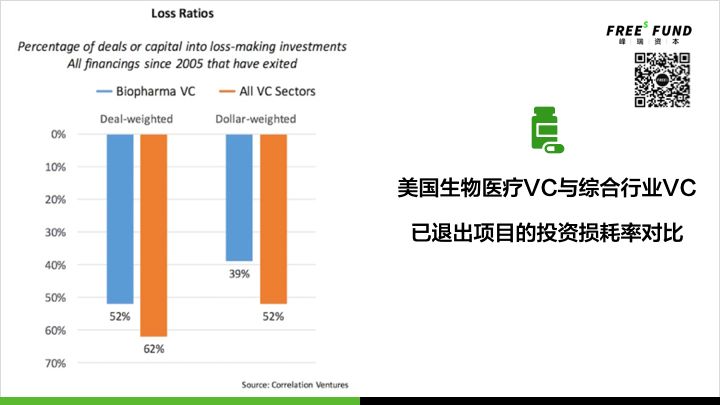
Now let's look at investment losses. The following chart reflects loss rates for exited projects by U.S. biotech/healthcare VC versus generalist VC since 2005. Whether measured by deal count (deal-weighted) or investment amount (dollar-weighted), biotech/healthcare VC losses were smaller than generalist VC's.
Additionally, mature secondary markets have been favorable to biotech stocks.
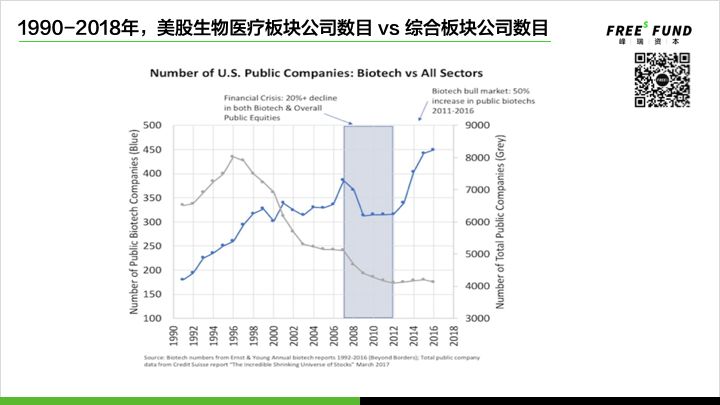
New biotech listings continue to grow. The blue line in the chart below shows total biotech stock listings in U.S. markets, while the gray line shows all secondary market listings. Though the sectors differ, the overall trend for biotech stocks is clear: listings keep increasing while delistings remain rare — very popular in secondary markets.

FreeS Fund Perspective (freesvc)
- Biotech and healthcare VC has become an important component of venture capital in mature markets (primarily the U.S.). From the perspectives of investment returns, exit cycles, and investment losses, biotech and healthcare VC has performed exceptionally well in mature markets.
- Diversified, standardized exit channels have made biotech and healthcare project exit returns quite attractive. The trend of technology-amplified healthcare innovation has also given biotech and healthcare projects good extensibility and liquidity in secondary markets.
/ 2 /
2018 Was a Big Year for Biotech and Healthcare Investment in China
We've covered mature markets. How has biotech and healthcare investment performed in developing markets? Let's turn our attention to the world's second-largest healthcare investment market: China.
2018 was a banner year for domestic healthcare investment. Let's look at some numbers to get a feel for last year's heated market:
In 2018, global healthcare industry investment totaled $38.801 billion across 1,410 funding events, with 930 concentrated in the four hottest areas: biotechnology, medical devices, pharmaceuticals, and healthcare IT.
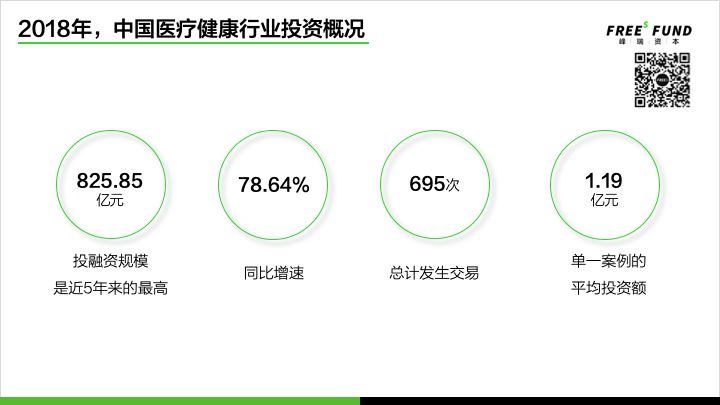
That same year, China's healthcare industry investment reached 82.585 billion yuan — a five-year high, with a year-on-year growth rate of 78.64%. There were 695 total transactions, with average investment per case of approximately 119 million yuan.
Favorable national policies, technology-driven innovation, and demand growth from an aging population formed a powerful combined force, bringing China speed to healthcare industry development in 2018.
Why did China only welcome its big year for healthcare investment in 2018? Let's turn the clock back four years.
In 2015 and 2016, healthcare investment was booming internationally. The timing coincided with the initial completion of electronic health records in the US, amplified by the mobile internet, giving rise to numerous business model innovations: telemedicine, chronic disease management, healthcare big data, and more.
During those years, supply-demand imbalance and inefficiency were the most prominent contradictions in China's healthcare sector. However, the market's talent pool and policy infrastructure were insufficient to support technology-driven healthcare startups. As a result, venture capital investments in healthcare at the early and growth stages leaned heavily toward model-based innovations. Meanwhile, established domestic healthcare funds primarily focused on generic drugs or later-stage projects. Looking back, these directions have largely run their course today.
Starting in mid-2016, technology-driven healthcare investment began to rise. Advanced diagnostic technologies, biotechnology, and the platforms supporting them started emerging, carving out a meaningful place in healthcare entrepreneurship. All of this laid the groundwork for the explosion of healthcare investment in 2018.
FreeS Fund Perspective (freesvc)
- FreeS Fund has consistently focused on early-stage healthcare investment. From its founding over three years ago, the fund participated in several early-stage healthcare projects centered on model innovation. These projects — from initial concept to product and service delivery — have been tested by time, market dynamics, and policy shifts. Some have found new growth after encountering challenges.
- For such asset-light service models, we believe an entrepreneur's capacity to learn and withstand pressure is critical. Healthcare concerns people's livelihoods and is highly policy-sensitive; founders must continuously adapt to evolving policy environments to push their projects forward. Entrepreneurs with the right intentions and determination can persist until they see the dawn.
- From 2016 onward, we identified a trend: innovation is inherently cross-disciplinary, with breakthroughs most often occurring at the intersection of fields. Healthcare is no exception — biology plus data and computing, biology plus electronics (automation, sensors), AI plus drug discovery, biology plus materials... Deep technologies including single-cell and synthetic biology began driving the industry's advancement.
- This meant we needed composite teams with diverse know-how — spanning technology, application, and consumer insights — to evaluate projects together. In 2016, we established a tech-enabled healthcare team with multidisciplinary backgrounds, pivoting toward technology-driven early-stage healthcare investment and working to identify outstanding early projects at this intersection.
2.1 Three Driving Forces Behind China's Biomedical Industry Development
The current moment represents an excellent opportunity for biomedical VC in China — one that could potentially match the investment expectations the US market holds for the sector. This section analyzes why we are in a relatively favorable window, drawing on key drivers in China's biomedical industry today.
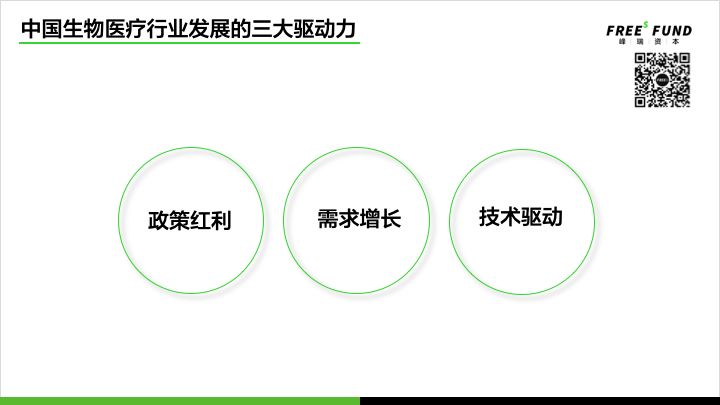
The drivers fall into three categories: national policy dividends, demand growth from demographic shifts toward an aging population, and deep technologies represented by artificial intelligence, cellular immunotherapy, and gene editing.
Policy dividends can be assessed through three indicators:
National health expenditure as a percentage of GDP: In 2016, China's total health spending accounted for only about 6% of GDP, while US health expenditures that year reached approximately 18%. The US healthcare industry has accelerated its growth in recent years, with its GDP share projected to rise to roughly 20% by 2026. By then, the US healthcare sector is expected to employ about 14% of all American workers (17 million people), underscoring the sector's immovable importance in the national economy.
While China's health spending has also increased year by year, it remains comparatively low. Since 2012, the share of health expenditure in China's GDP has steadily risen, and the government has introduced a series of favorable policies related to biomedical investment, becoming a core driver of future economic growth in China's healthcare sector.
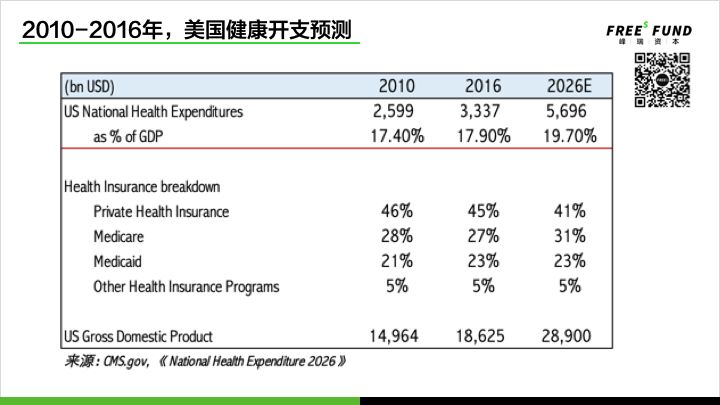
Government fiscal spending on healthcare: According to statistics, China's healthcare expenditure in 2017 accounted for only about 7% of total fiscal spending, far below the US figure of 27% for the same year. The US is projected to reach approximately 30% by 2028, meaning the government budget would direct nearly three-tenths of its spending toward healthcare for the elderly and poor. China may need to see increased support from its Ministry of Finance in this area going forward.
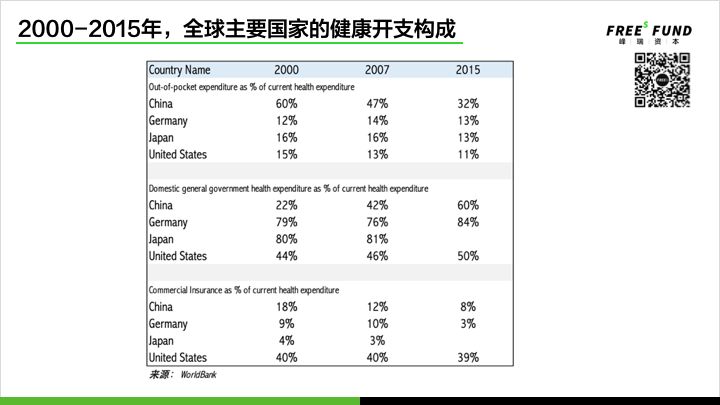
- Out-of-pocket spending ratio: Currently, China's healthcare payment system features a high proportion of direct personal cash expenditure, requiring medium- to long-term development.
The World Bank collected data on health spending composition among major global countries from 2000 to 2015. The data shows that in 2015, out-of-pocket payments in China accounted for 32% of total health expenditure — meaning that on average, 32 cents of every medical dollar that year came directly from patients' pockets. Compared to countries like Japan, Germany, and the US, this proportion is notably high.
In Japan and Germany, a major direction in healthcare structure has been continuous expansion of public health insurance funds to achieve universal coverage, with the state essentially paying for medical care and individuals bearing minimal costs. However, this approach increases fiscal pressure while also raising the difficulty of cost control and management.
The only country in the chart with commercialized health insurance is the US. Yet even there, where commercial insurance covers roughly 50%, the government still contributes about 40% — the larger share — with individual contributions remaining quite small. Over-treatment and insurance waste have long been widely criticized in the US healthcare system, but from the citizen's perspective, not having to pay much out-of-pocket for quality medical coverage represents an aspect of social advancement.
The US has continued to promote commercial health insurance development in recent years. Whether this can develop robustly depends in the medium term on whether the commercial health insurance industry can effectively leverage health big data and deepen partnerships with medical institutions to enter managed care models. In the longer term, it depends on whether public health insurance funds and commercial health insurance can assume greater spending to help middle-class families and rural populations share the risks of illness, while also improving medical resource supply and building robust family doctor healthcare systems.
Demand growth driven by demographic shifts. The most significant visible demographic change is the acceleration of aging. United Nations data shows that from 2015 to 2050, China's population aged 65 and above will rise from 10% to 26% of the total. In absolute terms, given China's massive population base, the current number of people over 65 already exceeds that of Japan and the US combined. The causes of China's accelerated aging are numerous, including the baby boom of the 1970s and improvements in medical conditions over the years.

Furthermore, advances in medical technology have increased supply across the healthcare sector and optimized resource allocation. As a result, they have effectively extended human lifespans while simultaneously intensifying societal aging.
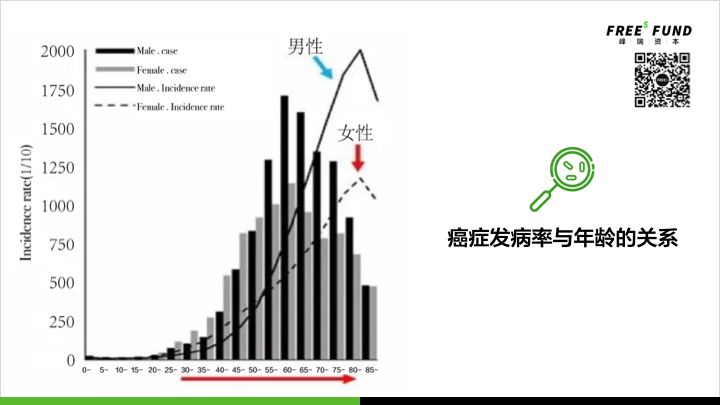
As people age, disease prevalence rises, generating greater demand in the medical market — particularly for chronic conditions such as cancer, diabetes, and hypertension. The chart below offers supporting evidence: between ages 30 and 80, cancer incidence correlates positively with age. After 80, various cellular metabolic processes slow, cancer cells become less active, and incidence actually declines.
Finally, deep technology represented by artificial intelligence, cellular immunotherapy, and gene editing. For a long time, technology and healthcare have formed a positive feedback loop. Growing medical demand and insufficient supply drive technological advancement; new technologies bring better treatments and cure rates, which in turn generate new medical demand. For example, as medical technology continues to advance and more serious and life-threatening diseases like cancer and diabetes are fully conquered, new health demands may shift toward anti-aging and longevity.
Currently, information technology and biotechnology are simultaneously driving healthcare industry upgrading. Thanks to IT development, hospital information systems have been upgraded, and mobile health and telemedicine — promoted by government policy — are working to advance health and chronic disease management while addressing uneven distribution of medical resources. The leap in biotechnology has made precision medicine possible, shifting the entire healthcare system upstream so that prediction and prevention become the center of gravity. Its commercialization could reshape the future landscape of the healthcare industry.
The benefits these two technological forces have brought to healthcare can be seen in the American Cancer Society's annual report titled "Cancer Statistics 2017," published in a leading oncology journal. The report notes that over the past two decades, overall cancer mortality in the US has declined by 25%. Incidence and mortality rates for several major cancers — lung, breast, prostate, and colorectal — have all dropped substantially.
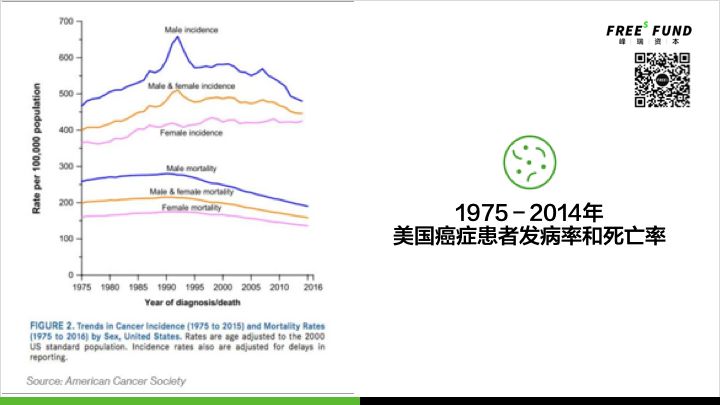
The two main drivers behind the decline in US cancer cases are advances in medical technology for cancer detection and treatment, and strict government control of tobacco. Dr. Otis Brawley, chief medical officer of the American Cancer Society, noted that tobacco causes roughly 30% of cancer deaths, and the drop in tobacco consumption has effectively pushed cancer incidence rates down.
China has also seen downward trends in cancer prevention and treatment after introducing some advanced drugs and technologies, but catching up to the US clearly remains a longer journey.
FreeS Fund Perspective (freesvc)
- Three major forces drove China's biotech and healthcare sector in 2018: new technology, growing demand, and policy support.
- FreeS Fund places particular weight on how new technology is pushing the healthcare industry forward, and has invested in multiple tech-driven healthcare projects at the angel and Pre-A stages: Singleron Biotechnologies is dedicated to applying breakthrough single-cell analysis technology to clinical testing, health management, and drug development; XtalPi is a world-leading, computation-driven innovative drug R&D technology company that has established partnerships with pharmaceutical giants including Pfizer and Roche; in the field of synthetic biology, Bluepha — another of our portfolio companies — is the world's only full-spectrum PHA bioplastics provider.
2.2 Five Catalysts Made 2018 a Breakout Year for Biotech Investment in China
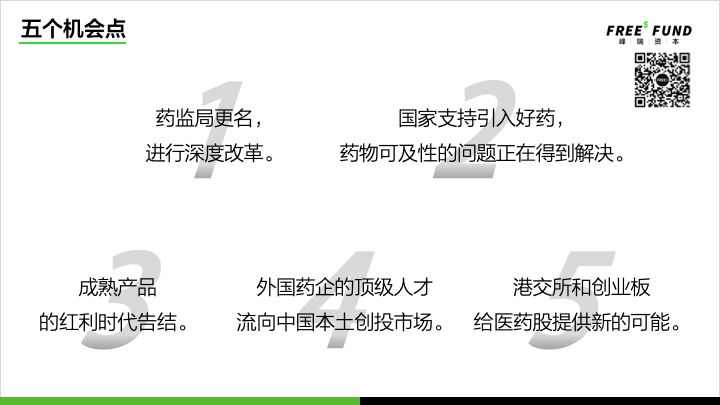
2018 became a breakout year for biotech investment in China due to five converging catalysts, all reflecting the accelerating pace of China's healthcare ambitions:
First, the regulatory agency was renamed and underwent deep reform. In June 2018, the agency approved 71 drugs in one batch. In September, it was officially renamed the NMPA (National Medical Products Administration) and recruited heavily from institutions including the US FDA. The signal was clear: China wants new drug registration to become standardized, professional, and faster.
Second, government support for bringing in quality drugs is solving the problem of drug accessibility. In 2018, both the national essential medicines list and the national reimbursement drug list expanded significantly, adding 17 oncology drugs. Now, most standard cancer drugs are available in China. After the film Dying to Survive was released, the issue of drug accessibility drew national attention, and the government became more willing to introduce expensive drugs for difficult and serious diseases. For biotech VCs, pharmaceutical investment has always been a hard demand area, and with current policy tailwinds, this space will become even more attractive.
Third, the era of windfall profits for mature products is ending. Mature products from foreign drugmakers that have passed their patent terms are beginning to face challenges in China. Take the cephalexin we commonly use — Eli Lilly's Keflex — as an example. The drug was approved in the US in 1979 and its patent expired in 1993. In the US, generics appear immediately after patent expiration, essentially at zero switching cost.
However, since entering China in 1993, Keflex has remained a bestseller, generating hundreds of millions in annual sales on average. Interestingly, Keflex is not an exception. Foreign-produced drugs generally remain active in China for more than 15 years after registration.
Recently, the NMPA's 4+7 policy — a centralized drug procurement system involving four municipalities and seven provincial capitals or separately listed cities — aims to have domestic pharmaceutical companies produce and sell equivalent alternatives to Keflex at relatively lower costs. This policy is designed to encourage domestic manufacturers to independently produce quality drugs, and represents a heavy blow to foreign companies. The crisis facing mature products signals more opportunities and room for Chinese pharmaceutical companies going forward.
Fourth, top talent from foreign drugmakers is flowing into China's domestic startup ecosystem. Five years ago, China's healthcare innovation projects were relatively scarce and talent was thin; imported talent mainly focused on CMC (Chemical, Manufacturing and Control) and CRO (Contract Research Organization). Today, healthcare entrepreneurship is booming and a talent war has begun. Senior executives from top-tier foreign drugmakers are leaving big multinationals to join China's healthcare startup wave. For example, Sanofi's former Asia-Pacific R&D head announced in 2016 that he would join CStone Pharmaceuticals as CEO; a former AstraZeneca VP left in 2018 to join Zai Lab. The same trend exists among middle and upper-middle management at foreign companies, spanning R&D, clinical, and other functional departments. Their management experience and industry connections will benefit the development of healthcare startups.
Fifth, the Hong Kong Stock Exchange and STAR Market offer new possibilities for biotech listings. While China's secondary market remains far less welcoming to biotech stocks than mature markets like the US, the privatization model can barely support biotech companies. Going public to seek more capital is inevitable, and the trend is toward earlier and earlier listings. The future development of biotech companies on China's ChiNext or Hong Kong markets will largely follow this trajectory.
The Hong Kong Stock Exchange is highly receptive to biotech companies without revenue. Overall, the total fundraising by Chinese biotech startups still lags far behind the US, whether in government support or VC and PE backing. While VC and PE support has increased significantly since 2015, the entire industry will advance further driven by capital. Some feel the current boom in this market is accompanied by a bubble, but we're not quite there yet.
FreeS Fund Perspective (freesvc)
- 2018 was a pivotal year for healthcare entrepreneurship and investment in China, with numerous positive factors converging. On one hand, the government is deepening reform and encouraging domestic innovation; on the other, mature products from foreign drugmakers are losing ground in China, while top foreign talent is joining domestic healthcare startups. Combined with richer and more founder-friendly exit channels, we believe this is a golden period for early-stage healthcare investment.
- The healthcare entrepreneurship chain is long — from initial concept to productization to commercialization, each step has high barriers. This means founders need genuine expertise. We are optimistic about healthcare industry veterans entering entrepreneurship, particularly practitioners with deep pharmaceutical management experience.
How We Are Positioning for Biotech Investment
At the macro level, our positioning focuses on early-stage innovation and technology-integrated projects, projects where market and pricing space can justify the risk, and projects with access to suitable innovative talent pools.
In addition, projects involving relevant technologies and interdisciplinary intersections represent new opportunity points, because the innovation process in any industry that looks massive today is entirely cross-disciplinary — breakthrough innovations mostly occur at the intersection of disciplines. Examples include biology + data and computing, biology + electronics (automation, sensors), chips + algorithms, biology + materials, chips + consumer scenarios, consumer + data, and so on.
Excellent healthcare projects FreeS Fund has invested in over the past few years — such as XtalPi, Bluepha, and Singleron Biotechnologies — are typical interdisciplinary projects: XtalPi combines cloud computing + AI + pharmaceuticals; Bluepha falls under AI + computing + biology; Singleron is biology + chips + computing.
At the micro level, we focus on several directions: first, in vitro diagnostics, especially opportunities in molecular and immunodiagnostics that are growing rapidly; second, innovative biologics and platforms including monoclonal antibodies, protein drugs, and large molecules; third, differentiated small-molecule chemical drugs; fourth, disruptive biotechnologies; fifth, micro-innovative devices and consumables that can replace imports.
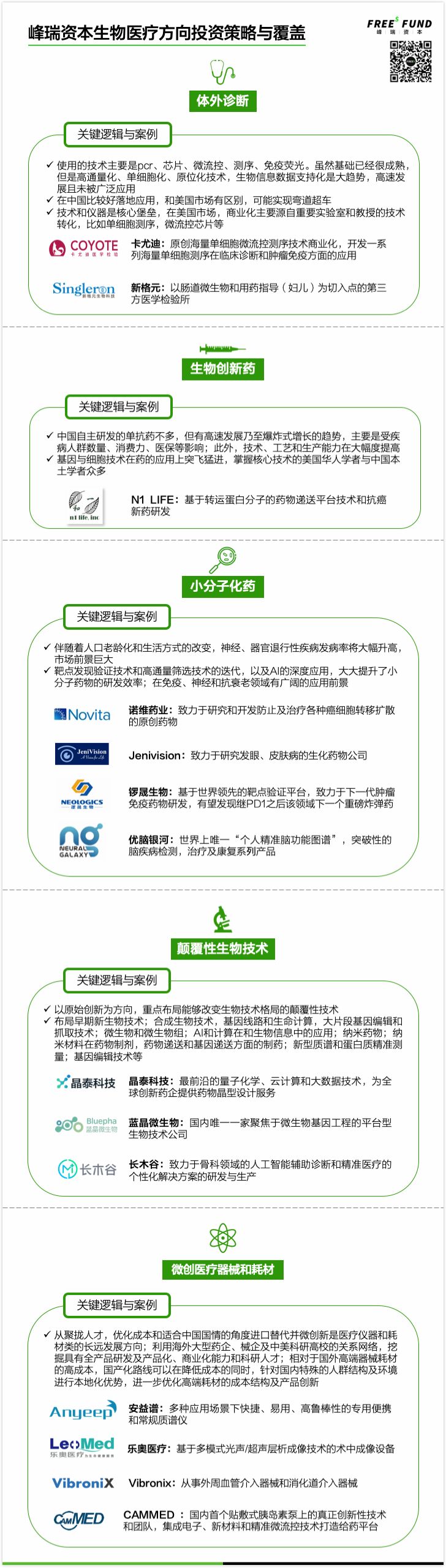
Finally, thank you for your patience in reading through this long analysis of the biotech and healthcare industry. We hope it offered some insight, and wish you success in navigating healthcare — the most mysterious ocean for VCs.
(Feel free to share to Moments. For republication on other official accounts, websites, or mobile apps, please reply "reprint" to learn about republication rules and contact FreeS Fund for authorization. Copyright belongs to FreeS Fund.)

FreeS Report 15: Life's Gamble — The Adventurous Journey of Drug R&D
FreeS Report 14: Cosmetics Keep Getting Pricier — Is Your Face Really Worth Millions?
FreeS Report 13: To Understand China's Consumption Upgrade, Look at Japan 40 Years Ago
FreeS Report 10: The Shared Secret Behind Snack Hits That Survived Economic Cycles
FreeS Report 9: How Can Sportswear Brands Achieve Brand Upgrade?
FreeS Report 8: Will the Matcha Industry Produce the Next Starbucks?
FreeS Report 7: Four Major Directions for Health Data Entrepreneurship in China
FreeS Report 4: The SaaS Boom — Opportunities, Logic, and Challenges
FreeS Report 3: Is an Online IKEA Possible? — Investment Opportunities in Home E-commerce
FreeS Report 2: Investment Outlook for the Healthcare Industry in China and the US
FreeS Research 1: Opportunities and Future of Export Cross-Border E-commerce