Why Is Going Global Still a Must, Even as Globalization Slows? | Li Feng Column

The Rise, Fall, and Future of Globalization

Today's content comes from the macro discussion segment of the podcast High Energy. Over the past two years, "globalization" has been one of the topics Feng and Li Xiang have returned to frequently.
- From a long historical perspective, has the globalization process been continuously increasing?
- How many stages has globalization gone through, and which countries led each one?
- Are the tech war and trade friction China is currently experiencing inevitable? Have similar things happened before?
- In a cycle of slowing globalization, what are China's opportunities?
- For startups, is going global an option or a necessity?
We've selected portions of their discussion and edited them into this article, hoping to offer a fresh angle for consideration. You're welcome to search for and subscribe to High Energy on Xiaoyuzhou, Apple Podcasts, or Ximalaya to listen to the full episodes.





Reader Giveaway
What are your thoughts on globalization versus deglobalization? Leave a comment below — we'll randomly select six readers to each receive a copy of Marc Levinson's The Box: How the Shipping Container Made the World Smaller and the World Economy Bigger.

/ 01 / The Historical Evolution of Globalization
1. Looking back at history, from the ancient Silk Road to the powerful Ottoman Empire at its peak, from global trade after the two World Wars to today's Belt and Road Initiative — all of these have substantially raised the level of globalization. Viewed on a scale of 50 or 100 years, the deepening of trade globalization has brought tremendous benefits to human society as a whole.
2. Over the past 300-plus years, the construction of three global trade systems has been driven by maritime powers using shipping as the primary means — whether Spain, the Netherlands, Britain, or the United States.
3. Post-WWII globalization was mainly driven by the United States. As the world's most powerful manufacturing nation at the time, the U.S. needed to open up global markets and demand to advance its technology and trade.
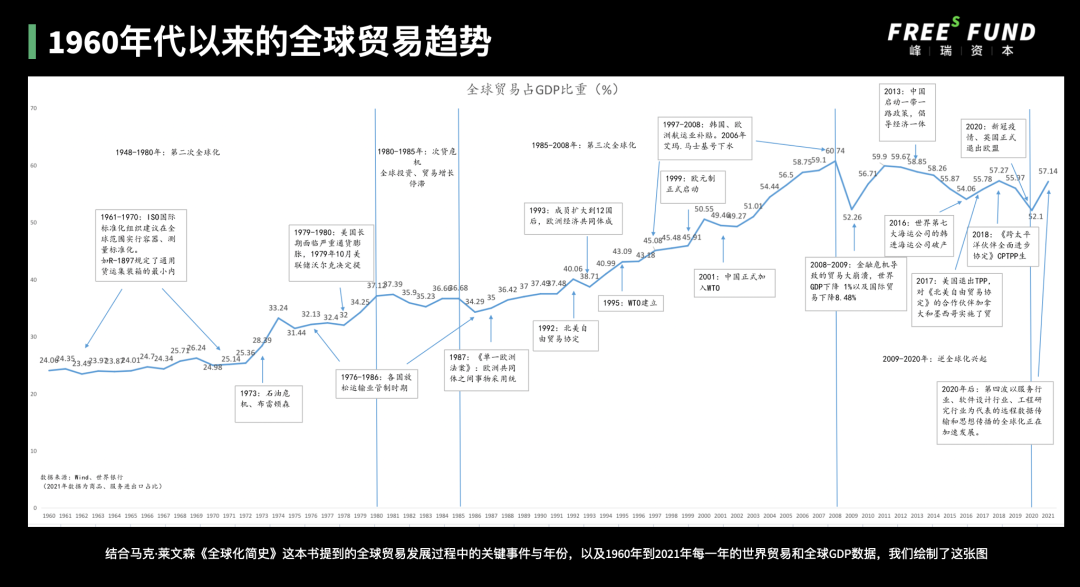
4. Between the end of WWII and 2008, global trade grew rapidly, primarily due to the development of maritime shipping. One key turning point was that ships became simultaneously larger and better, cheaper and more capacious. Another was the global adoption of containerization, which dramatically improved shipping efficiency and reduced port operating costs. (Interested readers might check out Marc Levinson's The Box: How the Shipping Container Made the World Smaller and the World Economy Bigger.)
5. The period from the 1980s to the 2008 financial crisis — over 20 years — was the most rapid phase of globalization in history. During this time, the ratio of total global trade to global GDP rose from roughly one-third to nearly two-thirds. In other words, world trade grew 40-50% faster annually than world GDP.
6. "Deglobalization," or the slowing of globalization, didn't begin with the pandemic or the U.S.-China trade war. It started after the 2008 financial crisis. The data shows that in 2008-2009, international trade fell by 8.48%. Since then, global trade has grown more slowly than global GDP each year, and the ratio of global trade to global GDP has never returned to its 2008 peak. That means we've gone more than a decade without achieving "better globalization."
7. Why did the pace of trade globalization slow after 2008? Beyond the demand decline caused by the global recession, an important factor was that with the development of machinery and automation technology, large-scale manufacturing caused the share of manufacturing itself in total product costs to begin shrinking. Moving goods around the world by sea, as had been done for decades, may no longer be so cost-effective.
8. China's economic development benefited from this fastest wave of globalization, which began in the 1980s. We became the world's factory and the world's second-largest single consumer market. This was connected to China's labor dividend, manufacturing capacity, long coastline, and busy ports. The other side of the coin: in the previous wave of globalization, the rules were set by others, and rule-makers tend to have more dominance — which has left us in a relatively passive position in trade wars and tech wars.
/ 02 / Globalization's Present and Future
1. Looking from history toward the future, advancing globalization better aligns with the developmental needs of human society and is a direction worth persisting in and striving for. At the crossroads between "globalization" and "deglobalization," China and the U.S. have made different choices today.
2. Once China developed a certain competitive relationship with the U.S., America began employing more competitive and restrictive strategies. To some extent, this was inevitable. In a way, Britain's "cotton war" against the U.S. bears considerable resemblance to America's "chip war" against China today. After U.S.-China trade friction intensified, bilateral trade growth slowed.
3. One of our competitive approaches is to leverage China's advantages to promote a trade system different from those of the past. Our strengths include ranking second globally in GDP, possessing the world's second-largest single consumer market, being the world's largest manufacturing base, the world's largest goods trader, and the world's largest user of resources and energy.
4. Typified by the Belt and Road Initiative, China has made considerable efforts to partially rebuild and advance globalized trade during this cycle of slowing globalization.
5. The results show that both the structure of China's foreign trade (products) and its partner countries (trading partners) have undergone fairly significant changes. Specifically, Chinese exports have shifted from the former "old three" (clothing, furniture, home appliances) to the "new three" (electric vehicles, lithium batteries, solar cells), reflecting China's industrial chain moving toward medium-high value-added segments. Additionally, since ASEAN first surpassed the EU and U.S. to become China's largest trading partner in 2020, China and ASEAN have been each other's top trading partner for four consecutive years. This means China is driving a redistribution of certain industrial chains.
6. Unlike previous trade globalization dominated by maritime shipping, the global trade system we are now promoting connects with neighboring countries through land transport (primarily railways) combined with sea-land intermodal transport, forming efficient industrial division of labor and value chains. In this system, Europe and China have massive consumer markets; China, Eastern Europe, and Southeast Asia possess strong manufacturing capabilities; and the Middle East, Central Asia, and Russia hold abundant natural resources and energy. Connecting this vast region creates a configuration with natural resources and energy, manufacturing production capacity, and consumer markets all linked together.
7. If this land-transport-centered globalization system can coexist with the previous maritime-centered system, with both reaching considerable scale, many countries will benefit. In previous waves of globalization, many land-based nations benefited relatively little and developed more slowly than maritime powers.
/ 03 / What Does Globalization Mean for Startups?
1. When Chinese companies today discuss going global and globalization, some are proactive, others reactive. However, looking at the development trajectories of Japan and Germany as economies, China has now reached the stage where it needs to massively increase overseas investment. Producing things for the entire world is no longer the biggest contributor to China's economic growth.
2. Despite global uncertainty, corporate globalization has become a necessity. For entrepreneurs going global, it's best to choose countries and regions that are diplomatically friendly with China, to reduce risks from policy uncertainty. On the openness front, China has introduced many unilateral visa-free and 144-hour transit visa-free policies, which will enhance more substantive experiences and understanding of China among more countries and regions.
3. Among American consumer brands we know today, besides century-plus-old brands like Coca-Cola, many — Starbucks, KFC, Pizza Hut, Walmart, Nike — were born between the 1950s and 1970s. This was because the U.S. economy developed rapidly after WWII, with demand and supply reinforcing each other, consumer markets and consumer brands mutually driving growth. More notably, the globalization America promoted after WWII also drove the globalization of American companies. These brands evolved from American companies into global companies, becoming first or second in their industries worldwide.
4. If the globalization driven by China that we discussed earlier can achieve long-term progress, we might draw a similar conclusion: as China advances globalization, excellent Chinese companies will have the opportunity to go global and become outstanding international enterprises. Similar developments are already occurring across many industries — smartphones, new energy vehicles, consumer drones, and more.

▲ Nine years and going strong — join FreeS Fund to go further together ▲ "Not Going Overseas, But New Globalization": Here Are the Thoughts and Practices of Nearly 20 Companies ▲ Deciphering Aging, Resisting Aging | FreeS Report ▲New Strategies for Going Global: From "Air Force" to "Marine Corps" | FreeS Research ▲ Congratulations on XtalPi's Successful IPO: FreeS Fund's Research-Driven Approach, Learning to Invest by Investing ▲ The Truth About Weight Loss, and Innovation Opportunities | FreeS Report
▲ The Road to Embodied Intelligence | FreeS Report
Star the FreeS Fund WeChat Official Account for timely business insights