How Can Startups Build a Steady Stream of Top Talent? | FreeS Fund Free Talk

Building a Team in the Early Days: Forget Titles, Focus on Functions
"FreeS Free Talk" is a small-scale offline gathering for CEOs in the FreeS family. We invite experts who know their stuff and seasoned FreeS family CEOs to share their knowledge and experience on topics and directions that matter to founders.
At a recent "FreeS Free Talk" HR session, Qiu Qiu, FreeS Fund's HR lead, invited Pu Wenling, HR Head at Tongdun Technology. Pu has 14 years of HR and management experience, including over eight years at Alibaba Group's headquarters and North American division. She brings deep expertise in designing innovative organizational structures, attracting key talent, building talent pipelines, and embedding company culture.
At the event, Pu shared her thinking and methodology with more than 20 founders on the following questions:
- What three key points should startups watch for when defining top talent?
- How do you solve the problem of premium pricing for scarce roles?
- How should startups build an HR team? How should HR partner with the CEO?
- How do you cultivate a talent pipeline so the organization has successors?
- How can startups distill their own team culture?
We hope this brings fresh perspectives. We welcome your thoughts in the comments.
We're Also Hiring
FreeS is looking for investors in biotech, deep tech, and consumer/TMT across Beijing, Shanghai, and Shenzhen. If you have an industry background and an interest in investing, we'd love to hear from you — full-time or internships welcome. Referrals appreciated too: hr@freesvc.com (resumes welcome).
Three Keys to Hiring at Startups: High Availability, Stretch, and Cultural Fit

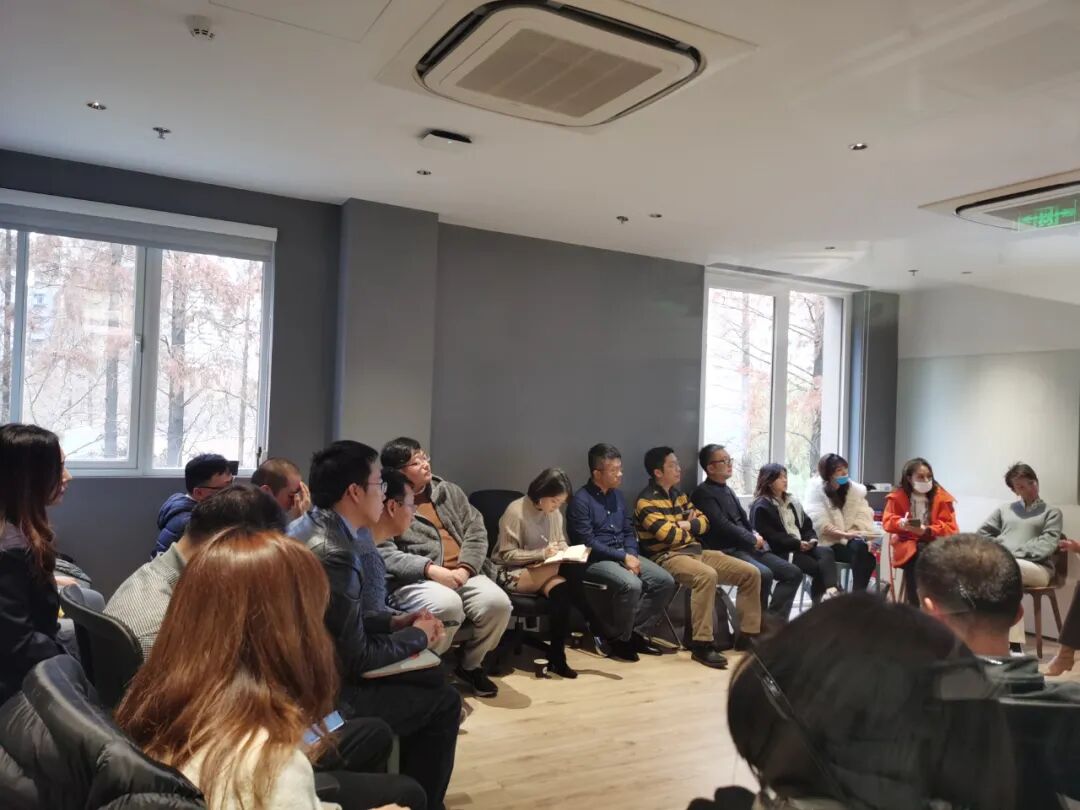
For startups, the first priority in hiring is figuring out how you define talent that fits your company.
When any company defines what excellence looks like for them, it's never just about whether someone comes from a major tech company like BAT, their previous level, or past achievements. You have to connect it to your business and look at what capabilities, experience, and qualities a candidate has that your organization can actually use.
High Availability
So how do we define top talent?
First, look for "high availability." I understand this as rock-solid professional competence and industry experience, combined with an ability to embrace uncertainty, strong reflection skills, and an open mindset ready to tackle all kinds of problems. Someone who can hit the ground running from day one, roll up their sleeves, and get to work.
Stretch
Second, the person needs stretch.
Compared to major tech companies that already have established systems and ways of working, startups face many novel problems.
Experience from BAT has extremely low copy-paste value in a startup. That experience may not directly inform decisions — instead, it helps you develop a way of thinking, broaden your perspective, and create methods or systems suited to your startup's current context. Copying major company practices directly into decision-making is dangerous.
So startups need people who understand not just what works but why it works. "Understanding why" means that even if someone didn't participate in building a great system from zero to one, they still grasp why the system looks the way it does and what logic drove its creation.
Moving from knowing what to knowing why — that's stretch. It means someone has learning ability, curiosity, can see the context behind how things evolve, and can draw analogies. This lets them apply problem-solving logic to actual business scenarios and challenges, rather than just transplanting experience.
Cultural Fit
Third, cultural fit matters quite a bit.
Startups define culture differently at different stages. Early on, the company's culture is the culture created by the founder and founding team.
Mapping out a startup's initial culture starts with mapping out the founder's own underlying life assumptions — this is especially important. Compare Alibaba and Huawei: why do outsiders perceive such different cultures? Beyond industry, customers, and business model, the most fundamental difference comes from the two founders' very different underlying life assumptions and life experiences.
Why do some companies strongly encourage bottom-up, wild growth while others rarely celebrate individual heroism, emphasizing instead organizational execution and immovable processes and mechanisms? Why do some focus on unleashing human potential and encouraging the good in people, while others use mechanisms to control and constrain the bad? These all reflect the founder's own life logic and experiences.
The CEO should ask themselves: What do I want this company, this organization, to become?
Your team and HR can help you distill and articulate that organizational culture so middle and frontline employees can understand it. We'll share more later about how startups can distill their own culture.
Once distilled, what scale do you use to measure candidates?
Culture starts with intuitive understanding and discernment — what people often call "smelling the vibe." So-called cultural values are really about finding fellow travelers. This isn't a black-and-white process; it's about whether people can make consistent judgments about things.
Try bringing five people into a room and ask each to describe what they think this company's core values, culture, and people are like. See how much common ground emerges. Only when there's broad internal consensus on organizational culture can you gradually find people who fit with it.
The CEO Is Ultimately the One Who Pays for Hiring Decisions
Once you've defined talent clearly, you need to solve the question of who does the hiring.
In a small team — under 50 people, or under 200 — the CEO needs to interview every single person.
In the hiring process, the CEO's function isn't to make the final decision. The CEO interview serves many purposes, involving both information input and output.
"Input" means the CEO gains industry and customer insights through conversations with candidates, learns about peer company developments and business challenges, and can even gather competitive intelligence. Such conversations help the CEO calibrate their own business judgment and understanding, and develop better awareness of how different companies in the industry are performing and where talent is concentrated.
"Output" means the CEO needs to determine whether a candidate fits their organization, figure out how to attract them, assess how they'll mesh with the existing team, identify their absolute strengths and weaknesses, and determine how the team can compensate for those weaknesses. This information must flow to business teams and HR to coordinate on attracting and onboarding the person.
The CEO must interview two levels down at minimum. If the team isn't that large, three or even four levels down may be necessary. So if you have VPs, directors under them, and senior managers under directors — two levels means you should at least interview directors. If time permits, going one level further is worth it.
My boss still often schedules five to eight hours of interviews on weekends. Attracting and hiring the right people is one of the most important parts of his daily work. Even when time is scarce, the CEO needs to be clear which key roles, levels, and candidate backgrounds require their personal interview, gradually forming explicit hiring rules.
When it comes to defining roles, the CEO cannot delegate this authority outward. Because the person who ultimately pays for hiring decisions — is the CEO.
How to Solve Premium Pricing for Scarce Roles?
In hiring, we also encounter this situation: certain professional talent is scarce in the market, the role is still in early development, the person may not be that senior, but the salary is very high.
Fundamentally, talent pricing is determined by market supply and demand. A role commanding a premium reflects that at a certain stage, its specialization and scarcity carry a market price.
If we're unwilling to accept premium pricing for certain roles, worried about creating serious salary inversion within the team, then we need to think: if we don't rely on someone in this role to achieve the capability we need, how else can we achieve it?
We can start by defining the role profile, clarifying what professional and soft skills it actually requires. Then consider what talent pools might yield such people.
Today's talent market still has information asymmetries. Some excellent people may come from traditional industries with lower salaries than internet companies, but that doesn't mean they lack the professional capabilities.
When we understand where people with such capabilities might be distributed, we can choose from those backgrounds based on company budget and current internal salary levels.
But before deciding, you must think through whether this person's background and capabilities can meet company requirements.
In the HR field, for example, excellent HRBPs are very hard to find in the market, especially for startups trying to attract good HRBPs. We break down: in our organization today, what specific professional capabilities do we value in an HRBP — is it team building, system building, culture driving, industry knowledge, or ability to have business conversations? You can identify one or two capabilities you particularly need at this stage from candidates with diverse backgrounds. Because China's internet industry experienced rapid growth over the past decade-plus, hiring HRBPs from internet companies is relatively expensive. But that doesn't mean traditional industries, including some early multinationals in China, can't produce excellent HRBPs.
However, if after mapping the talent market you find the people you want only come from certain specific companies and roles, and such people genuinely cost more, we have to accept that. After bringing such talent into the team, we need to watch internal balance. For early team members, think about what value besides salary can keep them — show them they can continue growing with the team.
Focus on HR Team Function, Forget the Title
The HR Three-Pillar Model
After clarifying what to hire and who does the hiring, you need to build an HR team that fits your business development stage, future aspirations, and current organizational reality.
For earlier-stage teams, when thinking about how to build an HR team, I suggest focusing more on what functions the HR team needs to fulfill, and forgetting titles or structure.
In the HR three-pillar model, beyond HRBP, there are COE (Center of Expertise) and SSC (Shared Service Center). The three pillars work together.
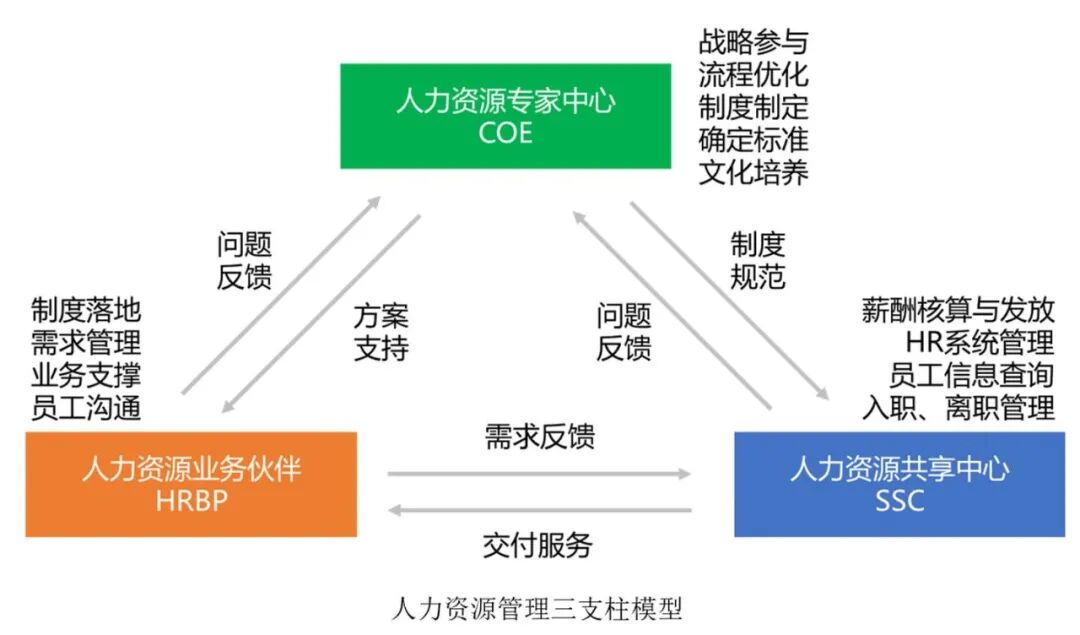
(Image source: Zhihu)
HRBP is most tightly integrated with business teams; its goal is helping the business achieve its objectives. The core logic is identifying the critical path and key challenges to reaching goals, finding where team capability gaps lie, and designing HR solutions to close those gaps. These solutions may span talent acquisition, team culture, mechanisms and processes, performance and incentives, and more.
Because HRBP is closer to frontline teams, they have horizontal knowledge of every HR module's professional techniques, but may not have deep expertise in every specialty area. COE brings its own professionalism and methodology, providing expert consultation to HRBP and helping solve team capability, culture, compensation, goal management, or recruiting challenges.
So the difference between HRBP and COE is: HRBP acts more like a "diagnostic expert" for the business team — they know what solutions to propose, but the ammunition comes from COE support. Meanwhile, SSC handles more standardized, process-oriented transactional work like payroll and personnel information management.
Also, while teams do need the HRBP function, it doesn't have to be filled by someone with an HR background. In early-stage startups, understanding the business matters more than knowing HR tools or methodologies.
Some companies function quite well organizationally even without an HRBP role. Two possible reasons: first, the managers themselves pay close attention to organizational management; second, veteran team members serve as glue, knowing how to hold the team together, what to look for when hiring, and how to adjust mechanisms when team communication isn't smooth — essentially performing the HRBP function.
Whether at Major Platforms or Startups, HR Methodology Must Keep Evolving
From my own experience, whether at major platforms or startups, you need to keep iterating your HR methodology.
Currently I'm leading HR at a B2B company with over 1,000 employees, in a period of exploring a second business curve and management transformation.
Before this, I spent nearly nine years at Alibaba. My time there had two phases: first, domestic responsibility for university partnerships and campus recruiting programs; second, HR for Alibaba's North American tech team.
On the first phase: our campus recruiting program was CTO-led, so it wasn't purely a recruiting program — it was a program to reserve and land high-potential talent for Alibaba's future business development. From 2011 to 2015, especially 2013 to 2015, the group was reserving roughly three to four thousand people annually. A significant portion of Alibaba's technical bench today exists because Alibaba consistently focused on reserving and developing young high-potential talent.
After Alibaba's 2014 IPO, 2015 became its internationalization launch year, and that's when I went to the US. Alibaba had established its own tech team in North America. The context: we saw technical talent, especially in infrastructure and fundamental research, had a technology gap between China and the US. From when I joined the North American tech team in 2015 until leaving in early 2020, the team grew from dozens to hundreds, experiencing significant growth.
Outsiders may see Alibaba as a platform with very strong organizational capabilities, well-developed mechanisms, and especially a mature HR team. But it still experienced different HR challenges due to rapid business change and development, constantly iterating and building itself.
For the North American tech team, early on it was essentially a zero-to-one startup process. The team had no local business闭环 at the time, serving not a North American or overseas business line but the entire group's business. Moreover, with team members from diverse educational and cultural backgrounds, already quite senior and accomplished in their fields, we faced questions of how to define the team and how to integrate with domestic tech teams and Alibaba's native culture.
The questions and problems the North American tech team had to grapple with then have much in common with what I encounter now at a startup: integrating diverse backgrounds, landing new executives, organizational goals and strategy during business exploration periods, and so on.
So major platforms also go through reflection and iteration on HR methodology. Large and small companies often face the same problems, just to different degrees, and everyone is exploring. The key, as one friend here mentioned: after going through things, does the organization have the ability to reflect and self-iterate? Reflection, review, and organizational self-iteration are strengths at Alibaba. After many failures or uncertainties, it can quickly summarize and reflect, distilling experiences that others can absorb and apply — this is crucial.
HR Must Have the Ability and Courage to Dialogue with the Number One
As a partner to the business team, HRBP maintaining neutrality is important. We can tell our partner: here are issues I'm seeing in you, problems our team is encountering, and suggestions for improvement. Two conditions enable this dialogue between HR and the business lead: on one hand, HR must have the ability and courage to dialogue with the number one; on the other, the number one must be willing to engage.
Often, the CEO wants organizational change but isn't behaviorally or mentally ready, or doesn't realize someone can have this dialogue with them about problems.
A crucial part of building organizational capability is managers going through their own consciousness evolution. Even many relatively open managers — not necessarily the number one, maybe a company-level leader — have this to some degree: "Anyway, this is how I think the company should be, so we'll do it my way."
But many problems root in the manager themselves. How does the manager systematically view this problem? Who's the main factor behind it? What factors have already been considered... This whole process of thinking and consciousness evolution matters. If HRBP can actively guide and accompany this, thinking in sync with the business leader, mutual rapport and trust gradually deepens.
Which HR Work Can Be Outsourced? Which Needs In-House Teams?
Currently in the market, recruiting, termination, HR consulting, and more all have outsourcing companies. For startups, how to use outsourcing companies well? How does internal HR collaborate with them?
The commonality of outsourced roles is that the work is largely well-defined and at scale. In today's HR systems, recruiting is the most mature — the headhunting business or HR systems everyone knows. If third parties want to provide HR consulting or other services, they need to deeply understand the client, otherwise they can't do it well. But even for recruiting, third-party companies often don't do great, because it's hard to measure the ultimate business impact of talent brought in.
If work is highly standardized — payroll, social insurance contributions, or bulk layoffs at large companies needing policy and legal experts to clearly explain terms — these are very concrete actions. As long as you have no data concerns, external resources can handle them.
But if what you've defined isn't a technical problem but a solution-type problem, requiring deep company understanding, combining with business, development stage, and existing organizational capability, helping you discuss, analyze, validate, and continuously adjust solutions in this dynamic process — then you probably can't simply outsource. Or even if you use organizational development consultants, you need good internal coordination and the external expert needs opportunity to deeply understand the business.
How to Build Talent Pipelines So the Organization Has Successors?
Organizational capability is a critical and very broad issue. Talent pipeline building is an important aspect; let me share some Alibaba practices.
As many know, Alibaba pays great attention to talent pipeline and leadership development. For each talent level, Alibaba has its own definition, inventory, and development process — for example, frontline needs to set goals, deliver results, and follow process; middle management needs to understand strategy, build soil, and be a director.
Alibaba continuously focuses on developing successors throughout company development, not just for the number one position but for every level and key role. It doesn't mean someone is groomed as CEO from day one; rather, many executives are brought in, developed in their roles, rotated through different scenarios, and observed. Ultimately finding people who can deliver business results, have high cultural fit, have been through battles, and can build a team.
So "having successors" is an end result. For HR work, the more valuable part is the process in between. The process isn't achieved overnight — you start today and may see results three years later. But you still need to gradually build such a system, continuously enabling the organization to produce waves of capable leaders and have successors.
How Startups Can Distill Their Organizational Culture
Once talent joins the team, they integrate into team atmosphere. They need to feel whether their personal traits match the organization and whether the organization accepts them. This isn't just about their relationship with the boss, but with a broader group, atmosphere, and soil — their relationship with company culture.
Good company culture can be distilled, described, manifested in daily work and key management scenarios, communicated, understood, and continuously attract fellow travelers. When CEOs think of company culture, many may think of The Netflix Culture Deck, with its talk of "only hiring adults" and "letting people go proactively." These are Netflix's cultural genes, manifested in its mechanisms and daily management decisions. Our prerequisite for learning is understanding what Netflix's culture is, and why this is Netflix's culture. Copying directly will definitely cause indigestion.
Culture is a result, not something you build. We need to understand and deconstruct what our company's culture is and how it emerged. There's methodology behind this: exploring the founder's underlying logic; reviewing the company's past to see what choices were made at key moments and what values supported those choices; referencing future vision, learning from industry benchmarks, understanding the cultural genes of successful companies in the industry, and so on.
A company's cultural values need not just direction but specific gradational descriptions. For example, "pursuing excellence" — what exactly is "pursuing excellence"? What are different levels of expectation for "pursuing excellence"? You need employees to realize that even when the word looks the same, it means different things in different organizations.
The process of values being generated, interpreted, communicated, and landed is crucial. When these values map to management scenarios and land in recruiting and performance mechanisms, team culture continuously ferments and gains more adherents. And this culture works both internally and externally. External people must also identify with and understand your culture to join.
Also, when borrowing from other companies' team cultures, pay attention to industry attribute differences. B2B and B2C have fundamentally different underlying logics. B2B companies can't simply encourage bottom-up, wild growth like B2C. B2B needs strategic focus, efficient execution, and efficient collaboration to deliver customer value. Here, top-down design and matching culture are especially important.
Summary
1. The most important thing in startup hiring is figuring out how you define excellent talent. High availability, stretch, and cultural fit are three reference standards. 2. The person who ultimately pays for hiring results is the CEO. 3. For earlier-stage teams, when thinking about building an HR team, focus more on what functions HR needs to fulfill and forget titles or structure. 4. Company culture is a result, not something you build. We need to understand and deconstruct what our company's culture is and how it emerged.

FreeS 2021 Outlook ④ | The Sensor Endgame Behind Autonomous Driving
Li Feng's 2021 Outlook: How We See China's Present and Future
FreeS 2021 Outlook ② | Three Trends in Biomedical Innovation
FreeS 2021 Outlook ① | Eight Trends in Consumer Entrepreneurship
ByteDance HRD Du Hong: What Can Startup HR Actually Help CEOs Do? | FreeS Free Talk
Six Years In, FreeS Capital Is Hiring Investors | Let's Do What's Right, Not Easy