How Can Consumer Tech Products Go Global?

Intelligence and Localization: How Chinese Tech Consumer Brands Are Going Global

"China's new consumer brands going global have shown strong growth momentum... Despite facing cultural differences and fierce competition, these new consumer brands have gradually established international influence through flexible market strategies and precise positioning. Overall, these brands have not only elevated the image of Made in China but also brought more choices to global consumers."
This was part of ChatGPT's answer when we asked it, "What do you think about Chinese new consumer brands expanding overseas?"
At a time when going global has become an essential path for new brands, we wanted to hear firsthand experiences from entrepreneurs. We invited Liu Tao, founder of Speediance; Niu Yafeng, founder of Dair Music; Lu Shengbo, founder of uahpet; and Shen Ying, Vice President at FreeS Fund, for a discussion on "How new consumer brands can succeed at globalization."
The three entrepreneurs are targeting fitness, musical instruments, and pet supplies respectively, all developing products through smart technology. Speediance has been operating overseas for three years, with digital strength-training equipment as its main product and a smart bike recently launched. Dair Music is committed to redefining musical instruments through technology, lowering the barrier to playing music, with smart pain-free guitars and motion-sensing electronic drums as its main products. uahpet focuses on intelligent products and services for pet cleaning, feeding, travel, entertainment, and training, with roughly equal domestic and international business.
Their discussion covered topics including:
- Which countries they've visited during their global expansion, and what impressions and observations they had
- How to choose the first overseas market
- How international users perceive Chinese brands
- How to provide emotional value to overseas users
- How the core capabilities required for consumer brands going global differ at different stages
- The biggest challenges faced during global expansion
- How to arrange supply chains amid US-China competition
- How to achieve product intelligence
- What they've learned from global brands like DJI, Netflix, and Tesla
We've compiled portions of the discussion into this article, hoping to offer fresh perspectives and insights. You're also welcome to listen to the full episode on Xiaoyuzhou or Apple Podcasts by searching for and subscribing to "High Energy."

Engagement Giveaway
What do you think about new consumer brands going global? Leave a comment below — we'll randomly select 5 readers to each receive a copy of Marc Levinson's The Box: How the Shipping Container Made the World Smaller and the World Economy Bigger.

01
"A faucet in Germany
might be designed to last several decades"
Shen Ying: In recent years, the wave of Chinese companies going global has been magnificent, with new brands emerging constantly. All three of you have laid out plans in the consumer electronics space. Which countries have you visited during your global expansion, and what impressions and observations did you have?
Niu Yafeng: In September this year, I attended IFA in Berlin. We found that European and American users have quite high musical literacy — many visitors could play instruments directly, and distributors showed high acceptance of smart music products. Over 80% of the users on-site were above 40. With such a strong music culture, we need to meet higher standards in product definition and design to deliver a richer experience.
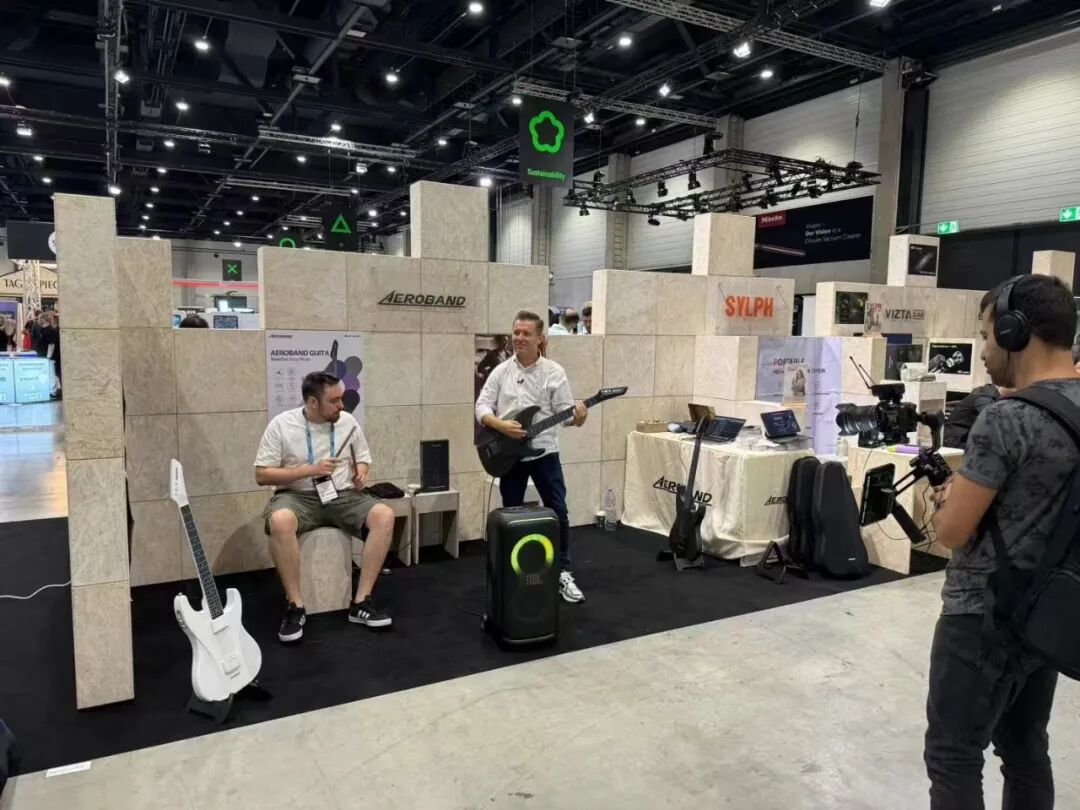
▲ Dair Music exhibiting in Germany.
Image source: Dair Music
Shen Ying: So overall, the music consumer base in Europe and America is quite mature, with higher expectations for musical understanding and instrument quality.
Niu Yafeng: Exactly. We also got a feel for local life in Berlin — maybe 70% of people on the road were cycling, restaurants closed around 9 p.m., and almost all shops were shut on weekends. People spent their weekends either working out or playing music, with large blocks of time to cultivate their interests. So they really care whether your product can make life better.
Lu Shengbo: Similar to Yafeng, I also exhibited in the US and Germany in the first half of this year. Domestic pet owners might focus more on product aesthetics, functionality, and experience. But two things struck me about European and American users: first, they pay particular attention to whether product materials are healthy and safe; second, they look at whether materials are environmentally friendly and recyclable. Some users even have an almost "paranoid" belief that plastic is toxic while metal products are eco-friendly.
I also felt that overseas users maintain a good work-life balance. Moreover, the e-commerce penetration overseas isn't as high — offline retail channels remain well-developed. We're looking to further expand our overseas offline channels.
Shen Ying: I also went to the US in 2023. The offline sales channels for pet supplies there are quite mature, and people have the habit of buying pet supplies in physical stores.
Liu Tao: In October 2023, my team and I went to Europe for research. Our first stop was Germany. It was quite cold in Berlin then, but many people still insisted on outdoor morning runs. European society as a whole is quite orderly — store displays and payment methods are very traditional, and people's acceptance of product innovation isn't as high as in the domestic market. This may be why many new products first roll out in China and the US before reaching Europe. How smart products enter the European market and how to educate users there may still present certain challenges.
Shen Ying: From the overall market environment, would you say that China and the US have better acceptance of technology and innovation products than Europe?
Liu Tao: China's new generation of consumers, including post-80s, post-90s, and Gen Z, have very high acceptance of innovation. And the US has always been at the forefront of innovation, with consumers willing to try new things.
▲ Speediance launched its new smart bike, VeloNix.
Niu Yafeng: I feel the same way — Germany is relatively traditional. Many buildings may be over a hundred years old. Being in Germany feels like being in "the last century." In downtown Berlin, some buildings have tiny elevators that only fit one or two people, since they had to install elevators in such old structures. German products are also built very solidly — even a faucet might be designed to last several decades.
Liu Tao: That's why product return rates in Europe are higher than in the US.
Niu Yafeng: They also care more about after-sales service. During the exhibition, a German consumer told me he noticed that German and Chinese brands differ in after-sales service duration. For example, some Germans buy an appliance and can still find a repair point after three to five years. But many new Chinese brands may not offer after-sales support for that long.
"Long warranty periods" and "reliable products" seem to be embedded in European consumers' DNA. They might care about innovation too, but the premise is that the product must be dependable.
02
How to Choose Your First Overseas Market?
Shen Ying: Has any overseas market surprised you?
Niu Yafeng: We had a layover in Serbia on our way back from Germany and stayed a few days. Like Germany, Serbia's architecture is quite traditional, but many new consumer brands have gathered there. Bars were still open at 11 p.m. or even 1 a.m., with plenty of young people on the streets — just like Changsha.
So even within Europe, Serbia and Germany are very different. Before entering a market, you must visit in person and experience local life — you'll consider things more deeply.
Shen Ying: Understood. So how do uahpet and Speediance expand overseas? What's the underlying logic and strategy?
Lu Shengbo: When choosing overseas markets, we first look at the overall potential of the pet market and cultural fit. Our first overseas stop was the US — the largest and most mature pet market globally. Over 70% of American households own pets, and more than half own three or more pets.
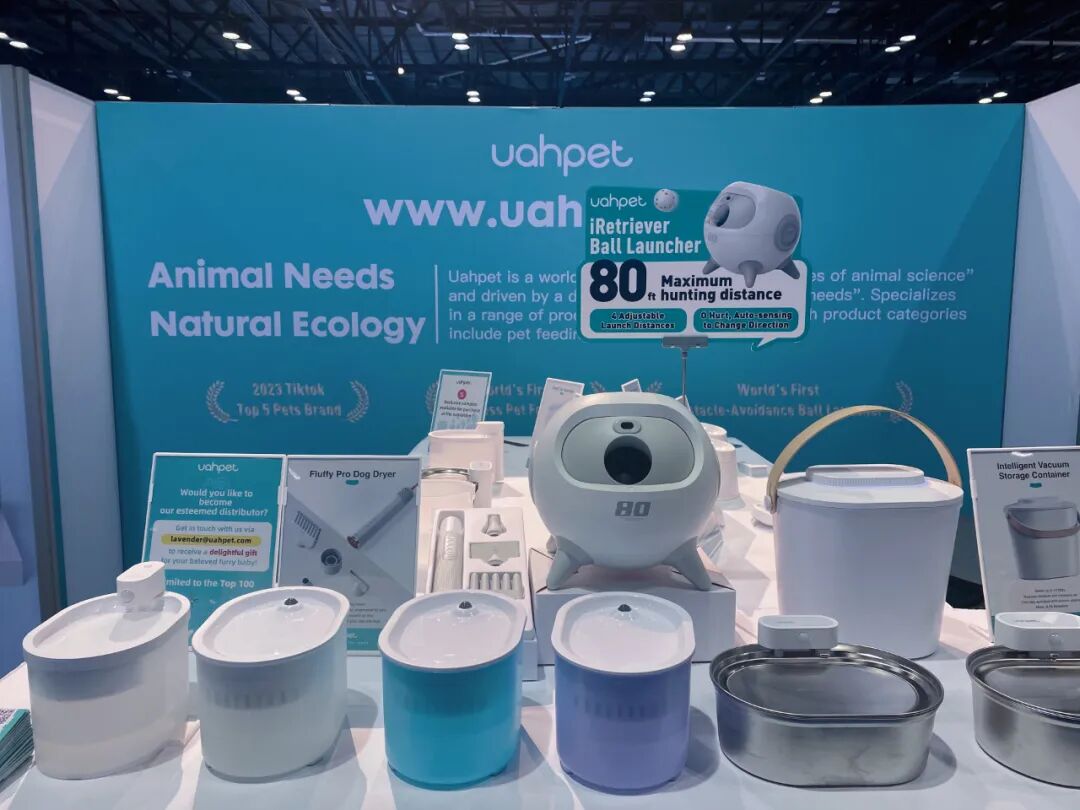
▲ uahpet exhibiting overseas.
Image source: uahpet
Shen Ying: You wanted to enter a market with large volume. But does larger volume also mean fiercer local competition?
Lu Shengbo: Indeed. European and American consumer markets are still in the "channel brand" stage. They entered "deindustrialization" quite early — many products are Made in China, with long product iteration and update cycles. So many products in European and American markets may lag behind Chinese equivalents by half a generation or even a full generation. This means there are still many potential opportunities for innovation and differentiation in these markets.
Liu Tao: Speediance's products are in the very niche fitness track. When choosing markets, we focus more on whether users are interested in the product. The US has the highest fitness penetration rate globally — nearly half the population exercises regularly. Second, we want to go to markets with strong purchasing power, since Speediance's price point is relatively high: over 10,000 RMB domestically and around $3,000 in the US. Additionally, our products are quite innovative and need a market with some tolerance for new things. So overall, the US is currently the best market for us.

▲ Speediance's new VeloNix.
Image source: Speediance
Shen Ying: To summarize, when choosing markets, you tend to favor European and American markets with relatively high purchasing power, large market capacity, and good market maturity.
**/ 03 / **
How Do Overseas Users Perceive Chinese Brands?
Shen Ying: Right now, globalization may not be surging ahead the way it once did. All three of you have positioned your products in European and American markets. What's the local users' receptivity to Chinese brands?
Niu Yafeng: In our early overseas expansion, Donner's product design and the models we featured were all based on Western aesthetics. Many users probably didn't realize we were a Chinese company. Later, through interacting with users, we discovered that many overseas users simply assume these innovative smart hardware brands come from China.
That's because on Amazon, probably more than half of smart hardware products are made in China. Chinese products offer better user experience and higher cost performance — something American domestic products struggle to match.
Shen Ying: In other words, 3C consumer electronics users have developed a kind of tacit understanding now. When they see a new brand with some technological innovation, they figure it's probably from China, and might even actively search for Chinese innovative brands.
Niu Yafeng: Yes, "Made in China" has gradually become "Intelligently Made in China."
Lu Shengbo: Objectively speaking, overseas users' acceptance of Chinese products is actually increasing. They recognize the quality of Chinese products and the innovation behind them. But subjectively, in the current international public opinion environment, negative perceptions of Chinese products still exist — something like "I don't like it, but I have to accept it." Chinese companies need time to gradually change this stereotype.
Also, our competition in overseas markets today isn't just against local companies — more often, it's against our domestic peers.
Shen Ying: You finally go overseas, only to find it's the same crowd competing out there.
Lu Shengbo: Right, competing in the same way. Currently, the average order value for pet products is still relatively low. I hope to see more healthy competition — not just through low prices, but by standing out through brand and quality. Only when Chinese brands in the market collectively innovate technologically and differentiate in positioning will the industry develop faster and better, and will the overall impression of Chinese brands in users' minds improve.
Shen Ying: Building brands driven by premium positioning and technological innovation, rather than purely by improving production efficiency and cutting costs.
Liu Tao: Chinese products have permeated every aspect of overseas users' lives. For our products, brand, and service, I feel users' acceptance is quite high. When a user is willing to spend $3,000 on our product, they care deeply about product quality and service. As long as you deliver, their acceptance of the brand gradually increases. Especially on the service front — we're on opposite sides of the globe from our American users. At first, some users worried whether we could handle after-sales service well. Now, very few users worry about this.
When your product isn't just on Amazon, when you have offline stores and enter more major offline channels, users feel even more assured.
**/ 04 / **
How Do You Provide Emotional Value to Overseas Users?
Shen Ying: Whether it's music, fitness, or pet care, all three entrepreneurs are targeting needs at the level of self-actualization or emotion. In the process of taking products overseas, can you sense any common needs among domestic and overseas users — needs that transcend culture and national boundaries?
Niu Yafeng: Music has no borders, and products and goods themselves have no nationality. Companies like Apple and Tesla serve global users. Although music culture differs across countries, the feelings music brings to people have common ground. For example, at a party, the atmosphere is completely different with or without music.
Behind products are still "people." We need to empathize with users, uncover their specific needs in local contexts. When users want to practice alone at home with focus, they want the sense of achievement and relaxation from learning songs they love. When users are at gatherings, they want joyful moments under a musical atmosphere. After understanding users' living environments and psychological needs, providing emotional value beyond their expectations makes it hard for them to leave your product — because you've created many beautiful moments for them.

▲ The smart guitar developed by Donner Technology.
Image source: Donner Technology
Shen Ying: ToC brands indeed need to bring emotional value to users. Music has no borders, but how do pet products and fitness equipment move users and create resonance between users and the brand?
Lu Shengbo: Whether facing domestic or overseas markets, two logics are universal: first, accurately understanding consumer needs; second, building your own moat and enhancing users' recognition of your brand. Brand recognition depends largely on emotional value — so how do you provide emotional value to users?
Pet owners are naturally very willing to share and be social. On this foundation, we focus on two things: first, making user word-of-mouth central to everything; second, penetrating offline more deeply.
On the word-of-mouth front, we communicate with users through more platforms — independent sites, email, Facebook groups, Instagram, TikTok, and so on. On the other hand, we let some users participate in product development from very early stages. Additionally, the "seed planting" logic applies both domestically and overseas. We collaborate with KOLs (Key Opinion Leaders) or KOCs (Key Opinion Consumers) to spread our brand content.
On offline activities, compared to many domestic users, overseas users generally prefer participating in offline events. We hope to organize as many offline salons and activities as possible, letting overseas consumers understand and perceive our brand.
Liu Tao: Compared to pet products and musical instruments, fitness equipment demands higher service attributes. When users receive this fitness tool, that's when we begin building a strong connection with them. So we pay close attention to how to co-create with users.
There's a very typical example: one user lost dozens of pounds and posted before-and-after comparison photos and his fitness plan in a Facebook community. With his consent, we turned his fitness plan into a course serving users with similar needs. In the week after release, it had the highest click-through rate in the system — many users were willing to follow along.
Shen Ying: Can you continue by talking about your logic and thinking on the direction of combining hardware and software?
Liu Tao: Fitness is very counter to human nature. For most users, they need companionship and guidance when exercising. Hardware is just a tool; what truly keeps users going is usually software.
The standard for evaluating hardware might be making good products, achievable through improving technology and reducing costs. But to do software well requires understanding each user's health status and expectations in a personalized way. For users, health has four relatively core indicators: first, sleep; second, diet; third, emotion; fourth, exercise. Only by considering all four levels can we build a closed loop.
But software has a long road ahead. From the evolution of Apple Watch, we can see it's increasingly focused on people's overall exercise and health status, with increasingly comprehensive data analysis and interpretation. For example, on sleep metrics, Apple Watch calculates how much time is light sleep versus deep sleep. On emotion, Apple Watch occasionally pops up a message reminding you to record how you're feeling. Standing on the shoulders of giants like Apple, in the future our software might become an AI personal trainer. For example, based on yesterday's sleep quality, today's work schedule, and emotional state, it arranges appropriate training intensity and courses for you.
For Consumer Brands Going Overseas, How Do Core Competencies Differ at Different Stages?
Shen Ying: What's the most essential core competency for consumer brands going overseas? From when you first started going overseas until now, has the required core competency changed?
Lu Shengbo: I think the most essential competency is localization, which can be broken down into market research capability, product adaptation capability, and brand communication capability.
First, market research capability. New brands going overseas today are very different from foreign trade businesses decades ago — back then, as long as you could get overseas orders, you pushed production at the factory. Now you need more meticulous product research to validate feasibility. For example, before launching a pet interactive toy, our research found that in the US market, users raising medium-to-large dogs account for a higher proportion. So we specifically designed smart interactive toys for large dogs, not only using high-strength materials but also making significant adjustments to product form, specifications, and so on — ultimately receiving positive market feedback.
Second, product adaptation capability. After research, you'll find that different countries and different channels have different demands for your product. So how do you adapt well? We can learn from early foreign companies' localization strategies when entering China — for example, KFC in China launched the Old Beijing Chicken Roll and New Orleans Roasted Wings, products that don't exist in the US.
Third, brand communication capability. Some Chinese companies feel that as long as the product is good, "good wine needs no bush." But now users need to hear interesting brand stories and feel the brand's spiritual core. For example, Tesla's founder Elon Musk has built a geek image that's very attractive. In the process of going overseas, brand communication also involves cross-cultural communication issues — you need to respect local religions and cultural customs, not go against them.
Niu Yafeng: We also pay close attention to localized market demands. Before going overseas, you need to first experience the overseas market environment and user differences. At the product level, taking the music industry as an example, Asia leans toward "karaoke" culture, where folk music styles are very popular, but in Europe and America rock culture prevails. Different music cultures mean different instrument functions and style demands. For example, a guitar suited to folk accompaniment style may not satisfy rock users' preferences. Instruments that sell well in China may not sell well overseas.
At the marketing level, the marketing environment differs considerably between domestic and overseas markets. Domestic live e-commerce is very mature — from traffic display to final transaction, the entire chain is completely connected. Overseas, there are disconnects. Users' shopping habits on TikTok vary widely; many users prefer to place orders on Amazon or brand independent sites. But domestically, most brand official websites don't serve sales functions.
Liu Tao: In the process of going overseas, the most essential core competency changes dynamically.
In the first stage, don't rely solely on low prices — instead, create differentiated products and capture the dividends of differentiation. Moreover, the tools for going overseas are now very complete — how to build an independent site, how to do well on Amazon — enabling brands to first operate online as "air force," making initial entry into overseas markets. The advantage of "air force" is high efficiency and fast starts.
In the second stage, after you've covered your main customer groups, when you want to achieve precise coverage, you'll find that merely contacting users online is far from enough. Staying only online, the company's growth rate may also begin to slow. At this stage, you need to switch from "air force" to "army," gradually penetrating overseas offline channels and cooperating with local service providers, and so on.
In the third stage, as your scale gradually increases, you may face compliance and intellectual property issues — we can go into detail on this next.
The Biggest Challenges Faced in the Process of Going Overseas
Shen Ying: In the process of going overseas, what are the biggest challenges you've encountered?
Liu Tao: I think the biggest challenge we faced was a patent lawsuit initiated by an overseas competitor. Because we had sufficient evidence that our product didn't infringe on their patents, they eventually withdrew the lawsuit — it was resolved peacefully. The US is a country that places great emphasis on intellectual property. For companies going overseas, you need to pay even more attention to IP and product originality to avoid potential risks.
Lu Shengbo: Our biggest challenge was also IP-related. In 2023, our trademark registered on Amazon was mistakenly removed by the platform. It took us about five to six months of continuous appeals to resolve. Because the other party was across the ocean, all communication had to happen via email, sometimes even through Amazon's third-party teams. Each time you communicated with someone different, you'd go through a cycle, and each cycle took about a week. The longer it dragged on, the more anxious you became.
The biggest lesson for us was treating compliance as a cost of localization. Compliance is actually very important. The more surface-level legal and regulatory compliance is relatively easy, but beneath the surface there are unwritten rules — if you don't deeply understand them, you'll still run into problems. Because of this incident, we've now replaced all our compliance-related law firms and agencies with US-based companies. Even though the costs are higher, it genuinely makes resolving compliance issues easier.
Niu Yafeng: One point I'd highlight is that overseas orders are quite seasonal. On the supply chain side, for our drumsticks, order volume was fine between July and September 2023, but surged rapidly in October. With insufficient overseas inventory, how do you handle that? Fortunately, we had spent a long time working with our supply chain beforehand, and managed to produce and ship 10,000 sets in ten days.
So we need to pay special attention to characteristics of overseas consumption. Especially for electronics, there's inevitably a cycle from manufacturing to shipping, so you need to forecast peak supply chain capacity. The supply chain needs flexibility — for example, normally you might produce a few thousand sets per month, but during peak season, you need to have three to five times that capacity in reserve. Particularly for companies doing smart or innovative products, after a new product's PVT (Process Verification Test, a type of hardware testing for small-batch process verification), you need to test not just its ability to handle sustained high-volume production, but also short-term surge capacity.
Shen Ying: Making the supply chain flexible requires coordination with many partners. How do you collaborate with your partners?
Niu Yafeng: These partners have been with us for a long time and understand our product characteristics — which materials have the longest production cycles, which can be prepared quickly, which can rapidly scale up capacity. Stockpiling finished goods isn't necessarily economical because the cost is high, but you can prepare materials with long lead times that are relatively cheap.
How to Arrange Supply Chains Amid US-China Competition?
Shen Ying: Against the backdrop of US-China competition, global supply chains have undergone major changes. I went on a study trip to Vietnam a few days ago. Northern Vietnam actually has a concentration of consumer electronics with relatively mature supporting infrastructure — 70% or 80% of upstream materials can be sourced locally. Many Chinese 3C electronics processing and packaging plants have set up factories in Vietnam, then export to the US from there. Vietnam and other Southeast Asian countries have become indispensable links in the US-China trade supply chain.
These companies may have built factories in Vietnam partly due to comprehensive cost considerations like tariffs after scaling up; partly also due to geopolitical considerations, driven by the "China Plus One" strategy. Everyone is now watching how the US election will affect global supply chains. (Further reading: 18 Charts to Understand the Changing Global Supply Chain)
Since all three of you are still primarily doing product exports, a major theme going forward will be supply chain globalization. But there remains uncertainty in the global trade situation. How do you view potential future changes in the international landscape, and how are you planning future supply chain arrangements?
Liu Tao: Our supply chain colleagues have done some assessments of overseas markets and reached some preliminary conclusions. In extreme scenarios, we believe a large volume of Chinese consumer electronics could potentially move to Southeast Asia, which also has the conditions for mass production.
But we also need to pay attention to local policies. In Vietnam, if overseas products want to export under the "Made in Vietnam" label, they must add 30% new value in Vietnam. This means spending on electronic structures, packaging, assembly, and related components must account for more than 30% of total cost. It's not as simple as setting up a shell company, doing some assembly in Vietnam, and slapping on a label.
Additionally, there's been recent discussion about the government further promoting development of China's western regions, and the China-Europe Railway Express has been operating since 2011. So going west, toward cross-border exports to Europe, is also a good option. After all, trade between Europe and China is very close, and tariff policies are friendlier compared to the US. I think if you're considering the European market when going overseas, Chengdu could serve as one of the bridges between China and Europe — we should learn more about the economic policy direction of Chengdu and its surrounding areas.
Shen Ying: On this trip to Vietnam, I saw firsthand that Mixue Ice Cream & Tea already has very large scale in Southeast Asia, and it has also made Southwest China an important supply chain hub to serve overseas markets.
Lu Shengbo: From a business development perspective, supply chain localization is ultimately the path you need to take. What's unique today is that external objective circumstances are forcing you to make this decision earlier. When we now consider building production lines and supply chains, we tend to lean toward keeping these domestically. This may be related to our product characteristics — pet products are relatively not a major focus of current sanctions.
Niu Yafeng: Musical instruments haven't been sanctioned yet. For innovative, smart brands like Donner, considering comprehensive costs from manufacturing to repair and after-sales service, Shenzhen is currently sufficient to support us.
Additionally, I think we need to consider how to guarantee user after-sales service after localization. In early 2024, we visited many after-sales warehouses in Los Angeles and learned about many mature after-sales handling methods. For products like electric bicycles, shipping them back isn't realistic, and local disposal costs are very high — so how to properly solve this is something I think most innovative companies going overseas need to think about.
How to Make Products Smart?
Shen Ying: The intelligence and AI-ification of hardware products is the general trend. I'd like to ask all three of you to share how to do consumer electronics intelligence well?
Liu Tao: All innovation must stem from user needs. Product intelligence is essentially about what problem you're using intelligence to solve. For fitness, intelligence is really about teaching users how to exercise, so it doesn't need to be that complicated.
In the era of "mass entrepreneurship and innovation," a batch of products emerged that didn't really need to be smart. For example, smart fishing — the principle was connecting a sensor to the fishing line that could judge whether a fish was biting based on how the fish pulled the line. But this smart alert for fish biting probably wouldn't appeal to fishing enthusiasts.
So intelligence depends on user needs — think about what problem it solves, don't do intelligence for intelligence's sake. For example, I recently bought an electric toothbrush that can connect to your phone to adjust various brushing parameters, but after buying it I realized I don't care about various frequency and intensity settings at all — I care more about dental health and aesthetics.
Lu Shengbo: I strongly agree. First, we should think about how to truly understand user needs, and whether intelligence can genuinely create convenience or value.
There was a joke before about someone inventing a shared phone — when your phone died, you could scan a QR code with your phone to make a call. Obviously this intelligence was unnecessary. We've categorized our own products' intelligence into automation, digitization, AI, but still, some products or functions don't need to be smart.
So everything comes back to consumer needs — understanding what users need, what approach we should use to solve it, and whether intelligence can play a role. But I think the trend toward intelligence won't change, because technology will certainly keep developing.
Shen Ying: Because Uah's customers are pet owners, but the actual users are pets — doing needs research is more indirect and difficult. Can you share how you do user research, such as whether pets need intelligence, and how to make products intelligent?
Lu Shengbo: First, respect animals' natural instincts. Second, solve pet owners' pain points and needs — both need to be considered and balanced.
When we consider whether a product needs intelligence, we mostly approach it from the pet owner's perspective. Take automatic water dispensing — pets may not have any need for automation, but this function allows pets to have continuous, fresh water even when the owner isn't home.

▲ The smart water dispenser developed by Uah Tech.
Image source: Uah Tech
Specifically for digitization — the user of digitization is the pet, but the person receiving digital services is the pet owner. So we need to think about whether the pet data we collect is truly valuable, and whether after obtaining this data, we can create services and value for pet owners. If not, then digitization for digitization's sake is meaningless. Like Apple, which is actually quite restrained in intelligence innovation for many products.
Shen Ying: I can tell that the R&D chain for pet smart products is longer and more complex — you need to pay attention to both pet needs and pet owner needs. Finally, let's hear how Donner views intelligence.
Niu Yafeng: I agree — user needs are paramount. Intelligence is actually a tool, one of the solutions we use to serve user needs. Musical instruments are essentially users producing pleasant sounds through equipment and actions. Different eras have had different solutions. Over 200 years ago it was acoustic guitars, and folk music developed accordingly. Over 100 years ago, with the maturation of pickup and other technologies, electric guitars emerged and rock culture gradually rose. Even today, the solution hasn't fundamentally changed from 100 years ago, but user needs keep evolving — for example, electronic music has developed rapidly.
So could musical instruments also have an intelligent form?
Our intelligence approach starts from user needs, with the goal of bringing users a better experience. For example, how can instruments produce richer sounds, how can they be operated more easily. When we defined our smart guitar, digitization was the foundation — because speaker and tone sampling technologies are relatively mature now, these technologies can guarantee good sound. Then we can change the guitar's form through new combinations, making it more comfortable for users to pick up, and even allowing users to rely on AI for digital creation after playing a melody.
Shen Ying: Looking to the future, how do you view the impact of AI technology on smart musical instruments?
Niu Yafeng: Right now, digitization and partial intelligence on the hardware side are already in place. AI's role is increasingly about empowering content. First, there's AI-powered recommendation — users can quickly find songs they like. The next step is teaching functionality. Traditionally, learning music means starting with music theory. Going forward, users might simply pick a song they like, and the AI compiles everything needed to play it into a structured course, lowering the barrier to entry. After that comes creation: AI can assist with emotional expression and performance state, layering accumulated knowledge onto the user for a better overall experience.
Shen Ying: In the pet smart products space, what new possibilities do you see AI bringing in the future?
Lu Shengbo: I think it's mainly about smarter, more personalized services. For example, uah's feeder has AI feeding capabilities — you input the pet's breed, age, weight, plus the pet food brand and specific product specs, and the feeder automatically generates a relatively scientific feeding plan based on the animal's profile.
Today's smart products, first, serve everyone. Second, they aren't that targeted. What do people want the ultimate form of intelligence to look like? I think something like J.A.R.V.I.S. from Iron Man. It's the same for pets — owners want an expert caregiver providing more intelligent data and services.
/ 09 /
What Did You Learn from DJI, Netflix, and Tesla?
Shen Ying: Are there any global brands or companies you particularly admire that have influenced you significantly?
Liu Tao: DJI is, in my mind, the pioneer among Chinese consumer electronics companies going global. Without real competitors, they kept understanding the market and users, continuously driving technological innovation. From DJI, I see the effort and self-reinvention in its globalization process — it makes me believe more Chinese companies can create world-class products.
Lu Shengbo: The biggest influence on me is probably Netflix. What particularly attracts me is their "freedom and responsibility" culture. For startups, how to make organizations more efficient is an excellent topic. I especially hope the uah team can become self-motivation-driven in the future.
Shen Ying: Netflix has a book called No Rules Rules about how creative companies do management well. It sounds somewhat contradictory — creativity needs inspiration, challenging and breaking rules, yet managing a company requires sound systems. But Netflix balances the two very well.

▲ Image source: https://www.norulesrules.com/
Niu Yafeng: I really admire Tesla — in a new industry, continuously pushing new product categories to the forefront. That's something very worth learning for entrepreneurs. For example, how electric vehicles iterate to replace traditional fuel cars. Following first-principles thinking: the first principle of consumer goods is user needs. What satisfies user needs is the solution. And the first principle of solutions is how to optimize across experience, cost, and other dimensions. On cost control, Tesla has a metric called the "idiot index" — the ratio of industrial production cost to raw material cost. The higher the index, the more expensive the production process, which needs to be driven down through technological innovation.
By analogy, the musical instrument industry also needs to start from user needs and think about how to use technology to deliver better experiences, ultimately giving the entire industry efficient, innovative solutions for the intelligent era.
Reader Giveaway
What do you think about new consumer brands going global? Leave a comment below — we'll randomly select 5 readers to each receive a copy of Marc Levinson's The Box: How the Shipping Container Made the World Smaller and the World Economy Bigger.

China's Healthcare System Over 40 Years: From Past to Future | FreeS Report
18 Charts to Understand the Changing Global Supply Chain | FreeS Research
Globalization Has Slowed, So Why Is Going Global Still a Must? | Li Feng Column
"Not Going Global, But New Globalization": Thoughts and Practices from Nearly 20 Companies
Star the FreeS Fund WeChat official account for timely business insights