How do you bridge the "last centimeter" between robots and real-world interaction?

Why Is It the "Hand" That Chokes the Robot?

Our hands are so naturally woven into labor and daily life that we often overlook just how exquisite they are.
A single hand contains roughly 27 bones — carpals, metacarpals, and phalanges — controlled by over 30 muscles working in concert to execute complex motions like flexion, extension, and adduction. It is this precise biological system that enables surgeons to perform millimeter-scale operations and pianists to draw out moving melodies.
Carbon-based life developed such dexterous hands through eons of evolution. So how might silicon-based life — robots, for instance — acquire hands that can truly touch the physical world?
Recently, on The Material Hour (Youliao Shijian), a program by Tencent News's Shenwang Studio and Xiaoman Studio, Tencent editor Xue Fang spoke with Dehao Wei, founder and CEO of Interstellar Epoch, and Qianhang Yan, vice president of FreeS Fund. They explored the technical barriers, investment logic, and commercialization paths for dexterous hands, analyzing how Chinese startup teams can break through intense competition and navigate the real-world challenges of scaling toward mass production.
Dehao Wei, a '98-born entrepreneur, earned his bachelor's degree from Harbin Institute of Technology before being admitted to Tsinghua University for graduate studies. He previously worked as a robot learning algorithm engineer at ByteDance's AI Lab. Faced with multiple million-yuan salary offers, he chose the far more arduous path of building dexterous hands. In August 2024, he founded Interstellar Epoch. Within just over a year, the company developed a product matrix of dexterous hands covering multiple scenarios through its self-developed hardware and software platform.
In his view, large models have already proven their generalization capabilities in the digital world. To extend that intelligence into the physical realm, robots must be able to interact efficiently with their environment. And dexterous hands are the critical "last centimeter" — the most central yet woefully underdeveloped link in the current robotics supply chain.
Qianhang Yan is a vice president at FreeS Fund, where he primarily invests in and helps manage projects including LimX Dynamics, Pulin Technology, and Interstellar Epoch. He believes that dexterous hands, as the foundational enabler of general manipulation capabilities, are an inevitable step toward truly general-purpose robots. In time, we will see mature, deployable-at-scale product forms emerge. The journey will be long, but the direction is clear and the trend is certain.
This is a deep conversation bridging both entrepreneurial and investor perspectives. We've edited excerpts from the dialogue in hopes of offering fresh angles for reflection. This piece is part of our "AI Industry Observer" series, which will continue to share firsthand practices and observations from AI entrepreneurs.
AI Industry Observer Series
From Large Models to AI Companions: What Cyclical Patterns Lie Behind the Rotating Hype?
"In AI Hardware, There's Always a New Opportunity"
Reader Giveaway
What changes do you think dexterous hands will bring to our lives? Share your thoughts in the comments. By 17:00 on November 26, 2025, the two most thoughtful commenters will receive a copy of The Logic of Civilization.

Born in '98, Tsinghua Master's Graduate Turns Down Million-Yuan Salary to Build a Hand | Shenwang
Source: Shenwang · Tencent News Xiaoman Studio
By Li Shengwen, edited by Xue Fang
/ 01 /
Leaving ByteDance to Build: Dexterous Hands as the "Last Centimeter" of AI Deployment
The Material Hour: Why did you choose to leave ByteDance and start a company?
Dehao Wei: Large models have already proven their generalization capabilities in the digital world. I've been asking myself: how do we extend that capability into the physical world? The answer points to robots — and dexterous hands are the "last centimeter" of interaction between robots and the real environment, as well as the most critical yet severely missing link in the current supply chain.
During my time at ByteDance, I realized that without high-performance, easy-to-use dexterous hands, AI couldn't truly enter real-world scenarios. Starting in 2021, I began focusing on dexterous hand R&D and have since accumulated five years of experience spanning structural design, hardware development, and control algorithms. It was this clear understanding of industry pain points that drove me to start Interstellar Epoch, with the goal of building a high-performance dexterous hand product for general-purpose applications.

Interstellar Epoch's product matrix. Image source: Interstellar Epoch
The Material Hour: Why did FreeS Fund choose to bet on Interstellar Epoch at the angel round?
Qianhang Yan: In May 2024, I first met Dehao Wei in a Beijing rental apartment. He hadn't graduated yet. The room was packed with CNC machines, 3D printers, and various prototypes. In that very environment, he had already built a working dexterous hand prototype. He's the archetypal geek — strong hands-on skills, clear goals, and the courage to start a company right after graduation.
We had in-depth discussions about technical approach. His breakthroughs in tendon-driven design, his understanding of AI control algorithms, and his clear productization path all aligned well with FreeS's investment logic in robotics.
Dehao Wei: We're young, but we understand technology. Fortunately, we met FreeS — an investment firm that truly believes in technology and in the creativity of young people. Today's venture capital environment increasingly focuses on the essence of technological innovation and founders' original vision, rather than just pedigrees or resume highlights. For tech geeks, this is an unprecedented opportunity. If you have ideas and conviction, you should take that step.
Qianhang Yan: Dehao Wei's entrepreneurial resolve is rock-solid. He doesn't just want to build dexterous hands — he wants to build robot systems with truly free interaction capabilities, with AI at the core.
The Material Hour: Where does your passion for dexterous hands come from?
Dehao Wei: I've been a science and engineering guy since childhood, passionate about inventing and creating. After entering the mechatronics program at Harbin Institute of Technology, I could finally unleash that passion fully. During my graduate studies at Tsinghua, I came across OpenAI's research using reinforcement learning to control a dexterous hand solving a Rubik's cube. I was deeply struck.
Traditional control methods struggle to handle real-time coordination across 20-plus degrees of freedom, while AI showed unprecedented possibilities. This ignited my desire to explore further. At the time, the domestic market lacked high-DOF dexterous hand products, while overseas equivalents cost millions of yuan. So I proposed to my advisor that we develop our own dexterous hand and research reinforcement learning-based control methods.
/ 02 /
Tendon-Driven + Cerebellar Model: Building the Next Generation of Dexterous Hands
The Material Hour: Could you introduce the technical approaches and future directions for dexterous hands?
Dehao Wei: The ultimate goal of dexterous hands is to approximate human hand form while matching or exceeding human hand performance. Historically, dexterous hands were mainly used in prosthetics, where signal precision limitations typically restricted DOF to under 10. Today, AI control technology can effectively manage systems with 15 to 20-plus degrees of freedom, freeing dexterous hands from "mechanical" rigidity and enabling more natural, flexible manipulation.
As early as 2021, we established our technical approach. The mainstream options at the time were four: direct electric drive, linkage transmission, artificial muscle, and tendon drive. After comprehensive evaluation, we chose tendon drive because its biomimetic structure most closely resembles the human hand: by simulating tendon force transmission, it achieves high degrees of freedom while maintaining excellent impact resistance. In terms of payload, DOF, and lightweight design, tendon drive offers unique advantages.
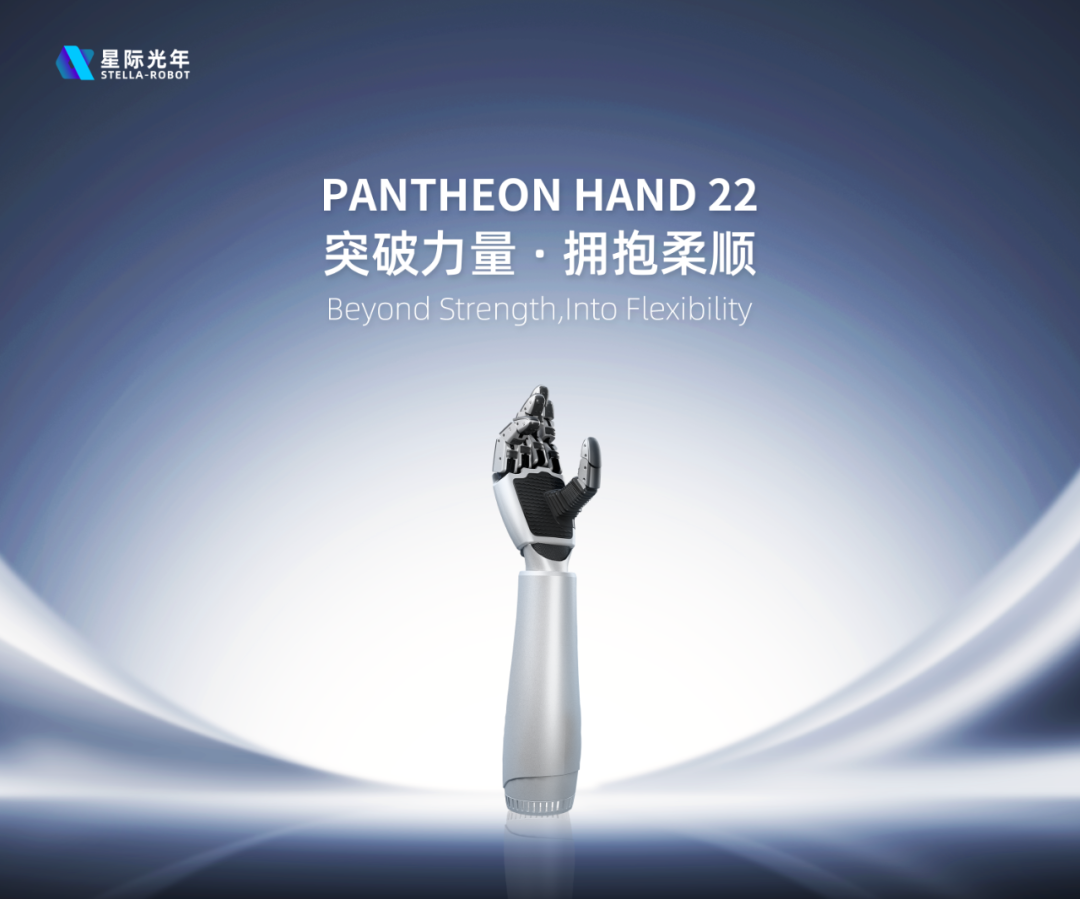
Interstellar Epoch's Pantheon Hand 22, a fully tendon-driven five-finger dexterous hand.
Image source: Interstellar Epoch
Of course, tendon drive also faces challenges, primarily cable lifespan and creep (material deformation). To address this, we independently developed novel cable materials, extending service life to 500,000–800,000 cycles, and combined structural design with control algorithms to achieve automatic tensioning mechanisms that effectively solve the creep problem.
The Material Hour: How does FreeS view the different technical approaches in the dexterous hand field?
Qianhang Yan: Technical approach selection depends on product goals. Dexterous hands need to balance degrees of freedom, precision, payload capacity, and cost. Currently, the industry mainly focuses on two paths: joint motor direct drive and tendon drive.
From a performance ceiling perspective, tendon drive has greater potential in high degrees of freedom, human-like form, and lightweight design. More importantly, tendon drive technology has moved from the lab toward initial commercialization, offering stronger cost elasticity and better suitability for real-world application deployment.
The Material Hour: What is Interstellar Epoch's next strategic move?
Dehao Wei: Interstellar Epoch's mission is to "advance the deployment of embodied intelligence for general manipulation," and dexterous hands are the core vehicle for this vision. Currently, vision-language large models generally suffer from response latency, making them ill-suited for tasks requiring immediate reaction like quickly catching a falling coffee cup. Therefore, we're bullish on the "cerebellar model" — delegating high-timeliness底层 operations to local processing rather than relying on cloud inference.
The next generation of dexterous hands should deeply integrate cerebellar models into the hardware itself, building a software-hardware integrated manipulation platform. Users should be able to execute various fine manipulation tasks right out of the box, without complex deployment or tuning.
The Material Hour: Does the cerebellar model imply lower costs?
Dehao Wei: Compared to large models, cerebellar models are smaller in scale, so inference costs are indeed lower. But the R&D difficulty is no less challenging — it remains a frontier exploration area. We'll continue investing resources to develop cerebellar models with strong generalization capabilities that can work in synergy with large models' reasoning abilities.
The Material Hour: What are the main difficulties in hardware refinement?
Dehao Wei: Dexterous hands are essentially "AI-defined hardware." The difficulty lies in the deep coupling between hardware and algorithms. For example, the coupled joints of human fingers make mechanical sense but can pose challenges for reinforcement learning. Our team combines software and hardware backgrounds, enabling us to tackle coupled-joint problems through system-level co-design — this is our core advantage.
The Material Hour: What progress has Interstellar Epoch made in data collection and open-source ecosystems?
Dehao Wei: During my graduate studies at Tsinghua, I developed an "endoskeleton-exoskeleton dual-modal data collection system." The logic is similar to a kindergarten teacher guiding a child's hand to write — through "hand-by-hand teaching," we simultaneously collect sensor data and force feedback information to efficiently generate training data. This approach has since been adopted by leading international institutions including Stanford and MIT.
On the open-source front, we released the open-source Gaia Hand dexterous hand project, which has received positive feedback from academia and the developer community.
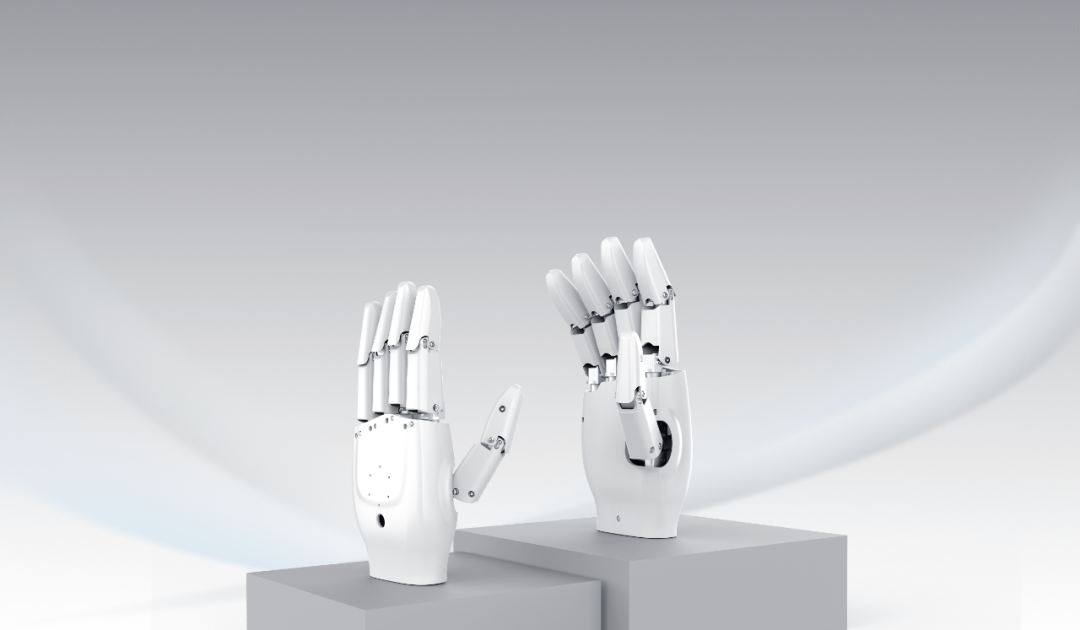
The open-source Gaia Hand dexterous hand. Image source: Interstellar Epoch
The Material Hour: How does FreeS view the "open-source hardware" model?
Qianhang Yan: In the early stages of technology development, lowering barriers and cultivating ecosystems is crucial. Currently, resources in the dexterous hand field are scarce. Open-source can attract more researchers and engineers to participate and spark more creativity. First get the ecosystem active, then gradually explore commercialization paths.
/ 03 /
The Critical Leap from Geek Toy to General-Purpose Component
The Material Hour: Are we on the eve of an explosion in embodied intelligence application scenarios?
Qianhang Yan: Whether a true explosion happens depends critically on product maturity. Dexterous hand technology is still in early stages — high-DOF solutions are constrained by missing control models and hardware performance bottlenecks. The real marker of explosion will be when system integrators can access dexterous hand functionality with low barriers. At this stage, accompanying research institutions and seed users to explore real application scenarios matters more than pursuing scale.
The Material Hour: Which industries have the most urgent demand for dexterous hands?
Qianhang Yan: Right now, the most visible applications are demonstration or performance scenarios. But in manufacturing, industrial, or consumer applications, the value of dexterous hands hasn't been fully unleashed — we're still in an exploration phase. The core advantage of dexterous hands lies in completing tasks that traditional robots cannot handle and that require human-level fine manipulation, such as delicately handling fabric during garment sewing.
The Material Hour: How do you view the employment and ethical issues brought by technological substitution?
Qianhang Yan: Technological revolutions may冲击 some existing jobs in the short term, but in the long run, they tend to create higher-value new professions. As technology investors, we're optimistic — we believe technology can liberate humans from repetitive, monotonous, and even dangerous work, unleashing greater creativity.
Dehao Wei: Technological transformation is inevitable. If the substitution process is gradual and orderly, prioritizing the replacement of high-risk, high-intensity, highly repetitive positions while shifting humans toward more creative and decision-oriented work, this is undoubtedly social progress. As Yan said, new technologies eliminate old jobs while creating new opportunities. When automobiles replaced horse-drawn carriages, employment didn't shrink — instead, it spawned mechanics, assembly line workers, traffic management, and a host of new professions, driving societal advancement.
The Material Hour: Is it too early for dexterous hands to push toward mass production? What specific challenges will mass production face?
Qianhang Yan: Mass production is an unavoidable hurdle for all hardware startups. I always tell Wei to be mentally prepared, hoping he "falls a little lighter."
The challenges start with supply chain choices: balancing cost control with stable, reliable quality. Then there's coordinating hundreds of components — any single link going wrong can slow overall progress. Additionally, there's a frequently overlooked but critical issue: capital efficiency at different production scales. From hundreds to tens of thousands of units, capital attrition rates differ completely. As scale expands, the cumulative effect of微小损耗 across every环节 will severely test a company's overall operational capabilities.
The Material Hour: What is the current cost structure and reliability level of dexterous hands?
Dehao Wei: Currently, over 95% of dexterous hand costs come from non-standard machined parts, custom motors, and specialized circuit boards. These components mostly require individual tooling or custom development, making it difficult to leverage existing supply chains.
As for reliability, this is a矛盾 common to early-stage hardware technologies: rapid iteration often comes at the expense of充分的 stability testing. We're working hard to find the balance between R&D speed and product validation — please give technology some time to grow.
The Material Hour: Can dexterous hand prices drop from tens of thousands to thousands of yuan?
Dehao Wei: Entirely possible. Looking at the development paths of LiDAR, air suspension, and other technologies, they were once premium configurations and are now普及型 components. Through scaled mass production, dexterous hand costs could drop substantially, providing humanoid robots with a high cost-performance core component option.
The Material Hour: What are China and the US's respective advantages in embodied intelligence?
Qianhang Yan: China's advantages lie in abundant application scenarios, numerous customers, and an efficient supply chain system. In Shenzhen's Huaqiangbei, circuit boards ordered today can be delivered that evening — this hardware iteration speed is something the US cannot match.
The US advantage lies in capital's high tolerance for frontier innovation, allowing startups to focus on exploration more like research institutions. In short: the US excels at "zero-to-one"原始 innovation, while China is stronger at "one-to-hundred" rapid落地 and scaling.
The Material Hour: Which links in the dexterous hand supply chain still urgently need breakthroughs?
Qianhang Yan: Overall, domestic manufacturing of dexterous hand main structures already has strong supporting capabilities. But in critical subsystems like tactile sensors, continued technical攻关 is needed. This is also one of the key directions that investment institutions are currently focusing on.
The Material Hour: Will dexterous hands become standard equipment for robots?
Qianhang Yan: Most likely. As the foundational enabler of general manipulation capabilities, dexterous hands are an inevitable step toward truly general-purpose robots. In time, we will see mature, deployable-at-scale product forms emerge. The journey will be long, but the direction is clear and the trend is certain.
"Sometimes What Matters Most Is Not What You Do, but What You Don't Do"
The Material Hour: As CEO, how do you allocate your time?
Dehao Wei: Early on, as a technically trained founder, I often got bogged down in execution details, later realizing this was actually inefficient use of resources. Now I focus my energy on three things: finding people, finding money, and setting strategy.
I'm increasingly clear about this: sometimes what matters most is not "what to do" but "what not to do." We've committed all our resources to one direction — building a "software-hardware integrated dexterous hand manipulation platform."
The Material Hour: What challenges arise in building a software-hardware integrated team?
Dehao Wei: As AI-driven hardware, dexterous hands naturally require cross-disciplinary, composite technical capabilities. Founders must possess a "full-stack" perspective — understanding algorithms, control, mechanics, electronics, and other modules, while also being able to precisely assemble teams according to development stages. Rapid team building and continuous iteration are our core strategies for meeting these challenges.
The Material Hour: What advice does FreeS have on team building?
Qianhang Yan: The core task of early-stage startups is attracting the best talent to join. And how to become an excellent CEO is a critical question founders must confront. Wei has already done quite well in this regard. The next key step is getting more people willing to follow him and fight together.
The Material Hour: Beyond financial support, how else does FreeS help Interstellar Epoch?
Qianhang Yan: Mainly two ways: first, introducing founders who have gone through similar hardware startup challenges to share practical experience; second, helping connect downstream application scenarios and upstream supply chain resources. For example, we'll take technically trained CEOs to meet entrepreneurs who have transformed from "tech people into sales masters" — this kind of genuine cognitive shock may be far more valuable than theoretical lecturing.
The Material Hour: How do you view the current investment boom in embodied intelligence?
Qianhang Yan: This boom began in 2022 when Tesla announced its Optimus humanoid robot plan, and Unitree's appearance at the Spring Festival Gala truly brought embodied intelligence into mainstream public awareness.
The real moat in embodied intelligence lies in software-hardware integration capabilities. Hardware design and control algorithms must co-evolve, forming a spiral upward positive cycle. FreeS was already actively布局 in embodied intelligence before the boom. Currently, our embodied intelligence investments cover four directions — core components, key sensors, AI + embodied systems, and scenario applications.
In core components, we've invested in Interstellar Epoch and INNFOS Robotics; in sensors, we've backed Zhaoguan Technology and Hangkai Microelectronics; in AI + embodied systems, we support LimX Dynamics, Yuanluo Technology, and Dongyi Technology; and on the application side, we invested years ago in Covariant AI, a robotics company focused on warehouse logistics.
We're always watching for when the breakthrough and commercialization tipping point in embodied intelligence will arrive.
Reader Giveaway What changes do you think dexterous hands will bring to our lives? Share your thoughts in the comments. By 17:00 on November 26, 2025, the two most thoughtful commenters will receive a copy of The Logic of Civilization.

"In AI Hardware, There's Always a New Opportunity"
From Large Models to AI Companions: What Cyclical Patterns Lie Behind the Rotating Hype?