From Scientific Innovation to Tech Entrepreneurship in Semiconductors | FreeS Fund Chip Series

What are the core moats at different stages of hard tech startups?

On the morning of April 24, the first episode of the "FreeS Fund Dialogue · Chip & Semiconductor Series" livestream — Challenging World-Class Problems: The Present and Future of Photonic Chips — featured an in-depth conversation between Yichen Shen, founder & CEO of Lightelligence, and Feng Shu (Li Feng).
Yichen Shen is the founder & CEO of Lightelligence and holds a PhD in physics from MIT. In 2017, he published a cover paper as first and corresponding author in Nature Photonics, pioneering a novel computer architecture based on optical neural networks and opening up photonic computing as an entirely new industry direction. Building on this breakthrough, Shen founded Lightelligence in 2017, a company focused on photonic computing and AI semiconductors. FreeS Fund invested in Lightelligence as early as the angel round. Today, Lightelligence leads the global photonic computing race across technology R&D, product development, and funding scale.
Shen and Feng Shu discussed technical innovations, application scenarios, and development trends in photonic chips. Shen also reflected on the challenges of transitioning from scientist to founder, and how he navigated that shift.
This is the third installment in the FreeS Fund chip series. Before diving in, here are some key takeaways from their conversation:
- Cutting-edge technologies typically go through a journey from skepticism to broad acceptance. Initially, there are many doubters — will it take off, and when? The debate only subsides once the breakthrough actually arrives.
- When traditional technical approaches can no longer resolve market supply-demand imbalances, industrialization opportunities emerge for frontier technologies.
- Research often begins with point breakthroughs. But translating technology into products requires connecting many more dots together.
- Hard-tech companies need to build different core moats at different stages. Early on, the moat lies in breakthroughs across several key underlying technologies. In the second phase, it's about integrating these底层 technologies into a larger, more complex hardware-software unified architecture. Further out, the core moat shifts to refining better products, gradually building a developer ecosystem, accumulating supply chain advantages, and more.
- For large and mid-sized customers, software generality matters most. When facing such customers, tech startups shouldn't try to build something comprehensive. Instead, find the customer's most painful point and the scenario where your technical advantage shines brightest, and use that as your entry point.
- When starting out, the most important thing is to find a 60-70 point solution in the shortest time possible, then move fast and iterate along the way. Even in hard-tech entrepreneurship, research capability is only one piece of the puzzle.
We've edited and included excerpts from the conversation below, hoping they offer some useful insights. We'll also be releasing highlight clips from this discussion on the FreeS Fund WeChat video channel.
Upcoming Livestream
On May 8, the second episode of the "FreeS Fund Dialogue · Chip & Semiconductor Series" — Hammer vs. Nail: How Hardcore Tech Finds Its Ideal Scene — will feature Cheng Li, founder & CEO of VisionICs, and Ningning Feng, founder & CEO of LuminWave, in a deep discussion with Yongcheng Yang, partner at FreeS Fund, about how hard-tech entrepreneurs can turn vision into reality.
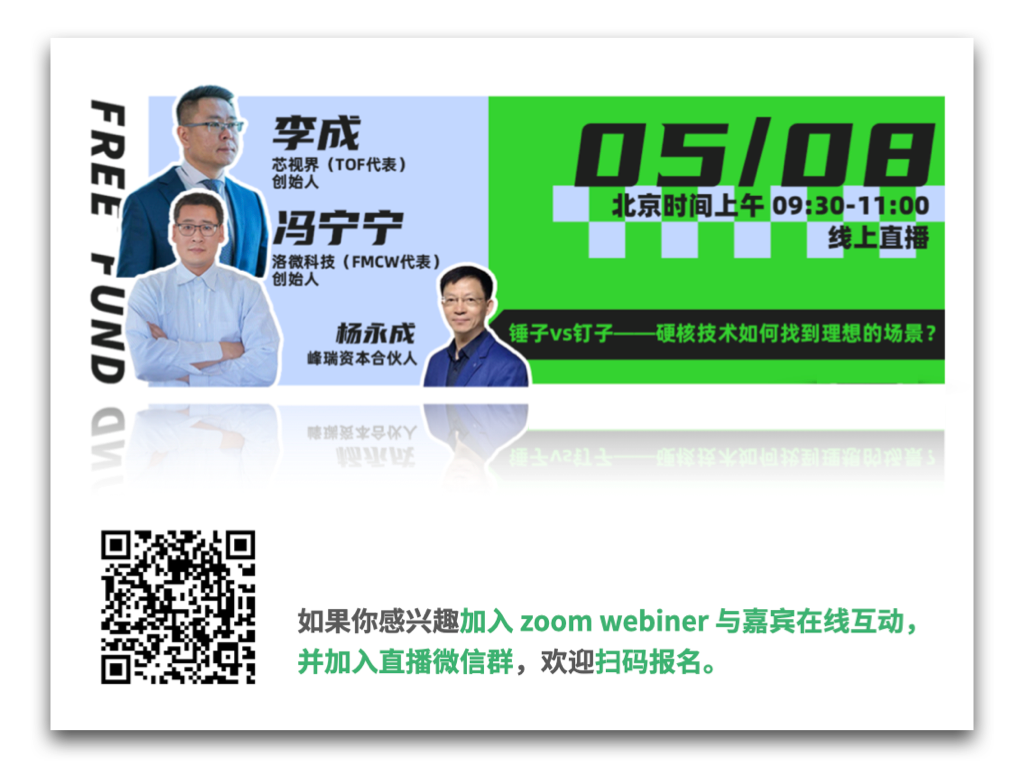
(Click the reservation button to lock in your spot)

/ 01 /
Behind the Unsolvable Supply-Demand Tension
Lies the Industrialization Opportunity for Frontier Tech
Li Feng: Dr. Shen and I first met a long time ago.
Yichen Shen: Yes, my first time meeting Feng Shu was in 2015, right after I'd finished my thesis.
Li Feng: Your paper made quite a splash at the time — both Nature Photonics and MIT promoted your findings prominently. While academia embraced the direction of photonic computing, industry was more divided on this entirely new technical path.
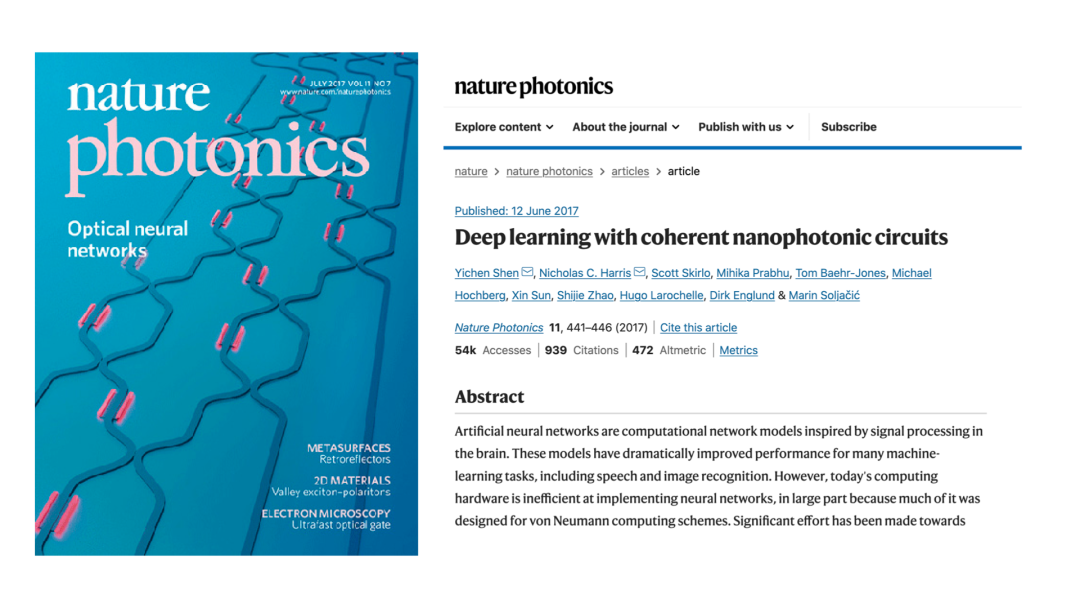
▲ Dr. Yichen Shen's cover paper as first author in Nature Photonics introduced integrated photonic computing to the world for the first time. Image source: Nature
This reminds me of another frontier project we were looking at around the same time in Boston — XtalPi (XtalPi is a drug discovery company powered by cutting-edge computational physics, quantum chemistry, AI, and cloud computing, providing intelligent drug R&D services to global pharmaceutical innovators).
After we invested in XtalPi in 2016, some biotech investors in Boston gave us puzzled looks. Photonic chips were similar — five years ago, we consulted many chip technology experts. But there was no consensus on whether this direction would work, or whether now was the right time to pursue it. So I'm curious — did this controversy affect your decision to start a company?
Yichen Shen: Photonic computing has developed very rapidly over these five years. Five years ago, there were maybe one or two companies globally working on it. By 2019, a couple more emerged. In 2020, three to five more were founded, and in 2021, about ten more. To date, there are roughly twenty-plus companies worldwide in this space. Photonic chips have become one of the hottest directions in the industry.
Lightelligence was among the earliest. When we founded the company in 2017, AI chips themselves were still a novel concept, let alone photonic AI chips. So it's understandable why many people grouped us with quantum computing as far-out frontier tech. But recently, as industry giants like Intel and NVIDIA have ramped up their research and announcements in photonic AI chips, the field has gained more recognition — this may not be such a distant prospect after all.
Actually, from research to industry, frontier technologies generally go through a process from skepticism to broad acceptance. In the first five to ten years, everyone has doubts — will this technology actually take off, and when? The debate only quiets once the breakthrough truly arrives.
Li Feng: From an investor's perspective, for early-stage projects, we typically focus on three questions: why this timing? why this direction? and why this solution? Let's start with timing. What research breakthroughs at that point convinced you that the moment was right for photonic chip entrepreneurship?
Yichen Shen: Photonic chips aren't actually a particularly new concept. They've existed for decades — even longer than the electronic chips people are familiar with today. The laser pointer you use in class, for instance, contains a laser chip that's a photonic chip. Or the transceiver modules in submarine cable terminal equipment — those are photonic chips too. So photonic chips have had industrial applications for decades. What changed to accelerate development in recent years? The main driver is the supply-demand imbalance.
First, the supply side.
Traditional digital chips have advanced rapidly over the past fifty years. According to Moore's Law, the number of transistors on an integrated circuit roughly doubles every 18 months, with performance doubling as well. This held true for five decades. But in the last five to ten years, Moore's Law has faced an endgame. As individual transistors scale smaller and integration density increases, quantum effects make it increasingly difficult to reduce transistor power consumption further.
Additionally, as interconnect wires get thinner, their cross-sectional area shrinks, resistance rises, and heat generation from wires becomes harder to bring down. Beyond a certain scale, higher device density actually leads to greater heat generation. So digital chips will struggle to maintain their previous momentum in breaking through per-area or per-watt computing capability in the near term.
Now, the demand side.
Over the past five to ten years, whether big data, artificial intelligence, or the metaverse in recent years, more and more scenarios requiring massive compute have emerged. Demand for chip computing power continues to explode. Over the next decade, if new hardware with stronger computing capabilities emerges, the space for technological advancement and real-world deployment will expand dramatically.
So from a supply-demand perspective, demand is surging while traditional technology breakthroughs have hit bottlenecks, unable to keep pace with demand growth. In this context, those with longer-term vision become willing to take some risks and explore technologies that could achieve fundamental breakthroughs. Frontier technologies get their window of opportunity. Our technical breakthrough happened to arrive at this inflection point, so we decided to start the company and successfully raised funding.
Li Feng: What about from a personal angle?
Yichen Shen: Right, another important push came from positive encouragement around me. At MIT, we had access to important resources beyond research — the local startup community, investors. Honestly, right after finishing my thesis, I hadn't fully thought through whether to start a company. But later, including you, Feng Shu, many top investors kept encouraging me and affirming this direction. So I'd say the decision to take that step came from both belief in the technology itself and external positive reinforcement.
Li Feng: Back to the technology itself — could you explain what made your celebrated paper innovative? And how has Lightelligence advanced beyond that original research?
Yichen Shen: Lightelligence works on optoelectronic hybrid computing chips, an important branch of photonic chips — using hybrid optoelectronic approaches for high-performance computing chips. A key challenge this direction addresses is: how to use optical devices to replace the transistors in electronic chips for computation? In my paper, I proposed a new solution — using the interference of light as it passes through network-like interferometers, and controlling those interferometers, to perform large-scale linear computation. AI makes heavy use of linear computation. So this was a breakthrough point.
After starting the company, we realized that AI systems are far more complex than a matrix calculator. And light has significant potential in other areas too, especially data transmission — for instance, replacing electrical wires. So as we've progressed, our technical approach has continued to mature.
/ 02 /
Foundries Will Target Growth Opportunities
Beyond Digital Chips,
Benefiting Silicon Photonics Companies
Li Feng: Research into silicon photonics has actually been around for quite a while. In recent years, what changes have occurred in the chip-related infrastructure, including foundries, that create opportunities for silicon photonics to break through?
Shen Yichen: Overall, from an industrial perspective, while the maturity of the silicon photonics supply chain still lags behind that of digital chips, it has been improving rapidly—especially in the last two to three years, as many major international foundries, EDA design companies, and packaging and testing firms have begun formally positioning themselves in the silicon photonics direction.
The current increase in market investment into the silicon photonics supply chain has been driven primarily by the booming optical communications market. Right now, the main market for silicon photonics chips remains optical communications. Beyond that, there are other high-potential areas like optical computing, and LiDAR for optical sensing, which are also driving the supply chain toward greater maturity.
So at this point, every segment has relatively mature suppliers, and the technology keeps upgrading. At least for us, producing a silicon photonics chip is entirely achievable through the existing supply chain at mass-production scale. And silicon photonics itself doesn't require cutting-edge process nodes, so many foundries are capable of this kind of process.
Li Feng: I have noticed that more and more foundries are no longer pursuing or have abandoned R&D on more advanced nanometer processes. The result is that their already-built capacity needs to find new application breakthroughs. Has this shift in wafer infrastructure also given the silicon photonics industry some push?
Shen Yichen: Yes. If foundries kept going down the digital chip path, the process race would become increasingly difficult. Moving from 5nm to 3nm now might require over $100 billion in investment. The number of foundries worldwide that can do this is countable on one hand. So where do the rest of the foundries go? Beyond digital chips, where are the growth points and breakout opportunities for other capacity demands? This trend is favorable for silicon photonics chip companies.
That said, the chip industry has remained in a tight capacity situation these past two years. Whether domestically or internationally, when capacity is especially tight, everyone still prefers to maximize earnings on existing capacity before developing new technologies. But in the long run, your assessment is certainly correct—more and more foundries will target growth opportunities beyond digital chips.
Li Feng: At the end of last year, we did an estimate based on public data. From 2019 to 2024, mainland China's major foundries will roughly triple their capacity for 8-inch and 12-inch chips. This figure doesn't yet account for new capital investments and capacity effects coming online in the next two to three years. Although our chip supply-demand gap still exists, let's assume that in a few years, mainland China's major foundries could achieve supply-demand balance, or even slight capacity surplus. How could this surplus capacity be utilized? Which directions would it go?
Shen Yichen: I believe suppliers will make the most advantageous plans based on their comprehensive understanding of the industry. From my perspective, silicon photonics would be an excellent choice for them, bringing significant capacity growth opportunities. Beyond silicon photonics, there are several other directions that now appear to be developing relatively quickly and don't require particularly advanced processes—such as micro-electromechanical systems (MEMS) chips, chips based on novel memristors, and in-memory computing chips like MRAM and RRAM.
/ 03 /
The Biggest Future Opportunity for Silicon Photonics
Lies in Further Increasing Integration Density
Li Feng: Next question, back to silicon photonics. Looking at the control of light itself, in what areas is the industry likely to make breakthrough progress going forward?
Shen Yichen: We're particularly bullish on silicon photonics. Of course, beyond silicon, there are many other ways to work with light in photonic chips, including the MEMS approach I just mentioned.
Li Feng: Why are you bullish on silicon photonics?
Shen Yichen: The primary reason is that it can directly leverage the existing supply chain—you can use the same processes and packaging methods that foundries use for electronic chips to make photonic chips, without needing to develop an entirely new process from scratch.
Moreover, the greatest potential of silicon photonics lies in its ability to integrate many optical devices on a single chip. Currently, optical chips for optical communications might have just a few or a dozen devices. The biggest future opportunity for silicon photonics is in further increasing this integration density—integrating thousands, tens of thousands, or even hundreds of thousands of optical devices. And as integration density continuously improves, just as with the development path electronic chips have taken, the applications for photonic chips will become increasingly broad, generating more and more use cases.
Computing is likely the most important application scenario for photonic chips, primarily using them for linear computation and data movement—together these account for over 80% of the total power consumption of computing chips. Because photonic chips themselves don't have heat generation issues, there's significant potential to substantially reduce the energy consumption of computing systems and computing chips. These are all things we can pursue in the silicon photonics direction. Beyond that, areas like LiDAR, optical sensing, and DToF (Direct Time-of-Flight) could also generate many new commercial application scenarios.
/ 04 /
Research Focuses on Breakthroughs at a Single Point,
While Products Require Connecting Many Points into a Surface
Li Feng: Indeed, I'm also particularly optimistic about silicon photonics' future potential to achieve large-scale energy savings in computing and improve efficiency. Among the 20-plus chip-related projects we've invested in, roughly one-third are related to silicon photonics—covering both底层 innovation like yours, as well as sensors, detection, and various other aspects.
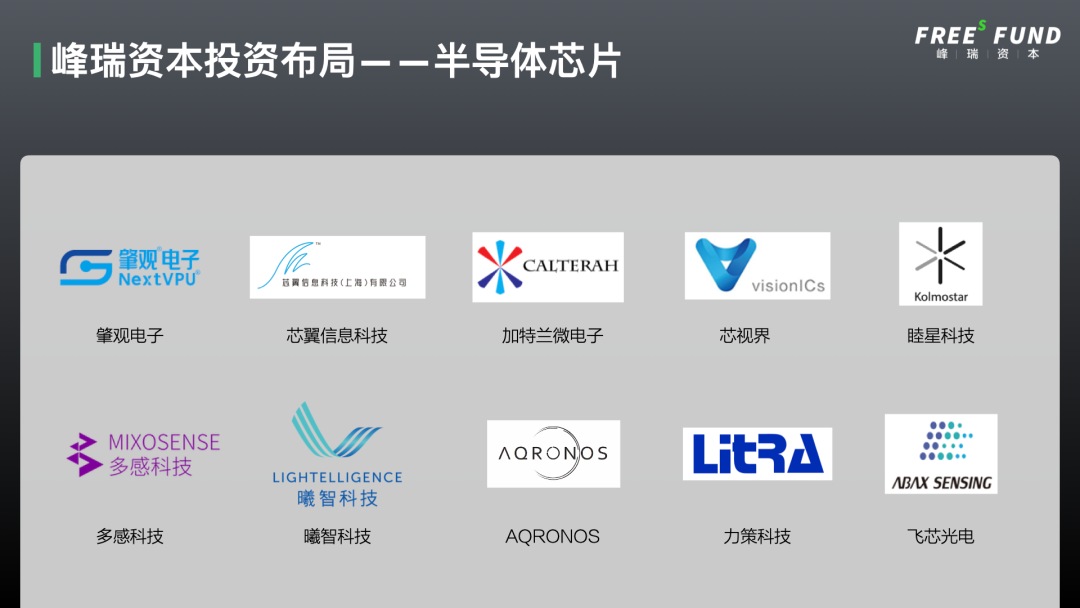
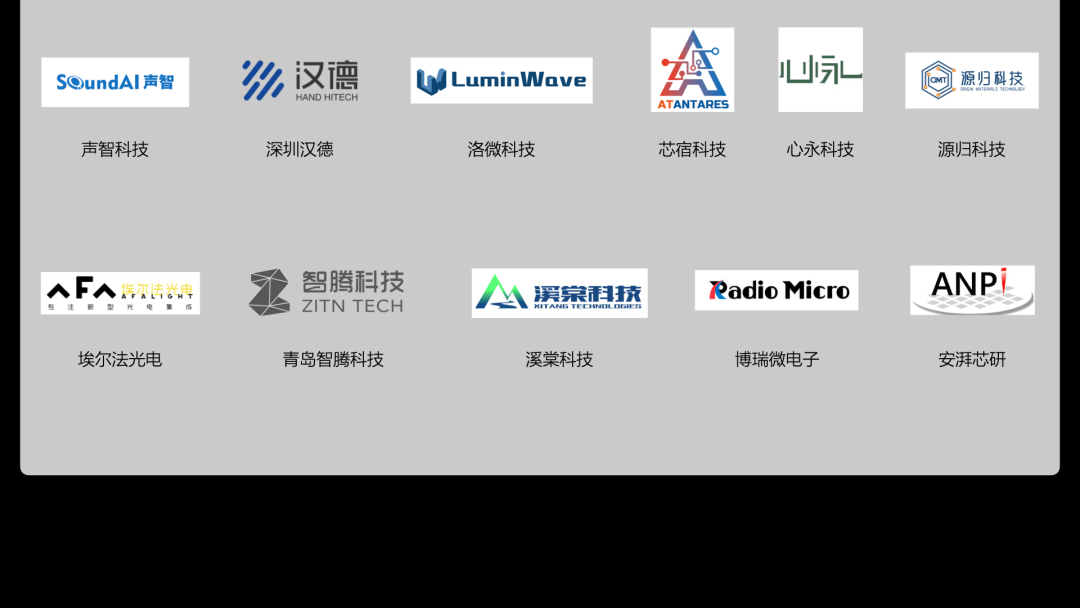
The next question relates to entrepreneurship itself. Over these years of building your company, what has been your biggest realization in the process of commercializing research成果?
Shen Yichen: That's a great question. Personally, I have two deep takeaways from the transition from science to commercialization.
First, regarding the work itself. Research often starts with a breakthrough at a single point. When I was doing research at MIT, I saw just one point within a very large system, and achieved a breakthrough at that point. But from a researcher's perspective, it's easy to view this point as the entire world, as the most important part of the system.
Later, when doing product development and commercialization, we bring in talent from various fields to together complete a computing system. In this process, you strongly sense that this point is just one of many points in the system. If we want to build a competitive product, we need more points to come together to support commercialization. So the founding team needs to expand their knowledge base more quickly and broaden the team's professional backgrounds.
Take optoelectronic hybrid computing chips as an example—beyond the optical component, software and electronic chips are also quite important. These may not have as much room for innovation comparatively, but they're essential parts that must be solved. I like to analogize photonic chips to the electric vehicle industry. Fifteen years ago, the core innovation areas in EVs were batteries, drivetrains, and power management systems. But to actually build a car, steering wheels, seats, and tires were all essential. So my biggest realization is that technological innovation may only manifest at individual points, but the final product is a surface.
On company governance, scientific research and commercialization require completely different governance approaches. Research demands rigor and meticulousness. Commercialization requires a way of working that lets you trial-and-error and iterate more quickly, in order to rapidly build the product. These are two fundamentally different mindsets. I believe many peers who have transitioned from research to entrepreneurship have their own experiences with this.
/ 05 /
Core Barriers for Hard Tech Startups at Different Stages
Li Feng: From initially having a breakthrough idea at the research level, to building a commercially viable product—what adjustments, even compromises, did you make along the way?
Shen Yichen: At the starting stage, for technology and especially hard tech entrepreneurship, being able to propose a defensible solution based on industry pain points is critical. For us, our research breakthroughs, patent accumulation, and a team with years of deep cultivation in this research field were our core barriers when we first started.
At the second stage, during industrialization and commercialization, you encounter various areas requiring compromise—sometimes you need to pull back slightly from the heights of research.
Take Lightelligence as an example. From a financial perspective, over the past five years, as time has progressed, the proportion of our investment in底层 technology R&D has gradually decreased. In the beginning, perhaps 80% of funds went into底层 design and packaging solutions. Now, it's roughly 30-40%, with the larger share going to productization, commercialization, and the software team.
From the initial few people to our current team of over a hundred, spanning electronic chips, photonic chips, and software, everyone in the team learns about each other's fields, and the team continuously refines itself through the experience of building a complete product. So at the second stage, our competitive barrier became product development experience.
To summarize: at the initial stage, our barrier lay in several key底层 technology breakthroughs; at the second stage, we needed to integrate these底层 technologies into a larger, more complex hardware-software integrated architecture. Going further, as products continue to iterate, through refinement and compromise, we'll develop better products, and gradually build a developer ecosystem and accumulate supply chain advantages—these will become our core barriers going forward.
Li Feng: To productize technology and build it into a solution requires coordination with infrastructure like foundries—do you need your partners to make any special accommodations for you, in terms of materials, processes, capacity, process nodes, and so forth?
Shen Yichen: For building products, currently we don't. The existing supply chain fully meets our product needs. Of course, with deeper binding and coordination, we could certainly build better products in the future. We also hope that as a leading customer, we can have deeper partnerships with foundries to develop processes more suited to us.
/ 06 /
Lessons from Engaging with Leading Customers
Li Feng: Understood. Back to the demand side. Typically, those who need this kind of AI computing chip that can significantly improve efficiency and reduce power consumption are large or even extra-large leading customers. They're the ones who can most fully realize your product's effects and technology. Over the past two to three years, in dealing with these most leading customers, what experiences or lessons have you gained?
Shen Yichen: Indeed, this is probably a problem that many AI chip startups both domestically and internationally face and urgently need to solve. These leading customers' biggest demand is software versatility. The larger the customer, the higher their requirements for product maturity—for instance, plug-and-play capability, compatibility with thousands of applications. Take NVIDIA as an example: it has itself invested tremendous time building a software developer ecosystem. For any product seeking to enter this industry, it needs to address the major customers' demand of how to get these products deployed as quickly as possible, without requiring extensive modifications to underlying software frameworks.
For any startup, going head-to-head against NVIDIA's decades-built ecosystem on software is a challenge that speaks for itself. Specifically for us, I've been spending much of my time recently on how to find the killer app.
Large companies often have many different application scenarios — like multiple vertical businesses under one big umbrella, each with its own priorities. Some businesses are in real pain with existing computing hardware. For instance, they need to run an especially large computational model and finish it within a certain timeframe.
So one of our priorities in Phase One is to find the pain points that really torment mid-to-large customers — the computing scenarios where our optical advantages shine the most. In these especially painful scenarios, when customers face the temptation of a several-dozen-fold leap in computing power, they'll likely be willing to sacrifice some learning cost in software generality. That's the profile of our Phase One Early Adopters.
We won't go straight for something big and comprehensive. In Phase One, we just look for pain points. Because this market is massive — trillion-dollar level — we need to precisely identify where it hurts most. I think any new innovative technology looking to commercialize can follow this logic to find its entry point. This is what we've been spending the most energy on lately. We've been fortunate — we've already found several such points.
Li Feng: Yes, this is especially important. General-purpose chip entrepreneurs often face this paradox: on one hand, only big customers can use your product well; on the other hand, it's hard to build an ecosystem quickly. Your approach does offer a good path, though the prerequisite is having clear technological breakthroughs and obvious technical advantages. If the advantage is clear, and you can find a sharp enough point where efficiency demands can exceed demands for generality and ecosystem maturity, maybe you can pierce through that membrane.
Shen Yichen: Right.
/ 07 /
At the Startup Stage,
The Most Important Thing Is to Quickly Find
a 60-to-70-Point Solution,
and Iterate as You Go
Li Feng: If you could redo these five years of entrepreneurship, what would you adjust to take fewer detours or arrive faster?
Shen Yichen: The past five years have seen enormous changes, many of them unexpected — the pandemic, for example. I've changed a lot personally too. Before starting up, I did mental preparation, imagining some difficulties. But even so, I still took some detours early on. Looking back, I have several important suggestions for friends considering entrepreneurship.
First, at the starting stage, speed is critical. We spent a lot of time early on chasing solutions, hoping to come up with a perfect solution where every detail scored 100. The further along we got, the more we realized that for entrepreneurship, you need to spend the shortest time finding a 60-to-70-point solution, then push forward quickly and iterate along the way. The time and energy spent polishing that 100-point solution early on turned out to be less important than we thought. Because entrepreneurship is far from just a contest of research ability — recruiting, selecting customers, and choosing investors all matter, and all require your serious time and attention.
Li Feng: Right. Many top students have an inertial thinking pattern of aiming for 100, or at least 99. But in industry, because adjustments and changes are endless, what matters is first finding a way to solve the problem, then iterating as you run, adjusting as you move.
Shen Yichen: That's exactly it. Many people around me share this feeling. Scientist-turned-entrepreneurs often hold themselves to very high standards, but to some extent, being too perfectionist can be a shackle, because you have to consider time cost.
/ 08 /
Hard Tech Entrepreneurship Requires Distinguishing
"Urgent" from "Important"
Li Feng: This is also something we in hard tech venture capital discuss a lot — the balance of knowhow between technology and commercialization. It's rare for a scientist to come out and immediately have strong commercialization ability, just as it's hard for a businessperson to be deeply technical from day one. In the quadrant these two metrics form, different industries, different models and applications, and different stages will have different proportions. From where you stand now, what's your view on the respective weight of these two capabilities in hard tech?
Shen Yichen: As I mentioned earlier, early on, the proportion of core technology is higher. In the middle and later stages, you increasingly pursue balance between technology and commercialization, and the commercialization proportion may even become higher.
Li Feng: Mm, you can continue on lessons learned. We were talking about how speed is critical at the starting stage.
Shen Yichen: Right. Second, I want to emphasize that the team must have strong conviction in the company's vision — this is especially important for hard tech startups. Because hard tech's biggest challenge is its long time horizon.
Over a very long cycle, if the team's sense of conviction isn't strong enough, it's easy to give up or be tempted to change direction. But some of the most important technical breakthroughs often require a team to maintain an almost religious fervor in a broad direction for a very long time, persisting through something very complex.
While ensuring the team has this long-term conviction and persistence, another important point is distinguishing between urgent and important matters. What's urgent and what's important — these two concepts often point to different things.
What's urgent right now is what must be done immediately. For us, that's finding the Killer App, finding the market's most painful and weakest point for our needle to pierce. What's important, for us, is investment in underlying technology — continuously producing innovative technology and products. Important things have longer sustained time horizons, bearing fruit in three, five, or ten years, and aren't so urgent in the present.
This actually also answers your earlier question about balance. In this process, you must constantly find new methods to achieve better balance. For instance, in technology breakthrough areas with longer cycles, we can collaborate with other companies, suppliers, and research universities. But for what's most urgent right now, we'll definitely do it ourselves. Of course, from a corporate strategic planning perspective, properly grading and planning various medium-to-long-term tasks is genuinely challenging.
Li Feng: Next, a management question. You mentioned team磨合 [磨合 =磨合, team磨合] before. Many scientist-entrepreneurs encounter this. In your case, you have a business and marketing team, a traditional chip design team, an optical fundamental technology team, and a software algorithms team. Each of these groups is very strong, with its own logic and system. But the team needs to come together, produce a product, connecting dots into a surface. In this process, there inevitably exists the question of who accommodates whom, or who accepts whom, who's willing to take whose core design requirements. How have you managed this?
Shen Yichen: Now, our team is much better on this issue. Over the past five years, there were indeed two or three years of growing pains in team磨合. Initially we were mainly a scientist team, then we added a product team, and later brought in business and marketing teams.
A major conflict point at the time was that the tech team really wanted to build the most impressive technology, and in the face of technology, cost or customer needs were put in a relatively secondary position. But from the marketing team's perspective, they focused more on customer needs and had to constantly communicate with the tech team, conveying the idea that technology ultimately serves the product. Of course, after two or three years of磨合, everyone in the team now recognizes that the company needs to be customer- and market-oriented.
However, being market- and product-oriented doesn't mean the tech team has to abandon their pursuit of cutting-edge technology. This is what we mentioned earlier about balancing "urgent" and "important." Currently, we advance frontier technology research through external collaboration, which also helps control costs.
Li Feng: Looking ahead from today, what kinds of talent and partners does Lightelligence most need to find in its development?
Shen Yichen: I think for the past three years, the company's most important goal has been what I mentioned earlier — finding industry pain points and entry points, and achieving commercialization and market落地.
From a talent perspective, the chip market is vast, and we need people with deep industry understanding at various scales, including BD, marketing, and productization. On the software side, for example, when we engage with customers now, we need to build a software stack — the compilation drivers behind the chip. In hardware, we're currently recruiting VP-level talent domestically.
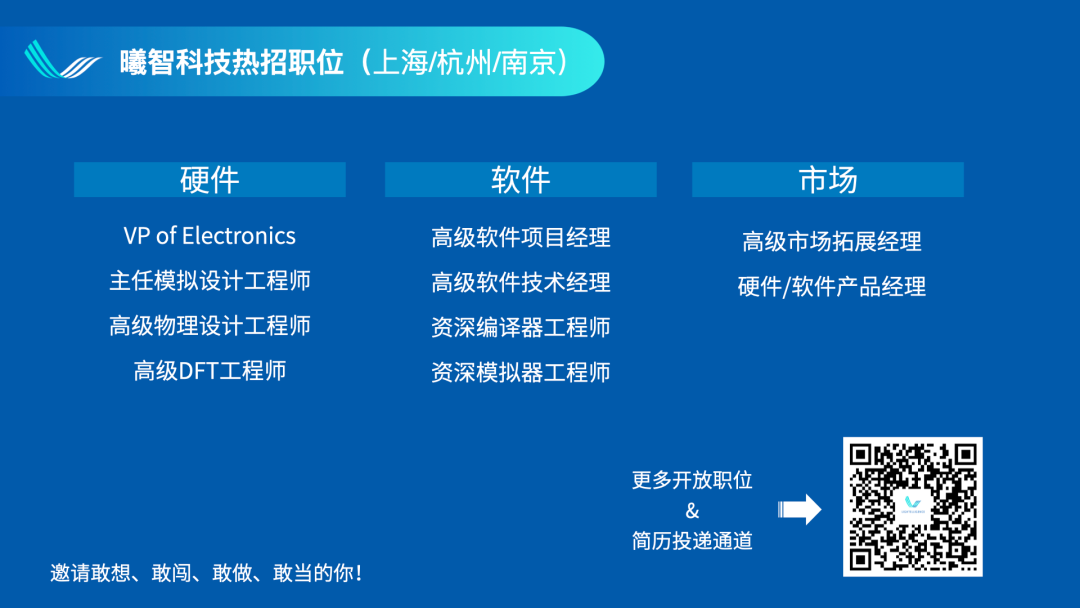
The image shows Lightelligence's currently open positions, covering hardware, software, and marketing. We look forward to passionate partners who embrace new technology joining us.
Li Feng: Since we mentioned frontier technology, I'd like to ask you for a final outlook. In your view, in the chip space, what technologies might currently carry some controversy or uncertainty, but could have opportunities to grow big in the future?
Shen Yichen: I come from a physics background, so the directions I look at are somewhat scattered. In the next five to ten years, the chip industry as a whole will probably still be silicon-based, with mainstream products or directions being non-digital CMOS, including silicon photonics, MEMS, in-memory computing memristors, and so on.
But if we look further out, I believe some newer technological directions will emerge and grow in succession, such as III-V compound semiconductors, room-temperature superconductivity, and so on. Room-temperature superconductivity in particular — if new materials can achieve it, it would be a disruption for the entire chip industry. But this timeframe isn't five or ten years; it may be longer.
Livestream Preview
On May 8, the second episode of the "FreeS Fund Dialogue · Chip & Semiconductor Series" livestream — Hammer vs. Nail: How Hardcore Tech Finds Its Ideal Scenario — will invite Li Cheng, Founder & CEO of VisionICs, and Feng Ningning, Founder & CEO of LuminWave, to join Yang Yongcheng, Partner at FreeS Fund, for an in-depth discussion on how hard tech entrepreneurs can turn ideals into reality.
(Click the reservation button to lock in the livestream)

Why We're Bullish on the Optical Chip Industry | FreeS Fund Chip Series
Can Domestic Semiconductor Materials Outpace International Competitors? | FreeS Fund Chip Series
FreeS 2021 Outlook ④ | Endgame Speculation for Sensors Behind Autonomous Driving