"How Hard Is It to Build an 'Artificial Sun'? Demystifying the Core Technology and Startup Opportunities in Controlled Nuclear Fusion | FreeS Fund Report"

A Primer on Controlled Nuclear Fusion: Origins and Future

"AI and nuclear energy utilization are two great things that can change the face of human life in the 21st century." So declared Sam Altman, CEO of OpenAI.
Artificial intelligence and nuclear energy are like two tracks leading to future civilization — one reshaping the essence of intelligence, the other attempting to harness energy from the very origin of the cosmos.
More importantly, these two tracks are converging. On one hand, AI is advancing rapidly, computing power demand is surging, and energy consumption has become a pressing concern. Nuclear energy, especially controlled nuclear fusion, is seen as the key to addressing this challenge. On the other hand, AI may assist nuclear energy development — not only by managing reactor systems, but perhaps even by participating in real-time control of the reactions themselves. In June 2025, TerraPower announced the completion of a $650 million funding round, with NVIDIA among the new investors.
Feng Shu once mentioned on a podcast that if we could master controlled nuclear fusion, it would mean we are no longer merely passively receiving energy radiated by the sun, but actively manufacturing energy. In other words, humanity itself becomes the "sun."
So how far away is the dream of controlled nuclear fusion?
In this research piece, we focus on controlled nuclear fusion as the ultimate energy proposition, exploring its development challenges, industry progress, cross-sector impacts, and the entrepreneurial and investment opportunities behind it. We hope to offer a fresh perspective for understanding how this technology may shape future energy landscapes, tech ecosystems, and even the trajectory of civilization.
If you're also exploring possibilities on the path to controlled nuclear fusion, you're welcome to contact the author, Li Gang, at lig@freesvc.com.

Reader Giveaway What changes do you think controlled nuclear fusion will bring to people's lives in the future? Share your thoughts in the comments. By 17:00 on July 10, 2025, the three most thoughtful commenters will receive a copy of A Piece of the Sun: The Quest for Fusion Energy.

01
What Is a Nuclear Reaction?
Whether nuclear fusion or fission, the essence is the same: releasing enormous energy through the transformation of elements. Different elements, due to their mass differences, release varying degrees of energy during reactions.
Nuclear fusion, as the name suggests, is the process where light elements such as deuterium and tritium combine to form heavier elements, releasing tremendous energy in the process. Nuclear fission, such as the splitting of uranium-235, releases slightly less energy, but remains one of the most energy-dense methods currently available to humanity.
In the early moments after the Big Bang, the universe consisted almost entirely of hydrogen. Through nuclear reactions inside stars, helium, carbon, oxygen, and other elements gradually emerged, eventually forming heavier elements. These heavy elements are the foundation of planets and life — they were primarily born in the final stages of stellar lifecycles.
To achieve controlled nuclear reactions, material purity and density are critical. Both fusion and fission require certain conditions to initiate chain reactions. For example, Iran's previous uranium enrichment was a process of increasing uranium-235 purity — a key step toward nuclear energy utilization.
During nuclear reactions, besides generating new elements, various radioactive byproducts are produced, such as alpha, beta, and gamma rays. These rays carry substantial energy. Beyond ultimately converting to heat and electricity as usable energy sources, their radioactive properties can also be directly harnessed for value creation — such as in cancer treatment within the medical field. (See Every Coin Has Two Sides: How to Use "Nuclear Radiation" to Make Anti-Cancer Drugs | FreeS Report 28)
In short, the essence of nuclear energy is controlling elemental transformation to release the enormous energy contained within atomic nuclei. How to efficiently control and utilize this energy is a key direction for future energy technology development.
02
Controlled Nuclear Fusion: Why Now?

▲ Scan the QR code to listen.
On May 23, Trump signed a series of executive orders related to nuclear energy. Previously, his policies had leaned more toward supporting traditional fossil fuels. This move attracted considerable attention and raised questions: Why now? Why skip new energy and go straight to nuclear fusion?
I. Nuclear Fusion: A Solution to Energy Scarcity in the AI Era
Feng Shu noted on a podcast that a key backdrop for developing nuclear fusion is that the US and possibly the world have realized that relying solely on traditional energy may be insufficient to support technological demands in the coming decades — especially given the massive energy consumption driven by rapid AI development and surging computing power demand.
Before Trump's nuclear energy executive orders, Musk had already pointed out in media interviews that AI development would face a power bottleneck by next year, while China's power infrastructure far exceeds that of the US. Vicki Hollub, CEO of Occidental Petroleum, had noted that approximately 97% of global oil production was discovered in the 20th century, and because the world cannot replenish existing crude reserves fast enough, the oil market would face supply shortages by the end of 2025.
Against this backdrop, America's choice becomes clear: on one hand, China has established a leading advantage in new energy; on the other, traditional energy's conversion efficiency and sustainability are limited. Thus, the US may choose to skip new energy entirely and aim directly at controlled nuclear fusion as the solution.
Of course, such policy shifts are not set in stone. Due to the influence of America's two-party politics, many policy directions fluctuate — for example, subsidy provisions in the CHIPS Act signed during the Biden administration were later cut or canceled. Therefore, the public may remain cautious about the sustainability of this pro-fusion policy support.
II. Humanity Can Begin to See Beyond the Solar System
All energy humanity has used throughout history has essentially been transformed solar energy. Whether coal, oil, wind, hydro, or photovoltaic, these energies all originate from solar conversion — differing only in conversion difficulty and application scope.
Feng Shu believes that if we can master controlled nuclear fusion, it means we are no longer merely passively receiving energy radiated by the sun, but actively manufacturing energy. In other words, humanity itself becomes the "sun."
At that point, humanity will have the capacity to see beyond the solar system and step toward interstellar civilization.
Looking back at history, every stage of advanced civilization has been built upon formidable engineering capability. China built the Great Wall, Egypt constructed the pyramids, and during WWII the US churned out ships like dumplings.
In this round of nuclear industry competition, China may be among the most promising nations. Because we can "achieve miracles through sheer scale" — using powerful organizational and execution capabilities to drive complex systems to fruition.
Developing controlled nuclear fusion is not simply about competing on population or resources. It requires strong organizational capability, engineering capability, scientific research capability, design capability, management capability, and more. The entire process is like a precision chain — every link must be secure, or the whole system breaks. The absence of core technology often stems not from falling behind at a single point, but from the entire chain snapping.
03
"Boiling Dumplings in a Paper Pot" — Just How Hard Is Nuclear Fusion?
Nuclear fusion carries humanity's ultimate dreams for energy and civilization, yet the difficulty of achieving it exceeds imagination.
The challenge of realizing nuclear fusion is comparable to "boiling dumplings in a paper pot" — the entire process must be controlled with extreme precision, or all is lost. You must make the water boil just right (maintaining plasma at hundreds of millions of degrees), prevent the pot from breaking (existing materials are extremely fragile during nuclear fusion), and keep adding new dumplings (injecting fuel).
I. Core Elements for Achieving Nuclear Fusion
The essence of nuclear fusion is causing light atomic nuclei (such as deuterium and tritium) to fuse under extreme conditions, releasing enormous energy. To achieve this, three core conditions are required: sufficiently high particle density, extremely high temperature (typically reaching hundreds of millions of degrees Celsius), and sufficiently long confinement time. The product of these three elements is known in physics as the "triple product." Only when this value is large enough can fusion truly "ignite."
Additionally, one often overlooked factor is volume — volume scales with the cube of radius, while surface area scales with the square. So as long as volume is sufficiently large, even with modest energy output per unit, the overall system can accumulate considerable power.
Another key parameter for measuring whether nuclear fusion is practical is the Q value, the ratio of output energy to input energy required to maintain the fusion state.
Currently, people have already achieved Q values greater than 1, meaning output energy exceeds input energy. But this is only the first step. The real challenge lies in how to continuously and stably generate electricity, rather than merely brief, one-off experiments.
II. Main Technical Paths for Nuclear Fusion
Currently, the main technical paths for nuclear fusion can be roughly divided into two categories: inertial confinement and magnetic confinement.
The first category, inertial confinement, includes several main technical routes:
- Laser ignition: Using laser shock waves to bring fuel pellets (typically containing deuterium and tritium) to extremely high temperatures and pressures, initiating nuclear fusion reactions;
- Field-reversed configuration: Directly using fusion reactions for power generation, rather than heating fluid or driving turbines for indirect power generation;
- Z-pinch: Using powerful magnetic fields to confine and pinch plasma, thereby achieving nuclear fusion.
The principle of these methods is to input large amounts of energy in short bursts to compress fuel. The advantage is that extremely high parameter conditions can be achieved in brief periods.
For example, the US National Ignition Facility (NIF) focuses on laser ignition, while American energy company Helion Energy has achieved relatively high parameters in field-reversed configuration. The challenge of this route is that each firing produces only a single pulse, making continuous discharge and energy utilization difficult.
The second category, magnetic confinement, is currently the technical route closest to achieving continuous operation, including tokamaks, stellarators, magnetic mirrors, and other forms. Although these differ in structure, their basic principle is the same: using magnetic field configurations to confine high-temperature plasma within an enclosed space.
China's Experimental Advanced Superconducting Tokamak (EAST), the International Thermonuclear Experimental Reactor (ITER), and the Joint European Torus (JET) are all important representatives of this route.
Among them, ITER is currently the world's largest tokamak device, weighing 23,000 tons and standing nearly 30 meters tall — equivalent to a ten-story building.
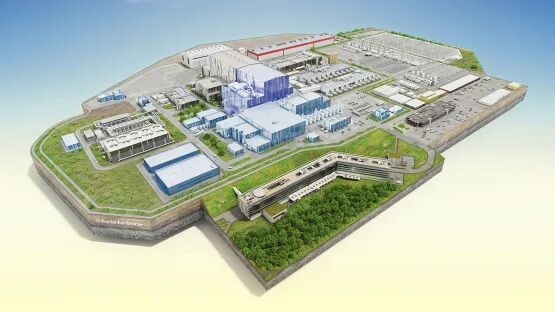
▲ ITER construction site. Image source: ITER
How is such a massive system as a tokamak started? We can briefly outline the process:
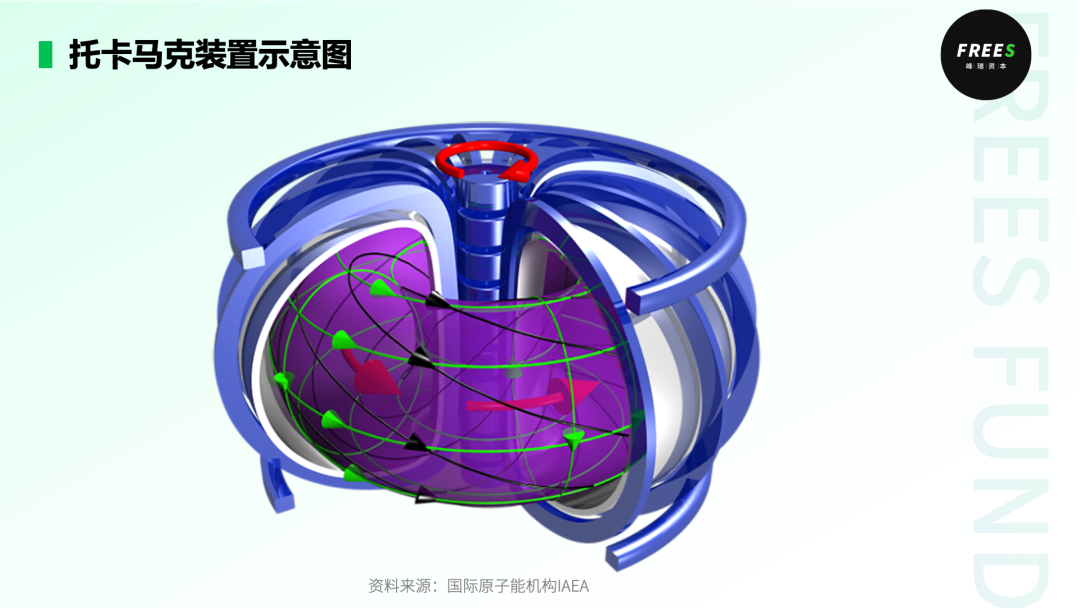
First, the toroidal coils are energized to generate a powerful toroidal magnetic field; then hydrogen isotope gas is injected and ionized through electrical discharge, transforming into plasma. Charged particles rotate around magnetic field lines within the magnetic field. But this is still not stable enough — the plasma expands outward. So scientists add a poloidal magnetic field to squeeze the "donut" inward; finally a vertical magnetic field is added to create a mirror compensation effect, with the ultimate goal of minimizing plasma escape. Throughout this process, the plasma must be continuously heated to surpass the fusion threshold temperature, while the magnetic field is dynamically adjusted to maintain stable confinement.
Sounds not too complicated? But the problem is that magnetic fields have a characteristic: they have no beginning or end, always forming closed loops. Electric fields, by contrast, are divergent. The interaction between these two types of fields means we cannot achieve completely stable plasma confinement through electromagnetic forces alone. Therefore, scientists have been constantly striving to "game" the system — how to precisely control magnetic fields to minimize plasma escape.
We can understand the difficulty of controlling magnetic fields through the "prison guard model." Plasma is like prisoners in a jail, always trying to escape. We want to manage them with minimal manpower (control energy). However, these "prisoners" carry electric charge, repel each other, and are affected by magnetic fields, making their dynamics extremely complex. Even more troublesome, we cannot track every "escapee" in real time — we can only regulate through macroscopic means. It's like building a prison where you want far fewer guards than prisoners, yet cannot allow them to break out en masse.
Furthermore, simulation is an enormous challenge. Fully simulating the boiling process of a pot of water is already very difficult; controlling plasma is vastly more complex. Every tiny disturbance could trigger loss of control — for instance, a local density spike somewhere could set off a chain reaction, like water ripples spreading and oscillating throughout the entire system.
Therefore, nuclear fusion is not only a challenge to the limits of physics, but also a test of the limits of human engineering capability. In terms of materials, we need structures that can withstand extreme temperatures and radiation; in terms of control systems, we must achieve real-time, efficient monitoring and adjustment; and in terms of engineering integration, we need to combine multiple subsystems into a controllable, sustainable energy device.
Nuclear Fusion Industry Progress
Despite the formidable challenges in developing nuclear fusion, humanity's exploration has never ceased. Where exactly does nuclear fusion stand today?
I. Fusion Research Has Grown Exponentially
Since the 1960s, global nuclear fusion research has advanced continuously.
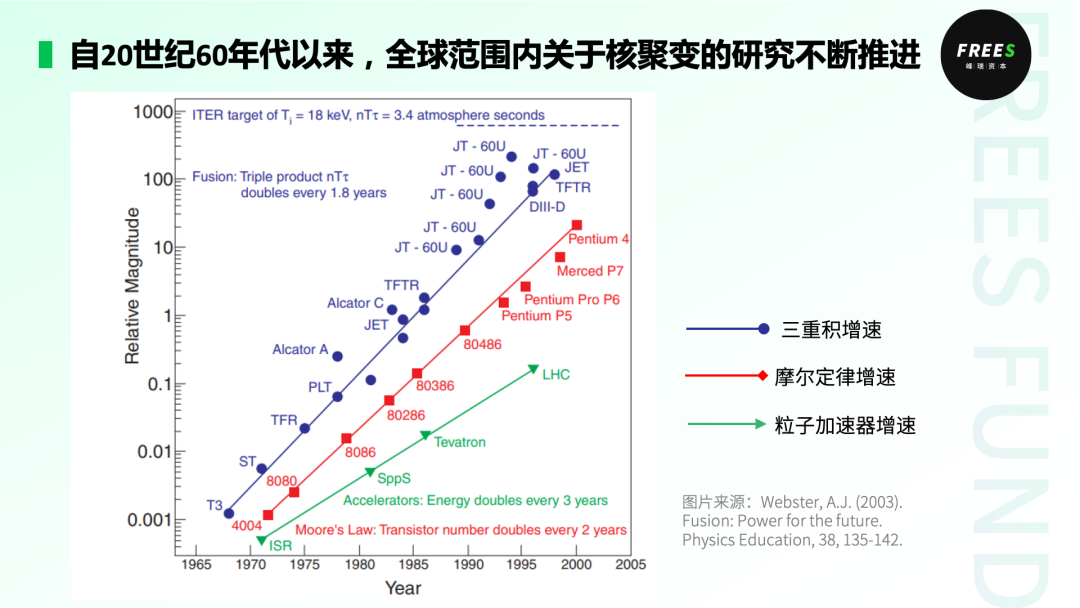
According to statistics compiled by Anthony J. Webster of the UK Atomic Energy Authority, from the 1960s to the early 2000s, the triple product (the product of fusion's three key elements) roughly doubled every 1.8 years — its growth rate (purple line above) outpaced Moore's Law's doubling every 2 years (red line above). It also outpaced another star device in physics research: particle accelerators, which increased in energy grade every three years (green line above).
Behind this exponential growth lies the coordinated breakthrough of multiple technical fields including system control, materials science, and structural design.
II. Humanity's Ability to Control Complex Systems Has Improved
If nuclear fusion is a precision physics experiment, it is simultaneously a challenge to the limits of control systems.
Modern chip manufacturing extensively uses plasma etching technology, giving engineers rich experience in plasma manipulation. In the nuclear fusion field, this experience is being applied to build more refined, faster-responding control systems.
A typical example is dynamic control of magnet coils. Due to the superconducting properties or physical parameters of coils, rapid adjustment has long been a technical challenge. But with the rapid development of power electronic devices, we can now quickly regulate coil current, making the entire magnetic field system more flexible and controllable. In other words, a system that originally could only adjust slowly like an "incandescent bulb" has become an "LED light" capable of rapid variation.
This improvement in control capability means people can not only initiate nuclear fusion reactions, but also intervene in the intermediate process in real time, preventing plasma from getting out of control, significantly enhancing system controllability and enabling stable operation.
III. Magnets Are the Core of Nuclear Fusion, and China Is Rising in This Field
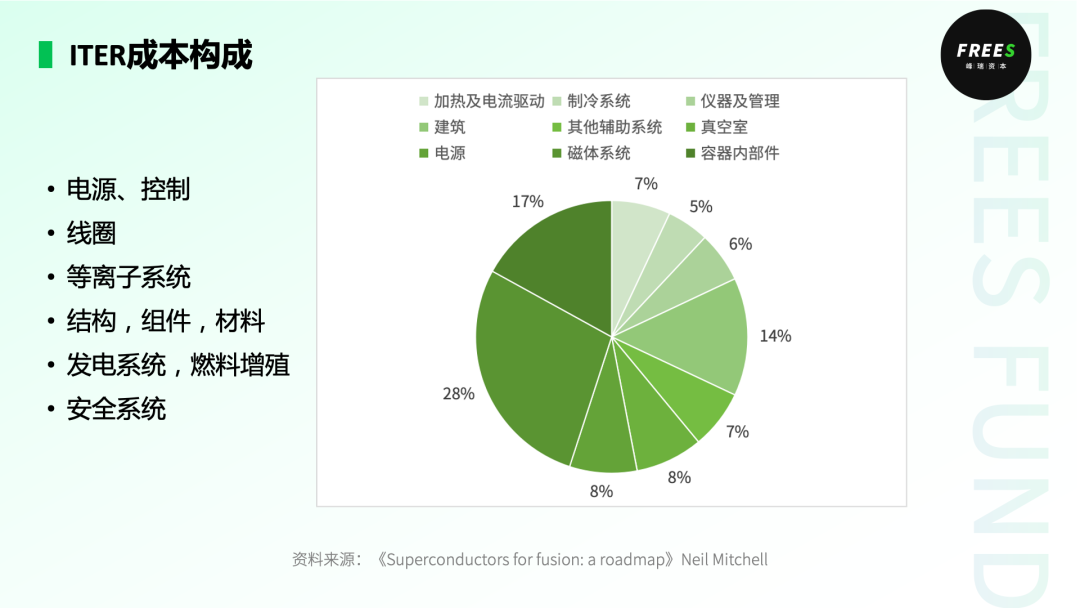
Nuclear fusion devices (such as tokamaks) typically consist of the following key components:
- Power supply and control systems: responsible for providing and regulating energy;
- Magnet systems: used to confine high-temperature plasma;
- The plasma system itself: including vacuum chambers, fuel injection mechanisms, etc.;
- Structural components and safety systems: ensuring the entire device can withstand extreme environments;
- Power generation and cooling systems: converting released energy into usable electricity.
Among these, the magnet system is the core of the entire device, accounting for approximately one-quarter of costs. Next are structural components (such as vacuum chambers, support frames, etc.), comprising roughly one-third of total costs. The remainder consists of various control, measurement, and auxiliary systems.
In these key technical areas, China's participation and competitiveness are rising rapidly. Whether in R&D of high-temperature superconducting magnets, manufacturing of large vacuum equipment, or overall engineering integration, China has demonstrated considerable strength.
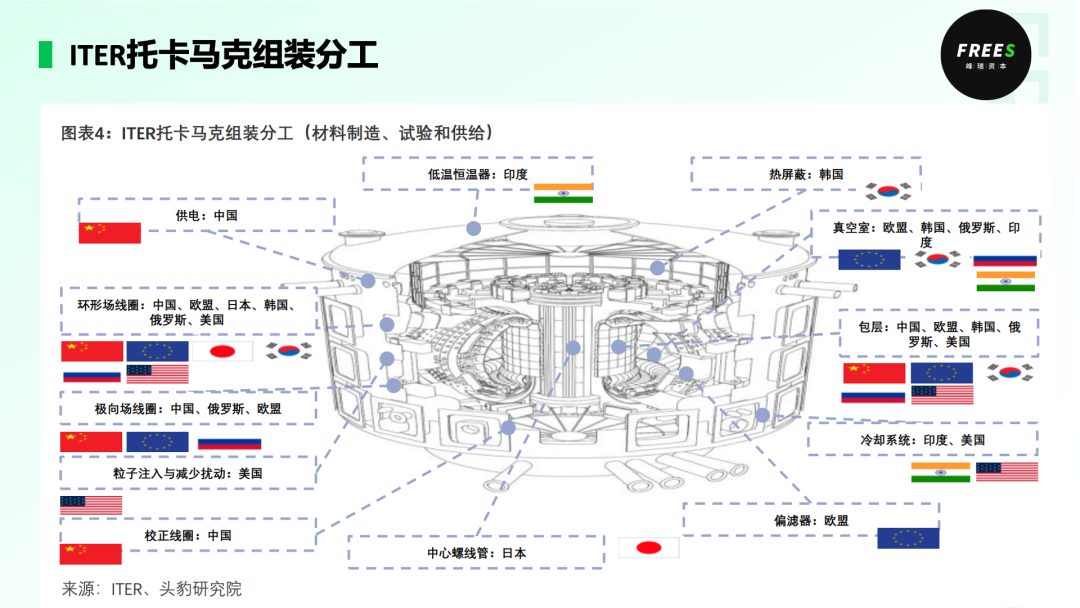
Taking the International Thermonuclear Experimental Reactor (ITER) as an example again, major participating members including the US, EU, Russia, Japan, and India each have their strengths, contributing respectively to ion injection and perturbation reduction, vacuum chambers, poloidal field coils, central solenoids, cooling systems, and other important components. Particularly noteworthy is that China's manufacturing tasks involve core critical components such as magnet support systems, gas injection systems, and reactor cores capable of withstanding extreme temperatures.
In summary, across key links in the nuclear fusion industry chain, apart from some auxiliary systems, China already holds world-leading positions in multiple areas.
Cross-Industry Applications of Nuclear Fusion Technology
Nuclear fusion is not only the core technology of humanity's energy dreams, it is also becoming a "technology amplifier," driving applications of high-temperature superconducting materials and promoting development of non-ferromagnetic materials. In collisions across different industries, advances in power electronics are in turn promoting superconducting technology for nuclear fusion.
I. Declining Costs of High-Temperature Superconducting Materials Are Boosting Cross-Industry Applications
Nuclear fusion technology has not only driven demand growth for high-temperature superconducting materials, but also significantly reduced their mass production costs. This progress is crucial not only for nuclear fusion itself, but also for boosting widespread application of high-temperature superconducting materials in other fields.
For example, in medical equipment, superconducting coils in magnetic resonance imaging (MRI) are a notable case. Traditional MRI equipment relies on low-temperature superconducting materials requiring complex cooling systems to maintain extremely low temperatures. High-temperature superconducting materials have lower cooling requirements while also improving image resolution and scan speed.
Another example: in the power sector, high-temperature superconducting materials can be used to manufacture efficient, compact high-power motors. Because superconducting materials have virtually no electrical resistance, current can flow through them without losses, thereby improving motor efficiency.
II. Nuclear Fusion Is Driving Applications of Non-Ferromagnetic Materials
The extreme environments of nuclear fusion have also created strong demand for non-ferromagnetic materials.
The reason non-ferromagnetic materials are needed is that materials like steel and iron experience strong forces in magnetic fields, and in changing strong magnetic fields generate currents (eddy currents), causing heating and energy losses.
For example, in an aluminum electrolysis plant, if you throw a wrench several meters from an electrolytic cell, it might be pulled upright by the powerful magnetic field. As nuclear fusion technology develops, magnetic field strengths are getting higher and higher, even reaching 20 tesla levels, making the effect of magnetic fields on materials increasingly pronounced. For comparison, mobile phone speaker magnets are generally 0.001 to 0.01 tesla — 20 tesla is 2,000 or even 20,000 times stronger.
Therefore, nuclear fusion equipment requires more new materials with low magnetic field interaction. High-temperature-resistant alloys, materials capable of resisting neutron damage, and composite materials such as ceramics and carbon fiber will all become increasingly important.
III. The Power Electronics Industry Is Advancing Nuclear Fusion Power Supply Development
It's not just that nuclear fusion is influencing other industries — power electronics development is also promoting nuclear fusion technology progress.
For example, AI chips operate at increasingly lower voltages but require increasingly higher currents, while demands for voltage regulation speed are also rising. The superconducting power supply systems used in nuclear fusion (typically operating at 1-10V low voltage, tens to hundreds of kiloamperes of high current) share similar characteristics with AI chips. If AI chips develop further, they may help superconducting power supply systems overcome voltage regulation challenges.
Similarly, whether silicon carbide motor drive chips used in robots or electric vehicles, or the readily available fast-charging (gallium nitride) chargers in our daily lives, all greatly enhance our ability to control electricity. And this control capability, when transferred to the nuclear fusion field, means we can quickly regulate coil current, making the entire magnetic field system more flexible and controllable.
This means that progress in the electronics industry may improve nuclear fusion power supply performance, achieving "mutual advancement" between the technologies.
Entrepreneurial and Investment Opportunities Related to Nuclear Fusion
Currently, the entire nuclear fusion industry remains in an early stage of development. Many key technical links are not yet fully connected, especially the latter stages of engineering and system integration, which urgently require sufficient enterprise participation. But this also means opportunities are emerging for entrepreneurs and investors.
I. What Kind of Entrepreneurs Does the Nuclear Fusion Industry Need?
Nuclear fusion is a typical "extreme engineering" endeavor, involving extreme temperatures, ultra-strong magnetic fields, high vacuum, low-temperature cooling, and multiple other extreme conditions. These factors intertwine, making control of the entire system extraordinarily complex.
In this situation, we need to find people with genuine hands-on experience. They may have worked in large experimental facilities, know which links are prone to failure, and have even experienced the pain of equipment explosions and experimental failures. More importantly, they can transform past experience into viable next steps.
Furthermore, in a highly interdisciplinary frontier field like nuclear fusion, entrepreneurs may need relatively strong ability to rally talent, gathering people from outside nuclear fusion specialization — for example, those with deep expertise in materials, power electronics, and AI.
The reason AI talent is needed in nuclear fusion is that AI can not only help predict system behavior, optimize control parameters, and assist system design, but may also participate in real-time control of the reactions themselves.
**II. Entry Points for Startups: Becoming Key Players in Niche Segments, "Laying Eggs Along the Way"
The nuclear fusion industry chain is extremely complex, and startups may find it difficult to independently undertake the R&D and operation of complete fusion devices in their early stages. But this doesn't prevent them from becoming providers of core subsystems.
Just as in the satellite industry's development: while launch missions are state-led, numerous private companies achieved growth and technology iteration by providing key components such as navigation chips, communication modules, and ground station equipment.
Across the upstream and downstream of the nuclear fusion industry chain, multiple promising niche segments have already emerged: for example, superconducting magnet design and manufacturing, high-precision control system development, plasma diagnostics and measurement equipment, specialty materials and coating processes, cooling circulation systems, and neutron shielding solutions.
Additionally, in the nuclear fusion field, attention must be paid to whether a technology has the potential to "lay eggs along the way." That is, while serving nuclear fusion, its technical achievements can also be applied to other markets. For example, the superconducting coils in medical imaging mentioned above, plasma sensors in industrial inspection, and power electronic devices in new energy vehicles.
III. Policy Support and Capital Driving: China Has Potential to Catch Up from Behind
Nuclear fusion is not only a scientific problem, but also a national-level strategic layout. Against the backdrop of obstructed energy transition in the US and challenges facing the traditional energy system, China may accelerate investment in this field. After all, we possess a complete industrial system, strong organizational capabilities, and continuously growing research investment — all foundations supporting the industrial realization of nuclear fusion.
For entrepreneurs, nuclear fusion is not a track where returns will be seen in the short term, but it represents a long-term, deterministic direction. In this process, entrepreneurs need patience, continuous accumulation of resources and technology, and willingness to keep trial-and-error and iterating under "extreme conditions." After all, on the road to the stars and the sea, every step requires down-to-earth innovation and persistence.
Reader Giveaway What changes do you think controlled nuclear fusion will bring to people's lives in the future? Share your thoughts in the comments. By 17:00 on July 10, 2025, the three most thoughtful commenters will receive a copy of A Piece of the Sun: The Quest for Fusion Energy.

AI Virtual Cells: Exploring Digital Life | FreeS Report Every Coin Has Two Sides: How to Use "Nuclear Radiation" to Make Anti-Cancer Drugs | FreeS Report 28 "Standing High, Seeing Far": The Origins and Future of the Satellite Communications Space Race | FreeS Report 34 Embodied Intelligence, Pet Medicine, Brain Science, Gene Therapy... 6 Portfolio Companies Announce New Funding Rounds | FreeS Family Funding News Vol. 23
Star the FreeS Fund WeChat Official Account — timely business insights delivered to you