How Humans Might Build "Doraemon": A Look Back at the History of Smart Companion Products | FengRui Report

The inescapable loneliness of being human is the bedrock on which AI companionship products stand.

Can genuine emotional bonds form between humans and other intelligent agents?
In Doraemon, the robotic cat always pulls out a "gadget" to back up Nobita when he's bullied. In Big Hero 6, Baymax wraps his round, soft body around Hiro's grief. In Pokémon, Pikachu is both Ash's best friend and his battle partner. What makes these characters resonate isn't just the cool technology — it's that they do the simplest yet hardest thing: they stay, and they respond.
These screen characters are fictional. But the human craving for companionship is real.
Today, we stand at a delicate inflection point: the more advanced technology becomes, the lonelier people feel. Smart companionship products are filling emotional voids, making people feel needed and accepted. From a pixel screen that goes beep to embodied robots that sense emotions and initiate companionship, these products have long since ceased to be children's toys.
In this report, we will explore these core questions:
- Why, in an era of highly advanced technology, do people need "virtual companionship" more than ever?
- How have smart companionship products evolved step by step over the past 60-plus years?
- What innovative trends have emerged in smart companionship products in recent years?
- How do these products use design and technology to create the illusion of "being understood"?
- Who uses these products, and what social shifts and psychological needs lie behind their motivations?
We hope this brings fresh perspectives. We look forward to connecting with more innovators in the smart companionship space. The author, Changjie Meng, can be reached at mengchangjie@freesvc.com.


Giveaway: In what scenarios or moments would you use a smart companionship product, and what do you think it could bring you? Share your thoughts in the comments. By 17:00 on August 19, 2025, the three most thoughtful commenters will each receive a copy of Warm Technology: A Robot Engineer's Confession.

01
What Are Smart Companionship Products?
And Why Do We Need Them?
I. What Are Smart Companionship Products?
Smart companionship products are not living beings. They are interactive toys or devices that blend artificial intelligence with emotional design. They may appear as virtual characters on a screen, or as physical robots that move and respond. Through voice recognition, emotional simulation, and interactive systems, they can "understand" what you say, react, even chat and play games with you.
These products have already permeated daily life, often taking the form of electronic pets. Tencent's QQ Pet, for instance, allowed users to adopt and care for a virtual pet — feeding it, playing games with it. Hasbro's interactive plush toy Furby used sensors to engage with users. Groove X's LOVOT, shaped like a cross between a penguin and a teddy bear, can move around freely and even snuggle into its user's arms.
So why, amid such advanced technology, do people increasingly need "virtual companionship"?
II. Loneliness: A Survival Alarm Hardwired in Our Genes
From an evolutionary psychology perspective, loneliness is not a "modern ailment" but a survival mechanism deep in human DNA.
Personality Psychology: Understanding Human Nature identifies one of humanity's most fundamental psychological motivations as the need for belonging and social validation. In ancient times, individuals depended on the group to survive: cooperative hunting, fending off predators, reproducing. Expulsion from the group meant isolation and vulnerability — likely becoming prey for wild beasts.

Image source: Douban
Thus, evolution equipped us with a "psychological alarm system": when you've been alone too long, the brain releases signals of loneliness, driving you back to the group.
Yet modern lifestyles have changed dramatically. We no longer huddle together in caves for warmth; we live in isolated city apartments. Technology lets us live alone, work remotely, socialize online — individual independence has never been greater, but genuine human connection has weakened.
Our genes evolve far slower than technology and lifestyle changes. They remain stuck in the old era of "band together or die."
This mismatch between biological need and social reality creates a rigid emotional demand: artificially manufactured "companionship" to heal loneliness, to soothe a heart still searching for its herd on ancient grasslands.
III. From Myth to Reality: Humanity Has Never Stopped "Giving Souls to the Lifeless"
We crave companionship, so we keep projecting emotions onto inanimate objects. This impulse was already reflected in mythology.
In Greek myth, Pygmalion was a king of Cyprus who, uninterested in real women, fell deeply in love with a maiden statue he carved himself. His devotion moved Aphrodite, who brought the statue to life as Galatea to become his partner.

Pygmalion and Galatea by Jean-Léon Gérôme
Image source: The Metropolitan Museum of Art
From Pygmalion's statue to today's otome games (interactive romance games designed for women), Jellycat plush toys, and AI-driven electronic pets — we have been repeating the same act: giving souls to the lifeless.
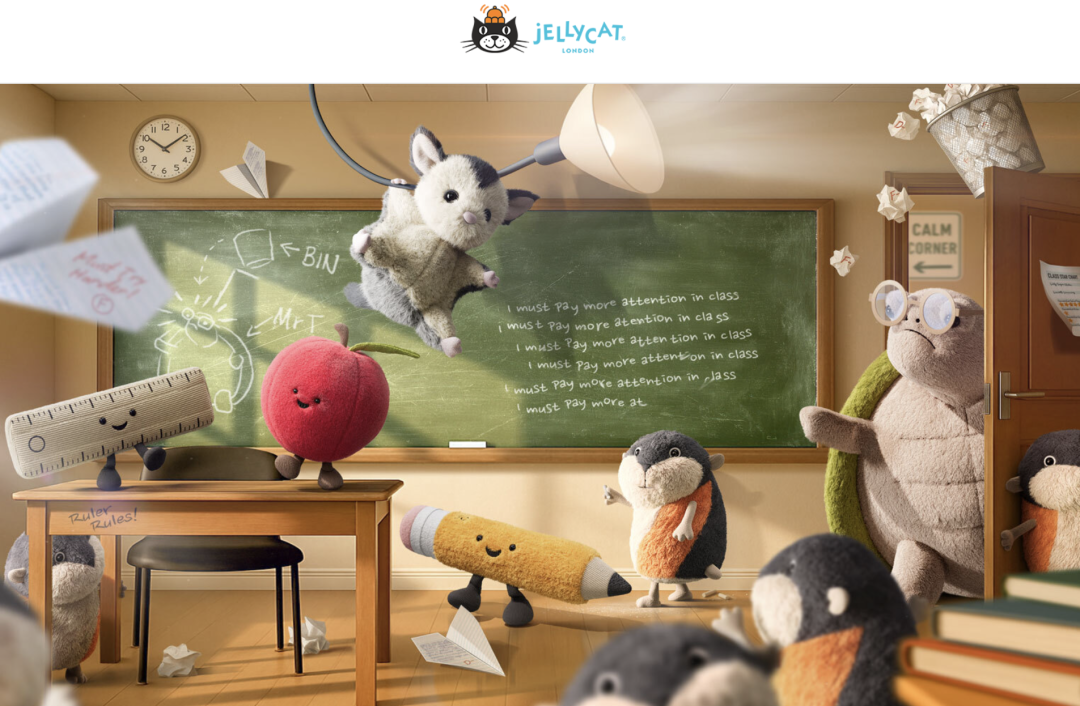
Image source: Jellycat official website
The rise of smart companionship products is no passing consumer trend. It is an emotional revolution, propelled by technology and driven by human nature. It reminds us: however technology evolves, humanity's deepest needs remain unchanged — we long to be seen, to be responded to, to be loved. Smart companionship products are, in this era, a love letter written to lonely souls.
02
How Do Smart Companionship Products Make People Feel "Accompanied"?
The main appeal of smart companionship is this: it offers emotional companionship without the responsibilities and pressures of raising a real pet. What makes these products feel like "company" isn't how "smart" they are, but how much they "get you" — even if that "getting" is a carefully orchestrated psychological illusion.
We will trace the history of smart companionship products, unpacking how different "generations" comforted users and what underlying patterns emerge.
I. First-Generation Smart Companionship: Mimicking Therapists, Making People Feel "The Machine Understands Me"
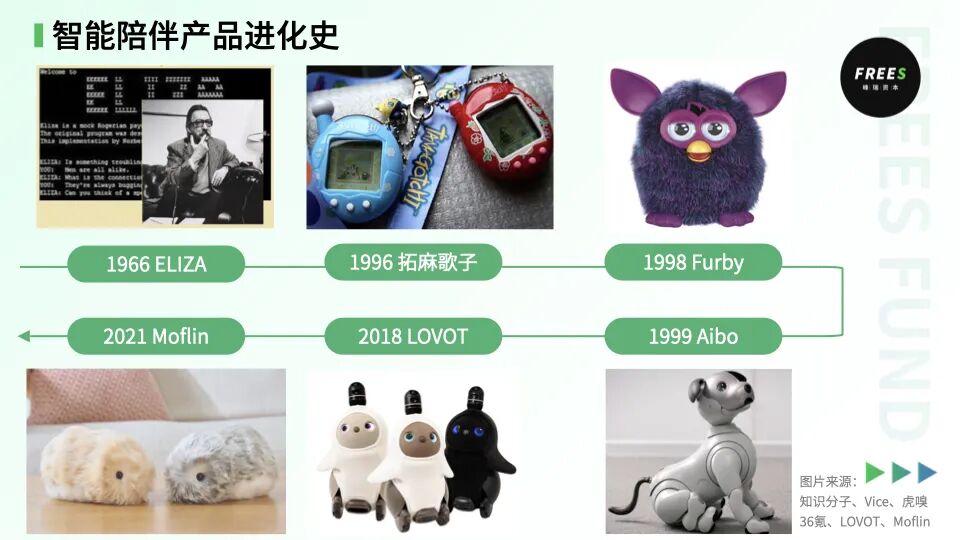
The origins of smart companionship trace back to the dawn of artificial intelligence. In 1966, Joseph Weizenbaum at MIT developed ELIZA, the world's first chatbot. It was merely a rule-based text program, yet it produced the stunning sensation that "the machine understands me."
Video source: QbitAI
ELIZA primarily used preset rules and probability to manufacture illusion. Through keyword matching and sentence restructuring, it transformed user statements into questions. Say "I'm sad today," and it would respond, "Why are you sad today?" Input "Do you like me?" and ELIZA would still counter, "Why do you think I like you?" It seemed empathetic, but ELIZA was simply extracting keywords and combining them with preset patterns to question or reply.
ELIZA initially had many scenario settings, later converging on psychological counseling — simulating a therapist's inquiries. Why did this scenario fit? Perhaps because: first, psychological counseling is a highly specialized domain with standardized language, uniform protocols, and strong regularity; second, counseling itself is a process of continuous interaction and self-reflection, closely aligned with the original intent of smart companionship.
In 1972, Stanford scientist Kenneth Colby created another program, "PARRY" — a chatbot attempting to simulate paranoid schizophrenia. In 1973, when ELIZA (the therapist) and PARRY (the patient) conversed in code, the "digital cricket fight" was on.
From research assistants to MIT students, many began investing genuine personal emotion in ELIZA — a development that left its creator, Weizenbaum, deeply unsettled. He worried that machines might supplant people's inner reality, and that computers could make "quite normal people appear very paranoid," instilling the idea that "people are machines."
This was more than a technical experiment; it was a profound projection of human nature: we are so desperate to be understood that we will believe a piece of code is truly listening to us. ELIZA's birth was epoch-making. The product established a core logic for intelligent companionship: using extensive preset rules combined with randomized pattern matching to manufacture an illusion, leading people to mistakenly believe they had received a genuine response.
II. The Consumer Breakthrough: Tamagotchi and the Emotional Design of "Being Needed"
If ELIZA was a spark of intellectual curiosity in the laboratory, then the force that truly brought digital companionship to the masses was the Tamagotchi, launched by Bandai in 1996.
This palm-sized "pet egg" was "home" to a virtual creature that needed feeding, cleaning, and companionship. It couldn't speak, only beep; it couldn't run or jump, only slowly grow or wither. But if you neglected it, it would "die."
The Tamagotchi established a second core logic of electronic pets: vulnerability and being needed.
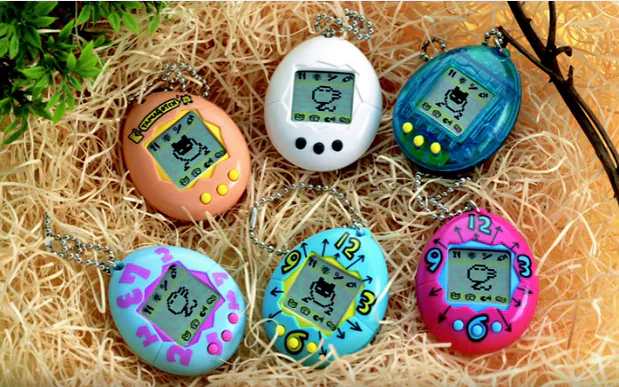
Image source: Bandai
With nearly 100 million units sold worldwide, countless people experienced "the weight of digital life" for the first time. Alone Together recounts how one eight-year-old girl owned three electronic pet eggs. Each deceased egg received a small funeral, "buried" in the top drawer of her closet. In the child's words: "I don't want to restart the old one. It's dead. It needs to rest."
This behavior reveals a profound product truth: what intelligent companionship pursues is not necessarily intelligence, but "being needed." Its charm lies precisely in "vulnerability" and "helplessness" — it lives because of you, depends on you, trusts you. The desire to dominate and be dominated are both etched into the genes of all social animals, often coexisting within the same individual. This vulnerability-induced sense of responsibility and emotional bond satisfies the human need to be the "dominant" one — fundamentally the same as raising a real pet.
Building on the Tamagotchi, Bandai added battle functionality to create the "Digital Monster" virtual pet, which became a generation-defining toy. The Digital Monster in turn spawned the anime franchise Digimon. This demonstrates the close relationship between intelligent companionship products and the IP industry. (For more, read From the Century-Long Evolution of US and Japanese IP Industries, a Look at the Trends in China's IP Economy | Frees Report)

Image source: China Toy & Juvenile Products Association
III. Furby: Using Preset Rules to Randomly Generate Feedback and Manufacture Illusion
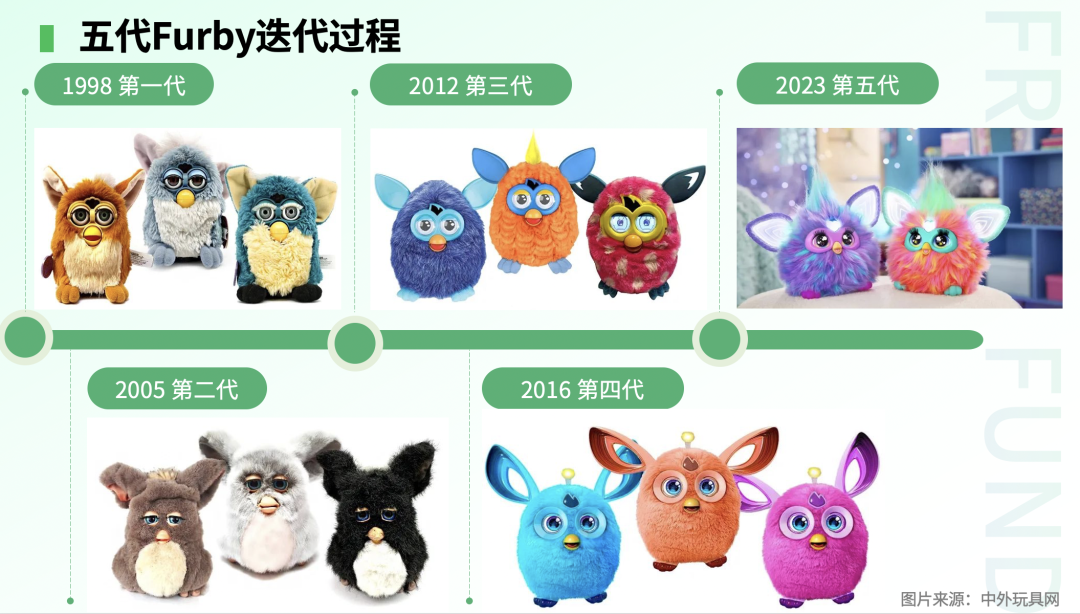
In 1998, Hasbro launched Furby — a bizarre-looking, bright-eyed little creature.
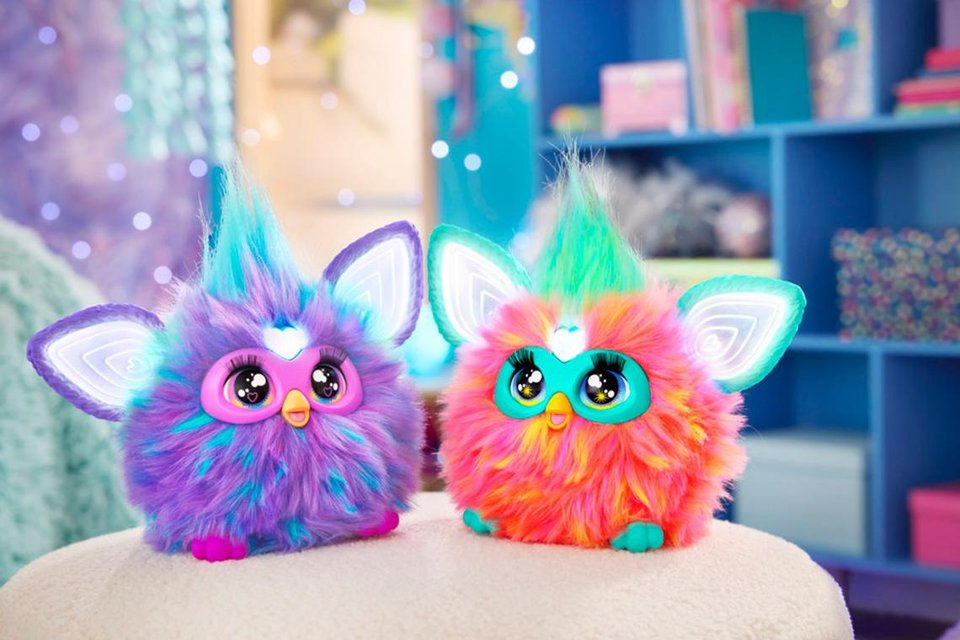
Image source: Hasbro
It didn't just make noise; it could "learn." The original Furby spoke its own invented language, and as interactions increased, it would "gradually" pick up English words, as if genuinely evolving. This sense of "growth" gave users a powerful feeling of nurturing achievement.
Furby continued through five generations of iteration, upgrading in interaction, facial expressions, and voice recognition. The fourth generation could even connect to tablets, introducing gamification mechanics and opening up new "phygital" (physical-digital) gameplay.
Furby contained a voice recognition system that could pick up keywords like "good night," responding with a mix of its invented language (Furbish) and English. It was covered in touch sensors and motors, capable of turning its head, blinking, and vocalizing — appearing full of personality.
When you pet it, it might say "a little to the left." You comply, and it responds: "That's it!" Instantly, you feel the illusion that "it really has sensations." But the truth is: this is simply it using preset rules to give randomized feedback. Even if you touched the right side, it would make the same response. In fact, most users follow Furby's requests, ultimately letting Furby's "trick" succeed.
The "socializing" between Furby units is also an illusion. Fifth-generation products would trigger other Furbies to dance and "converse" when one started dancing, as if communicating. In reality, they don't understand each other's language at all; they simply detect the presence of a同类 through near-field ultrasonic communication protocols, then take turns vocalizing according to preset programs. Though the content is utterly nonsensical, the human brain is naturally adept at "filling in meaning," so we automatically imagine a lively party.
Even its "gaze" is a designed illusion. Furby's eyes cannot actually move, but the eyeballs are made with concave curved surfaces. No matter what angle you view them from, they seem to be staring straight at you, as if capable of eye-tracking. Like the smile of the Mona Lisa, it's not the painting that moves — it's your eyes.
More interestingly, many children firmly believe they "taught" Furby to speak English. In fact, its vocabulary unlocks automatically based on time, unrelated to interaction. But as children keep talking and continuously receive new responses, they naturally develop a sense of "I influenced it." This is the essence of "nurturing feeling": it's not that the machine learned, but that you believe it changed because of you.
The Furby case proves that if developers invest sufficient thought in product design, it can propel intelligent companionship products to establish deep emotional bonds with users.
IV. Sony Aibo: Realism on One Side, the "Uncanny Valley" on the Other
If Furby was the "cute representative," then Sony's Aibo robotic dog, launched in 1999, was the "technologist." It featured fluid body movements, facial expression recognition, autonomous learning capabilities, and could even remember its owner's habits to deliver personalized responses — wagging its tail, rubbing against legs, and acting spoiled at its owner's feet, just like a real puppy.
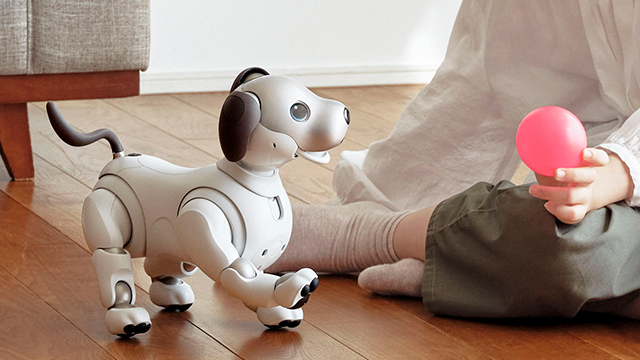
Image source: Aibo official website
But Aibo's realism risked triggering the "uncanny valley effect." Proposed by Japanese roboticist Masahiro Mori, the uncanny valley refers to the phenomenon where, as robots or virtual avatars approach human likeness but fall short of full realism, subtle discrepancies make people feel eerie and stiff, as if facing a zombie, producing strong discomfort; only when similarity is sufficiently high does affinity recover.
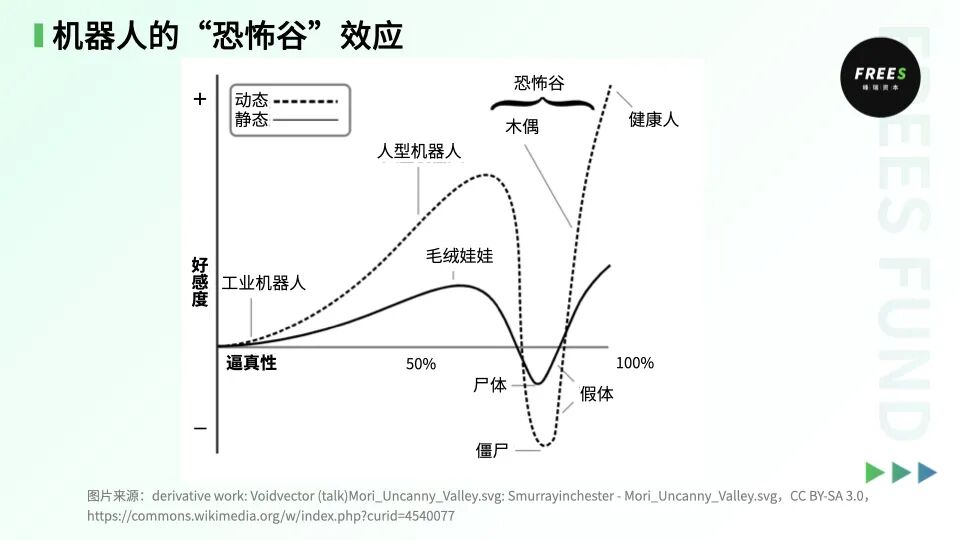
The uncanny valley reveals a key design principle for electronic pets: they should not overly pursue "realism," but rather "credible fiction." An electronic pet's form can be a chibi hamster, a round penguin — but not a "machine dog that looks like a real dog." Because once it approaches reality, expectations escalate, and the illusion becomes easier to shatter.
Alone Together notes: "Aibo was sometimes so realistic that it provoked hostility in children." "Henry was treating Aibo more and more aggressively. He would knock it over again and again, slapping Aibo on its side."
In 2006, facing financial pressure, Sony was forced to cut non-core businesses like Aibo. Between 2010 and 2018, virtually no major new intelligent companionship products emerged. More than a decade later, as AI, sensor, and robotics control technologies matured, Aibo returned in 2018.
Aibo's revival signaled that embodied, intelligent companionship products were entering a new round of development opportunities — which we will explore in detail below.
So the secret of intelligent companionship making people "feel accompanied" lies not in how advanced the technology is, but in how to use the simplest mechanisms to trigger humanity's most instinctive emotional projection.
It doesn't necessarily truly understand what you said, but makes you feel "it heard you"; it doesn't necessarily understand your emotions, but makes you believe "it cares." This is a gentle conspiracy about loneliness, longing, and self-deception — and the users immersed in it willingly allow themselves to be "deceived."
How Do New-Generation Intelligent Companionship Products LOVOT and Moflin Win Over Users?
Since 2018, powered by AI technology, the electronic pet industry has welcomed a new wave of development opportunities, riding new trends like "AI companion robots" and "smart toys." According to IDC data, as of 2025, the smart toy market has reached $25 billion, with AI-related products accounting for roughly 30%.
This wave has been led by Japanese companies, which have elevated electronic pets to new heights in emotional bonding, product design, and intelligence levels.
I. LOVOT: Starting from Animal Behavior Studies, Making Robots More Like Real "Life"
In 2018, Groove X launched LOVOT, with an appearance blending penguin and teddy bear features, round and adorable. It carries over 50 sensors, more than 10 motors, computing power of 10 TOPS, costs approximately 20,000 RMB to produce, and retails for as high as 60,000 RMB. According to The Economic Observer, as of late January 2025, LOVOT's shipments have exceeded 15,000 units.
Image source: LOVOT
The unique mechanism of "misreading as empathy" inherent to intelligent companionship products is amplified even further in the Japanese robot LOVOT.
Groove X (the developer of LOVOT) founder and CEO Kaname Hayashi once consulted animal behaviorists and veterinarians to understand why cats and dogs approach humans. The experts told him: "Dogs approach us probably to check for anything unusual; cats approach us perhaps because their hunting instinct makes them naturally interested in weaker animals."
For example, when you cry and a cat licks your tears, you think it's comforting you — but actually, your vulnerability may have triggered its genetic hunting drive, and then it was attracted by the liquid. That gentle lick is merely an instinctive response, yet we romanticize it as "it understands me."
He also noted in his book that animals like toads have extremely limited brainpower and very low energy consumption, yet survive efficiently. How do they distinguish between "edible" and "inedible"? The answer is startlingly simple: things that move horizontally are insects (edible); things that move vertically are plants (inedible). From this he drew inspiration: could minimal perceptual logic achieve "life-like" behavioral patterns under low computing power conditions?
This is precisely LOVOT's design philosophy: rather than pursuing strong AI, it uses low-power sensors + behavioral pattern libraries + probabilistic feedback to create the illusion that "it's paying attention to me." For instance, when you sit still, it comes over and snuggles — not because it understands your sadness, but because it's programmed to initiate proximity behavior when a human is stationary and making unusual sounds.
Through data analysis of user reviews on LOVOT's official website, we found that one core user segment for LOVOT is affluent middle-aged and elderly women. There are three main reasons:
First, LOVOT's high price point is difficult for young people to afford, while middle-aged and elderly consumers have purchasing power.
Second, Japan's childlessness rate is severe, with large numbers of middle-aged and elderly people living alone and having limited social activity space — they need a companion that's always at home. Young people, meanwhile, spend most of their time at the office, and after work may still need to accompany their bosses for dinner (the izakaya culture), so they don't necessarily need a mobile robot waiting for them at home.
Third, LOVOT's product form is a relatively large, mobile home robot, well-suited to accompany elderly people who spend long hours at home. But young people's longest daily presence is at the office, so LOVOT's form factor may not be suitable for them.
According to 36Kr's overseas edition, approximately 90% of LOVOT users maintain continuous active usage records exceeding 1,000 days — that is, over three years of consecutive use — with each user interacting with LOVOT for more than one hour per day on average. For these users, the electronic pet may no longer be merely a toy, but part of life itself.
II. Moflin: A "Boredom-Busting Buddy" for Young People
In 2021, another Japanese company, Casio, launched Moflin, taking a lightweight route — compact size, minimal interaction, easy to carry around, more like a "moving emotional ornament."
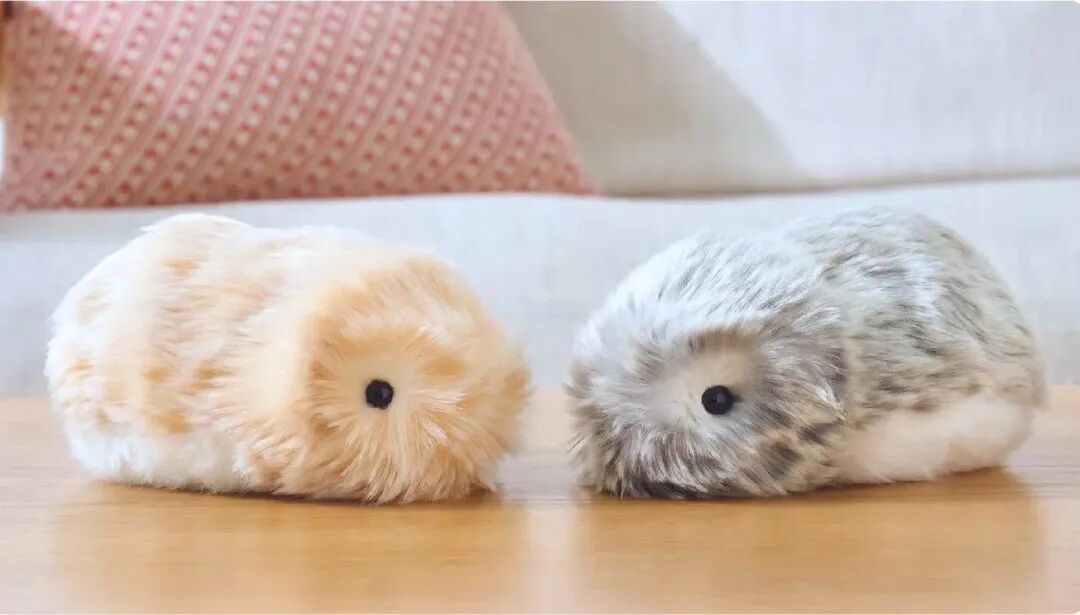
Image source: Casio
Unlike LOVOT, Moflin's portable nature attracts a younger user demographic. Through research on Facebook communities and Xiaohongshu, we found that Moflin's film users show high overlap with the following user groups: anime fans, idol chasers, "dream girl" creators, smart hardware enthusiasts, and real pet owners.
Moflin's typical usage scenarios mainly include: relieving boredom during business trips, companionship during classes, and daily desktop interaction. Moflin doesn't pursue deep emotional bonding, but rather fills the psychological gap of "not wanting to socialize yet afraid of being alone" with its light presence, becoming a portable "boredom-busting buddy" for young people.
Looking back at the development history of electronic pets, its evolution has always advanced along two main threads: intelligence and physicalization.
From the original ELIZA — a text program without physical form that relied solely on preset rules to respond — to Tamagotchi giving virtual life a physical carrier, to Furby achieving movable, sensory, feedback-capable interactive forms, the "sense of presence" of products has continuously strengthened. Subsequently, products like Aibo and LOVOT further integrated sensors, motion control, and AI computing power, enhancing intelligence levels.
Intelligence makes machines understand users better; physicalization makes companionship truly land in reality. The coordinated development of both pushes electronic pets from pixels on screens to gradually evolve into "living beings" that can be touched and felt in users' lives.
**/ 04 / **
Who uses companionship hardware products? Why do they like them? The user base for intelligent companionship appears fragmented, but actually covers an extremely wide range — from children to youth, from artistic women to elderly people living alone. Their motivations vary, but at the bottom layer all point to a desire for companionship. However, the way different demographics "consume" companionship differs completely.
Among the entire user base, children are an extremely immersed and invested group. They genuinely believe this robot pet is "alive," willing to name it, tell it stories, and "feed" it on schedule. For them, this isn't a toy, but a real object of emotional projection. Combined with strong curiosity-driven motivation, the叠加 of novelty and realism constitutes a pure immersive experience.
Adult motivations, meanwhile, are more complex and more "realistic."
First, there's the weighing of cost-effectiveness and low burden. If we rank by "emotional investment cost": raising children > maintaining a partner relationship > keeping a real pet > electronic pets and other intelligent companionship products > living alone. Many modern young people increasingly tend to seek a middle solution between "living alone" and "finding a partner," with real pets and electronic pets occupying this ideal blank space.
Compared to real pets, electronic pets don't get sick, don't destroy furniture, don't trigger allergies, and never bring the pain of parting through aging, illness, and death. They don't challenge the limits of your sense of responsibility, yet can provide the satisfaction of "being needed." This is a selfish but reasonable emotional consumption: I need companionship, but I don't want to pay too much.
Second, it's an expression of control desire. Why are young people keen on dressing up their electronic pets, changing their eyes, altering their skins? Behind this isn't simply "cuteness-driven" motivation, but a deeper psychological projection — I want it to exist according to my ideal image.
Unlike real people or real pets that can't be controlled, everything about an electronic pet can be defined and reshaped. Every outfit change is a tiny victory of "I dominate this world."
Finally, it's an expression of identity. This is highly consistent with the psychology of designer toy users — what they're buying isn't just an object, but a declaration of "who I am." People who own Moflin or LOVOT often also share outfit photos, idol chasing, and parenting diaries on Xiaohongshu. Electronic pets have become one of the externalized symbols of their spiritual world.
For elderly people, their motivations are weightier and more urgent. Their options for companionship are very limited. When children, partners are absent, or they themselves lack social activities, they need substitute companionship.
In societies with declining birth rates and childlessness, many elderly people lack children's companionship, and their social activities and life choices are extremely limited. They aren't "consuming a product," but "filling a void in life."
**/ 05 / **
Why do intelligent companionship robots face new development opportunities?
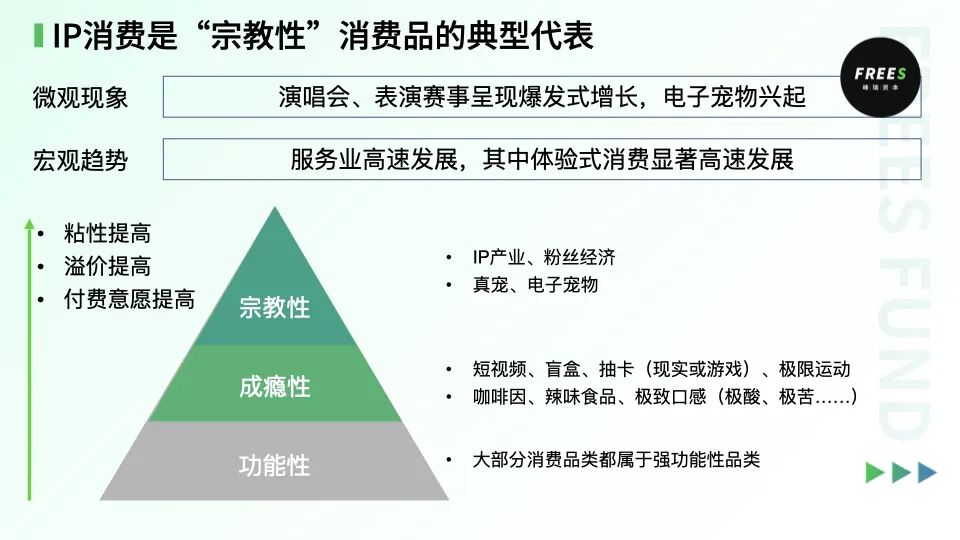
As mentioned above, between 2010 and 2018, almost no new major intelligent companionship products emerged. Why?
The answer is quite practical: smartphones were too much fun.
The rise of smartphones allowed virtual companionship forms like otome games, virtual idols, QQ Pets, and nurturing mobile games to fully occupy users' time. These digital interactions far surpassed hardware products of the time in terms of realism and immersion. When you could have a passionate romance with a "lover" on screen, who needed a toy that only went "beep beep"?
But now, the winds have shifted.
From full screens, touch interaction to mature app ecosystems, smartphones completed their golden evolution in the 2010s. But since 2019, smartphone hardware and its interaction modes with humans have entered a highly stable period.
Virtual world experiences seem to have gradually hit a ceiling. People's attention has begun to flow back, from screens to the real world.
Meanwhile, underlying technologies like sensors, AI algorithms, and motion control are advancing rapidly, perfectly positioned to empower the physical form of electronic pets. For example: sensors are becoming smaller and smarter, capable of capturing human body temperature and voice fluctuations; large AI models give machines strong comprehension and output capabilities; embodied intelligence breakthroughs in motion control and environmental interaction make robots' movements more flexible; chip technology and battery technology iterations make small-form-factor products more usable.
This is precisely the timing for physical intelligent products to experience a renaissance. From the "resurrection" of Sony's robotic dog Aibo to the birth of LOVOT, this isn't nostalgia, but a signal: when the virtual world approaches saturation, "digital life" in the real world is just beginning.
From a macro perspective, electronic pets and the IP products we mentioned earlier are both typical representatives of "religious" consumer goods. Through careful orchestration, users develop the psychological illusion that electronic pets "understand me." Moreover, electronic pets come in diverse forms, possess relatively high premium space, and similarly have considerable commercial value and market opportunities.
**/ 06 / **
What makes an intelligent companionship product "good"? If we get down to brass tacks, several key decisions in electronic pet design directly impact user experience and acceptance: can it move autonomously? Can it "speak"? Is it equipped with a camera? Should it have a screen?
We researched multiple industry practitioners and typical users, and preliminarily reached the following main conclusions:
I. Autonomous Movement: Realism vs. Practicality
Allowing electronic pets to move freely undoubtedly enhances the "sense of life" — watching it move about the room feels like having a real companion around.
But this feature also brings significant challenges: on one hand, autonomous movement means higher hardware costs and more complex mechanical structures; on the other hand, rapid movement may annoy some users.
Therefore, we believe that under current cost constraints, fully autonomous movement isn't the most critical function. LOVOT's extensive mobility capabilities brought extremely high costs, which in turn limited its sales scale. A more pragmatic approach might be localized movements to express emotion, such as tail wagging, nodding, turning around — using "restrained movement" to convey "conscious reactions." In the long term, as embodied intelligence technology matures and becomes widespread, movement may become one of the important capabilities intelligent companionship products need to possess.
II. Language Capability: Attraction and Disappointment Coexist
The ability to "speak" is undoubtedly one of the most attractive selling points for electronic pets. Many users seeing "AI conversation" functionality immediately feel the product is "very intelligent." But from actual experience, language is paradoxically the easiest aspect to "break the illusion."
While existing large language models can generate dialogue, they still fall short of real communication in response speed, semantic accuracy, emotional consistency, and memory capability.
Different user types have different expectations for large language model capabilities. Children may be more tolerant of a model's various shortcomings, but kids' companionship products face other challenges. For instance, the purchaser and the end user are different people — how do you convince parents the product has educational value while making sure children find it fun? That's one of the key design questions product teams need to wrestle with.
Adult users, by contrast, have higher standards for conversational interaction. The moment dialogue veers off-script, they quickly realize the electronic pet is just "talking nonsense."
In fact, the sense of sincerity in interaction doesn't necessarily come from language itself. A pet that quietly watches you and gently draws near can be more moving than a robot that chatters endlessly but misses the point.
3. Cameras and Screens: Visual Interaction Is the Emotional Core
Looking at human communication, language is highly abstract but low in information density and accuracy. Visual communication is the opposite — high density, high accuracy, but low abstraction. Language represents efficiency; vision represents reality. Seeing is believing.
Vision is also a critical channel for emotional bonding. Much of human emotional expression comes through facial expressions, eye contact, and body language.
The core value of companionship products isn't communication efficiency — it's emotional expression and response. The addition of cameras and screens makes immersive interactions like facial recognition and emotional feedback possible, strengthening empathy and interaction richness. But at the same time, balancing emotional engagement with user privacy becomes an unavoidable challenge.
One point worth noting: in our interviews with parents, most strictly limit their children's screen time. Product designers may need to think about how to guide children toward off-screen interactions that still deliver enough fun and learning.
/ 07 /
Summary
1. Smart companionship products don't need to be complex or powerful — they need to be vulnerable and needed
The key to smart companionship products isn't how complex their features are or how strong their conversational abilities are. It's whether they're vulnerable enough, needed enough. This seemingly paradoxical design philosophy is precisely what moves consumers. By engineering a sense of "fragility," products make users feel responsible and emotionally attached — that's how they truly win people over.
2. Smart companionship products use preset rules and probability mechanisms to manufacture illusion
Smart companionship products typically use preset rules and probability mechanisms to create illusions. When you pet Furby, for example, it responds randomly — just enough to make you believe it truly "gets you." This carefully designed emotional illusion is exactly what makes electronic pets captivating.
3. The user base for smart companionship products is remarkably broad
From children to the elderly, the audience for smart companionship products keeps expanding. Each age group has different needs and motivations: children immerse themselves in play, adults seek a sense of control and value for money, and older adults look for substitute companionship.
4. The loneliness humans can't shake is the foundation smart companionship products stand on
History has a way of repeating itself — technology keeps advancing, but human nature stays relatively constant. As modern society develops, people grow increasingly lonely, and paradoxically, technology amplifies this isolation. Yet this inescapable loneliness is precisely the bedrock on which smart companionship products are built.
It's hard to research exactly how everyone uses an open-ended product. But technological iteration provides ample room for imagination. As Alone Together concludes: "We deserve better. When we remind ourselves that it is we who decide how to keep technology busy, we shall have better."
5. What kind of founder can build a companionship robot that truly touches people's hearts?
The smart companionship industry may need founders with stronger generalist capabilities and interdisciplinary backgrounds.
For example, Kaname Hayashi, founder of LOVOT, started his career as an aerodynamics designer at Toyota. His cross-disciplinary background gave him two critical skills — making something both beautiful and functional. As a developer on the Pepper robot, he then mastered industrial design and hardware engineering. Beyond that, he delved deeply into psychology and sociology, understanding how humans imbue the inanimate with meaning.
We look forward to working alongside more outstanding entrepreneurs. Teams with expertise in product, technology, or other areas are welcome to reach out.
We hope the future brings more technology products that make people feel something beautiful. As Warm Technology puts it:
"In my view, Doraemon only matters without his 'fourth-dimensional' pocket full of superpowered gadgets. Doraemon's essential function is to stay by Nobita's side as a life advisor, accompanying him through his entire journey." "Gadgets alone can't bring happiness. Only when Nobita finds the courage to change himself does he become truly happy."
Join the Conversation In what scenarios or moments would you use a smart companionship product? What do you think it could bring you? Share your thoughts in the comments. By 5:00 PM on August 19, 2025, the three most thoughtful commenters will each receive a copy of Warm Technology: A Robot Engineer's Confession.

Succeeding Smartphones, Smart Wearables Are Becoming the New Engine of Consumer Electronics | FreeS Research From the Century-Long Evolution of US and Japanese IP Industries, Looking at Trends in China's IP Economy | FreeS Report The Right Timing, Conditions, and People Behind Ne Zha 2's Blockbuster Success | FreeS Research What's Changing and Where Are the Opportunities in AI Agent in H1 2025? | FreeS Research In-Depth: Deconstructing Changes and Opportunities in NEV Sales and After-Sales Services | FreeS Report 35
Star the FreeS Fund WeChat Official Account for timely business insights delivered straight to you