How Should We Think About Green Investing? | FreeS Research Institute

Why Does Carbon Neutrality Have to Be Zero?
Global consensus and momentum on climate change have reached a point of no return.
In the summer of 2022, extreme weather struck multiple regions worldwide. Unprecedented heat waves even claimed lives. This occurred in Portugal, Germany, Poland, Spain, and China, among other countries.
Faced with this stark reality, reducing 51 billion tons of CO2 equivalent to zero is something humanity, as a collective, must push forward with strength and consistency. Achieving a win-win of carbon reduction and economic growth won't be easy for us. But we believe that enormous challenges drive enormous change — especially for a manufacturing powerhouse like China, where carbon neutrality signals a disruptive energy revolution, technological innovation, and economic transformation.
This is the first article in FreeS Fund's environmental protection and carbon neutrality series. FreeS Fund partner Rui Ma analyzes the necessity of carbon reduction and the innovation opportunities and challenges behind it, examines how this wave of green investment differs from the previous Clean tech boom, and shares case studies of innovative companies in green technology.
We hope this offers fresh perspectives, and we look forward to exchanging ideas on green innovation technologies with you. Feel free to contact the author, Rui Ma, at marui@freesvc.com.
Livestream Announcement
Starting in September, we will launch the "FreeS Fund Dialogues: Environmental Protection and Carbon Neutrality" livestream series. We'll speak with innovative companies about how industries like consumer goods, new energy, and biomedicine can ride this wave to capture new growth opportunities. As an investment firm, FreeS Fund will also share what we've learned from founders.
The first session, "Synthetic Biology: From Groping in the Dark to Riding the Wave," will go live on September 4. Bluepha co-founder and CEO Haoqian Zhang, co-founder and president Teng Li, and FreeS Fund partner Rui Ma will discuss green innovation opportunities in synthetic biology.
Scan the QR code to register and submit your questions — we'll select and pose them to our guests. We'll also email the livestream link before the event.
Scan to register 👆
01 Carbon Neutrality: Why Must It Be Zero?
For "dual carbon" investment, How to Avoid a Climate Disaster offers valuable insights. The book notes that humanity emits roughly 51 billion tons of greenhouse gases into the atmosphere annually. Manufacturing and production (including steel, cement, and plastics) accounts for the largest share at 31%. Electricity generation and storage ranks second at 27%. Agriculture, transportation, and heating/cooling follow at 19%, 16%, and 7% respectively.
Since humans began using fossil fuels in the mid-18th century, global average temperatures have risen more than 1.2°C. Without action, temperatures could increase 1.5-3°C by 2050 and 4-8°C by century's end. Even achieving negative emissions by 2060 would still see temperatures rise close to 2°C. Such warming brings droughts, floods, agricultural losses, and rising sea levels — disasters on a global scale that are nearly impossible to reverse.
Therefore, reducing 51 billion tons of CO2 equivalent to zero is something humanity, as a collective, must advance. Strong and stable policy expectations for carbon neutrality have already taken shape globally. By late 2020, 44 countries and economies had formally announced carbon neutrality targets. Major powers including China, the US, and Japan have made commitments — the global consensus and trend on climate action cannot be reversed.
A country or region's carbon emissions can be clearly calculated from its fossil fuel consumption. Energy expert Ke Liu has shared relevant statistics. In 2020, China's CO2 emissions reached approximately 10.3 billion tons, about 20% of the global total. Coal, oil, and natural gas accounted for 9.5 billion tons, roughly 92% of total emissions. Accurately tracking these three sources provides a comprehensive picture of carbon emissions. Meanwhile, China's external dependence on oil and gas remains persistently high — crude oil imports exceed 70% of consumption, natural gas imports over 40%. The tension between massive economic demand for oil and gas and reliance on imports has long been an energy security vulnerability. Replacing fossil fuels thus serves both carbon reduction and energy security.
But achieving a win-win of carbon reduction and growth is no easy task for China. In September 2020, China announced its goal to peak CO2 emissions before 2030 and strive for carbon neutrality before 2060 — known as the "30-60" dual carbon targets.
At the same time, economic growth must continue. China's per capita GDP currently exceeds $10,000. According to national planning goals, per capita real GDP should reach upper-middle-income developed country levels by 2035 and average developed country levels by 2050 — a timeline that largely overlaps with the "30-60" period.
As the "world's factory," China produces goods for global consumers relying on fossil energy, leaving substantial hidden carbon on Chinese soil. Under current greenhouse gas accounting standards, emissions are calculated from the producing country's perspective rather than the consuming country's. In other words, China bears some carbon emissions that actually belong to other countries.
Enormous challenges drive enormous change — especially for a manufacturing powerhouse like China, where carbon neutrality may trigger disruptive energy, technology, and economic revolutions. Enormous change means enormous investment opportunities:
- Energy structure: A shift from coal dominance to non-fossil energy sources (wind, solar, hydro, nuclear). This structural change drives grid and storage transformation, requiring more flexible, intelligent power grids and new energy storage systems matched to renewable sources.
- Materials production: A likely shift from petrochemical-based to increasingly bio-based materials; simultaneously, zero-carbon inorganic materials become inevitable, particularly for construction materials like glass, steel, and cement.
- Agriculture: Significant carbon reduction potential through cultivated meat, zero-carbon fertilizers, biological nitrogen fixation, and more. Additionally, transportation, construction, finance, and consumer sectors all offer space for green transformation.
Understanding the necessity of zero emissions and the challenges and opportunities in carbon reduction, let's examine the timeline for achieving carbon neutrality.
Current timelines vary — some describe "three steps over 40 years," others break it into "eight five-year plans" — but all point from emissions inventory to strict controls, then to power sector carbon neutrality, decoupling development from carbon, and finally near-zero or negative emissions.
We are currently in the preparatory phase before major push. By the 16th Five-Year Plan period, disruptive technologies must emerge to achieve substantive energy substitution and carbon reduction. The next 10-15 years represent the critical stage for green technology supply.
McKinsey & Company's 2021 analysis of Europe's zero-carbon pathway indicates that perhaps only 60% of emissions reductions may come from mature technologies, 30% from technologies currently in demonstration but not yet fully mature, and 10-15% from technologies still in R&D stages.
02 From Clean Tech to Climate Tech: What's Different About This Round of Green Technology Investment?
Green technology investment is hardly new.
What we now call climate-related technology (Climate tech) was known as Clean tech around 2008-2012, itself a specialized investment category. Led by the US, numerous institutions bet heavily on clean tech then. The MIT Energy Initiative estimates that from 2008-2016, US investors poured $25 billion into clean tech, with over half lost. For a time, this dampened enthusiasm for green technology investment.
How does the current round differ from the last?
Here's our conclusion: this round has better prospects.
First, the driving force differs. The previous round was propelled by high oil prices, which at one point surged to $200 per barrel. But oil prices are inherently volatile — when they fell, green markets suffered. This round is driven by climate response, a systematic, long-term, and clearly defined demand.
Second, funding dynamics differ. In the last round, US clean tech investment was led by Silicon Valley venture capitalists, while China's was mainly driven by TMT funds. This round's green investors are far more diverse, with numerous public and private institutions joining the green investment wave.
According to the Asset Management Association of China, as of Q3 2021, public and private funds focused on green, sustainable, and ESG directions numbered nearly 1,000, with combined assets exceeding 790 billion RMB — up 36% from year-end 2020. This included over 190 public funds managing 410 billion RMB, and 800 private funds managing 370 billion RMB, 90% of which were equity and venture capital funds.
Third, green technology itself continues evolving. The last round focused mainly on thin-film photovoltaics, biofuels, and electric vehicles. This round's green technologies are more mature and broadly applicable: large-scale lithium battery deployment, declining solar costs, and synthetic biology-based products achieving cost and efficiency advantages.
It is precisely because green technologies have reached certain maturity levels that commercialization and green investment have reached a new starting point.
According to an IRENA report, after over 30 years of R&D and investment, utility-scale solar PV electricity costs have fallen 98% globally: government subsidies plus technological innovation drove roughly 85% cost reduction from 1980-2000; from 2000-2014, rising solar deployment and economies of scale further reduced costs by approximately 85%. Despite navigating financial crises, anti-subsidy and anti-dumping measures, and industry shakeouts over the decades, solar commercialization never stalled. Currently, solar levelized cost of electricity has approached or fallen below coal-fired power prices.
03 How Do We Think About Green Investment?
Through investment practice and research, we've identified numerous fields critical to zero carbon:
- Power sector: Contributing 40% of China's carbon emissions, future focus involves shifting coal power to green electricity. Solar technology, wind power, nuclear fission, and nuclear fusion. The new power systems accompanying green electricity — including ultra-high voltage transmission, distributed generation, short-duration energy storage and peak shaving, friendly integration of various loads, and intelligent control systems — all demand new technologies and models.
- New energy storage systems: Next-generation batteries, mechanical storage, chemical storage, etc.
- End-use electrification: By 2060, electricity's share of terminal energy consumption could reach 66%; power batteries, electric vehicles, 5G base stations; industrial electrification including electrofuels, biomass fuels, hydrogen energy, and zero-carbon manufacturing.
- Agriculture (food): Plant and cell-based meat and dairy products, gene editing, AI breeding for better seeds, biological nitrogen fixation, etc.
- Materials: Material recycling and regeneration, synthetic biology, bio-based materials.
- Others: Decarbonization in transportation and construction, CCUS (Carbon Capture, Utilization and Storage), etc.
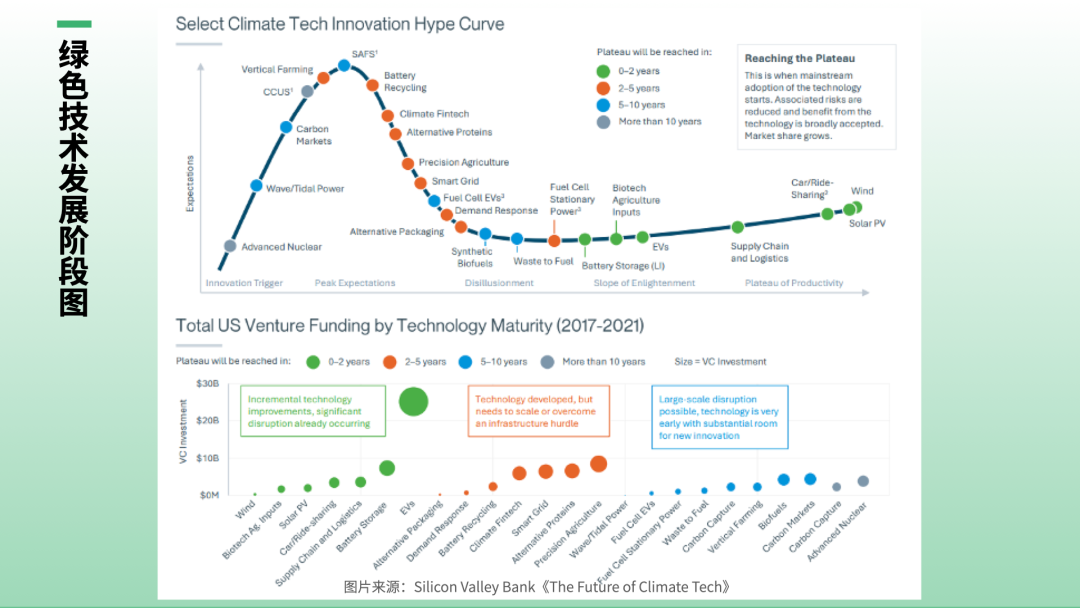
Different zero-carbon technologies sit at various positions on the technology maturity curve. As shown in the figure below: lithium-ion batteries, wind power, and solar PV have already been deployed at scale and are gradually developing cost advantages over fossil fuel generation; some technologies like alternative proteins, synthetic biology, smart grids, and battery recycling may achieve larger-scale application within 2-5 years; fuel cell vehicles, biofuels, and carbon capture remain in earlier development stages. But nearly most climate-related technologies may achieve scaled application within 10 years. Thus, Climate tech as a whole stands at an inflection point from technology to application.
From an investment practice standpoint, we apply first-principles thinking to systematically map out a breakthrough path for energy and materials. At their core, both energy and materials are simply molecules or polymers. Approaching energy and materials investment from first principles and a systems perspective means returning to atoms and molecules themselves — considering what the feedstocks are (carbon sources, hydrogen sources, etc.), where they come from (agriculture, petrochemicals), what biological or chemical reactions they undergo, what molecules or polymers they become, and what industries they ultimately serve.
The industry often cites a striking fact: of a barrel of crude oil, 83% goes toward fuels and energy, corresponding to a global market of roughly $3 trillion. The remaining 17% becomes petrochemical products and chemicals, generating a global market of about $4 trillion — nearly the same economic value as the 83% share, despite using a fraction of the material.
If the world can eventually replace that 83% of petrochemical fuels with electricity, and substitute petrochemical production with bio-synthesis, humanity will gradually reduce its dependence on fossil resources.
Among new modes of material production, synthetic biology offers particular advantages in diversity and optionality.
We are bullish on synthetic biology for three main reasons:
First, it is sufficiently digital. The convergence of "IT + BT" (information technology and biotechnology) has become a defining trend; the bio-industry is arguably one of the sectors most deeply integrated with digitization today. Over the past 10 to 20 years, new tools have proliferated — gene sequencing, gene editing, AlphaFold2, biochips, and more. These tools have generated vast quantities of new data, giving synthetic biology the opportunity to iterate on a data-driven foundation.
Second, it bridges digital and physical worlds. Synthetic biology serves as a bridge between the digital realm and the real world. While internet innovation remains largely confined to the digital sphere, the ability to regulate, edit, and iterate biological system code in the digital domain translates directly into real-world molecules and materials — ultimately delivering APIs, textile materials, cultivated meat, nutraceuticals, pesticides, energy, and more.
Third, it radiates across industries. The 14th Five-Year Plan for Bioeconomic Development, released in May 2022, states: "Bioeconomy, powered by advances in life sciences and biotechnology, based on the conservation, development, and utilization of biological resources, and characterized by deep and extensive integration with medicine, health, agriculture, forestry, energy, environmental protection, materials, and other industries, is sketching a beautiful blueprint for the future development of human society." Innovation built on biotechnology as its foundation can extend and radiate into bio-chemicals, bio-manufacturing, bio-agriculture, bio-medicine, and beyond.
Green Tech Innovation Case Studies
Since its founding, FreeS Fund has incorporated ESG factors into its investment and decision-making processes, making early bets on innovative companies that now align with China's "dual carbon" goals: in solid-state batteries, we have continuously backed QingTao Energy since its angel round; in synthetic biology, we have firmly supported Bluepha from its angel round onward; in waste sorting, we have stood by Aobei Environmental's growth. We have also explored AI-enabled crop breeding, next-generation separation technologies to replace membrane separation, and production of high-safety lithium electrolytes.
Bluepha: Marine-Degradable Material PHA
In synthetic biology, we have invested in companies including Bluepha, Xinsu Technology, Yanwei Technology, and Hesheng Technology.
Bluepha is a molecular and materials innovation company built on synthetic biology. It is dedicated to designing, developing, manufacturing, and marketing novel bio-based molecules and materials, creating products with the greatest commercial imagination — including marine-degradable PHA, regenerative medicine materials, novel cosmetic functional ingredients, new food additives, and probiotic products.
Bluepha's lead pipeline is "Lansu™" (Bluepha-produced PHA). Lansu™ can fully decompose into water and carbon dioxide in virtually all natural environments. 100% of the carbon atoms in Lansu™ come from CO₂ captured from the atmosphere via bio-based feedstocks. By estimate, each ton of Lansu™ product delivers roughly two tons of biological carbon sequestration, helping Bluepha build a demonstrative "zero-carbon industrial chain" in synthetic biology. Beyond its carbon footprint, Lansu™ has also achieved significant cost reductions. In terms of performance, it can be made into very thin biaxially oriented films with excellent barrier properties. (Read more: How to Think About Biotechnology Opportunities Over the Next Decade? | FreeS Fund Dialogue)
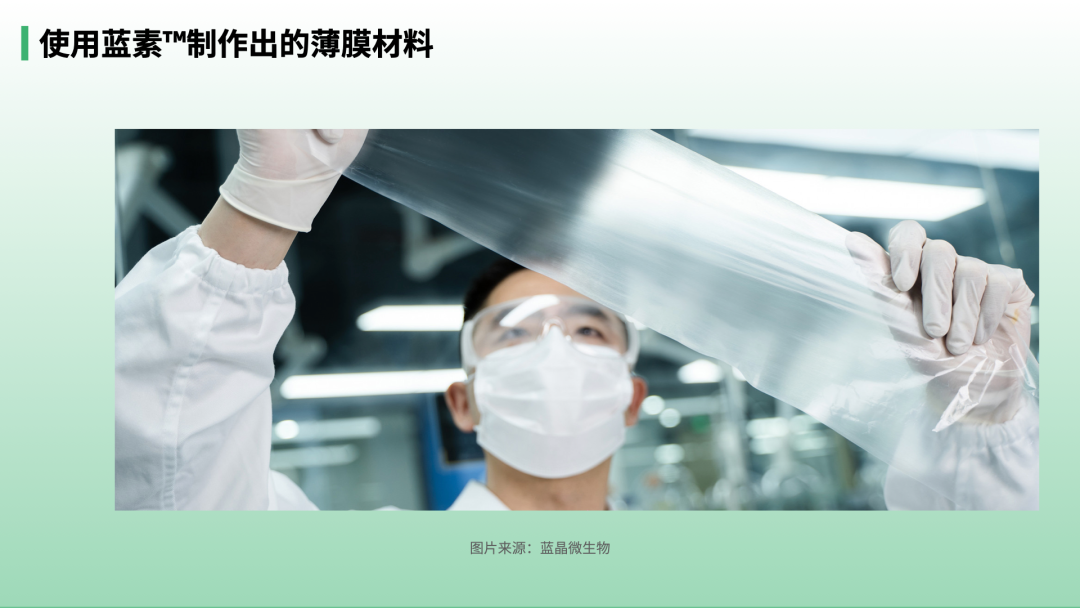
The challenge is that PHA production costs have historically been high. Bluepha's proprietary strains and processes, however, are tightly engineered around "atom economy" — designing, computing, and optimizing every atom to the extreme, dramatically lowering production costs.
We have firmly supported Bluepha from its angel round, adding to our position across seven consecutive rounds. We believe Bluepha can evolve from a platform technology company to one that delivers products, and ultimately empower more products through the Bluepha platform.
It is fitting, perhaps, that Bluepha was the first project I invested in after joining FreeS Fund. In my initial conversations with the founding team, they showed me a metabolic map that remains vivid in my memory to this day.
The map resembles a subway diagram. Each station represents a substance; the lines between stations represent enzymes. When you ride the subway, you go where you want — Sanyuanqiao, Liangmaqiao, wherever. In theory, synthetic biology offers the same engineering and design freedom: you can synthesize whatever you want.
This foundational, engineering-driven molecular control was what moved me most.
Perhaps one day we will find that many stations on this synthetic biology map have been lit up, with so many destinations and their surroundings now reachable.
AI Breeding: Breeding-by-Editing
Seeds are often called "the chips of agriculture." China currently needs to reduce its dependence on foreign seeds. According to data from Farmers' Daily: "In 2021, China's crop seed imports exceeded exports. Imports reached $680 million, mostly horticultural crop seeds; exports were $330 million, with rice seeds holding the advantage. For certain vegetable varieties — carrots, spinach, onions, high-end tomatoes, as well as sugar beets and ryegrass — China's import dependence exceeds 90%."
In agriculture, we are optimistic about using computational and gene-editing tools to improve breeding efficiency, and have invested in Xingluo Technology, which focuses on AI-enabled breeding. Through gene sequencing, AI can predict the phenotypes corresponding to different sequences — for example, whether a given seed will grow into a high-protein-yield or stress-resistant crop. We can use computation to make predictions, then apply gene editing guided by those predictions to transform the seed.
Agriculture sits upstream of energy and materials. It concerns not only food security but also industrial feedstock supply — its importance cannot be overstated. Biotech agriculture inputs are already considered mature technology and applications in the United States, but in China further regulatory opening remains necessary.
Maihai Environmental: Nanoscale Precision for Separation
Nano-Micro Science has demonstrated the commercial value of nanomaterials for separating biological macromolecules (proteins, peptides, antibodies, etc.). In industrial separation, the growth of new energy, bio-manufacturing, and biomedicine has created expanding demand for next-generation separation technologies capable of higher precision, higher purity, shorter processes, and lower costs.
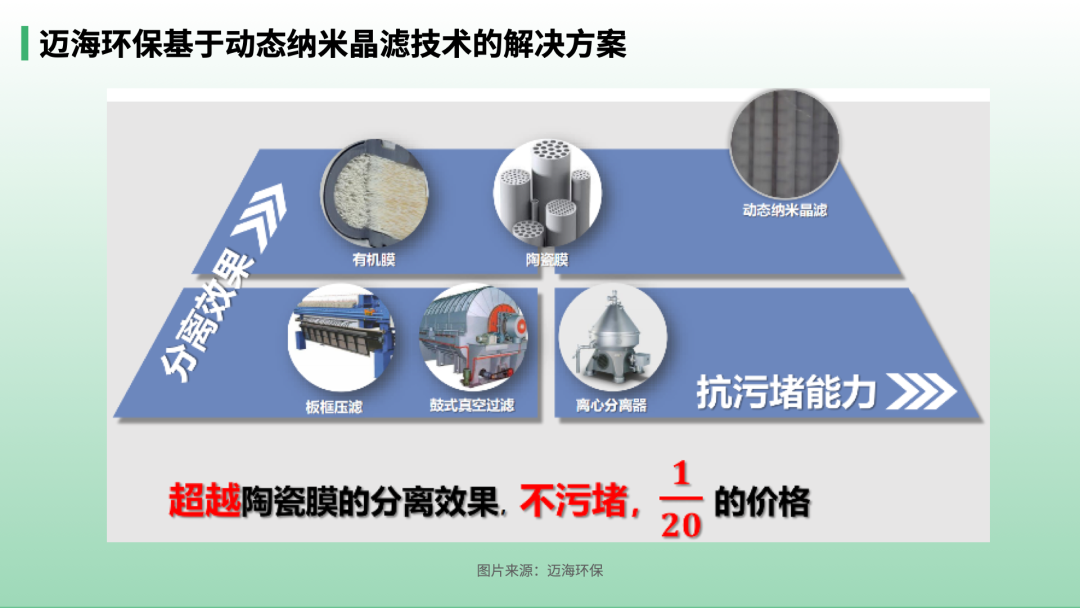
FreeS Fund's angel-round investment, Maihai Environmental, offers a solution based on dynamic nanocrystalline filtration technology. Using functional nanomaterials, innovative reactor design, and IoT-driven process intelligence, it has achieved a disruptive membrane-replacement separation technology. By tuning nanoparticle size and nanolayer thickness in its dynamic crystalline filtration process, Maihai achieves nanoscale control of separation precision, enabling effective separation of components differing by more than 2nm, completing high-precision, production-scale product purification while effectively avoiding membrane fouling issues common in membrane separation. Maihai's products exceed ceramic membrane separation performance at less than 1/20th the cost. This technology is currently being deployed with leading companies in new energy and synthetic biology, with preliminary results showing excellent separation performance.
As nanomaterial synthesis technology matures, precise control over nanomaterial size and arrangement can enable advances in separation, light manipulation, single-molecule detection, and more — a promising area that FreeS Fund continues to watch and invest in.
QingTao Energy: Solid-State Batteries
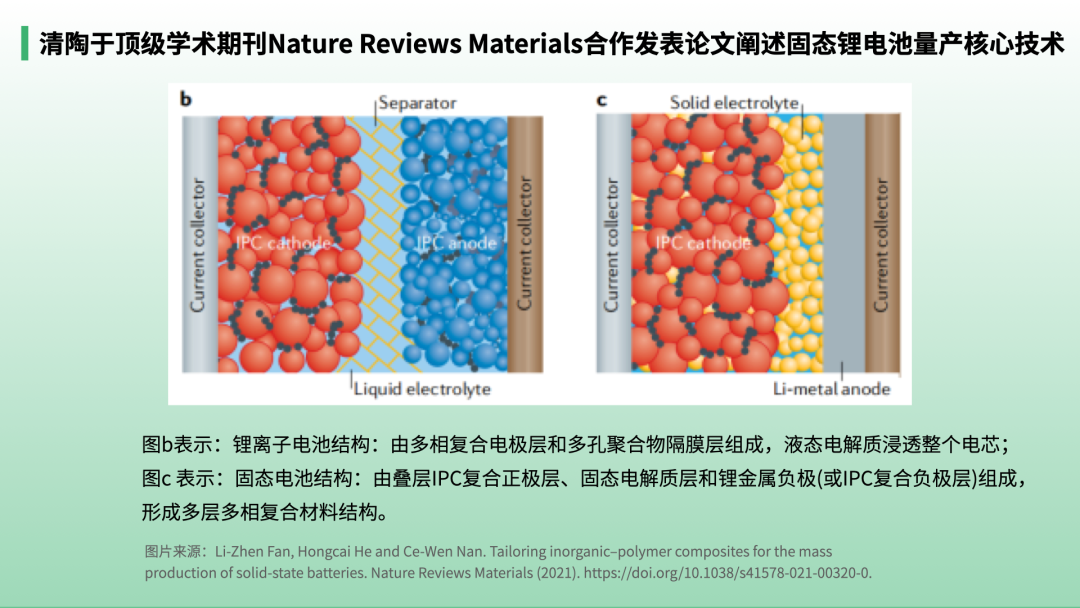
In the 160-plus years since the lead-acid battery's invention, progress in batteries and materials has been remarkably slow. Compared to lead-acid batteries, ternary lithium batteries have only achieved roughly a 5x improvement in energy density (Wh/kg). Liquid lithium-ion batteries struggle to surpass the single-cell energy density limit (350 Wh/kg), and there is an inherent trade-off between high energy density and safety. Solid-state batteries have emerged as the next-generation focal point. By replacing liquid electrolytes with solid electrolytes, they dramatically reduce thermal runaway risk. Their electrochemical window can exceed 5V, higher than liquid lithium batteries (4.2V), enabling pairing with high-voltage cathodes and lithium metal anodes to substantially increase theoretical energy density. Solid-state batteries can simplify packaging and cooling systems, further reducing battery weight within limited space, with volumetric energy density improvements of over 70% compared to liquid lithium batteries (graphite anode).
From the perspective of electrons and ions, reversible lithium-ion intercalation between positive and negative electrodes (the "rocking chair" mechanism) is the electrochemical foundation of lithium-ion batteries, while the core of solid-state battery R&D lies in electrolytes and interfaces. This still means solving ionic conductivity in electrolytes, as well as grain boundaries in electrolytes; space charge layers and interfacial layers at cathode-electrolyte interfaces; and lithium dendrites and interfacial reactions at anode-electrolyte interfaces.
The QingTao Energy team, led by Academician Cewen Nan, brings over 20 years of accumulated expertise in polymer and inorganic nanocomposite materials, solid-state electrolyte materials, and computational analysis of microstructure-property relationships.
FreeS Fund has been backing QingTao Energy since its angel round. QingTao Energy focuses on the industrial commercialization of new energy materials technologies. In terms of industrialization, it is a leading domestic solid-state battery company — not only did it pioneer the construction of pilot and mass production lines, but it also secured investments plus strategic partnerships from three major automakers: BAIC Group, SAIC, and GAC. The solid-state lithium batteries developed and produced by QingTao Energy feature high safety performance, long cycle life, high energy density, and wide temperature tolerance.
In 2021, passenger vehicles equipped with QingTao's solid-state power batteries achieved single-cell energy density exceeding 360Wh/kg, with tested pure-electric range surpassing 1,000 km, as well as ultra-fast charging within a 600 km range. Additionally, QingTao's solid-state lithium batteries have achieved large-scale batch supply in specialized energy storage and other fields.
Summary
-
About 40% of future total carbon emissions reductions will depend on low-carbon technologies currently in R&D, or even earlier-stage innovations that will mature gradually over the next 5 to 15 years. Whether such green technologies can be supplied, and whether they can be matched with demand, are critical factors influencing the success of future carbon neutrality efforts.
-
FreeS Fund's investment strategy in the low-carbon sector starts from first principles, returning to atoms, molecules, and ions to rethink energy and materials. We focus on molecular design, atom economy, and interfacial properties, using cross-disciplinary technology to find green innovations.
-
Carbon neutrality is an unstoppable trend. But the path toward it is full of challenges. Potential difficulties in the carbon neutrality field include: the adequacy of funding, the pace of technological progress, and the uncertainties around integrating new technologies into existing infrastructure and hardware/software systems.
Reader Giveaway
From your perspective, what innovation opportunities do you see in the environmental protection and dual-carbon space? Share your thoughts in the comments section. The six most thoughtful commenters will receive a FreeS Fund custom edition of Trends 2030: Eight Megatrends That Will Reshape the World. We look forward to exploring certainty amid change together, and staying sharp.

Livestream Preview
Starting in September, we will launch the "FreeS Fund Dialogues: Environmental Protection & Dual Carbon" livestream series. We will discuss with innovative companies how industries such as consumer, new energy, and biomedicine can seize new development opportunities by riding the wave of environmental protection and dual-carbon trends. As an investment institution, FreeS Fund will also share the insights we've learned from founders.
The first livestream, "Synthetic Biology: From Groping in the Dark to Riding the Wave," will go live on September 4. Haokian Zhang, co-founder and CEO of Bluepha, and Teng Li, co-founder and president, will join Rui Ma, partner at FreeS Fund, for a conversation about green innovation opportunities in the synthetic biology field.
Scan the QR code to register and submit questions you're interested in — we'll screen and pose them to our guests. We'll also send out the livestream link via email before the event.


Scan the QR code to register 👆

Baidu Finance | FreeS Fund Video Channel | 36Kr | Sina Tech | Sina Finance

BioSpark | BioBoat | CEO | Chinese Entrepreneurs Organization | CMU Summit | CMU China-U.S. Innovation and Entrepreneurship Summit | CVEC | Cornell Venture Capital Club | Harvard Venture Club | MITCEO | MIT Chinese Entrepreneurs Organization | OxfordCSSA | Oxford Chinese Students and Scholars Association | UCLS-VC | UChicago China Forum
Listed in alphabetical order; no ranking implied

▲How to Think About Biotech Opportunities Over the Next Decade? | FreeS Fund Dialogues
▲ Synthetic Biology: The Heavenly Craftsman for the Next Twenty Years | 2021 FreeS Fund Annual Investor Summit
▲ Shize Bio Founder Xiang Li: The Latest Intersection of Biotechnology — The Spring of Stem Cell Therapy | 2021 FreeS Fund Annual Investor Summit
▲ How Can Single-Cell Sequencing Help You Understand the 40 Trillion Cells in Your Body? | 2021 FreeS Fund Annual Investor Summit