How to Build a Global Cross-Border E-Commerce Brand? | FreeS Fund Going Global Series

Can cross-border e-commerce players still win everywhere with the "value for money" playbook alone?
Global trade is nothing new, but the deep integration of the internet with economic globalization has planted a new seed capable of reshaping the landscape — "digital trade" — with cross-border e-commerce growing the most aggressively.
From January to June 2021, China's cross-border e-commerce imports and exports reached 886.7 billion yuan, up 28.6% year-over-year. The sector has become China's fastest-growing, most promising, and most influential new format in foreign trade.
Since 2015, FreeS Fund has invested in multiple cross-border e-commerce companies, including PatPat, which has since become a global leading DTC brand. As of August 2021, PatPat announced the completion of $510 million in Series C and Series D financing, having grown into a veritable industry unicorn.

PatPat's website features "Cute, Quality, Great Price" in the upper left corner
With capital pouring in, competitors in the cross-border e-commerce track now face fiercer rivalry. PatPat founder Can Gao believes that to survive this war and stand out, brands need to "seize opportunities," "meet challenges," and "build brand competitiveness."
Today, we bring you Can Gao's speech from the 2021 FreeS Fund Investor Annual Summit, where he shared PatPat's explorations and insights during the pandemic:
- What impact has the global COVID-19 outbreak had on the cross-border e-commerce industry?
- What challenges have domestic cross-border e-commerce players faced during the pandemic?
- How do you build a globally competitive cross-border e-commerce brand?
We've compiled and edited his sharing into this article, hoping to offer some inspiration for those following the cross-border track.
Interactive Giveaway We warmly welcome your thoughts in the comments section. The 3 most thoughtful commenters will receive a customized FreeS Fund notebook set (including two notebooks in different designs). Comment screening closes at 12:00 noon on March 3, 2022.


How Can China's Cross-Border E-Commerce Build Momentum for Breakthrough?
Speaker: Can Gao
Cross-border e-commerce, as a not-so-new industry, has for years occupied a position of exporting China's production capacity abroad for profit, and has generally been quite lucrative — by the end of 2021, import and export trade's contribution to GDP exceeded 40%.
From when the pandemic began spreading globally, China's cross-border e-commerce industry has attracted considerable attention. In April 2020, when import and export trade was shrinking in countries worldwide, China's cross-border track still saw 15% growth, with continued momentum in 2021. In this process, the brand-outbound model based on D2C has encountered many new development opportunities and challenges.
However, many friends may still not fully understand what the cross-border e-commerce industry specifically looks like, or what PatPat does. PatPat entered the cross-border e-commerce track in 2014, experimented with many directions, witnessed the changes and rises and falls of various models and approaches, and in 2016 identified a major direction worth sticking to: "Based on China's powerful supply chain, using our team's core internet technology to optimize every link in the industry chain, to build a global, disruptive children's clothing brand."
Today, I'd like to share some of our observations and reflections over the years in this industry, to show you what opportunities and challenges the cross-border e-commerce industry faces under the pandemic, and what we believe needs to be done to build a global brand in this context.
01 The "Rise" of Cross-Border E-Commerce Under the Pandemic
The pandemic that erupted starting in 2020 brought significant impact to nearly every country, and for the cross-border e-commerce industry, these impacts represented opportunities in many respects.
From the consumer, or demand, perspective: the lockdowns and restrictions on going out brought by the pandemic increased people's time at home and online across nations, leading to an explosion in online shopping demand and rapid growth in e-commerce penetration.
On the supply chain front: regions outside China, such as Europe, the Americas, South America, and Southeast Asia, saw their supply chains affected during the pandemic by phase-specific suppressive factors like inconsistent recovery across upstream and downstream areas. This meant that both demand transferred from other countries and their own new production capacity needs could not be brought online normally, causing many new foreign trade orders from these regions to flow to China, and much online consumer demand to shift to Chinese cross-border e-commerce — because at that time, China was the only country with a complete supply chain and relatively balanced recovery.

Amid global supply chain crisis, China's trade surplus hits record high
Bloomberg, November 8, 2021
As countries were caught off guard one after another by the pandemic, China brought the situation under control early, enabling production capacity to recover quickly and even improve, providing strong support for the high-speed development of cross-border e-commerce. Intense competition on the track brought more domestic brands and traditional suppliers into the market, while also attracting more attention and capital investment. All of these were explosive growth opportunities that cross-border e-commerce gained starting in 2020.
Among the many favorable conditions, what our team felt most deeply was the benefit brought by rapid e-commerce penetration growth. The data shows that in 2020, consumers' online shopping time began increasing in most countries, with average growth in online shopping time reaching 47%, leading to rapid rises in e-commerce penetration. China leads the world in e-commerce penetration at 37%, but looking overseas, even the US, which ranked first in e-commerce penetration, had only about 16% before the pandemic. After the outbreak, by around April 2020, its e-commerce penetration had rapidly climbed to 27%.
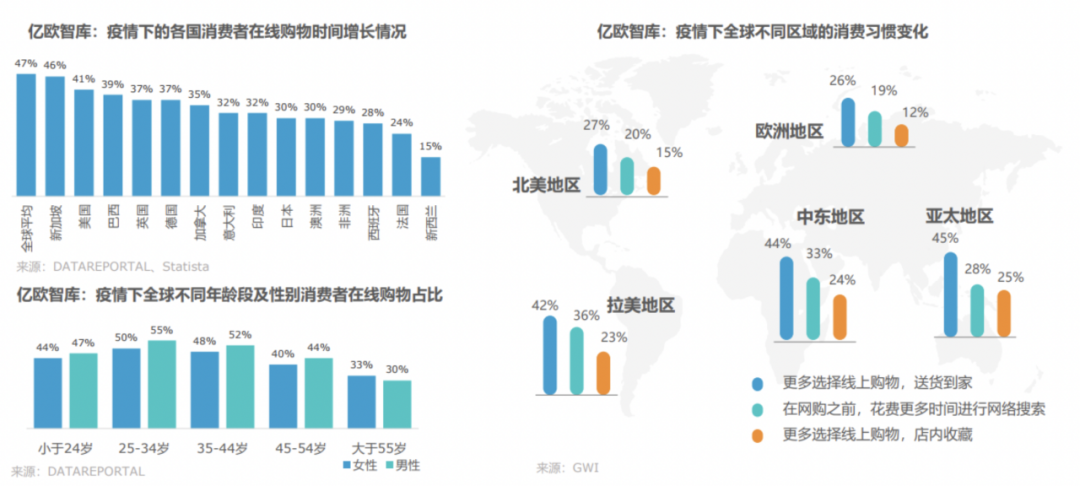
EqualOcean Intelligence
The pandemic directly or indirectly raised e-commerce penetration across countries overseas, and the most direct impact this had on us was the rapid decline in customer acquisition costs. What we felt deeply was that in 2020, whenever a country we covered announced strict stay-at-home orders and lockdowns, even without any additional operations, our sales would double the next day.
Under this factor, we observed that last year, almost every merchant on the track with some foundation, regardless of model or category (outdoor categories excepted), had very good sales figures. Basically, you could make progress without particularly great effort. According to Marketplace Pulse data, in 2020, the proportion of Chinese sellers among Amazon's top sellers also repeatedly hit record highs.
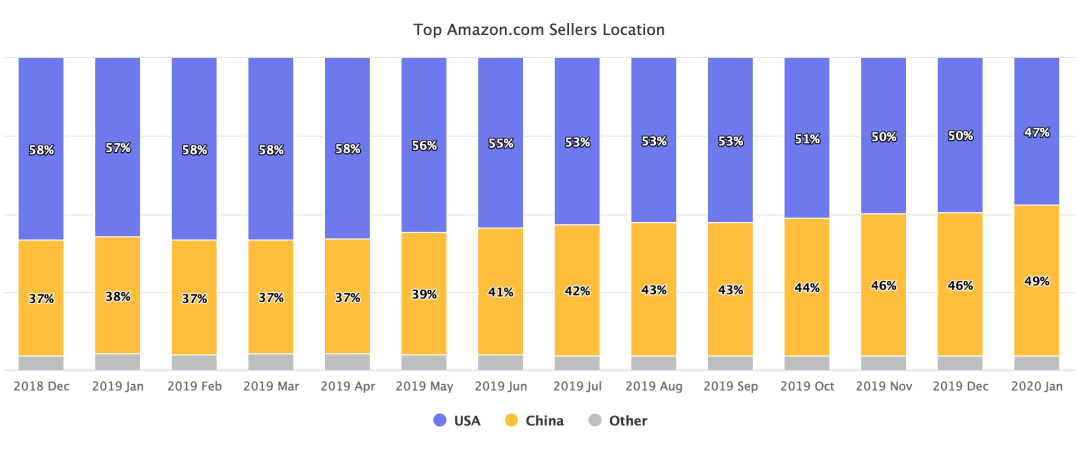
Marketplace Pulse
Chinese Sellers Outnumber US Sellers on Amazon.com
Earlier we mentioned that China's rapid production capacity recovery during the pandemic provided strong support on the supply chain end for cross-border e-commerce, and this is something we also experienced deeply. From February to March 2020, our supply side was once interrupted, as many places were forced to halt work and production. But this situation didn't last long, because capacity recovered very quickly. We can see that starting in June 2020, China's export volume began showing positive growth, which continued into 2021. Outside of China, many countries' foreign trade exports were mostly negative growth.
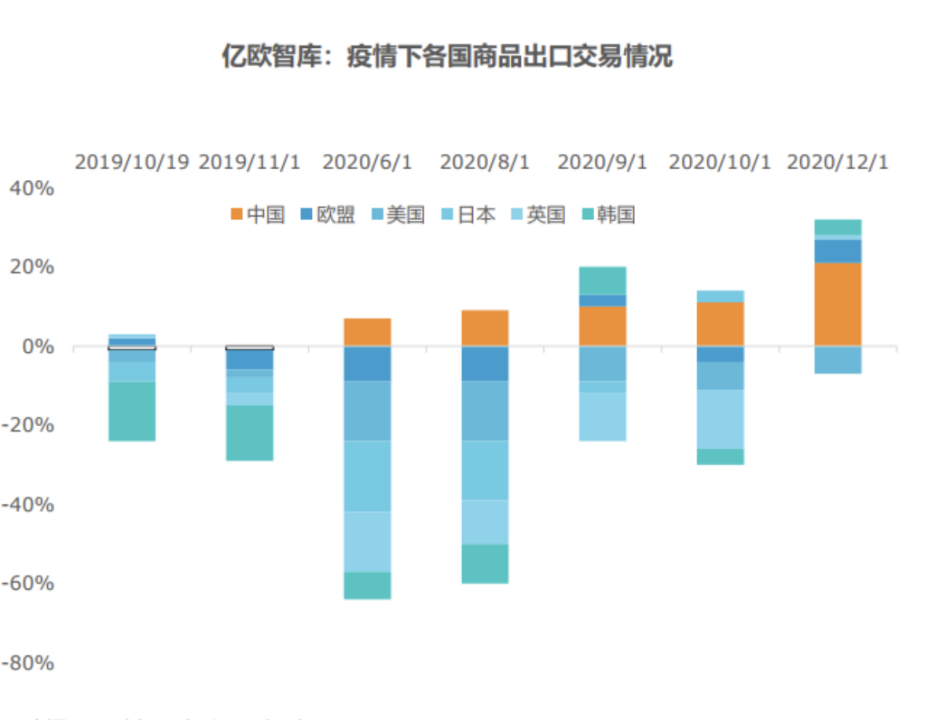
EqualOcean Intelligence
02 The Challenges That Followed
It's fair to say our supply side was never a problem in 2021, but this situation didn't bring only benefits. Starting in 2021, even larger volumes of orders flooded into China from overseas, while our transportation resources didn't see corresponding increases. Transportation resources refer to ships, planes, and so on. This shortage of transportation resources led to explosive growth in cross-border trade shipping costs. For example, in August-September 2020, shipping prices between China and the US were still $3,000-$4,000/FEU (40-foot equivalent unit), but by October 2021 they had at one point surged to $20,000/FEU — nearly quintupling. Air freight prices also rose several-fold, bringing considerable challenges to many cross-border e-commerce enterprises.
Beyond high shipping costs, we also faced some other challenges, including:
-
When our business covers some less developed countries and regions, incomplete infrastructure such as payment and logistics configurations in these places, plus frequent changes in customs and related policies, create resistance and challenges for our business.
-
Because you enter an entirely new market, each market has users with different consumption habits, needs, and cultural backgrounds. You need thorough understanding to gain traction. How to localize services well for different regions is also a major challenge for cross-border e-commerce.
-
Cross-border trade often involves various product quality risks, intellectual property risks, and risks from policy changes in various countries. For example, in July 2021 the EU began implementing new cross-border e-commerce tax regulations, affecting nearly every link in the cross-border e-commerce supply chain. For us, if destination countries' compliance policies tighten, and our competitiveness at that point is only some cost advantage, this brings major challenges.
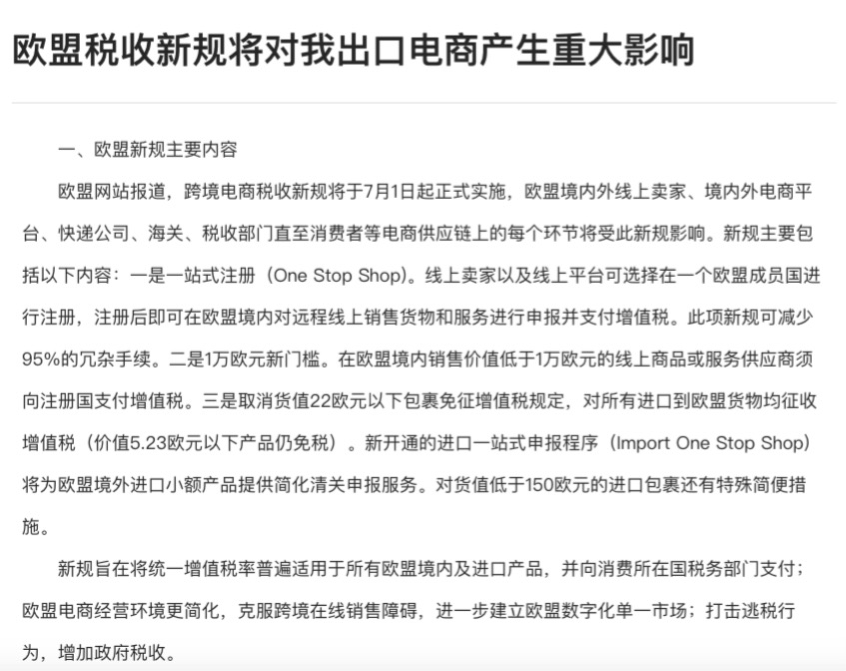
Ministry of Commerce of the People's Republic of China
- A relative shortage of specialized talent. For example, PatPat follows a D2C model, and our organizational composition is quite diverse. Our brand team consists more of people with overseas study/work backgrounds or even foreigners; our overseas traffic-related team has different backgrounds; our operations team consists more of people from domestic platform operations; our supply chain, fulfillment, and warehousing-related team mostly comes from traditional foreign trade backgrounds. The professional span of talent we need is quite large.
In 2020 we weren't as troubled by recruiting, because after the industry's profile rose, many more talents were willing to join us. But in earlier stages, when we wanted to recruit many specialized talents, we were always frustrated by people's lack of understanding of this industry, or their preference for internet companies. Though recruiting difficulty has decreased now, integrating teams from different backgrounds remains a very large challenge.
03 How to Build Global Brand Competitiveness
The challenges mentioned above are, in my view, the inevitable path to building a global brand, and the PatPat team has been continuously working to overcome them. But we also clearly know that to build a global brand, beyond overcoming challenges, you must form distinctive brand competitiveness.
So how to form brand competitiveness? Personally, I think there are at least four points.
▍Possess High Cost-Performance and High Quality
As we mentioned at the beginning, Chinese cross-border e-commerce may have long followed the path of exporting abundant production capacity, and has often been tagged with "cost-performance" by overseas consumers. But in fact, product cost-performance is almost the entry-level baseline for Chinese cross-border e-commerce merchants. On the foundation of high cost-performance, only by also building a quality system that satisfies users can you step onto the path of brand advancement.
▍Do Fulfillment and Service Well
Fulfillment and service are probably the innate weak points of nearly every cross-border e-commerce enterprise not born from foreign trade. Filing, customs clearance, duty-free registration, and other links all require enterprises to do substantial groundwork. If any single link goes wrong, it may collapse the entire business line, and the brand ultimately cannot stand. So how to explore and perfect fulfillment and service capabilities is key to making a brand viable.
Enhance Product Technicality and Innovation
Actually, many industry practitioners no longer use the term "going out to sea" when communicating. In the past, many people's understanding of cross-border e-commerce may have been "product export," but now, many brands resolve from day one to build a global brand. Innovation and quality are very important factors for Chinese-born cross-border e-commerce brands to form global competitiveness.
I believe technicality and innovation can be achieved in any category. For example, PatPat does clothing — beyond refreshing styles, we can also innovate in raw materials. When you truly create some innovative products and develop innovative raw materials, your brand will naturally form core competitiveness.
Increase the Proportion of Internet Technology Across the Entire Business Chain
I believe increasing the proportion of internet technology application across the entire business chain can significantly improve overall operational efficiency. Take our PatPat team: although we are an online cross-border children's clothing brand, our IT team accounts for a high proportion of our overall team, and the system is relatively large — currently several hundred people in scale.
We have consistently insisted on building all systems ourselves, and independently completing integration between different business systems, using data and automation to assist every business decision and daily specific workflow across the team — from front-end customer acquisition to automated online product pushing, or personalized user-side displays, new product development, and back-end supply chain and fulfillment. We hope to use more comprehensive and richer data to support these links, and use more automated methods to improve overall efficiency. This is something we have always insisted on in the past and will continue to in the future.
The reason I believe doing well in internet technology application helps form core competitiveness is that we have observed that the cross-border e-commerce industry has for years developed almost alongside traffic dividends. Compared to traditional European and American brands, Chinese cross-border e-commerce brands are relatively more adept at capitalizing on traffic dividends.
Domestic e-commerce industry competition is still quite fierce, but placed abroad, many domestic e-commerce players are people with advanced traffic competition experience, so in recent years many cross-border e-commerce players going out from China have achieved quite good development.
But currently, the traffic dividends available for cross-border e-commerce players to leverage are increasingly scarce. Whether it's search traffic from overseas search engines represented by Google, or social engine traffic represented by Facebook, these traffic dividends are gradually decreasing or even disappearing. When traffic dividends are exhausted, what cross-border e-commerce players must compete on is efficiency. We have always hoped to use internet technology to optimize efficiency at every link, implementing efficiency improvements across the entire SOP each year down to every process and every system function update and iteration. This is what helps us form true core competitiveness.
Going forward, we also hope to apply more and newer internet technologies in our model and chain, such as AI and AR technology applications. We hope to efficiently apply new technologies, good technologies to both product development and shopping experience creation.
We firmly believe that new internet technology applications will bring us unparalleled efficiency and advantages in building a new global brand.
We also have reason to believe that global brands soon to emerge from our country will far surpass traditional European and American brands in efficiency and internet technology application, and we as cross-border e-commerce brands should also equip ourselves with such competitive advantages.
Event Preview
We are currently hosting the FreeS Cross-Border Series online events. We look forward to in-depth exchanges with you at these events. You are welcome to scan the QR code below or click "Read More" at the bottom left of this article to fill out the form.

Event 1
At 10:00 AM Beijing time on March 5, we will hold an online office hour for cross-border e-commerce. Limited seats, entrepreneurs only. Feng Shu will bring a mystery guest to exchange and discuss with entrepreneurs.
Event 2
At 9:00 PM US Eastern time on February 25, 10:00 AM Beijing time on February 26, Feng Shu will be joined by Wang Chen, founder and CEO of Beijing Lizhi and Mango Technology Co. (Cider), and Kyle Jiang, founder and CEO of JUNO & Co., to share their industry insights on the Zoom platform.

You are welcome to directly click the FreeS Fund video channel appointment button below to schedule for the event.

How Will the Cross-Border E-Commerce Track Develop in 2022? | FreeS Cross-Border Series
Bidding Farewell to a Year of Inflection Points, Will 2022 Be Better? | Li Feng's New Year Outlook

↙ Click "Read More" at the bottom left to fill out the event registration form!
