How to Build Your Corporate Brand Strategy from 0 to 1 | FreeS Talk

"Different" beats "better."
"FreeS Talk" is a small-scale offline gathering for CEOs in the FreeS Fund family. We invite experts who know their stuff and seasoned FreeS family CEOs to share insights and experience on topics and directions that matter to our CEOs.
At a recent "FreeS Talk" PR session, we invited veteran brand consultant Shi Beichen, founder of One Key. Shi is a well-known writer, writing coach, and founder of the Shi Beichen Writing Camp. Zhao Jiamin, co-founder of Yeeyan, called him China's finest tech columnist. He's also a contributing writer for FT Chinese, a top-ten author at TMTpost, and a producer for the variety show A Good Book. His book Make Writing a Weapon for Self-Improvement has been widely read.
"Branding means this: when you've figured out where you want to go and who you want to reach, and you find ways to get that message out, the place you want to go and the people you want to find will show up." In Shi's view, how each company builds its brand needs to be clearly mapped out by the founder and team — no one can substitute for their unique thinking.
Drawing on his experience doing brand strategy and communications for companies like LinkedIn, Baidu, SF Express, and United Family Healthcare, as well as his own entrepreneurial journey, Shi analyzed common pitfalls in brand building. He also took everyone back to classic brand marketing texts to sketch out a framework for developing corporate brand strategy. This framework comprises a brand origin point, plus four elements: brand symbols, brand story, brand endorsement, and brand touchpoints.
About twenty founders and CMOs from different industries and stages of development joined this workshop with their own brand questions and reflections:
- Before a product is fully mature and serving a large customer base, how do you reach target customers and build influence?
- For companies drilling into new technologies, how do you build brand in the market?
- For B2B companies, where should the focus of brand building be?
- How do you build rich brand content?
- How do you develop different brand strategies for different customer types — B-end, C-end, and government?
- How does a brand break out of niche circles into broader territory?
- What organizational capabilities does a B2B brand team need?
We hope this brings fresh angles for thinking. Share your thoughts at the end. (P.S. There's a surprise at the end.)
(We also made a short video from the event — follow us to check it out.) ▲ Special thanks to Nuoxin Chuanglian, a FreeS Fund portfolio company, for the venue.
01 Common Pitfalls in Brand Building
Building a brand is a systematic undertaking, and there are many common pitfalls. I'll highlight three.
Lack of Strategic Brand Management Awareness
Many people start out without having done brand planning, or without developing a brand strategy. Without a brand strategy, it's hard to manage a brand with long-term consistency and comprehensive unity throughout the building process.
Often, we assume the purpose of branding is to get more people to know about the company. That's a perfectly fine goal. But before thinking about how to get more people to know about you, you need to solve some foundational questions first — like brand positioning, who the brand is actually for, and the relationship between product and brand.
Doing a Positioning ≠ Solving the Company's Problems
"Positioning" is very trendy in the market right now. I don't know how many founders have taken positioning courses or thought about positioning. Sometimes when I meet clients, they'll ask: can you do a positioning for me? As if once positioning is done, all the company's brand problems will be solved. But building a corporate brand requires systematic solutions — you can't rely on positioning alone as a single tool.
Brand Building Easily Falls into an Internal Perspective
In the brand building process, one problem that can't be ignored is that company operators easily fall into an internal perspective. When we're running a business, especially in the startup phase, we have so many problems to solve every day that it's hard to clearly perceive what the market actually needs.
On May 20 this year, Yiming Zhang announced he was stepping down as ByteDance CEO. In his all-hands letter, he wrote: "Every day I listen to many reports and summaries, do a lot of approvals and decision-making — this easily leads to an internal perspective, with knowledge structures updating slowly. So over the past six months, I've gradually formed this idea to adjust my own state, step away from CEO work, and be able to focus relatively more on learning knowledge, systematic thinking, researching new things, trying and experiencing hands-on, with a ten-year horizon, to create more possibilities for the company."
The most important thing in brand building is switching to an external perspective and thinking about the problems you encounter in brand building.
Brand Building Is a "CEO-Led Initiative"
Many founders might think brand building is just the marketing director's or brand director's job. But regardless of company size, brand building must be a "CEO-led initiative."
Why is brand building a CEO-led initiative?
Because the founder's thinking and understanding of brand affects the company's brand building. Here's an example. The company's number two wants to do brand building and plans to start with basics — building a website, opening a WeChat public account, establishing industry media relationships, and so on. The founder says this is worth doing. But when the number two goes to find vendors to execute, the founder comes back asking: what results will this money bring? What returns? After many such questions, brand building gets shelved. This scenario probably plays out at many companies.
Brand building might look like just one of many things in company development, but it permeates every week, every month of business operations. Brand building absolutely requires founder and CEO involvement. They don't necessarily have to do it directly, but they need to understand it — they need to recognize that building a brand requires using all kinds of resources and channels to help get brand messaging out to all corners.
02 What Brand Needs to Solve: Who Are You? Where Are You Going?
What problems does brand need to solve? You have to keep telling the outside world who you are, who your company is, where you're going — these are ultimate questions.
Xing Wang once shared on Fanfou what he thought were a CEO's three most important jobs: "Set the company's vision and overall strategy and communicate it to all stakeholders; recruit and retain the very best talent; ensure there's always enough cash."
To some extent, what Xing Wang said is also about branding. At its essence, brand is a process of building a community of shared meaning. Among the "everyone" you want to influence, this includes not just people inside the organization, but existing and potential customers, potential talent, and so on.
Peter Drucker said: "The results of business enterprise are on the outside; inside there are only costs." All business results ultimately live in consumers' minds. When a product is consumed, what remains is the connection between consumer and brand. As a founder, the question you need to think about is: what are you leaving behind for customers and partners?
One way to measure whether a company has established brand and recognition: can you get consumers to ask for you by name? For example, when you buy a cup of coffee, there are two scenarios. First, you immediately think of going to Starbucks. Second, you don't know which brand to buy, so you duck into a corner café and grab whatever. This is the core difference between having and not having a brand. When you've established a brand, you achieve mental pre-sale — users ask for you by name.
Once brand is established, the premium is obvious. According to a chart in Starbucks' franchise manual: in a 32-yuan cup of coffee, brand premium accounts for half; the rest is coffee cost, store rent, and other costs.
03 Back to the Brand Origin Point
After analyzing common pitfalls brands encounter and what brand needs to solve, I'll share the most basic framework for understanding brand. Brand equity can be organized as "1 origin point + 4 elements." The brand origin point is the foundation of brand equity; brand symbols, brand story, brand endorsement, and brand touchpoints — these four elements all grow from the brand origin point.
Regardless of what stage your company is at, you need to keep returning to the origin point to think and correct course.
Original Intention and Mission
The brand origin point includes the original intention and mission of founding the company, core values, and brand positioning. And brand positioning must be derived from the original intention and mission, and core values.
First, original intention and mission. Branding really means this: when you've figured out where you want to go and who you want to find, and you use various ways to get this message out, the place you want to go and the people you want to find will definitely appear.
When I communicate with some founders, I often ask: why are you doing this?
Many people have very clear logic when talking business — like this year's revenue target is 100 million, and how that breaks down across business lines. But when they talk about why they founded the company, about external communications, they can't move people.
We've seen many education and knowledge-payment companies that have turned themselves into financial-attribute companies, calculating conversion rates layer by layer. Most of these companies don't do very well. One important reason is that these companies haven't established real connection and trust with users — they're purely operating with a traffic mindset. When you truly think about brand, you'll discover that operating with a traffic mindset may look good on the data, but users are churning. Users don't truly identify with you, or with the platform you founded.
Core Value
Core value refers to your ability to provide unique value for customers, differentiated benefit points. In other words: "Don't be better, be different."
We can divide core value into three categories: rational value, emotional value, and spiritual value. Rational value refers to functional product attributes — for example, phone brands talking about component performance: how many cores the processor has, whose chip it uses. Emotional value refers to what feelings you bring users emotionally. Spiritual value refers to the brand becoming a way for users to express personal positions and even personal values.
Hard tech companies often feel they can't find emotional or spiritual values that move users. But actually, the foundation of technology is culture and politics. The problems Huawei and ByteDance encountered in the US reflect cultural and political conflicts. When doing brand communications, hard tech companies can also find stories closer to cultural foundations that resonate with people.
Take Jiuzhou Yunjian, a FreeS Fund investment, as an example. The company's product — a reusable rocket engine — and its performance characteristics belong to rational value. Where's the emotional value?
You'll notice that in recent years, there's been a trend in China where public national sentiment and cultural identity have deepened, with more recognition for domestic brands like Li-Ning. What Jiuzhou Yunjian does can naturally summon national sentiment at the emotional value level. Elon Musk's SpaceX has influenced the development of global commercial aerospace technology. China unquestionably needs companies like this too.
Brand Positioning
Brand positioning means getting your core value proposition into customers' minds.
When doing brand positioning, one situation many companies may encounter is that the product decision-maker and user aren't the same party. When communicating externally, it may be hard to find a common point that moves both groups simultaneously.
What we need to do is actually layer — recognize that these are two target customer groups. Second, based on these two target customer groups, reverse-engineer messaging, business logic, which people to use for spreading the word, and how to use communication channels well.
Take Onion Academy, a FreeS Fund portfolio company, as an example. Onion Academy's business is parents paying, students using. Parents probably won't look at each course individually. To improve parent satisfaction, you need to communicate with parents, like holding parent days and similar activities. At the same time, you need to improve student satisfaction — so you need to deliver better products and make students happy.
Additionally, brand positioning must be distinctive and unique. You need to clearly define target customer groups and core value proposition. Use one message to penetrate one user group. For example, Guazi Used Cars once ran the tagline "No middlemen taking a cut," placing it across various media channels. When users received the message "no middlemen taking a cut," they felt happy about buying and thought of the platform.
Beyond the user side, Guazi Used Cars also needed to influence the supply side — finding people who wanted to sell used cars. Like cooperating with used car recycling channel platforms, communicating with car owners. This kind of communication probably wasn't advertising; it might be targeted presentations, one-on-one customer service: "Selling this car can earn you X amount, XX amount."
/ 04 / Brand Symbols: Several Characteristics of a Good Name
After clarifying brand positioning as the origin point, let's analyze how brand symbols, story, endorsement, and touchpoints — derived from brand positioning — should be built.
First, brand symbols. Company name, logo, slogan — these all belong to brand symbols. And a name is a particularly important asset for a company.
When HEYTEA was founded in 2012, it was actually called Royaltea. But the market was chaotic then — many milk tea shops were called Royaltea, with varying trademarks and decor. If HEYTEA had kept the Royaltea name, it would have been hard to immediately differentiate from other brands by name. Three years later, HEYTEA founder Neo changed "Royaltea" to "HEYTEA," spending 700,000 yuan to acquire the "HEYTEA" trademark. The name change became an important watershed in HEYTEA's brand building.
Also, if the company name you choose carries cultural background, it's like accumulating intangible assets for the company. For example, Cao Cao Special Car is very memorable because this name inherits cultural symbols that have accumulated in Chinese minds for generations — completely different from making up a name from scratch.
Specifically, what characteristics should a good name include?
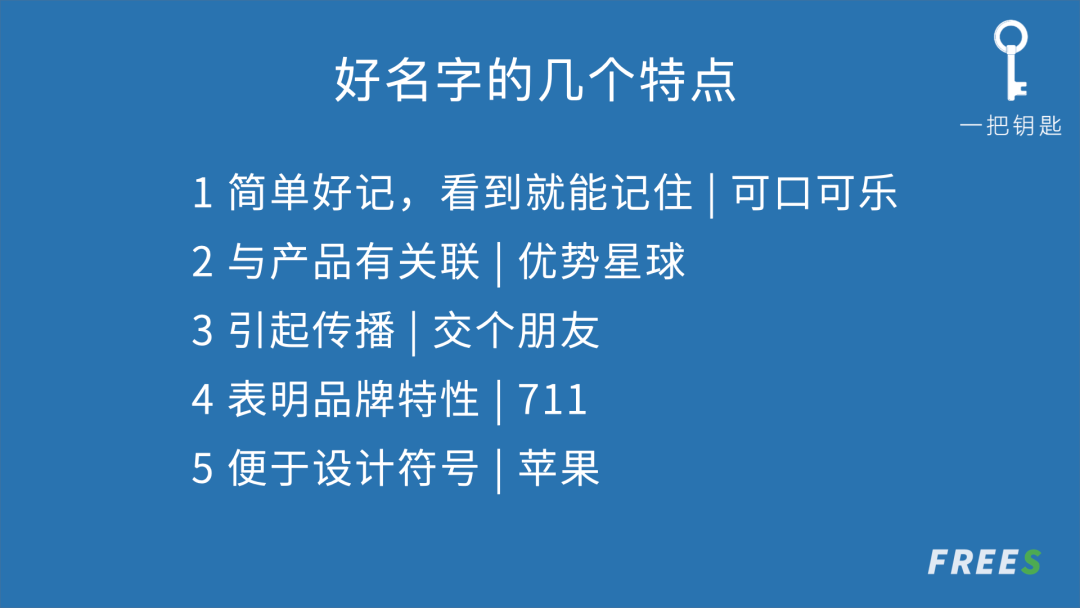
▍Simple and memorable — remember it upon seeing
A good name sticks after one hearing, and you know what it does immediately. This way when you advertise externally, or even when talking with someone face-to-face, you save a sentence of explanation cost.
Still using Guazi Used Cars as an example. "Guazi" is a common word in daily life. "Used cars" is a category word. "Guazi Used Cars" — five characters that communicate what this company does.
My own company is called "One Key." "Key" is also a common daily word, simple and memorable. Second, people say "one key opens one door" — the meaning of enlightenment that key symbolizes fits very well with what I want to do in education.
At that time, many education brands on the market added suffixes like "academy" or "university" in their names. There's nothing wrong with this per se, but I felt adding such suffixes didn't highlight our brand's uniqueness. In the recently issued Opinion on Regulating the Registration and Use of "University" and "Academy" Names by Eight Departments Including the Ministry of Education, it stipulates: "Except for universities and academies established with approval, and their internal institutions or organizations legally registered that they initiated, other organizations shall not use 'university' or 'academy' in plaques, advertisements, and other external publicity and various activities." We happened to avoid this minefield.
▍Connected to product
Besides being memorable, a good name should also connect to product. For example, Momself, a FreeS Fund investment, launched a new brand — Advantage Planet. This company's core business is advantage assessment and advantage courses, helping everyone discover their advantages and make good use of them.
▍Able to spark spread
Talking about sparking spread, many people have probably heard about Yonghao Luo naming his companies: "Luo Yonghao and His Friends Education Technology Co., Ltd.," "Beijing Jiao Ge Peng You Digital Technology Co., Ltd." Borrowing the colloquial meme "let's be friends first" sparks curiosity about the company, sparking discussion and spread.
▍Indicates brand characteristics
The convenience chain 7-Eleven's name comes from the store's early operating hours of 7 a.m. to 11 p.m.
▍Facilitates symbol design
Besides indicating brand characteristics, the 7-Eleven name I just mentioned also facilitates symbol design. The Apple company name is similarly well-suited for symbol design.
The "One Key" name has a similar effect — the key symbol can apply to many scenarios and works particularly well for cross-industry collaboration. When we cooperated with Alibaba last year, they had a bear image. The visual we designed was a bear holding up a key.
/ 05 / Brand Story
Yuval Noah Harari once wrote on Bloomberg: "Of all mammals, only humans can cooperate with countless strangers because only we can weave stories and spread them far and wide."
For a company, a brand story with detail, personality, and emotion can leave a deeper impression of your brand in users' minds, and is also one of the four brand elements we've outlined. We can tell our brand story from four dimensions: founding story, employee story, product story, and customer story.
▍Founding story
First, founding story. The book I wrote, Make Writing a Weapon for Self-Improvement, isn't actually a how-to book — it's more a book about who Shi Beichen is. In this book, I shared my experiences learning writing and founding a company. All important partners, team talent, and core users came to find Shi Beichen after reading this book. You could say this book allowed me to carry out "indiscriminate attack" on the groups I wanted to "target."
One important reason I wrote this book: in 2018, I saw Microsoft CEO Satya Nadella publish a book called Hit Refresh. He was a professional manager, not someone who built the empire with Bill Gates back in the day — he joined Microsoft later and did technical and management work there for a long time.
After becoming CEO, he specifically sought out Bill Gates for a conversation. The most important task of this conversation was to rediscover Microsoft's soul. He talked with Bill Gates about why they were doing Microsoft, what was the original intention? He wanted to write these reflections into a book because he believed this book was the most efficient, lowest-cost way to help millions of Microsoft employees globally, partners, and core clients understand what Microsoft as a company is today.
Interactive benefit What confusions and insights do you have about brand building? Welcome to share your thoughts in comments at the end. We'll give away Shi Beichen's book Make Writing a Weapon for Self-Improvement to the 5 readers with the most thoughtful comments. (Activity deadline: 9:00 p.m., June 17.)
▍Employee story
I previously worked at Wandoujia. When Wandoujia did recruitment publicity, they did something very special. In the promotional video, they didn't highlight the founder or core employees — instead, they had an auntie who cooked for everyone every day appear on camera. Through the auntie's perspective, she talked about what the founder was like, what the company culture was like, what employees at the company impressed her.
At that time, many colleagues in technology and product joined Wandoujia because of this video. They said: "I saw that auntie's video and I wanted to come." Many tech guys are very simple — they felt it was particularly humanistic and were moved.
Wandoujia brand promotional video: "The Wandoujias in Auntie Wandoujia's Eyes"
▍Product story
If we study HEYTEA's product naming, you'll discover it's very particular, with high differentiation from most other milk tea shop product names, and HEYTEA products all have individual names.
HEYTEA founder Neo once shared: "We make a 'Very Grape Cheezo' — because there's temporarily no better way, to both satisfy consumers' expectation of not wanting to eat grape skins and seeds, and guarantee the final product doesn't have the obvious saccharin taste of canned fruit flesh, all grapes in the cup can only be peeled and deseeded by hand, one by one." Through this story, you can appreciate the human effort behind this milk tea, and will share this story with others.
▍Customer story
For a company, especially B2B companies like education and consulting, customer cases are very important. Because these companies aren't suited for broad mass media spread, they're better suited to using customer cases to increase persuasiveness. For example, when people learn I've done brand planning for companies like LinkedIn, Baidu, SF Express, and United Family Healthcare, their trust in me increases.
/ 06 / Brand Endorsement
The brand endorsement part is very important because it's your brand equity. Brand equity comes from four aspects: people, things, places, and other brands. You can have your team do this, or invite partners to help sort through these assets from an external perspective. After inventorying, you then screen: at which stage, which type of brand asset to emphasize.
The ultimate purpose of sorting brand equity is to transfer other brands' and cultural assets into your own brand account, making them your assets. For example, Cao Cao Special Car that we mentioned earlier integrates traditional cultural elements into its own brand.
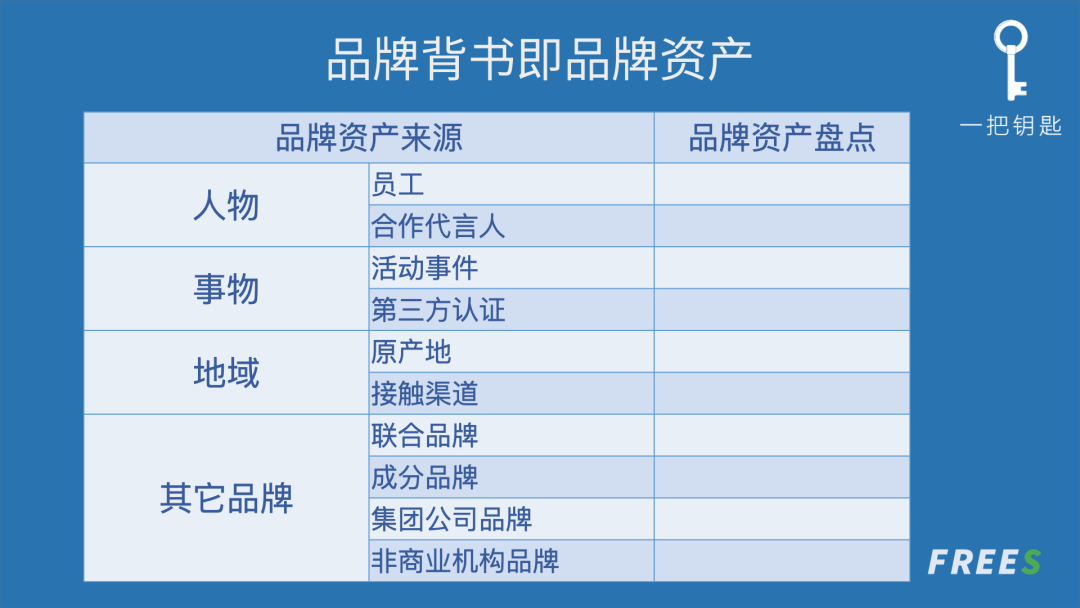
▍People
People stories include founder stories, employee stories, spokespersons, and partner stories.
First, founder stories. Onion Academy's founders have Harvard backgrounds — from a professionalism perspective, educational credentials are a form of endorsement. But for some moms, founders' high educational credentials might create a sense of distance.
How to break through this and close the distance with users?
Take myself as an example. Previously when I worked at a company in Beijing, many colleagues had business school backgrounds. When our writing product recruited students, many users were from second- and third-tier cities, from ordinary backgrounds, lacking confidence — seeing such resumes, on one hand they admired them, on the other hand they felt distance. To close the distance with these people, I would talk about failing Chinese in middle school, retaking the college entrance exam, having very poor foundations when first learning to write, and being from a national-level impoverished county. Through these stories, I could close the distance with users and build emotional connection.
Looking at employee stories — when you clearly sort out employees' resumes and achievements, you'll attract similar people to join the team. A friend of mine founded a company in Fuyang, Anhui. He told the outside world that their company's teachers could earn 10,000 yuan a month, buying cars and houses locally. Many local teachers only earned three or four thousand — through cases like this, he attracted much similar talent.
Cooperation spokespersons are also a path for brand endorsement. For example, recently SoYoung got Zhao Wei as spokesperson, with the main tagline "professional." The medical aesthetics industry faces much negative word-of-mouth, with mixed public opinion about the industry. And Zhao Wei was very professional when acting and directing. So the brand wanted to transfer Zhao Wei's personal brand equity to the SoYoung brand.
Additionally, franchisees can also endorse brands. Here's a case that penetrates the franchisee marketing layer — Guming. Guming now has about 4,000+ stores. Its development strategy is "let franchisees make money," thereby having franchisees pull in other people who want to franchise. Guming screens franchisee qualifications at a certain ratio, confirming that franchisees themselves have certain operational capabilities.
▍Place
Regarding place-of-origin endorsement, a landmark case is Nongfu Spring. Nongfu Spring has consistently used water sources to endorse its brand, forming its own style in beverages, a category with severe homogenization. In April this year, Nongfu Spring launched a new product "Changbai Snow" — this product's water source is in the primeval forest of Changbai Mountain. Nongfu Spring printed images of Changbai Mountain's Siberian tigers, chipmunks, sparrowhawks, and scaly-sided mergansers on the "Changbai Snow" bottle packaging, strengthening users' cognition of the product's water source.
▍Other brands
We can also find other brands to endorse our own brand. These other brands include co-brands, ingredient brands, group company brands, and non-commercial institution brands.
For example, Huawei cooperated with Porsche to launch a Porsche-designed phone — this is elevating brand image through co-branding. Uniqlo also frequently does co-branding, launching collaborative collections with big-name designers and well-known IPs. Huawei phones using Leica cameras is using ingredient brand endorsement.
▍Group company brand
Group company brands are easy to understand — like Procter & Gamble, Tencent, Alibaba. These companies launch many new products every year. When new products appear, clients and partners haven't heard of them, but names like P&G, Tencent, and Alibaba — everyone knows them. Using group brand to build trust for product brands.
▍Non-commercial institution brand
So-called non-commercial institutions include government, NGOs, etc. We often see some brand activities with government endorsement — for example, when Disney Shanghai opened, Shanghai municipal government leaders attended the opening ceremony, which was equivalent to Shanghai government endorsing Disney. When I was at LinkedIn, our GR colleagues facilitated a meeting between then-Shanghai Party Secretary Han Zheng and LinkedIn founder Reid Hoffman — such activities can strengthen domestic clients' confidence in LinkedIn's business.
/ 07 / Brand Touchpoints
Let's look at the last of the four brand elements: brand touchpoints. Brand touchpoints are the media connecting you with target users. Brand touchpoints can be online or offline channels, and can also be KOLs. You need to find the touchpoints that most influence users, based on the user. For example, for some government-facing enterprises, you might need official media like Xinhua or People's Daily to help clients learn about you. For consumer goods, WeChat Channels and Xiaohongshu are brand touchpoints you must take seriously.
You also need to prioritize different brand touchpoints, investing more at key touchpoints. "Invest" doesn't mean how many resources you put in, but how much insight you put in. Through brand touchpoints, you collect information and repeatedly validate assumptions about your brand.
So the essence of paying attention to brand touchpoints is this: you need to understand users, interact with clients, even spend time with clients.
For example, before Ji Shisan founded Hang, he spent time at universities, being with students every day, understanding what university students were thinking about, what their interests were. After research, he discovered many young people had troubles — troubles that needed a guide or mentor-type figure to help them. So he launched "Hang," where through this platform, you can directly book an expert in a certain field to help answer your questions.
**/ 08 / ** Summary
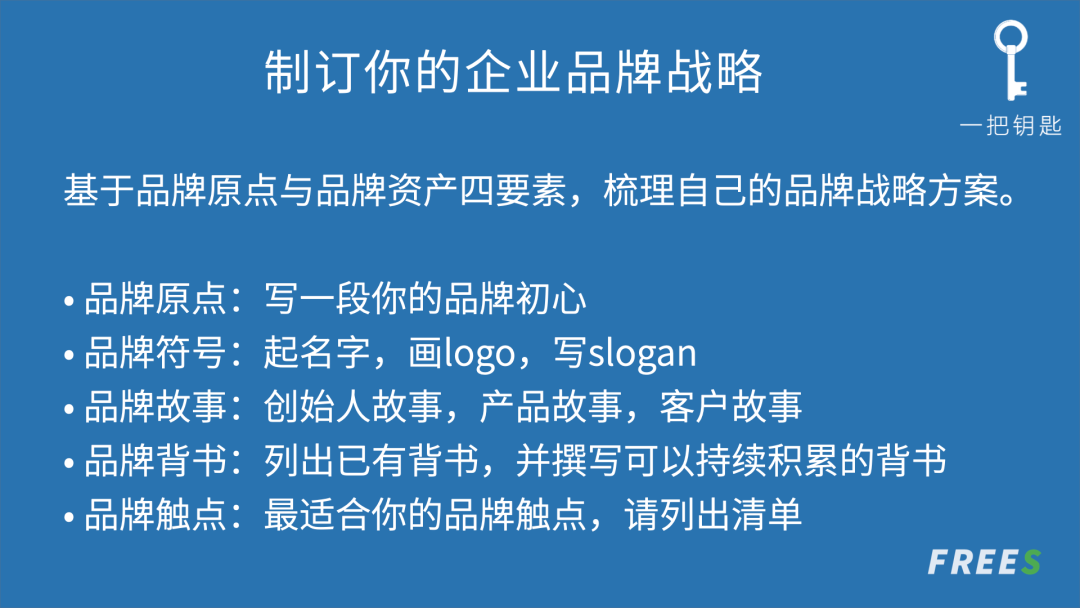
For this final section, I invite you to take out a piece of paper and, based on the brand origin point and four elements of brand equity, sort out a brand strategy for your own company.
First is brand origin point. Please write down your original intention in founding this brand. This is the most important part of brand — you can also call it mission, vision, and values. Please think: have you analyzed these contents before? Are there parts that need adjustment? For different types of customer groups, what stories should you tell?
Second, brand symbols. Please think about whether your company name, logo, and slogan have room for adjustment and improvement.
Third, brand story. You don't necessarily need to write a complete piece of copy — it can be an outline, or several paragraphs. After clarifying a thinking framework, you can communicate with your team.
Fourth, brand endorsement. Please analyze which people, places, and other brands can help endorse your brand.
Fifth, brand touchpoints. Please list brand touchpoints that fit your brand's characteristics.
Interactive benefit What confusions and insights do you have about brand building? Welcome to share your thoughts in comments at the end. We'll give away Shi Beichen's book Make Writing a Weapon for Self-Improvement to the 5 readers with the most thoughtful comments. (Activity deadline: 9:00 p.m., June 17.)

What does it feel like to experience Huawei up close for a day and a half? | FreeS Talk
How can startups have a tide of good generals? | FreeS Talk
Early-stage medical aesthetics investment moves toward underlying technology | FreeS Research
Join us
We're currently seeking investors in biomedicine, deep tech, and consumer/TMT in Beijing, Shanghai, and Shenzhen. Welcome those with industry backgrounds and interest in investing to join us, and welcome recommendations of excellent partners. (For specific job descriptions, please click the read-more link at the end.) Please send resumes to hr@freesvc.com *Email subject please indicate: Applying for "Biomedicine / Tech / Consumer / Investor" - "Work location" We're also seeking interns in investment research, legal, finance, HR (post-investment direction), and video content operations. Welcome interested students to apply. (For specific job descriptions, please click the read-more link at the end.)
Internship duration: 3-5 months, 3-5 days per week on-site, Beijing-based preferred.
Please send resumes to hr@freesvc.com
*Email subject please indicate: Position applied for - Name - School - Major - Minimum guaranteed internship X months - X days per week on-site - Earliest start date