How to Understand the Divergence Between Chinese and American Development Models, and Find China-Based Startup Opportunities? | Li Feng Column

Why "Spring" Remains Elusive for SaaS, and the Root of US-China Startup Differences

This past May, at a China-US venture capital forum hosted by FreeS Fund, I posed a question to a colleague that had been on my mind for some time — for the enterprise software industry, are we at the beginning of spring, still before spring, or already in full spring?
His answer was telling: "I'd say we've passed the Lunar New Year."
That colleague is Chongzhe Li, a lead on early-stage projects at FreeS Fund. Before joining FreeS, he was the founder of Silicon Valley enterprise software company insight.io, which was later acquired by NYSE-listed Elastic.
In my dozen or so years as an investor, China's enterprise software industry has declared "spring is here" at least four times — first around 2014, again in 2016, once more in 2018–2019, and again this year. The long-term growth trajectory of enterprise software is beyond doubt. But why has this industry been proclaimed to be entering "spring" so many times over the past seven or eight years, yet true "spring" has still not arrived at scale?
This June, at a FreeS e-Salon, entrepreneurs raised similar questions [follow and register for FreeS e-Salon sessions 3 and 4]. This is of course a complex question, but one cross-section of it points to the theme we're exploring today — the differences between Chinese and American commercial development paths. The process of trying to understand this question is also what makes the industry's historical evolution, current contours, and future trajectory come into focus.
Before diving in, here are the main arguments:
- A key difference between Chinese and American commercial development paths: in many industries, social division of labor came after digitalization.
- In the US, industries gradually achieved full marketization, full competition, and full social division of labor offline before the internet emerged. When the PC internet and mobile eras arrived, industries took the chains they had formed pre-internet and moved them online, beginning datafication. In China, many industries entered the internet era before completing full competition and social division of labor; subsequently, based on new data-driven infrastructure platforms, supply and demand developed, and only then did new social division of labor emerge, leading to efficiency iteration.
- These differences in how markets formed and competitive landscapes evolved have produced entrepreneurial characteristics in China completely distinct from the US: First, development catalyzed on new data-driven platforms brings more intense efficiency gains, especially when叠加 with technology iteration. Second, platform-based infrastructure means startup space will inevitably face compression from platforms; to survive and grow, startups need to find opportunities in vertical ecosystems. Finally, for both platform companies and other startups, in a rapidly developing market, how to identify variables and convert them into competitive advantages is both a challenge and an opportunity.
Below is the detailed analysis. I hope it offers some insight, and welcome continued exchange with us.
Event Preview
FreeS e-Salon is a regular small-scale online closed-door event. The first two sessions primarily attracted Chinese students from well-known overseas universities and tech industry practitioners. At e-Salon, we believe in getting straight to the point and speaking freely. Topics you care about or raise related to entrepreneurship and investment may well be discussed. The salon is by invitation only. For the upcoming third and fourth sessions, we have reserved a limited number of seats — scan the QR code to register and join face-to-face with "Uncle Feng."


01 Typical Manifestations of China-US Commercial Development Differences
In the conventional sense, mature market development can be divided into three stages: full marketization — full competition — full social division of labor.
As an industry gradually opens to private and civilian capital, it enters the marketization process. The advancement of marketization brings full competition, which drives finer division of labor and ultimately market maturation. The result is a long and complete chain with many interconnected links.
This is especially typical in the US. A particularity of China is that many industries did not fully experience those three stages before beginning to undergo infrastructure datafication. In short, social division of labor in industries came after digitalization.
To some extent, the different development paths of many industries in China and the US can explain many interesting commercial phenomena. For example, why do China's internet brands and D2C brands look quite different from America's? Why did China's financial payments industry skip checks and yet surpass the US to become the world's largest mobile payments market?
1. Take Retail as an Example
Chinese Retail: Entering the Internet Before Both Supply and Demand Were Fully Developed
Around the 1990s, as policies restricting foreign investment in retail were gradually relaxed, a wave of foreign retail giants including Walmart, Carrefour, Metro, and Lawson entered the Chinese market, launching operations through joint ventures.
The development of chain retail formats required, beyond policy preconditions, the marketization of real estate. In the 1990s, as private enterprises were permitted to enter the real estate industry, real estate marketization began. This brought the development of commercial real estate, making chain store expansion possible. Chinese retail began building offline momentum.
Emerging around the same stage were China's private retail representatives Gome and Suning, founded in 1987 and 1990 respectively. By end of 2004, Gome's sales reached 23.88 billion yuan, making it the top home appliance chain, and founder Huang Guangyu became China's richest person. That same year, Suning ranked second with sales of 9.1 billion yuan. The two were once called "the commercial twin stars of the first decade of the new century."
The rise of Gome and Suning was likewise tied to housing commercialization. With the implementation of the 1998 housing commercialization reform policy, China's real estate entered a golden decade of development. More and more people bought homes, driving demand for home appliances and other durable consumer goods.
Around 2000, Taobao and JD.com were founded in succession. At that point, Gome and Suning had not yet had time to penetrate below third-tier cities before China's retail industry began moving online.
With the development of e-commerce, several super-platforms emerged in retail. Compared to offline retail, e-commerce achieved datafication of one or multiple links, significantly improving the degree of datafication and efficiency in retail, with the platforms themselves becoming infrastructure. The result: many internet brands grew on platforms.
US Retail: Social Division of Labor Before Digitalization
The development path of US retail is fundamentally different from China's.
If you follow the US retail industry, Shopify needs no introduction. Shopify is a one-stop SaaS e-commerce service platform providing independent brand retailers with technology and templates for building online stores, managing omnichannel marketing, sales, payment, logistics, and other services. During the pandemic, online shopping demand surged, large numbers of sellers moved online, and Shopify's market cap rose rapidly — currently approaching $180 billion.

▲ Image source: Shopify official website
So here's the question: Why hasn't China produced a Shopify?
Because China produced Taobao, Tmall, JD.com, and other platforms first. Datafication in retail happened first on platforms, and these platforms as infrastructure grew large enough that most industry sub-chains grew on them.
For example, the "Taobao brands" that rose with Taobao, and the various细分 services that developed around their needs (whether ERP, CRM user management, store operations, marketing and promotion, etc.) — these did not emerge through gradual offline iteration but appeared and developed directly within these e-commerce platform ecosystems.
What's different about the US? Let's trace American retail's development.
After WWII, as market competition intensified, the US retail industry underwent increasingly strong social division of labor and specialization through full offline competition. Industry chain links continuously refined and deepened, maturing through competition. On the consumer side, users developed clearer understanding of what products they wanted (brand, features, characteristics, price range, etc.).
After the mid-1990s, relatively mature offline retail began "going online" and experienced several rounds of gradual development: software-ification — online-ification — mobile-ification — data intelligence-ification. Each round built upon the market segments and social division of labor formed previously, with each node in the industry chain "upgrading" upward — what we might call "up-flipping."
This "up-flipping" process contained many enterprise service development opportunities. The reason: in the US, social division of labor in many industries came before digitalization, and industry chains were large and refined enough that each sub-chain's upgrade to online brought huge markets for enterprise services, with sufficiently thriving enterprise service ecosystems and sufficiently strong willingness to pay. Since 2020, e-commerce penetration in the US increased substantially, and Shopify — which provides e-commerce services to sellers — thus encountered new development opportunities, a typical "up-flipping" example.
By contrast, Chinese retail "went online" directly from a stage of insufficient offline competition and division of labor, without so many fully developed, finely segmented industry chains and nodes that could "up-flip" one by one — thus missing many enterprise software startup opportunities. This partly explains why China's enterprise service market, despite years of development, remains less vibrant than America's.
2. China-US Comparison: Take Financial Payments as an Example
The development stories of China-US financial payments are similar. Let's start with the US.
US Financial Development: A Gradual "Up-Flipping" Process
Similar to retail, US banking and its systems are highly mature. Over the past 40-plus years, US payments underwent gradual development: it fully experienced cash transactions, checks, and bank card stages, relatively fully experienced PC internet payment stages, then entered mobile payments. This gradual process also determined that financial ecosystem development similarly "up-flipped" level by level.
Take Silicon Valley emerging payments company Stripe. Stripe focuses on online payments, primarily providing third-party online payment services for enterprises. According to PingWest, enterprises can connect their own websites and apps to Stripe by adding seven lines of code, then conveniently use Stripe's services.
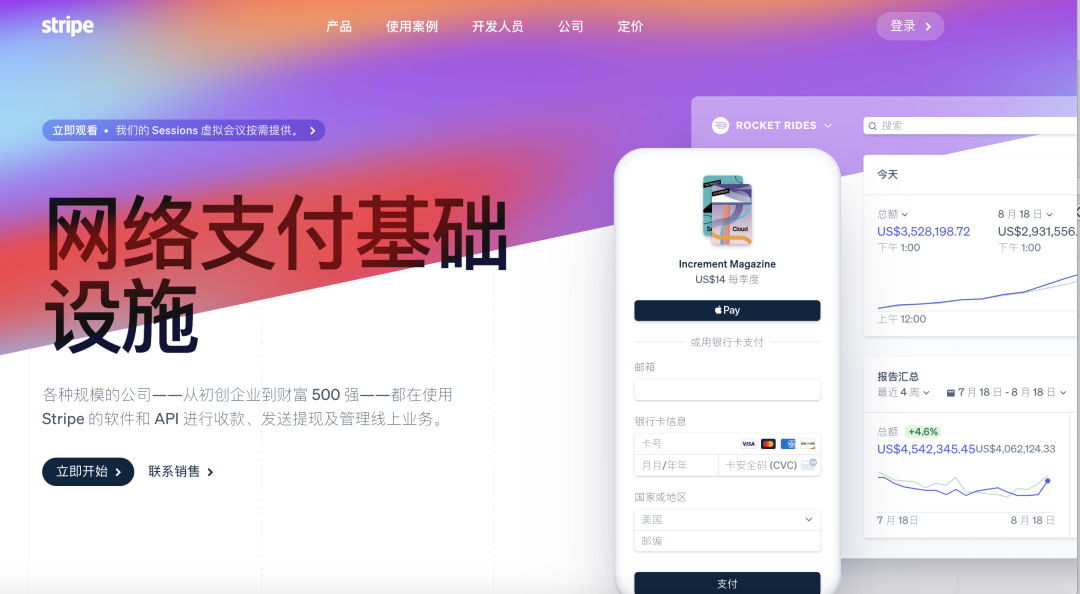
▲ Image source: Stripe official website
Square's business model also has broad market in the US, for an important reason: whether for US merchants or consumers, credit cards were already fully普及, so how to satisfy merchant and consumer credit card acceptance in the mobile payment era became an important "up-flip" demand.
Why is this demand's market not large in China?
Because China partially skipped the credit card "up-flip" stage, and the population migrating from credit card habits is not large. According to PwC's 2019 Global Consumer Insights Survey, in 2018, 86% of China's population used mobile payments — roughly triple the global average.
Why Could China Quickly Enter the Era of Universal QR Codes?
The reason we could so quickly enter the universal QR code era relates to Chinese financial payments' development path: we did not fully experience the segmented development stages of the US financial payments market.
From individual experience, we essentially leaped directly from cash to wireless payments, completely skipping checks, and partially skipping credit cards and PC internet payments.
I recall when I first started investing in financial projects in 2012, China's credit card penetration was still relatively low.
According to the 2012 China Credit Card Industry Development Blue Book published by the China Banking Association, in 2011 China added 55 million new credit cards, with cumulative issuance reaching 285 million. At the time, credit card issuance was growing fast, but card usage activity was low, with many becoming "dead cards." Even by 2017, according to Qianzhan Industry Research Institute data, active cards accounted for only about 30% of total issuance.
Beyond credit cards, we also skipped half of PC payments. Behind PC payments lay the need for users to bind bank card systems for settlement. In 2007, bank cards were China's most widely used non-cash payment tool, with a penetration rate of 21.9%. Thus we can see that even for a long time after Alipay's founding in 2004, internet payment development was incomplete. You may still remember that Taobao supported cash on delivery for many years.
By 2012–2013, we entered the mobile internet era.
In the mobile internet era, accompanying China's urbanization development, bank card system penetration gradually increased, meaning mobile payment infrastructure was established. By 2020, annual bank card penetration reached 49.18%. By end of 2019, cumulative bank card issuance reached 8.53 billion.
Meanwhile, through wireless mobile broadband internet and IoT technology, and with the普及 of mobile apps like WeChat and Alipay, we could not only complete simple payments, transfers, and fee payments by phone, but could essentially complete most daily banking needs by phone.
Now, we steadily rank first globally in mobile payments. According to the 46th Statistical Report on China's Internet Development released by CNNIC in September 2020, as of June 2020, China's online payment user base reached 805 million, accounting for 85.7% of total netizens, with mobile payment market scale ranking first globally for three consecutive years.
Thus we can see that the gradual development of US financial payments represented efficiency re-upgrading of existing supply and existing demand. In contrast, in China, without full competition or sufficient social division of labor and chain refinement, we jumped directly to infrastructure datafication, mobilization, and platformization. Applications or efficiency tools born on new platforms began full competition and formed social division of labor. Without the influence and interference of preceding development stages, market education costs were lower for both consumer and supply sides, and this transformation was more rapid and smooth.
02 How to Properly Understand China-US Development Model Differences, and Find Entrepreneurship Opportunities Based in China?
Beyond retail and finance, if you think carefully, many industries including video follow similar patterns:
- In the US, many industries completed social division of labor refinement and industry development through achieving full internal competition. On this basis, entering the internet era and mobile era, industry chain links "up-flipped" accordingly.
- In China, many industries began experiencing internet infrastructure datafication before completing full competition and full social division of labor — that is, social division of labor came after industry digitalization. Subsequently, based on supply and demand development on infrastructure, division of labor refinement and competition emerged, leading to efficiency iteration.
This difference manifests in nearly all industries, and recognizing this difference helps us better understand challenges and opportunities in the venture capital field.
1. "Up-Flipping" Is Faster, Especially When叠加 with Technology Iteration
In the finance section above, we mentioned that because financial development in China essentially skipped checks and partially skipped credit cards and internet payments, user dependence on existing methods was low, and new payment methods faced less resistance from old patterns when being promoted — so compared to the US, our mobile payment promotion speed was faster.
On the other hand, compared to the US-style level-by-level "up-flipping," because of differences in China's market formation methods and competitive landscape, development catalyzed on new data-driven platforms brings more intense efficiency gains.
To understand the degree of this efficiency gain, we can analogize to changes brought by offline infrastructure construction.
In 2008, China began large-scale high-speed rail construction. By end of 2018, China's total high-speed rail mileage reached 29,000 kilometers, ranking first globally. Compared to many developed countries where railway development proceeded from low speed to medium speed to high speed, China largely skipped intermediate stages and directly "up-flipped" to the high-speed rail era. High-speed rail drove urbanization advancement, tightened economic connections between cities, improved industrial coordination between regions, greatly enhanced efficiency, and catalyzed more new things.
In the retail section above, we mentioned that the biggest China-US difference in retail is that China began pushing underlying datafication before achieving full marketization. The datafication process happened first on infrastructure like e-commerce platforms, which grew large enough that most industry sub-chains grew on the infrastructure.
We can simply call this model "platform-based up-flipping." On one side is continuously upgrading supply; on the other, increasingly mature consumers; in the middle is a highly efficient connection platform. If this happens to coincide with a technology innovation stage, without obstruction from existing patterns, under technology's "magic," various factors acting together will catalyze极限 efficiency gains. We might also call this a "second-round opportunity" — especially when China's market scale is so enormous, bringing more opportunities and making it easier for platforms to grow large.
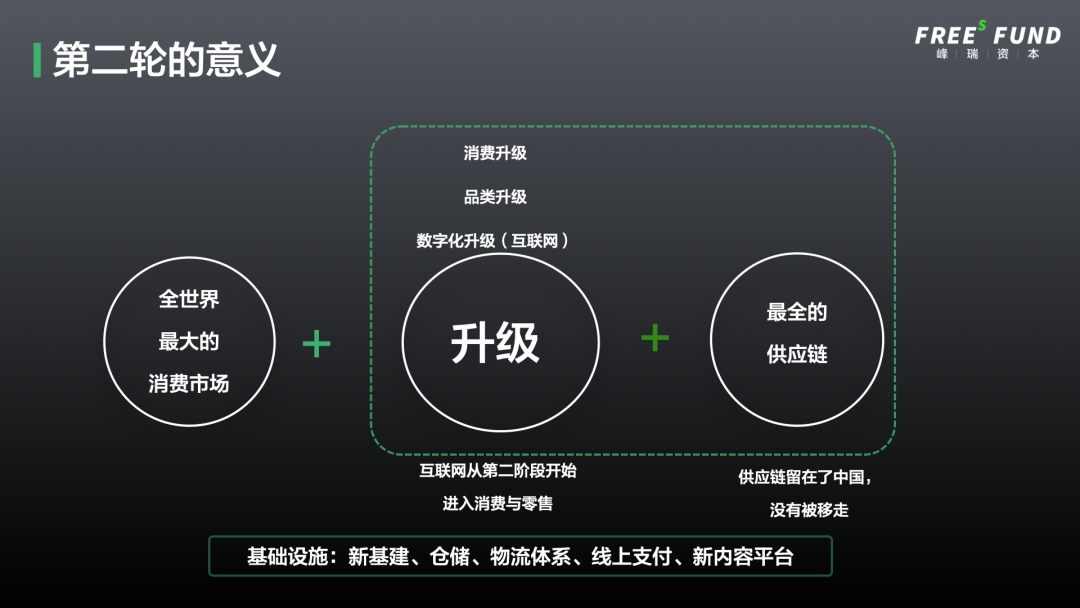
This is also why we believe Taobao can be more powerful than Amazon.
2. More Variables, More Complex Development
While we say opportunities are greater, to seize them requires facing more complex issues and bigger challenges.
Because US "up-flipping" is level-by-level, based on relatively formed market structures and mature market entities. China is different — there are too many variables in the "up-flipping" process. Both supply and demand sides are changing and growing; in the middle you need to make connections; if you encounter technology innovation opportunities, you also need to digest and落地 technology, grasping changes in industry characteristics.
In this situation, a major pressure on enterprises is having no precedents — everything is completely new. In a rapidly developing market, how to identify variables and convert them into competitive advantages?
For example, for consumer brands, against the background of continuously declining growth in total retail sales of consumer goods, to survive and develop sustainably and grow large, they must grasp both online and offline, with both hands strong.
Take Three Squirrels as an example. An important reason for its initial rise was leveraging online traffic dividends — Zhang Liaoyuan, who started offline, discovered the new continent of online. In recent years, the industry has rapidly changed. We've also seen Three Squirrels begin pushing offline, striving to achieve integrated online-offline development.
3. Challenges and Opportunities from Large Platforms
Earlier we mentioned that doing SaaS in China is somewhat harder than in the US. Beyond the fact that many domestic industries achieved datafication before social division of labor, without going through level-by-level "up-flipping" and thus not having so many chains to serve, another important reason lies in infrastructure platformization. The most typical example: Alibaba's "cloud-ding integration" layout, Tencent's WeChat, plus its invested e-commerce ecosystem (Pinduoduo, JD.com, Youzan, Weimob...)
Platformization means that platforms control important positions/links, and have considerable say in how sub-chains on the platform grow. Especially in the internet industry, when an innovative company creates a highly efficient data-driven infrastructure platform, many things can grow on it.
For startups, challenges also stem from this. Take Taobao as an example — as a new retail platform, a new data-driven platform, theoretically its ecosystem should also have an "up-flipping" process. But in reality, we see that not many SaaS-type enterprises have grown on the Taobao platform. An important reason is that when Taobao provides services to merchants, it essentially builds the SaaS for corresponding key node positions. The result: Taobao becomes industry infrastructure, while squeezing the survival space for vertical ecosystem enterprise service companies.
That said, how to face platform giants head-on and find innovation opportunities from them is an issue before many industries.
Discussion In this piece, we tried to explain China-US commercial development differences from one perspective. We also welcome you to share your observations and thoughts: What business formats have you seen that are very different between China and US markets, and which of these represent opportunities for China?

▲ "You always need to balance desire, capability, and resources" | FreeS 2021 China-US Venture Capital Forum transcript
▲ Do returnee entrepreneurs no longer have advantages? | 2021 FreeS China-US Venture Capital Forum transcript
▲ What's it like doing venture capital in China? | 2021 FreeS China-US Venture Capital Forum transcript
▲ FreeS Family Funding News · June | Saturnbird, Shize Bio, Light Travel receive funding
Breaking consumer industry involution — is the secret "going premium"? | Li Feng Column