ByteDance HRD Du Hong: What Can Startup HR Actually Do for a CEO? | FreeS Fund Free Talk

Are values really that big and empty? No.

"FreeS Talks" is a small-scale offline gathering for CEOs in the FreeS Fund family. We invite experts who know their stuff and fellow FreeS family CEOs with real battle experience to share insights and lessons on topics and directions that matter to them.
Human resources management at startups is a classic topic. What are the key steps for a startup to find top talent? When it comes to finding and using people, how should HR and managers divide responsibilities? After finding people, how do you get everyone aligned? For this edition of "FreeS Talks," we invited Du Hong, HRD at ByteDance, to share his methodology. Over the past decade-plus, he has witnessed companies go from startup to IPO and through all the ups and downs along the way, and has accompanied and assisted multiple executives in hiring and strengthening organizational capabilities.
We welcome you to share your thoughts and insights at the end of this article. By 21:00 on August 29, the 3 readers with the most thoughtful comments and the 2 readers whose comments receive the most likes will each receive a copy of Sapiens: A Brief History of Humankind by Yuval Noah Harari. Du Hong finds the book's most interesting idea to be that a key factor in humans reaching the top of the food chain is our capacity for imagination. Animals can only organize up to about 150 individuals, but through imagination and communication, humans can get far larger groups to believe in the same thing — such as corporate culture and values. In business, to reach the top of the food chain, you also need all employees to believe in the vision and mission you set out. We hope this book brings you further inspiration.


Du Hong
ByteDance HRD
From 2006 to 2014, I built HR from scratch at Autohome, learning as I went. Later I worked with some startup projects, and in mid-2014, I joined a sharing-economy company. That company grew extremely fast in its first year, then went through some rollercoaster experiences. In 2017, I joined ByteDance.
These 12 years, I've been fortunate to experience a company from startup through growth, maturity, and IPO. I've also seen individual businesses decline, gone through corporate spin-offs, and been through mergers and integrations. So I'm very happy to share some observations and lessons from my years at startups.
In recent years, the startup environment has changed. I feel there are three especially core success factors for startups today: first, still, is the competition for talent, and once people arrive, how to build and iterate their capabilities based on strategy. Second is understanding how organizations function; third, the company needs a shared rhythm — that is, building corporate culture is important.
Every time a startup CEO comes to me, they start by asking if I can help them find people. So let's start with the topic of finding people.
/01/
Liu Bei's Six Steps to Finding Top Talent
Most people remember the story of Liu Bei visiting Zhuge Liang's thatched cottage three times as being about sincerity in recruiting talent. But it's not simply a story about sincerity — it actually contains many elements. I once read an excellent article that broke it down: Liu Bei did six things.
-
Needs analysis. CEO Liu knew what kind of person he needed. He asked many people, saying he wanted to accomplish great things. He had a clear profile: someone with strategic vision, an entrepreneurial mindset who was truly willing to come out and build something, capable of outputting management frameworks, and preferably with experience.
-
Situation analysis. CEO Liu's company was a "three-no" enterprise — no capital, no market, no brand. What to do? He raised a banner, calling himself the Imperial Uncle; then raised a vision, saying he would restore the Han dynasty. These were all moves based on reading the situation.
-
Candidate analysis. He needed to lock in a pool of candidates, filtering by background, talent, reputation, temperament, aspirations, education, and so on. Zhuge Liang was a senior talent with very strong job-seeking motivation. Once locked in, Liu Bei went to find him.
-
Targeted action. How to attract this candidate? If you just say "come join me" when the person is right there, will they come? Of course not. This included telling him about the team's grand ambitions, telling him there was huge room for growth, and expressing sufficient sincerity through three visits to the cottage — these were targeted actions.
-
Interview and assessment. Assessment requires methodology. Since Zhuge Liang had almost no work experience, Liu Bei used the "Longzhong Dialogue" approach to talk with him and gauge his vision. This interview process was quite important.
One more point that's especially important: probationary period management. Everyone knows that before the Battle of Bowang Slope, Zhuge Liang was quite unwelcome there — Guan Yu and Zhang Fei felt this person had no right to sit as an equal to their elder brother. If Liu Bei hadn't protected Zhuge Liang at this point, hadn't helped create opportunities for him to prove himself, Zhuge Liang would have found it very difficult to施展 his talents.
/02/
The STAR Method for Selecting People
In the three visits to the cottage, Liu Bei used the hypothetical method for his interview. This method suits potential-based talent, but carries high risk — it's easy to be all talk and no action. Today's startups overwhelmingly need experienced talent, and for this the STAR method is more rigorous.
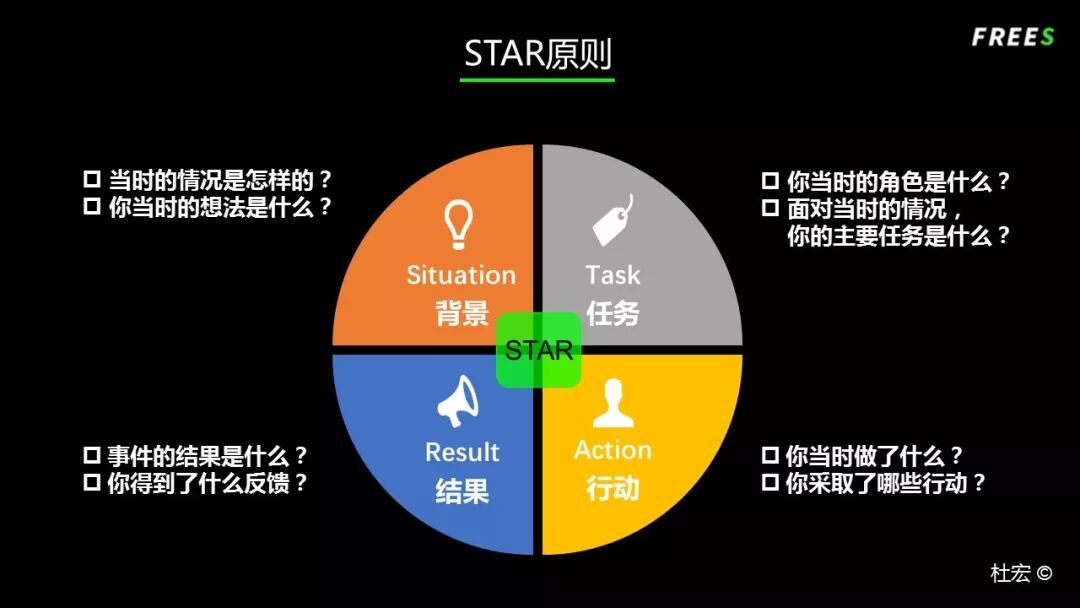
STAR stands for the first letters of four words: Situation, Task, Action, Result. Its core philosophy is using facts that have already occurred to infer the likelihood of future occurrences.
So I need to understand more about what you've done before. For example, if a young woman here asks her boyfriend "Will you love me?" — how will he answer? He'll definitely say "I love you." This hypothetical is useless. What should you do instead? You should ask him: how did you treat your last girlfriend? Listen to the specific actions he describes in each thing he tells you. Only by talking with him about this can you use facts that have already occurred to infer what might happen in the future.
When asking interview questions, also pay attention to focus.
Methods for focusing: First, I suggest asking only two to three core questions about events related to your assessment target. For example, if we're saying to ask him about how he treated his previous girlfriend, and he says "I treated her very well" — that's not enough, you need to dig deeper. For instance: what did you buy her? He says I bought five handbags. What brand were the handbags? Where did you buy them? Were they knockoffs? You need to ask one after another, getting to the bottom of things, asking to the extreme, before you can judge whether he would actually do these things.
Second, pay special attention to distinguishing "I" versus "we." If you find a candidate tends to use "we" when describing something, be especially vigilant, because there's a high probability they were merely a participant. So if you find they mostly use "I" — "I was doing this" — then there's a high probability they actually had strong ownership of the matter.
Third, pay attention to distinguishing facts versus extrapolation. For example: "Would you buy your girlfriend handbags? Have you bought handbags?" If he answers "On such-and-such date, in Hong Kong, I bought such-and-such handbag" — that's a fact. But if he says "I would, I buy her one every year" — that's mostly extrapolation. Some people, when facts are insufficient, will use extrapolation to substitute for facts. If you don't catch this, they may actually be using extrapolation to fill themselves out to look more substantial.
Fourth, pay attention to distinguishing actions versus methodology. This is somewhat similar to facts versus extrapolation — observe whether they're talking about specific actions, or whether they only know how to speak in generalities.
One more thing to pay special attention to: interviewing is listening, not challenging. Observe thought process and methodology, rather than pursuing answers and validation. Although most CEOs tend to have somewhat strong personalities and easily have a preset answer in mind, even if you have an answer, try your best not to refute. Second, don't directly challenge or negate others' answers — neither affirmation nor negation is good. If you attach directionality to them, it means they'll follow your direction to change some of their judgments or statements, which isn't conducive to judging their true thoughts and behaviors.
To emphasize again: going forward, when we're finding people or finding top talent, the core is "using facts that have already occurred to infer the likelihood of future occurrences" — this is how we find people who are likely to be suitable. Finding the right person every single time is impossible. We can only ask: how do we maximize probability? And the core method for improving probability is still this same principle.
/03/
What the Three Visits to the Cottage Didn't Tell Us
There's one thing the three visits to the cottage didn't address: does strong capability necessarily mean suitability?
Elements of a person can be divided into three categories: one is knowledge and skills — the ability to get things done; one is thinking patterns and potential — growth and reflection; one is culture and values.
For positions at different levels, the focus of assessment will differ. When recruiting for higher-level positions, knowledge and skills are basically baseline requirements — their capabilities have been validated in the market, and you can basically judge through conversation. What you should pay more attention to is actually their thinking, and especially their culture.
Generally speaking, the more important the person, the more you should focus on cultural fit and the like. If during conversation you feel something's off in your gut, you must be especially careful. If you truly encounter someone culturally mismatched, the stronger their capabilities after they join, the greater their destructive power. Also, observation may seem easy, but it can also take a long time — some people conceal things well, or their traits aren't visible. So for higher-level positions, you should still consider doing background checks and gathering references.
Sometimes you actually face a dilemma. For example: I simply need people, this person's capabilities are excellent, but some of their ways of working are somewhat different from ours — then you weigh it. It depends on whether you can tolerate it, or whether you can bear the risk. If you can, and you make this choice, don't regret it; deal with it when problems actually arise. This is another thing the three visits to the cottage didn't tell us.
On finding people, a few reminders: First, hire for the future. I believe startups all want to find such people — this hardly needs saying, everyone knows. Second, if something hasn't happened with a person in the past, it probably won't happen in the future — so pay attention to whether what you want them to do has actually happened with them before. One more point: money can't really buy time, but if it can buy talent, it's still worth it.
/04/
CEO and HR: Who's Responsible for Finding People? How to Divide Responsibilities?
Finding people is hard for all startups. I've had CEOs complain to me that they can't find people.
They say: the industry is narrow, I can't poach from big competitors, and I don't think highly of people from small competitors. I ask: if the industry is narrow, have you analyzed adjacent industries? If you can't poach from big competitors, have you at least met with the top people there? If people from small competitors are terrible, have you met with the very best people at those small competitors?
If the answer to all of these is no, then it's really the CEO's own problem.
Others complain to me that their HR isn't capable. I ask: how much does your HR head make? Answer: 5,000 RMB...
Others say: I'm meeting clients every day, no time.
My prescription for them is: CEOs should spend at least one evening per week meeting top talent who aren't looking for jobs, treating them like clients — only this way can you find people. Finding people is definitely not just HR's job. What we can optimize: first is understanding of talent, second is division of labor.
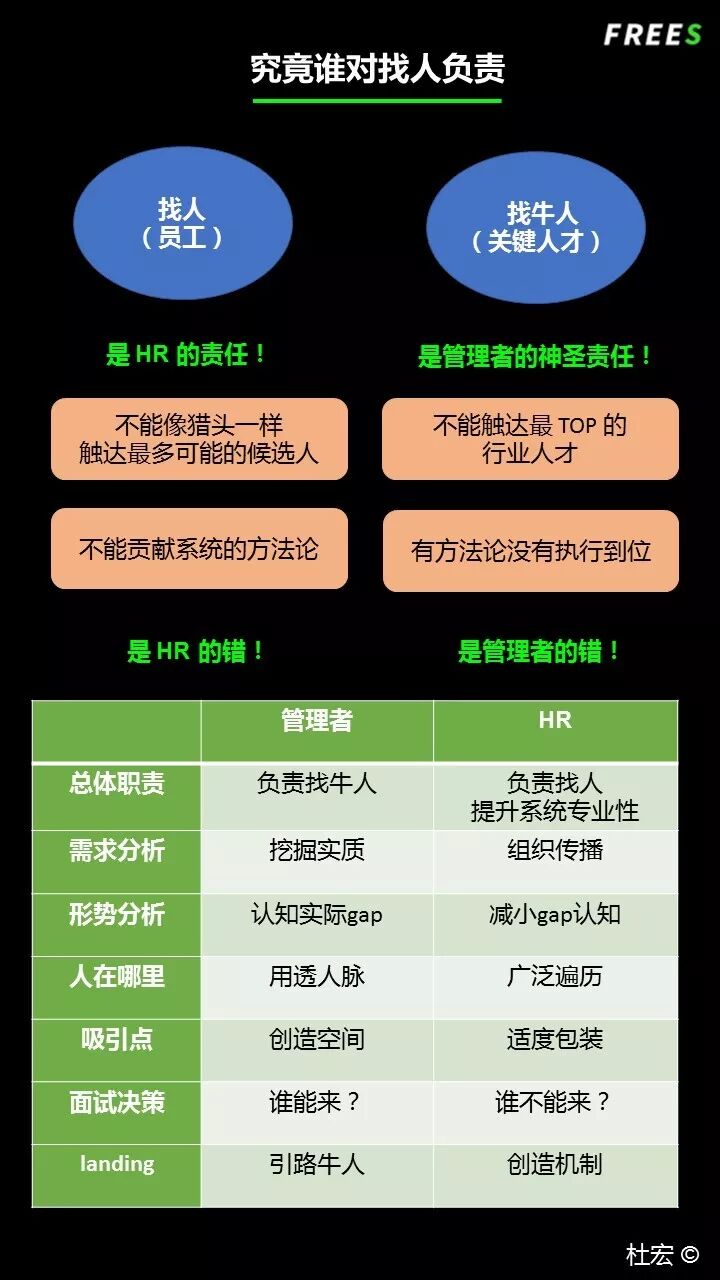
When finding someone important for a team, how do managers and HR divide responsibilities? Managers or CEOs are mainly responsible for "finding top talent," while HR is mainly responsible for "finding people." On the finding people front, managers must take responsibility for key talent coming on board — if top talent can't be found, don't blame HR, blame the CEO yourself. Only the CEO is the actual operator of talent landing. If frontline employees can't be found, that's HR's problem; if top talent can't be found, that's the CEO's or manager's problem.
If you can't reach the maximum possible candidates like a headhunter can, and can't contribute systematic methodology — that's HR's fault. If you can't reach the top industry talent, and the methodology HR contributes isn't executed properly — that's the manager's fault. This division of responsibilities must be clear.
Additionally, environment and market is an unavoidable invisible hand. For example, our entrepreneurial environment, funding environment, the intensity of talent competition in the market — including so-called major internet companies, everyone is aggressive in hiring. In this situation, it also brings some difficulty to entrepreneurs. But this is an unavoidable hand. If market price has become 12, and you're still asking me if you can find someone for 5, I'm powerless. Finding people also depends on market entrepreneurial environment and talent flow conditions — everyone needs to go with the flow, pursuing the balance your enterprise can accept.
/05/
After Finding People, How Is Organizational Capability Built?
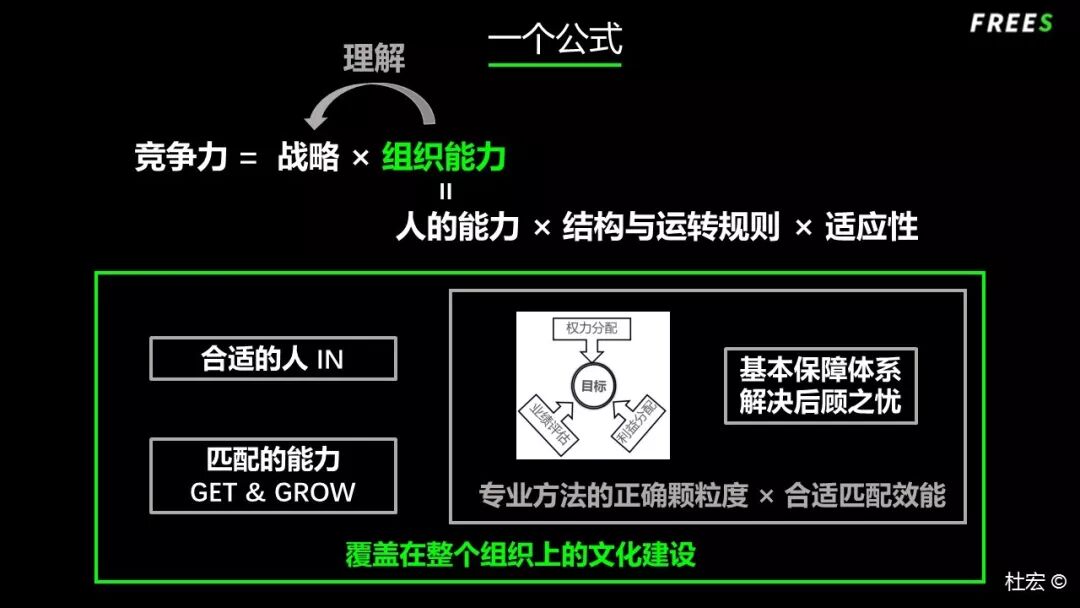
Finding people is only the first step. Startup competitiveness = Strategy × Organizational capability. Neither can be missing; if either is zero, competitiveness is zero. I won't expand on strategy, but let's elaborate a bit on organizational capability.
Organizational capability also has a formula: Organizational capability = People's capability × Structure and operating rules × Adaptability.
First, people's capability. The core is two points: first is finding people with the capabilities to help you achieve your strategy. But there's another point: improving the team's capability — that is, after suitable people join, enabling their capabilities to grow.
Let me share a small story, actually a realization from one meal.
In 2011 I was still at Autohome. Once I was eating with founder Xiang Li, and I asked him: what could HR do better next year? He thought for a moment and said: next year, just don't do so much useless training. I was particularly shocked at the time, because I believed my main achievement over the past two years was that the company had training, and training was recognized by employees.
Later I went back and thought carefully, and realized I had indeed done wrong. Why? You can't ask employees what they like about training. That's wrong. What I should ask is: what does this enterprise need? Then based on what the enterprise needs, cultivate employees' capabilities.
All training and development should actually serve corporate strategy and organizational capability improvement. It can basically be divided into four categories: business capability, management capability, cultural adaptability, and general capability.
Of these four points, regarding management capability: I feel the most important thing for improving management capability is unifying management language — choose one and don't overthink it. There are management theories ABCDE in the world; if the CEO doesn't buy into DE, then among ABC just pick one you like reasonably well, don't overthink which of ABC is better. After choosing, you must get all managers in the team to believe in the same management language — this is 100 times more important than which one you choose.
For example. Many people often complain about low meeting efficiency. A company I previously served had two core concepts: one is conclusion first, and problem = ideal situation - actual situation. So when we had meetings, we all stated conclusions first, and when stating problems, first made clear the ideal situation and actual situation. Every meeting, the management team pushed everyone to use these two methods, and efficiency was high. I'm not saying these two concepts are necessarily the best — rather, unifying management language is what improves efficiency.
Second is structure and operating rules. It has three key legs, core to strategy or objectives: power allocation, performance evaluation, and benefit distribution. Power allocation is to put suitable people in suitable positions; performance evaluation is to drive everyone forward, making those who do well do even better and those who do poorly improve; benefit distribution is to use leverage to make this team run better.
Only by choosing the correct granularity and matching efficiency can these three legs become a stool that doesn't wobble. One reason startups can't directly copy Alibaba or Huawei's strategies is that the granularity is likely wrong. A 20-person company — basically the CEO can decide by gut feel, shout and everyone executes, no complex procedures needed. A company over 150 people may need to start doing some coarse-grained strategies.
Finally, let's talk about corporate culture. Today's entrepreneurs actually all particularly value culture; many want to say they're going to build corporate culture. But after ten years, my feeling is: doing culture is the hardest thing. Although many people start out saying they want to do culture, actually getting it thoroughly understood and truly effective is quite difficult. Second, every company's culture differs greatly — some companies may treat a slogan or phenomenon as culture, but actually you need to look more comprehensively at this culture's effect on this enterprise, which indeed requires some tempering over time.
The adaptability of corporate culture: pay attention that culture does not equal employee experience. Making employees feel the company is warm is necessary, but not necessarily good — culture carries larger goals and missions.
/06/
Corporate Culture, Which Determines Survival: How Does It Actually Land?
Using Water Margin as an example, I feel that Liangshan Marsh as an enterprise went through four very major transformations. Each change happened because culture and mission changed, and the ending followed suit.
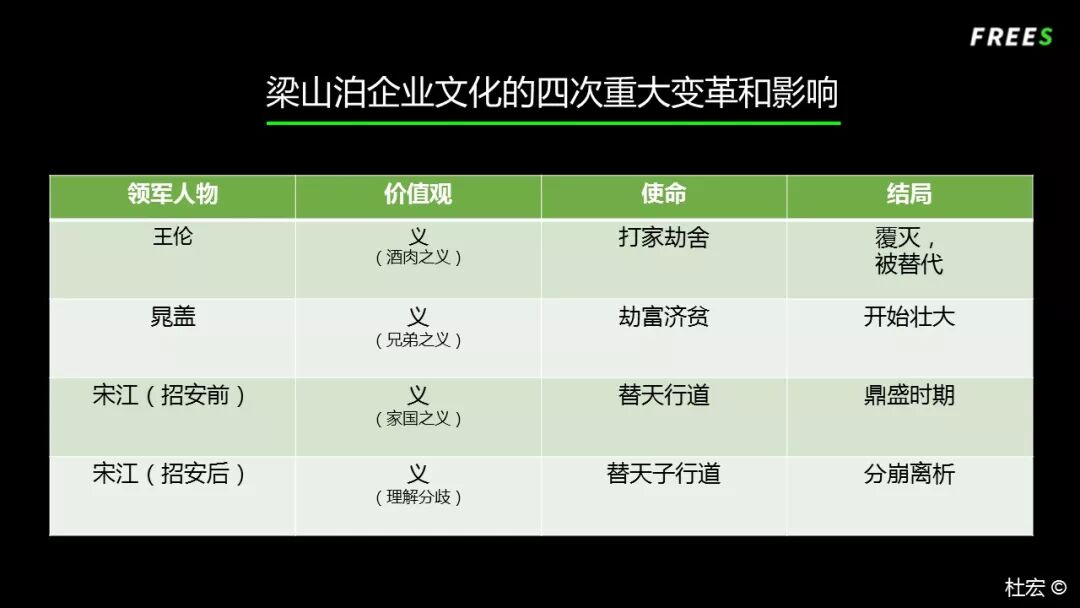
The founder of Liangshan Marsh was Wang Lun, a local bandit, not famous — he dies as soon as he appears. In Wang Lun's period, Liangshan's values were camaraderie of wine and meat — everyone lived together, drinking from big bowls and eating big pieces of meat. The mission was to rob whoever, whatever — anyone and everyone. The ending was destruction.
In the second stage, Chao Gai took power, and mission and values changed. They said: we brothers swear brotherhood, rob the rich to help the poor, don't strike at the poor. The outcome of this stage was that Liangshan Marsh began to grow. In trendy terms, it became a unicorn company.
The third leader of Liangshan Marsh was Song Jiang. He resolved to practice righteousness for the nation, hanging out a banner saying "Act on Heaven's Behalf." The values of this period clearly upgraded, and the mission became grander. Liangshan Marsh entered its peak period — in today's terms, it went public, and became one of China's two biggest, equivalent to one of A or T.
Then something happened: Song Jiang accepted amnesty, and his mission gained one more character, becoming "Act on the Emperor's Behalf." People in the organization held all kinds of views; values began to diverge. Finally, Liangshan Marsh fell apart (delisted!).
I'm telling this story to say: cultural values and corporate mission truly relate to an enterprise's survival.
Culture is not something big and empty. It is a cloud of values — everywhere, yet invisible and intangible. The way it works is: managers spread this cloud of values over the enterprise, and when problems arise, use value-driven approaches to solve "edge cases," forming a self-operating positive cycle.
For example. If our value is user first, then when user interests and client interests conflict, we should choose to protect user interests. At this point, values become the basis for judgment.
Gradually, when all employees in the enterprise can understand using values to judge these edge cases, a positive cycle of values can form.
For values to land, there's a "three threes make lasting" rule.
The first three: three core methods — declaration, ritual, story. First, tell everyone what our values are, so everyone knows. Then, through ritualistic events, help everyone remember and refresh their impression of values. Also, through continuously accumulating stories that embody values, help employees truly understand and reinforce them. Telling the story of yielding ten thousand times may not equal one story of Kong Rong yielding pears.
The second three: three signals in culture or values — who was rewarded, who was punished, who was fired. These three signals may sound like isolated actions, but they're not. Behind these three signals is continuous construction — they are the three lines we draw: the high line, standard line, and red line of culture or values. Every act of reward, punishment, or firing is actually strengthening employees' understanding of values, consolidating values.
The third three: observing what degree the team has currently reached in culture or values. We can divide this into three stages: consensus, resonance, and co-action. Consensus means I know it; resonance means not only do they know it, they actively preach it — "I think this is particularly good, I particularly endorse this, I particularly agree with the user-first philosophy, I think we're better than other companies." The highest realm is co-action: if when employees encounter the edge cases we just mentioned, they directly use values to judge and solve them — this is true action.
/07/
Who Ultimately Builds Organizational Capability?
Finally, we say organizational capability is important work for HR, but who ultimately builds organizational capability? Clearly HR alone can't do it. I've drawn a diagram called the perpetual motion machine of organizational capability.
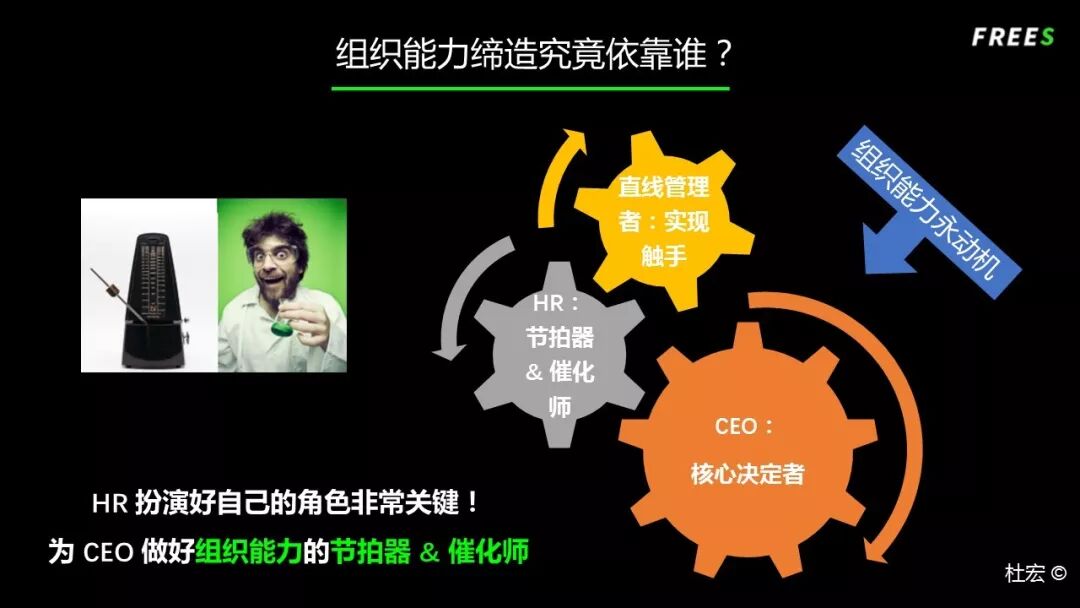
This perpetual motion machine consists of three parts. The CEO is the core determiner of organizational capability, because what kind of people this organization needs, especially top talent, is ultimately determined by the CEO.
Line managers are the tentacles that realize organizational capability — all conceptions, methodologies, and tools for organizational capability ultimately need to be implemented through them. If they can't execute properly, relying on HR or even the CEO won't build it.
I define HR as the metronome and catalyst. Metronome means making the right timing choices at corresponding points in enterprise development; catalyst means HR must catalyze the enterprise to use correct tools and build organizational capability at the fastest speed.
Summary
-
The competition for talent, organizational operating rules, and shared culture are especially core elements in startups. The three visits to the cottage is a classic case of finding top talent, but after finding top talent, HR's work has actually just begun.
-
Enterprise competitiveness is mainly strategy and organizational capability. Good HR needs to understand strategy, and based on strategy design and optimize organizational capability.
-
Organizational capability includes people's capability, structural operating rules, and adaptability. A good HR, the kind of HR a CEO needs, should think of all of these, and serve as the metronome and catalyst for organizational capability for the CEO.
Giveaway
We welcome your comments at the end of this article, sharing your views and perspectives. By 21:00 on August 29, the 3 readers with the most thoughtful comments and the 2 readers whose comments receive the most likes will each receive a copy of Sapiens: A Brief History of Humankind by Yuval Noah Harari.
You're welcome to share to your Moments. For reprinting to other official accounts, websites, or mobile apps, please reply "reprint" to learn reprint rules, and contact "Frees Xiaorui" (id: freesfund) for authorization. Copyright belongs to FreeS Fund.

▲ [Long Read] How Should Startups Capture This Wave of Douyin Traffic? | FreeS Talks
▲Knowledge Payments: Profitable Industry or False Proposition? | Content Entrepreneurship Closed Forum (Part 2)
▲Can The Fair and Mi Meng Be Replicated? What's the Moat for Content Companies? | Content Entrepreneurship Closed Forum (Part 2)
▲ The Anxiety You Can't Shake Off, Yet Which Created Viral Hits Across the Internet | Content Entrepreneurship Closed Forum (Part 1)
▲ BAT Stars Came and Left — Why Can't You Retain Them?
▲To Recruit, He Drove a BMW to Be a Private Driver Outside Baidu. Are You This Committed?