I Saw the Future Before the Product Iteration, and I Couldn't Pretend I Hadn't | FreeS Fund Business School

Spend 80% of your time doubling down on what works, and 20% testing new channels.


Stuck choosing between Option A and Option B for your product iteration?
Andrew Chen, Uber's head of user growth, wrote recently on his personal blog that user growth for mobile internet products is becoming increasingly difficult as the current tech growth cycle nears its end.
That's not fear-mongering. But at a "CEO Talk" series event co-hosted by FreeS Fund and Baichanghui on August 5, Ye Wang — former Google growth team member and founder of AppAdhoc — argued that even as growth gets harder, we don't need to overcomplicate things or resort to unconventional tactics. As long as you correctly understand product value and user behavior, and use the right methods to validate decisions, you can still achieve solid results.
- Stuck choosing between Option A and Option B for your product iteration?
- Team members all have valid arguments about which features to ship. How do you decide?
- User activity spikes or drops suddenly, and you can't figure out why. What next?
- Growth slows and the bottleneck arrives sooner than expected. How do you find another path?
If you're curious about the answers to these questions, this article should offer some direction.

Ye Wang, AppAdhoc: There's No Secret Recipe for Growth, Only Hacking
Source: Baichanghui, WeChat Official Account: baichanghui666
Edited by: Baichanghui, FreeS Fund
If you've ever done business in the US, you'll notice there's no such thing as a "demographic dividend" — customer acquisition costs are high, making it tougher than the Chinese market.
But the China market is getting tough too. Whatever sector you enter, you'll face competitors, and winning over customers is brutally hard. The internet used to be a premium channel — no need to cater to media, suppliers, or distributors, just grab traffic and customers online. But now even internet customer acquisition has become difficult. Over the past five years, the growth rate of new internet users has plummeted from 40% to around 5%.
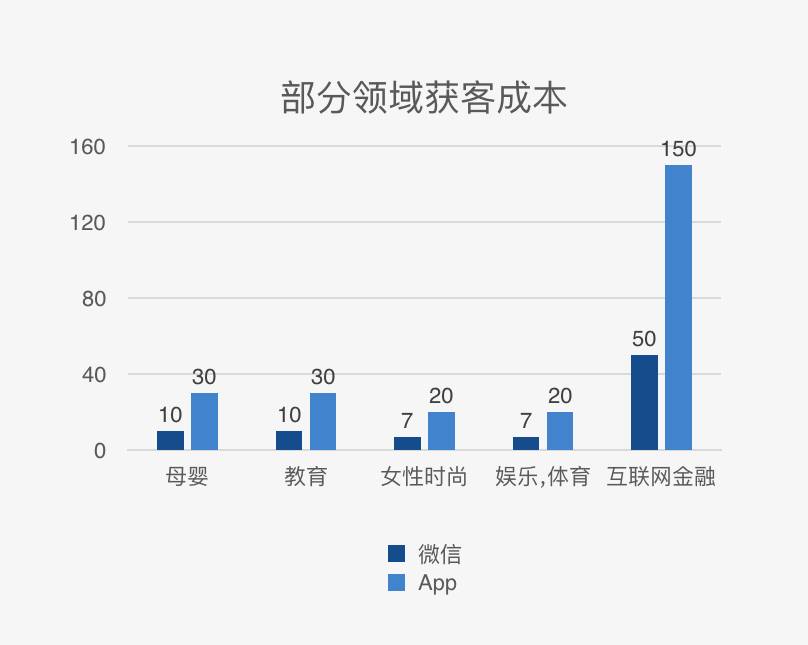
The chart above shows a customer acquisition cost analysis from one institution, though I think some figures are inaccurate. From what I understand, in education, the cost per app download can exceed 100 RMB. The fintech numbers are more realistic — it may take over 1,000 RMB to acquire a single user. Overall, the picture isn't optimistic.
What's more painful is that users who do register or download your app can churn at any subsequent step. If you're in e-commerce, after a user views a product detail page, what's the likelihood they'll actually add it to cart? Typically, you buy a batch of traffic, watch it leak away, redesign, buy another batch, and watch it leak away again.
Cumbersome processes and long approval times? Too high a bounce rate on your homepage? Too low a click-through rate on product detail pages? High cart abandonment? Low checkout conversion? Low repurchase rates? Struggling to acquire new users? Slow retention growth? Landing page conversions stuck? ...
These are problems every entrepreneur faces. So how do we find a path to sustained business growth amid complexity and constant change?
The answer: the CEO needs to use available resources to solve an equation with a beautifully simple objective function: maximize conversion rate.
Let's explore this through a model. Based on the depth and type of user engagement at different stages, we can break down growth goals into the AARRR conversion funnel model: Acquisition, Activation, Retention, Revenue, Referral.
In this model, some imported users drop off at each subsequent stage, while others continue through to the next level, achieving ultimate conversion through progressive deepening.
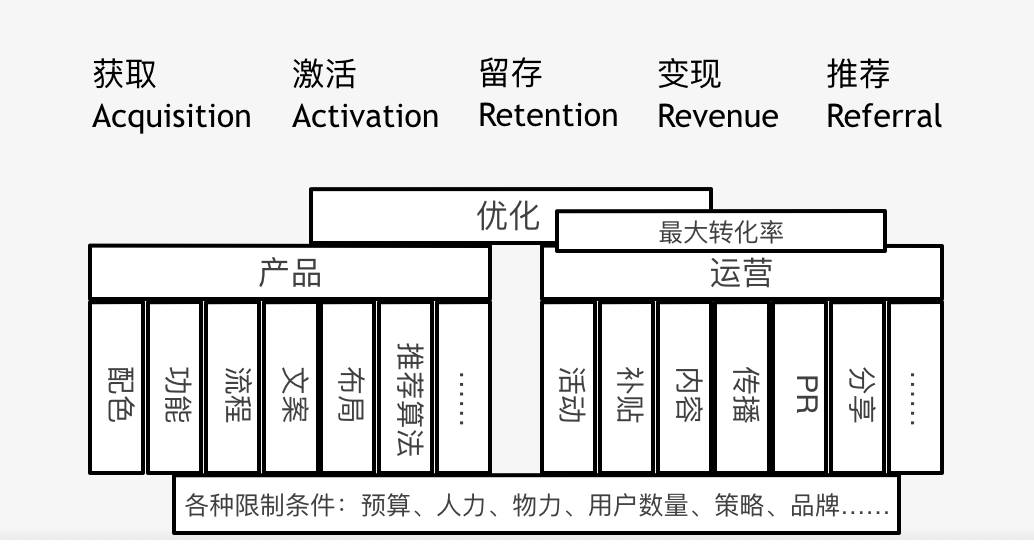
There are many variables the CEO can manage here. Each of the five funnel stages offers optimization opportunities. After buying traffic, how do you get users to open your emails and become actual users? How do you get them to stay after one use because they find the product valuable? How do you get retained users to repurchase and generate revenue? For social or media products, how do you create commercial value or drive organic sharing?
Operationally, we can run events like Baichanghui does, or offer subsidies, content marketing, PR, and so on. On the product side, we can adjust UI, color schemes, layouts, copy, and add features like check-ins, lotteries, and personality quizzes — a favorite of growth operators.
But do these methods work? It's hard to generalize. There's no universal secret recipe. You have to find the optimal solution for your specific equation. At this point, you face too many choices. What to do? Just keep experimenting.
The Secret to Building a Billion-Dollar Product:
Silicon Valley's 8 Rules for Efficient Growth
Don't use growth hacking before achieving Product/Market Fit
Before reaching PMF, premature promotion and excessive optimization are unnecessary. At this stage, the most important thing is getting feedback from a small group of early users and iterating continuously. But once you've achieved PMF, you can start using growth hacking methods.
How do you know the timing is right? Here are two good signals:
- If you're building a consumer product, you have hundreds or thousands of new organic users daily;
- If you're building an enterprise product, you have about ten new enterprise customers signing contracts with you.
Think big, but start small
When you're ready to start growth hacking, remember to start with small things and give your very first user an amazing experience.
I still remember that about two days after our A/B testing system launched, we got our first registered enterprise customer: "Xiaoguan Economy." They were still at Series A then, specializing in real estate sales management software. They came to us wanting to test adding a "spinning wheel" feature. That experiment didn't run very successfully at first. We kept improving the product to better achieve market fit.
Users generally have little patience, especially for new products. So make sure everyone can understand what you're doing — this is our trick for building products or running operations.
If you're not doing A/B testing, you're doomed
Every day, we generate lots of ideas. But are these ideas actually useful for you? How can you make them have major impact? This requires running A/B tests. Users only care about their own experience. If you do something and bring in 1,000 new users, you need to know what you did right and what's worth doubling down on.
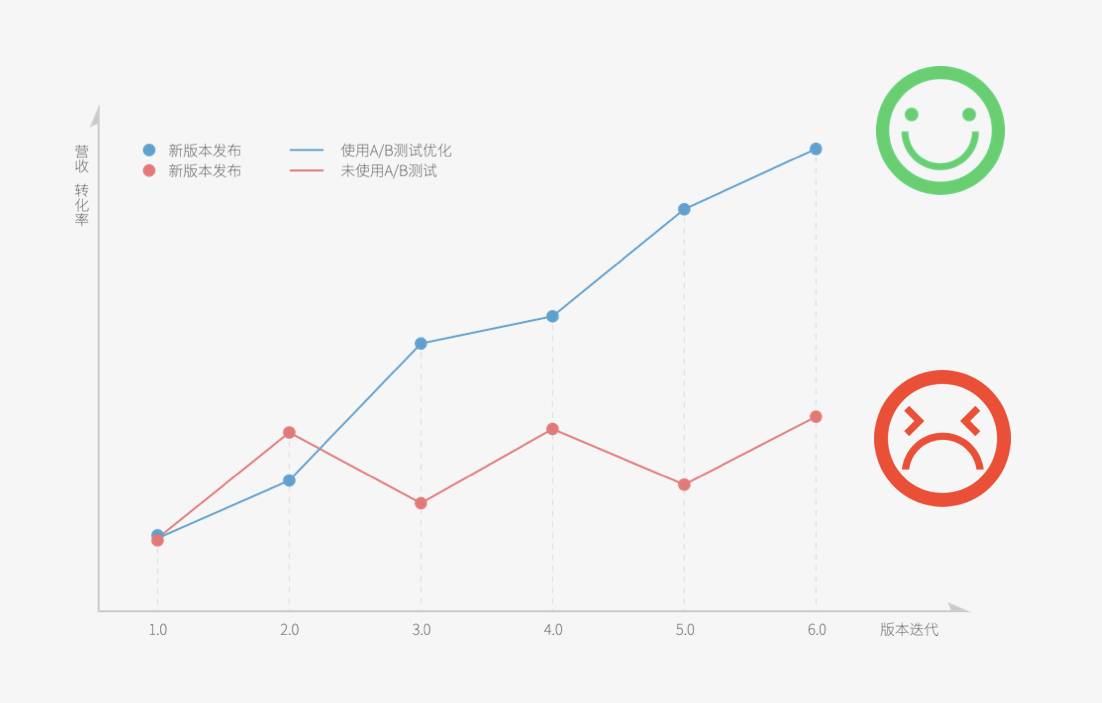
Some products survive without A/B testing, but they can never be sure whether each redesign actually drives growth.
Consider two companies with different styles — "XX News" and "XX Headlines." Their divergence gradually widened over a longer period as their products iterated.
Spend 80% of your time doubling down on what works, 20% testing new channels
We often look for our weaknesses and try to fix them, but that's foolish. Always try to find what you're best at and go all-in. Then spend a little time and effort trying new methods.
A startup building a couples' one-stop service platform app shared their experience with us. Early on, their advertising efficiency wasn't great. But by chance, they ran an ad with copy along the lines of "This is the app that lets you be woken up by your lover in the morning" — because the app had a remote alarm feature for couples. This line had exceptionally high share rates. The company stopped trying other taglines, pinned this one on Weibo, repeated it endlessly in their official account, and highlighted it in every ad they ran. In a short time, they accumulated a massive user base.
Be data-driven, not just data-informed
Many people think of data as just reports. It's not. It's truly cutting-edge, action-oriented intelligence.
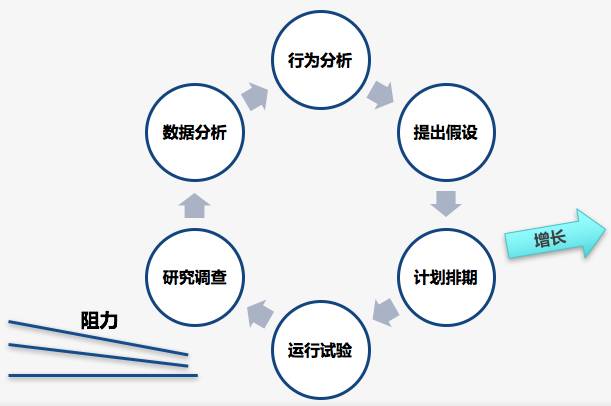
We use this wheel to simulate the experiment process. Where the wheel actually touches the ground, there's friction. The stuff at the top of the wheel is useful but doesn't move things forward. Only "growth" makes the wheel advance.
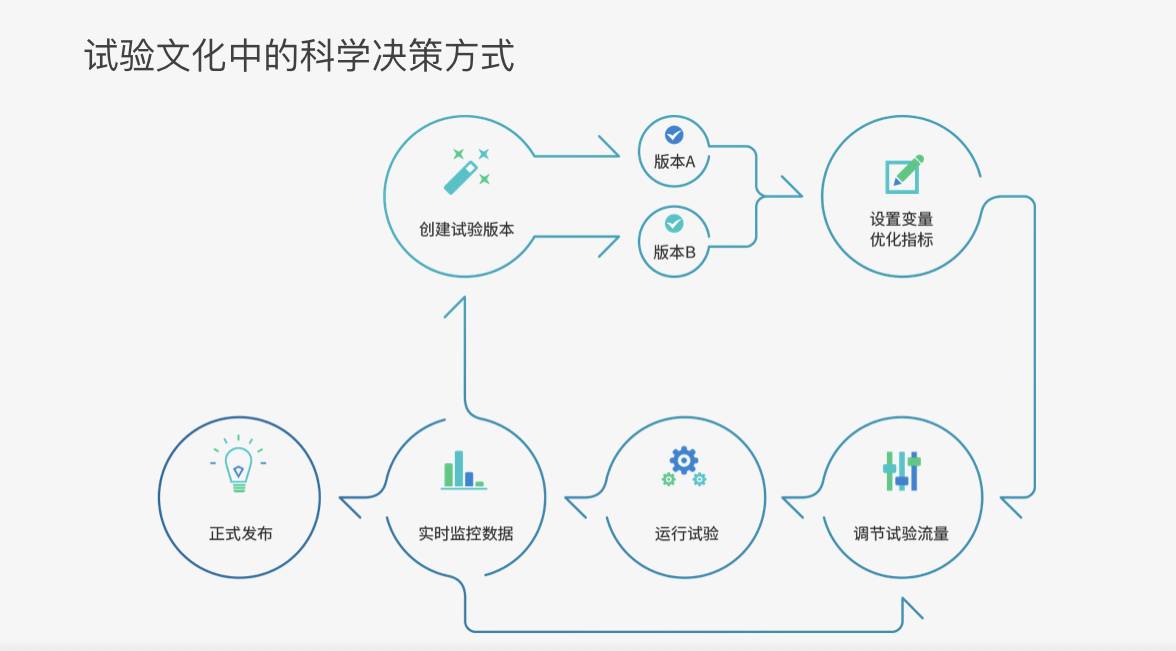
The experiment process is simple: user traffic comes in, you split them into three groups — one control, two test groups — paying attention to scientific rigor and statistical validity. Give different users different product experiences: change copy or images, or use different promotional schemes, then observe the conversion rates across the three groups to find the most efficient approach.
Build an experimentation culture
Experienced entrepreneurs often run their companies in an orderly fashion, but this can slowly turn the company into stagnant water where everyone waits for orders and executes as well as possible.
This culture is wrong. You need to put all frontline colleagues — whether designers, product managers, operations managers, or account managers — into an experimentation culture. Everyone should run experiments to reach credible data-driven conclusions and achieve actual growth. I'll explain later how to design these experiments.
If data is the fuel for growth, analysis is its engine
Without good analytical capability, data as growth fuel can't perform its function.
If you understand what customers want, using that understanding to help them grow is highly effective. A recent viral marketing hit was Tencent's Army Day campaign letting people composite their photos with military uniforms — they really understood user needs: users want beautified photos, plus a way to express their military aspirations.
But if you're slightly weaker and can't immediately grasp user thinking, then study the relevant data.
Your first "Hack" is your product — build something people want
Finally, to emphasize again: there's only one way to succeed, which is to build a product people love. Growth hacking's core lies in the product itself — get users involved in product development and iteration, with operations and other aspects as supplements.
Changing 1 Detail Brings 5% Growth
I worked at Google for a while. Google loves learning hot ideas — when Pinterest was popular with its image ads that both advertisers and users liked, Google wanted to launch an image ad product too. But it wouldn't implement the idea directly; instead, it ran A/B tests: build a simple, usable, most basic image ad product, sell it to selected advertisers, then deploy to 1% of users and compare whether ad click-through rates rose or fell. The test result: despite Google's enthusiasm for image ads, user ad clicks actually declined, causing losses, so the project was killed.
Now, Google runs about 300 experiments simultaneously each month. Most don't work, only about a dozen or so do. But that's enough to boost ad revenue by roughly 2% monthly — equivalent to $1 billion. This has underpinned Google's stock growth for over a decade.
The second example is DiDi. DiDi hacks many details. For instance, DiDi's map shows available cars — if the map is zoomed in too tight, say to a single courtyard, there might be no cars; if zoomed out to all of Xicheng District, it might show 1,000 cars.
So what's the right zoom level? Show 5 cars, 10 cars, or 15? DiDi ran A/B tests comparing which user group placed more orders, using that data to decide.
Details like this — a single hack can bring 5% growth. If 20 out of 100 points can be hacked, overall growth doubles, leaving competitors far behind.
Continuous optimization, seeking improvement space. I think in Silicon Valley, the experimentation culture breeds a certain mindset: anyone — whether engineer, product person, or operations — thinks "what improvement can I make?" If everyone approaches problems this way, your business will undoubtedly grow.

The big shot in this photo is Sean Ellis. He's invested in many companies and was one of Facebook's earliest investors — a true growth hacker. He has a saying: "If you're not running experiments, you're probably not doing growth."
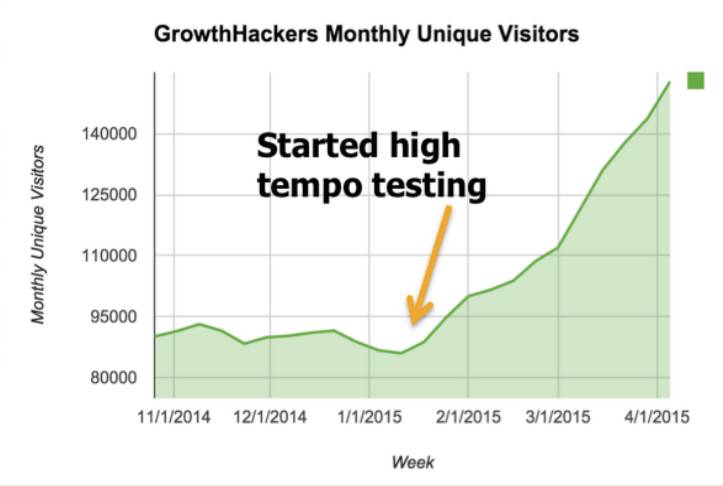
On his site GrowHackers, he shares many cool cases. He also runs experiments on his own pages to boost visitor conversion rates. In early 2015, he started doing heavy A/B testing, after which GrowHackers' business growth followed this curve:
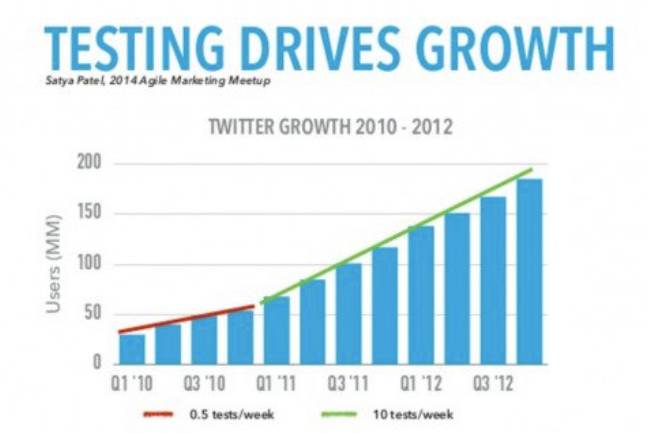
For a third example, let's look at Twitter, which Sean invested in. Before 2011, due to limited resources, Twitter's experiment frequency wasn't high — 0.5 times per week, meaning one experiment every two weeks. Many startups we encounter start at this pace too. After 2011, Twitter began running 10 experiments weekly, and growth speed more than doubled:
How to Design a Growth Experiment?
Take Facebook as an example. Before officially launching "People You May Know," they went through these steps:
- Identify "highly active" and "inactive" users, split into two groups of roughly tens of millions each
- List potential features that might affect outcomes (e.g., online duration, number of text posts, number of photo posts)
- Compare feature values between the two groups to find the most divergent and potentially influential metrics
- After two-plus months of analysis, reached the conclusion with biggest impact on Facebook growth: the most important factors for user activity were a) number of friends and b) completeness of personal information
- The Growth team decided to lead a new feature aimed at automatically recommending friends to each Facebook user to increase their friend count. Thus, "People You May Know" was born
- The Growth team quickly developed a prototype using the simplest algorithm — recommending potential friends based on "mutual friends"
- After development, they did a gray release and A/B test, selecting 5% of users to observe their behavior
- The experiment found that "guinea pig" users' average friend count kept rising, activity gradually improved, and some began converting to highly active users
Here's a problem: observational data can only show correlation. That is, it can only tell you that highly active users indeed have more friends, but doesn't mean that if you make a user add more friends, they'll become highly active.
It's like watching the NBA and noticing that the more Kobe Bryant scores for the Lakers, the higher their probability of losing. So if you make Kobe score less, will the Lakers win? Not necessarily. It might be precisely because the Lakers are likely to lose that Kobe desperately shoots to score.
So to validate whether an idea works, you need to run an experiment. For Facebook, they insisted on A/B testing, integrating all experiments planned for the next six months into code with each App Store release. The result: a few years ago, users spent only 50-60% of their mobile time on Facebook; now it's nearly 80-90% — you open your phone and basically spend your time on Facebook, as powerful as WeChat, quite terrifying.

Actually, many industries now use A/B testing. For example, fintech needs to validate risk control effects; logistics, where different dispatch systems may have different costs; education, where teacher-student matching needs continuous iterative optimization. Some service enterprises like telecom operators and internet BAT companies, when launching new features, often do batch releases — first pushing to 20% of users, comparing with the old version to see if data looks good, and if not, then pushing to 50-100% of users.
Additionally, A/B testing has another common use case: pricing. For a 400 RMB product, pricing at 399 or 398 may yield different conversion rates. Whether to write "80% off" or "Save 75 RMB" may also produce different results.
Finally, let me share something interesting to close. Google hacks everything — for example, placing different sized plates in different cafeterias, ultimately finding that "fewer large plates + more small plates" had the best impact on employee health, with fewer sick days. They also painted offices different colors to see which color made engineers code most efficiently, finding purple worked well, so the whole company gradually became more purple. So actually finance and admin teams can apply this hacking mindset too.
About Baichanghui (WeChat Official Account: baichanghui666)
Baichanghui is a short-term event venue rental platform based on the sharing economy model. Users can book gathering and event venues nationwide through their mobile phones. Whether you want to find an art gallery for a product launch, host a colleague party at a private villa, or take employees on an inspiring off-site, you can find venues precisely and quickly here.

▲ 14 Interview Tips from Silicon Valley to Help You Find the World's Best Growth Hackers
▲ A Good Product Is Like a Good Relationship: Continuous Growth with High Retention