Yifei Intelligent Control Completes Series A Round, Gaining Recognition from State Capital and Industry Giants | FreeS Fund Investment News

China's commercial drone market is wide open, and it's only a matter of time before homegrown industry giants emerge.
On April 9, 2018, drone solutions provider EFY Intelligent Control (一飞智控) announced the completion of a nearly RMB 100 million Series A round led by AVIC (中航).
Founded in 2015, EFY had previously raised a Pre-A round from FreeS Fund and an angel round from Fenghou Capital. Over its first two-plus years, the company's technology and products gained traction in agriculture and logistics; it was also pushing into new territory, targeting the unmanned retrofitting of manned aircraft.
From the Investor

Yin Hong, Vice President, FreeS Fund
Email: yh@freesvc.com
Consumer drones have already produced a super-unicorn, but China's commercial drone sector remains in a land-grab phase. Judging by market size, customer demand, and the development history of other aviation powers, China's commercial drone market has vast room to grow — and will inevitably produce its own industry giants. At FreeS Fund, our tech team continuously studies technological and industry trends to understand and validate the characteristics and growth paths of these outstanding companies.
EFY Intelligent Control is exactly the kind of high-potential team we've found in the commercial drone space. On one hand, the core team has productized years of experience leading key drone projects at the Chinese Academy of Sciences, validating and iterating across agriculture, logistics, and other verticals to build clear competitive advantages and commercial moats. On the other hand, they've been actively expanding, using ton-scale aerial autonomy as their core technical lever to establish positions in military-civil fusion and other related domains. It is these distinctive strengths that have earned EFY recognition from industry leaders and state capital, including AVIC.
Over the next three to five years, China will enter a period of rapid growth for commercial drones. We wish EFY Intelligent Control a soaring trajectory.
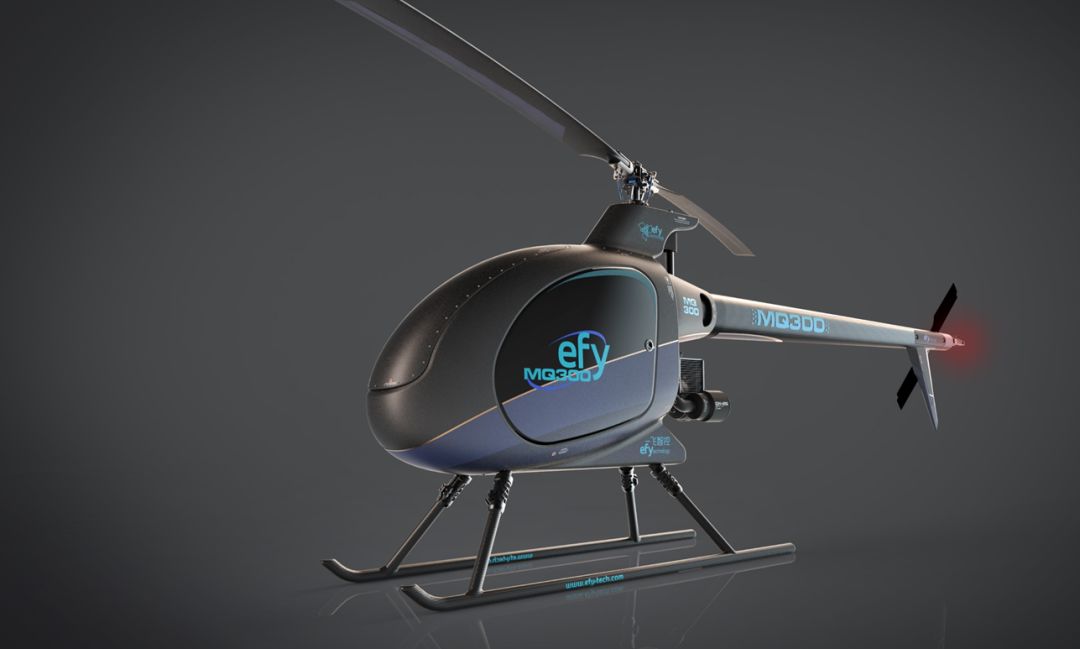
AVIC Leads Nearly RMB 100 Million Series A for EFY Intelligent Control, Which Offers Unmanned Helicopter Retrofit Solutions for Commercial Clients
Source: 36Kr
Author: Xi Da
EFY Intelligent Control (Tianjin) Technology Co., Ltd., a drone solutions provider founded in 2015 and headquartered in Tianjin, has completed a nearly RMB 100 million Series A round led by AVIC. Prior to this, the company raised a Pre-A round from FreeS Fund and an angel round from Fenghou Capital.
Flight control systems serve as the "brain" of drones and carry high technical barriers. EFY entered the market through intelligent flight control devices for agricultural plant protection drones, providing core control capabilities to integrators lacking strong in-house R&D. Founder Qi Tongjun said that in 2017, the company's B2B-focused operations shipped over 3,000 plant protection drone flight control units. Based on existing orders, 2018 shipments were expected to double.
Domestic competitors with intelligent flight control capabilities in agricultural plant protection include DJI, XAG, and Wuju, in addition to EFY. Qi noted that flight control hardware technology and supply chains are already relatively mature. Future differentiation will increasingly come from back-end software — specifically, the ability to mine and analyze flight data and integrate with other application platforms. EFY has built a dedicated data development team, recruiting mid-to-senior talent from Huawei and IBM focused on big data and cloud computing. During the 2017 agricultural season, its cloud platform "Best Intelligence Cloud" (百思智云) collected 160 million valid data points, with coverage extending to all provinces except Tibet and Qinghai, plus seven overseas countries.
The plant protection drone industry is the most mature segment, and large shipment volumes across broad application scenarios generate substantial flight data. This data helps EFY improve its flight control products' intelligence, while new technologies can be validated in agricultural settings — creating a virtuous cycle. Once its technology and business model proved out in agriculture, EFY began penetrating logistics.
However, domestic plant protection and logistics drone markets were developing at a relatively measured pace. While stabilizing its core flight control business, EFY identified new commercial demand.
According to Qi, building on years of flight control development experience, EFY set its sights on unmanned retrofitting of manned aircraft, offering complete solutions to logistics and exploration industry clients.
Most domestic drone manufacturers, including DJI and XAG, produce drones with effective payloads under 100 kg. At the ten-ton-plus level, traditional general aviation players like Boeing and Airbus dominate — a typical narrow-body like the Boeing 737 or Airbus A320 has a maximum takeoff weight of roughly 50–80 tons. But the middle ground — 100 kg to ton-scale aerial intelligent piloting — is virtually empty.
Technically, entering this trillion-scale market could be done through forward development: designing, producing, and testing an integrated airframe from scratch with appropriate payload, power, and actuator systems. The time and capital costs would be unimaginable. A relatively simpler path is reverse development: retrofitting proven manned aircraft by replacing the pilot and part of the payload with flight control and other equipment.
Compared to traditional manned aircraft, unmanned operation removes the pilot, increasing effective payload — a core concern for logistics customers. It also reduces personnel costs, and if the overall solution is sufficiently standardized and intelligent, customer operating costs drop substantially.
EFY chose the retrofitting route because China's general aviation technology and industrial chain maturity lag far behind developed countries like those in Europe and America. This means the cost-performance ratio of developing unmanned helicopters from scratch is far inferior to retrofitting existing manned aircraft. Qi said EFY currently procures mature manned aircraft from abroad and intervenes at the equipment installation stage to perform unmanned retrofits. Going forward, the company may invest in or acquire upstream firms to further reduce retrofit costs.
Large aircraft unmanned retrofitting demands sophisticated control technology. Qi explained that converting from manual to electric motor control involves servo retrofits and continuous control correction and compensation. Helicopters also operate primarily in complex low-altitude environments, requiring strong environmental perception and path planning capabilities. Due to these high technical barriers, no domestic large civil unmanned aircraft has yet been successfully delivered. Traditional research institutes like AVIC's industrial research centers and military general staff units focus on extra-large unmanned aircraft for defense needs.
Qi revealed that EFY has already received orders for large unmanned aircraft and completed unmanned retrofits of three manned aircraft models with payload capacities of 50 kg, 100 kg, and 200 kg. Depending on specifications, aircraft are priced between RMB 1–10 million.
Industry experts judge that aerial intelligent piloting has natural synergies with the general aviation industry, and general aviation's evolution is shifting from closed-door forward R&D to a dual-track approach. Whoever first masters core technologies for unmanned retrofitting of general aviation manned aircraft may gain first-mover advantage and the opportunity to leapfrog competitors.
To ensure sustainable future profitability, EFY prefers to serve as a general aviation service provider offering lease arrangements to industry clients, potentially charging by flight mileage in the future. Qi Juntong revealed that as part of the "national team," EFY will pursue investments, mergers, and acquisitions to absorb design, processing, and manufacturing strengths from established general aviation powers in Europe and America, aiming to build out the global intelligent aviation upstream and downstream value chain with aerial autonomy technology as its core, and seize the commanding heights of next-generation intelligent aviation.
EFY Intelligent Control currently has a team of roughly 150, with R&D staff exceeding 60%, and expects to expand to 200 this year. The core team consists of Qi Juntong, former head of the UAV direction at the State Key Laboratory of Robotics and one of the youngest PhD advisors at the Chinese Academy of Sciences; Sun Xun, former investment director at Intel Capital; and Chen Donghua, former senior product manager at Kyland Technology. The technical team was recognized by an international authoritative journal as "China's only entry: ranked 10th among the world's 27 most influential flight robotics R&D and application teams."
(This article originally appeared on 36Kr. Feel free to share to Moments.)

▲ Twelve Years Ago, I Studied Drones with a Shovel at the Edge of the Playground
▲ Li Feng | The One Trick That Made History's Only Successful Great-Power Transition
▲ Li Feng: We've Finally Made It to Value Returning — The Era Where Good People Make Money Is Here